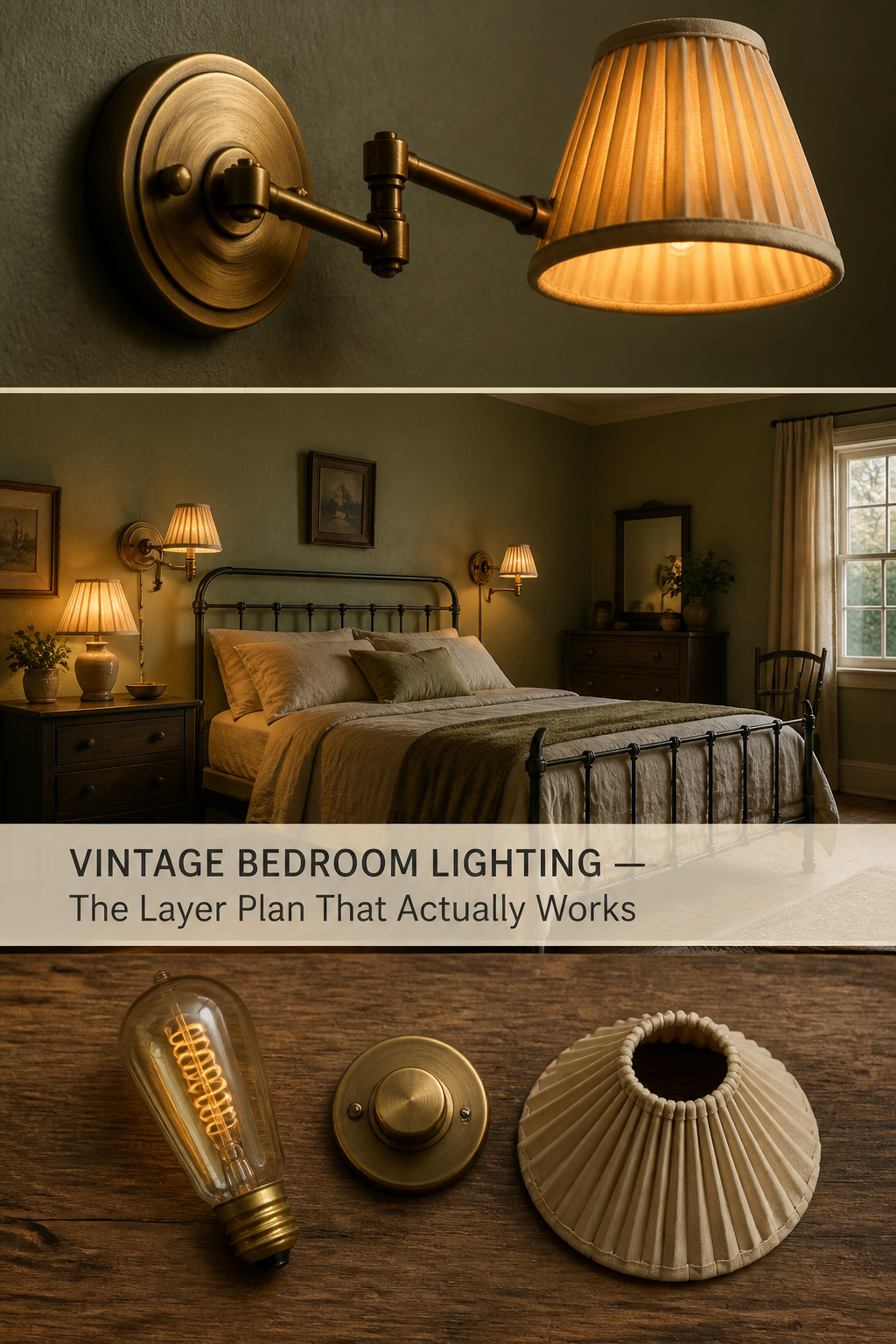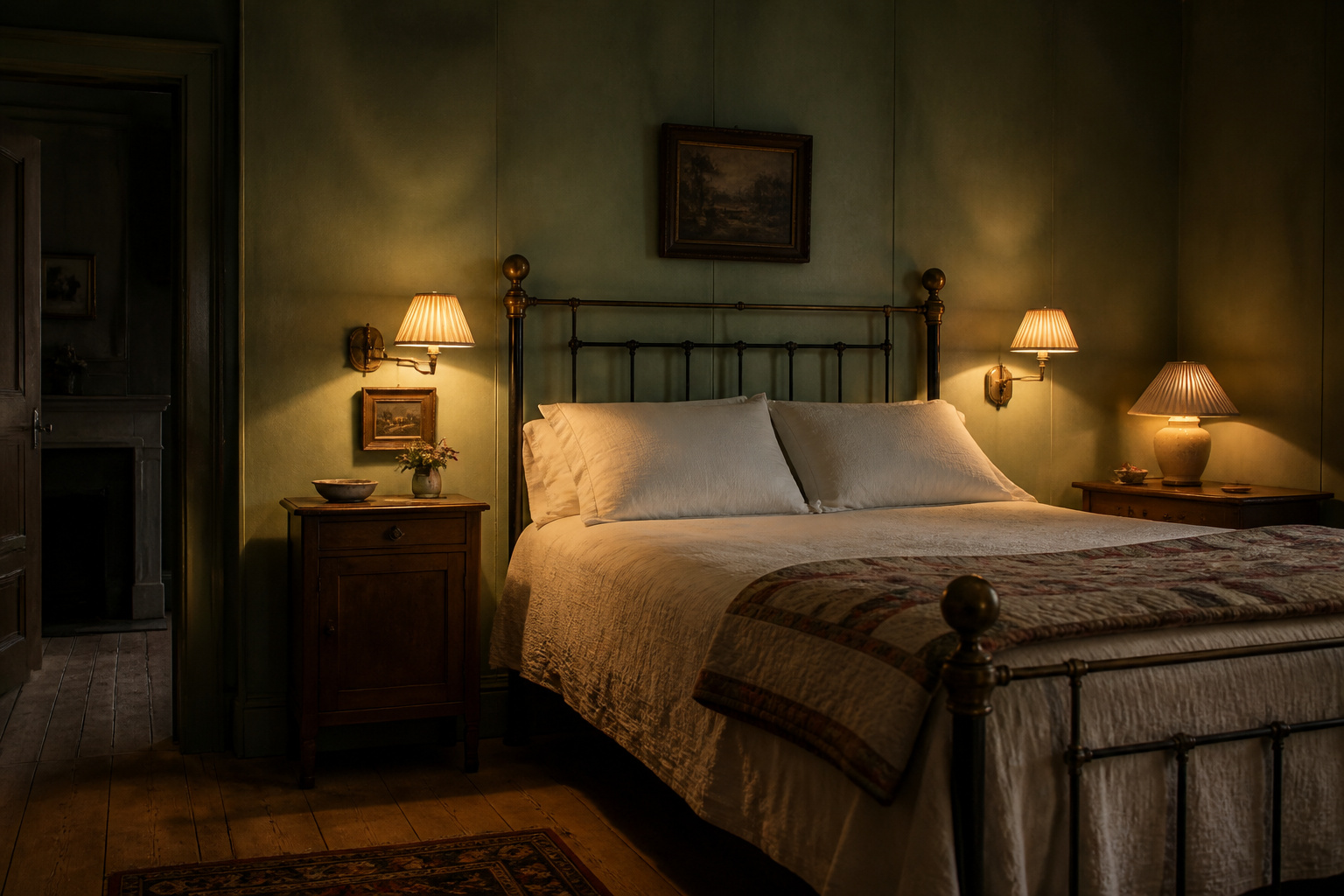
The old reading rooms of the great country houses were lit for the eye, not the ceiling: a lamp at the elbow, a candle at the page, the rest left in companionable shadow. Edwardian library designers understood what most of us have unlearned — you light the task and let the dark do the rest. That principle is why vintage bedroom lighting so often disappoints: the fixtures are right; the light is not.
TL;DR
- Mount bedside swing-arm sconces 60–65 inches above the floor to the backplate centre, 8–12 inches from the mattress edge — too high and the light crosses the room instead of landing on your book.
- Aim for 300–600 lumens of focused reading light; 450 lumens (a 40W-equivalent LED) is the sweet spot, and the bulb should be 2700K, dropping to 2200K on a dimmer for candlelit warmth.
- The single highest-return change is not a fixture: swap any bulb above 3000K for a warm filament LED on a trailing-edge dimmer, and the brass, wood and linen start working together.
Why Most Vintage Bedroom Lighting Fails (and What It’s Missing)
Ask the diagnostic question first: where do you actually read in bed, and how high is your shoulder against the pillows when you do? Almost nobody asks, which is why so much period lighting disappoints.
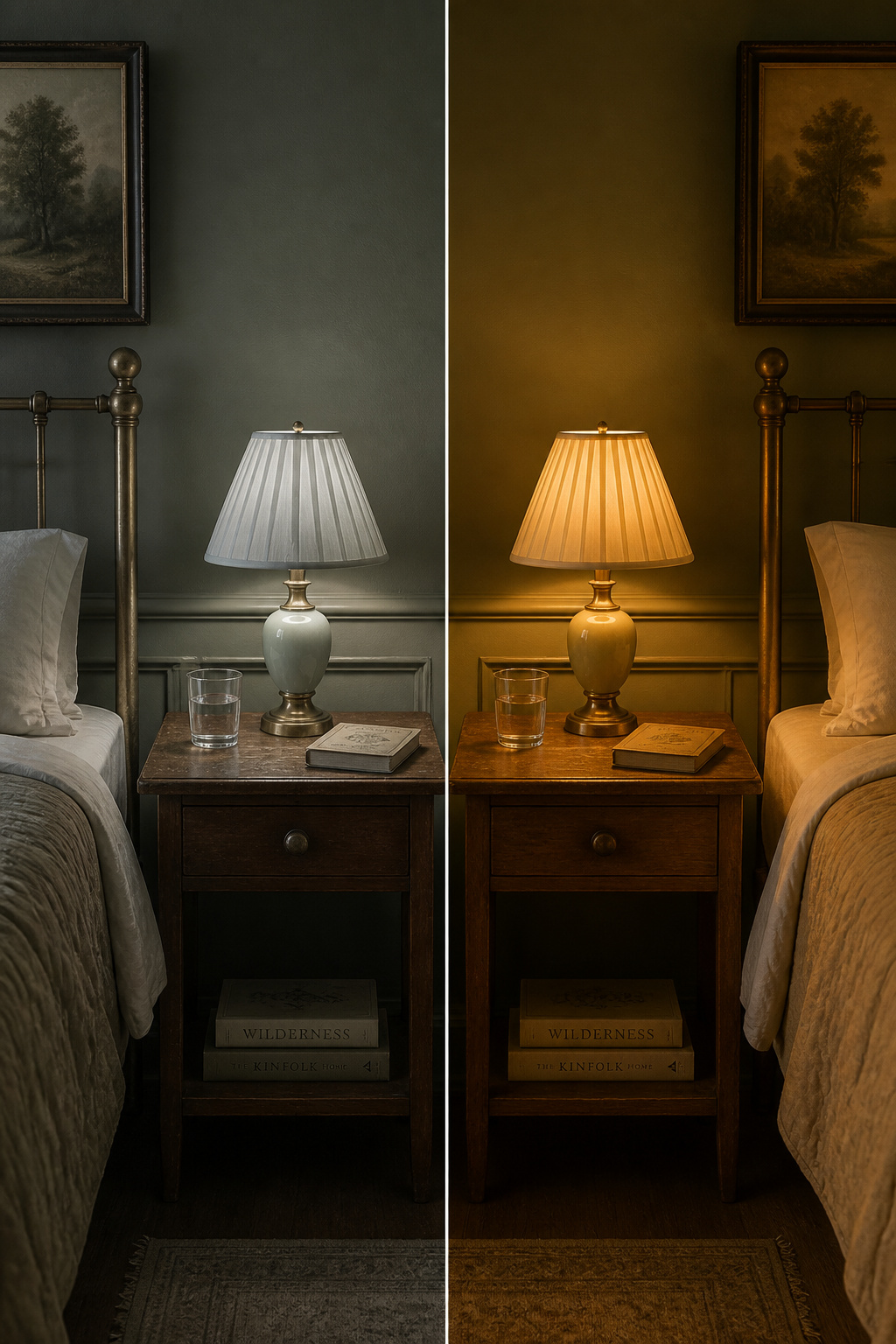
I spent a stretch of years in a university special-collections library, where the rule for light was the inverse of how most homes are run: you gave the page exactly what it needed and not one lumen more, because everything above that was working against the paper. I have carried that habit to the bedside ever since. A bedroom is not an archive, but the discipline transfers cleanly — find where the reading happens, light precisely that, and stop.
The fixture-first trap: why beautiful sconces in the wrong position still feel wrong
The common failure is buying for the wall, then finding a spot. A swing-arm sconce mounted above 65 inches from the floor throws its light across the room rather than onto the page — it stops being a reading light however handsome the brass. Position first, fixture second, always.
Colour temperature is the invisible decision: why 2700K vs 3000K changes a room more than any fixture
Colour temperature shifts a room’s mood more than the shape of the lamp does. The professional bedroom standard is 2700K soft white: the warm golden tone minimises blue light and supports melatonin. Above 3500K, warm materials grey out — brass goes pale, linen cold, heritage paint loses its depth. Choose by the job:
- 2200K — extra-warm white, near candlelight, almost always used dimmed for a late-evening glow.
- 2700K — the bedroom default; warm and flattering at full brightness.
- 3000K — the acceptable upper limit; anything claiming “warm” above this is marketing.
The layering principle: ambient, task and accent
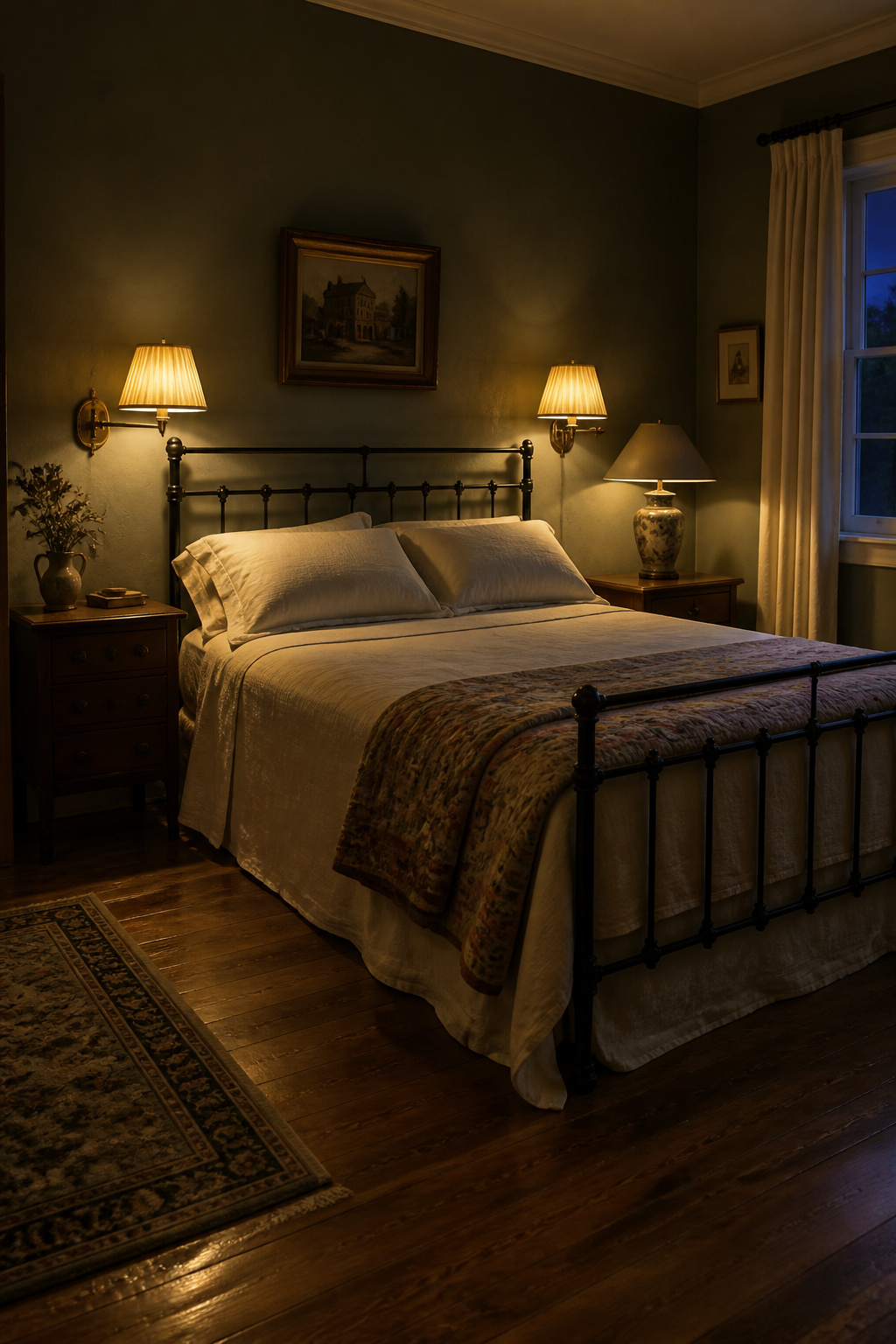
One ceiling fixture cannot do three jobs. A complete scheme needs three independent layers: ambient (general light, on a dimmer), task (reading, at the bedside), and accent (a dresser lamp, a glow in a dark corner). The bedside task target is 300–600 lumens, from above and to the side. Styling a vintage bedroom treats walls, furniture and light as one decision.
Brass Swing-Arm Sconces: The Highest-Impact Vintage Light
If you buy one fixture, buy this.
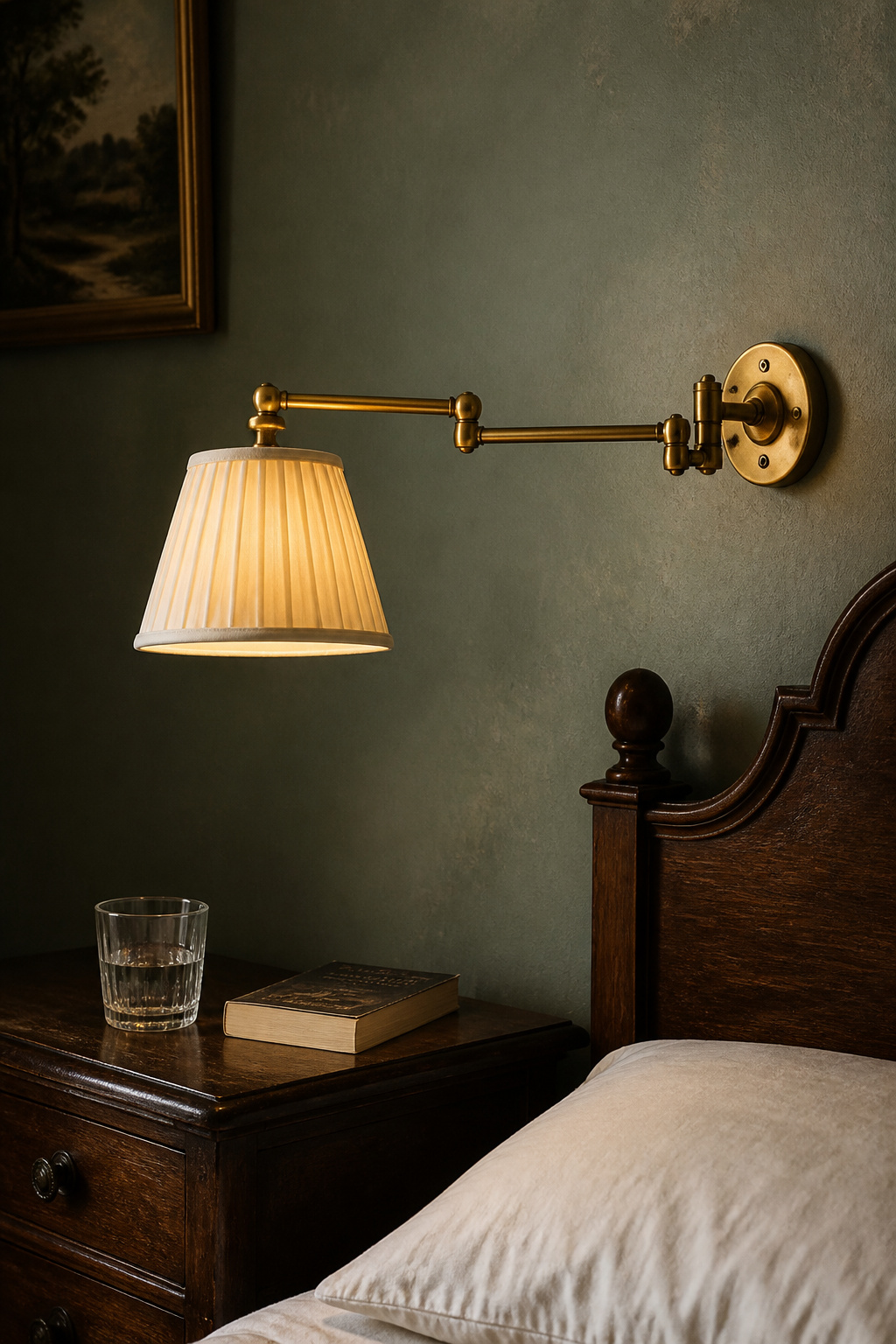
Why swing-arm sconces solve the reading-in-bed problem better than any table lamp
The articulated arm brings the source directly over the pillow, where a lamp can only sit beside and below it, casting shadow and glare for a reclining reader. It clears the nightstand entirely and folds flat against the wall by day.
Placement height and reach: the ergonomic numbers
Sit against your usual pillows and have someone mark the wall 6–12 inches above your shoulder; that mark is where the bottom of the shade should land. Reach is where people overspend — 24-inch arms are built for reading chairs, not pillow-height beds. A 24-inch arm over a pillow is a fixture that has wandered in from a different room and refuses to admit it.
| Placement dimension | Recommended spec | Why it matters |
|---|---|---|
| Mounting height (backplate centre) | 60–65 in above finished floor (or 30–36 in above the mattress top) | Higher and the light crosses the room, not the page |
| Horizontal clearance from mattress | 8–12 in (8–10 in for paired sconces) | Further out, the arm can’t reach over the pillow |
| Arm reach | 15–20 in (12–24 in available) | Clears the pillow yet retracts neatly; 24 in suits armchairs |
| Shade bottom above seated shoulder | 6–12 in | Light falls on the book, not into the eyes |
Hardwired vs plug-in: the honest trade-off
Hardwired sconces connect through a wall junction box — cleaner, permanent, not portable. Plug-in models need no electrician, run to an outlet via a brass-covered cord, and reposition as beds move. Many vintage brass models are now 2-in-1 convertibles — plug-in today, hardwired later, same fixture.
Vintage Bedside Table Lamps: Scale, Shade and Bulb
The table lamp is the most accessible way into vintage lighting, and the most often sized wrong.
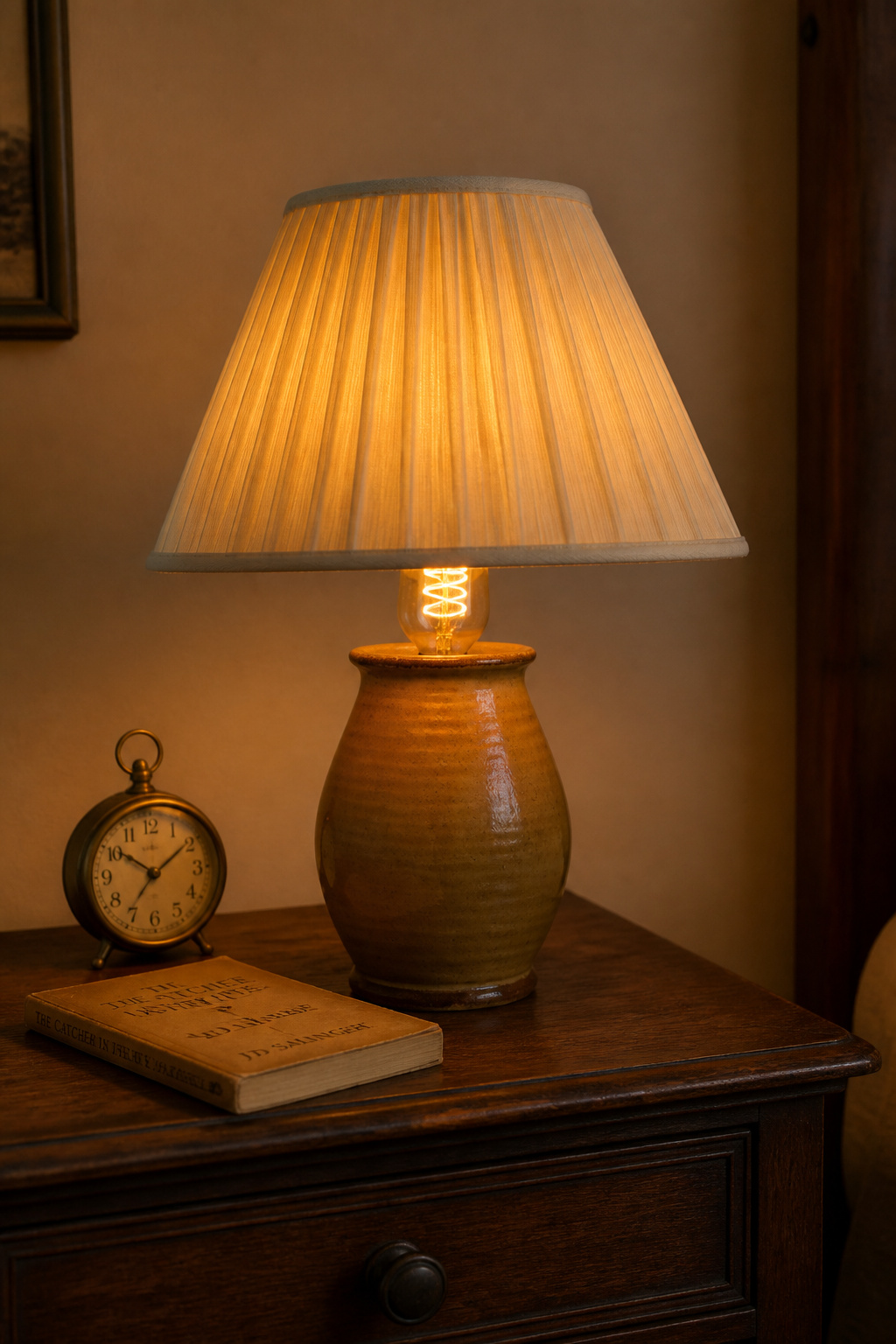
Lamp height and the proportion rule
The shade bottom should meet, or sit just below, your eye level when sitting up in bed — above that line the bare bulb glares. Most bedside lamps run 24–30 inches total; on a nightstand level with the mattress top, 24–27 inches lands the shade right.
Shade materials that read vintage: linen, pleated silk, coolie vs drum
Shade material is where a lamp declares its era. Linen scatters a warm diffuse glow rather than a hard pool — the versatile choice for ambient fill. Pleated silk is the formal, Edwardian-to-1930s register: it warms a room and ages into richer patina, though it resents damp and sun. Coolie shades, wide-bottomed and conical, are the mid-century shape, casting a broad wash from a tall slim base. Drum shades read modern-neutral on a period base; save them for transitional rooms.
Bulb type for a bedside lamp: filament, candelabra, and the lumen floor for reading
The comfortable range is 300–600 lumens, and 450 — a 40W-equivalent LED — is the sweet spot: enough for a long chapter, not so much it interferes with sleep, where a 60W-equivalent’s 800 lumens runs office-bright. Reach for an Edison-style LED filament bulb (ST19, G25 globe) in a medium E26 base: the spiral filament glows amber through clear glass and dims smoothly on a compatible dimmer. Leave the small candelabra E12 bulbs to multi-arm fixtures.
I inherited some two thousand four hundred books from my grandfather, a farmer who read every night of his working life by a single lamp at the bed’s edge, and when I catalogued them one winter I noticed the spines told you exactly where he read: the bottom inch of each cover was warm and faintly sun-faded from years under that one amber bulb, the tops untouched. He had built, without naming it, a perfect task layer — light placed precisely where the page was, nothing wasted on the ceiling. It is the cheapest lighting tutorial I have ever received, and it cost him nothing but the habit of reading.
Ambient Vintage Light: Pendants, Flush Mounts and the Dimmer Decision
The ceiling fixture is the ambient layer — the baseline glow you move around by — and where the dimmer decision lives.
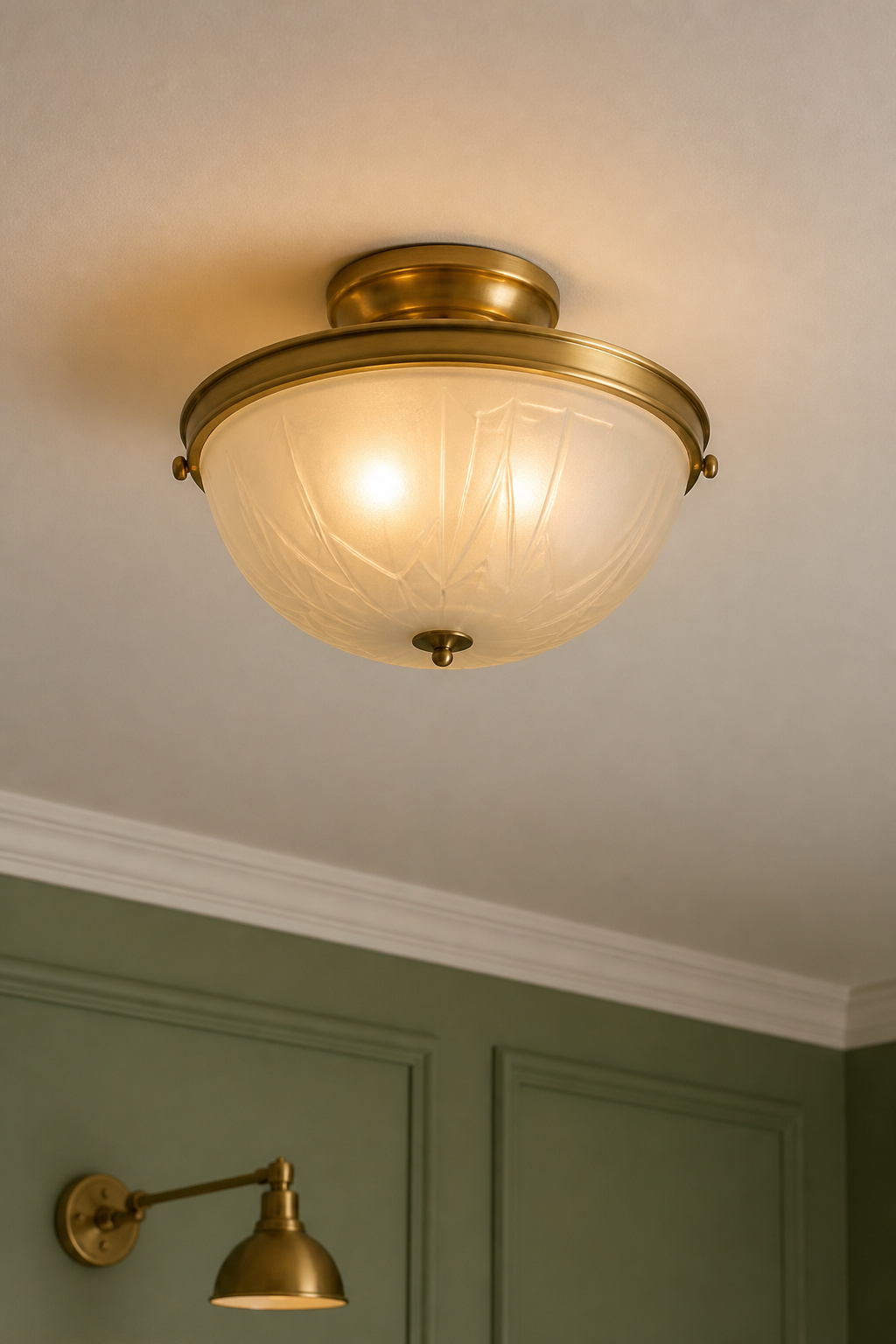
When a pendant works and when it competes
A pendant works when the ceiling allows it: leave at least 7 feet of clearance beneath — on a standard 8-foot ceiling, no more than 12 inches of hang. At full brightness it competes with the sconces, so put it on a dimmer and run it at 20–30% when the sconces are in use.
Flush-mount alternatives for low ceilings
From the 1920s through the 1940s the standard bedroom ceiling fitting was an Art Deco flush or semi-flush mount — opaline glass bowls, frosted geometric panels, sunburst metalwork. Flush mounts sit tight to the ceiling for under 8 feet; semi-flush mounts drop 6–12 inches for 8–9-foot ceilings. Period-correct, and flat enough never to fight the sconces.
Dimmer switches: the control system
One technical trap accounts for most “my LED bulbs flicker” complaints: it is the dimmer, not the bulb. LED filament bulbs need a trailing-edge (ELV) dimmer; the older leading-edge (TRIAC) type built for incandescent loads causes flicker, buzz and a narrow range. Edison-style filament LEDs are especially prone — on a leading-edge dimmer they may not switch fully off at the minimum. LED circuits also need a low minimum load rating, typically 5–10 watts. Lutron and Leviton both publish online bulb-compatibility tools.
The dimmer setting and the vintage wall colors behind the bed are one decision, not two.
Putting the Layers Together: A Lighting Plan
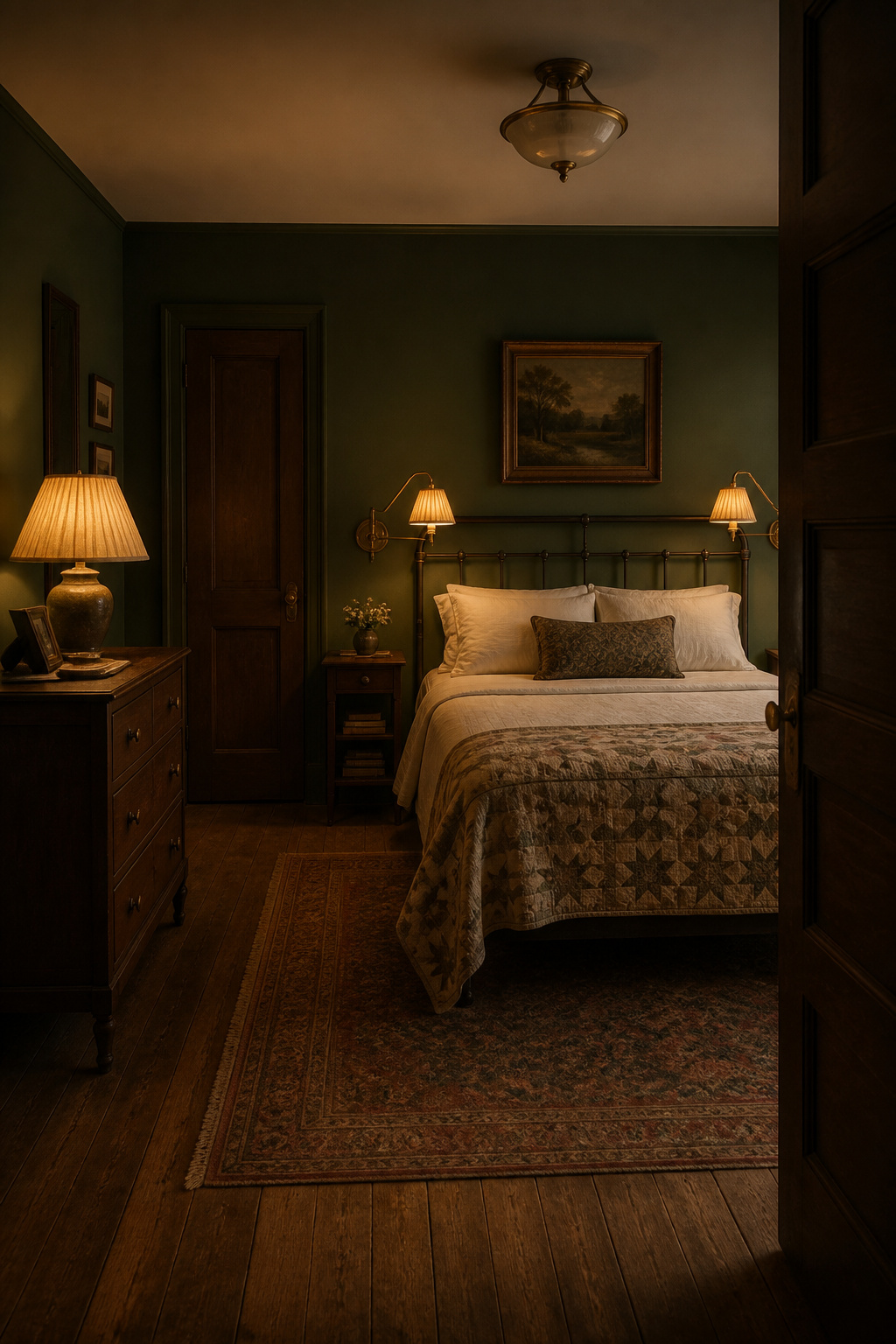
The minimum viable setup: two layers, not three
Two layers carry a vintage bedroom: a ceiling fixture on a dimmer for ambient, and bedside sconces or lamps for task. This covers the room’s two real states — general occupation and pre-sleep reading. Dimmed low with the ceiling off, the sconces serve as ambient sources too. Accent lighting is the optional third layer, added only where a dark corner needs filling.
What to swap first if you can only make one change
Swapping any bulb above 3000K for a 2700K or 2200K dimmable filament LED is a sub-$10-per-socket change that immediately shifts how brass, wood and linen read. In order:
- Swap the bulbs to 2700K (or 2200K) filament LEDs in every socket — the cheapest, fastest, most transformative move.
- Add a dimmer to any source that lacks one; a fixed-brightness light cannot contribute to a layered atmosphere.
- Add a swing-arm sconce if none exists, building the task layer a ceiling fixture can never provide.
Vintage bedroom lighting is not about fixtures but about light quality — its colour, its intensity, your control of both. One honest sconce with the right bulb at the right height feels warm and right. You now know which layer does which job and which change to make first. Pair warm light with cozy layered bedding and the room closes the loop.
FAQ
What colour temperature bulbs should I use in a vintage-style bedroom?
Choose 2700K soft white as the standard: the warm golden tone supports melatonin and makes brass, linen and wood read correctly. For the most candlelit warmth, especially on dimmers, drop to 2200K extra-warm white. Avoid anything above 3000K — 4000K and 5000K grey out warm period colours and disrupt sleep.
Can I install a swing-arm sconce without hardwiring it to the wall?
Yes. Plug-in swing-arm sconces screw to the wall and connect to a standard outlet by cord, with no electrician needed, and most include a cord cover. Many vintage brass models are 2-in-1 convertible: use them as plug-ins now and hardwire them later without replacing the fixture.
How many lumens do I need in a bedroom for reading in bed comfortably?
Aim for 300–600 lumens from a focused source positioned above and to the side of the page. The widely cited sweet spot is 450 lumens — the output of a 40W-equivalent LED filament bulb — enough for extended reading without disrupting sleep onset. A directional sconce shade concentrates output, so 450 lumens from a sconce reads brighter than the same wattage from an ambient table lamp.