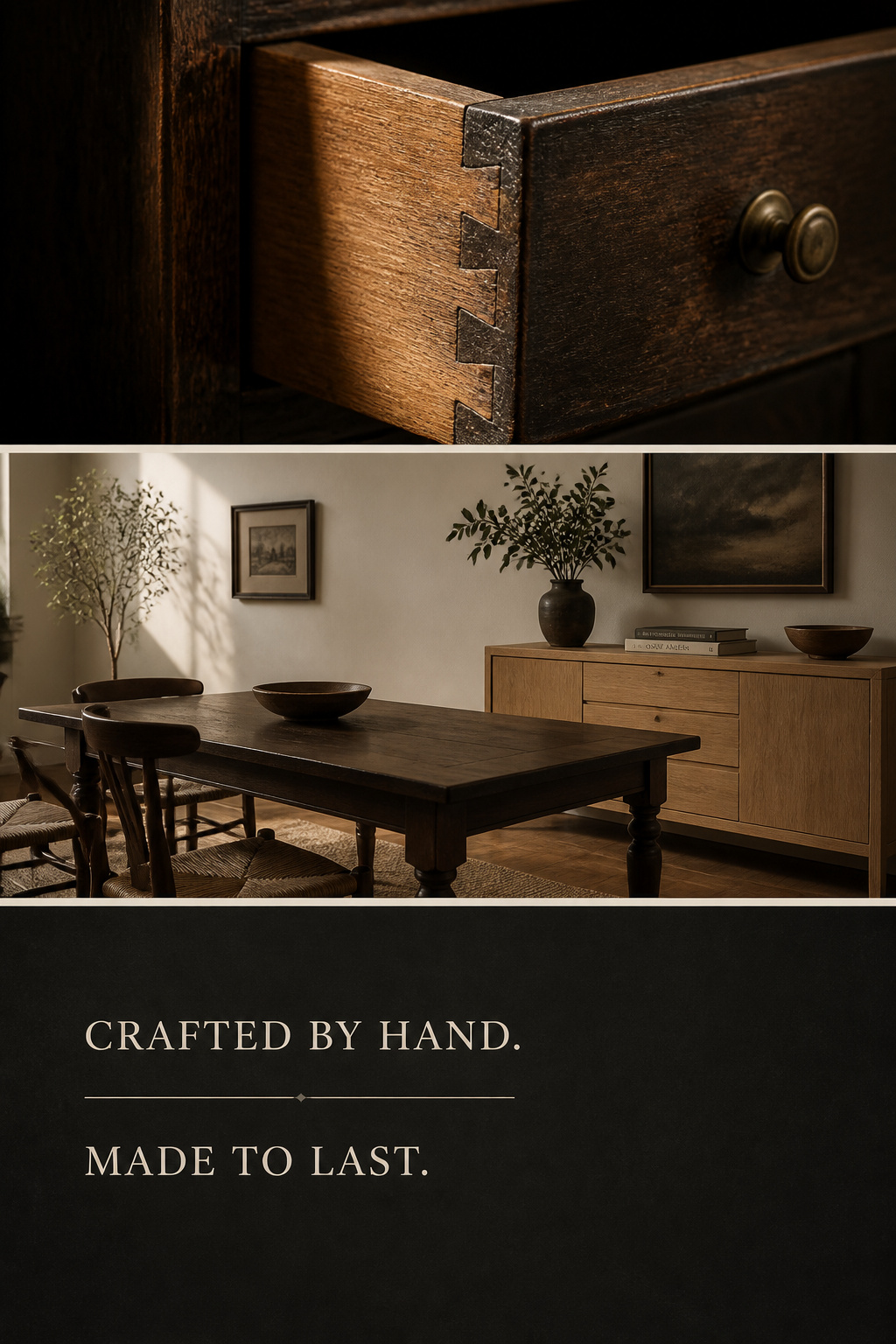
For most of the last century, a dining room meant a matched set: table, chairs and sideboard bought together, finished identically. That convention is barely a hundred years old — an industrial accident, not a design law. Before mass production, families assembled a dining room over decades, each piece carrying its own grain and joinery. Mixing vintage and modern dining furniture returns to that older habit. Once you can read what makes an old piece worth keeping, the mix is no compromise at all.
TL;DR
- Pair pieces by visual weight — mass, leg profile and finish sheen — not by era; keep a dining room to two or three wood tones, each appearing at least twice.
- Date and grade a vintage piece before buying: hand-cut dovetails read pre-1870 in America, genuine patina wears in logical places, and solid wood shows consistent grain through a drawer edge.
- The most forgiving wood pairing is dark walnut with light white oak — high contrast, compatible undertones, available across vintage and new ranges.
Why Mixing Vintage and Modern Dining Furniture Works
Designer Nicky Percival, BIID-accredited and a repeat Best of Houzz winner, calls this approach “slow interiors” — rooms assembled over time to tell a story, rather than bought as a complete scheme off the shelf. The professionals who do it well work to a loose ratio, roughly 80 percent modern to 20 percent vintage, so a room holding both a sleek custom table and a weathered antique hutch reads as intentional rather than accidental. As Percival puts it, “Classic pieces are your staples, with something new and modern adding that spark of excitement.” For the wider approach, see our eclectic dining room ideas guide.
How old-growth timber and hand joinery read beside contemporary pieces
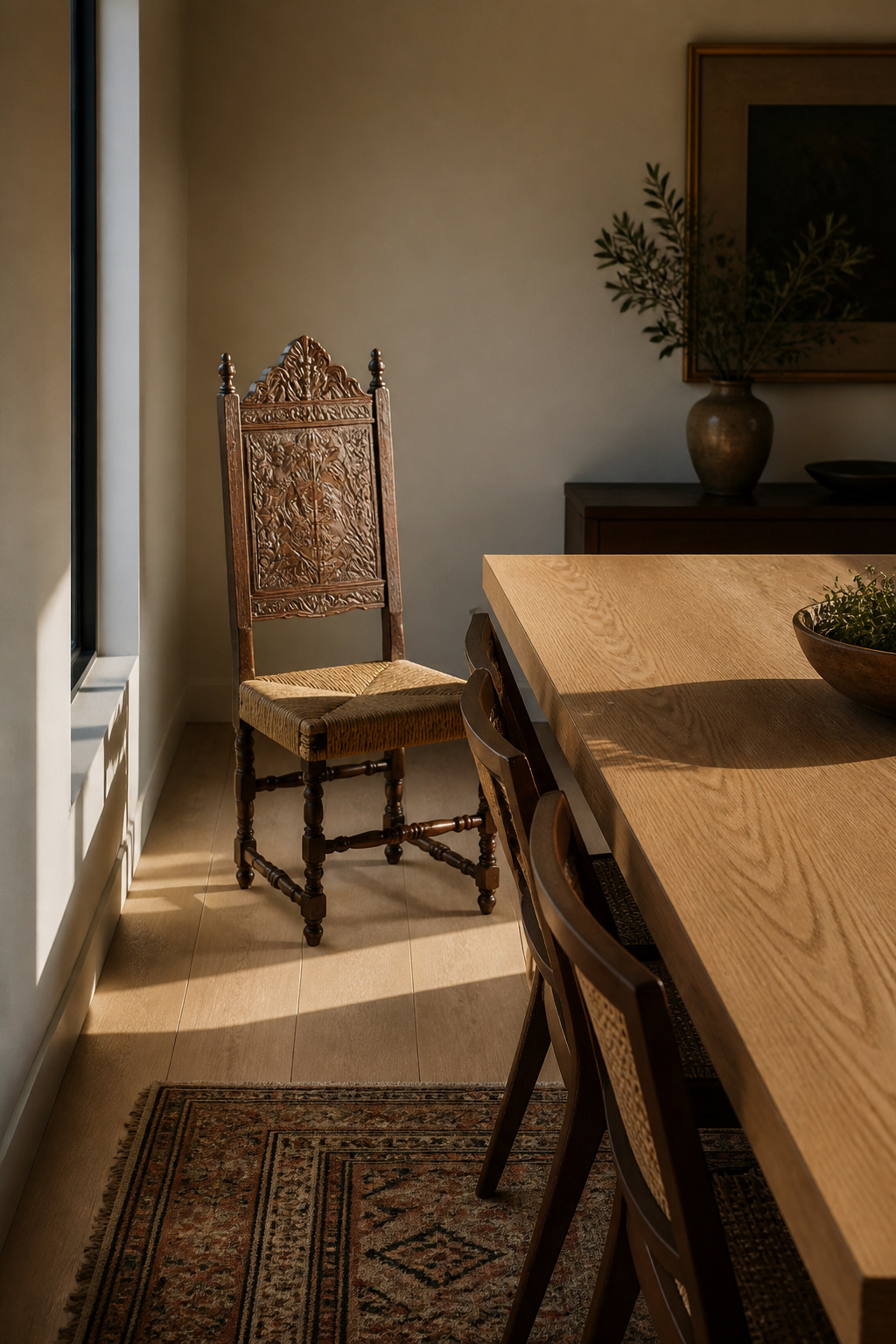
A genuine antique carries grain a modern piece cannot fake. Old-growth timber is denser than fast-grown stock, a wide single-board tabletop marks pre-industrial cutting, and the density has a physical tell: a solid old drawer is noticeably heavier than its veneer-over-particleboard equivalent. Set such a piece against a pared-back contemporary backdrop and the ornamented antique becomes more striking while the modern piece gains warmth — the contrast is the design effect, not a clash to resolve.
The visual weight principle that makes mixing work
Among practitioners, the concept that ties a mixed room together is visual weight: a loose read of a piece’s size, darkness, mass and leg profile. It is not a measured standard, but designers reach for it because it predicts what will balance. An antique table and a modern credenza of similar heft hold a room; two heavy, ornate pieces facing each other compete instead. Emily Henderson calls the productive version mixing “leggy” and “chunky” furniture, in controlled doses, for intrigue rather than monotony.
Reading the Piece: How to Date and Grade Vintage Dining Furniture
Most of grading a vintage piece happens in the first drawer you open, because the joint is the single most reliable dating cue. Hand-cut dovetails — slightly irregular in width and angle, often carrying a faint scribe line — were the mark of good work until roughly 1870 in America and through the 1930s in Europe. Machine-cut dovetails, identical and razor-precise, became the standard of better furniture by the 1920s; the absence of human variation is the tell.
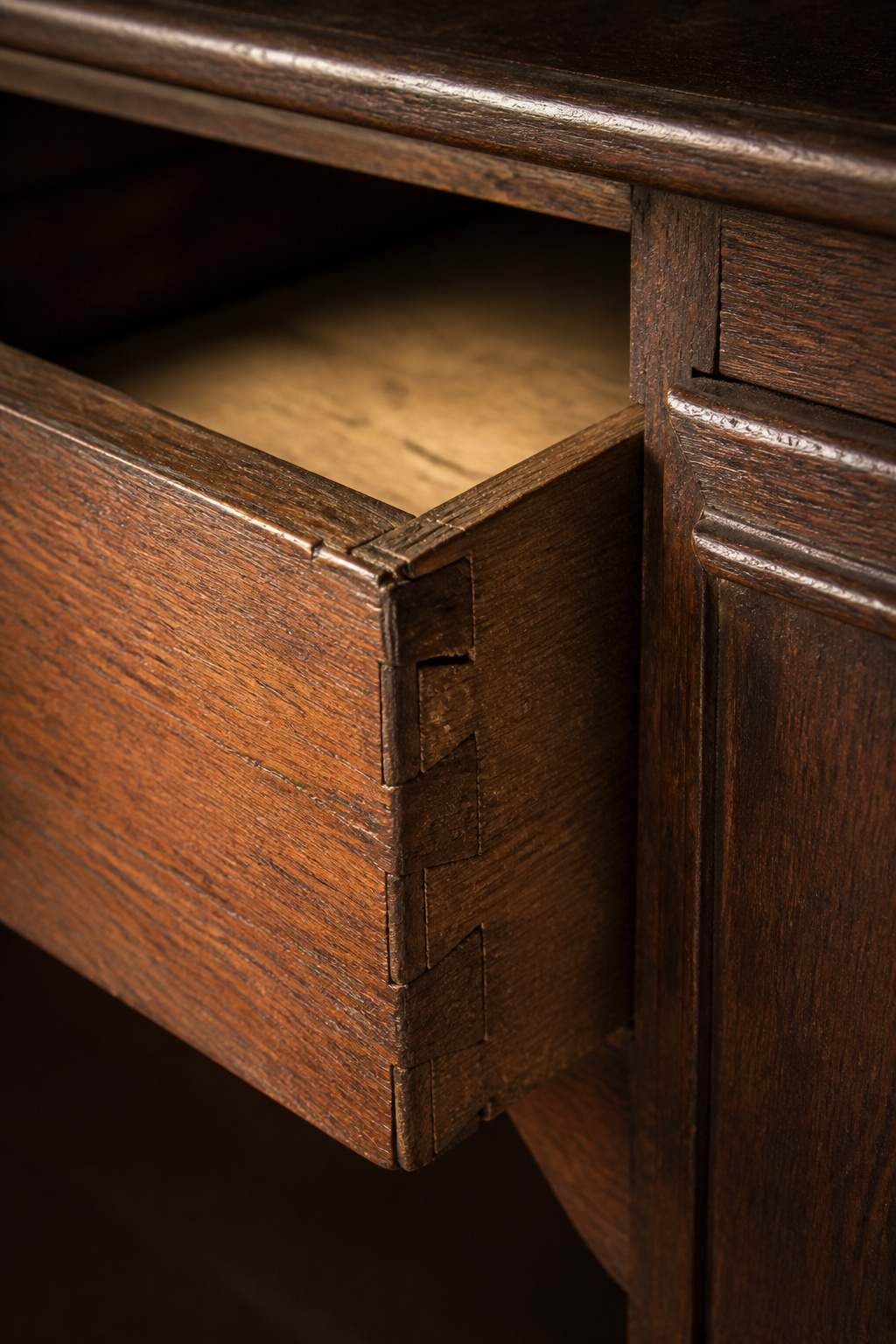
| Feature | What it tells you | Treatment implication |
|---|---|---|
| Hand-cut dovetails (irregular, scribe lines) | Pre-1870 US / pre-1930s Europe, solid hardwood throughout | Conservation-grade piece; preserve the joinery, never re-glue with modern adhesive |
| Machine-cut dovetails (identical, precise) | Post-1890s, standard by the 1920s | Quality but later; refinishing tolerance is good |
| Figure-8 tabletop fasteners | A maker who understood seasonal wood movement — a quality cue at any era | Keep them; they let the top breathe |
| Wide single-board top, rough-sawn drawer bottoms | Pre-industrial craftsmanship | Solid throughout; treat as a keeper |
The difference between genuine patina and applied distressing
Real patina follows the logic of use. Drawer pulls and table edges come up lighter and smoother where hands have touched them for decades, while the recesses of carving go almost black with oxidised wax — a depth that stain alone cannot reproduce. Applied distressing breaks that logic: scratches appear in the centre of a tabletop where nobody drags a sleeve, rather than along the edges and apron where real wear lives.
What solid wood versus veneer means for longevity and treatment
Solid wood can be sanded and refinished many times; veneer — a thin face over a different core — cannot, because sanding risks burning through to the substrate. To tell them apart, flip the piece and look at a drawer edge: solid wood shows consistent grain running through, while veneer ends abruptly, often with a visible glue line. Pre-1940s veneer was cut thick, 1 to 3 millimetres, and can often be refinished carefully, while modern commercial veneer at 0.6 millimetres or less usually cannot.
Pairing an Antique Table with a Modern Credenza or Buffet
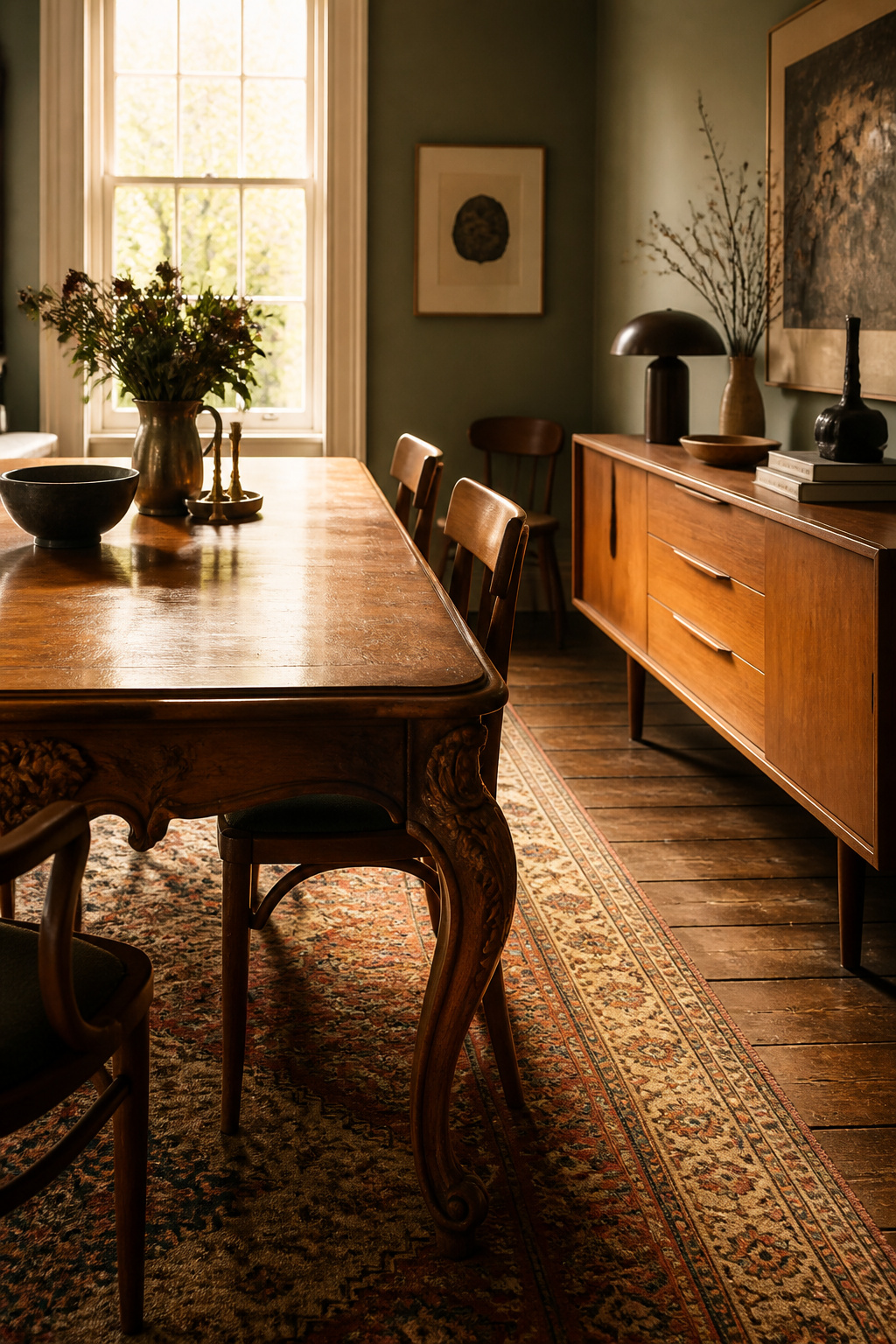
This is the central move of the whole style, and it is governed by visual weight, not by matching anything. A modern buffet typically runs low and horizontal — on the market, roughly 36 inches high and 60 to 94 inches wide — and that horizontal mass counterpoints an ornate antique table’s vertical emphasis. Finish does the quiet work of agreement: a matte modern buffet beside a naturally patinated antique table shares a finish language without sharing a species or an era.
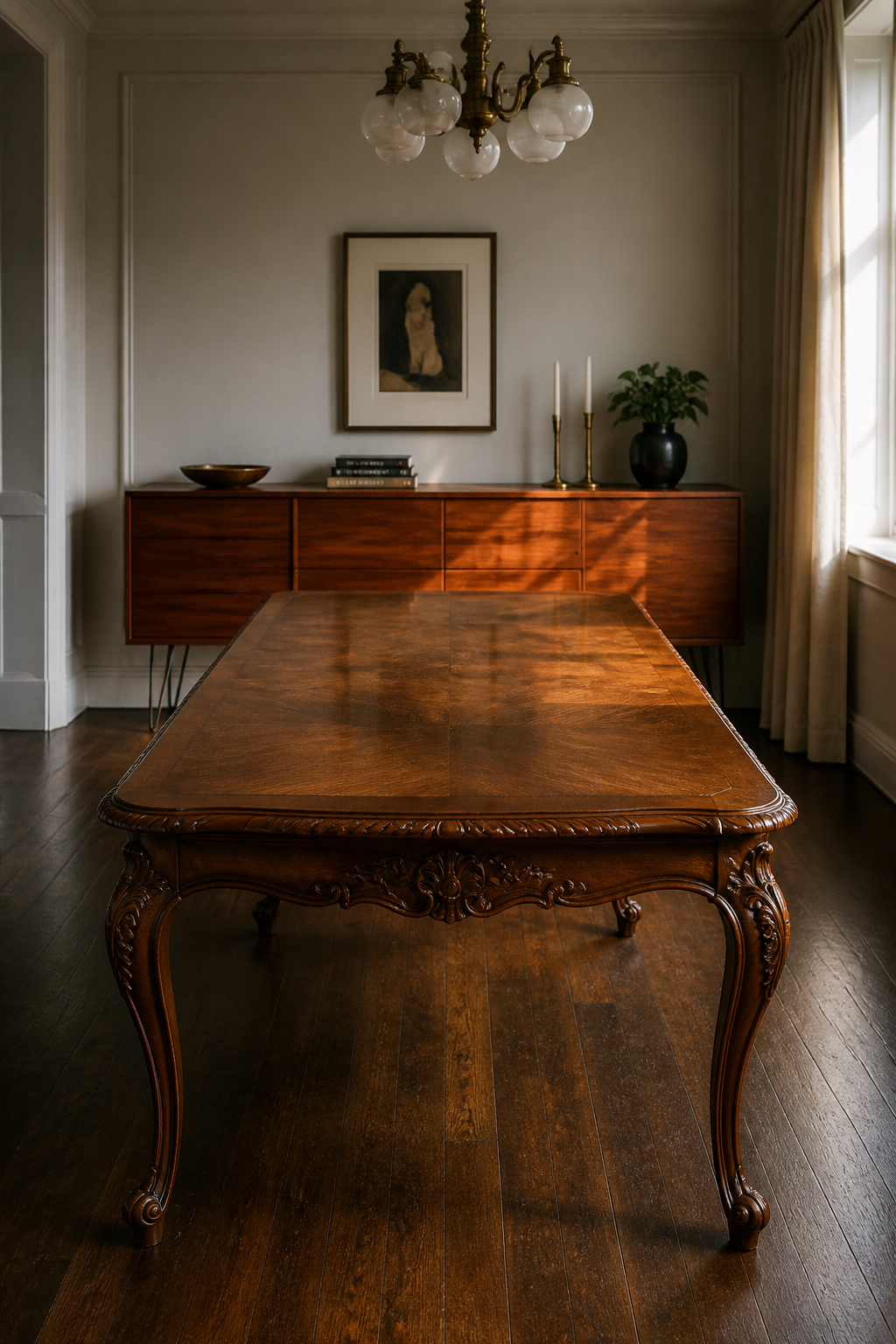
Why a modern buffet with clean lines balances an ornate antique table
High ornament reads as grounding warmth beside contemporary lines, not as visual noise. Percival demonstrates this in a Victorian house fitted with a sleek modern kitchen and bi-fold doors: an antique table and chairs “completely transformed” the room. The carved profile became the anchor precisely because everything around it was pared back. A single clean-lined accessory — a lamp or a vase — extends that dialogue without altering either piece.
Reversibility: never alter a vintage piece to match a modern one
Here is the one rule I will not soften. Conservation practice holds that any intervention should be reversible, so the next owner can undo it — and that applies to styling as much as restoration. Never cut, drill or strip a vintage piece to suit a modern companion. Historic furniture was assembled with hide glue, which releases with heat and moisture, while modern PVA or cyanoacrylate is permanent and has no place on joinery a professional may need to open. The reversible techniques are the good ones anyway: reupholstering a vintage chair leaves the frame untouched and the fabric free to change again.
Mixing Wood Tones in the Dining Room Without Visual Chaos
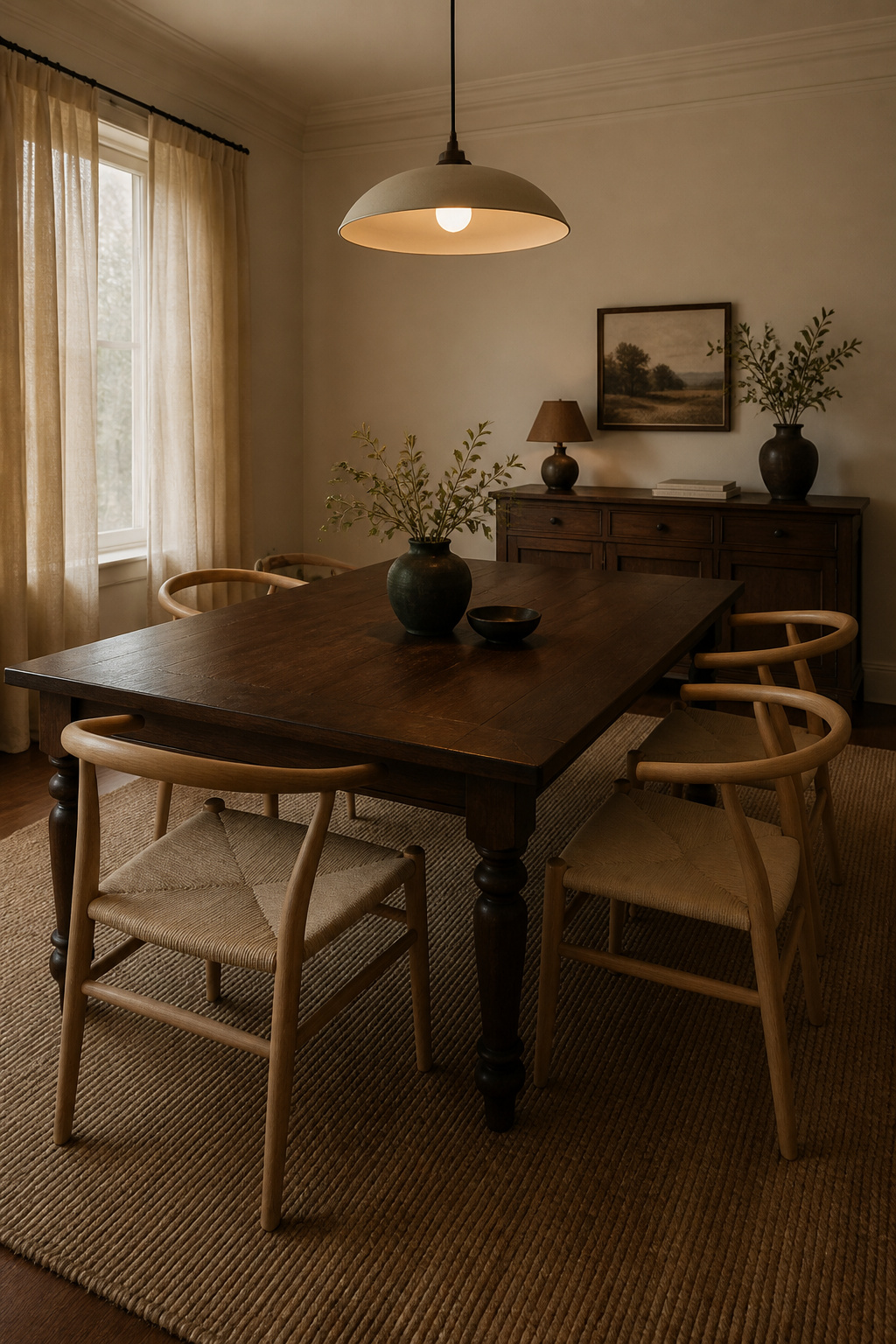
Wood tone is where mixed rooms most often go wrong. Emily Henderson’s design team applies a 60/30/10 rule: the dominant tone at about 60 percent of the wood presence, secondary furniture at 30, accessories at 10. The cap matters most — two to three tones maximum, because more reads as a “disarranged feeling.” Two rules carry the rest. First, each tone must appear at least twice; a single isolated accent wood looks like a mistake. Second, match undertone temperature before anything else. As the team’s Arlyn Hernandez puts it: “Wood is either cool-toned, warm-toned, or neutral… make sure they are all mostly the same temperature.” A black-stained or white-painted piece buffers warm and cool when they must coexist.
| Wood pairing | Compatibility | Finish strategy |
|---|---|---|
| Walnut + white oak | Best all-rounder; high contrast, compatible undertones | Keep both matte-to-satin; available new and vintage |
| Mahogany + red oak or maple | Works; all warm-toned | Match temperature, vary sheen slightly for depth |
| Cherry + walnut | Poor long-term; cherry reddens and darkens with age | Avoid pairing pieces you want stable for years |
| Walnut + grey-stained or bleached ash | Contemporary, but cool-meets-warm risk | Use a rug or neutral buffer to absorb the mismatch |
Dark walnut with light white oak is the pairing I would start a first eclectic dining room on. And a cool-grey floor under a warm walnut table — a common subliminal “not-quite-right” — is solved with a rug, not a compromise.
Using a shared finish sheen to tie different species together
Sheen is the under-used unifier. Matte sits at roughly 10 to 25 percent light reflection, satin at 25 to 40, gloss at 70 and above. Keep every wood piece within the matte-to-satin band and you create one surface language across different species — while two high-gloss pieces of different woods only amplify their differences.
Modern Table, Vintage Sideboard: Reversing the Formula
The formula runs just as well in reverse. A contemporary dining table can read cold on its own; a mid-century teak sideboard behind it brings craft presence and warm wood tone back. The restraint rule still applies: one period mahogany sideboard behind a marble table works, but add a hutch and a bench and the room tips from collected into cluttered.
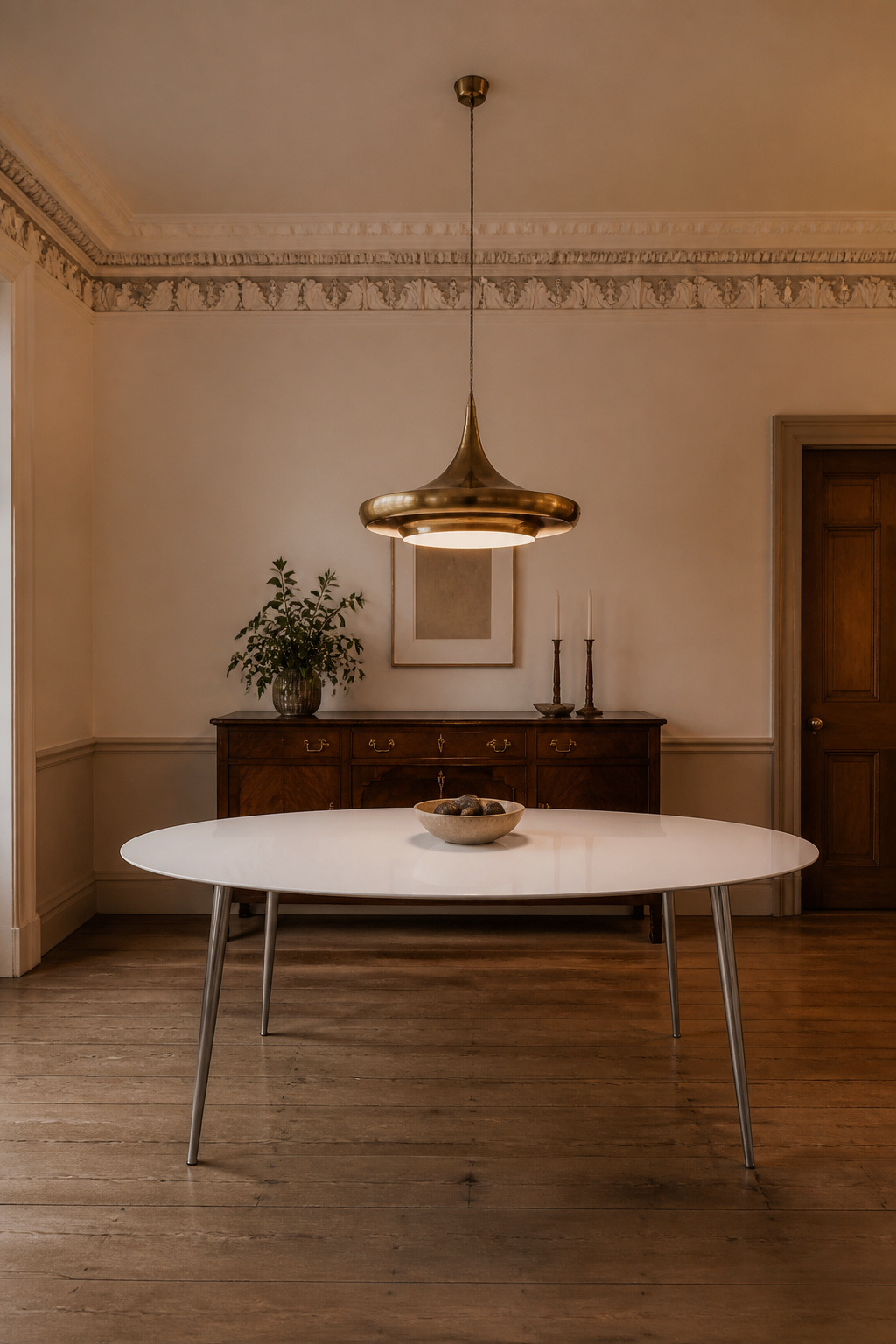
Let the architecture decide the direction. A Victorian house with period cornicing carries an antique table naturally, which makes the modern buffet the accent; a 1970s open-plan space supports the reverse. Light settles the rest: warm 2700K LED amplifies walnut, mahogany and cherry and deepens patina, while cool-white at 4000K greys those tones out.
Some pieces hold the dialogue inside themselves. A mid-century sideboard with thin steel legs and a walnut top is the canonical example: the steel reads modern and light, the walnut echoes an antique table’s warmth, and the two eras agree within one object. Reclaimed wood with aged brass reads as refined vintage-industrial; light wood with brushed steel reads contemporary Scandinavian. Either sits comfortably beside an antique.
Where to Find the Vintage Pieces Worth Mixing
The pieces worth mixing rarely arrive new. Estate sales and barn clearances yield the most dining casegoods with real provenance — preview listing photos before you go, and arrange a van first, because these sales rarely hold items. Condition is the largest single variable in price; a mint piece can be worth five to ten times a damaged twin, so a consistent on-site check pays for itself:
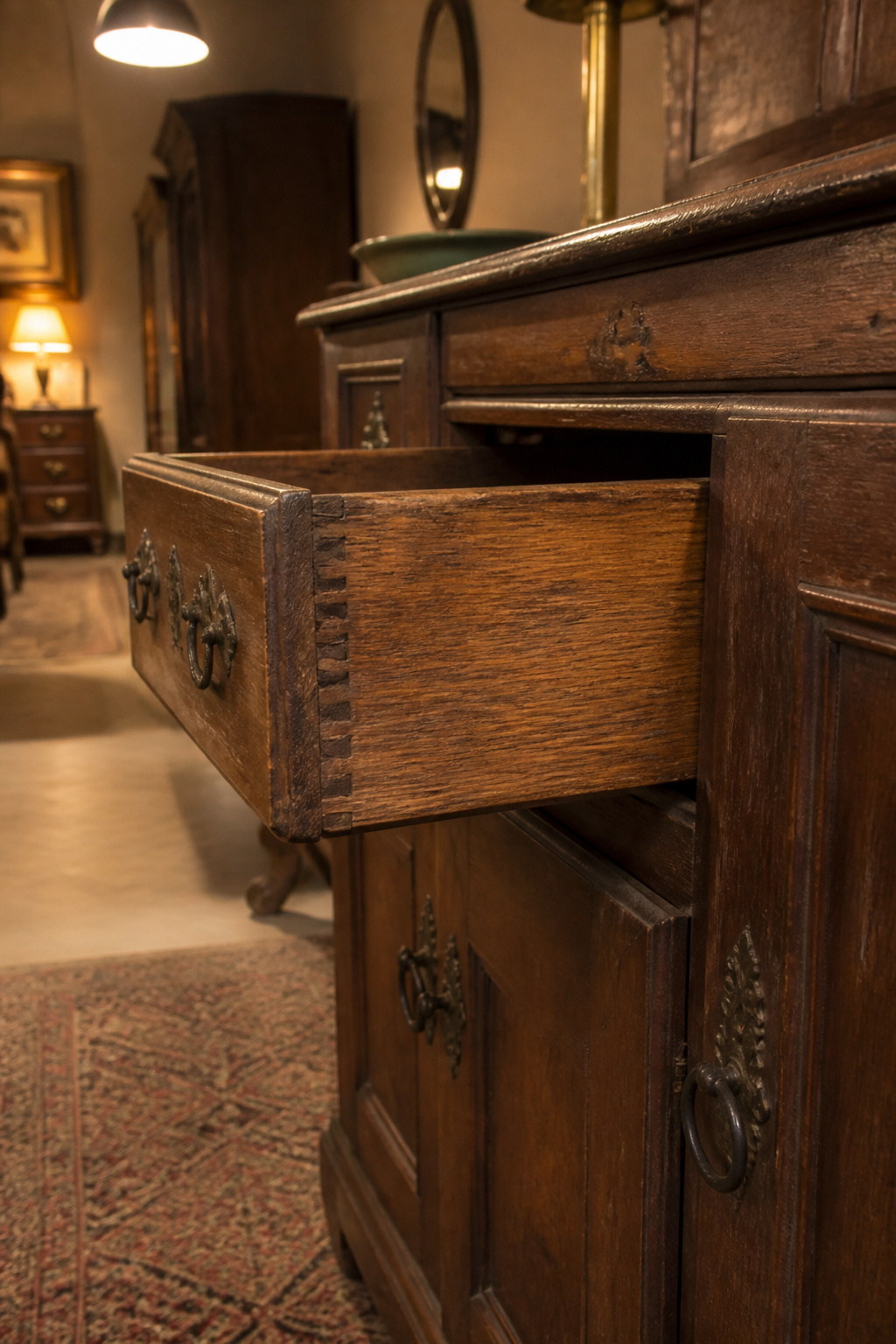
- Open every drawer and read the joint: dovetail type for age, binding for structural movement.
- Check solid versus veneer at a drawer edge — consistent grain through, or a glue line at the face.
- Look underneath for woodworm flight holes; reject anything with fresh, active holes.
- Do the sniff test — deeply embedded tobacco or mould rarely clears and will follow the piece home.
- Note the maker’s mark: Baker, Henredon, Drexel, Stickley and Kittinger are documented quality benchmarks for mid-century American dining casegoods.
For pieces with uncertain provenance, consignment stores offer the same casegoods pre-graded at a premium.
Handing off to seating: chairs are the next decision
With the table and casegoods settled, chairs are the next decision — and they run on different rules, where equal seat height and a repeated colour matter more than the table-and-sideboard logic. That mechanic gets its own treatment in our guide to mixing your dining chairs. Once the furniture is set, pattern and texture layer over it, which is where layering patterns and textures comes in.
A mixed dining room is not riskier than a matched one — it is more honest, built on a few firm principles. Pair by visual weight, not era. Hold the room to two or three wood tones of the same temperature, each repeated at least twice. Grade a vintage piece by its joinery and patina before it earns a place, and once it has, never alter it in a way the next owner cannot undo.
FAQ
Can you mix different wood tones in a dining room?
Yes — two to three tones is the professional recommendation, and two is the safest start. Establish a dominant tone, usually the table or floor, at roughly 60 percent of the wood presence, then use the second as an accent that appears at least twice. Above all, keep undertone temperatures matched: warm with warm, cool with cool.
How do you tell if a vintage dining table is worth buying?
Pull out a drawer and read the joints first. Hand-cut dovetails, irregular with faint scribe lines, indicate pre-1870 American or pre-1930s European construction and solid hardwood. Then check the underside for woodworm holes, test the drawers for binding, and do a sniff test, since embedded tobacco or mould rarely clears. Genuine patina feels smooth and wears in logical places.
What modern furniture pairs well with an antique dining table?
A low, horizontal modern sideboard or credenza is the classic answer: its clean lines contrast the table’s carved profile, and its horizontal mass balances the vertical emphasis. Modern chairs in upholstered fabric or steel frames also work, since the material contrast does the mixing. A single bold contemporary pendant overhead lifts the whole arrangement.