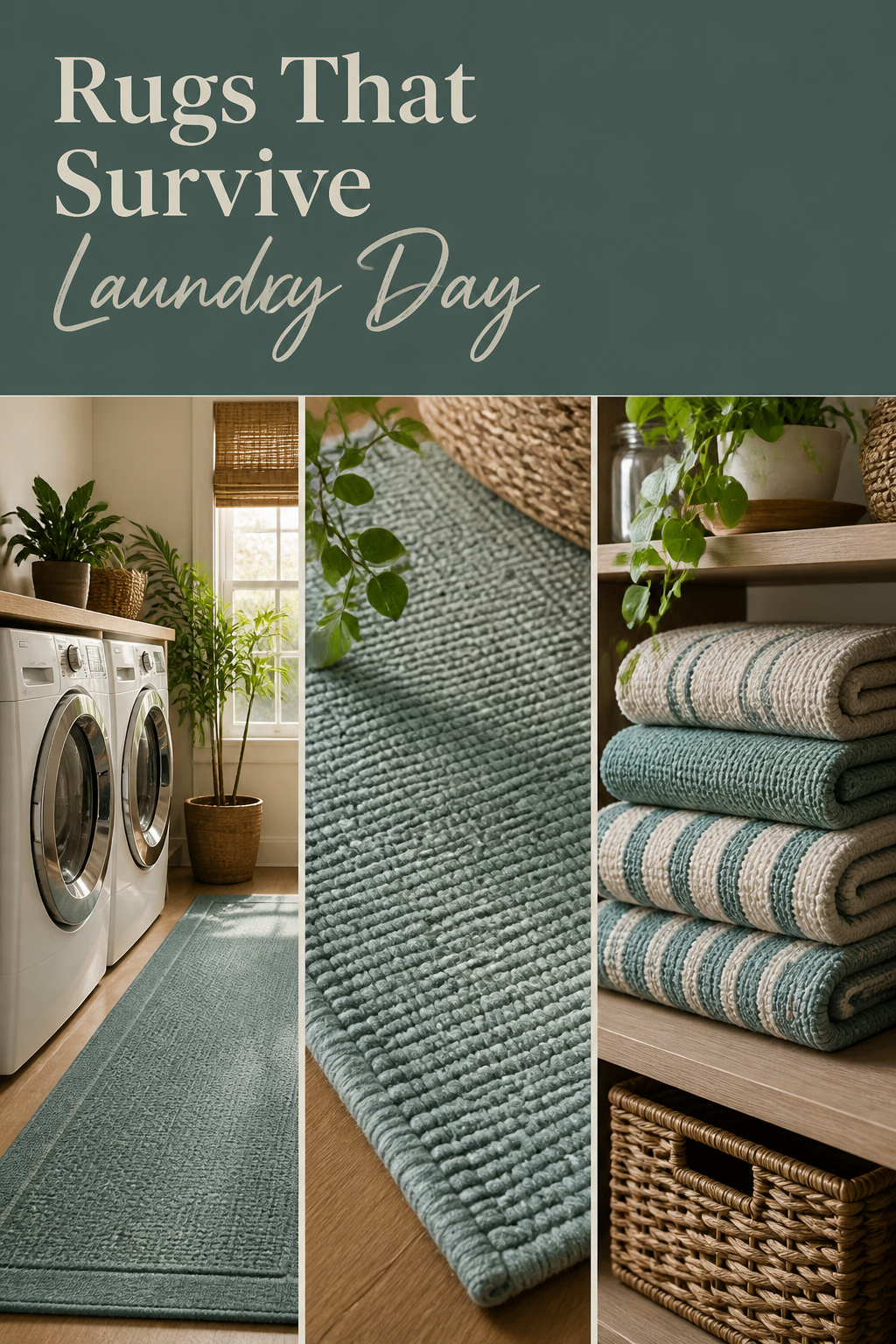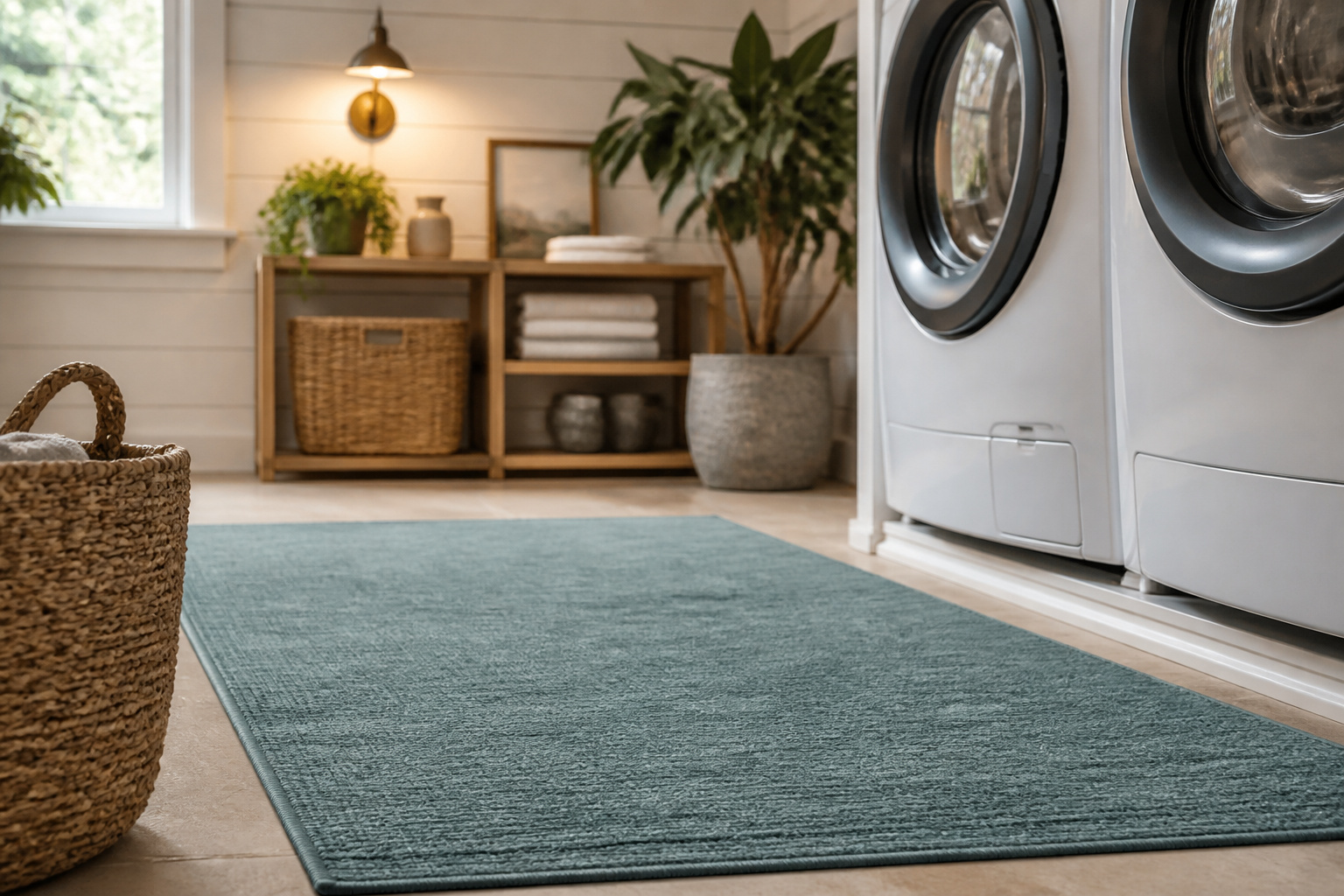

Step into most laundry rooms and everything you meet is hard — cold tile underfoot, flat paint, enamel and steel. When the spin cycle starts, the sound has nowhere soft to go; it bounces off every surface and back at you. The room does its work. It just does it loudly. Most laundry room rug ideas start at the shopping stage, with a colour or a print. I would start earlier: with what the bare room is missing, and how one soft layer answers it. Softness here is not decoration. It is the difference between a room you endure and one you can stand in.
TL;DR
- Poly-blend (polypropylene) is the safest laundry room rug: hydrophobic, mould-resistant, and it holds its pile. Low-pile cotton is washable but absorbent; jute belongs out, where mould can start within 24 to 48 hours of damp.
- Size a runner a few inches narrower than the appliances and 6 to 12 inches shorter than the run to clear the door swing — a side-by-side pair suits a 2′ x 8′ runner, a stacked closet a 2′ x 3′ mat.
- Add a felt or vinyl-safe pad to stop slipping and soften machine vibration, then wash the rug cold weekly to every few weeks depending on traffic, and air-dry it.
What a Hard-Surfaced Laundry Room Is Missing
Feel what the room is short on before you change anything.
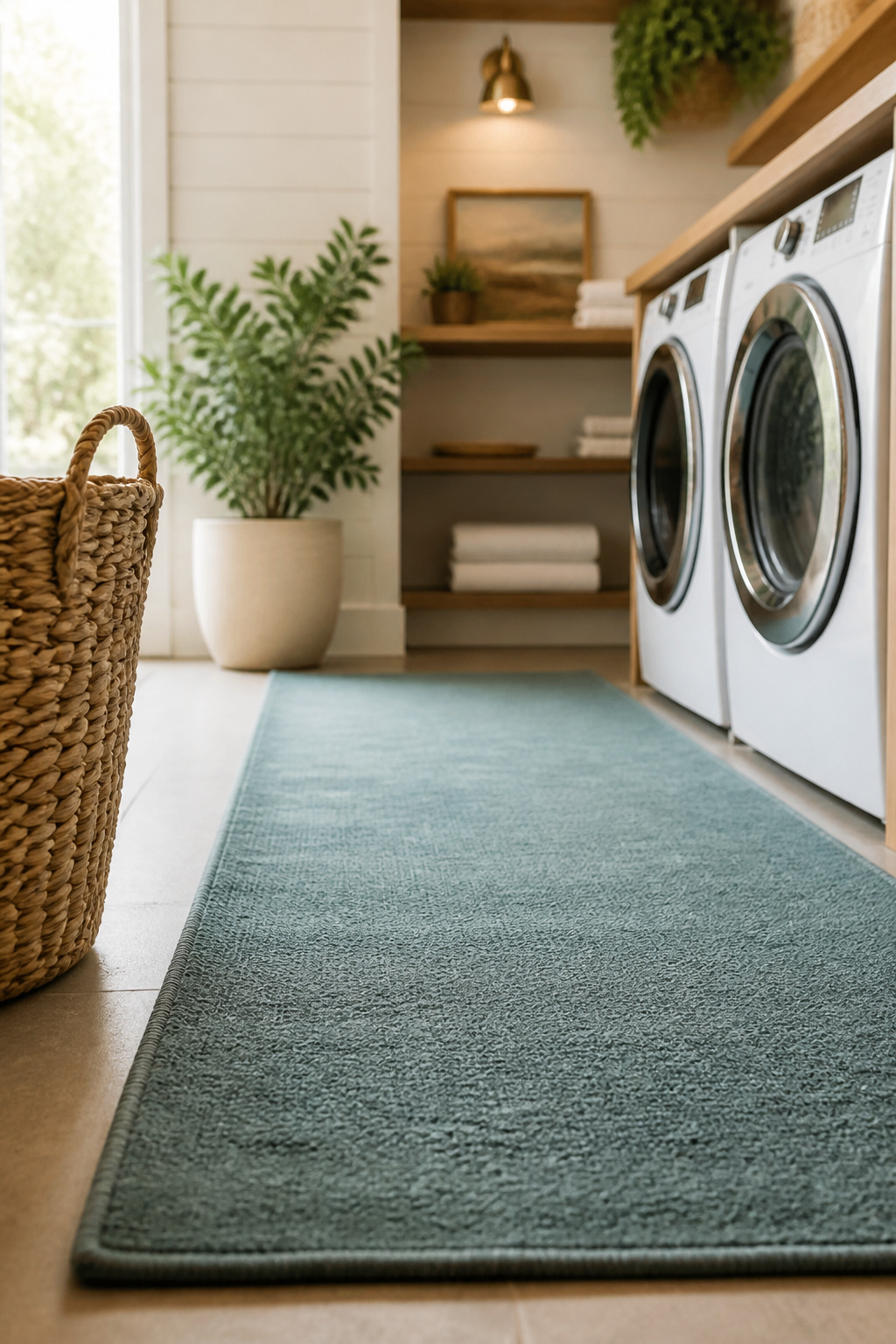
Naming what the room lacks before adding anything
What the room lacks is give. Laundry is a standing task — sorting, folding and transferring loads on your feet, on unforgiving tile or concrete. A low runner gives your feet somewhere to land, and it warms a space that otherwise reads cold. Comfort underfoot and a little warmth: name those two, and the colour choices follow.
The sound argument for soft materials
Soft surfaces absorb sound where hard ones throw it back. That is a general principle of any room, not a laundry secret — but a laundry room is almost all hard surface, with nothing to check the echo. Depth matters more than fibre: a dense, thicker pile absorbs more sound than a thin flat-weave, so a rug with body underfoot does real work here.
Where texture belongs first
If you lay only one thing, lay it in front of the machines. That patch holds the most standing time and sits closest to the loudest, most vibrating source. A pad beneath it absorbs some of that shudder too. So the first soft layer is one rug, in the place you already stand — put it there, and let the rest wait.
Materials That Actually Survive Detergent, Damp, and Machine Traffic
Not every soft thing survives this room, and the table below sorts the materials the way the room does.
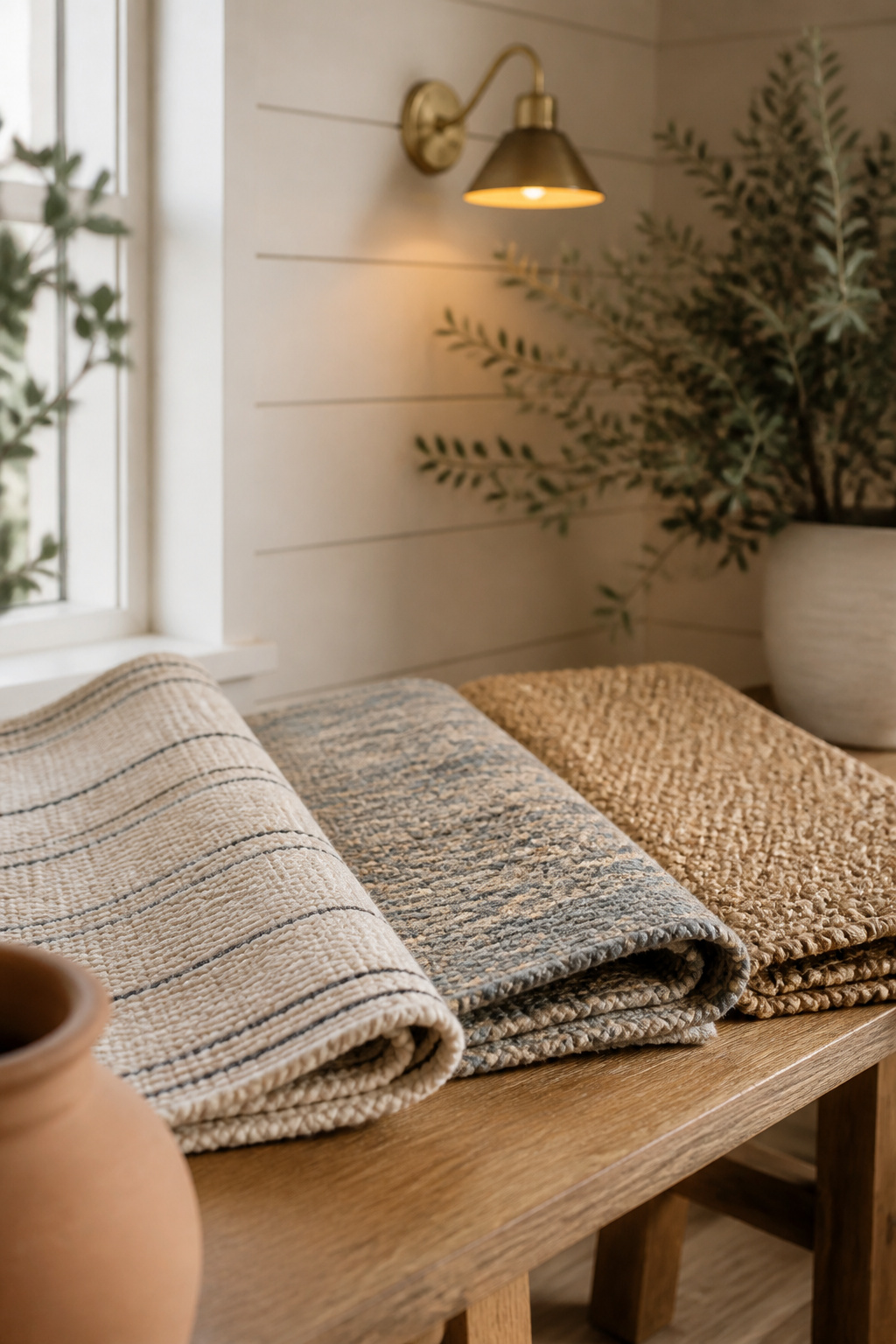
| Material | Damp and detergent | Wear and pile | Verdict for this room |
|---|---|---|---|
| Low-pile cotton | Absorbent, washable, shrinks 2–5% on first hot wash | Softens and flattens faster under traffic | Workable if low-pile and washed cold |
| Poly-blend (polypropylene) | Hydrophobic, mould- and mildew-resistant | Bounces back, holds pile height | The safest choice |
| Jute / natural fibre | Absorbs moisture from the air, cannot be washed | Warps, browns, grows mould | Keep it out |
Cotton
Cotton is soft and honestly washable, which is why people reach for it. Keep it low-pile — a low weave grabs less dirt and moisture than a plush one. Its weakness is thirst: it drinks spills deep into the fibre, so it stains harder and flattens sooner. It also shrinks 2 to 5% on its first wash, so wash it cold and air-dry it.
Poly-blend
Poly-blend — polypropylene, usually — is the material this room was waiting for. Its fibres are hydrophobic, so spills bead instead of soaking in, and cleanup is often a wipe. It resists mould and mildew, shrugs off traffic, and springs back rather than crushing flat. Choose a low, flat pile: it traps less lint and slides under a cabinet edge.
The jute caveat
One material belongs out of this room entirely: jute. Its fibres are highly porous — they pull moisture from the air alone, cannot be washed, and in a humid room they brown, warp and grow mould. In sustained damp, that mould can begin within 24 to 48 hours, and a running dryer is exactly the humidity swing that invites it. You will see jute and sisal marketed as taking “medium humidity.” Treat that as a caution, not a permission.
The first floor I ever laid down on purpose was jute — a single rug in a small rented corner of a Chicago apartment, a cushion on top. It was the right rug for a dry room, and that is the distinction: jute rewards a still, dry space and falls apart in a wet one. Give it a bedroom; give the laundry room something that can take the damp.
Choosing and Sizing a Laundry Room Rug or Runner
A side-by-side washer and dryer spans about 54 inches — those numbers, not a rug’s looks, decide what fits.
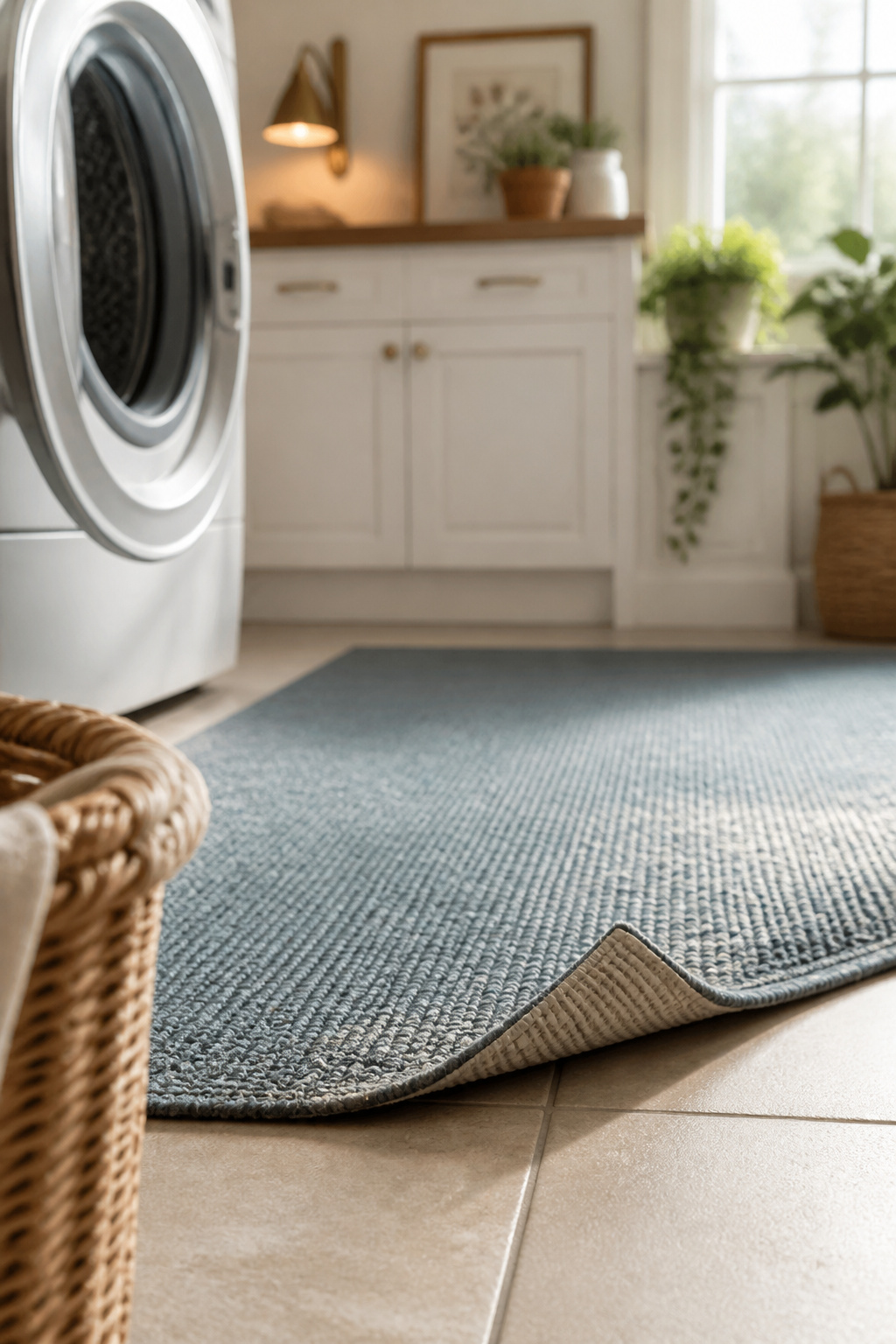
Runner vs. mat by room shape
Let the room’s shape choose the piece:
- A stacked washer-dryer in a closet: a simple 2′ x 3′ mat is enough.
- A side-by-side pair in a dedicated galley: a 2′ x 8′ runner is the standard fit, with 2′ x 5′ to 2′ x 7′ for a compact room.
- Machines set into a larger, open or shared space: a 4′ x 6′ area rug ties the whole floor together better than a runner.
Sizing around machine doors and traffic paths
Measure the run of the appliances, then take 6 to 12 inches off the length so the rug never fouls a swinging door. Front-load doors swing out about six inches, and you want three to four feet of clear floor in front for loading. For width, go a couple of inches narrower than the machines, and leave a small reveal at every edge — a rug that sits placed, not wedged, looks calm.
Non-slip backing for wet floors
On a floor that catches drips, backing is safety, not a nicety. A pure felt pad is the most forgiving — no rubber, no plasticizers, safe on vinyl, laminate and hardwood. Natural rubber grips well but stains vinyl plank in warm, damp conditions, so a synthetic EVA backing is gentler there. Either way, the pad does two jobs: it stops the rug sliding while you move fast, and it damps the machines’ hum.
Curtains, Towels, and the Finishing Textile Layer
What about the fabric above the floor? A curtain and a few towels finish what the rug starts.
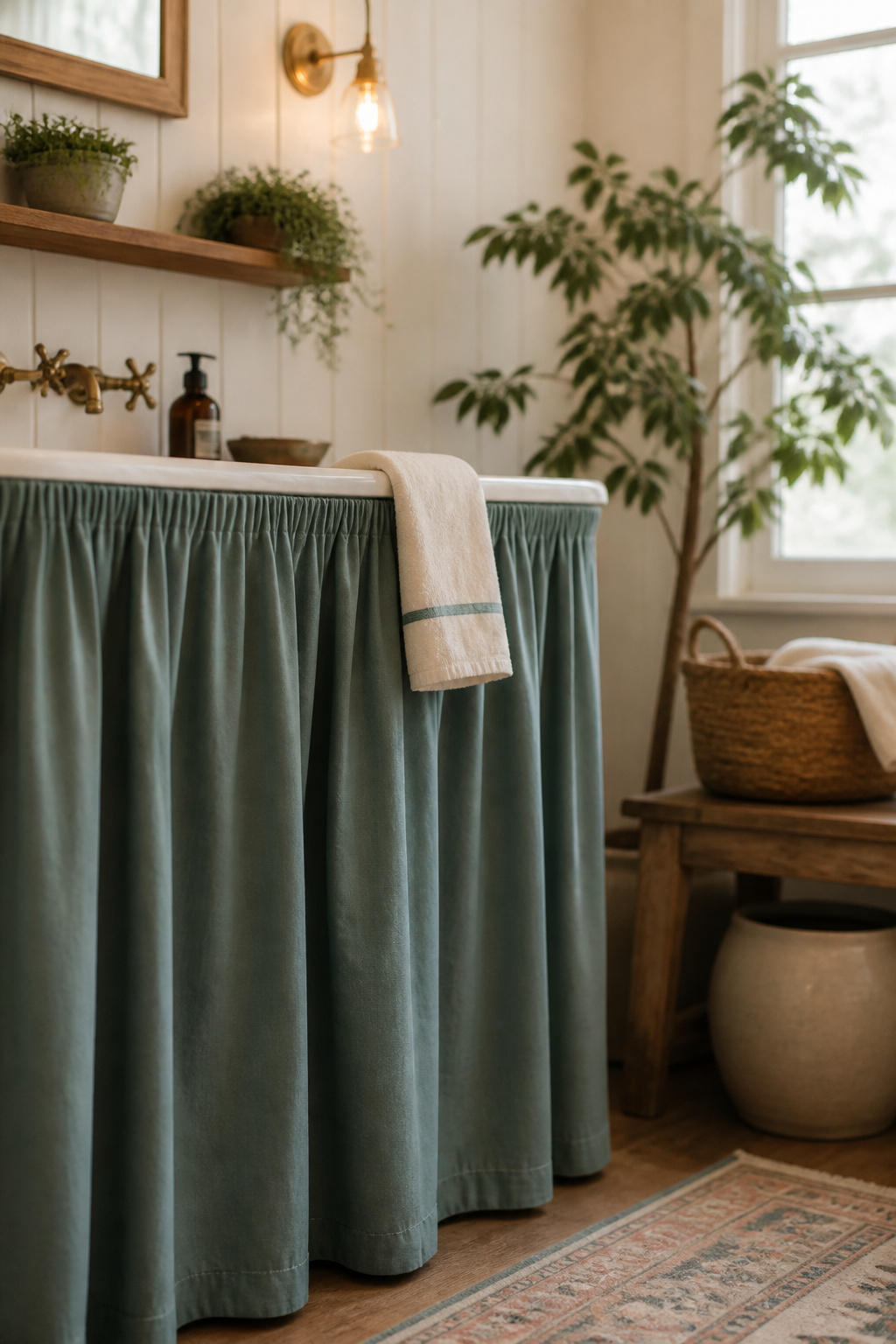
A curtain for open shelving or a window
A gathered fabric skirt is the quietest way to soften a laundry room’s hardest lines. Two simple panels sized to a utility sink or cabinet opening — hung on a tension rod, wire or Velcro — hide the plumbing and add a soft surface at eye level. The same works over open shelving. In a rental, self-adhesive skirts come off cleanly and leave nothing behind.
Hand towels as a small colour and texture note
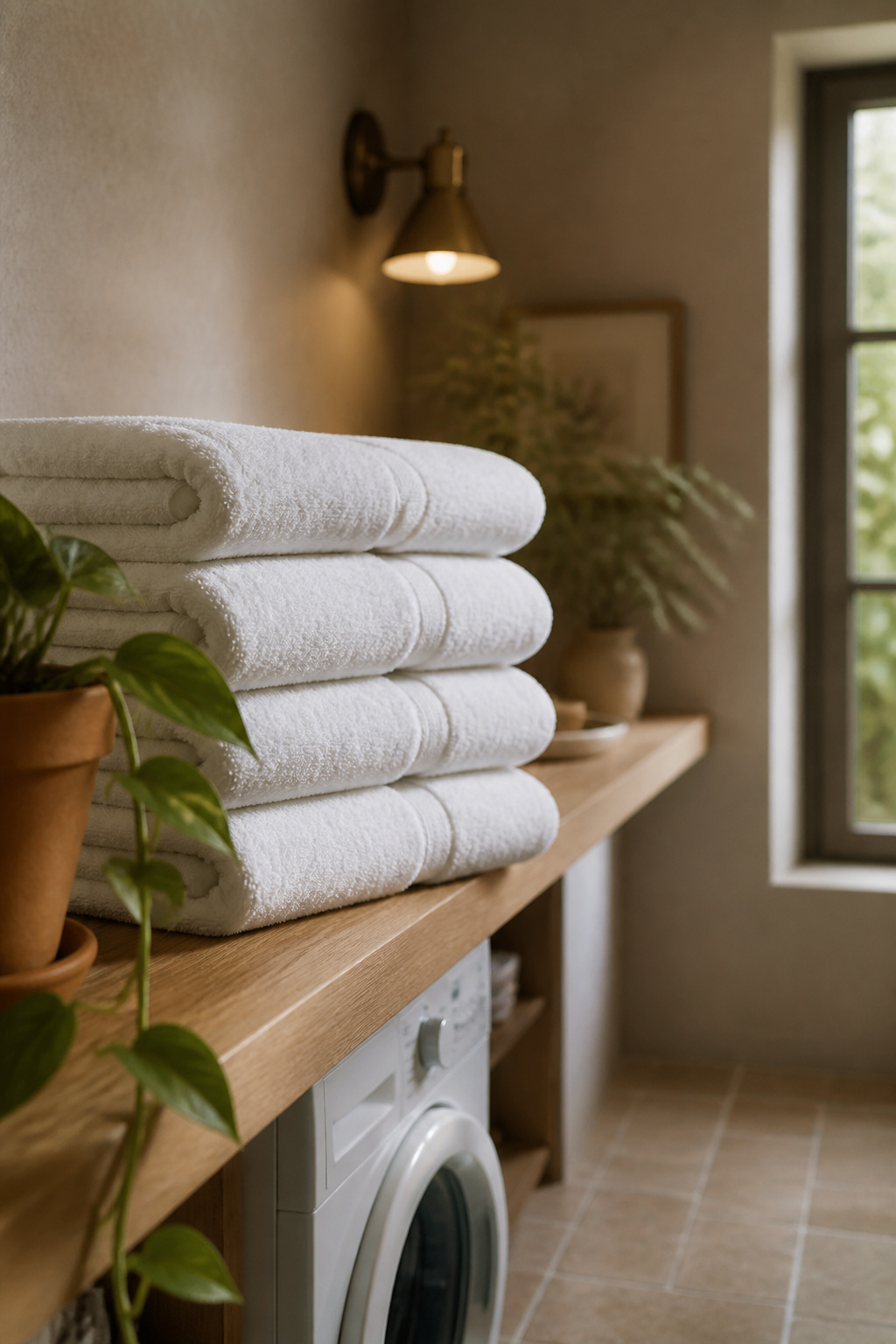
Hand towels are the smallest textile decision and the easiest to change. Folded on an open shelf, they sit within reach and add a spot of colour and weave to a room short on both. Keep them honest, though: a towel wants washing weekly and a full dry between uses, or the damp it holds makes it the least fresh thing in the room.
Coordinating without matching exactly
A matched rug-curtain-towel set from one collection tends to look flat. The collected look comes from one colour in tonal variations — a grey-blue rug, a truer blue skirt, a navy towel — not one exact shade everywhere. Find the piece with the most colour, usually the rug, and pull the other tones from inside it. Let the strongest textile lead and the rest echo it.
Layering Colour and Pattern Without Overdoing a Small Room
The mistake in a small room is three patterns at once, all competing for space too tight to hold them.
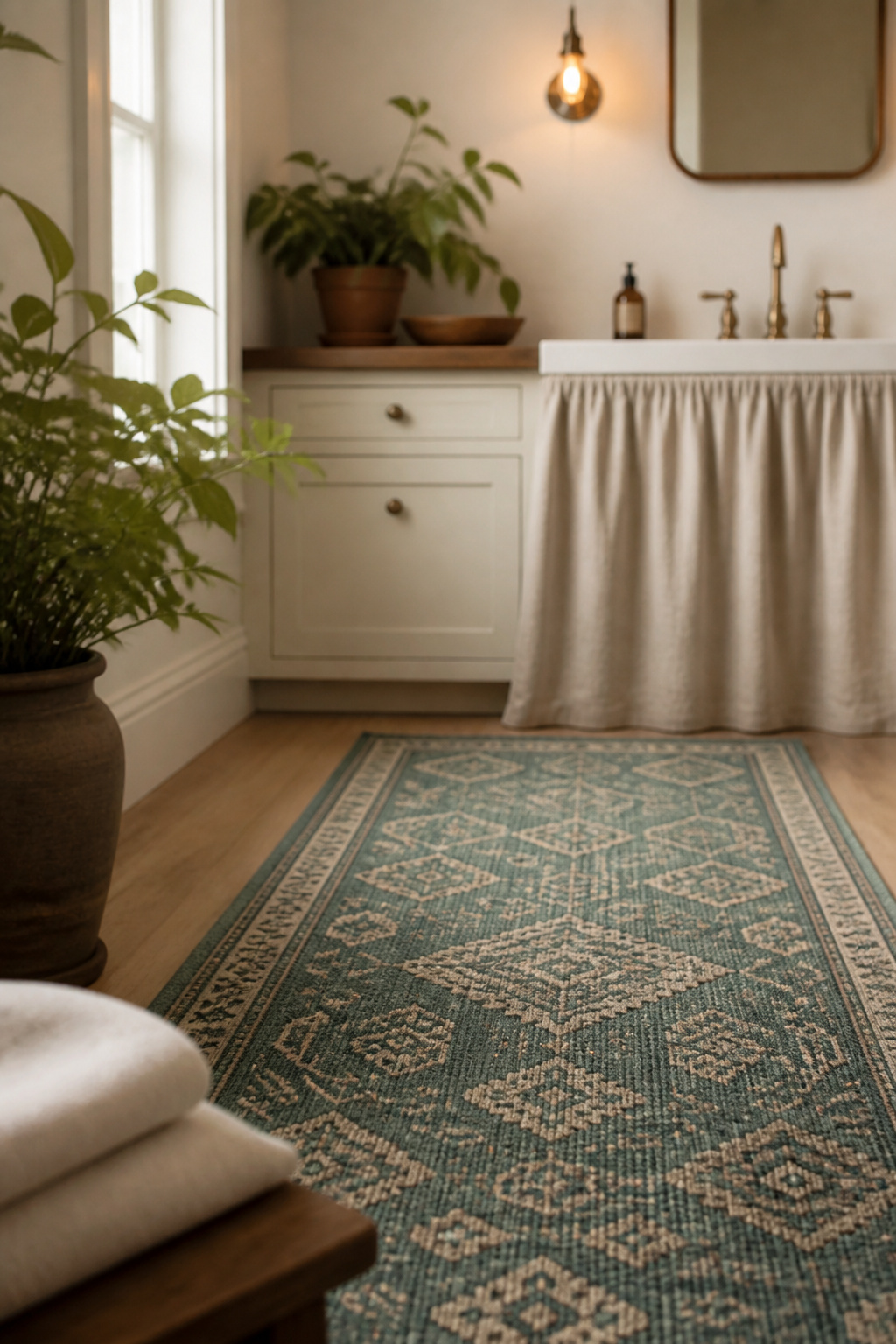
One dominant textile, the rest quiet
Let one piece carry the colour and keep everything around it calm. A bold rug is a safe place to spend that pattern, precisely because the room is otherwise all function — a runner holds more visual weight here than in a busier room. Pull the room’s other tones out of that one piece, and keep the curtain and towels solid. One voice, clearly, beats three talking over each other.
Where pattern is safe vs. risky in a small room
Pattern is additive only when it is not stacked. A single patterned rug against solid textiles layers; a patterned rug under a patterned curtain crowds. If the room already carries pattern — wallpaper, a bold cabinet colour — a neutral rug lets the rest breathe. When unsure, choose the quiet option; a small room forgives restraint far more than excess.
Softening the Room Alongside Plants
Textiles are one soft layer. Living greenery is the other, and the two work together rather than stand in for each other.
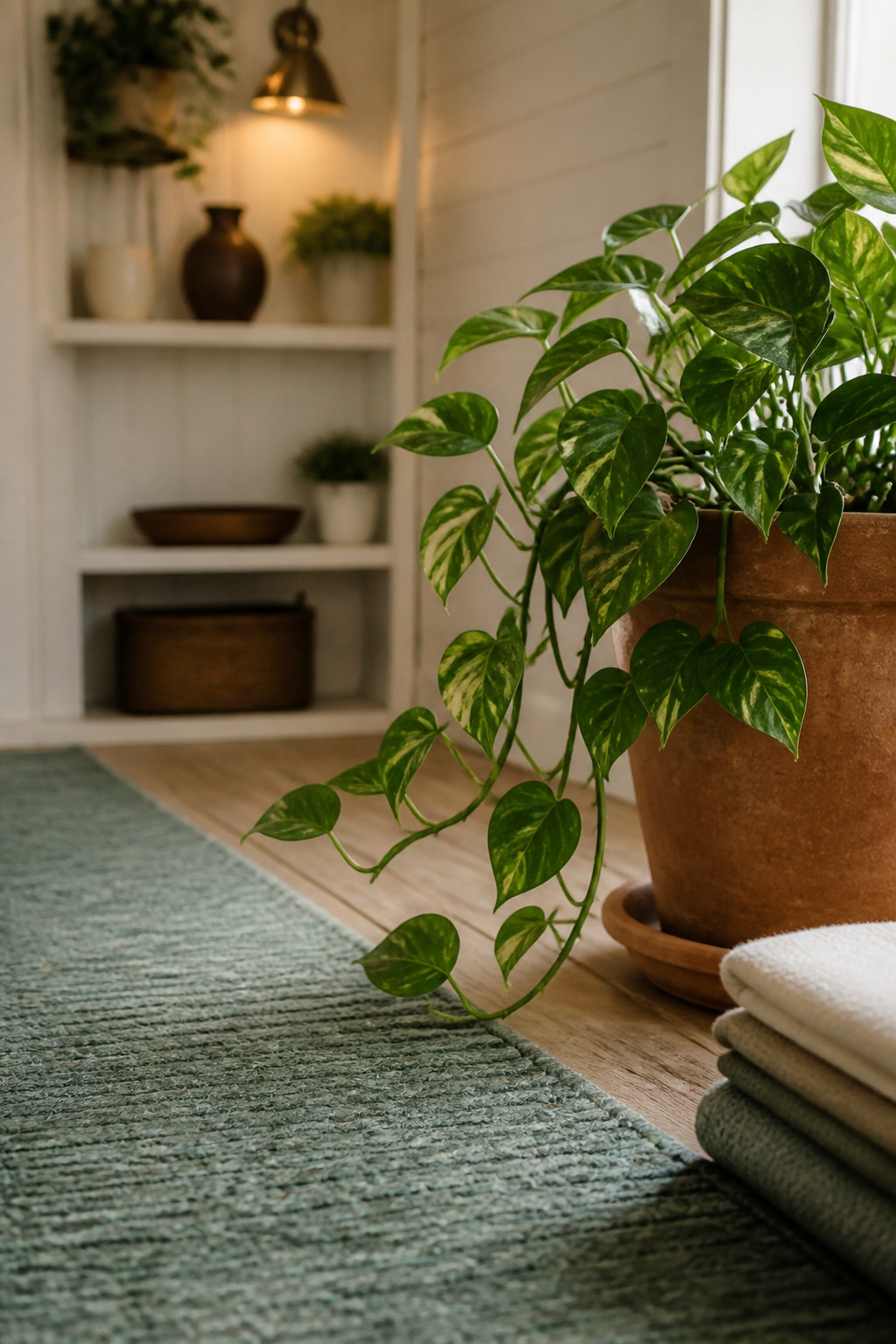
Textiles and greenery as the two soft layers
A hard room resists softening in two directions — touch and sound, which fabric answers, and colour and movement, which a plant answers. A rug takes the cold and echo out of the floor; a trailing plant takes the flatness out of the air above it. Once the rug is down, add greenery to soften further, and feel how much more the room lets go.
Placing a rug near a plant without crowding
The one caution where the layers meet is water. A watering can slips, a pot over-drinks, and a rug is the last surface you want catching that. Keep a plant just off the rug’s edge, or set it on the rug only with a waterproof saucer beneath the pot. Give each layer its own footprint, and they help the room instead of spoiling it.
The Room You’re Actually Building Toward
Picture the finished room: the floor gives underfoot, the spin cycle no longer rings off the walls, and a warm towel meets your hand instead of cold steel.
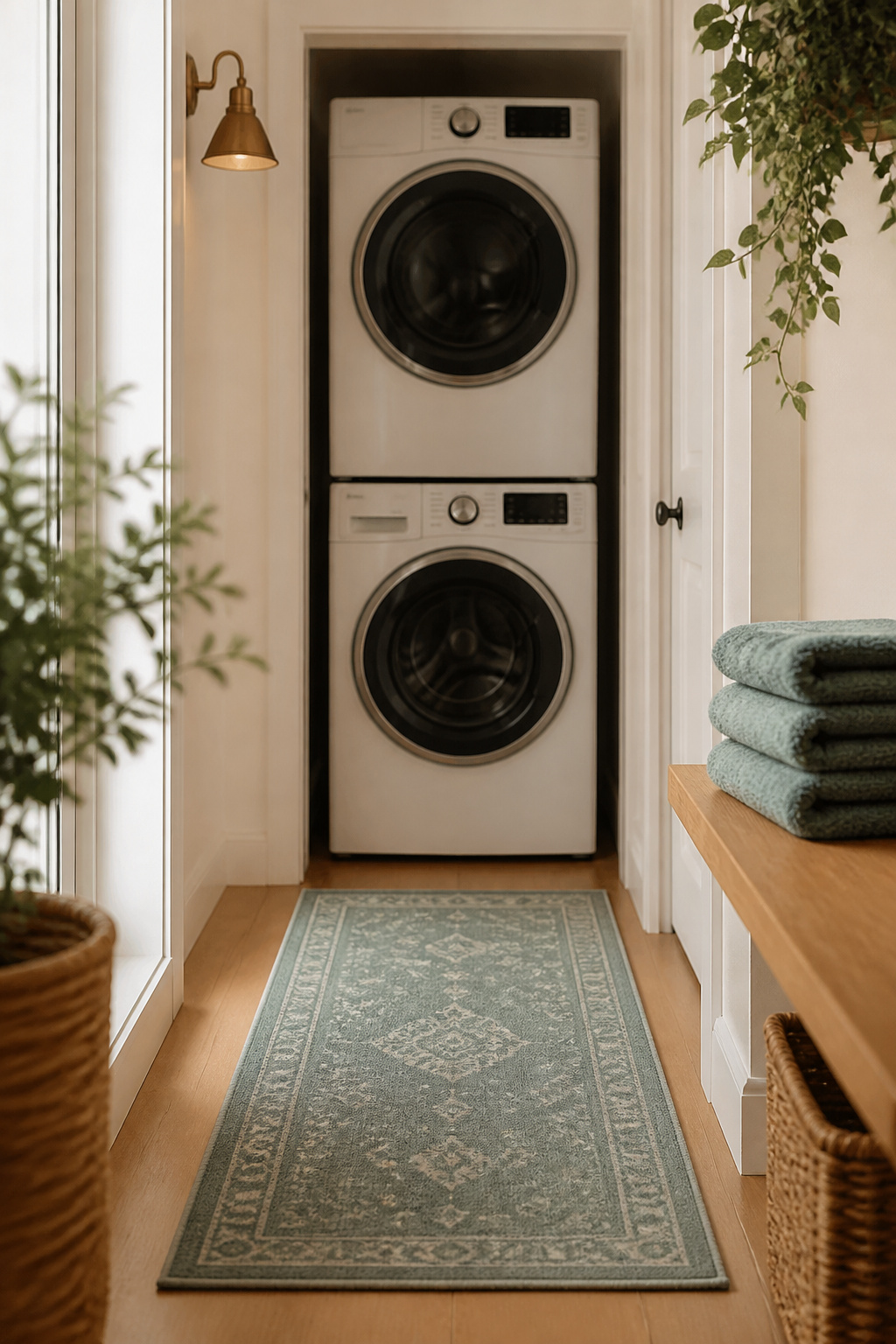
What the finished, softened room feels like
The real payoff is not the rug. It is a working room that stopped feeling like only work — the comfort, the warmth, the small quiet turn the wash from a chore you rush into something you can be present for.
Sizing this for a small laundry space
None of this needs a large room. In a tight or shared space, keep the rug to roughly the width of the machines — about two feet — so the softness ties to where you stand and the rest of the floor stays open. A stacked closet needs only a 2′ x 3′ mat to feel changed. If the whole room is small or rented, the same restraint runs through decorating a small laundry room, and the textile layer sits inside decorating the whole laundry room. Start with one washable rug, in the spot you stand — the room softens from there.
FAQ
Are jute rugs safe for a laundry room?
No. Jute is named among the fibres to keep out of laundry rooms, bathrooms and kitchens, because it is highly porous, absorbs moisture from the air alone, and cannot be washed. In sustained damp, mould can begin forming within 24 to 48 hours. For the jute look without the risk, choose a polypropylene natural-fibre lookalike instead.
How often should you wash a laundry room rug?
Wash a high-traffic laundry rug about weekly, or every two to four weeks for light, single-person use; absorbent cotton needs it more often than polyester. Rubber-backed mats can usually stretch to roughly every two weeks. Wash cold with a mild, non-bleach detergent, and air-dry rather than machine-dry, since heat cracks a rubber backing.
What rug size works for a small laundry room?
A stacked washer-dryer in a closet needs only a compact 2′ x 3′ mat. A narrow side-by-side setup suits a 2′ x 5′ to 2′ x 8′ runner, sized a few inches narrower than the appliances, with 6 to 12 inches trimmed off the length to clear the door swing.