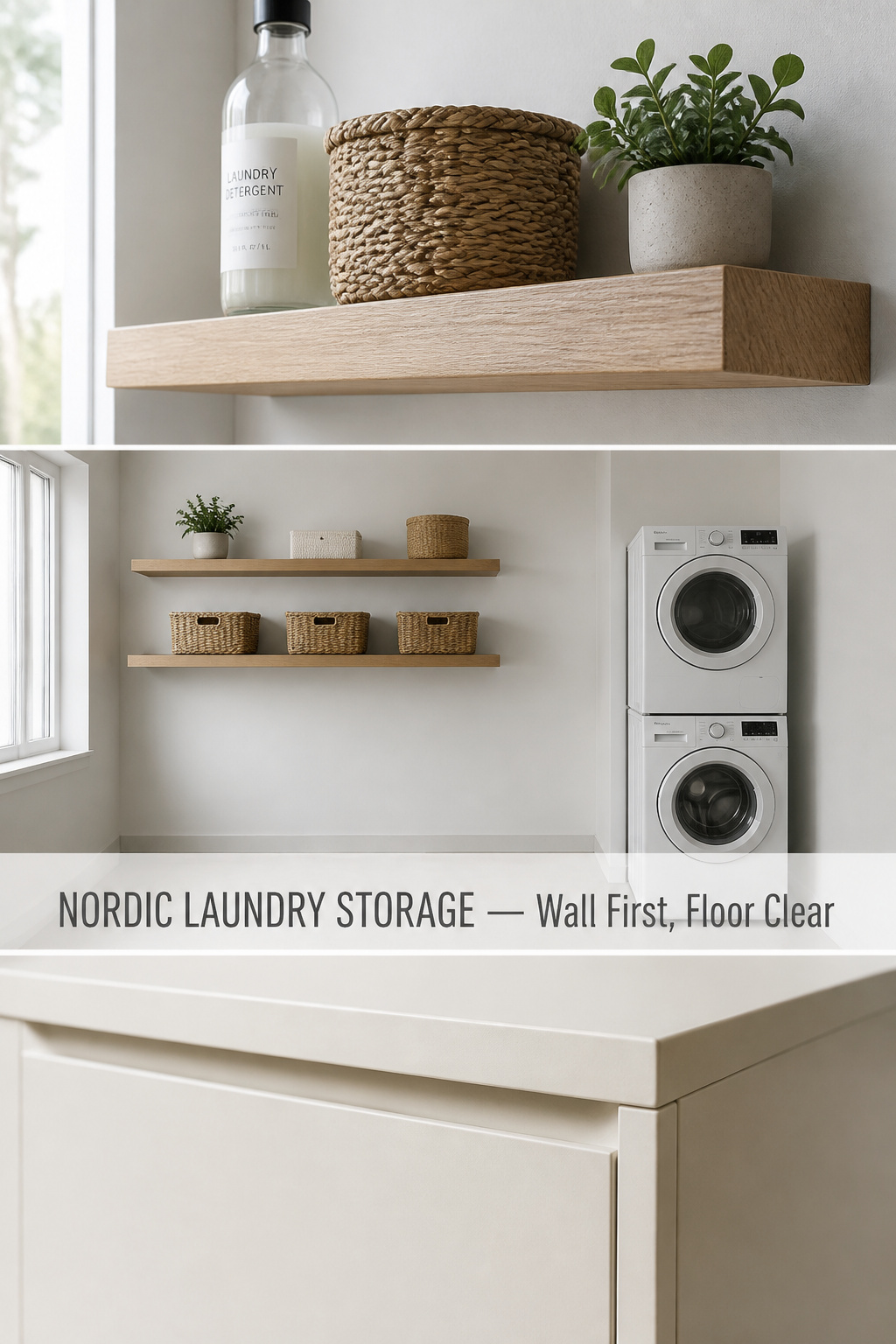
A laundry is the one room we let ourselves treat carelessly. It is a room for chores, so we decide it can be a room for clutter too. That gets the question backwards. The real question is what we want this small room to be — calm, or chaotic. Get that decision right and the storage follows, because good Nordic laundry room storage is not a shopping list. It is a single idea applied to one wall.
TL;DR
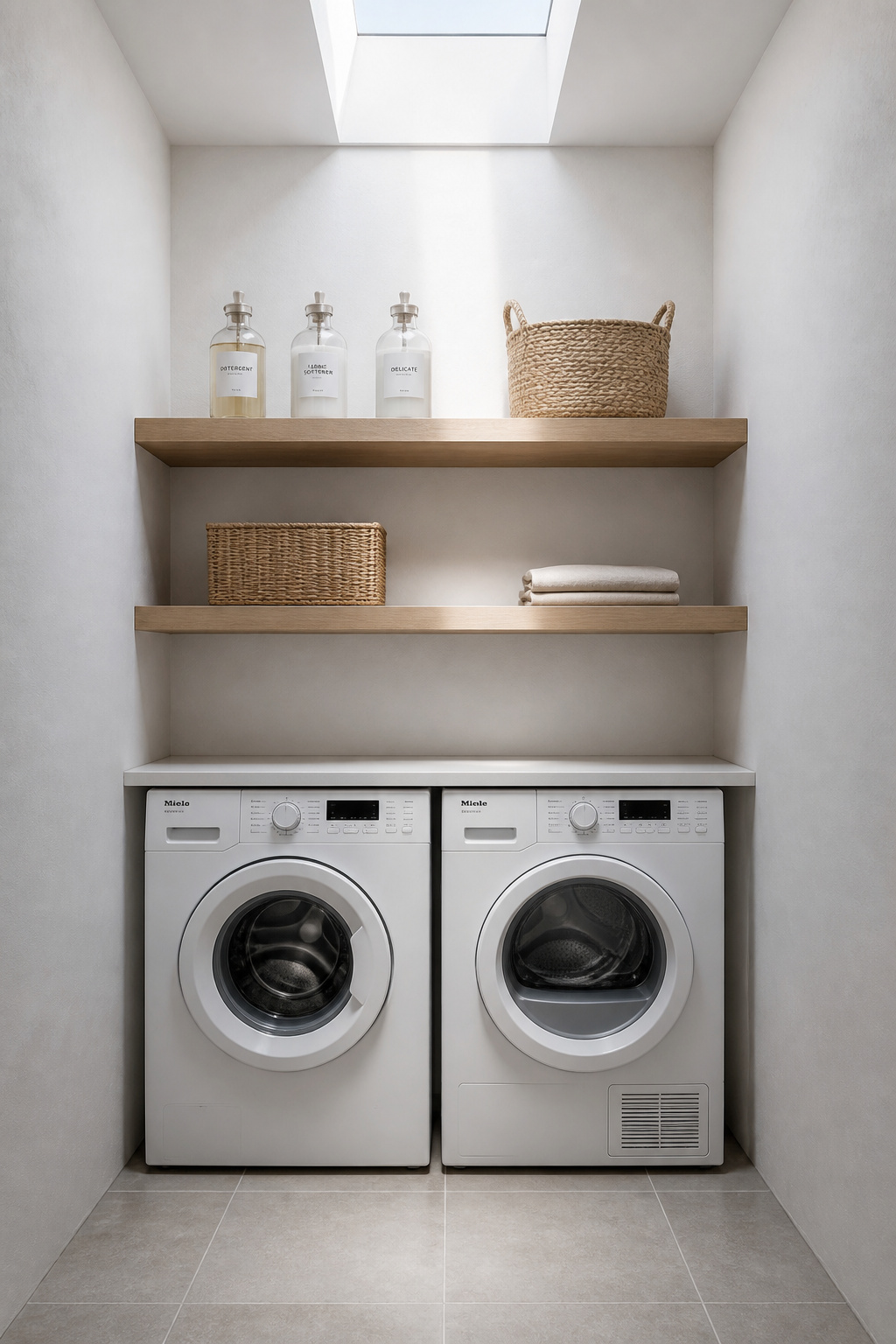
- Store on the wall, not the floor — floating shelves, cabinets and baskets keep the floor clear, which is the single most impactful upgrade in a small Scandinavian laundry.
- Floating shelves work at 10–12 inches deep, spaced 14–16 inches apart, mounted 18–24 inches above the machines; white oak resists laundry humidity best.
- Seagrass is the right basket fibre for a damp room; rattan suits dry shelf storage; jute develops mould above 50% humidity and does not belong here.
Why Nordic Storage Starts With the Wall, Not the Floor
There is a quiet rule behind every Scandinavian laundry I admire: nothing lives on the floor except the machines. Everything else is assigned to the wall. This sounds like a style preference. It is the most practical decision in the room.
Floor clearance as the first Nordic design principle
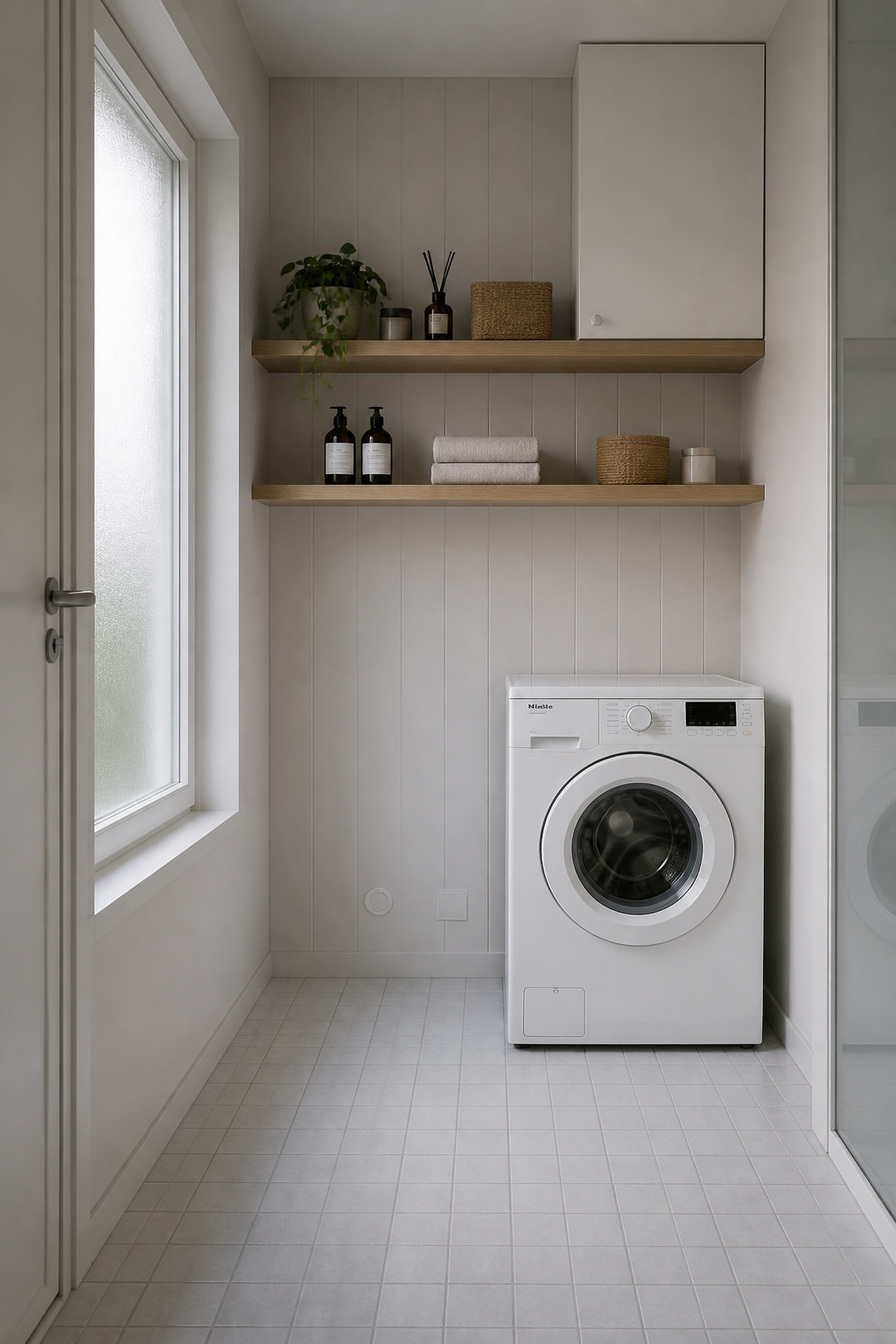
A clear floor is not decoration. It is the measurable outcome of the whole approach. Wall-mounted storage — floating shelves, cabinets, a basket on a shelf rather than underfoot — is the single most impactful upgrade in a small laundry, because the moment the floor reads as empty, the room reads as larger.
Start by stacking the machines. A stacked washer-dryer is the most effective space-saver in a tight room: the footprint shrinks to one machine’s width, and the whole wall above turns into usable storage. Claim the vertical; surrender the floor.
The argument for vertical: more storage, smaller room
Vertical storage is the defining habit of small-space Nordic living. Floor-to-ceiling cabinets hold every laundry necessity while taking nothing from the floor you stand on.
The Nordic home has always understood this. Every object earns its place or leaves — not as a philosophy, but as a daily discipline imposed by small-room living. When you run out of floor, you have not run out of room. You have run out of wall you were willing to use.
What ‘easier than the mess’ actually means in a laundry
Storage that requires daily discipline is failed design. If a system only works when you are tidy, it does not work — nobody is tidy at 7am with wet towels in their arms.
The right way to put something away must be easier than the wrong way. A basket you drop pegs into beats a drawer you open; a shelf at reaching height beats a cupboard you crouch for. Nordic design asks how the space actually gets used, then removes every step it can.
Floating Shelves: The Open-Storage Case
Open shelving is the signature of a Scandinavian laundry, and the easiest thing to get wrong. Done well, a shelf is a styled line of useful objects. Done badly, it is a ledge that collects.
When open shelves work — and when they make laundry worse
Open shelves are for things you reach for often and do not mind seeing: decanted detergent, a basket of pegs, a folded cloth. Anything you would rather not look at belongs behind a door. The rule is short: if you would not be glad to see it every day, it does not go on the open shelf.
For the things that stay, vary the heights. One tall item, one medium, one small, with space left at the edges — that is the difference between a shelf that looks intentional and one that looks abandoned.
Shelf depth and spacing for a working utility room
For a laundry, 10–12 inches is the working depth: 10 inches holds everyday detergent without projecting into the room, 12 inches earns its keep when baskets live up there. Ben Kuhl of Shelf Expression calls 10 inches the universal sweet spot — step up to 12 for heavier baskets. Mount the shelf 18–24 inches above the machines so lids still lift, and stack a second shelf 14–16 inches above the first.
One number matters more than the rest: the bracket rating. A loaded laundry shelf easily reaches 40–60 lbs in daily use. Standard floating brackets rated 25–30 lbs are not enough. Fit heavy-duty brackets rated 150 lbs into a stud.
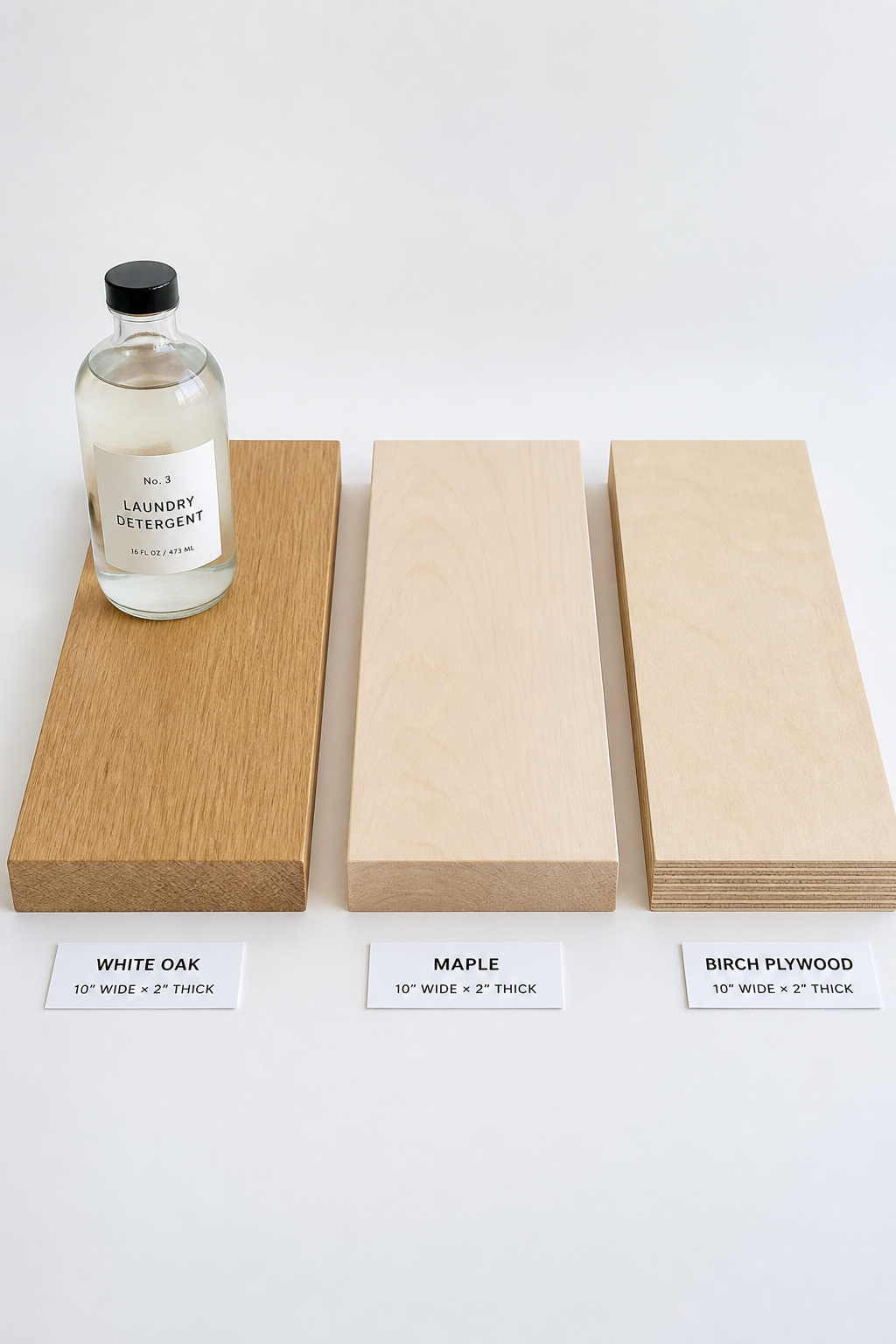
Natural wood tones: oak versus birch versus pine for laundry humidity
A laundry breathes moisture every time the dryer cycles, so the wood has to earn its place.
| Wood | Humidity resistance | Visual warmth | Cost tier |
|---|---|---|---|
| White oak | Best — tight closed grain | Warm, not rustic | Higher |
| Maple | Good when sealed; hardest surface | Palest, clean | Mid |
| Birch plywood | Good when sealed | Light, visible ply edge | Budget |
| Pine | Poor — dents and moves | Soft, knotty | Lowest |
Buy the white oak. Its tight, closed-grain structure resists moisture better than open-grain species, and in the Nordic palette it reads warm without tipping into farmhouse. Maple is the move for the palest, hardest surface; birch plywood is the honest budget answer. Whichever you choose, seal it with polyurethane — even hardwoods drink moisture quickly here — and ventilate well, since wood-industry guidance puts the comfortable range for cabinetry at 30–50% relative humidity, which a dryer blows past unless air can move.
Closed Cabinetry: When to Hide the Laundry
Open shelves give you display and reach. Cabinets give you silence. A working laundry needs both; the line between them is the edit.
The case for closed doors in a working utility room
Closed cabinets take the cleaning chemicals, the spare hangers, the bulk refills — everything that would undermine an open shelf the moment it landed there. In a room with no natural storage, a run of floor-to-ceiling cabinets holds every necessity and keeps the wall calm.
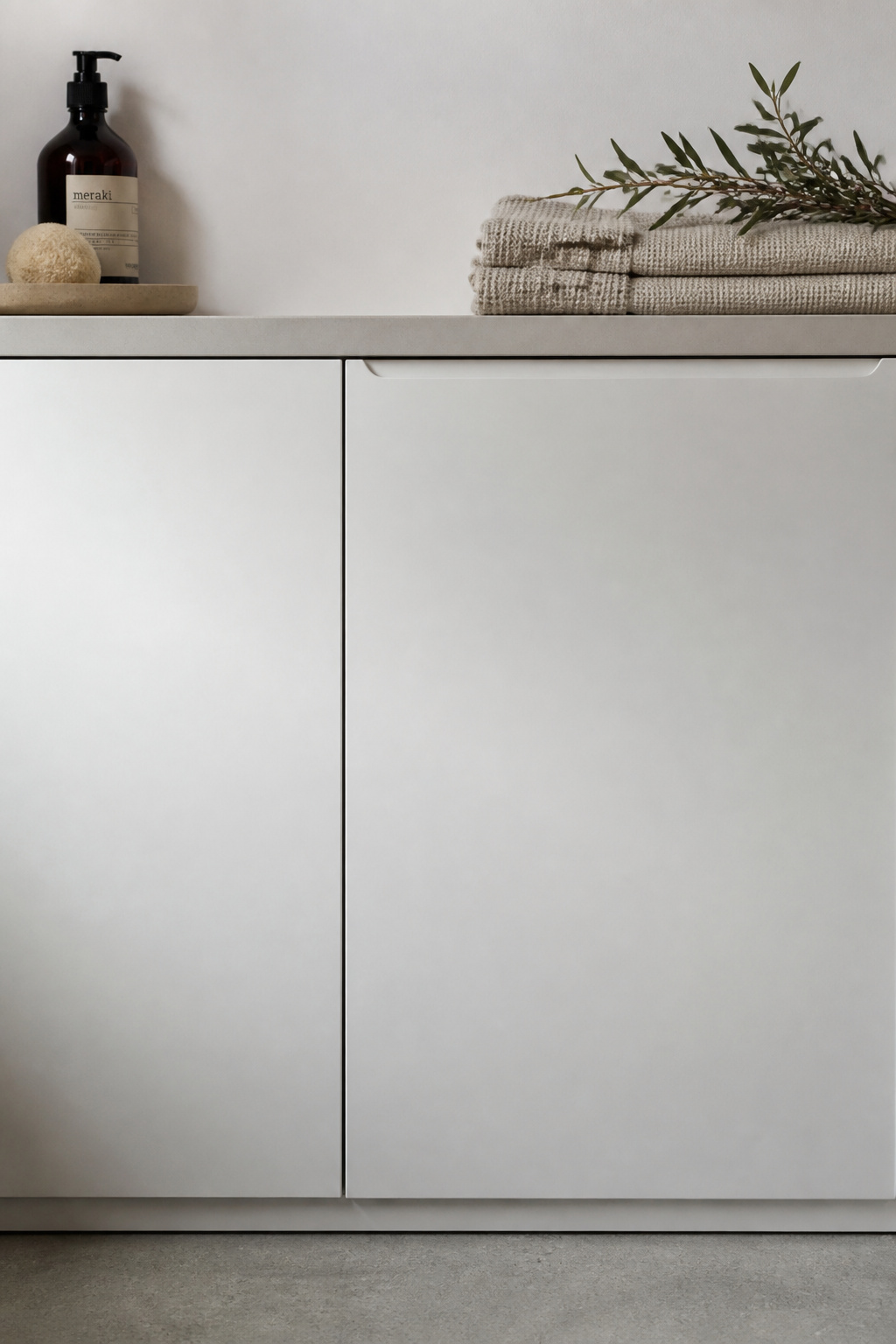
Minimal hardware — finger-pull edges, recessed handles, touch-latch
Here is where a Nordic cabinet declares itself: the door is flat, and the hardware all but vanishes. Across Houzz’s Scandinavian laundry galleries, flat-panel doors dominate — not shaker, not beadboard. The flat face is the point; nothing on the surface that does not need to be there.
You have three clean ways to lose the handle. A routed finger-pull groove along the door edge costs nothing, never loosens, and disappears at arm’s length — my default. Recessed flush handles sit level with the face for the same reason. Push-to-open systems, like Blum’s Tip-On, drop the handle entirely and open on a gentle press — useful beside a machine where bags and arms catch on anything protruding. Pick one and use it across every door; mixed hardware is the tell that a wall was assembled, not designed.
Integrated appliance panels to keep the Scandinavian look unbroken
Wrap the machines themselves. Integrated washer and dryer panels in matching flat doors let the appliances recede, so the wall reads as one composed surface. One last trick: a rail of hooks on the inside of a cabinet door turns a closed face into wall space too.
Natural-Material Baskets: Seagrass, Jute and Rattan
If shelves and cabinets are the architecture, baskets are the warmth — the cornerstone of Nordic laundry storage. A humid room punishes the wrong choice, so material matters more than looks.
Why natural baskets belong in a Nordic laundry
Natural fibres add the texture a laundry otherwise lacks. But a laundry is damp, and not every fibre survives. Match the fibre to the job:
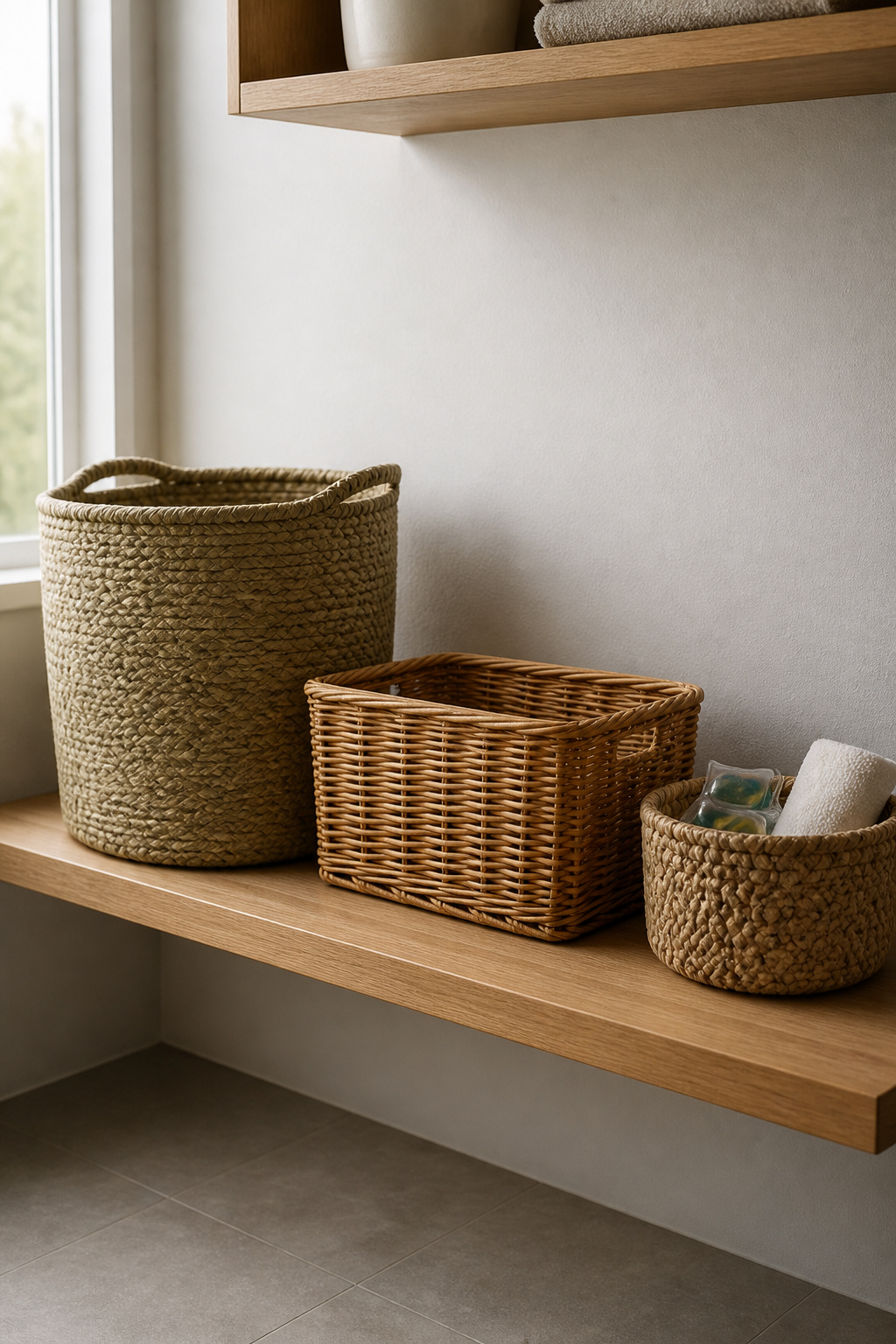
- Seagrass — naturally water-resistant, breathable weave that lets damp clothing air out. The right choice for active sorting bins.
- Rattan — handsome and warm, but it cracks when repeatedly wetted and dried. Keep it to dry shelf duty: dryer sheets, lint rollers, folded cloths.
- Jute — porous and absorbent; it develops mould and browning above 50% humidity, which an active laundry passes easily. Leave it out of this room.
The texture you choose here is the same story that runs through the room’s colour and material palette, so the basket fibre is a palette decision as much as a storage one.
Choosing size and shape for sorting, storing and carrying
Size to the task. A large seagrass hamper around 50 × 40 × 70 cm holds a full wash load and is the practical sorting bin; look for a reinforced rim and integrated handles so a basket of wet towels lifts without deforming. For the shelf, smaller open-top baskets 20–30 cm wide corral the loose accessories — pegs, dryer balls, the stain spray — that otherwise drift across the surface.
Labelling baskets the Scandinavian way
Labels should identify, not advertise. A small wood or clear-acrylic tag on jute twine, a single word — “whites”, “darks” — is all a sorting set needs: legible at a glance, invisible from across the room.
Pegboards and Wall Hooks: The Minimal Third Option
Above shelves and cabinets sits the lightest layer: hooks and pegboards, for the things that do not fold and have no shelf home. Used with restraint, a pegboard earns its wall. Used as a catchall, it becomes the visual noise the whole room was meant to avoid.
Where pegboards fit in a Nordic laundry (and where they don’t)
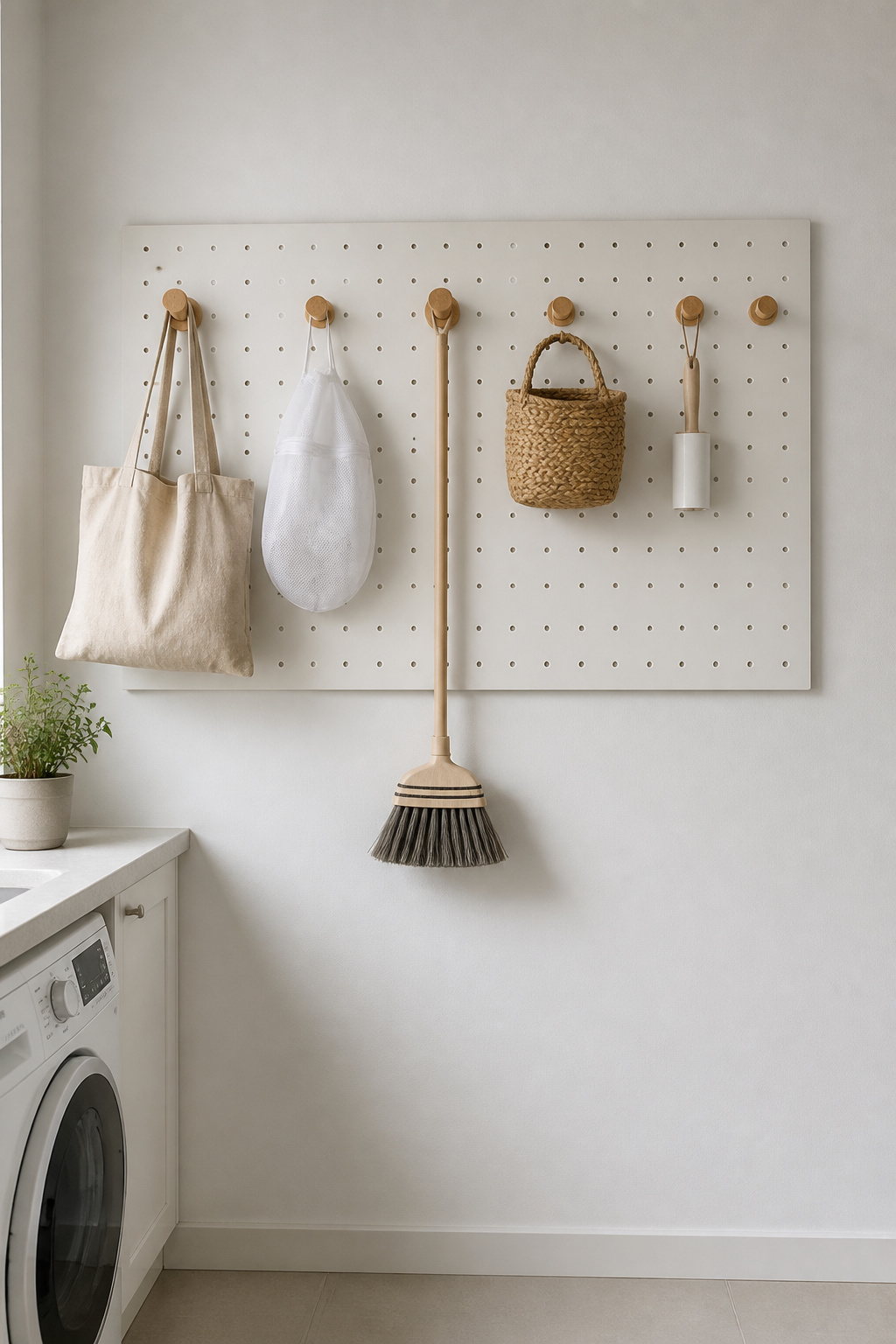
A pegboard belongs on an end wall, not the appliance wall, and never where it catches steam or splashback — moisture warps the board and corrodes the hooks. Keep it to natural wood in birch or oak rather than industrial metal, so the tone connects to your shelves and baskets instead of reading as a workshop bolted to the room.
Hook placement for bags, brooms and the things that don’t fold
Hooks earn their keep on the awkward items: a broom, a mesh delicates bag, the reusable totes that hang flat and get grabbed constantly. A row of four to six hooks at the same height reads as intentional; random heights read as mess. The air-drying system lives on this same wall plane, so plan your wall-mounted drying racks alongside the hooks rather than bolting them on after.
Keeping a pegboard minimal — the edit rule
A crowded pegboard defeats its own purpose. Every item on the board should be reached for at least once a week. If it has not moved in a month, it belongs in a cabinet. And leave empty pegs on purpose — visible empty space signals a managed system, and it is rest for the eye.
Putting the System Together: Shelf, Cabinet, Basket, Hook
A calm, working laundry is not four separate solutions bought at four different times. It is one wall, zoned and unified.
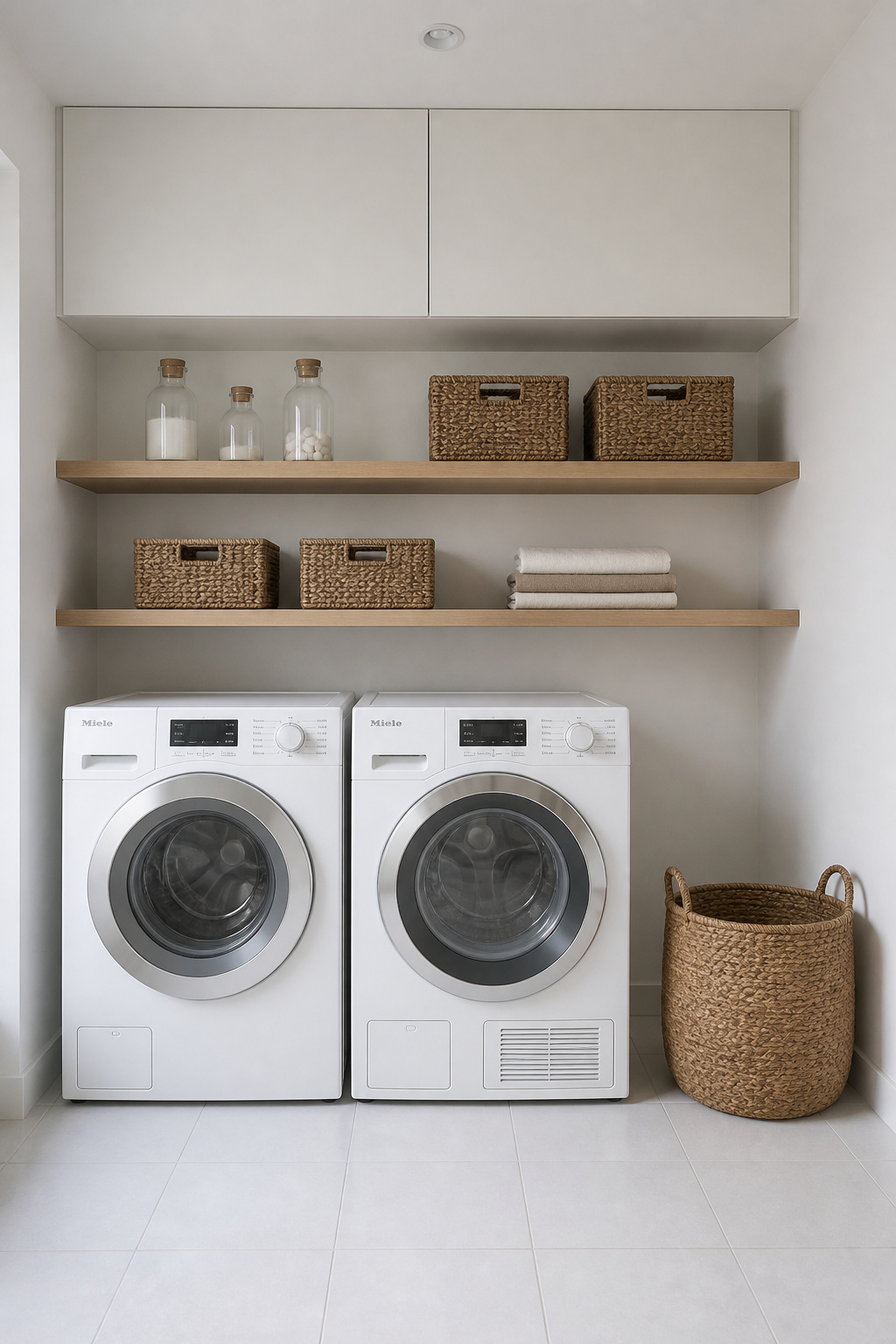
Zoning a small laundry wall from floor to ceiling
Read the wall in three bands. At floor level, the machines and the large baskets — nothing else. At mid-wall, from shoulder height up, the open shelves and cabinets you reach daily. Above the head, only the rarely-used, behind a closed door. If you fold or sort, give yourself a surface at least 36 inches high and 24 inches deep, above stacked machines or between a side-by-side pair.
The one commitment that unifies a mixed storage system
A mixed system — shelf, cabinet, basket, hook — only reads as designed if one thing stays constant: material and finish. Same wood tone, same paint, same basket fibre, the same no-handle rule on every door. Three seagrass baskets of different sizes look composed; two seagrass and one rattan look accidental.
What to remove before adding anything
The Nordic approach is subtractive before it is additive. Before you buy a single shelf, empty the room and return only what belongs — the things that migrated in from elsewhere leave with them. That edit is the prerequisite, not the conclusion. Then resist filling the wall you just cleared: the empty shelf section, the clear floor under the machines are not waste. They are what let everything else be seen. A laundry built this way stops being somewhere you endure and becomes, quietly, somewhere that works. For how this storage thinking fits the wider room, see the full set of Scandinavian laundry room ideas.
FAQ
How deep should laundry room shelves be for a Nordic look?
For most laundry rooms, 10–12 inches is the working depth: 10 inches holds standard detergent and baskets without projecting awkwardly, while 12 inches suits larger bins and heavier loads. In a tight laundry closet, drop to 8–10 inches so you can reach the machines without bumping the shelf edge. Space shelves 14–16 inches apart for tall bottles.
Can I mix open shelves and closed cabinets in a Scandinavian laundry room?
Yes — mixing them is the standard Nordic arrangement, not a compromise. Open shelves hold frequently used, good-looking items like decanted detergent and natural baskets; closed cabinets take cleaning chemicals, spares and visual clutter. The trick is keeping one wood tone or paint colour and the same no-handle hardware across both, so the wall reads as a single designed system.
What is the best basket material for a laundry room?
Seagrass is best for an active laundry: its fibres are naturally water-resistant and its open weave lets damp clothing air out, preventing musty odours. Rattan suits dry-shelf storage but splits if repeatedly wetted, so keep it off wet-sorting duty. Avoid jute entirely — it is porous and develops mould above 50% humidity, which an active laundry reaches easily.