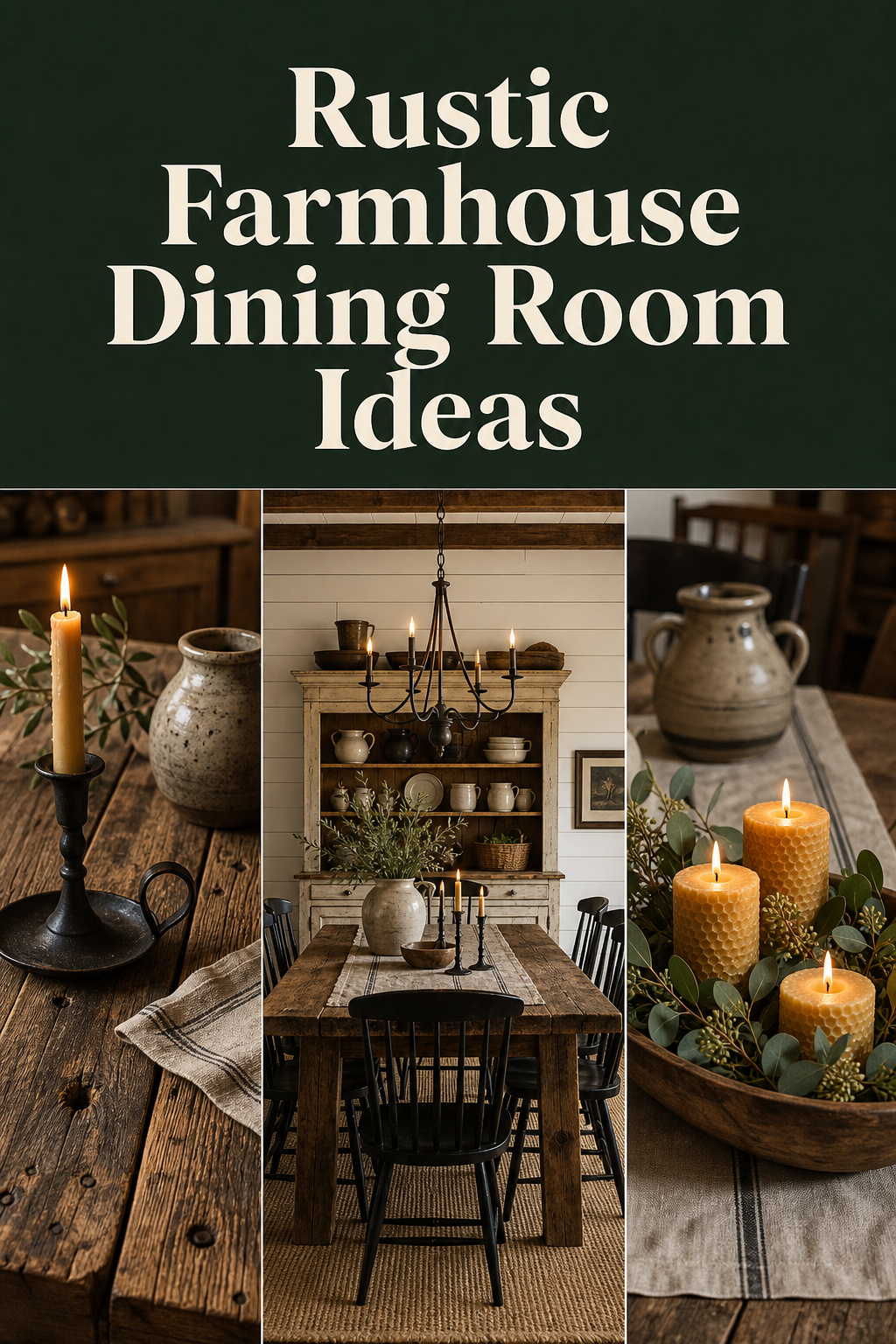
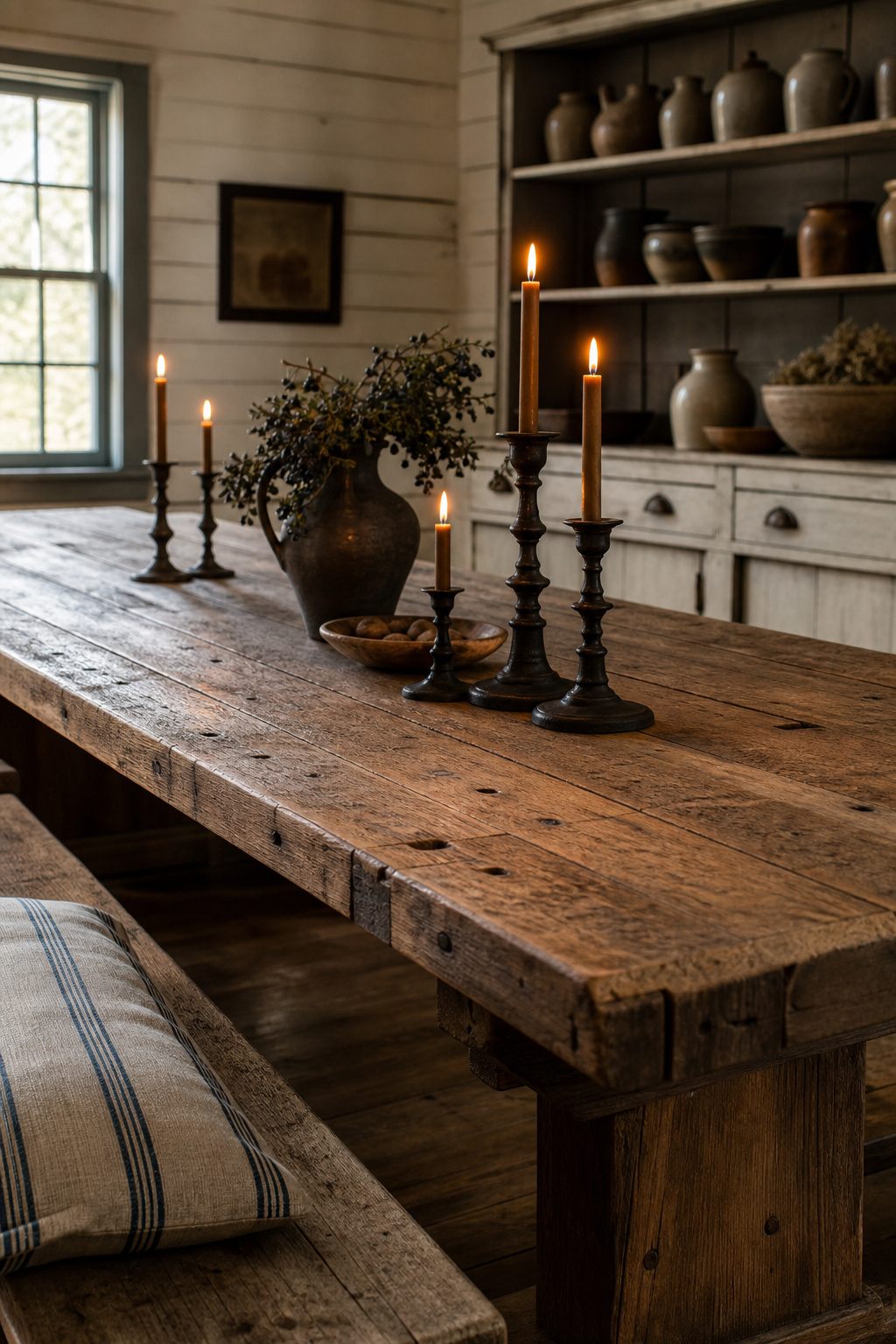
Step into a rustic farmhouse dining room at dusk and you feel it before you name it. Candlelight catches the grain of a long reclaimed table. The air carries beeswax and a faint sweetness of old oak. Iron candlesticks throw soft shadows across a planked wall, and the bench beneath your hand is worn smooth where decades of elbows have rested. Nothing in the room shouts. Everything has a past. That warmth comes from material truth, not a paint technique.
TL;DR
- A genuine rustic farmhouse dining room runs on real reclaimed wood, earthy warm-white and forest-green tones, and heritage furniture like trestle tables and ladderback chairs — not on applied distressing.
- Authentic age shows in square-cut nail holes, rust staining, mortise-and-tenon joints, and 15-plus growth rings per inch; uniform “distressed” damage is the tell of a fake.
- Source carefully: check moisture content (8–12% for interior use), read the nail holes for authentic dating, and inspect for active insects before any reclaimed piece comes inside.
What Makes a Dining Room Genuinely Rustic Farmhouse
The rustic register sits at the warm, raw end of the farmhouse spectrum. Where the polished interpretation leans on clean lines and cool neutrals, rustic farmhouse keeps the rough-hewn beams, reclaimed wood, and iron fixtures that carry actual history. The Homes and Gardens design desk frames the distinction well: farmhouse brings a cleaner, family-friendly look, while rustic carries a rougher, more naturalistic quality. A rustic farmhouse dining room lives at the intersection of both.
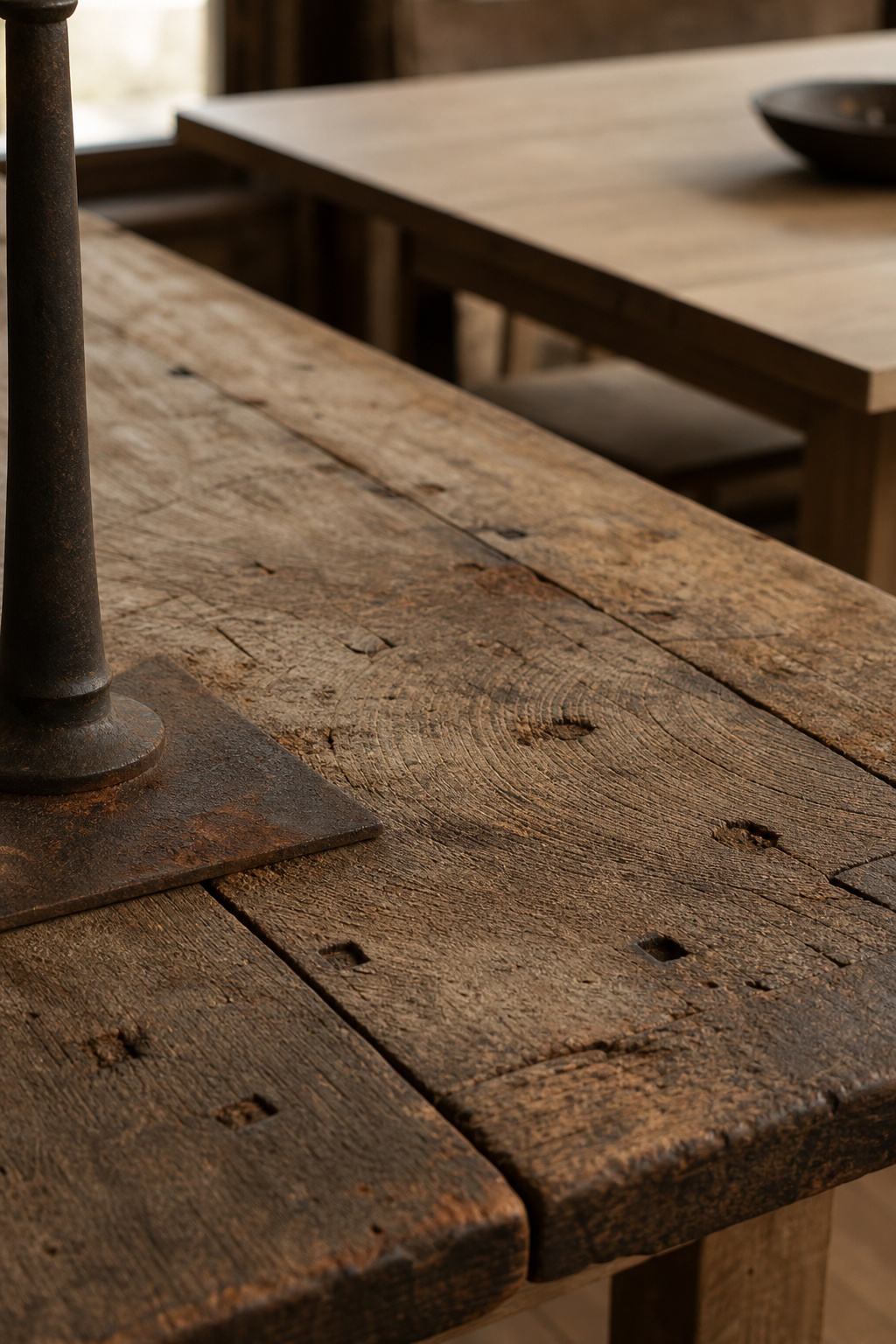
The tell-tale signs: hand-cut joinery, reclaimed grain, worn painted surfaces
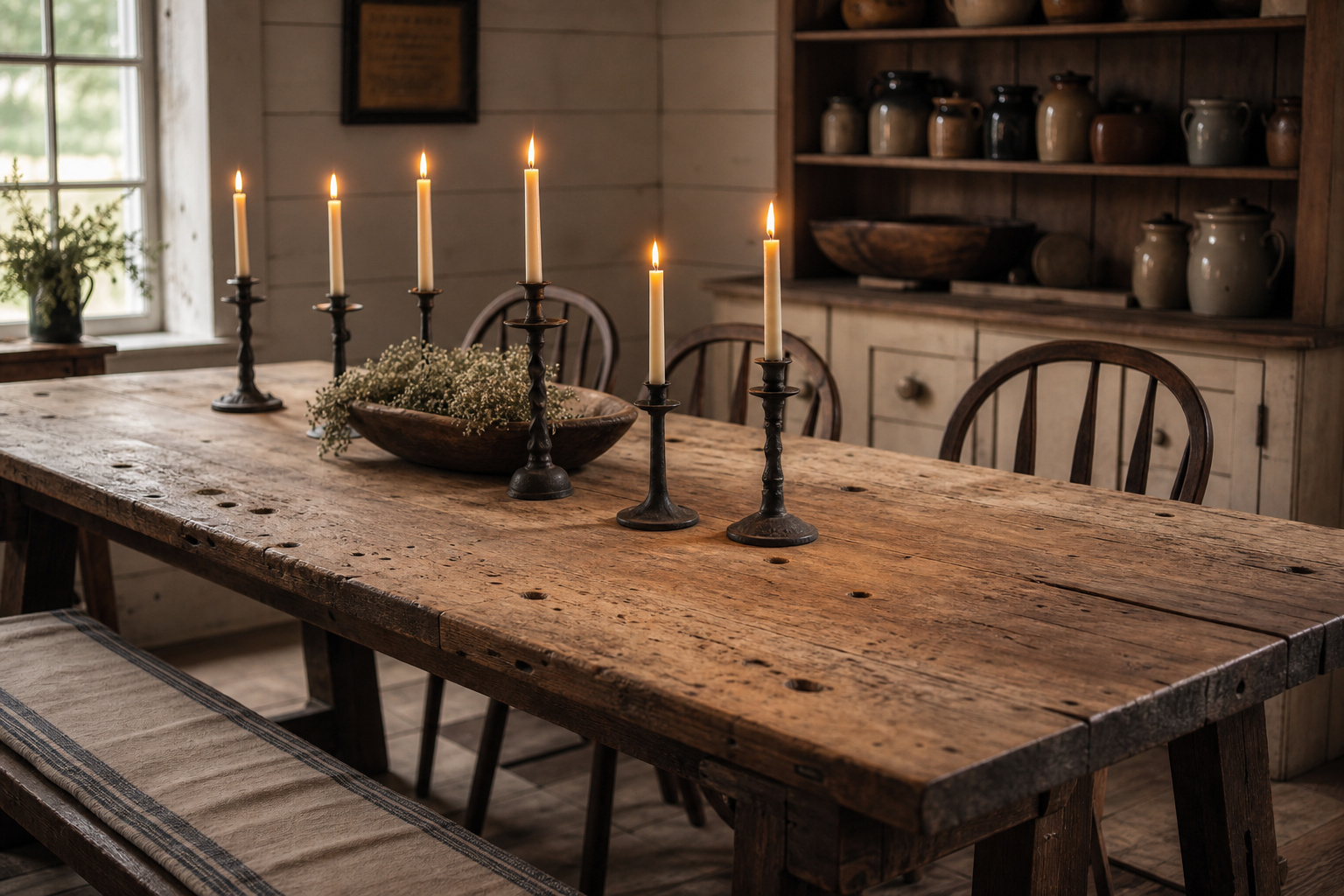
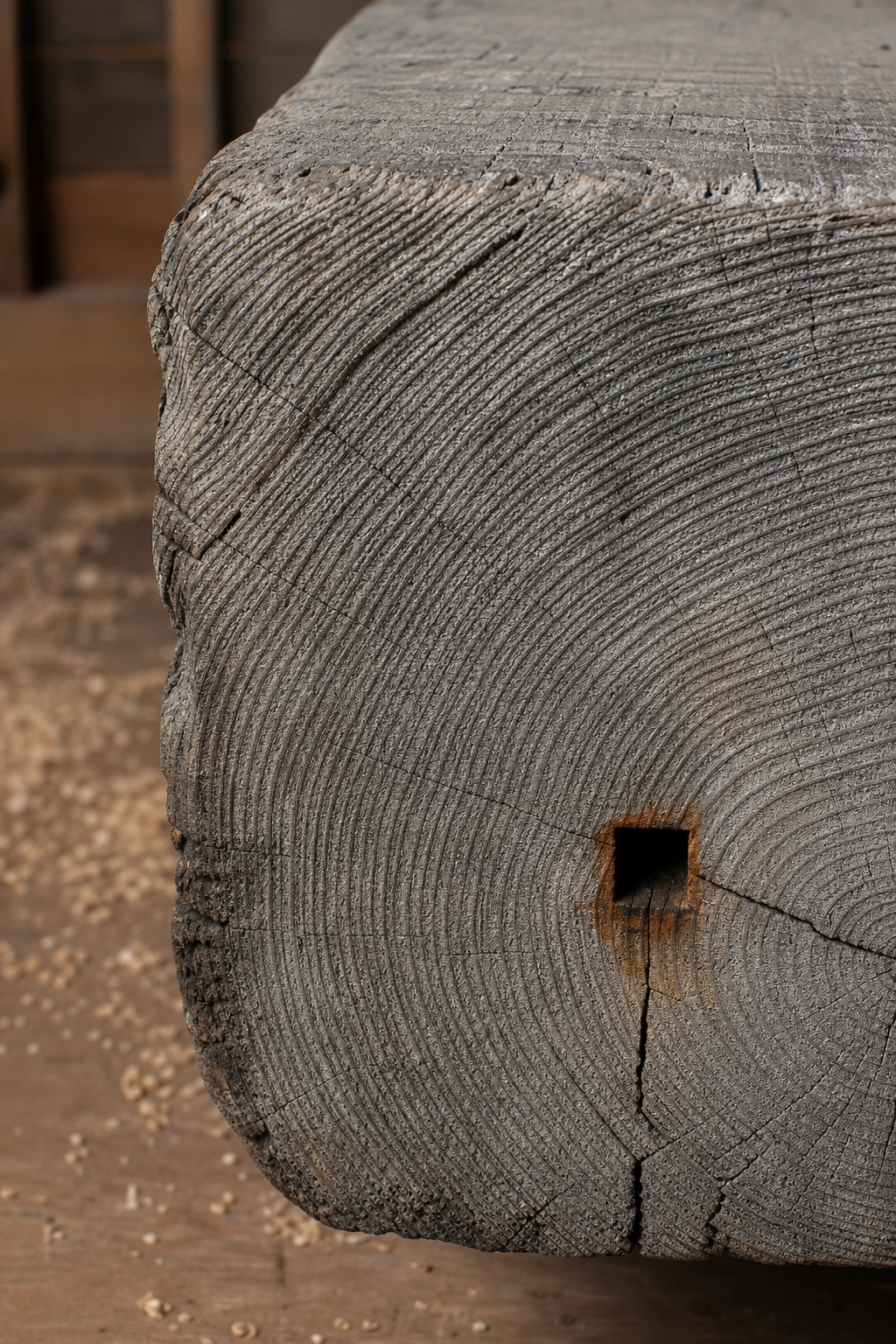
Give a piece its past before you judge it. Authentic reclaimed wood shows square-cut nail holes, common until about 1890, or the irregular heads of hand-wrought nails from before 1810. The rust staining that haloes those old holes is nearly impossible to fake. Mortise-and-tenon and wooden-peg joints leave large round or square bores in old barn timber — structural relics of pre-industrial joinery. These details accumulate slowly. No workshop reproduces them in an afternoon.
Earthy tones and raw textures — the palette of the working farm
The colours come straight off the working farm: warm whites, aged creams, clay reds, forest greens, and weathered wood browns. Cool whites and soft greys belong to the polished register, not this one. Just as important, the textures do real work. Linen, weathered wood, stone, and iron carry the room’s complexity, so even a simple two-colour palette reads as layered when the materials carry the right tactile character.
Why real wear beats applied distressing (and how to tell the difference)
I will always call sand-through-paint “aging” a costume. Wire-brush scratching, paint-thinner patina, and artificial nail holes all produce damage that looks like it just happened — it lacks the organic variation of decades of use. Genuine reclaimed pieces vary board to board in grain density, colour, and damage; mass-produced distressed wood is noticeably uniform, which is the quickest tell. If you want the opposite direction — the clean-lined version with deliberate polish — a modern farmhouse dining room is its own discipline. For the full survey of where rustic sits in the family, see our complete farmhouse dining room guide.
| Quality | Rustic farmhouse | Modern farmhouse |
|---|---|---|
| Palette | Warm whites, clay red, forest green | Cool white, bone, soft grey |
| Surface finish | Authentic wear, rust, patina | Deliberate polish, clean wood |
| Wall treatment | Planked wood, brick, dark shiplap | Smooth white shiplap, paint |
| Seating profile | Mismatched ladderback, benches | Matched clean-lined chairs |
Reclaimed and Weathered Wood: Sourcing, Reading, and Using It
This is where provenance earns its keep. No sibling article covers sourcing reclaimed timber, so spend the time here before you spend the money.
Barn wood, old-growth pine, and salvaged oak — what each looks like and costs
Oak and pine are the most frequently salvaged species because they dominated American barn construction, though elm, Douglas fir, hickory, beech, and maple all turn up. Pricing climbs with provenance and labour. A reclaimed oak farm table starts around $1,795 for a 60-inch top; trestle and turned-leg styles typically open at $2,295; premium built-to-order barn-wood tables run $3,000–$5,000 and up. Custom reclaimed hardwood tops are priced at $125–$150 per square foot — the premium covers kiln-drying, de-nailing, and structural inspection.
How to date a reclaimed board: grain patterns, nail holes, and colour depth
Nail type is the fastest dating tool you have. Saw marks help too: straight parallel marks point to an older water-powered vertical mill, while curved arc marks come from a post-1830s circular blade. Don’t date by colour alone — grey and silver tones can be chemically accelerated.
| Era | Tell-tale detail | What it means |
|---|---|---|
| Pre-1810 | Hand-wrought nails, irregular heads | Earliest material, highest provenance |
| c.1810–1890 | Square-cut nail holes | Pre-industrial barn timber |
| Post-1890 | Uniform wire nails | Later salvage, still genuine |
| Old-growth | 15–30 rings per inch in end grain | Denser, more stable than plantation pine |
Structural fitness: what to check before a reclaimed piece holds weight
Measure-twice energy applies to moisture, not just dimensions. Bring reclaimed wood to 8–12% moisture content before any interior use, because outdoor-sourced salvage can hold far more moisture than it looks. Test with a meter; visual inspection is unreliable. Kiln-drying to 6–9% is the furniture-grade standard, and it kills any wood-boring larvae lurking in the boards. Watch for tiny holes with sawdust trails — that means active insects. Then inspect for decay and splitting, and reject compromised boards for tabletops regardless of how handsome they look. Old-growth density helps you here: 15 or more rings per inch confirms timber far more stable under seasonal movement than the 3–8 rings of modern plantation stock.
Rustic Farmhouse Furniture: Tables, Benches, Hutches, and Ladderbacks
Trestle and turned-leg tables: profiles that read primitive farmhouse
Two profiles anchor the rustic repertoire. The trestle table uses a frame-and-base build with diagonal supports, which steadies it on uneven floors and frees all four sides for bench seating. The turned-leg table carries lathe-shaped baluster legs that echo Colonial American cabinetmaking. Both read as primitive farmhouse without decorative fuss. As Furniture from the Barn notes, mortise-and-tenon joinery on a trestle base resists racking under a full table of diners far better than modern knock-down furniture.
Spindle-back and ladderback chairs — the heritage seating choices
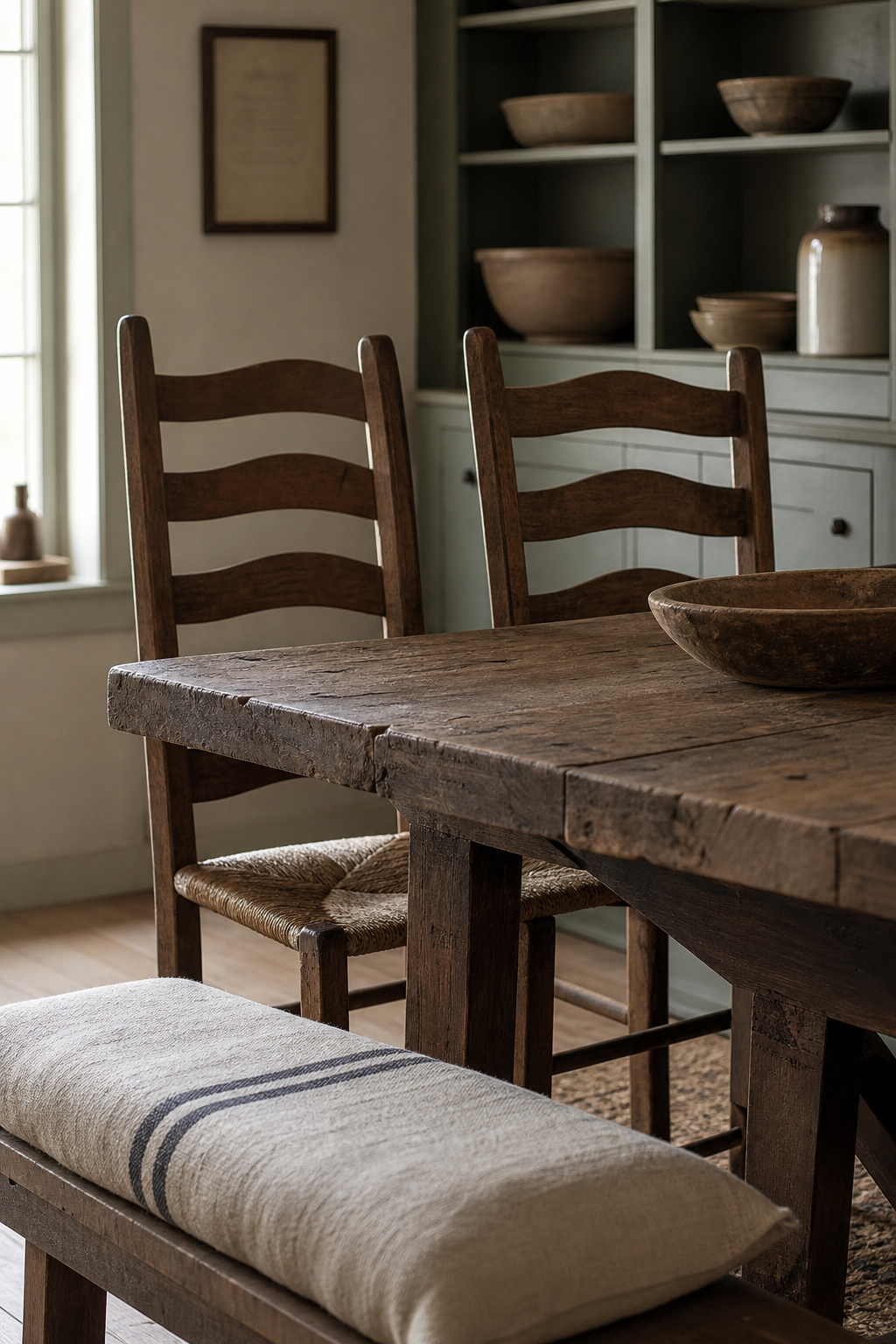
Ladderback chairs carry horizontal rungs across the back; spindle-backs use turned uprights, both rooted in early American practicality. DutchCrafters points out that these all-wood Colonial profiles outlast many modern chairs because their joinery can be tightened and repaired over decades rather than replaced. Resist the matched eight-chair set. Mixing ladderbacks, spindle-backs, and a bench on one side gives the casual, inherited quality that a uniform set never will.
Painted hutches and open dressers as dining room storage
The Welsh dresser is the archetype here — a lower cabinet topped with open shelving that stores linen and serving pieces while displaying ironstone and stoneware. Look for dovetailed drawers as a mark of real joinery, and favour a milk-paint finish, whose chalky texture and edge-wear are among the most historically accurate. A hutch in sage or deep forest green against a planked wall creates one of the style’s most characteristic layered looks. Whether you buy or build, the principle holds: one well-made storage piece does more for the room than three thin ones.
Earthy Palette and Textile Warmth in a Rustic Dining Room
Warm whites, aged linens, terracotta, and forest green: the rustic colour family
Start with a warm base — warm white, aged cream, weathered wood brown — then choose your accents from terracotta and forest green. Keep terracotta in the softened baked-earth range, not full clay red, so it reads earthy rather than Mediterranean. A deep forest green wall picks up the organic quality of the wood grain and partners it rather than fighting it.
Heavy-weight textiles: burlap, wool, washed cotton, and grain sack
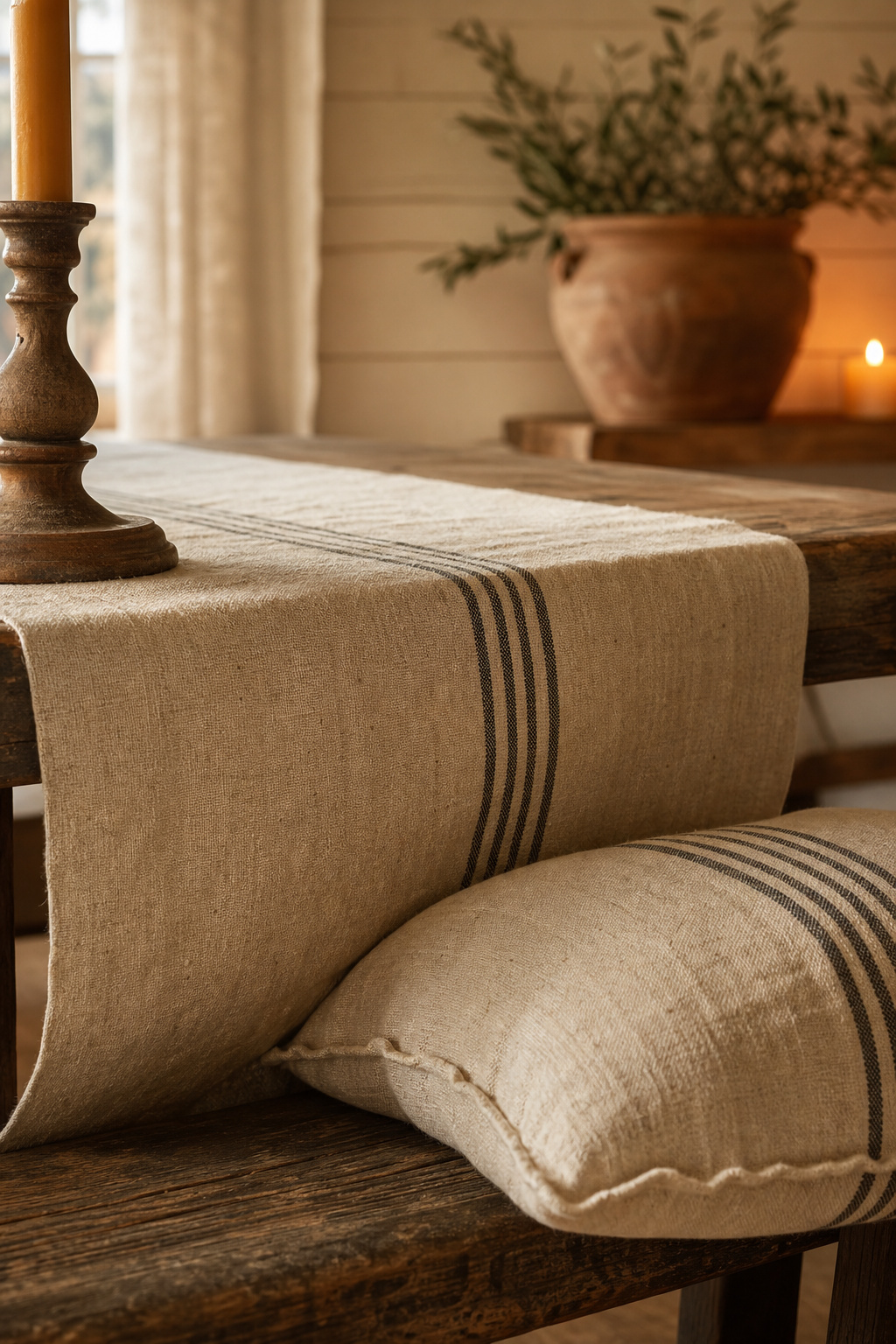
Five fabrics carry the rustic room: burlap and jute, grain-sack stripe, washed cotton, unbleached linen, and wool. Every one has a working-farm origin, which is exactly why the look feels unselfconscious. Grain-sack stripe is the most historically specific — the pattern comes from actual flour sacking. Choose washed linen for runners, because its slubs and slight sheen work with candlelight in a way cotton can’t. Skip unlined burlap as a daily runner; it sheds and frays within weeks.
Layering colour without losing the quiet: the one-deep-tone rule
Here is the discipline that keeps the room calm. Carry one deep accent — forest green, terracotta, or aged navy — across several surfaces at different scales: a painted hutch, a couple of textiles, a pottery glaze. Resist a second strong tone. When the textures are doing their job, one accent reads as layered and considered; three competing accents just read as busy.
Rustic Farmhouse Walls: Planked Wood, Brick, and What to Hang
Vertical shiplap and horizontal planking — the wall-profile choice
Horizontal shiplap echoes original barn boarding and widens a standard-width room. Vertical planking is the less common choice, so it carries more surprise, and it draws the eye upward in a low-ceilinged room. For the committed rustic look, dark charcoal or natural stained shiplap behind a long table makes a dramatic backdrop. The full how-to lives with a rustic accent wall, so I’ll keep installation out of this article.
Exposed brick as a rustic anchor wall
Brick is the most characterful anchor wall you can choose. Its colour shifts from warm red to charred grey depending on age, giving depth no paint can replicate. Thin-set real-brick veneer runs roughly $24–$50 per square foot installed; DIY-friendly faux brick panels cost $14–$24 installed. Pairing a brick anchor with planking on adjacent walls adds material depth without overwhelming the room.
What belongs on rustic farmhouse walls: mirrors, galvanised frames, botanical prints
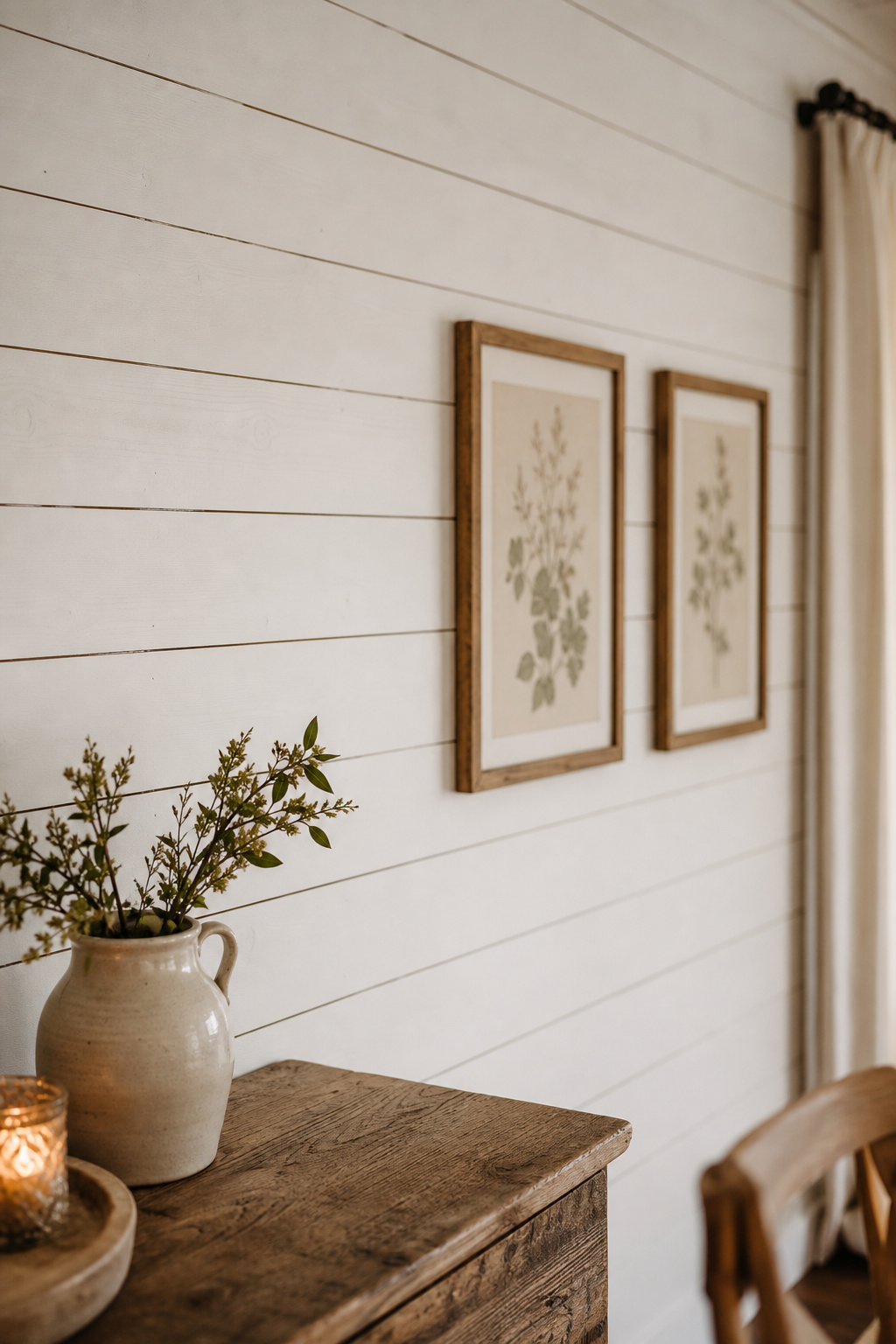
Galvanised metal frames and mirrors earn their place through barnyard-tool origins, and a mirror doubles its value by bouncing candlelight back into the room. Botanical prints in simple wood frames, repurposed vintage windows, and grouped ironstone round out the choices. Hang it all at conversation height — roughly 57–60 inches to centre — so the wall relates to the seated table, not the standing eye.
Styling a Rustic Farmhouse Dining Room: Accents, Centrepieces, and Lighting
Candles, lanterns, and iron candlesticks as the rustic lighting layer
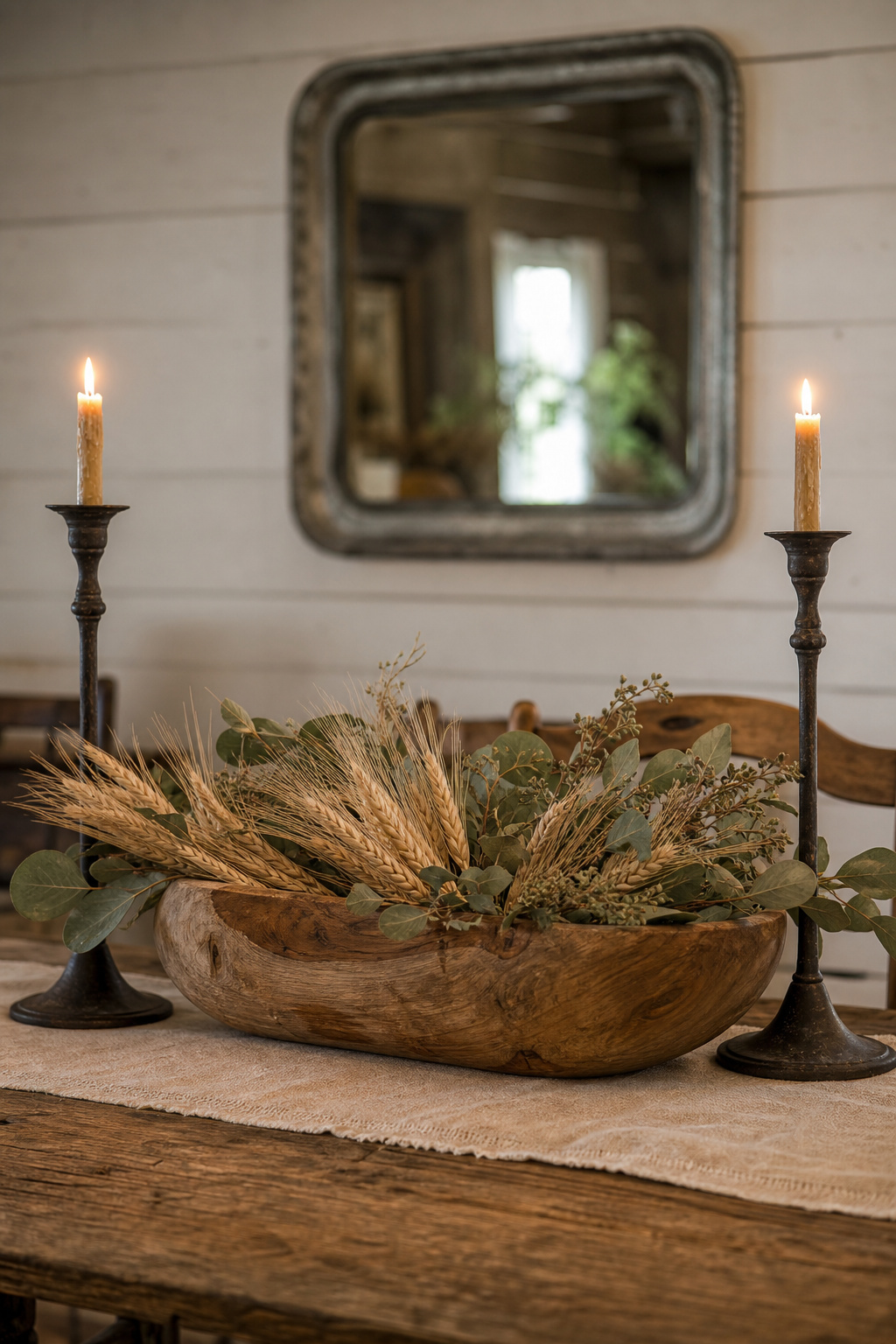
Candlelight is the right light for reclaimed wood. A wrought-iron candle-style chandelier descends directly from working-farm lighting and carries the material logic of the whole room. On the table, stagger iron candlesticks between dried wheat or foraged greenery for a linear centrepiece that works at any length. Choose beeswax or soy tapers; bright-white paraffin reads as formal dining, not farmhouse. Keep table-level accents under 12 inches so diners can talk across them.
Vintage pottery, wooden bowls, and foraged greenery on the table
A long wooden bowl filled with seasonal material — pinecones in autumn, branches in spring, wheat in summer — is the rustic answer to a floral arrangement: changeable, nearly free, and tied to the calendar. Ceramic jugs and antique stoneware crocks add visual weight and height. Favour flea-market pottery with chips and glaze variation over new reproductions, because the material story matters. Dried botanicals beat plastic every time; their natural irregularity does the work plastic can’t.
When to stop adding: the editing discipline for a cluttered-looking style
Restraint is the skill that separates a considered room from a busy one. Give every object a place and a purpose, and remove anything that can’t answer “why is this here?” Leave negative space on the table surface, because a trestle dressed end to end has no resting point — the opposite of the rustic quiet. Plain white dinnerware lets the centrepiece and table carry the character, and a single linen runner draws a visual spine that naturally limits how much you pile on.
A rustic farmhouse dining room is, finally, a room you inherit rather than assemble. Buy one genuinely old anchor — a trestle table, a painted dresser — verify its moisture and its joinery, then let earthy colour, honest textiles, and candlelight gather around it. Edit hard, source patiently, and treat each weathered piece as something you’re keeping in good order for whoever sits at the table next. That dusk-lit warmth you pictured at the start is well within reach, and the wood only gets better with use.
FAQ
How do I make a farmhouse dining room look rustic without it feeling dated?
Anchor the room with one genuinely old or reclaimed piece rather than dressing every surface in faux-distressed items. Mix in cleaner-lined ladderback chairs or a bench so it reads lived-in, not staged. Keep the warm-white and earth-tone palette, but avoid orange-brown stains and country-themed accessories like roosters and checked ribbons — those references date the look.
What is the difference between rustic farmhouse and primitive farmhouse style?
Primitive farmhouse is the more austere interpretation: muted tones, handmade antiques, quilts, and pottery with no contemporary influence. Rustic farmhouse sits between primitive and modern — it keeps raw materials and heritage furniture but allows fresher colour like sage or terracotta. If the room reads as an updated working farmhouse, it’s rustic; a museum recreation, it’s primitive.
Can I mix rustic farmhouse pieces with modern furniture?
Yes. One or two authentic rustic pieces — a reclaimed-wood table, a painted hutch — hold the room’s identity even among contemporary seating. Pairing weathered oak with iron or powder-coated steel chairs strengthens both through contrast. Keep one direction dominant and let the other act as counterpoint; neither style should crowd out the other.