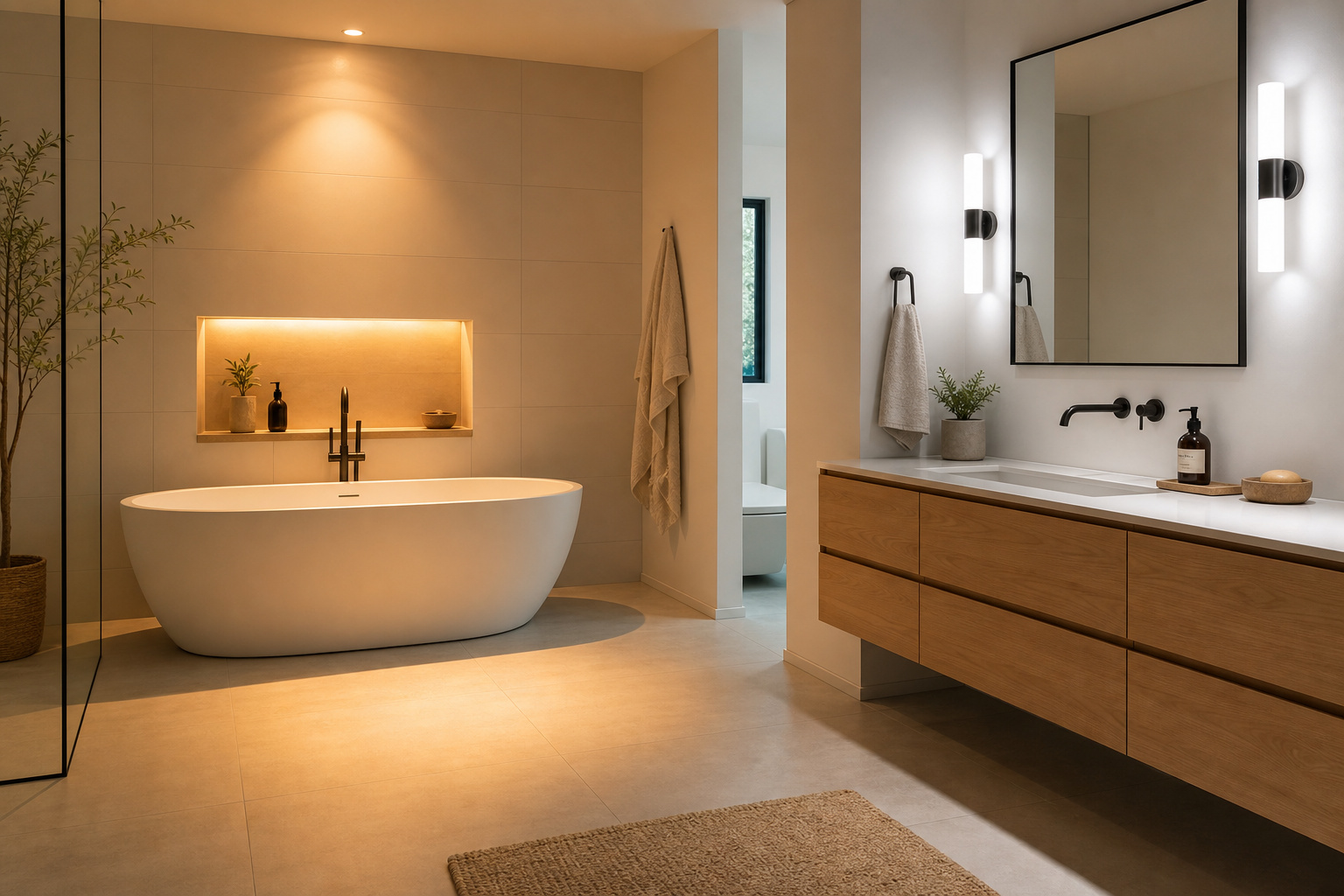

I have a habit of photographing rooms at 7am in February — the worst light of the Swedish year, thin and grey and unforgiving. A bathroom that holds up then holds up always. What that habit taught me about bathroom light color temperature is the opposite of what most fixture aisles tell you: brighter and cooler does not mean better. A very cool white flattens a room before breakfast and does nothing kind to a face. The number on the box matters more than the wattage, and most boxes only print half the story.
TL;DR
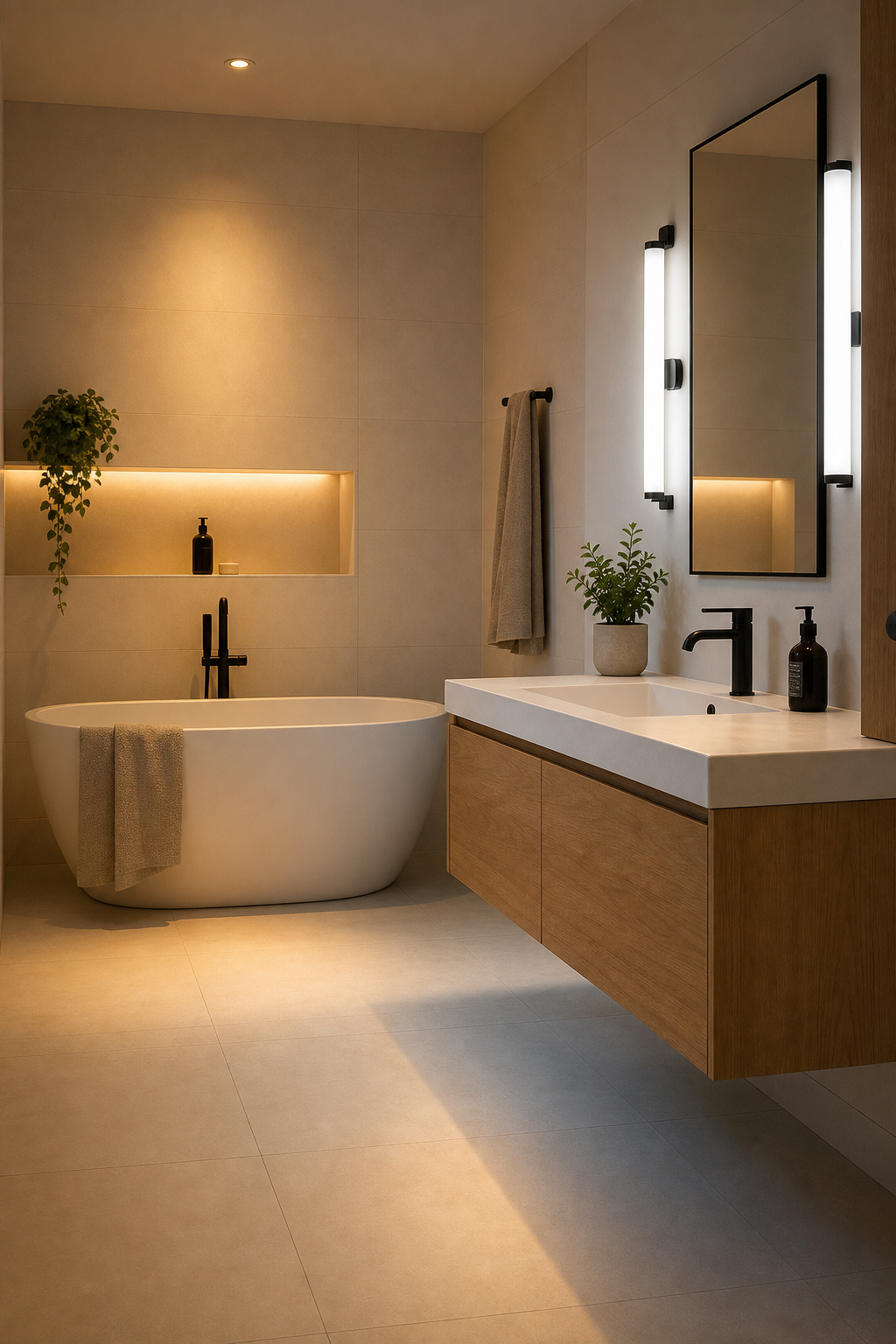
- Use warm 2700–3000K for ceiling and bath-zone ambiance; use neutral-cool 4000–5000K with CRI 90+ at the vanity for accurate makeup and grooming.
- Kelvin sets the colour of the light; CRI sets how truthfully it reveals colour. A CRI 80 bulb has an R9 near zero and renders skin pale; CRI 90+ renders it healthy.
- Put the two temperatures on separate circuits so they never fight — warm for evenings, crisp for mornings.
The Myth That Keeps Bathrooms Too Cold and Too Harsh
Most people choose a bathroom bulb by reaching for the brightest, whitest one on the shelf. The assumption is that more light, cooler in tone, means you see better. It does not. That belief confuses two completely separate measurements — lumens, the quantity of light, and Kelvin, its colour.
Why ‘bright white’ became the default — and what it actually does to a room
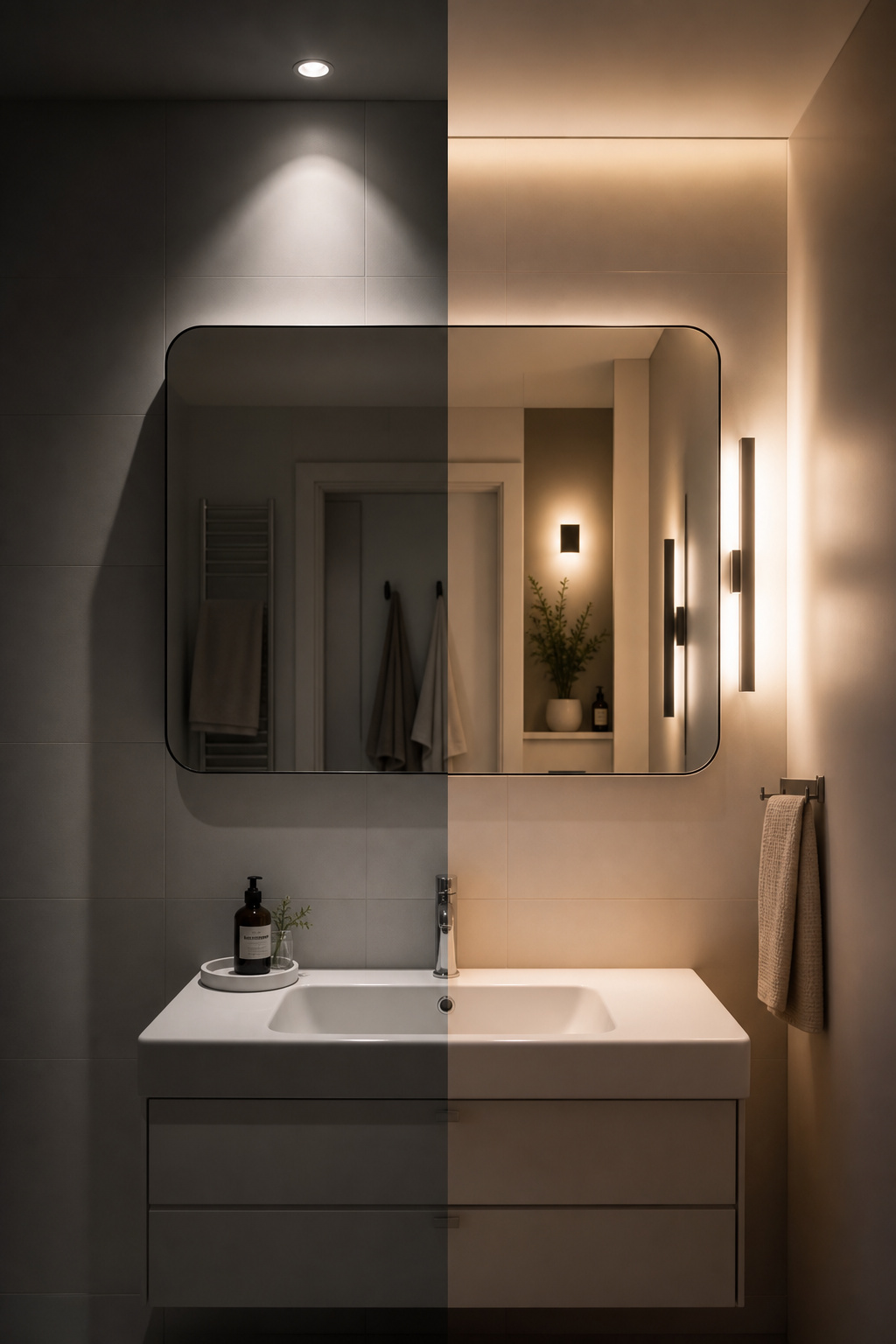
Cool-white LEDs in the 4000–6500K range became the builder-grade default because they are the cheapest to make at high lumen output, not because they suit bathrooms. As a single source above 5000K, they flatten warm materials: white tile reads ice-blue, beige grout goes grey, and timber loses its richness. In a Nordic-leaning bathroom of stone and wood, anything above 3500K starts to grey out the very surfaces you chose for warmth.
The two jobs light must do in a bathroom, and why they need different temperatures
A bathroom asks light to do two jobs that pull in opposite directions. The first is ambiance — the relaxing glow for evenings and long soaks, which wants warm 2700–3000K. The second is accuracy — seeing makeup, skin and grooming as they will look in daylight, which wants neutral-cool 4000–5000K. One fixture cannot serve both. Warm-only light makes navy hard to tell from black; cool-only light turns the room clinical.
What you’ll know by the end that most fixture labels won’t tell you
Two numbers decide whether vanity light works: Kelvin and CRI. Yet most packaging prints Kelvin on the front and buries CRI on the back — or omits it. By the end of this guide on how to light a bathroom for colour, you will read both correctly.
The Kelvin Scale: What Bathroom Light Color Temperature Actually Measures
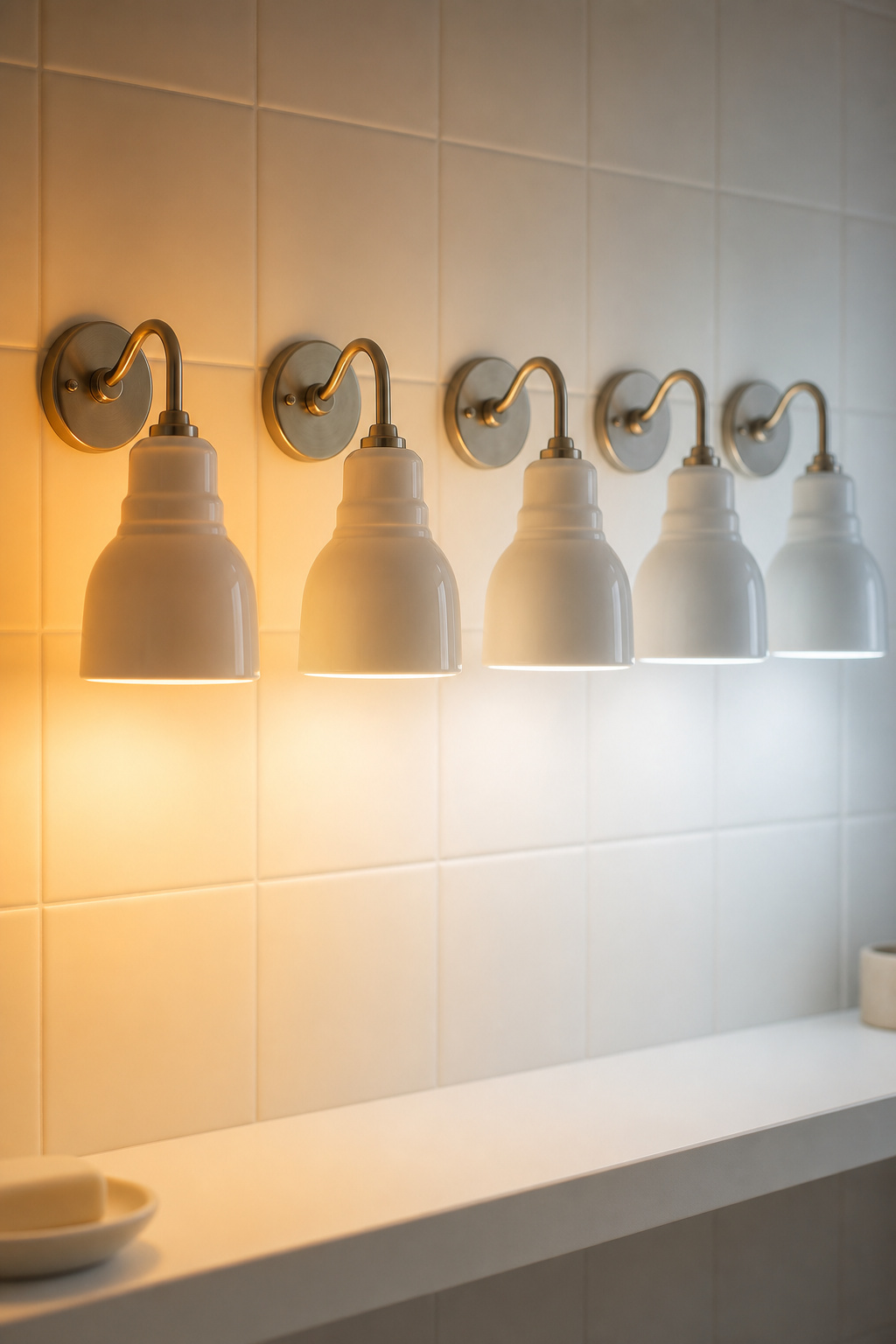
Think of colour temperature as a thermostat for the colour of light, not its heat. Low Kelvin numbers give a warm, candle-like glow; high numbers give a cool, blue-white light like midday sky. Counter-intuitively, higher Kelvin means cooler. For bathrooms, the useful range runs from 2200K amber accent to 5000K daylight task light.
| Kelvin range | Appearance | Bathroom use | Mood effect |
|---|---|---|---|
| 2200K | Candle amber | Accent, mood only | Intimate, cosy |
| 2700–3000K | Warm white | Ceiling, bath zone | Restful, spa-like |
| 3500–4000K | Neutral white | Busy family ambient | Clean, neutral |
| 4000–5000K | Daylight white | Vanity task light | Crisp, accurate |
Warm (2700–3000 K): the amber range and what it does to a space
2700K is warm white — the soft golden hue of a traditional incandescent bulb. It flatters wood, stone, rattan and cream tile, amplifying their warmth rather than cooling it. This is the Scandinavian residential standard, and the right ambient choice for most bathrooms.
Neutral (3500–4000 K): the middle ground most designers avoid on principle
3500–4000K is the so-called Goldilocks temperature — cleaner than warm white, without the clinical edge of 5000K. It earns a place as a neutral bridge in a busy family bathroom where many tasks happen at once. But I avoid it as a deliberate choice: it satisfies neither the warmth that ambiance wants nor the precision that makeup demands. It is a compromise, and a bathroom rarely needs one.
Cool (4000–5000 K): clarity and accuracy — and when that’s what you need
4000–5000K mimics indirect daylight and gives the most accurate colour rendering for detail work. Paired with CRI 90+, it is the professional recommendation for makeup, shaving and tweezing. As a sole overhead source it feels harsh, which is exactly why it belongs at the vanity only — never the whole room.
2700–3000 K: Warm Light for Ambiance, Evenings and Long Soaks
Here is the February logic. Nordic lighting design was born from long, dark winters where daylight is scarce for months. Light is not a complement to these interiors — it is the central axis. Warm-white bulbs around 2700–3000K are the standard because, as the Ledkia guide puts it, that yellowish tone “generates a feeling of home, of shelter.”

Why Nordic interiors default to 2700 K — the February logic
2700K is the most common domestic temperature across Nordic homes — bedrooms, kitchens and bathrooms alike. There is physiology behind the habit, not just taste. Research on circadian rhythm shows warm evening light helps lower stress hormones and prepares the body for sleep. A bathroom used at night earns its 2700K ambient for that reason alone.
How warm light reads on tile, stone and paint compared to daylight
Warm light amplifies what shares its amber spectrum. Cream tiles read warmer, natural stone gains depth, and greige paint looks inviting rather than flat. One trap, though: 2700K on a cool grey-and-white modern bathroom can make pristine white tile look faintly dingy. For strongly cool palettes, step up to 3000K. Match the ambient temperature to the dominant materials in the room.
When to go warmer still: the 2200 K option for accent and mood
2200K is extra-warm white — close to candlelight, which itself sits near 1800K. In a filament-style LED inside a decorative sconce, it adds an intimate glow for evenings. It is too dim and too inaccurate to work as a primary source, so treat it as accent only. For the full evening picture, see warm light for a spa mood.
4000–5000 K with CRI 90+: What Accurate Makeup and Grooming Actually Require
This is the section that matters most. Kelvin tells you the colour of the light. It does not tell you how truthfully that light reveals other colours — and that is a separate number called CRI.

Why Kelvin alone is not enough: introducing CRI and what it measures
CRI, the Colour Rendering Index, runs 0 to 100 and measures how accurately a source reveals true colours against natural daylight at CRI 100. Two bulbs rated 4000K can differ sharply: a budget LED at CRI 75 and a premium one at CRI 95 look identical in the showroom but render your face completely differently. The headline CRI is built from eight pastel samples — but a ninth, R9 for saturated red, is reported separately and matters most for skin.
CRI 90+ vs CRI 80: what the 10-point difference looks like on skin tone
The difference is biological, not cosmetic. Spectral analysis from Waveform Lighting shows skin reflectance rises sharply past 600 nanometres across every ethnicity — that rise is the blood under the skin. Light deficient in red wavelengths cannot render it, and the face reads pale or sickly. The R9 numbers tell the story: CRI 80 sources sit around R9 0–25, CRI 90 around 50, CRI 95 around 90. A CRI 80 bulb with R9 near zero literally cannot show the blood beneath your skin. Lipsticks and blushers also fall flat. That mismatch — perfect makeup indoors, wrong shade in daylight — is almost always a lighting problem, not a skill one.
The vanity mirror specification: neutral-cool task light with high CRI, warm ambient everywhere else
The professional spec is precise: 4000–5000K combined with CRI 90 or higher, delivered by fixtures flanking the mirror at eye level rather than a single overhead downlight. The direction matters as much as the temperature — side light kills the shadows that a downlight casts under eyes, nose and chin. Target 1500–3000 lumens across the vanity. Where it lands is its own subject, covered at the vanity.
- Colour temperature: 4000–5000K
- CRI: 90 minimum, 95 ideal — confirm R9 if you can
- Placement: flanking sconces at eye level, not a single overhead
- Lumens: 1500–3000 total across the mirror area
Mixing Warm Ambient with Crisp Task Light in One Bathroom
You do not have to choose one temperature. The single design decision that solves both jobs is a two-temperature scheme: 2700–3000K on the ceiling, 4000K+ with CRI 90 at the vanity.
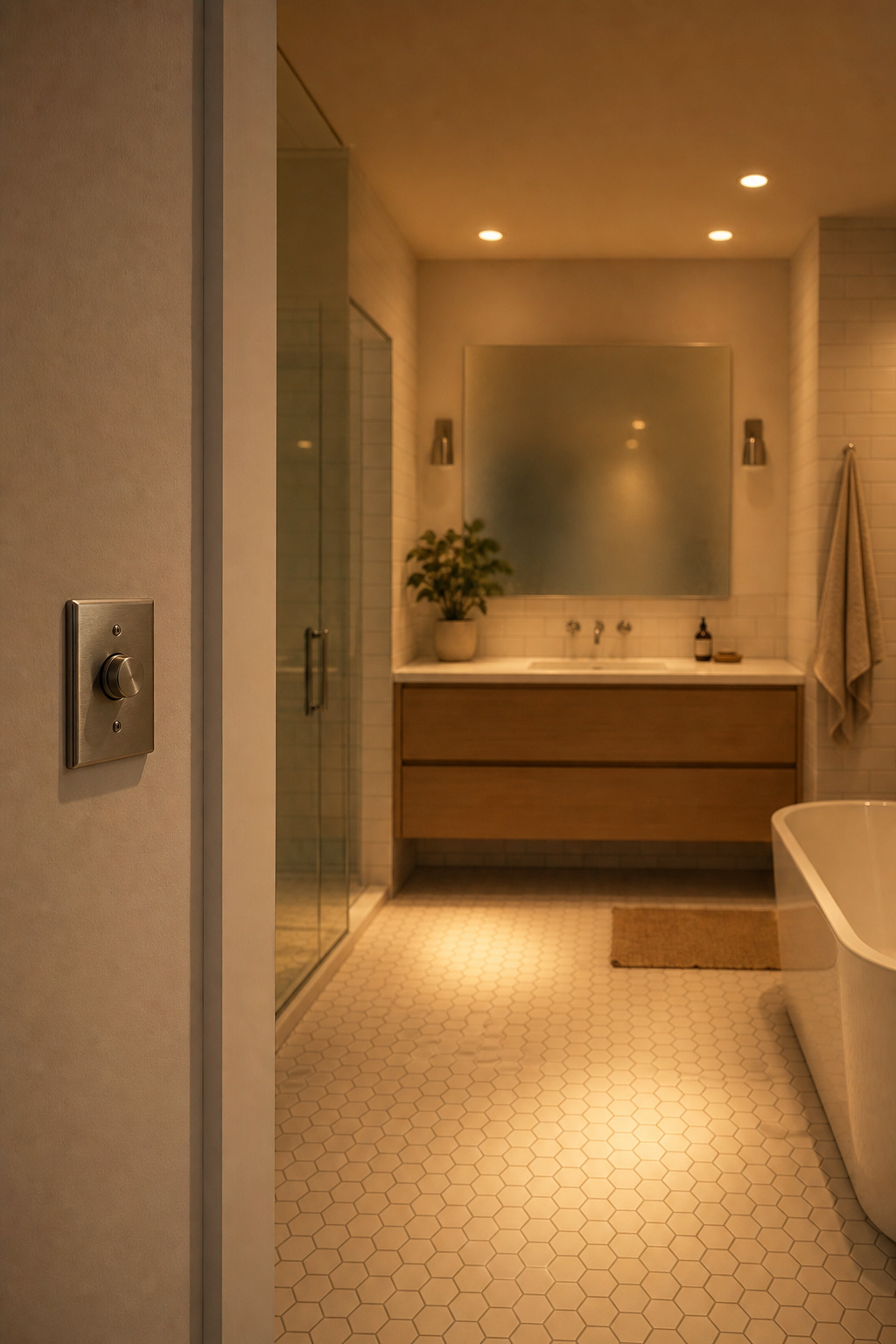
The two-temperature scheme: 2700–3000 K ceiling, 4000 K+ vanity
Warm light suits the ceiling and bath zone; cool task light suits the mirror. With each on its own circuit, the room shifts from a crisp grooming space in the morning to a warm retreat in the evening by a flick of the switch. An optional third layer — 2200K filament accent on its own switch — adds evening mood without touching either.
Why the temperatures don’t fight when they’re on separate circuits
Different temperatures only clash when mixed within one fixture or in adjacent fixtures in the same view. Separated by zone and circuit, the eye adapts to each independently. Dimmable circuits give full control: warm ambient low for a bath while the task lights are off, or the vanity at full while the ceiling rests. Use LED-compatible dimmers — incandescent-era dimmers cause flicker. A tunable-white fixture, shifting 2700K to 5000K on a dial, can do all this in one unit.
Choosing bulbs and fixtures that match across different brands
Consistency is what makes a mixed scheme read as deliberate rather than careless. The same Kelvin rating from two manufacturers can look different because of LED binning tolerances, so for the vanity, buy every bulb from one brand and one product line. Never put different temperatures in the same fixture or in an adjacent pair within one visual grouping — the mismatch shows instantly.
Reading a Light Bulb Box: The Three Numbers That Actually Matter
Three numbers separate a good bathroom choice from a frustrating one. Lumens tell you how much light. Kelvin tells you its colour. CRI tells you how truthfully it reveals colour. Together they give the whole picture.
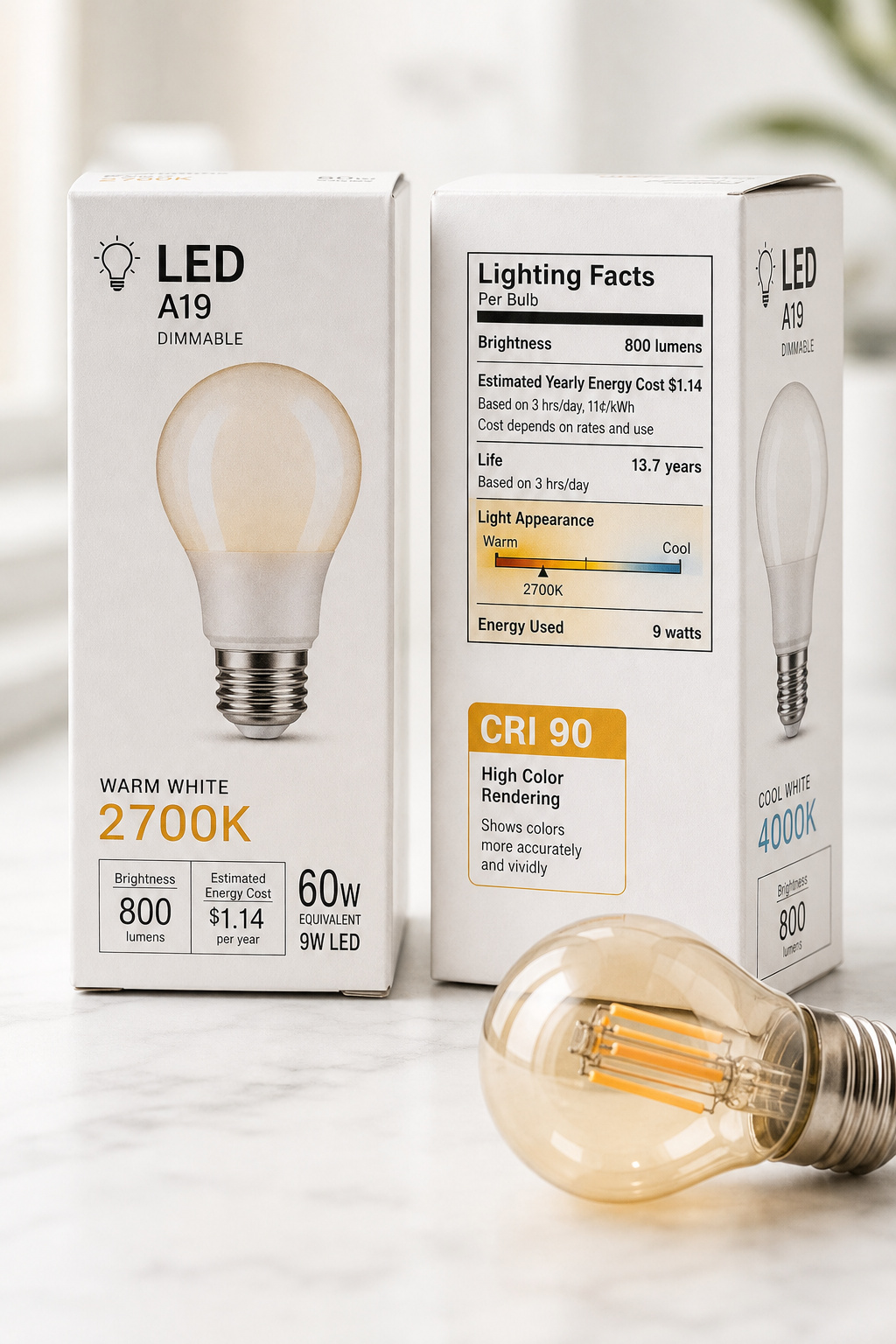
Kelvin (K): the temperature number and where to find it
Kelvin is the most prominent spec on modern LED packaging, usually front-of-box, labelled “light appearance” or simply “K.” Warm white may read “Soft White,” neutral “Bright White,” cool “Daylight.” For the ambient circuit, look for 2700K or 3000K; for the vanity, 4000K or 5000K.
CRI: why it’s often buried on the back — and what to do if it’s missing
CRI is not a required disclosure under the FTC Lighting Facts label, which mandates only lumens, Kelvin and energy cost. Budget makers routinely omit it. When listed, it appears on the back or side as “CRI 90+,” “Ra90,” or “Color Rendering Index 90.” If a bulb states no CRI anywhere, assume it is 80 or below and keep it away from the vanity. For premium brands, the LM-79 spec sheet online publishes CRI and R9 in full.
Lumens vs watts: the brightness number that replaced wattage
In 2012 the FTC made lumens, not watts, the primary brightness measure, because wattage describes energy use, not output. As a guide: 900 lumens replaces a 60W bulb, 1600 replaces 100W. A standard 50–80 sq ft bathroom wants 3500–6000 total lumens across all sources, at roughly 70–80 lumens per square foot.
Get the colour right and the rest of a bathroom scheme falls into place: warm where you rest, accurate where you look closely, and two circuits so the room can be both. Buy for the materials you already own, confirm the second number on the box, and you will not be the one squinting at your reflection wondering why the foundation looked fine indoors.
FAQ
What Kelvin is best for a bathroom?
There is no single best Kelvin, because the room does two jobs. For ambient and relaxation — the ceiling and bath zone — choose 2700–3000K warm white for a spa-like glow that flatters warm materials. For the vanity and makeup, choose 4000–5000K neutral-cool white with CRI 90+ so colours match daylight.
What is CRI and does it matter for bathroom lighting?
CRI, the Colour Rendering Index, measures how accurately a light reveals true colour against daylight at 100. It matters enormously at the vanity: under CRI 80 light, weak red wavelengths leave skin looking pale or sickly. Under CRI 90+, skin reads healthy and makeup appears as it will in daylight. Below 90, keep it off the mirror.
Can I mix warm and cool light bulbs in the same bathroom?
Yes, and professional design recommends it. Use warm 2700–3000K for ceiling and bath-zone ambiance and cool 4000K+ with CRI 90+ at the vanity. The rule is to separate temperatures by zone and circuit — never mix them in one fixture. Put each zone on its own dimmer for grooming by day and relaxation by night.