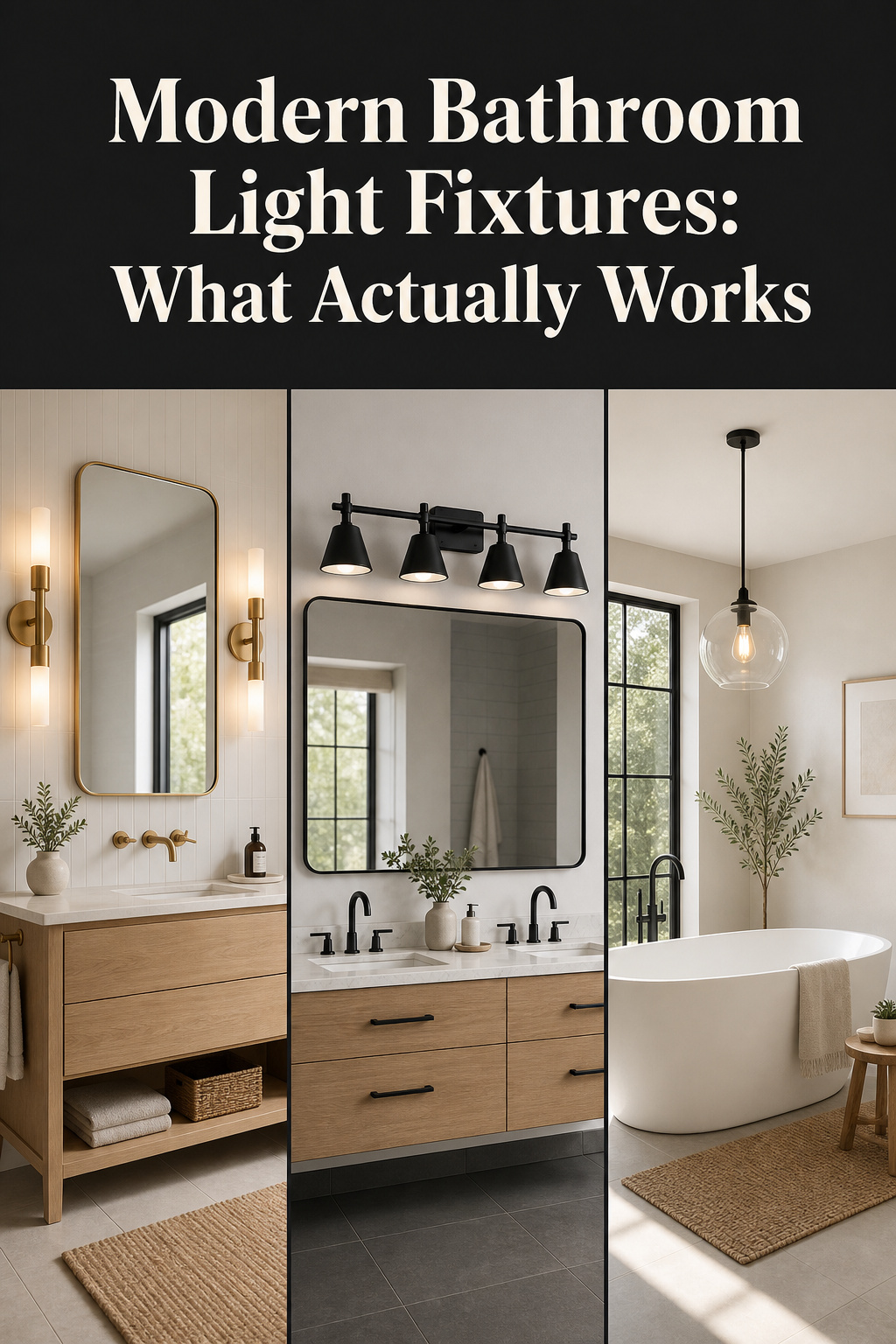

My grandparents kept their crockery on one open shelf in a cottage on the Stockholm archipelago — one shelf, enough plates for the people who came, lit at night by oil lamps. I think of that shelf whenever someone shows me a saved folder of forty modern bathroom light fixtures. The problem is never too few options; it is too many, chosen by how they photograph rather than what they do. Four fixture types, what each is genuinely for, and the few specs that tell you whether one will work.
TL;DR
- Choose by job: sconce or bar for the face, flush or recessed for ambient fill, a pendant only where the room earns it.
- Flanking sconces at 60–70 inches eliminate mirror shadows; a bar should be 75% of mirror width; a bath pendant needs 9-foot ceilings and 8 feet of NEC clearance.
- Match the finish to the dominant hardware and choose PVD — three to ten times more durable than electroplate — so the fixture still reads right in ten years.
The Fixture Is the Last Decision, Not the First
Most fixture regret starts at the wrong end: you pick the light you like, then ask the room to accommodate it — and the room rarely does.
Why most people buy before they know the job
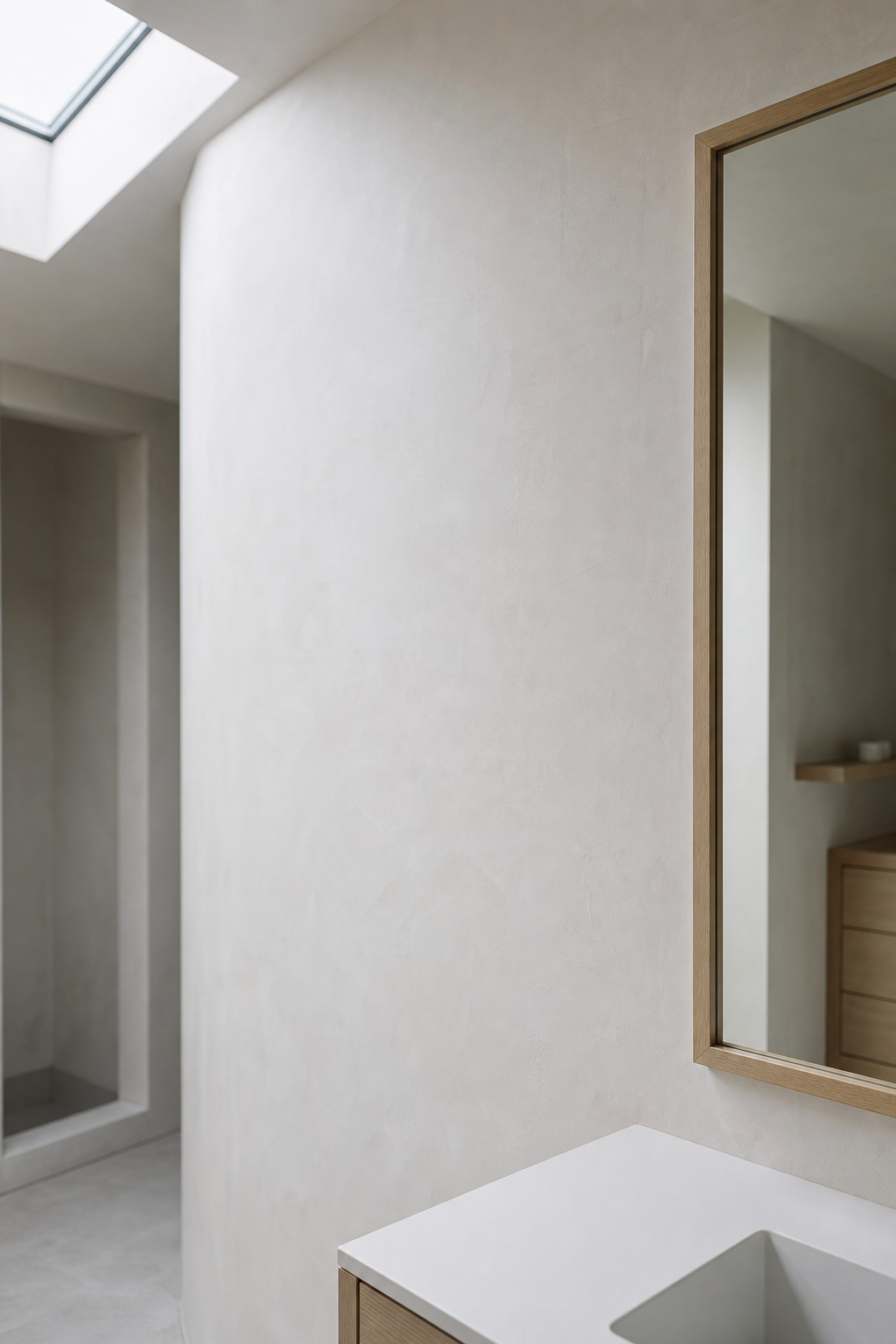
The most common bathroom lighting mistake is choosing by appearance before naming the task. A bathroom hosts several jobs at once: grooming wants strong face-level light, a shower needs ambient fill, an evening soak wants low warmth. A single ceiling fixture cannot cover all three — it throws shadows across the eyes and jaw that designers call the cave effect, and no wattage removes them.
The three questions I answer first
Before I name a fixture, I answer three questions — this is my own sequence, not a rule printed on a box.
- What is the job? Face-level task, ambient fill, or accent. The answer decides the category: sconce or bar, flush or recessed, or pendant.
- What is the geometry? Sconces need 6–8 inches of clear wall beside each mirror edge; recessed cans need 3.5–5 inches of joist depth; a pendant needs at least a 9-foot ceiling above a bath.
- What finish language already exists? Faucet, towel rail, pulls. The fixture has to read as a deliberate member of that family.
What ‘modern’ means here
Modern, in a fixture, means clean geometry and an LED-compatible source — not a finish colour that belongs to one moment. What dates a bathroom is ornament chasing a trend. Nearly all current fixtures assume LED, so check dimmer compatibility before you buy.
Sconces: The Fixture Most Bathrooms Should Have and Rarely Do
If wall space allows, a pair of sconces is the best vanity light there is — and the one most bathrooms skip.
What a sconce does that a vanity bar cannot
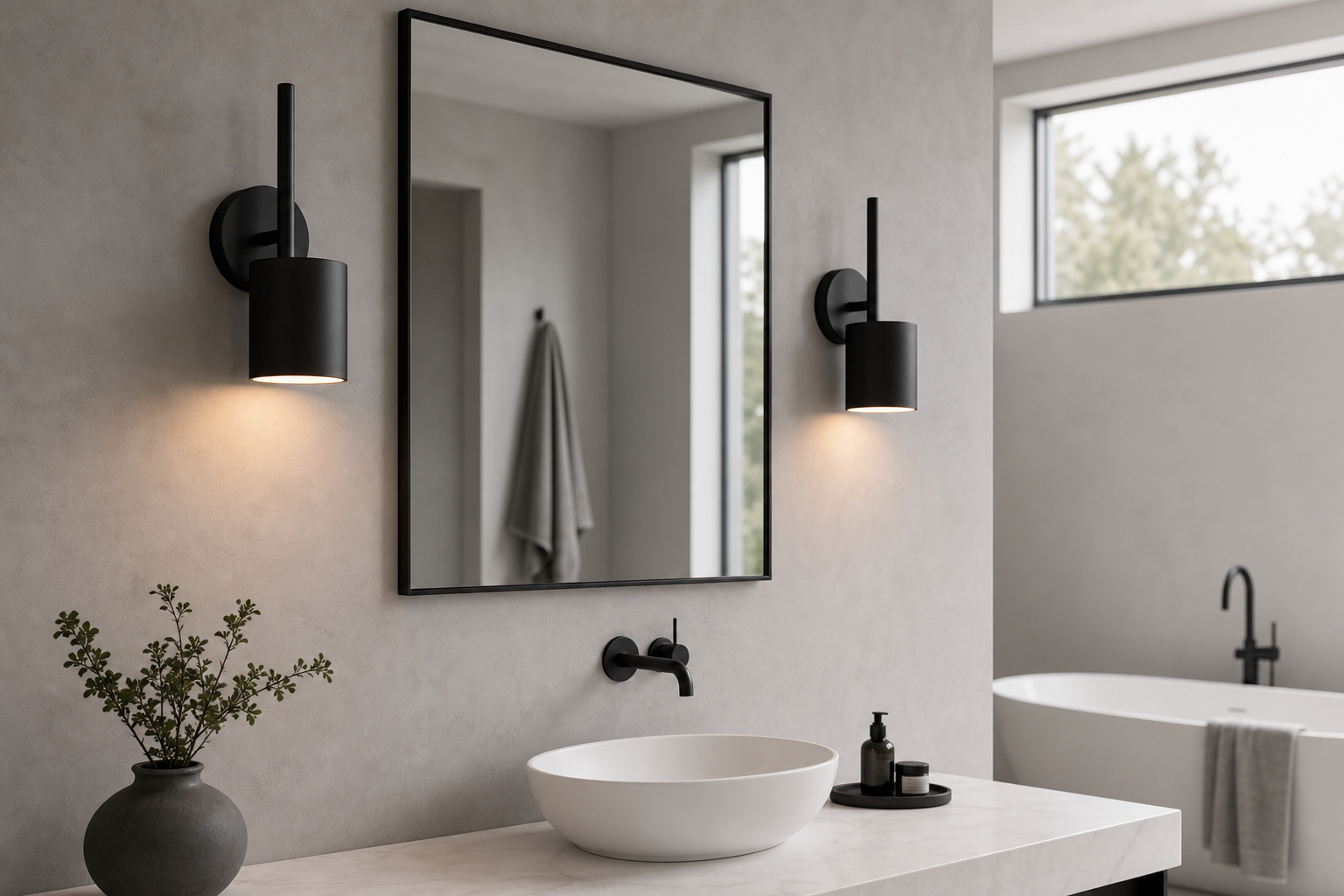
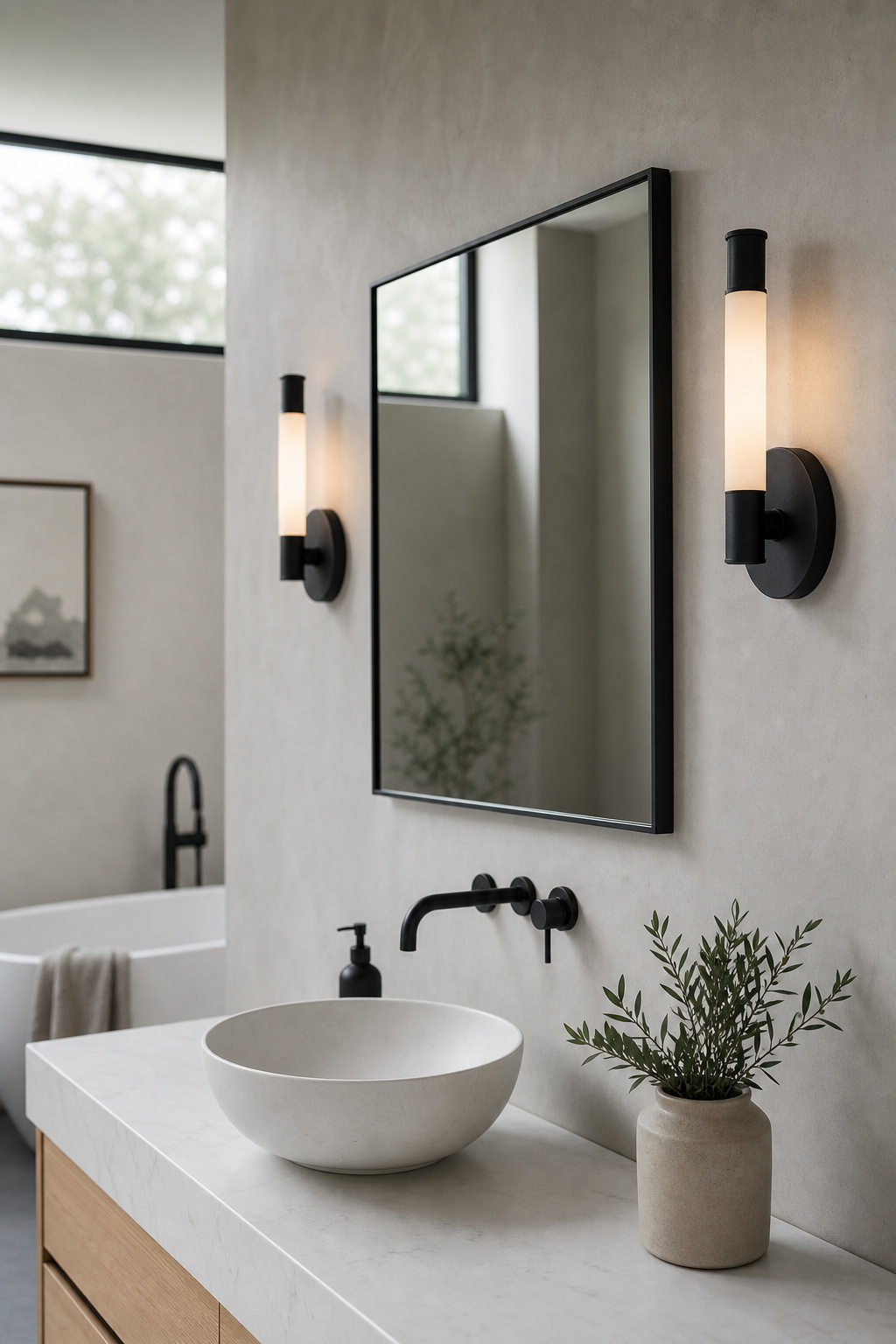
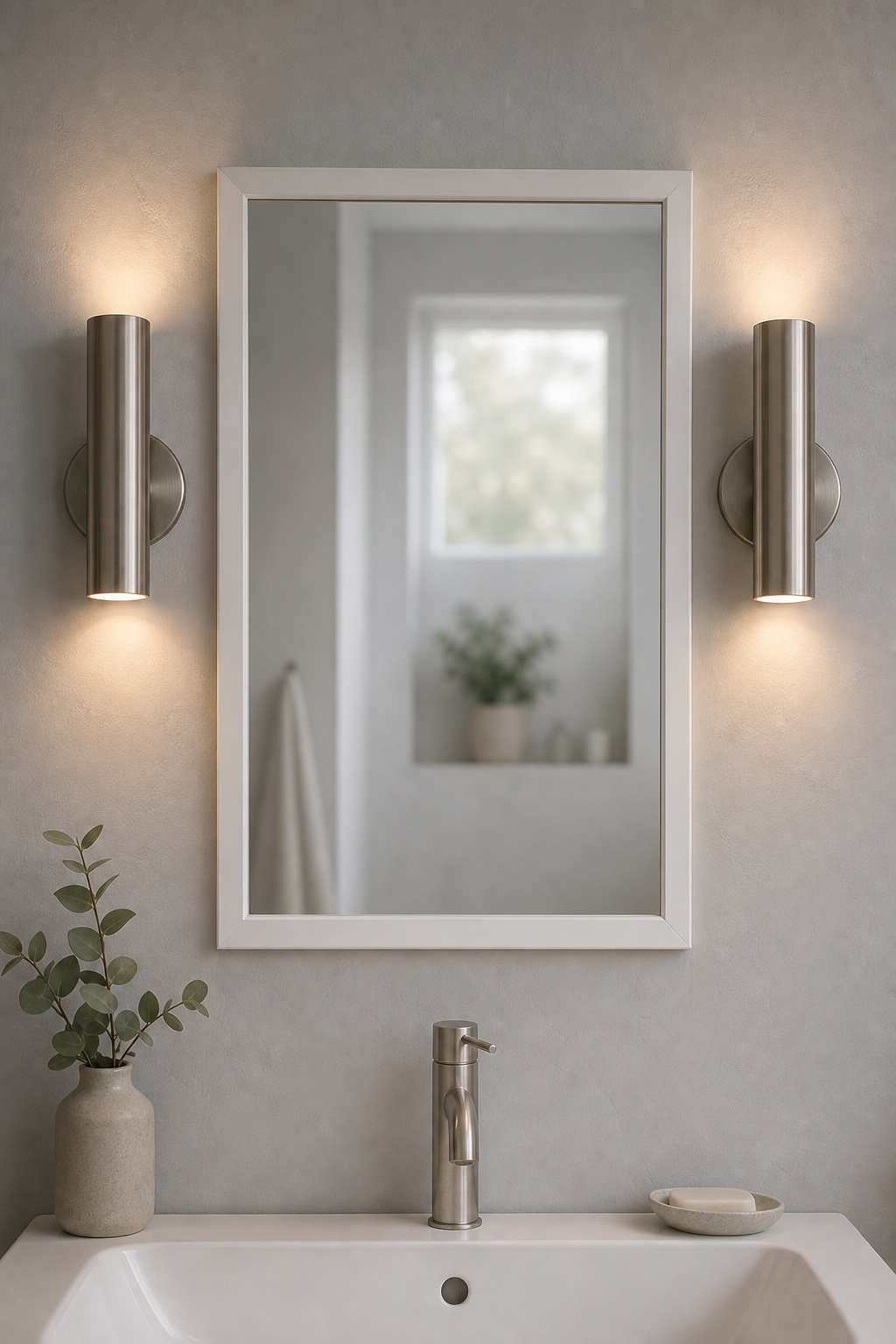
A sconce on each side of the mirror lights both sides of the face at once, filling the shadows an over-mirror fixture casts under the nose, brow and jaw. As the ParrotUncle guide notes, for the most flattering light at the face, side lighting almost always wins. Mount each sconce at 60–70 inches from the floor, placing the source beside the face rather than above it. Where they sit and how they wire is covered in where vanity fixtures go.
Reading a sconce spec sheet
Use the delivered lumens figure, not the bare-bulb rating — shade losses run 20–30% on shaded fixtures. Aim for 400–800 lumens per sconce; 12-inch fixture height suits a small bathroom, 18 inches a medium-to-large one, and anything taller risks the mirror frame.
Where sconces fail — and the case for a bar
Sconces fail where the wall does not exist. If the mirror runs to a cabinet, window, or corner, there is nowhere to flank it — and a single sconce on one side lights half the face and shadows the other. On a wide double-vanity mirror, sconces leave the centre underlit. Where the wall can’t carry a pair, a bar above the mirror is the honest answer: even spread, one junction box, good performance at 75–80 inches above the floor.
Vanity Bars and Over-Mirror Fixtures
The bar is the default over-mirror fixture — easier to wire than sconces, provided you get two numbers right.
Bar length relative to mirror width
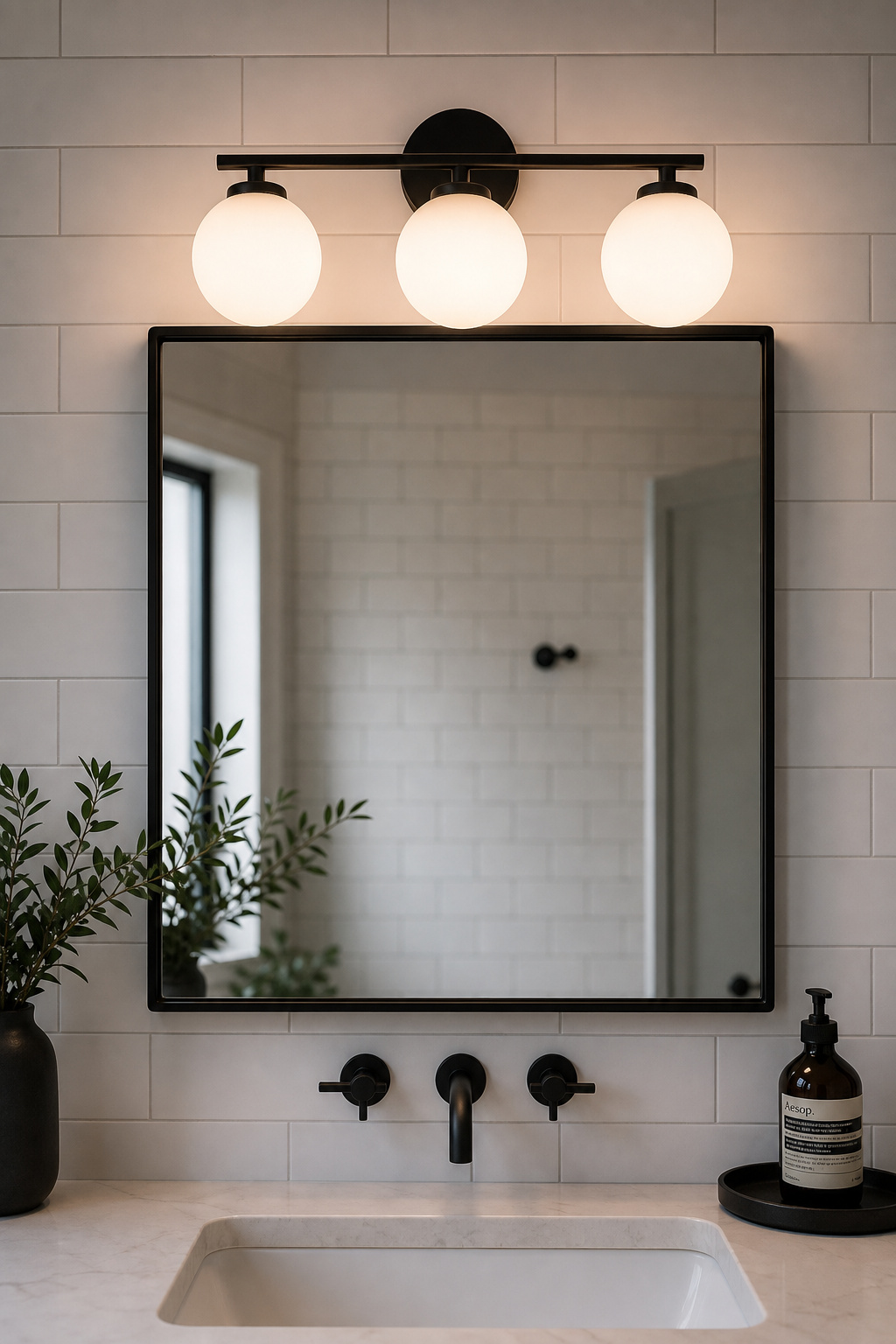
A bar should be about 75% of the mirror’s width and must never extend past the mirror edges — for a 48-inch mirror, that means a 36–38-inch bar. Mount it at 75–80 inches above the finished floor: lower competes with the mirror, higher deepens under-eye shadow.
Globe vs shade vs bare-bulb
The three bar styles distribute light differently — a difference you can reason through, not look up. Globe bulbs (opal or frosted spheres) throw omni-directional, diffused light with no harsh point source: the most even facial illumination and the popular default. Shaded heads enclose the bulb, cutting the raw glare a mirror bounces back into your eyes. Bare-bulb bars are the most graphic; reserve them for frosted LED filament bulbs, or the direct glare undoes the look.
Reading head count and lumens together
Always read the total lumen output, not just head count — a five-head bar at 250 lumens each (1,250 total) underperforms a three-head bar at 600 each (1,800 total). Head count tracks mirror width:
| Mirror width | Recommended bar length | Head count | Total lumen range |
|---|---|---|---|
| Up to 24 in | 18–20 in | 2 | 800–1,200 lm |
| 30–42 in | 24–32 in | 3 | 1,600–1,800 lm |
| 48–60 in | 36–44 in | 4 | 1,800–2,200 lm |
| 60 in+ / double | per-sink, 75% rule | 5–6 | 2,200–2,500 lm |
For most bathrooms, start at the three-head, 1,600–1,800-lumen row — it covers the common 30–42-inch mirror and hits the vanity brightness target without glare.
Flush Mounts and Recessed Downlights: Ambient Done Quietly
Ambient fixtures should disappear. Their job is to make the room navigable while the task fixtures do the visible work — and the best ones you stop noticing entirely.
Flush mounts for low ceilings
A flush mount sits 0–2 inches below the ceiling; a semi-flush drops 4–8. On a ceiling of 8 feet or below, the flush mount is the code-safe ambient choice, keeping clearance above the 7-foot minimum. Reserve the semi-flush for 9-foot ceilings. To size one, add the room’s length and width in feet for the target diameter in inches: an 8-by-6-foot bathroom wants a 14-inch flush mount.
Recessed downlights and dimmable LED
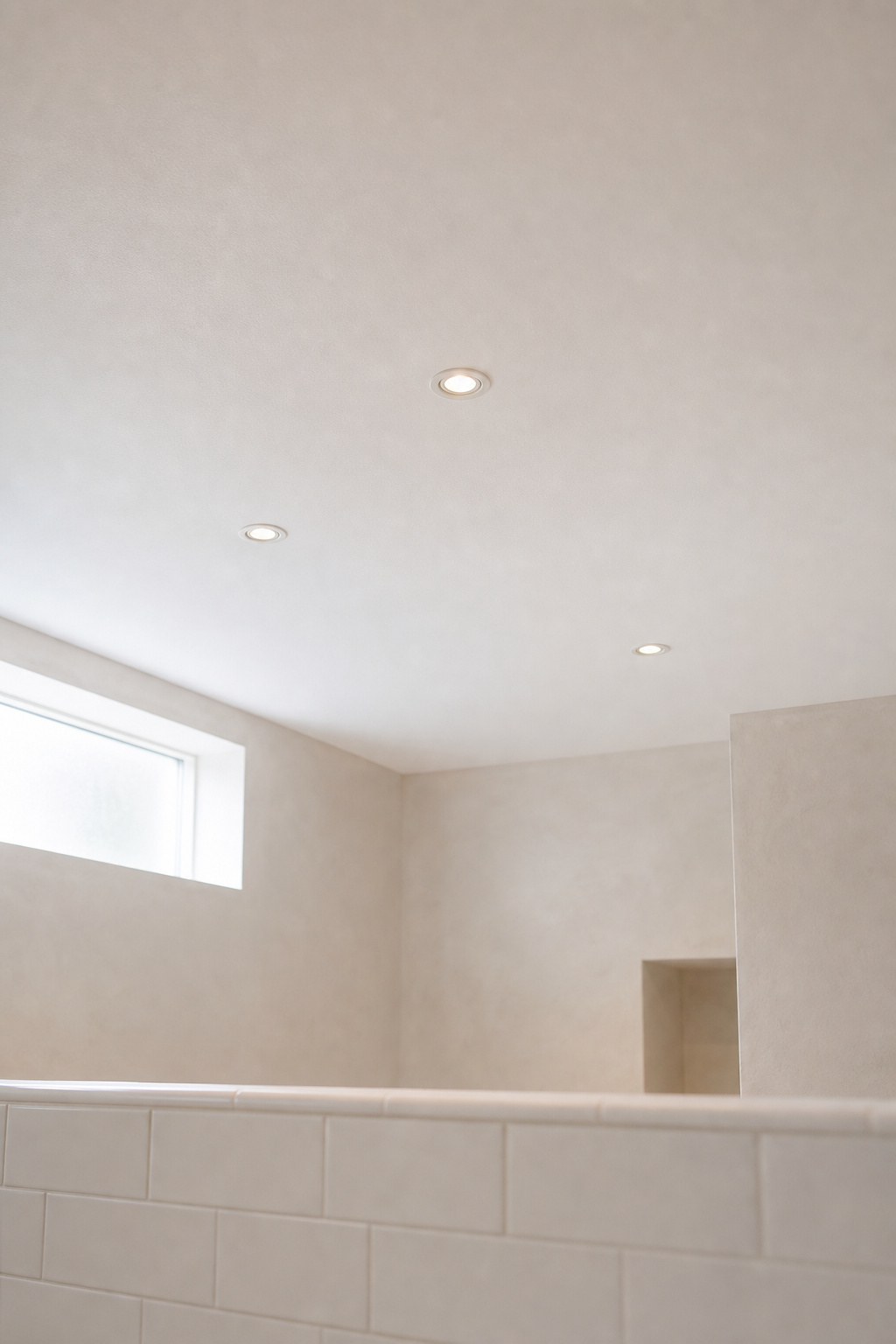
Recessed cans need 3.5–5 inches of joist depth; canless LED discs need only 2–4, viable where traditional housings won’t fit. Match aperture to ceiling height: 4-inch trims below 9 feet, 6-inch above. Specify dimmable LED at 2700–3000K so the ambient layer can drop to near-zero when other layers carry an evening.
A trim that disappears
In a Nordic bathroom, an empty ceiling is an asset, not a gap to fill. The spec that makes a recessed fixture vanish: a white or paintable trim, a tight 4-inch aperture, and a flat non-specular flange that reads as ceiling rather than hardware. Any downlight beside a shower needs the right rating — that decision is covered in matching the fixture’s rating.
Pendants: The Source That Earns Its Place
A pendant in a bathroom is a deliberate move, never a default. Most rooms are better without one — but where ceiling height and a feature align, a single pendant can become the composed centre of the room.
Where a pendant works
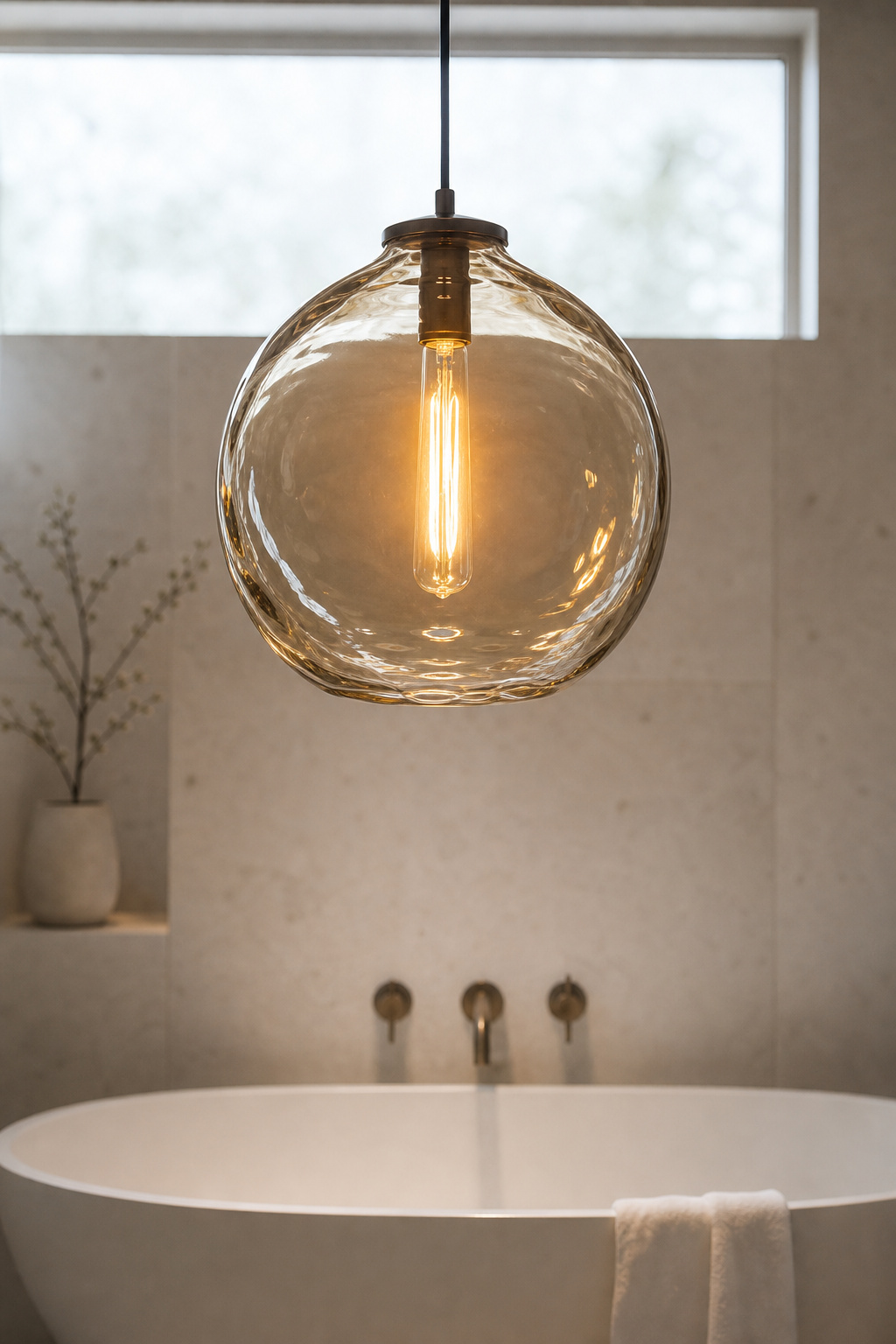
A pendant hung above a freestanding bath turns light and bath into a composed still life. It also works beside an oversized mirror where there is no wall for sconces — a pair at the outer edges delivers face-level side light. Hang the base around 66–72 inches from the floor for mirror use; over a bath, 67–71 inches keeps the canopy-like height that makes it work.
The clearance calculation to run first
The National Electric Code requires at least 8 feet between the top of the bath walls and the lowest point of any pendant above the tub. Take the ceiling height, subtract the floor-to-base target, and what remains is your maximum cord-plus-body: a 9-foot ceiling with a 70-inch target leaves 38 inches. On a standard 8-foot ceiling, do not attempt a bath pendant — as the My Blue Bath guide warns, it will hang so low the ceiling feels like it is falling on you.
What a composed pendant rules out
A composed pendant is distinctive in form or material but does not fight the architecture — a blown-glass globe or an oversized linen shade reads as considered without becoming noise. What I rule out: multiple pendants at competing heights, cluster fittings over a bath below 10-foot ceilings, and any pendant over a shower. Keep pendants 5–8 inches in diameter for a vanity pair, up to 12–14 inches for a bath.
Finish, Form and the Ten-Year Question
Finish is a longevity decision.
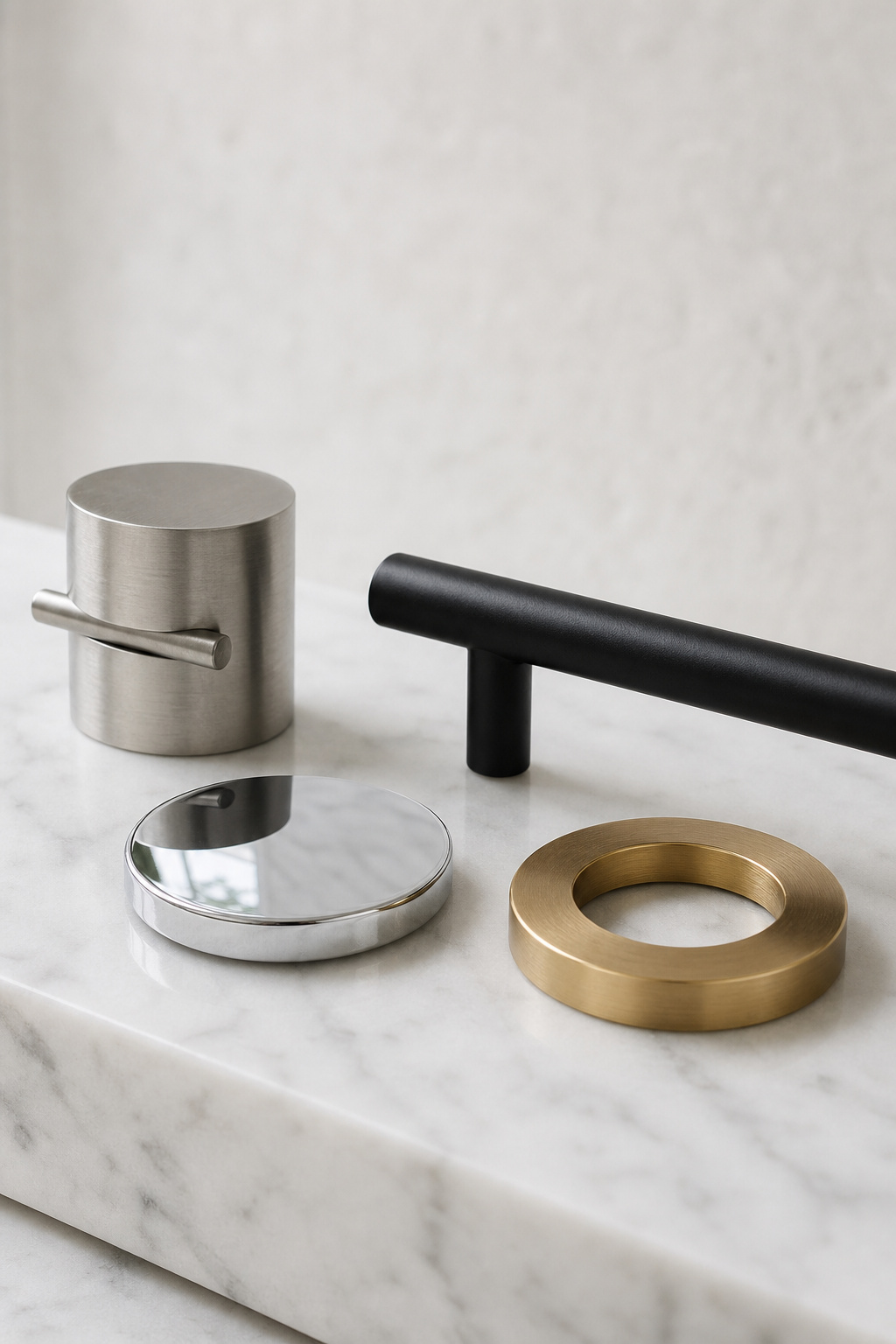
Longevity and maintenance, finish by finish
| Finish | Durability | Maintenance | Best setting |
|---|---|---|---|
| Brushed nickel | High, tarnish-resistant | Lowest — hides spots | Everyday family bathroom |
| Matte black (PVD) | Very high, 3–10× electroplate | Low — no ammonia cleaners | Modern, graphic schemes |
| Polished chrome | Hardest, never tarnishes | High — shows every spot | Bright, classic rooms |
| Unlacquered brass | Patinates over time | High if holding original tone | Warm, characterful rooms |
Matte black without PVD can go chalky grey within five to ten years in a humid bathroom; PVD resists that. Polished chrome never tarnishes but shows every fingerprint. Unlacquered brass patinates continuously — intentional if you want it, but quarterly polishing if you don’t. Never use ammonia or Windex on matte black — it breaks the topcoat and causes permanent spotting.
Mixing finishes deliberately
One dominant finish across 60–70% of the metal, one accent, three maximum. Match the fixture to the dominant hardware in the vanity zone. When you mix, choose genuine contrast: brushed nickel and polished chrome both sit in the silver family and the eye reads the near-match as a mistake, while matte black and brushed brass contrast cleanly.
The ten-year test
Here is the cottage shelf again. A bathroom refreshes tile, paint and cabinetry on a 10-to-15-year cycle, but fixtures stay put longer. Ask of any fixture: will this still read as a deliberate choice when everything around it has changed once? Clean geometry and a PVD finish answer yes; ornament tied to a trend answers no. Prioritise solid-brass construction over zinc die-cast — the body usually corrodes before the finish fails. For the broader scheme, see planning bathroom lighting.
FAQ
What are the most popular bathroom light fixture styles right now?
Wall sconces in clean geometric forms are the most consistently specified for their function and visual neutrality. Multi-head vanity bars in matte black with globe or exposed-LED bulbs are widely adopted for their graphic look. Rather than chase a moment, choose geometric simplicity and a finish that matches existing hardware — these read as current across many years.
How do I choose a finish for bathroom light fixtures?
Match the fixture finish to the dominant hardware in the vanity zone — faucet, towel rail, pulls. Prioritise PVD finishes: they resist moisture, chemicals and scratches three to ten times better than electroplate. When mixing two finishes, contrast them — warm brass with cool matte black, never two silver tones together.
Can you use pendant lights in a bathroom?
Yes, but ceiling height governs it. The NEC requires at least 8 feet between the top of the bath walls and the lowest pendant point — a standard 8-foot ceiling leaves no practical cord length. Pendants work best at 9 feet or higher, above a freestanding bath or beside a large mirror. Near a shower, wet-rated specification is required.