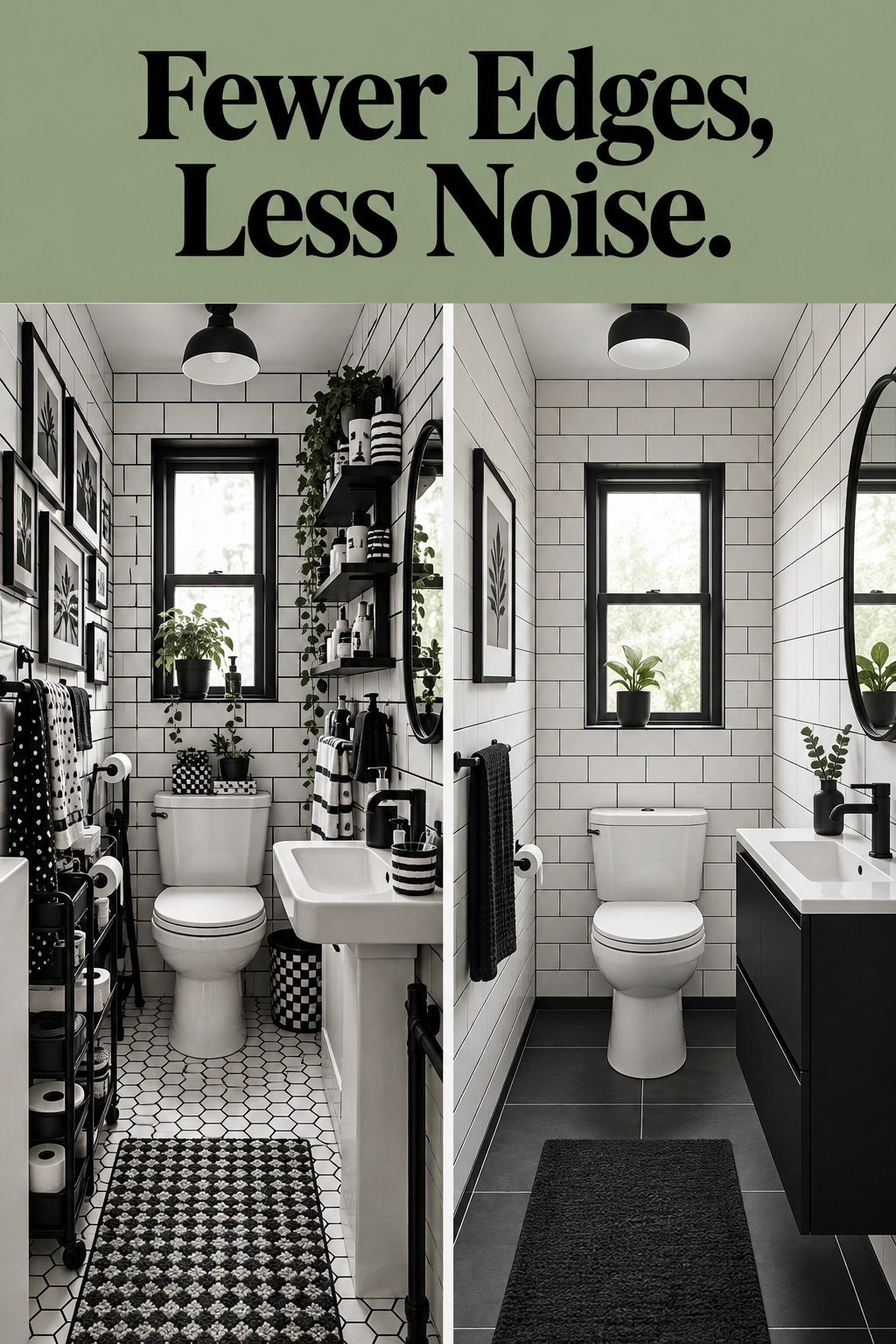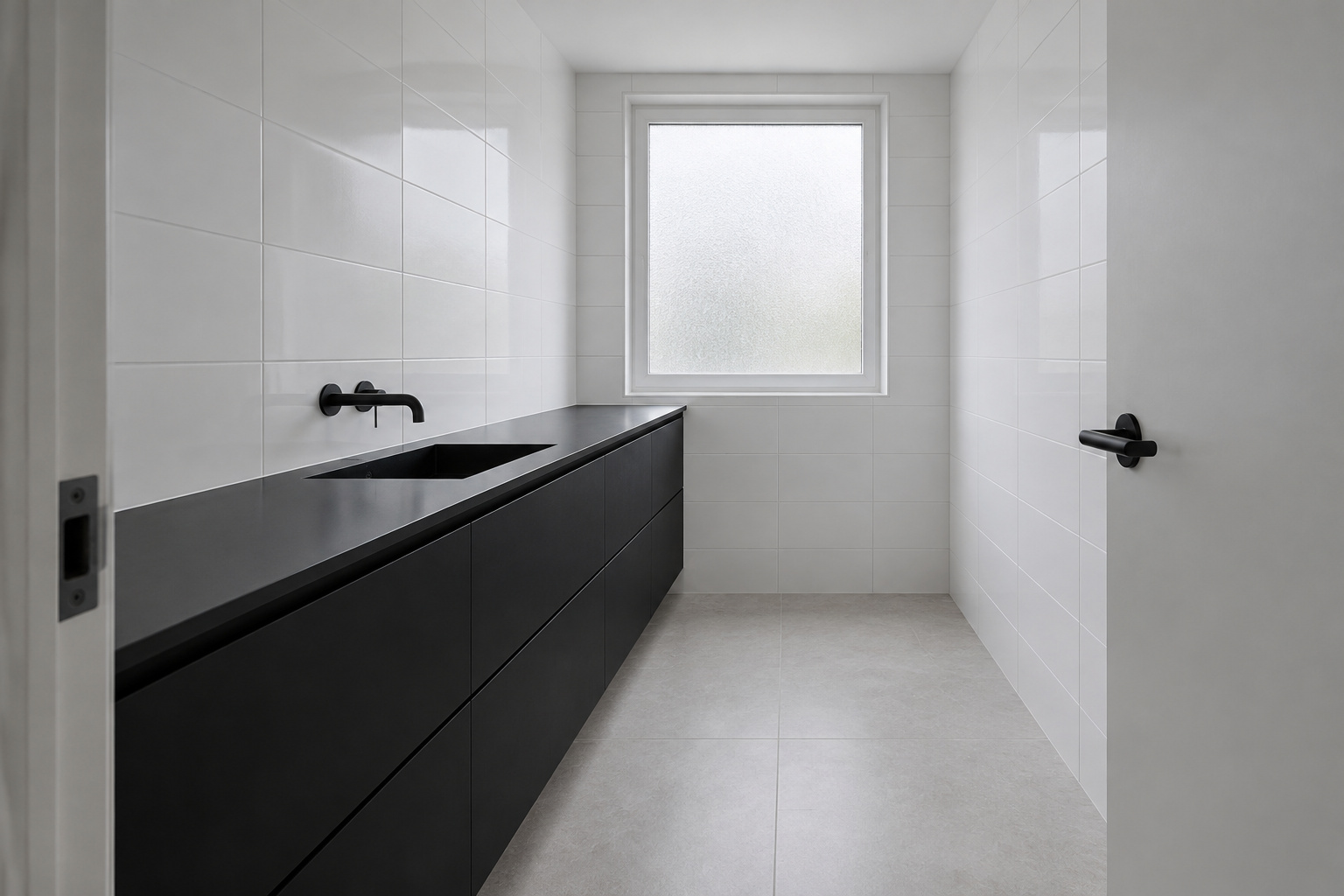
Stand in the doorway of your black and white small bathroom and count the black. A mirror frame. A towel bar. The faucet, the shower frame, a striped mat. Five things, and not much black. Now count again, differently. The mirror frame meets white tile on four sides. The shower frame runs up, across and down. Five black things have become more than twenty places where your eye stops, before the grout. You can take a piece of black out and the room still feels restless, because you were counting the wrong thing.
TL;DR
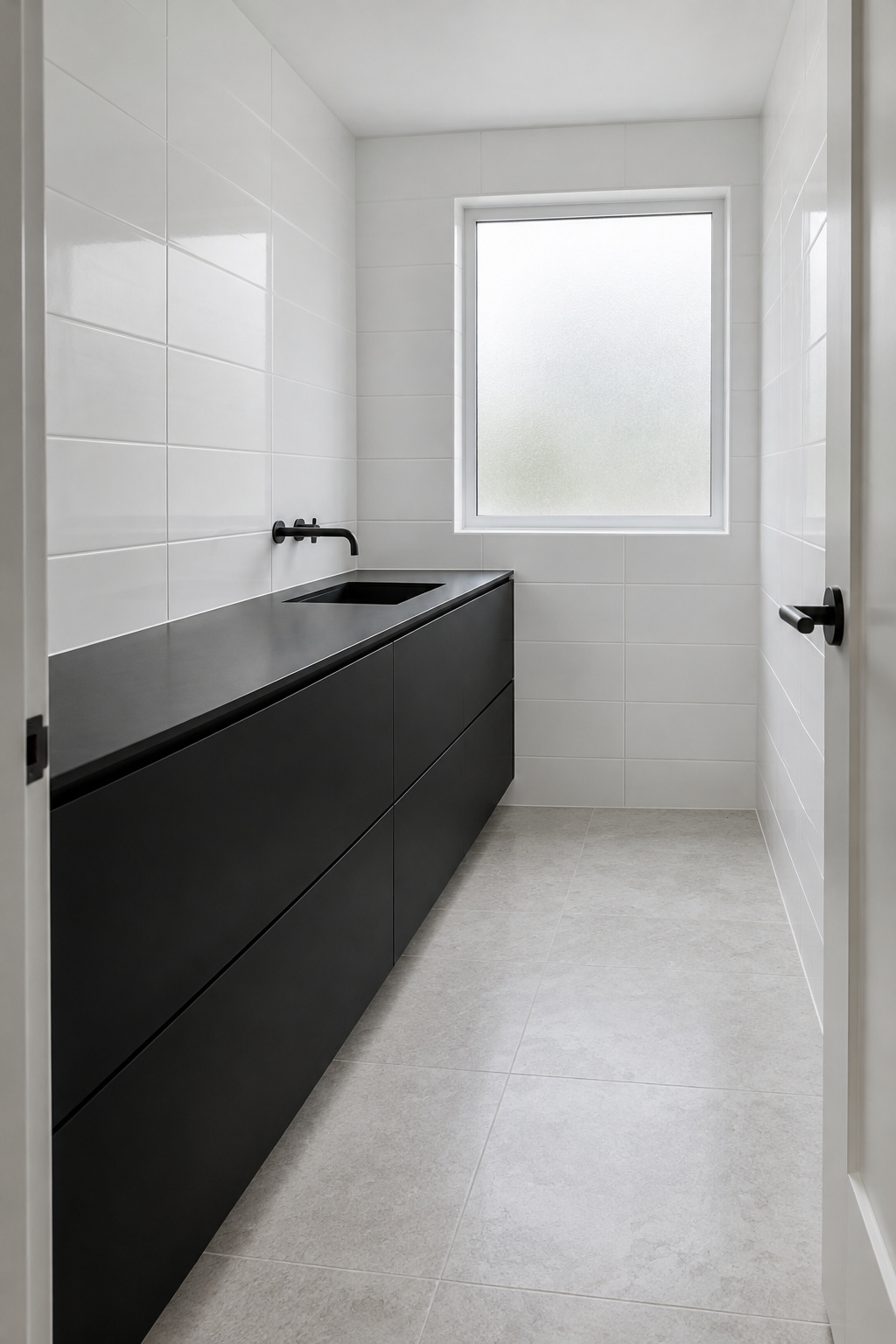
- Edges where black meets white make a small bathroom feel busy more than the amount of black does; lab studies suggest dark walls may cost a little apparent size, but no study has tested a black-and-white room.
- Black grout is the biggest edge maker: a 60 x 72 in tub wall in 3×6 subway tile carries about 2,028 in of joint, against 408 in for the same wall in 12×24 tile.
- Keep to one patterned surface, choose larger black areas over several small ones, and clear the shelf first, since objects cost nothing to move.
Black and White Small Bathroom Ideas Start With Edges, Not With Less Black
What should a room you stand in, half awake, ask of your eyes? Very little, I think. A small bathroom holds the most unguarded minutes of the day, and a room that keeps tugging at you then is tiring in a way that’s hard to name.
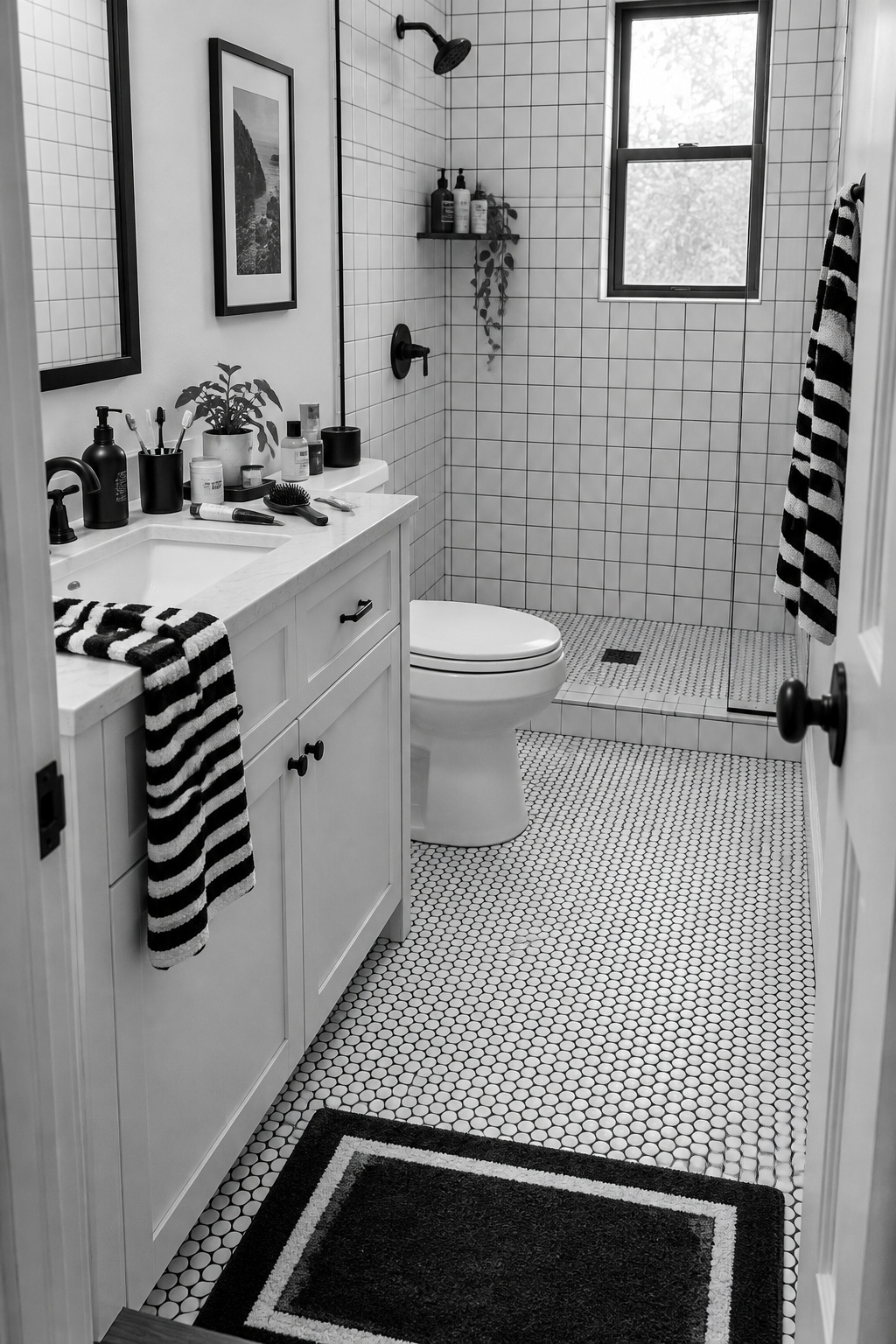
The usual belief is that black makes a small room smaller and busier, so use as little as you can. Half of that has some support. In lab studies, lighter walls and ceilings made virtual rooms look higher, and bright rear walls appeared on average 6.84 cm farther away than dark ones. Those were simulated rooms in grays, and the effect is small. Black may cost you a little apparent size; designers argue it both ways.
The busy part is a different matter. Ruth Rosenholtz and her team at MIT built measures of visual clutter from how much contrast, color and orientation vary across a scene, and edge density was one of the ingredients that tracked how hard people found it to search an image. They tested maps and pictures, never bathrooms, so I use it as a lens rather than proof. Through that lens, a small black-and-white room is mostly edges, and every edge is somewhere for the eye to land.
On a silent retreat once, the only clock in the hall was loud enough that by day two everyone had noticed it. Someone quietly took the battery out. Small sounds matter more in quiet rooms, and small lines matter more in small ones.
How much black a room can carry is a separate question, which the black-and-white laundry room guide takes up. Here the black stays and the lines go. For the whole room, see a black-and-white bathroom, surface by surface.
Five Ways to Cut Edges in a Small Black-and-White Bathroom, Compared
Each of these works on its own, and you don’t need all five.
| Option | Where the edges come from | What cutting them costs | Suits |
|---|---|---|---|
| Matching grout | A joint around every tile | Nothing extra if tile isn’t laid yet; regrouting otherwise | Starting from scratch |
| One pattern per room | Pattern on floor and walls at once | High if tile is already down | Starting from scratch, or choosing which surface to retile |
| Fewer, larger black areas | Several small black pieces, each with its own outline | Moderate: swapping or painting one piece | Tile already laid |
| Edited objects | Pumps, cups, towels, mats | Nothing | Rented bath, any bath |
| A frame that follows an existing line | A shower or mirror frame drawing a new line | Moderate to high | Replacing a door or mirror |
Objects and grout are the cheapest cuts. Pattern costs the most to change, and it is mostly decided before anyone picks up a trowel.
Black Grout on White Tile Is the Edge-Heaviest Choice in a Small Bath
Take one tub-shower back wall, 60 inches wide and 72 high, in 3×6 subway tile laid in running bond. That’s 24 rows of 10 tiles, 240 tiles in all. The horizontal joints run 23 lines of 60 inches, which is 1,380 inches. The vertical joints add 24 rows of nine joints, each 3 inches tall, another 648. Together that is 2,028 inches of joint, about 169 feet, on one wall. In black grout, every inch of it is a black line on white.
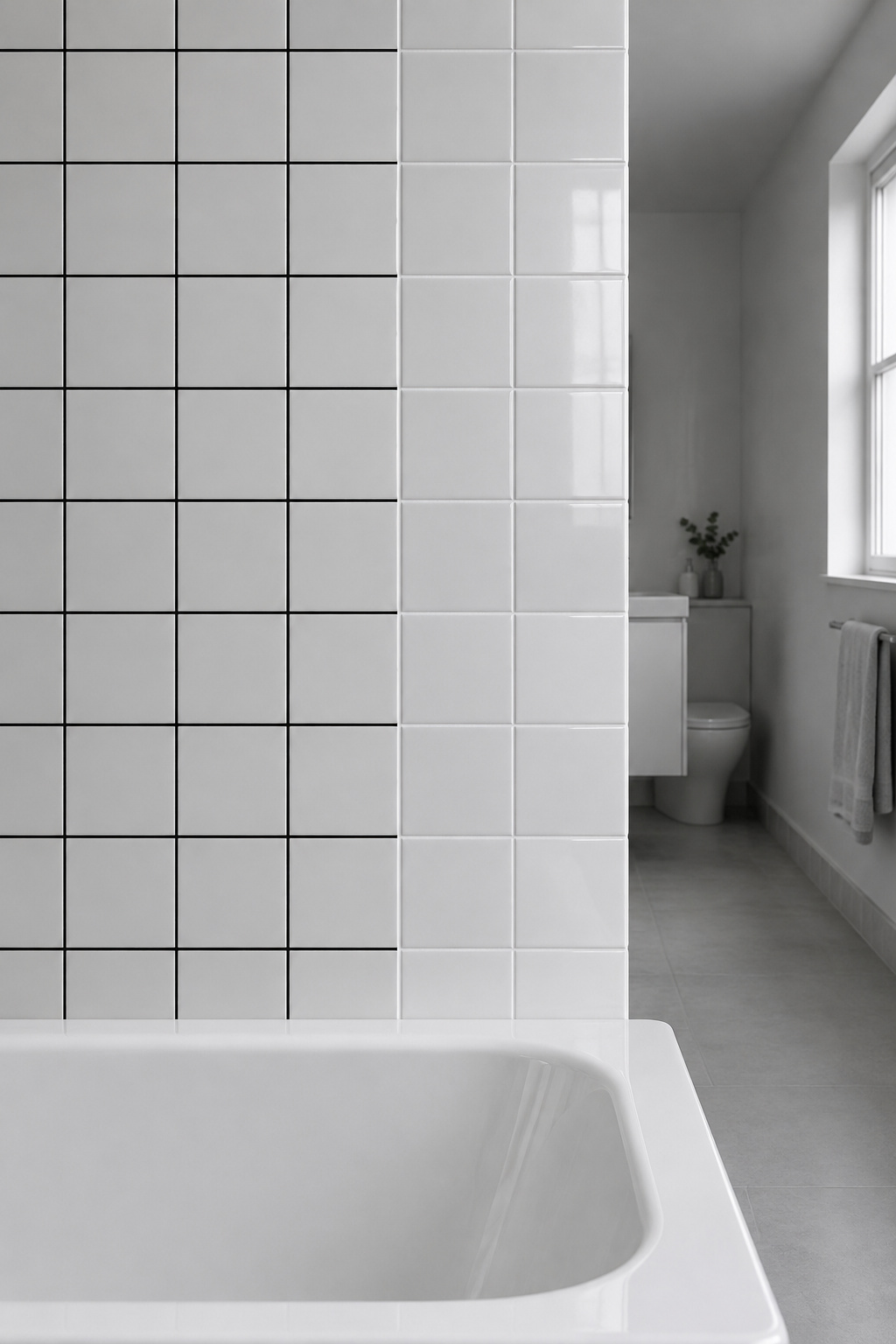
The same wall in 12×24 tile, stacked, has 120 inches of horizontal joint and 288 of vertical: 408 inches, about a fifth of the subway wall.
Matching grout removes the contrast, not the joints. The lines are all still there; they just stop reading as black. A Houzz piece on grout color says: with white tile and dark grout, “the grout itself and the patterns it creates start to become the visual focus over the actual tile.”
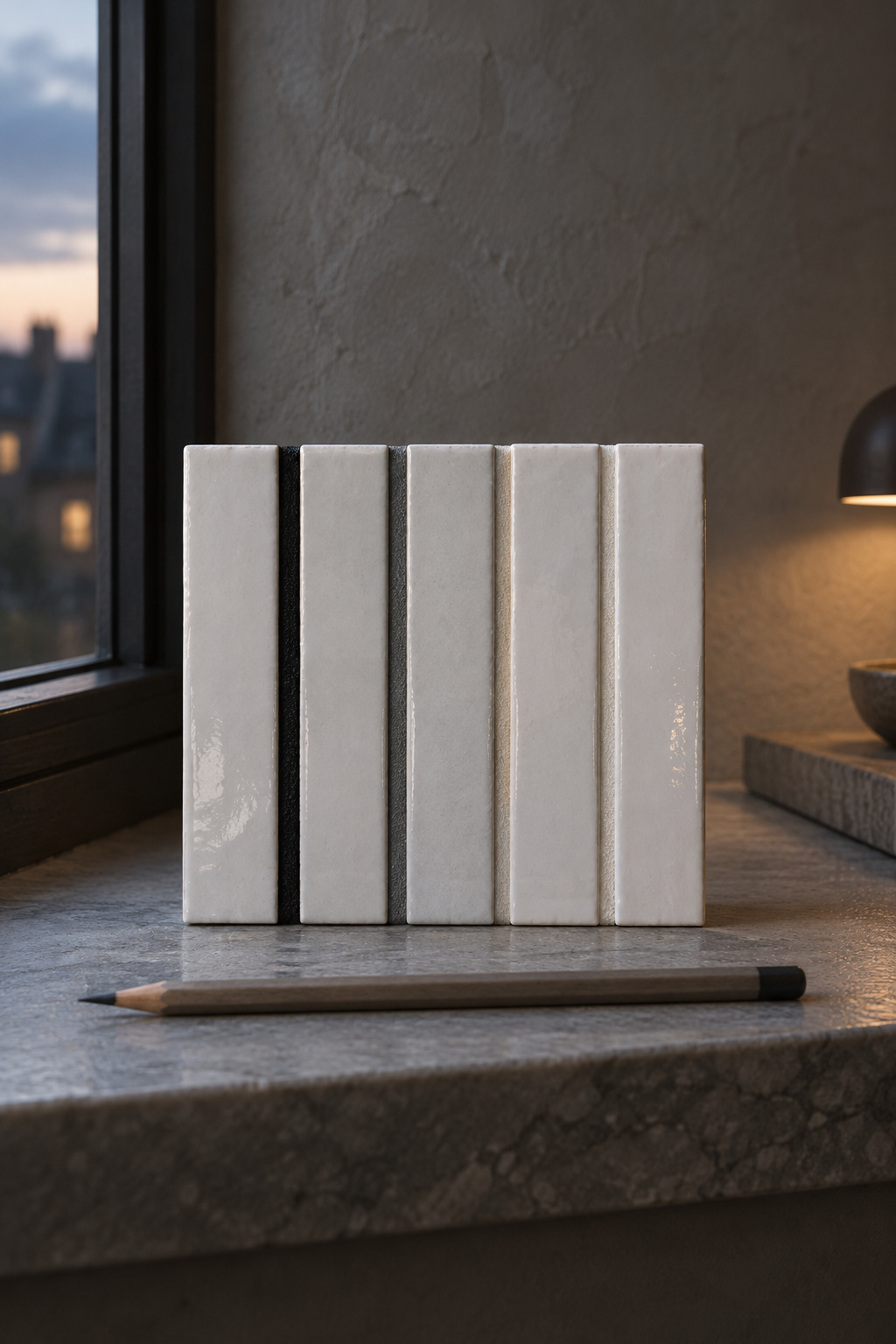
So keep white tile with white or pale grout, and put the black somewhere else entirely, in a vanity or one mirror. Make a sample board first, because grout can dry lighter than the swatch. What black grout shows over the years is its own subject, in the guide to white subway tile with black grout.
One Pattern Per Small Room: Let the Floor Speak and Keep the Walls Plain
A pattern is a chosen set of edges. Two patterns in one small room means edges running in two directions, and nowhere for the eye to rest between them.
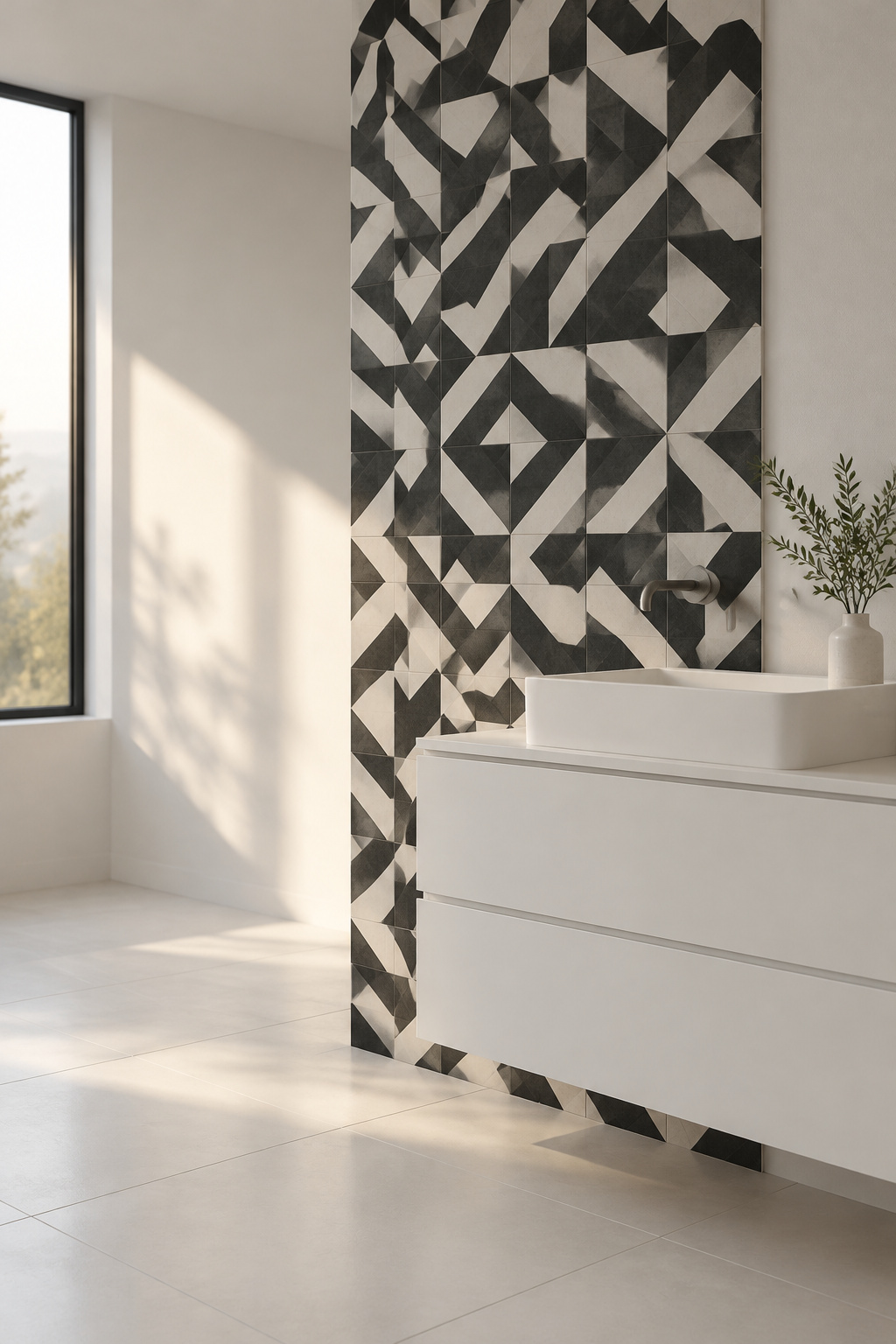
Houzz writer Laura Wheat advises restricting patterned tile to one surface, the floor or a feature wall. Abbas Youssefi of Porcelain Superstore agrees that if the floor does the heavy lifting, the walls play a supporting role. Ballard Designs allows up to three patterns in a room when one dominates, and Houzz’s own piece allows a second. In a small bath I take the narrower line.
Scale changes the count too. A 5 x 8 ft floor in 12-inch black and white squares has 4 interior lines running 8 feet and 7 running 5 feet: 67 feet of black-white edge across 40 squares. In 6-inch squares, it’s 72 feet plus 75, so 147 feet across 160 squares, about 2.2 times as much line on the same floor.
A busy floor can’t be tidied away. So in the smallest rooms I’d keep the floor plain and put the one pattern on the wall behind the vanity. If you love a checkerboard underfoot, let it be the only pattern, with plain white walls and matching grout. Choosing that floor by its light and wetness is its own decision, and a quieter black and white floor walks through it.
Decide which surface gets the pattern before you choose a single tile.
Fewer, Larger Black Areas, and an Edited Shelf
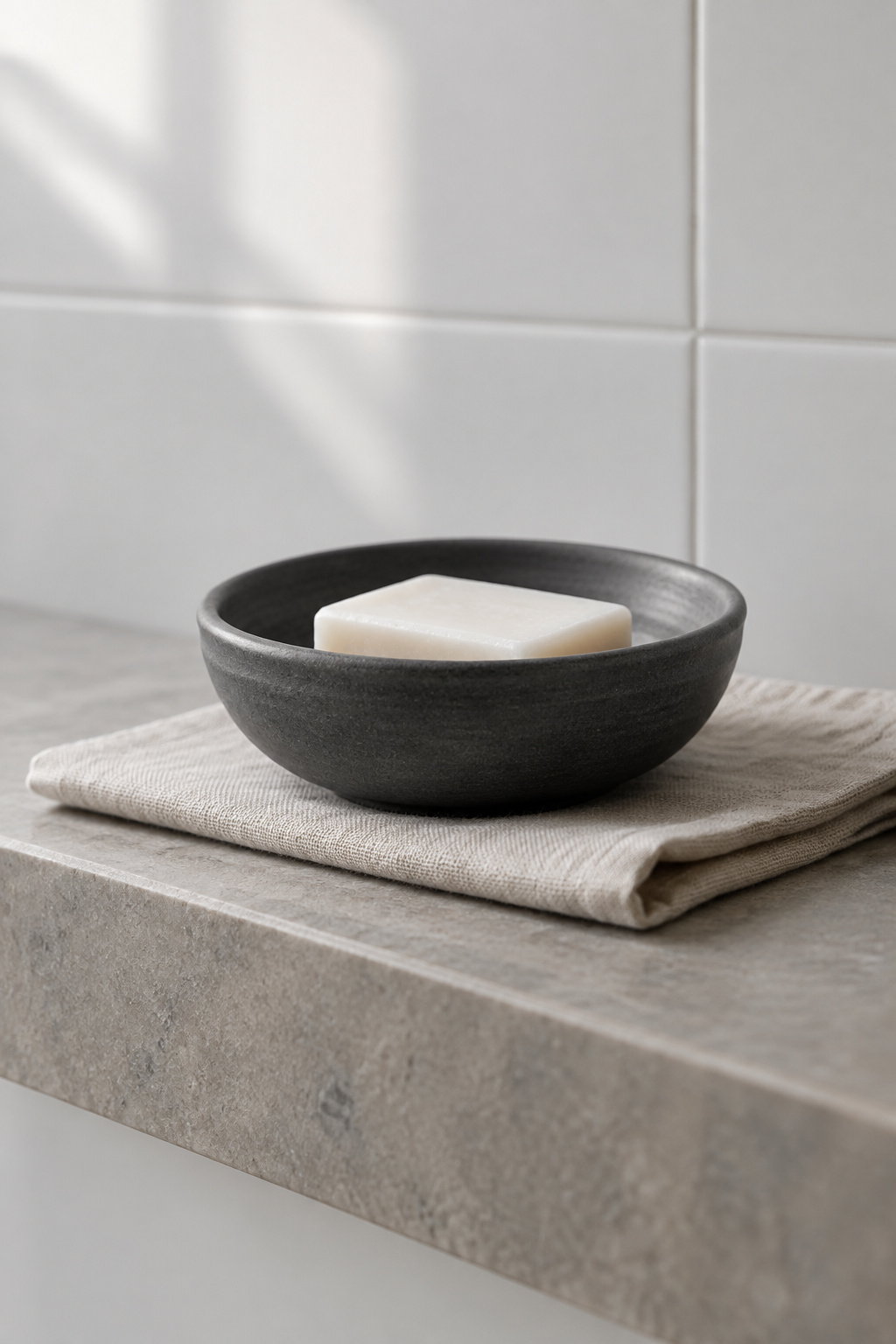
A 24 x 36 in black panel has a perimeter of 120 inches. Cut the same area into four 12 x 18 in pieces and each has 60 inches of edge, 240 in total, twice the line for exactly the same amount of black. One black vanity is one outline; a black dish, cup, tray, bin and towel bar are five, plus the gaps between them.
The Shower Door Frame Is the Longest Black Line in the Room
A black shower frame is likely the longest single black outline in a small bath. Caledora, a UK maker that sells both kinds, describes a framed door as drawing an unbroken metal edge, about 30 mm wide, around every panel, while a frameless one “has no line at all” apart from its hardware. Frameless has its own cost: the glass industry’s own design guide says frameless glass in a small corner enclosure is almost guaranteed to leak.
If you keep a frame, choose the thinnest you can and let it sit on a line the room already has, the edge of the tile or the height of a window sill, rather than cutting a new one across the wall. For frame types and care, see a black-framed shower door.
Objects: What Stays Out and What Earns a Place
Every object on a shelf is another small outline. When many things sit in view at once, they compete in the brain and suppress one another, as the neuroscientist Sabine Kastner showed in 1998. That says nothing about black-and-white things being worse than colored ones, only that more of them cost more.
Clutter on the floor is louder than clutter on a shelf, so I start with the mat. Then:
- Spare bottles and refills, kept anywhere but in sight
- The toothbrush cup, if a drawer will hold the brushes
- Matching black-and-white towel sets, swapped for plain ones
- Medicines, though not into the vanity: a damp bathroom is the wrong place for them
The guide to small-bathroom storage has more on where things can go.
I used to insist that calm rooms be bare. Clients told me a bare room felt like a waiting room. Now I keep one meaningful object in view and let everything else leave. I’m no model of restraint: my galley kitchen has one open shelf, and I rearrange it more often than I admit.
Clear the bathroom shelf down to one thing and leave it that way for a week.
Pick the First Edge to Cut, Then Live With It
Go into the bathroom at the hour you use it, with the light you use. Stand where you stand. Notice where your eyes keep getting caught. That is the edge to cut first.
The order follows effort. Objects can go today. Grout is a choice for before tile goes down. Pattern is decided while you’re still choosing, or is the reason to retile one surface rather than two.
Black was never the only thing making the room restless. The edges are, every place black meets white. Cut those and the black can stay.
Go back to the mirror you counted at the start. Keep its black frame. Take away the cup, the pump and the striped mat, and look again.
FAQ
What lighting stops a small black and white bathroom feeling harsh?
Light from the sides of the mirror, not above it. Eaton warns that a fixture directly over the mirror causes severe shadowing, and recommends sconces on either side. On color temperature the advice splits: Eaton calls 3,000 to 3,500K typical for bathrooms, while Northerncult recommends 4,500 to 5,000K for applying make-up.
How do you add warmth to a small black and white bathroom without adding more edges?
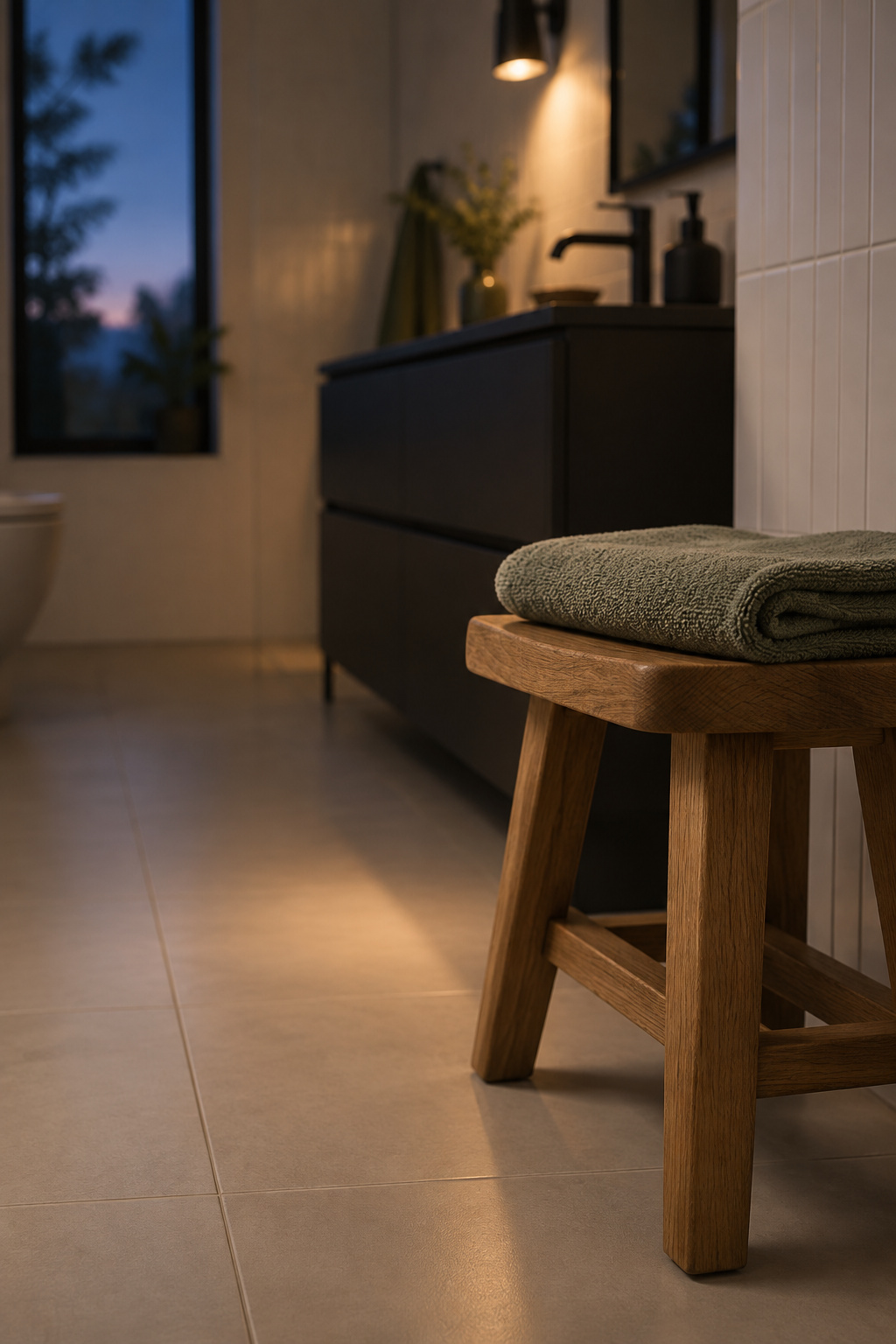
Warm the light first, because a bulb adds no edge. Eaton suggests accent lighting around 2,700K for a warmer glow. After that, choose one warm material as the single note outside black and white, such as an oak stool, a brass towel ring or a sage towel. Each added object brings its own outline, so stop at one.
Is a black ceiling too much for a small bathroom?
It can lower the room a little. In lab studies, light ceilings made virtual rooms look higher, though the effect was small and the rooms were gray, not black and white. In edge terms, a black ceiling over white walls draws one long line around the top of the room. Over black walls, it adds none.