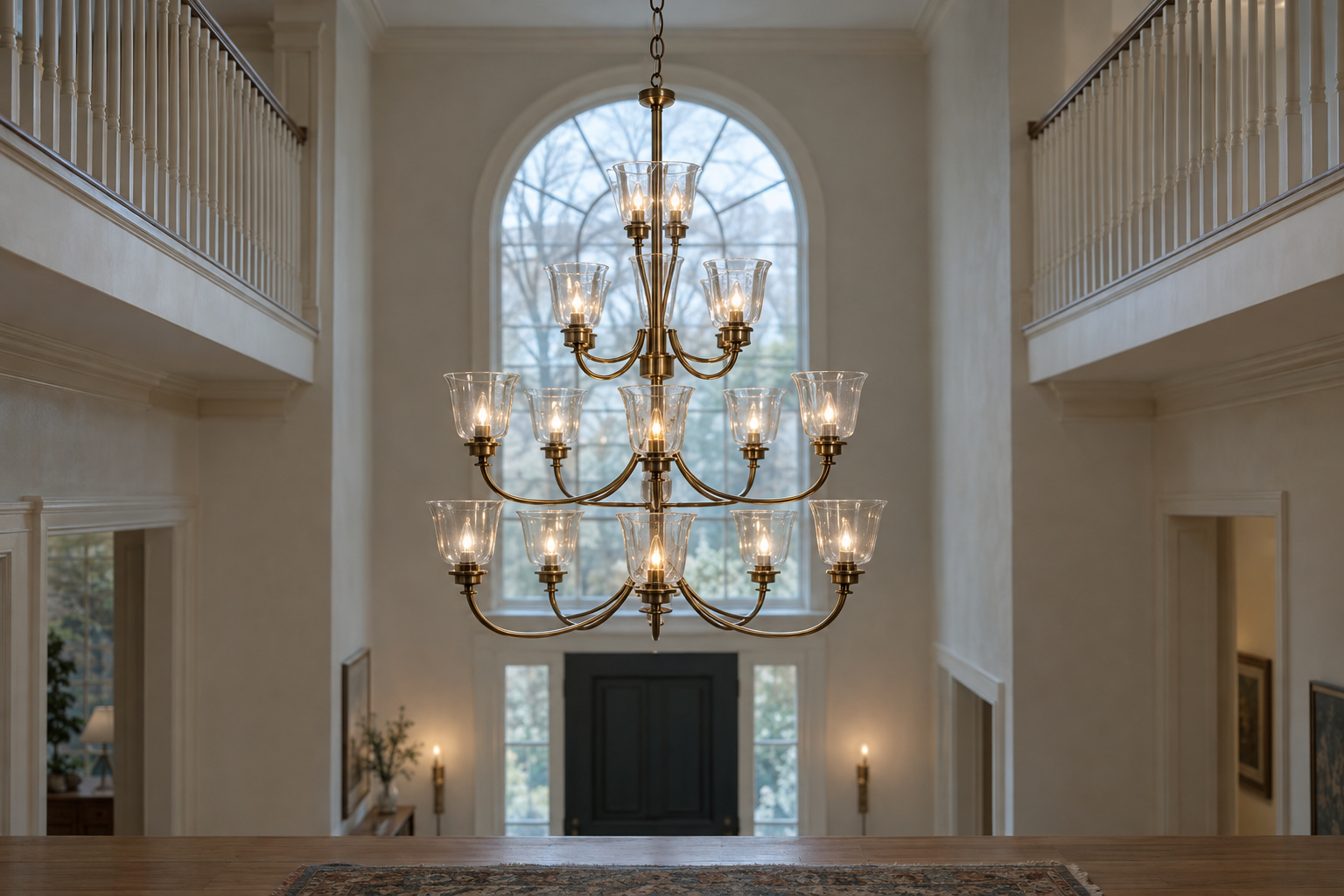
I read catalogs from the back. That is where the dimensions and the materials are. The front pages show a two story foyer chandelier glowing over a staircase at dusk. The back pages tell you how tall it is, how wide, and what it weighs.
Most people choosing one carry two rules in their heads. Add the foyer’s length and width in feet, and the sum is the diameter in inches. Then hang the bottom level with the second floor. Both are trade rules of thumb, and in a tall room they give you a minimum, not an answer. Use the formula as a floor, choose the fixture by its height, and check it from the front door and from the landing before you buy.
TL;DR
- The length-plus-width sum is a trade rule of thumb, not a standard: a 16 by 14 ft foyer gives 30 in, which is the smallest diameter to consider.
- Size by height first: allow 2.5 to 3 in of fixture height per foot of ceiling, so an 18 ft ceiling suits a fixture 45 to 54 in tall.
- Keep at least 7 ft under it, test the drop from the door and the landing, and plan the bulb change before you buy: an ordinary ceiling box is only required to carry 50 lb, and a motorized lift costs $1,149 to $2,319 before installation.
Does the length-plus-width formula actually size a two story foyer chandelier?
It sizes something, just not the thing that matters most in a double-height room. The sum is printed by lighting makers and retailers. Kelly Wearstler, asked by Architectural Digest in 2016, called it “a general rule of thumb” for “a safe determination of size”, and one maker that publishes the same sum calls the result the minimum. The American Lighting Association’s own shopping advice contains no formula and no second-floor rule. No standards body that I can find publishes either one, and the formula’s first appearance is untraced.
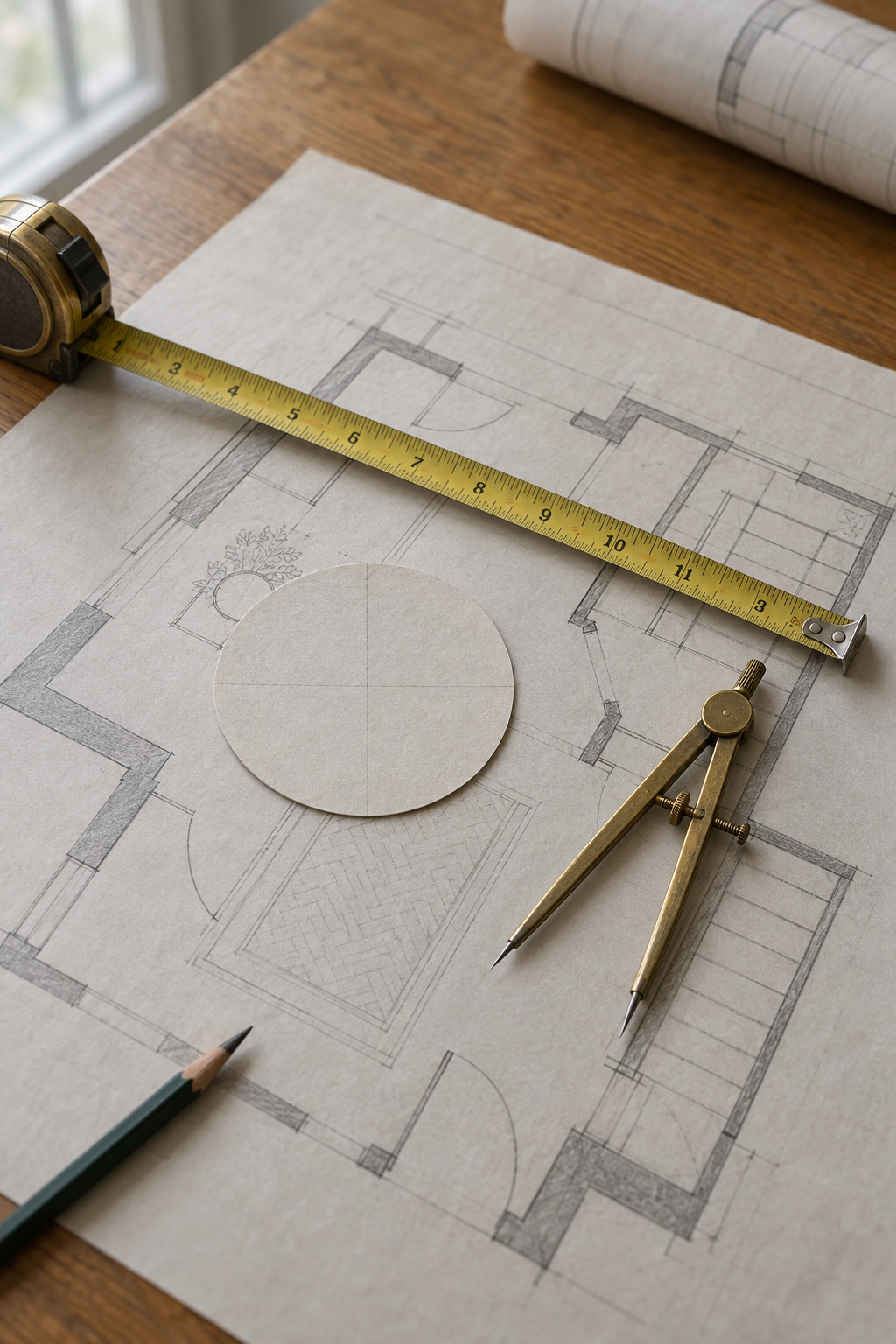
On a 16 by 14 foot foyer the sum gives 30 inches across, a sensible smallest size. It says nothing about height, and in a room roughly 17 to 20 feet tall, height is what the eye measures. A formula that ignores height is a weak guide in two story foyer decorating.
Here is where each rule you will meet comes from.
| Rule | Who publishes it | Standard or trade rule | What it assumes |
|---|---|---|---|
| Length + width in feet = diameter in inches | Lighting makers, retailers, one designer | Trade rule of thumb | A room seen from one floor, often a dining room |
| Bottom level with the second floor | Lighting makers and retailers | Trade rule | The fixture is seen from upstairs |
| 7 ft from floor to fixture bottom | American Lighting Association, makers | Trade association advice | People walk underneath |
| Bottom 6 in above the door, open foyer | American Lighting Association | Trade association advice | The view through the front door |
| 8 to 10 ft minimum in two-story foyers | One fixture maker | Trade rule | A high ceiling needs a higher drop |
If I could keep only one row, I would keep the 7 feet. It is the only rule written about people rather than proportion.
Size a two story foyer chandelier by its height first and its diameter second
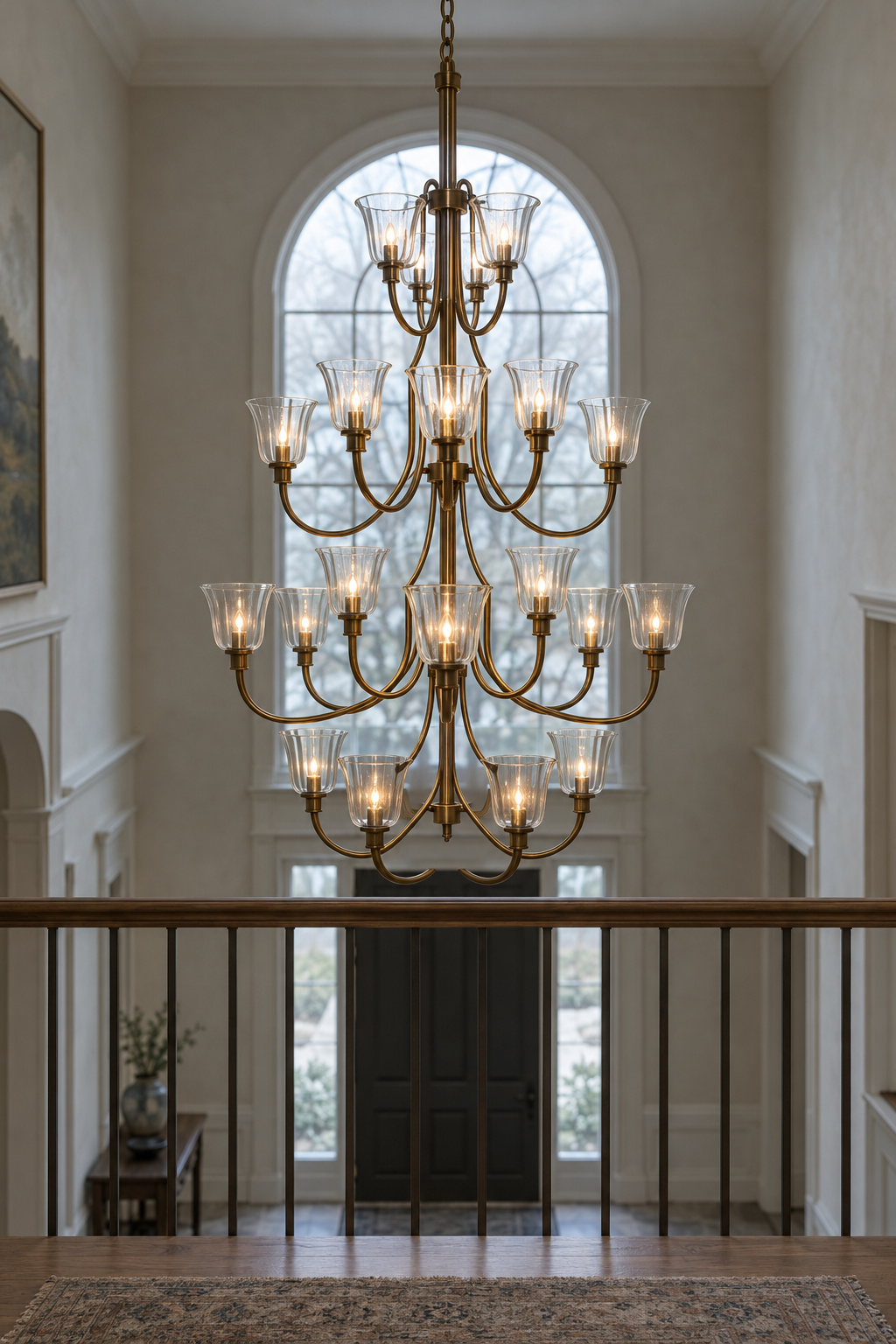
In a tall room the eye travels up before it travels across. A fixture chosen for width alone hangs in that height like a coin in a well. The fix is simple: retailers allow 2.5 to 3 inches of fixture height for every foot of ceiling. An 18 foot ceiling gives a fixture 45 to 54 inches tall.
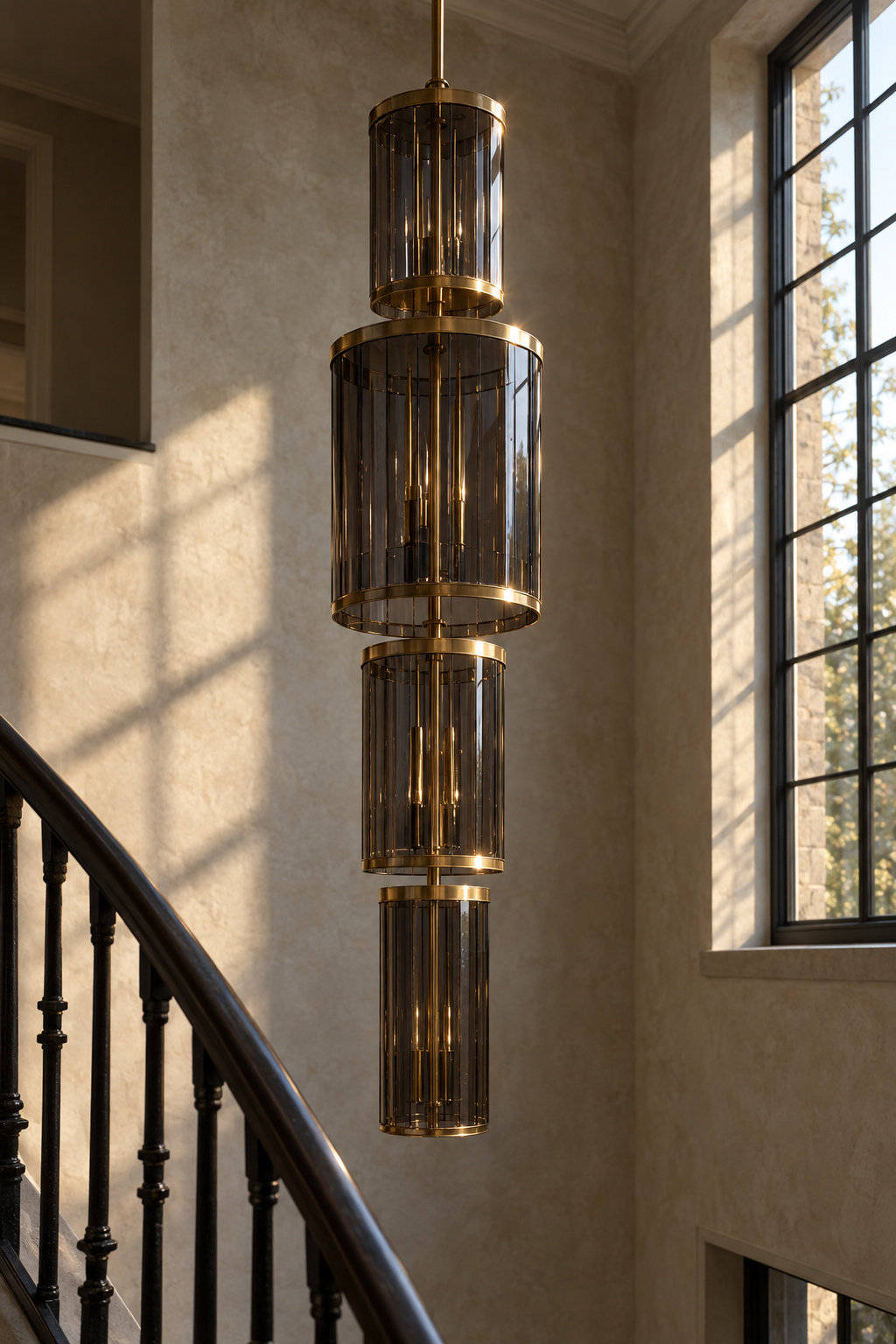
A fixture is called vertical when its height equals or exceeds its diameter. One seller’s example makes the point from the other side: a fixture 42 inches wide and only 12 inches tall will look undersized in a two-story foyer however wide it is. That’s furniture for a photograph. I would rather see a narrower fixture with real height than a wide one that looks generous in the catalog and thin in the room.
My recommendation is one fixture, tiered or elongated, rather than a pair. I use the same mug every day and have stopped apologizing to guests for not owning a set. Enough is a good word. One tall fixture does the job two smaller ones only argue about.
The sizing moves, in order:
- Take the length-plus-width sum as the smallest diameter, not the target.
- Work out the fixture height from the ceiling height.
- Prefer a fixture at least as tall as it is wide.
- Choose tiers or an elongated shape before choosing more width.
Where to hang it: judge the height from the front door and from the landing
The published answers disagree. The American Lighting Association asks for 7 feet between the floor and the bottom of a foyer fixture, and in an open foyer the bottom at least 6 inches higher than the door. One maker sets 8 to 10 feet as the minimum for a two-story foyer. Several makers and retailers say to hang the bottom level with the second floor. None of them can see your stair, so I trust my own eyes over all three.
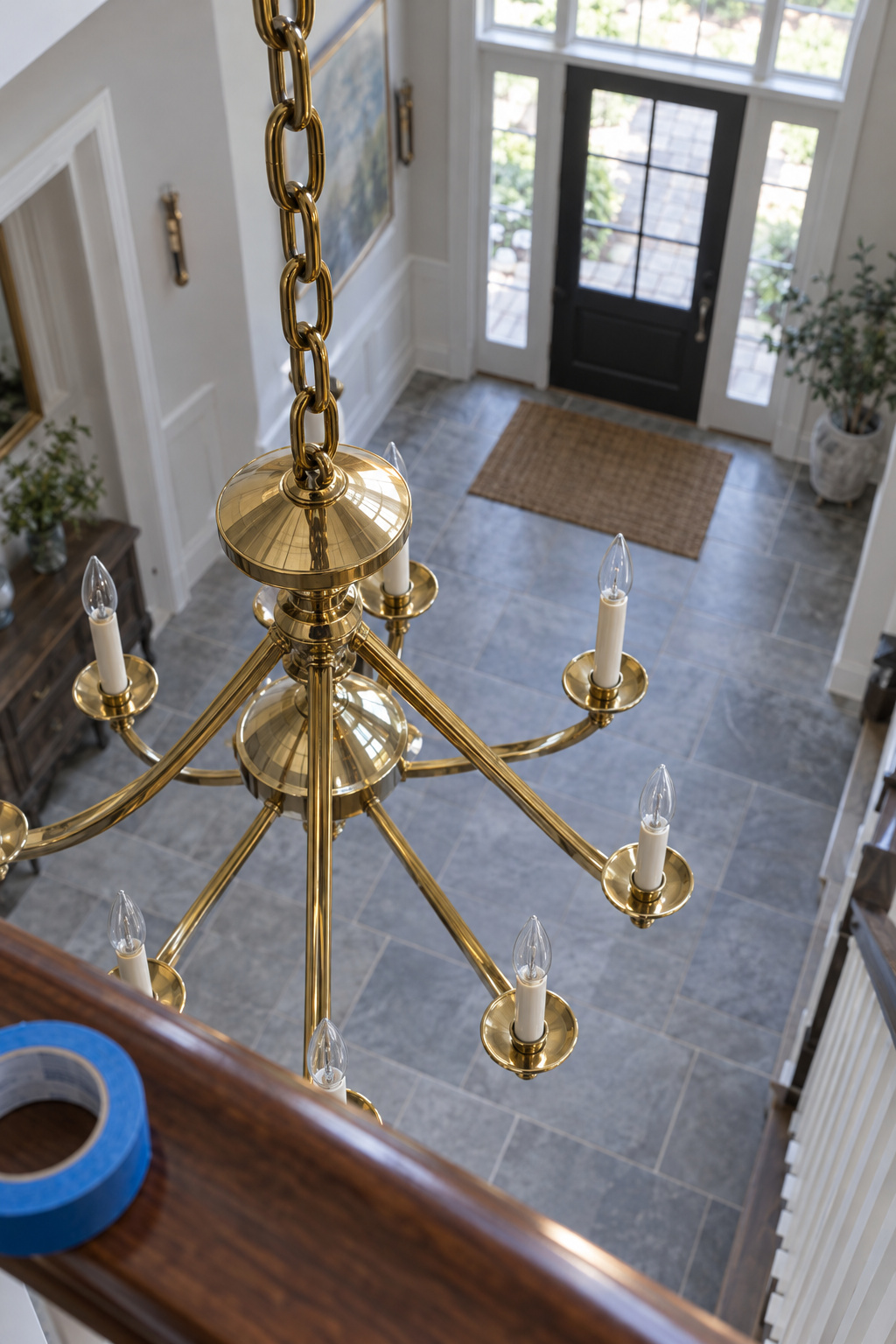
So test it in your own room:
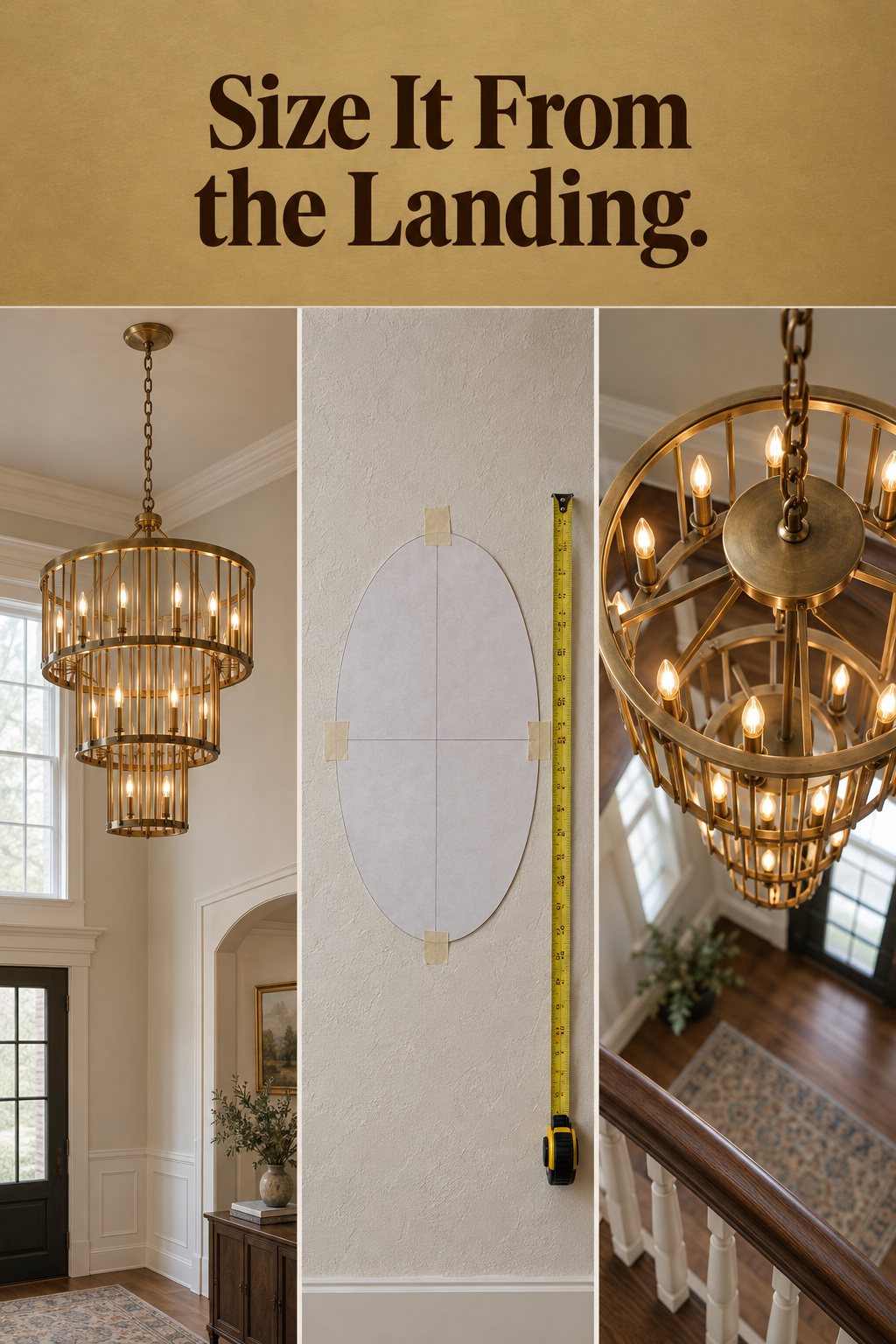
- Cut a paper template the height and width of the fixture you are considering.
- Tape it to the wall above the hang point at the drop you have in mind, top and bottom marked with painter’s tape.
- Stand on the doormat and look. Then climb to the landing and look again.
- Move the tape until both views agree, and write the final drop on the wall in pencil.
Standing at the front door
The door view sets the lowest point. Stand where a guest stands and notice where your eye goes first. Center the fixture on the ceiling void and the line of the front door, which is not always the middle of the room; if there is a window above the door, center it there. If the bottom edge cuts across that window from the doormat, the drop is too long.
Looking down from the upstairs landing
In a showroom I pull a drawer all the way out and turn it over, because the underside tells me how it was made. The landing does the same to a chandelier. From above you see the top, the canopy and the chain, and The Inspiration Edit puts it plainly: a dusty upper surface or bundled cords are “on permanent display”. The landing sets how much of that you see. Some sellers place the main mass of the fixture around the landing level. Buy one finished on top, with clean chain or cable work.
How it looks unlit at noon, when the high window does the lighting
Most hours of the day the fixture is off, and I think that is how it should be. Overhead lighting is for cleaning, not for living, so a foyer chandelier spends its life as an object in daylight, backlit by the window above the door.
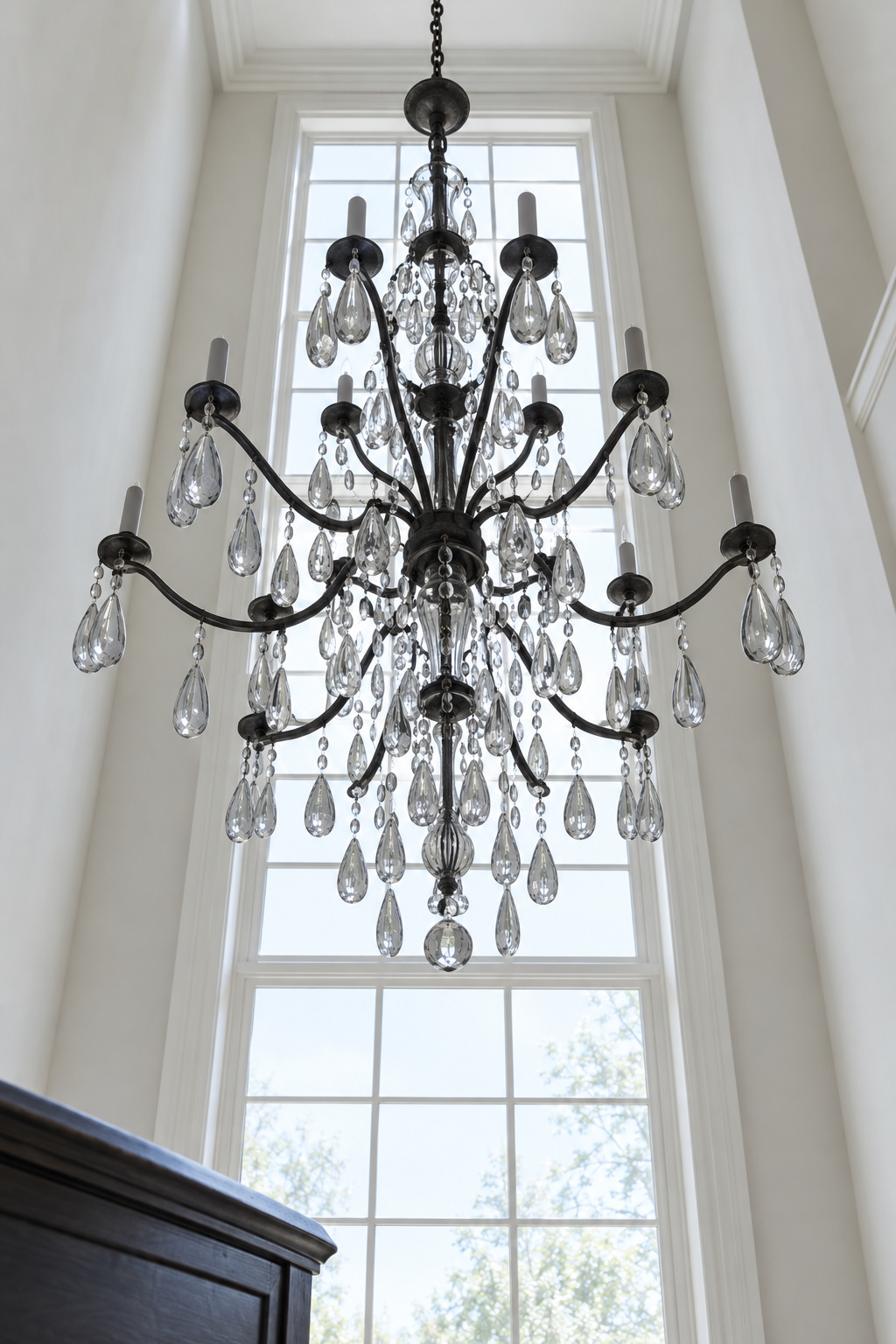
So look at it switched off, at midday, against the glass and the wall. Judge the silhouette first: a clear outline holds up, a tangle of arms turns into noise against the bright window. Then the finish, which daylight shows more honestly than any bulb. Then the glass, which can catch glare or simply disappear. A flat-bottomed drum shows a blank disc to anyone below it. A fixture that seems substantial in a showroom can vanish in a tall room, and noon is when you find out. Try it in February, when the sun is low. I would rather learn that from a paper template than from the finished ceiling.
The window shapes all of this, so settle what to do about the high window before you judge the fixture against it. Shaded or frosted glass is kinder to anyone on the stairs than bare bulbs at eye level.
What holds it up and who changes the bulb: plan both before you buy
The box, the weight and the electrician
Under NEC 314.27(A)(2), in the 2017 text, a ceiling box for lighting must carry a fixture of up to 50 lb. Anything heavier must be supported independently of the box unless the box is listed for that weight, and the maximum is marked inside the box. Fan boxes follow a different rule, so do not ask for a fan box and assume the matter is settled. Foyer chandeliers have no typical weight to quote, which is one more reason to read the back of the catalog. Fitting the box or bracing it to the framing is an electrician’s job.
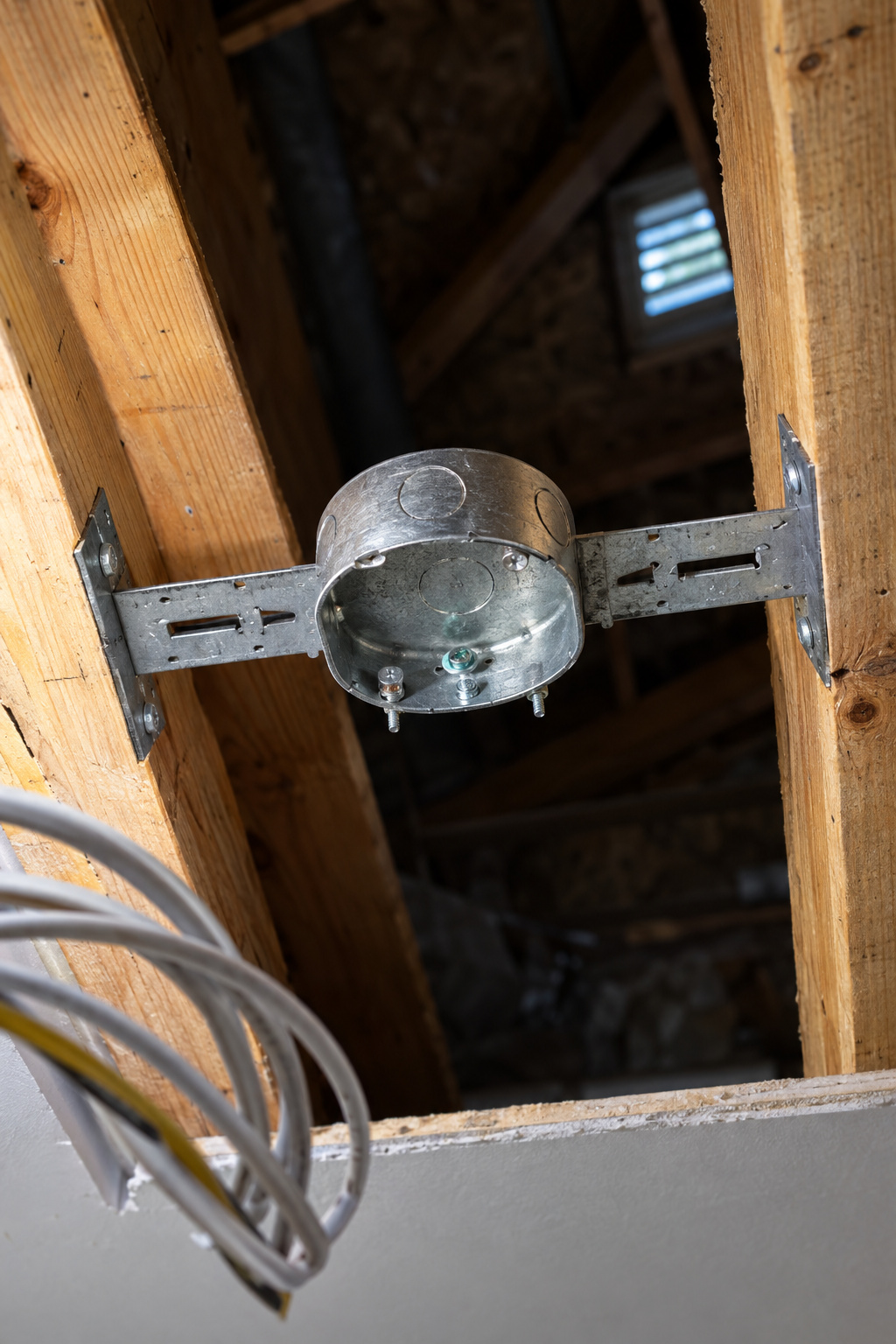
Three ways to change a bulb 18 feet up
The three options side by side:
| Option | Typical cost | What it suits | Trade-off |
|---|---|---|---|
| Long-life LED lamps | The price of the lamps | Any fixture with replaceable lamps | Needs a fixture with replaceable lamps |
| A pro with a tall ladder | $75 to $140 a visit, most pay about $110 | Occasional bulb changes | Labor only; ask whether they have equipment for a very tall ceiling |
| Motorized lift (Aladdin, rated 200 to 1,000 lb) | $1,149 to $2,319 for the 200 to 700 lb models, lift alone | Heavy or crystal fixtures that need cleaning | An electrician installs it at extra cost; needs about 3 ft of space above the ceiling or a remote mount |
ENERGY STAR’s decorative-lamp specification starts at a rated life of 15,000 hours; at three hours a night, about 13.7 years. Rated life is a lab figure, not a promise. Check before buying that the fixture takes replaceable lamps at all.
The lift lowers the fixture to the floor and cuts the power while it is down. On the lift’s price alone, with installation extra, the cheapest one takes about 10 typical visits to pay for itself, which is a long wait. Cleaning changes the sum: a professional clean of a mid-size crystal fixture runs about $260 every two to three years, so the cheapest lift equals nine to thirteen years of cleanings. Buy the better hinge. If the fixture is heavy crystal, I think the lift is that hinge. If it is simple metal with replaceable lamps, a professional visit now and then is enough, and the ladder plan for the top of the wall covers the rest.
Your first move this week: tape the height on the wall from both ends
You started with a formula and a rule about the second floor. Keep the formula as the smallest diameter. Choose the fixture by its height, set the drop by looking from the door and from the landing, and decide before you buy who holds it up and who reaches it.
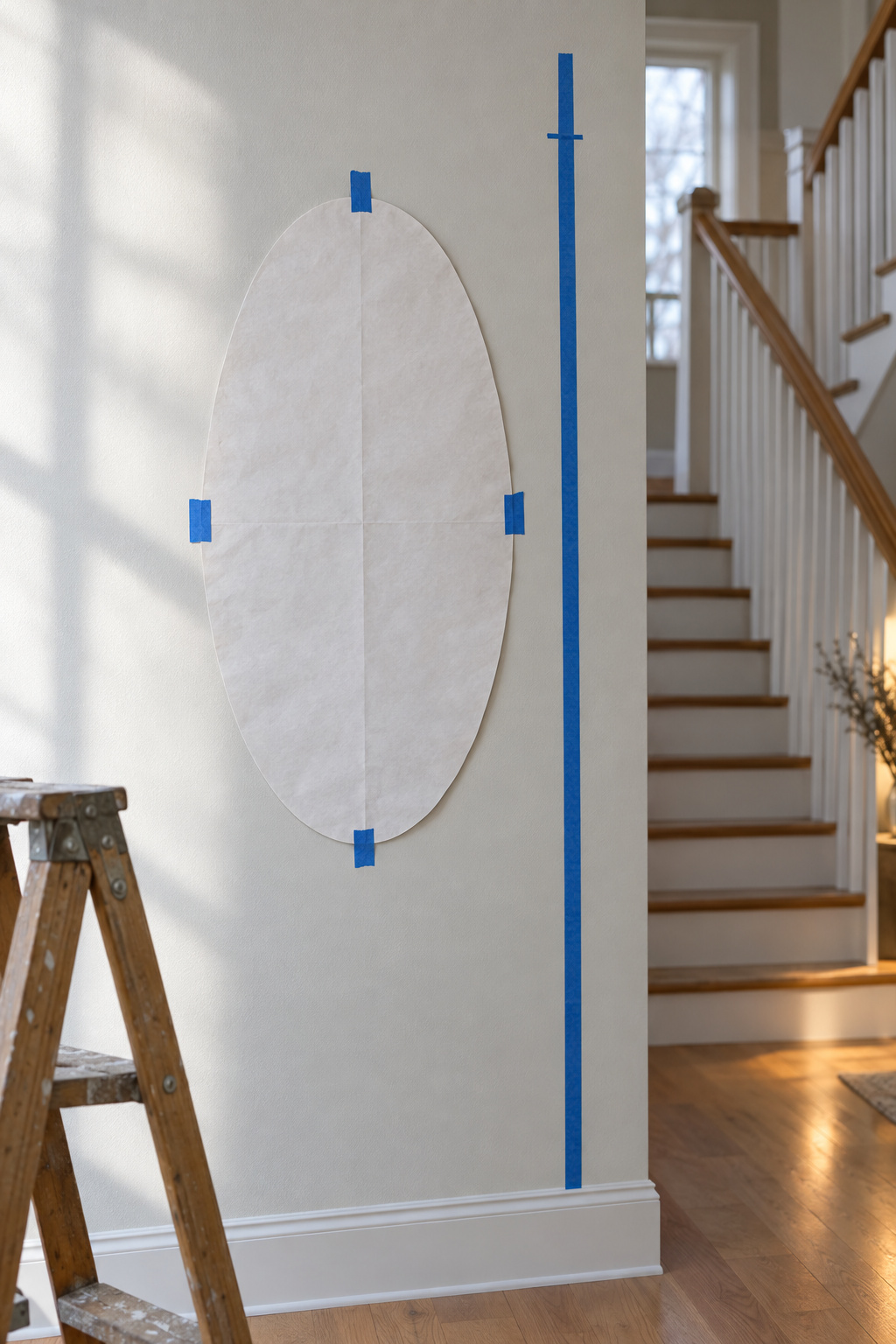
The first step costs a roll of painter’s tape. Mark the top and bottom of the fixture you want on the wall at the hang point, then look from both ends. A retailer suggests hanging a balloon at the planned size; I prefer tape, because you can leave it up for a week. Write the access plan in pencil beside the marks.
The chandelier is not the light you live by. From October I leave one lamp on in the kitchen window, so the house looks occupied from the road when I ski back. That low light does more for coming home than anything on a ceiling, and warming the foyer with lower light and softer surfaces is where the working light of the entry belongs.
FAQ
How many chandeliers does a two story foyer need?
One, in most foyers. Hang a single fixture centered in the space, or one long cascade that serves both floors, with wall lights to support it if needed. No standard sets a number. A second fixture in the stair void is a design choice rather than a requirement, and it usually makes two small decisions where one large one would do.
Should a two story foyer chandelier be on a dimmer?
Yes. A dimmer lets the same fixture run bright when people arrive and low as an evening light. With LED lamps, use a trailing-edge (ELV) dimmer; an ordinary leading-edge dimmer can cause flicker, buzzing and a narrow dimming range. Check the fixture maker’s compatibility list, and if you plan a lift, check its wattage limit too.
Can a chandelier hang off-center from the front door over the stairs?
Yes, if the clearances hold. Center it on the open stair well rather than the foyer floor, measure from the tread directly below, and keep the lowest point at least 6 ft 8 in above the treads. Where the well is narrow, keep at least 24 in between the fixture’s widest point and the railing.