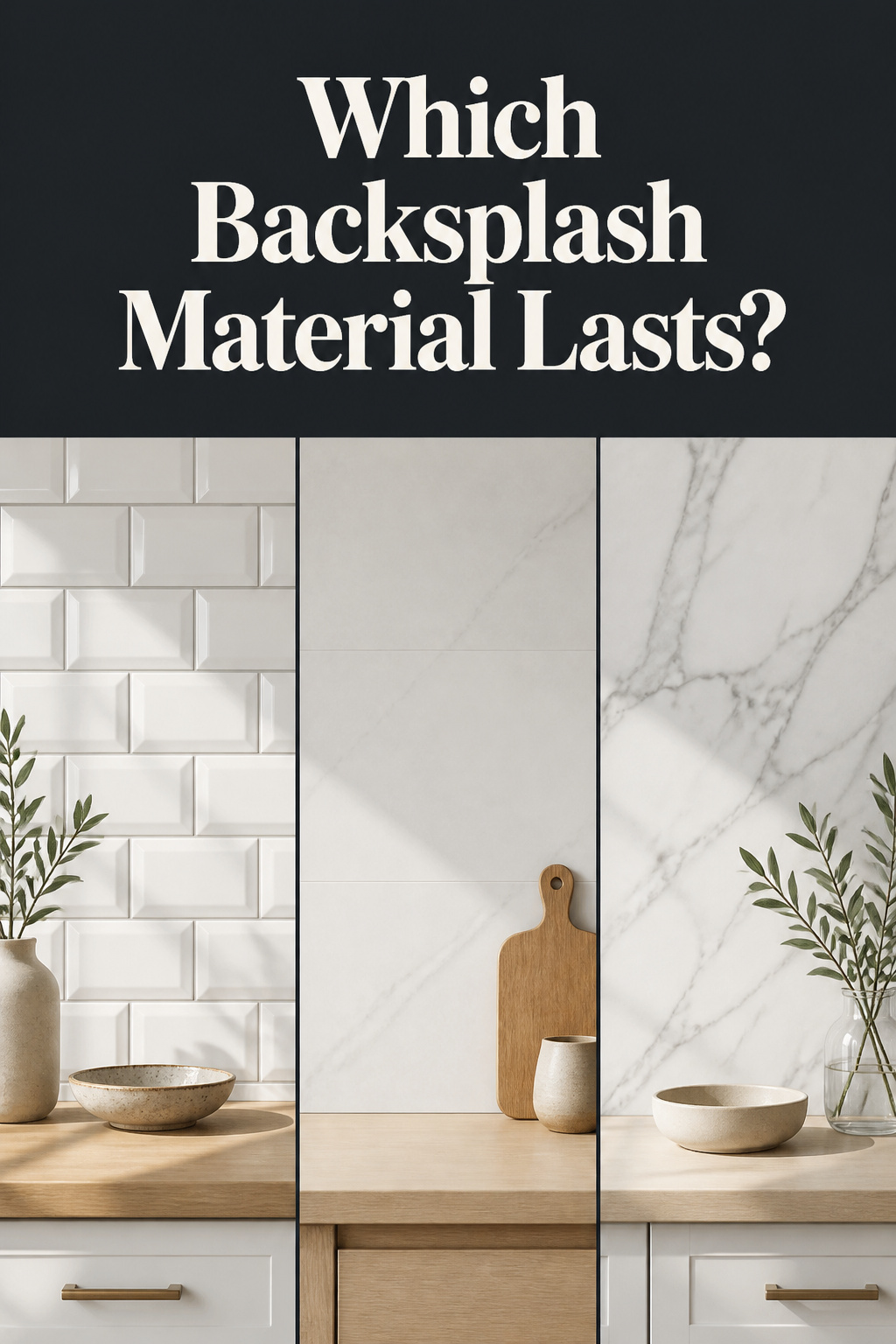
In a showroom, every sample wins. The marble looks as clean as the porcelain; the glass mosaic catches light the same way the ceramic does. That is the problem. A showroom shows you backsplash tile materials at their easiest moment — dry, evenly lit, never once hit by hot grease. The differences that decide a real kitchen stay hidden until six months after the install, and by then the wall is up. So the honest comparison is not which sample looks best on the board, but which material behaves best behind the way you actually cook.
TL;DR
- Porcelain is the most durable: fired to 2,500°F, it absorbs 0.5% or less water (ASTM C373) versus ceramic’s 3–7%, and never needs sealing — but for most backsplashes glazed ceramic performs the same for less.
- Marble and natural stone are porous and reseal every 6–12 months; marble also etches from acid splatter no sealer can stop, so a honed finish near the stove hides the damage best.
- Quartz slab gives the seamless, groutless look, but its resin binder softens around 150°F — keep it off the zone directly behind a gas range and use stone slab or porcelain there instead.
The Prettiest Sample Is Often the Wrong One
Ask first what you want this wall to be — a surface you forget about, or a material you are happy to look after. That answer ranks the five families faster than any showroom visit, because the showroom is built to flatter, not to inform. For the wider context on choosing a kitchen backsplash, the complete guide to kitchen backsplashes is a good starting point.
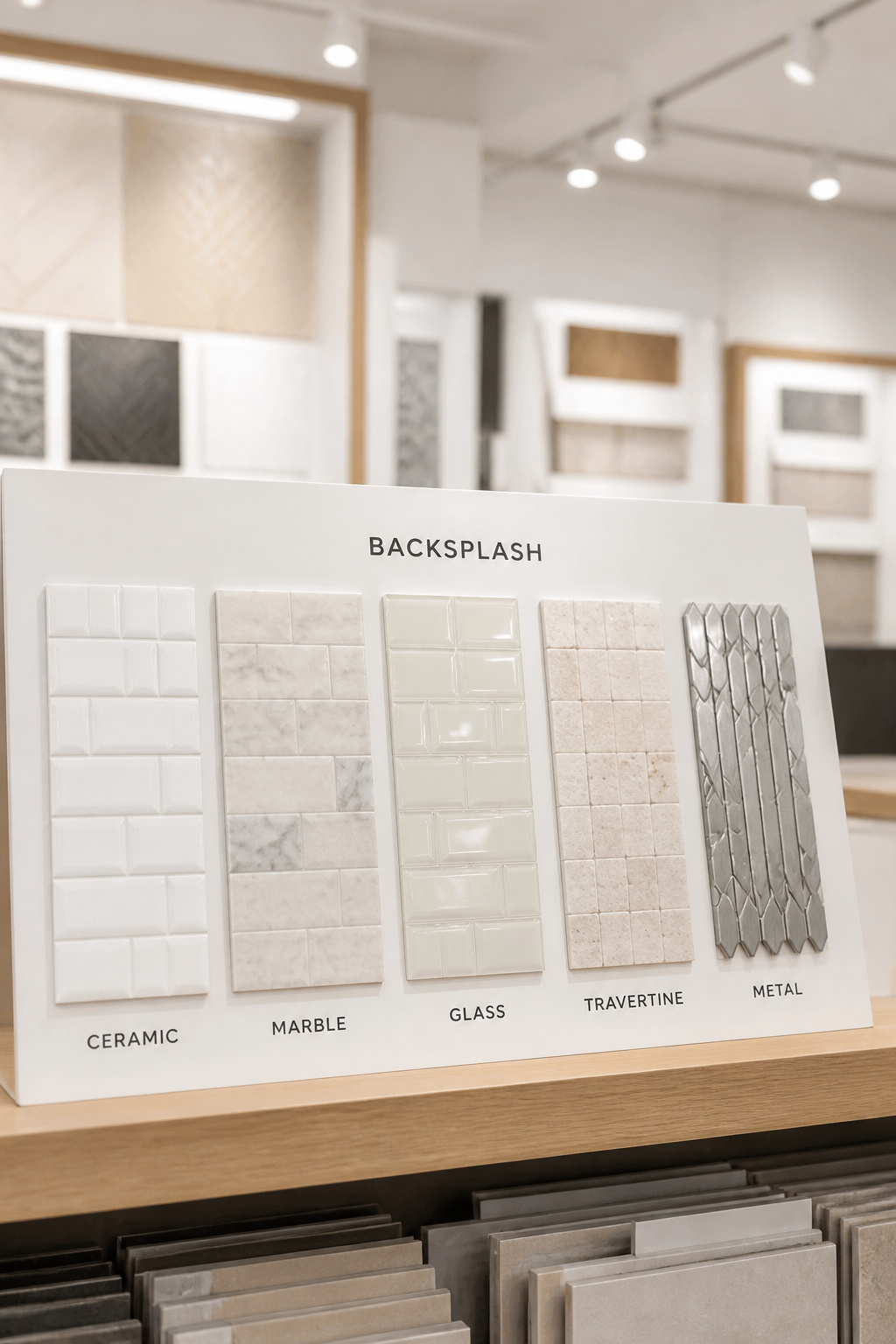
Why showrooms flatten the differences
Every sample sits on the board clean, dry, and under the same bright light — exactly the conditions that make all materials look equal. Marble and glazed ceramic are nearly indistinguishable under display halogen, and the gap only opens after the cooking starts, when one wipes clean and the other has dulled where the tomato sauce landed. Quartz and quartzite get confused at the counter too: quartzite is natural stone that needs sealing twice a year, while quartz is engineered and never needs it but cannot take direct heat.
The four axes that actually decide it
Four things separate these materials, and price is only one. Durability is resistance to chipping and surface wear. Heat and stain resistance is how the surface holds up behind the stove, where grease lands hot and acidic foods are constant. Upkeep is the ongoing cost — sealing, grout, cleaning effort. Installed cost is material plus labour together, since a cheap tile with a hard install can match a premium one once the fitter is paid.
How to read this comparison
Each section below gives one material family its own verdict and a plain “pick this if” line; the last puts all five on one table for a single-pass decision. This article is about substance only — how far up the wall to run it, and the seamless-versus-textured style question, are separate decisions.
Ceramic and Porcelain: The Sensible Default
For most kitchens, the right answer is here, and it costs less than the showroom would like. Ceramic and porcelain are both fired clay — not the same material, but on a vertical wall the cheaper of the two usually does the job.
What separates ceramic from porcelain
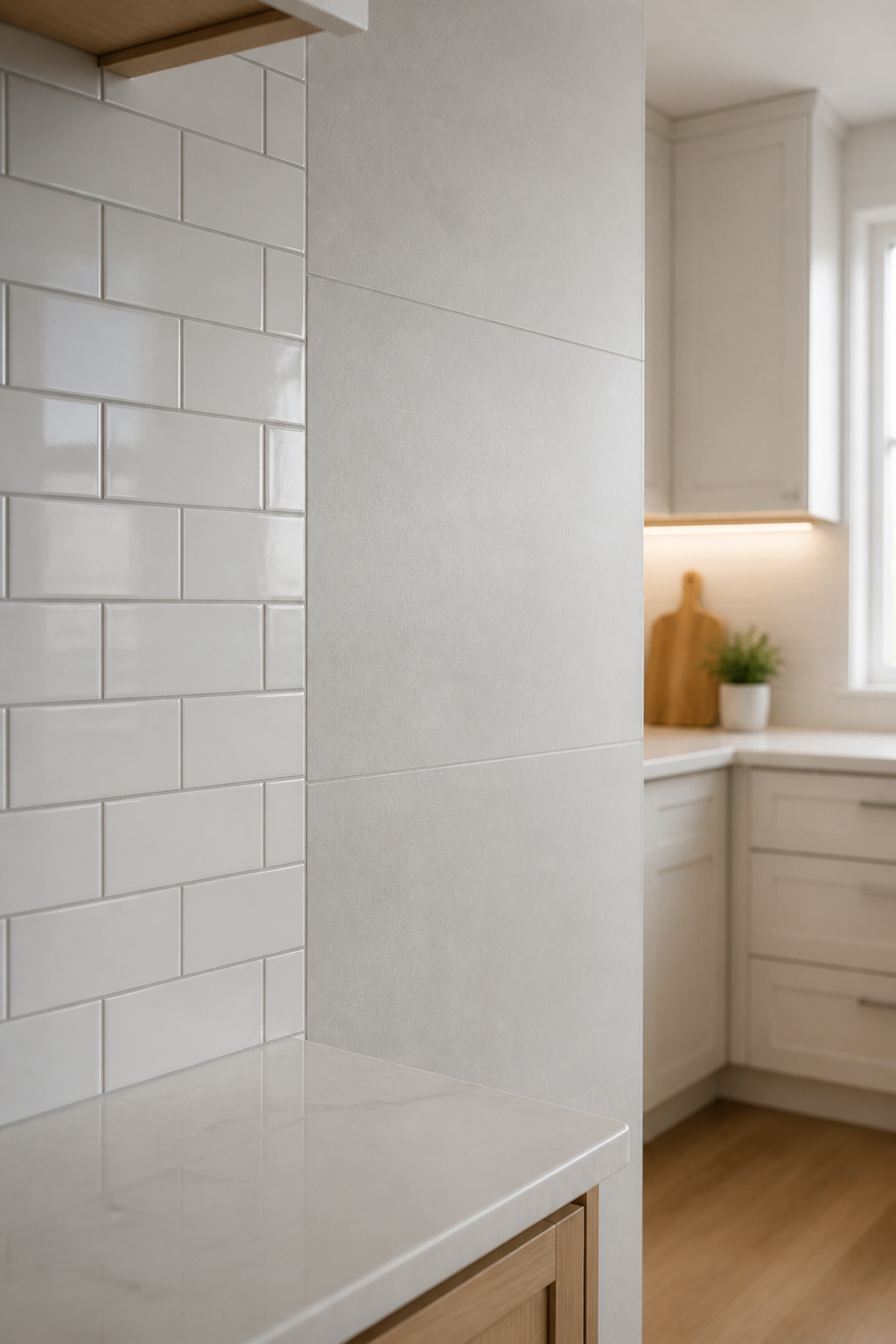
The line between them is measured. Under ASTM C373, porcelain is defined as impervious — a water absorption rate of 0.5% or less — while ceramic typically absorbs 3–7% of its weight. That density comes from heat: porcelain is fired up to 2,500°F against ceramic’s 1,800–2,000°F, giving a harder body and through-body colour that hides a chip. Most porcelain rates 5 on the PEI hardness scale and ceramic runs 1 to 4, but on a backsplash, where floor-level wear never happens, a ceramic at PEI 4 is effectively porcelain’s equal. The real trade is practical: porcelain costs 20–50% more in material and needs a wet saw, with the labour to match.
Where each one wins
Ceramic material runs $2–$10 per square foot; porcelain $4–$20. Ceramic also offers far more colour, texture and finish at the lower end, which matters when the design is doing the talking. Porcelain earns its premium in two places: behind a high-output stove, and in humidity, where its near-zero absorption shrugs off the moisture cycling that can micro-crack a more porous tile. Both are heat-resistant, stain-resistant once glazed, need no sealing, and last 20-plus years. One caution: buy glazed, not unglazed — the glaze does the protective work that a backsplash needs.
Pick this if
Pick glazed ceramic if budget and design variety matter and the wall is not behind a commercial-grade range or a permanently wet sink. Pick porcelain if it runs behind a gas or pro-grade cooktop, sits in sustained humidity, or you want through-body colour so a knock never shows. Away from the stove, ceramic is the rational choice — the porcelain premium buys nothing you will notice.
Glass: Light, Easy, and Its Limits
Glass is the easiest surface here to keep clean and, in the wrong kitchen, the most demanding to install. Both facts come from one property: it is genuinely non-porous.
Why glass cleans so well
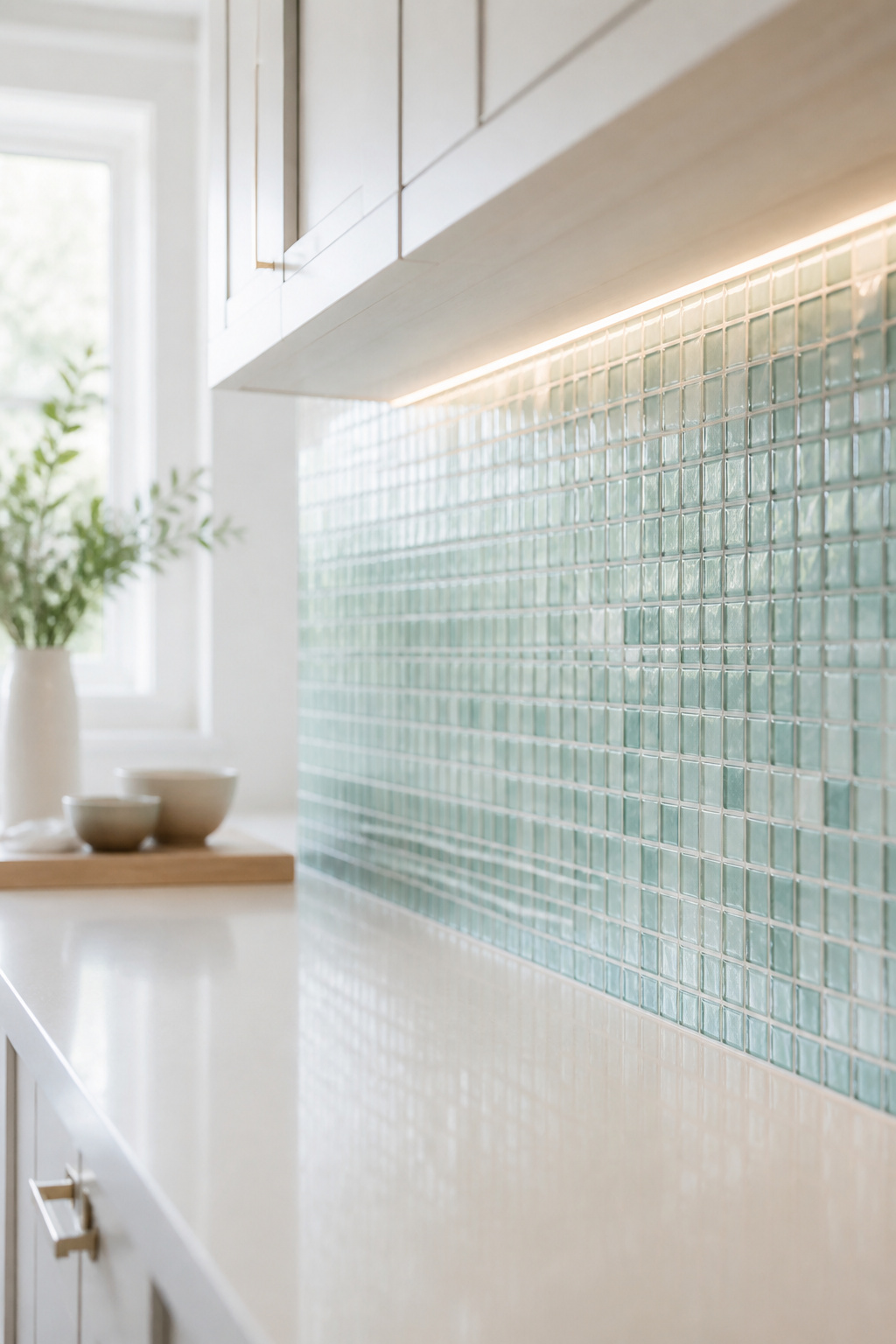
Glass has a 0% water absorption rate. Grease, splatter and limescale sit on the surface instead of soaking in, and a soft cloth with mild detergent takes them off. Nothing needs sealing, ever, and mould cannot colonise a non-porous face. It also reflects light, which no other material here does: in a kitchen short on daylight, a glass backsplash measurably lifts the brightness and makes a small room feel more open. Some glass tile is made from recycled glass and is recyclable again at end of life — a sustainability credential ceramic and stone cannot offer.
Where it shows its weaknesses
Cost is the first limit: glass runs $8–$44 per square foot in material alone, two to four times ceramic. The second is installation. Translucent and transparent glass shows the adhesive through the face, so it must be set on white thinset — a standard grey mortar reads straight through as a shadow. That is the common DIY failure, permanent once cured, so budget for a professional fitter. The third limit is daily: a glossy face shows fingerprints, watermarks and fine scratches more readily than ceramic or stone, where matte or textured glass hides them.
Pick this if
Pick glass if the kitchen is small or dark and the light it throws back genuinely helps, you value easy cleaning above all, and the budget covers a proper installer. Choose matte or textured over high gloss in a busy kitchen. Avoid it directly behind a gas range if you scrub hard and often — gloss marks over time where matte porcelain would not.
Natural Stone and Marble: Beauty With Homework
Natural stone gives a backsplash character no manufactured tile can copy — and asks for something back every six months. That trade should be made with eyes open.
Veining and character
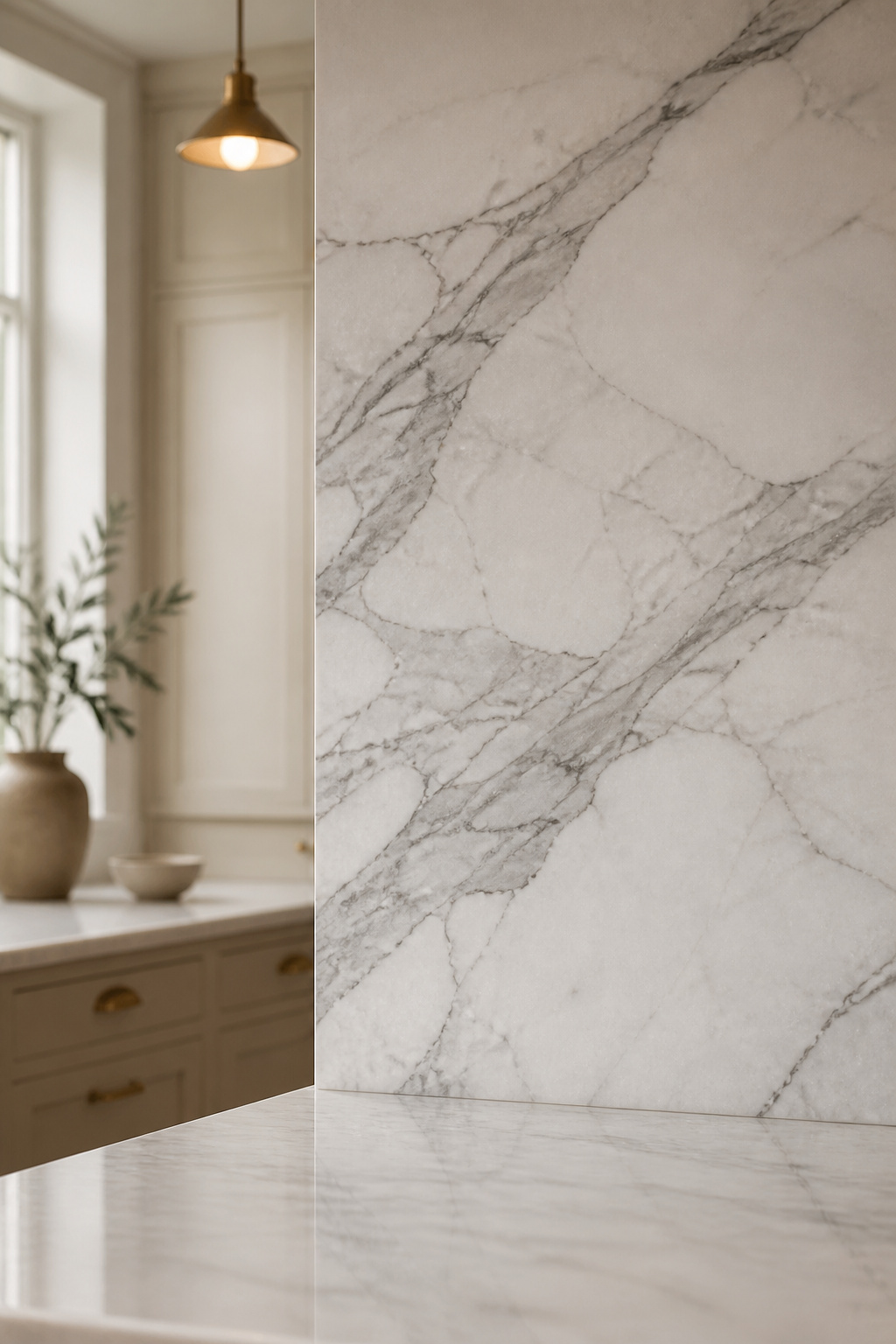
No two pieces are alike, which is the appeal. Marble runs $40–$100 per square foot installed, quartzite $60–$120, travertine $50–$100, granite $32–$75 — but the differences between the stones matter as much as price. Quartzite — metamorphic sandstone, not engineered quartz — gives marble-like veining at 7 on the Mohs hardness scale against marble’s 3 to 4, the most durable natural stone for a busy kitchen. Granite’s high silica content makes it toughest on heat and scratches. Travertine, a form of limestone, brings warm honeyed tones but must be fully filled, or oil and moisture work into its pits.
Sealing, etching and the acid problem
All natural stone must be sealed: marble and travertine every 6–12 months, quartzite about twice a year, granite less often. But sealing solves the wrong problem near a stove. Etching is not a stain — it is a chemical reaction. Acids in lemon, vinegar, tomato and wine react with the calcium carbonate in marble and travertine, dissolving the polished surface into a dull, rough patch that no sealer prevents — a sealer stops liquid soaking in, not the acid. The only prevention is keeping acid off the stone, more manageable on a vertical wall than a counter, but a heavy cook should accept light etching near the stove over time. One move helps: honed, matte marble hides etching far better than polished, because the etch and the surface share the same low sheen. On polished marble the mark reads as a dull spot against the gloss.
Pick this if
Pick marble if cooking is light, you can live with etching as a patina, and natural veining is the whole point. Pick quartzite for marble’s look closer to granite’s toughness — harder, more acid-resistant, sealed only twice a year. Pick granite if heat and durability lead. Avoid all natural stone near the stove if the household cooks acidic dishes daily and resealing every 6–12 months is not realistic — a material you will not maintain is the wrong material.
Quartz and Stone Slab: The Seamless Premium
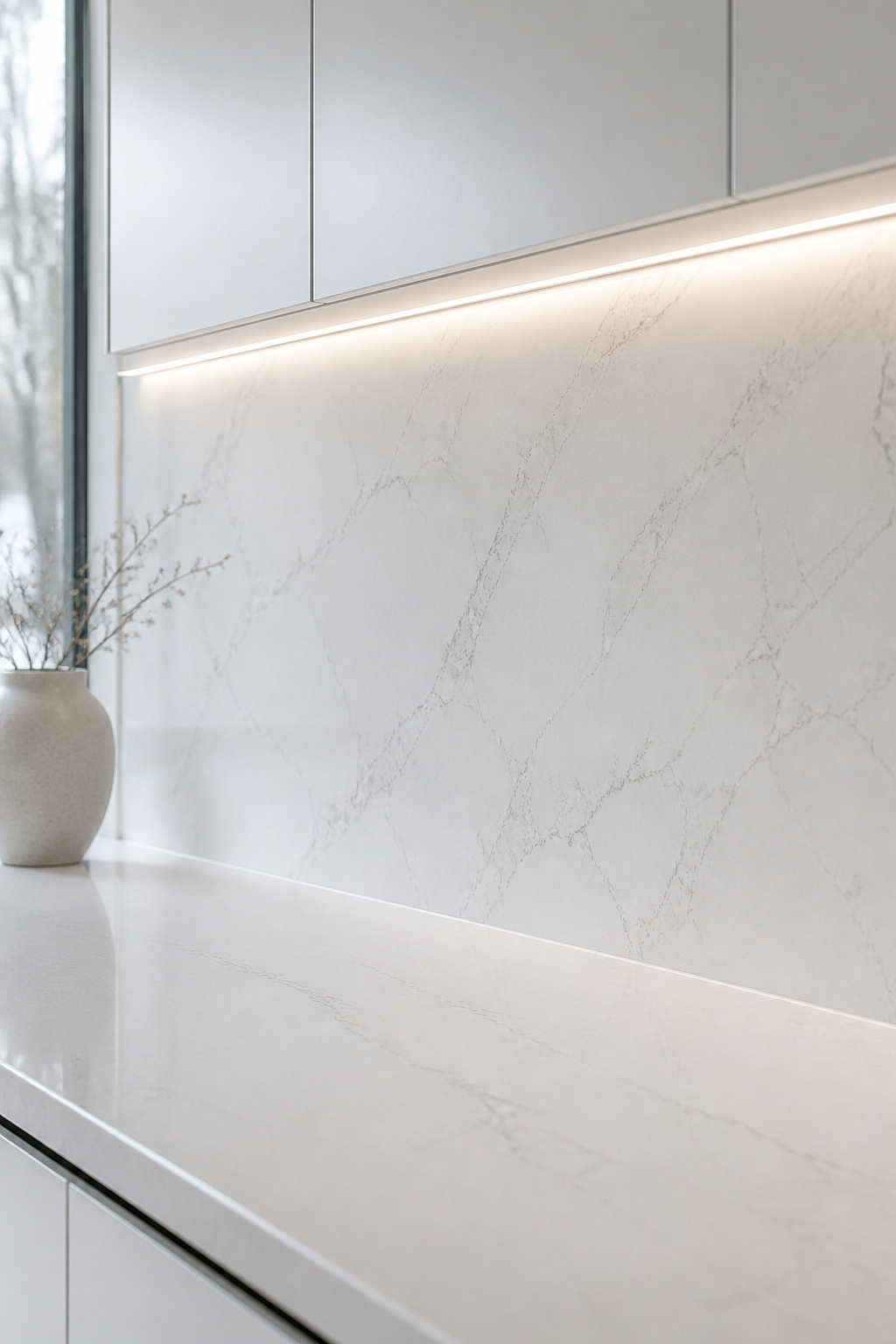
A slab does away with grout entirely, carrying the counter material straight up the wall in one continuous plane. It is the cleanest surface to wipe and the calmest modern look — and it carries one limit that decides where you can use it.
One continuous plane, no grout
The practical win is the absence of grout joints — nothing to harbour grease, bacteria or discolouration, the real advantage over tile in a heavy-cooking kitchen. Engineered quartz is roughly 90% ground natural quartz bound with about 10% polyresin, which makes it non-porous, sealing-free, and consistent in colour across the whole slab. It runs $50–$120 per square foot, $70–$180 installed at full height. Fitting is quicker than tile, but the weight and precise cutting need professional fabrication.
Heat caution and cost
Here is the one fact to fix before you commit: the polyresin binder in quartz begins to soften or discolour at around 150°F (65°C). A hot pan or griddle pushed to the wall can leave a permanent whitish burn in the resin, and that damage is usually irreparable — a scratch polishes out, a resin burn needs the panel replaced. So directly behind a gas range or high-BTU cooktop, natural stone slab — quartzite or granite — is the safer call, both fully heat-resistant. Everywhere else, away from direct flame, quartz outperforms marble and travertine on upkeep: non-porous, no sealing, more stain-resistant than either.
Pick this if
Pick quartz slab if you want the seamless countertop-to-cabinet look, your cooktop is electric or induction rather than open-flame gas, and zero grout maintenance is a firm requirement. Pick natural stone slab — quartzite or granite — for that same plane with full heat resistance behind a gas range, if you will keep to the sealing schedule. If the seamless plane draws you, the wider aesthetic of large-format and slab belongs to the seamless slab look.
Backsplash Tile Materials Side by Side: Your Pick
Set against each other on the axes that matter, the five families stop looking interchangeable. Match the material to how you cook and clean first; let budget settle the rest.
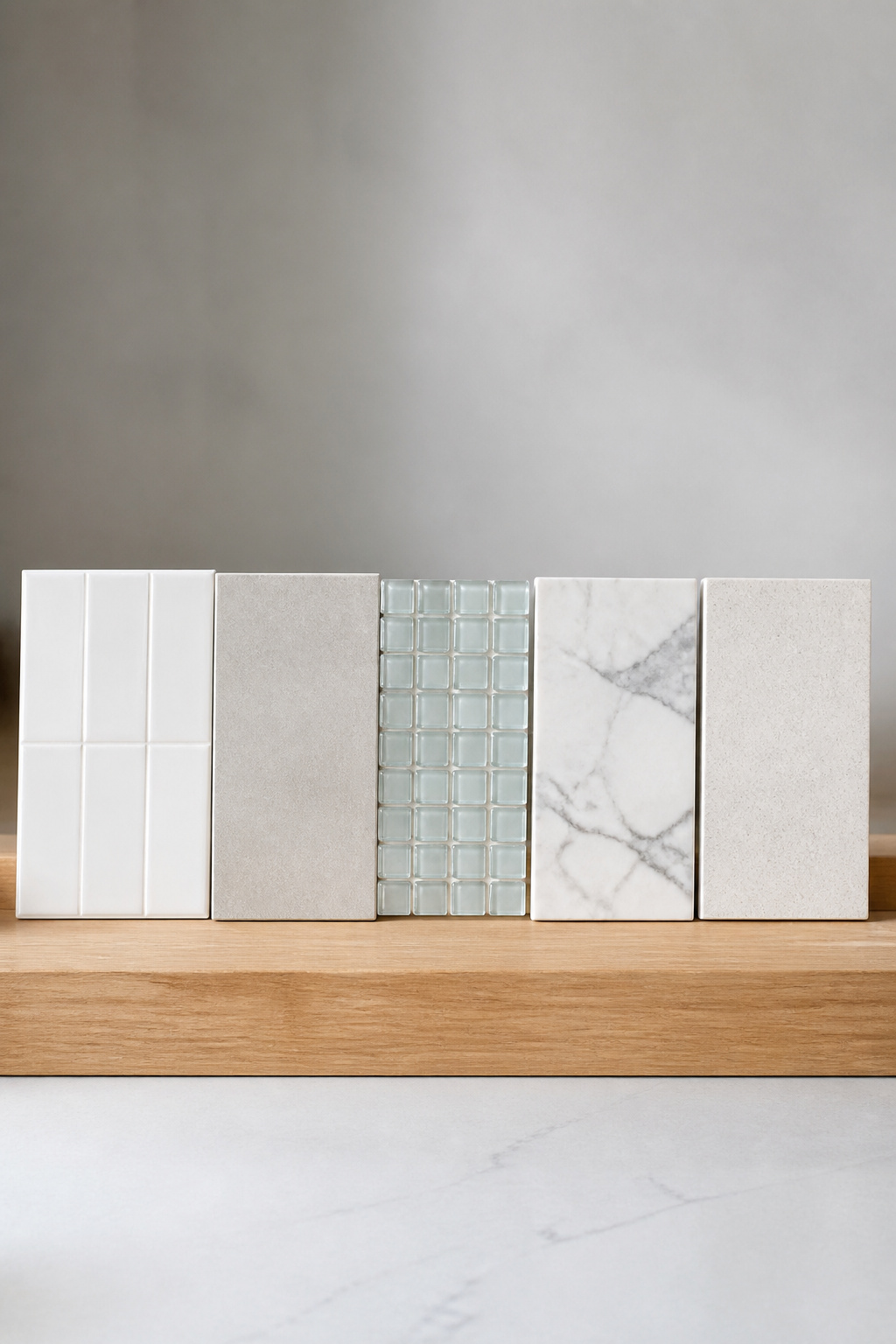
All five families on one table
The table reads on the four axes plus rough installed cost — one pass shows which families your kitchen rules in or out.
| Material | Durability | Heat / stain | Upkeep | Installed cost (per sq ft) | Best for |
|---|---|---|---|---|---|
| Ceramic (glazed) | Good | Good | Low — no sealing | $12–$45 | Budget and design variety |
| Porcelain | Excellent | Excellent | Low — no sealing | $16–$60 | High humidity, near a hot stove |
| Glass | Good | Excellent (non-porous) | Low, but shows marks | $18–$79 (pro install) | Light, easy cleaning |
| Natural stone / marble | Good to Excellent | Fair–Good (marble etches) | High — seal every 6–12 mo | $50–$200 | Design priority, will maintain |
| Quartz / stone slab | Excellent | Good (quartz ~150°F limit) | Very low | $65–$200 | Seamless, zero-grout look |
Your material, matched to how you cook
Sort yourself by habit, not by sample. Light cooks who prize the look reward marble or quartzite, both lasting decades with twice-yearly sealing. Heavy cooks want porcelain tile or natural stone slab behind the stove — the only two that handle heat, acid, and daily cleaning without a maintenance schedule. Renters on a budget are best served by glazed ceramic at PEI 4: a 20-plus-year lifespan at the lowest cost here. Once material is settled, standard versus full height is the next call.
FAQ
What is the most durable backsplash material for a kitchen?
Porcelain tile is the most durable. Fired up to 2,500°F, it reaches a water absorption rate of 0.5% or less under ASTM C373, resists stains, scratches and heat, and never needs sealing. Quartzite, at Mohs hardness 7, is the toughest natural stone alternative, though it requires sealing twice a year.
Is porcelain or ceramic tile better for a backsplash?
For most residential backsplashes, glazed ceramic at PEI 4 performs essentially the same as porcelain at lower cost; the measured difference is water absorption — porcelain 0.5% or less versus ceramic’s 3–7%. Porcelain earns its premium behind high-output gas stoves and in humidity. Away from the stove, ceramic is the rational choice.
Can you put a marble backsplash behind a stove?
Yes, but the concern is not heat — it is acid etching. Splatter containing lemon, vinegar, tomato or wine reacts chemically with marble’s calcium carbonate, leaving permanent dull spots no sealer prevents. A honed, matte finish hides etching far better than polished. Light cooks who wipe splatter quickly can manage marble; heavy cooks should choose quartzite or porcelain instead.