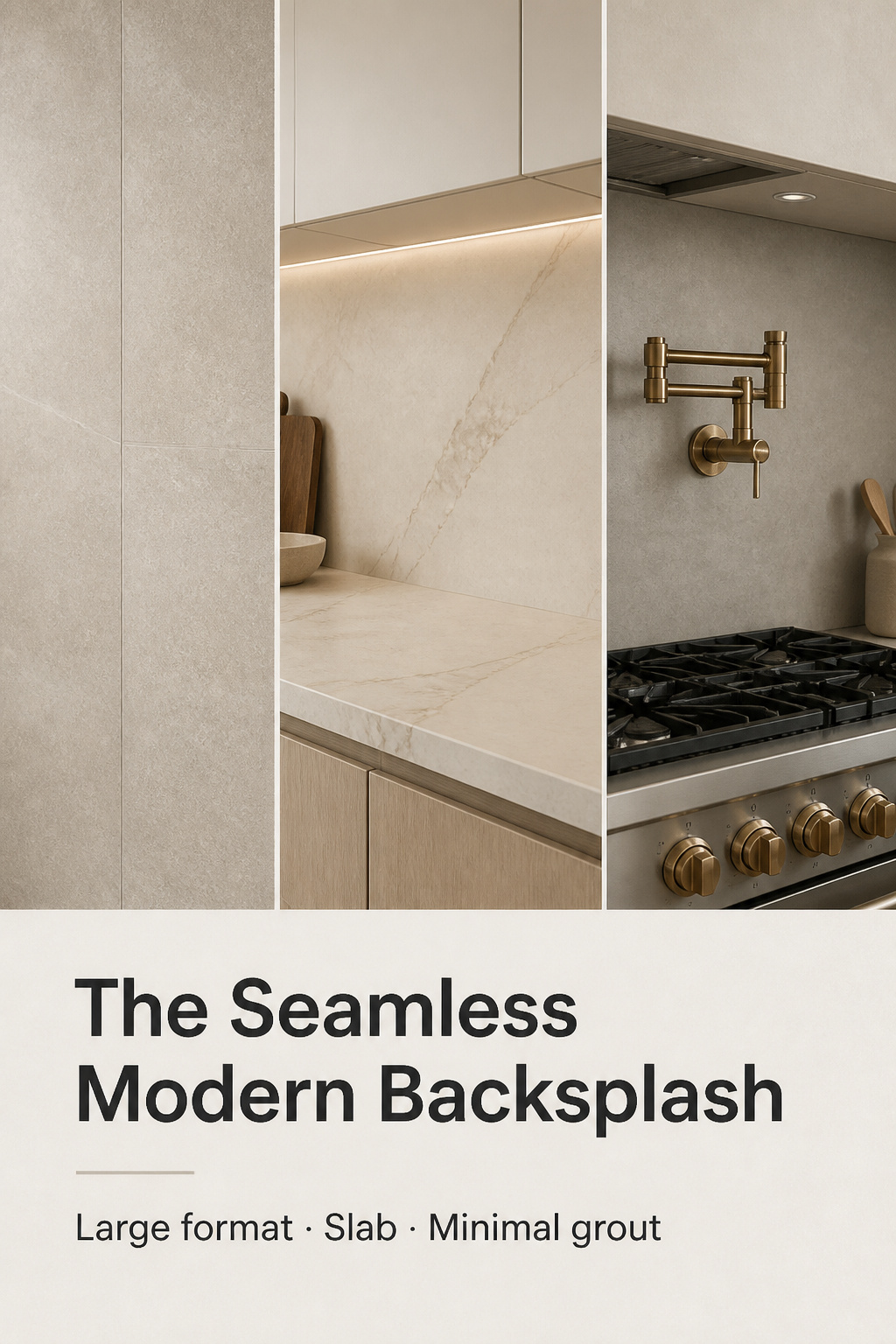
My grandparents’ summer cottage in the Stockholm archipelago had one open shelf of crockery and walls of unpainted pine — nothing decorated, everything quiet. I think of it whenever a client tells me they want a modern kitchen but can’t say what makes one read “modern.” The answer is rarely an object. It is the absence of interruption. A modern kitchen backsplash earns the word by going quiet: fewer lines, fewer joints, one continuous surface instead of a grid. The 2026 trend reports all point the same way — toward walls that read as architecture, not as decoration. The trick is doing it without the room turning cold.
TL;DR
- The seamless look comes from large-format tile (12×24 up to 24×48 inches) with matched grout, or a slab carried straight up from the counter — slab eliminates grout entirely.
- Quartz slab runs $80–$150 per square foot installed; large-format porcelain tile lands at $20–$30, achieving near-seamless results for far less.
- Keep minimal from reading cold with a matte or honed finish and a 3000–3500K under-cabinet LED — warm light grazing a textured surface is the whole correction.
Why Kitchens Are Going Quiet
For decades, a backsplash was where a kitchen got busy — small mosaics, contrasting grout, a band of pattern. The contemporary instinct is the opposite. The wall should settle the room, not perform in it.
The move toward continuous surfaces
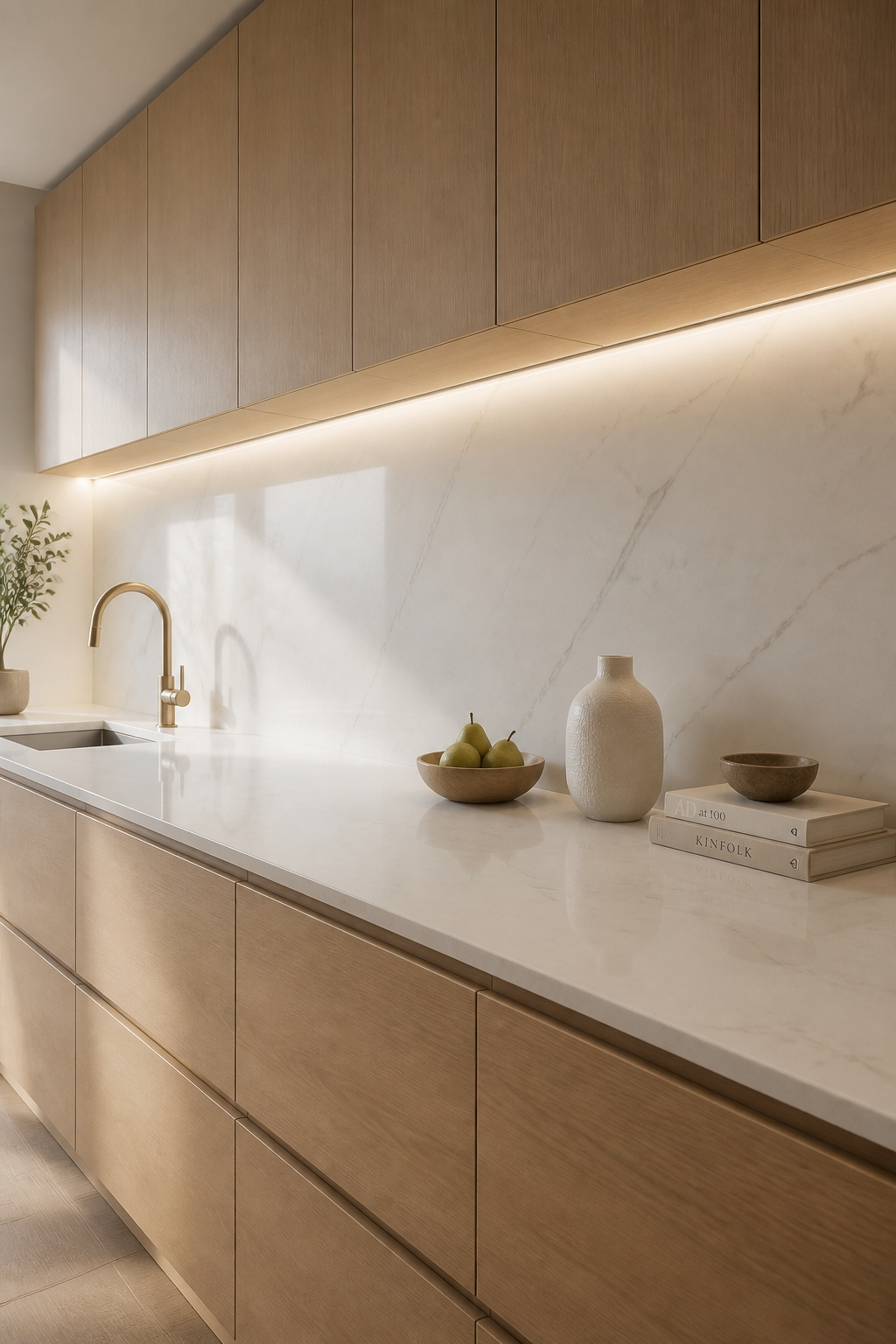
The defining 2026 move is the slab backsplash: a single piece of porcelain or natural stone running from countertop to cabinet with no grout lines at all. Design studios report it as one of the most requested upgrades of the year. A close cousin is the “countersplash” — the countertop material carried vertically up the wall, so the same surface that meets your hands also closes the room behind it. Multiple 2026 design sources — including data from the Houzz Kitchen Trends Study, as cited by stone fabricators tracking the category — list slab and large-format among the fastest-growing segments in kitchen renovation. What unites them is a single idea: one plane, not many pieces.
Fewer grout lines, calmer walls
Grout is the quiet enemy here, in two ways. Practically, grout lines collect grease and cooking residue, so a tiled wall asks for scrubbing where a slab asks for one wipe. Visually, every joint is an interruption the eye has to cross. Remove the joints and the wall stops competing for attention. Fireclay Tile puts it plainly: fewer grout lines mean “a smoother, cleaner look and less visual interruption.” In a Nordic kitchen, that reduction is the whole point — clutter, including visual clutter, is what we design against.
The ‘why now’ behind the trend
This is not trend-chasing dressed up as restraint. The slab and large-format movement is a deliberate rejection of busy patterns. As Turner Design + Build observes, homeowners in 2026 are “moving away from mixing multiple competing materials and instead choosing fewer elements that make a stronger statement.” That instinct is old in Scandinavia. Nordic kitchens have prioritised surfaces that feel like architecture for generations — pale stone, matte finishes, walls that diffuse light rather than chop it up. The seamless trend is the rest of the world arriving somewhere we have lived for a while. For the wider decision, the full kitchen backsplash guide sets the landscape.
Large-Format and Slab: The Backbone
Two material routes produce the seamless look, and they sit at different price points. One nearly erases the grout; the other erases it completely.
Large-format tile and minimal grout
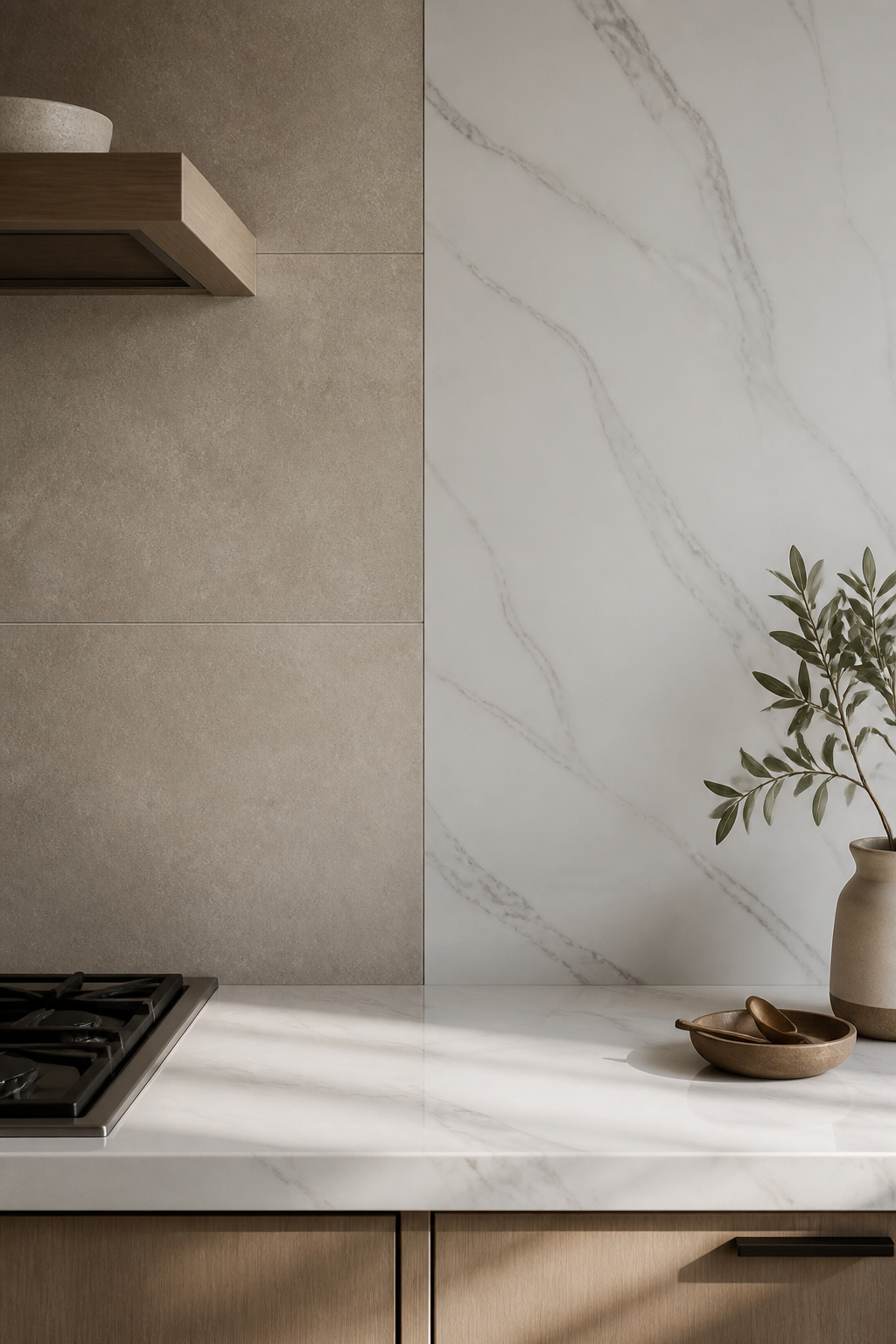
Large-format tile begins at 12×24 inches; 24×24 and 24×48 formats give the most expansive read with the fewest joints. But near-invisible joints have a rule behind them. ANSI A108.02, Section 4.3.8, requires a minimum 1/8-inch grout joint for rectified tiles with any side over 15 inches set in running bond; the absolute floor under any condition is 1/16 inch. The joint must also be at least three times the tile’s facial dimensional variation — which is why rectified tiles, cut to uniform size, are mandatory for this look. Hand-shaped tile varies too much to close the gap. Large tiles are heavy and unforgiving, too: any bow in the wall reads across a broad face. This is professional work.
Slab carried up from the counter
A slab goes further. It carries the countertop material — quartz, quartzite, porcelain — straight up the wall, so veining and movement continue in one unbroken plane. There is no grout to clean, ever. The cost reflects that: quartz slab runs $80–$150 per square foot installed, against $20–$30 for porcelain tile. The premium buys a fabrication process, not just material — precise templating, careful cuts around sockets, and heavy lifting that tile installation never needs. Most slabs run from counter to the underside of the upper cabinets; where there are no uppers, the material can continue to the ceiling. The material substance behind these choices — durability, heat, upkeep — is its own decision, covered in large-format and slab materials.
Matched vs contrasting grout
When you do use tile, grout colour decides whether the wall reads seamless or graphic. The rule for the slab look is simple: match the grout as closely as possible to the tile. A perfectly matched joint lets the eye flow across the surface as if it were one continuous piece. Contrasting grout does the opposite — it outlines every tile, turning the wall into a deliberate grid. That can be a fine choice, but it is the opposite choice. In a Scandinavian kitchen, matched grout is simply the specification: warm off-white, greige or taupe tuned to the tile, so the wall reads as one calm plane rather than a pattern of boxes.
Finishes That Read Modern Without Reading Cold
Here is the trap the seamless look sets. Strip out the joints and the pattern, and a flat, hard, over-lit surface can read clinical — minimal turning into sterile. Two things keep it warm: the finish and the light.
Matte, honed and soft-sheen surfaces
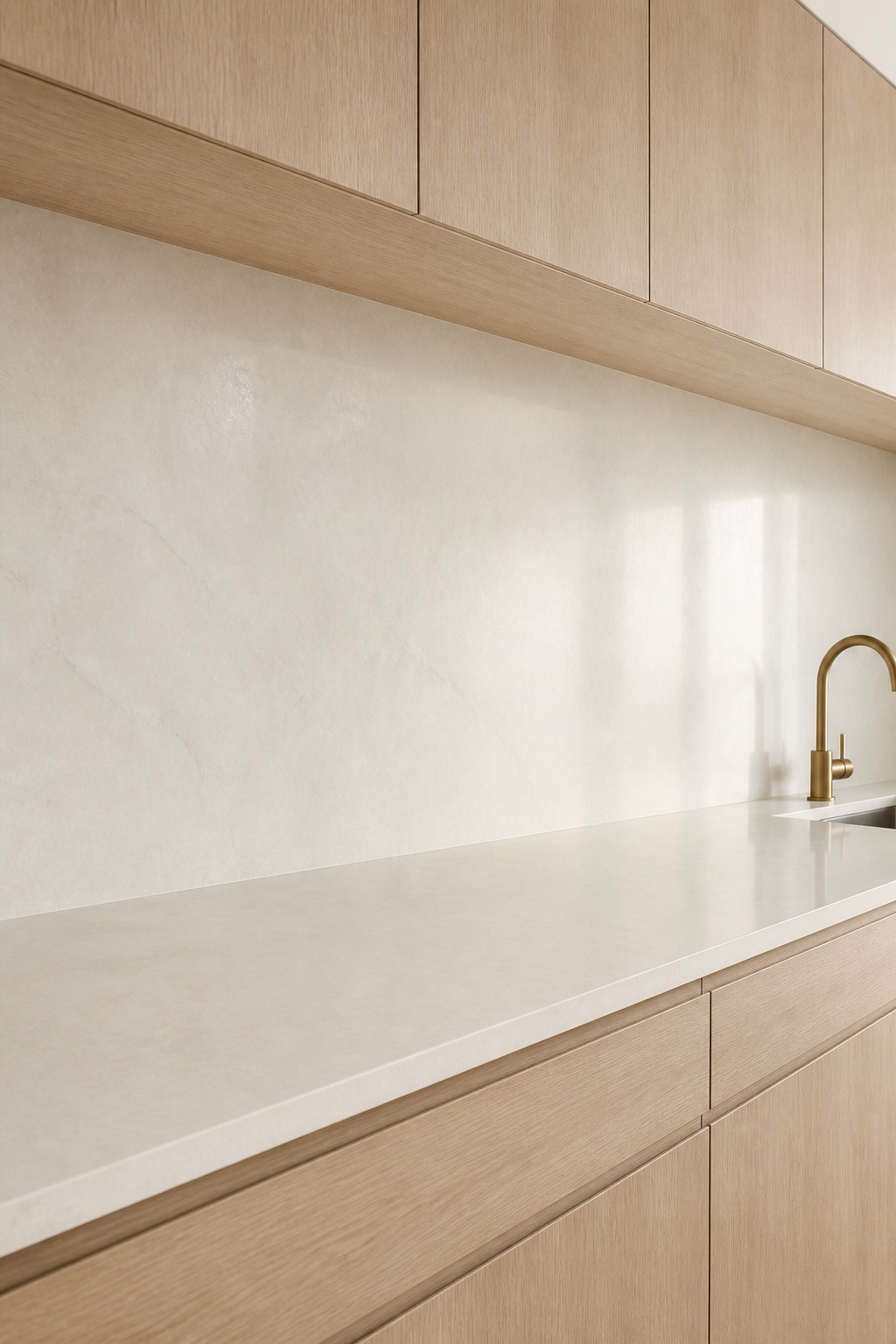
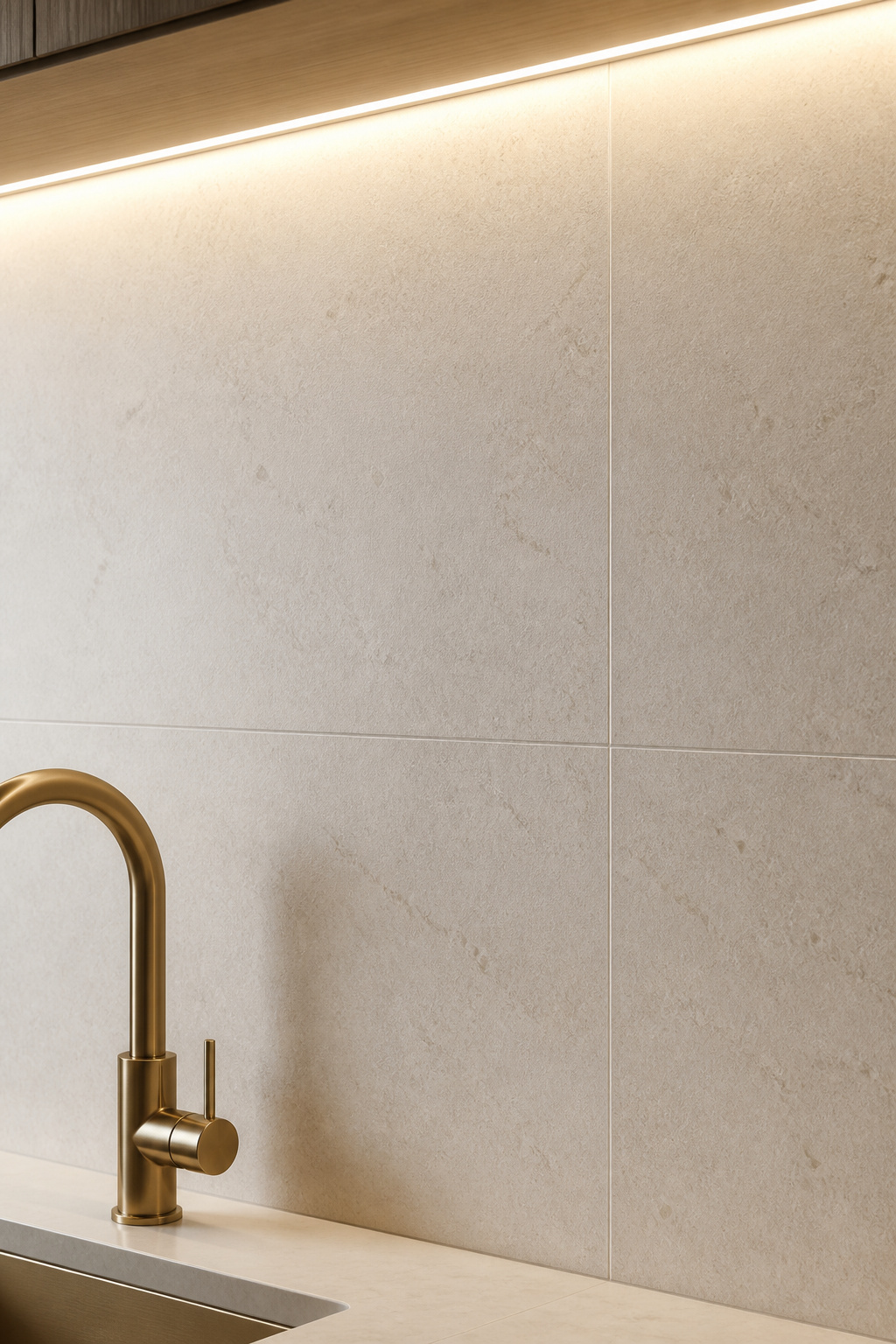
Finish is the first lever. Matte and honed surfaces diffuse light instead of bouncing it back, which is why they feel calm where high gloss feels hard. Matte also hides fingerprints and reduces glare — practical virtues in a daily-use kitchen, and the dominant specification in Nordic and minimalist work. Honed stone takes this furthest: a smooth, low-reflectance face that shows water spots far less than polished stone. If you want a touch of brightness without the harshness of gloss, a satin or soft-sheen glaze sits in between, reflecting some light while keeping the surface quiet. My rule is plain: away from a high-gloss face, every finish here ages more gracefully.
Concrete, metallic and stone looks
The material’s “look” carries warmth too, and the warm-neutral end of the range is where minimal stays human. Concrete-look porcelain now comes in oyster, clay, sand and tobacco tones, not only the expected cool greys — and the warmer tones sit far more comfortably beside oak cabinetry and brass. Better still, concrete-look porcelain is impervious, stain-resistant and needs no sealing, unlike real concrete. Metallic finishes belong in this conversation as accents, not fields — a brushed range-hood surround or a strip, where the hardware is already doing warm metallic work. The principle holds across all of them: choose the warm-toned, brushed, low-sheen version, and the modern surface stops reading like a laboratory.
Warming minimal with material and light
Light is the first material of any room, and in a seamless kitchen it does the final warming. The professional specification for under-cabinet LEDs is 3000–3500K for matte stone and concrete-look surfaces — warm enough to add life without clashing with cool-toned tile. Glossy marbles tolerate slightly warmer 2700–3000K; above 3500K, the light reads cool and can push a warm stone toward grey or green. Mount the strip near the back of the cabinet so it grazes across the wall rather than washing it flat. That raking light reveals the texture of a honed or concrete-look surface and adds depth at night, when daylight is gone. As Corner Renovation’s Viktoriia Hohunska puts it, Scandinavian surfaces “reflect light and keep the room visually quiet” — the LED simply finishes that job after dark.
Specifying Your Seamless Wall
So strip it back. For all the trend coverage, the seamless modern backsplash comes down to three decisions — and once you can name them, you can specify the wall.
The three choices that define the look
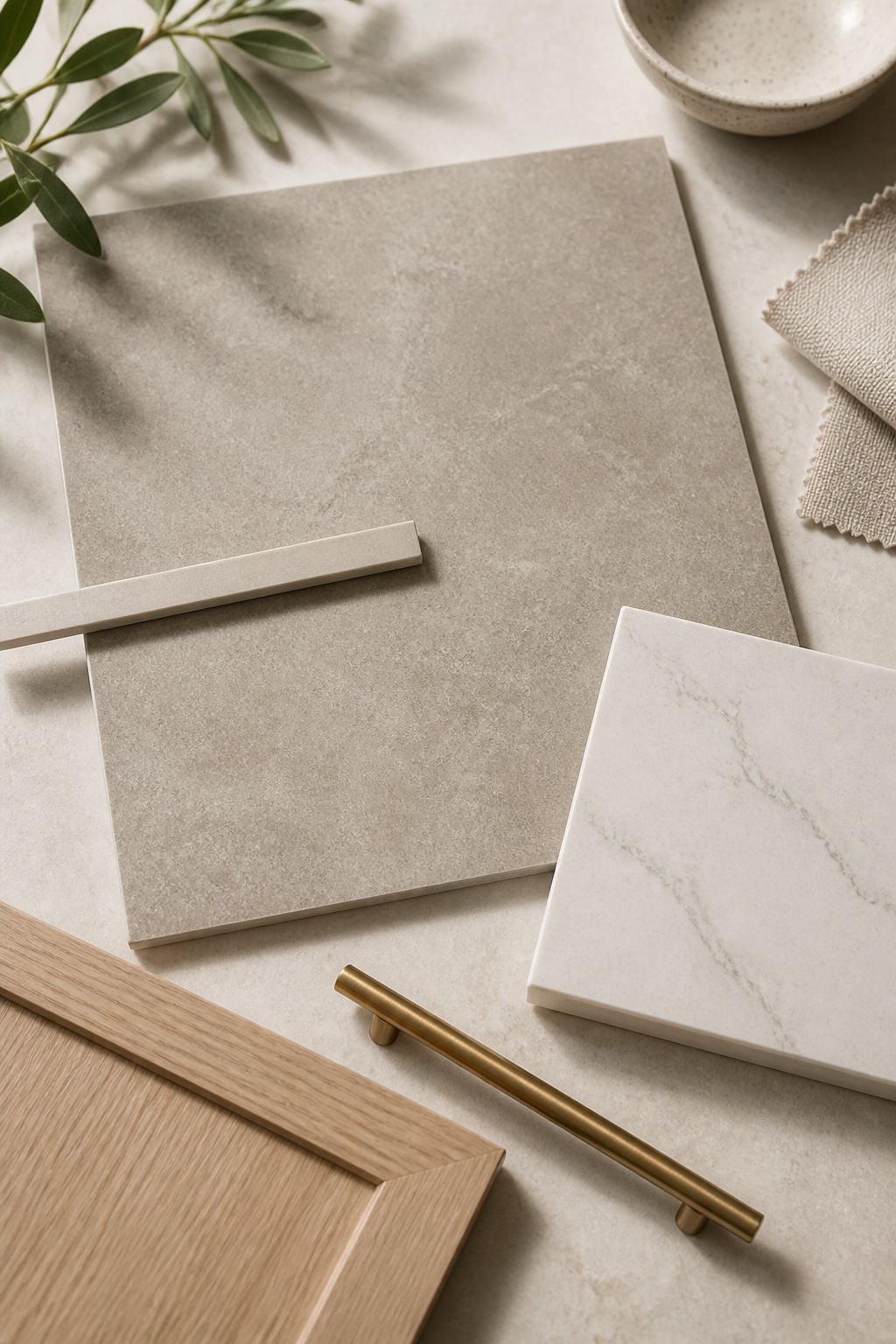
Three choices carry the entire look. Hold them in one view:
| Decision | The options | What delivers seamless |
|---|---|---|
| Material form | Large-format rectified tile, or continuous slab | Slab (no grout); large-format is near-seamless for less |
| Finish | Matte / honed, soft-sheen, or high-gloss | Matte or honed — diffuses light, hides marks |
| Grout | Matched to tile, or contrasting | Matched, in a warm neutral; slab needs none |
Read the table once and the pattern is clear: every column has a quiet answer and a loud one, and seamless lives in the quiet column. High-gloss reflects every ceiling light and shows every smear; contrasting grout rebuilds the grid you were trying to remove. The look is less about what you add than about which interruptions you decline.
One combination that always works
If you want a single specification that rarely fails, here it is: 24×24-inch rectified porcelain in a matte warm-stone look — oyster, greige or warm white — with matched grout at a 1/8-inch joint, run full height to the cabinets, lit by a 3000K LED strip. It covers all three decisions at a mid-range cost, and it works against pale oak, white or greige cabinetry. Want maximum seamlessness and the budget for it? Take the slab route instead — quartz or porcelain cut from the same stock as the counter, veining unbroken, zero grout maintenance, at that $80–$150 installed. Both are correct; the slab simply spends more to remove the last joint. Whichever you choose, running it full height is what lets the surface read as architecture.
The restraint test before ordering
One habit saves more seamless kitchens than any product choice. Before you order, tape a large sample — at least 12 inches, never a 4×4 chip — of the backsplash directly against the wall where it will live, beside your cabinet door and a piece of the counter material. Step back to normal kitchen distance. Then apply the restraint test: if the surface is asking for your attention from across the room, it will fight every element in the kitchen once it is tiled floor to ceiling. A seamless backsplash earns attention through continuity and material quality, not through its own pattern. Anything that competes before it is even installed is the wrong sample. Replace it with the calmer one and test again.
A seamless modern backsplash is not a mystery once you stop looking for the magic object. It is three plain decisions — form, finish, grout — each pointing toward the quiet answer. Choose large-format tile or a slab; keep the finish matte or honed; match the grout or skip it entirely; then warm the whole wall with light at 3000–3500K. Do that and the wall goes quiet in the good way: calm, continuous, contemporary, and never once cold. That is the difference between minimal and sterile, and now it is a difference you can specify.
FAQ
What is a slab backsplash and is it worth it?
A slab backsplash extends the countertop material — quartz, marble, quartzite or porcelain — vertically up the wall as one grout-free surface. It is worth it when the stone is dramatic enough to carry the wall, at $80–$150 per square foot installed for quartz. For a flat, subtle material, the premium over tile rarely justifies itself.
Is large-format tile good for a kitchen backsplash?
Yes. Large-format tile from 12×24 to 24×48 inches suits modern kitchens well: fewer grout lines mean less cleaning, a cleaner look and a more spacious feel, with rectified tiles allowing near-invisible 1/8-inch joints. The main caution is that large tiles need a very flat substrate and professional installation, since any imprecision reads across the broad face.
What backsplash looks most modern in 2026?
Full slab backsplashes — quartz and porcelain with subtle stone-look patterns carried up from the counter — are the leading marker of a modern kitchen in 2026, cited across multiple design sources and trend reports. For those preferring tile, 24×24-inch rectified porcelain in a matte stone look with matched grout reads almost as seamless at lower cost.