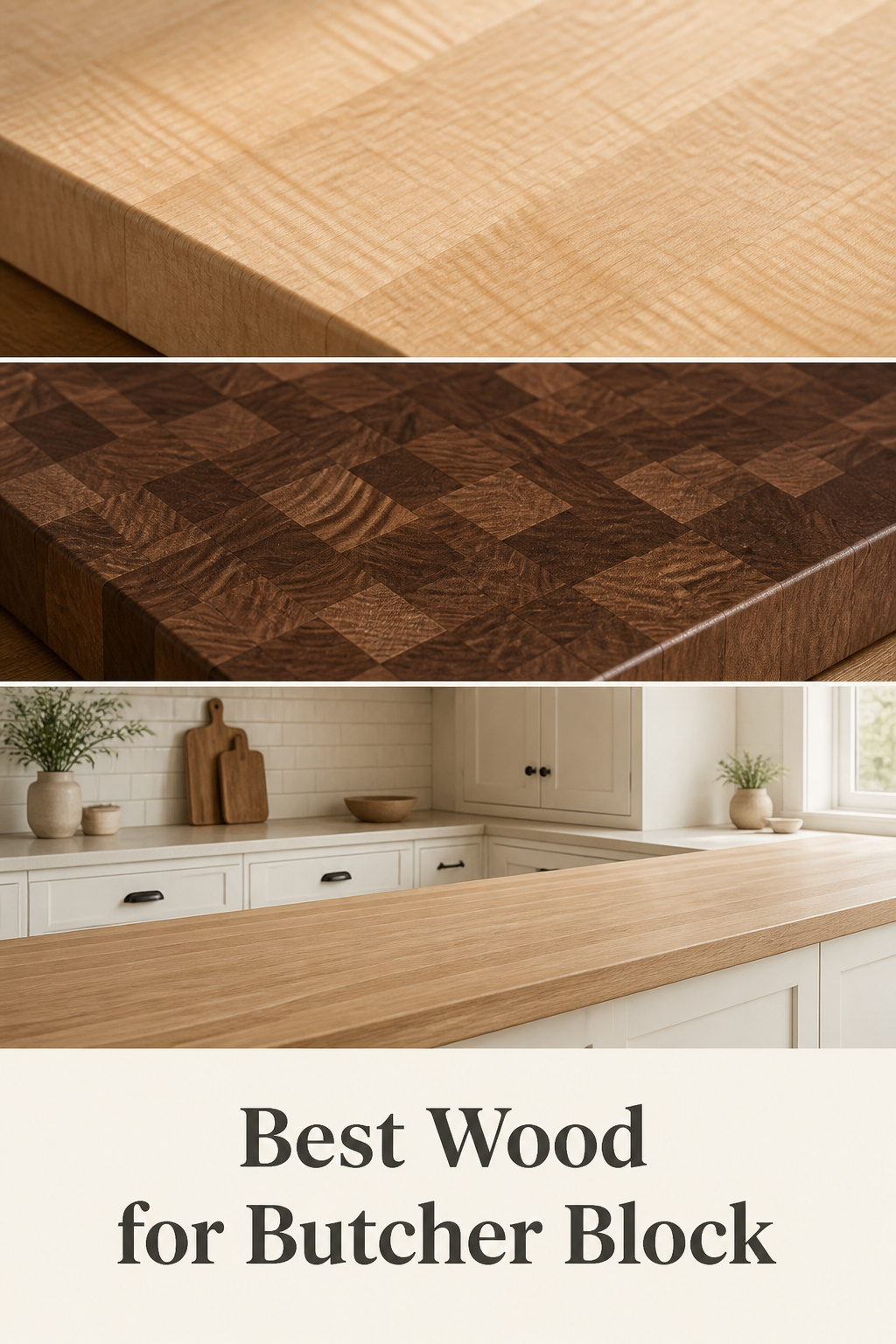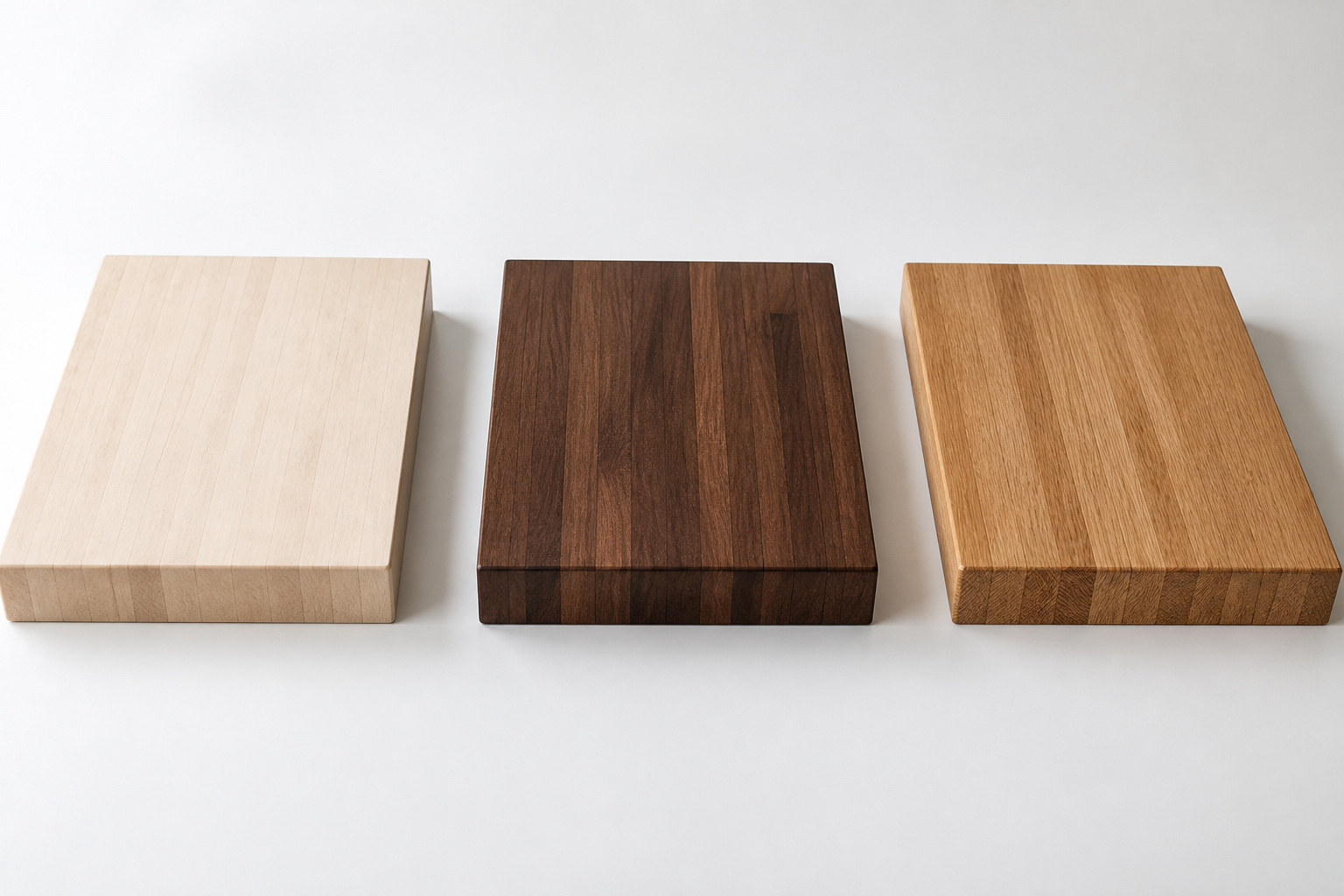
A wood countertop is the rare kitchen surface that gets better, or worse, with every year you live on it. So the question is not which species looks best in the showroom, but which one you still want to look at in a decade. The samples all photograph well; they will not all age well against your light, under your knife. Choosing the best wood for butcher block is mostly a matter of deciding what you want this surface to become, then picking the species that gets there.
TL;DR
- Hard maple (1,450 lbf Janka) is the value default: hardest of the affordable species, tight grain, around $40–$60 per square foot.
- Walnut and cherry buy warmth, not hardness — both are softer than maple, run a real premium, and suit prep islands over heavy chopping.
- White oak’s tyloses give it the best moisture resistance of any common species; hickory is the hardest domestic option; bamboo is a grass, not a wood.
I photograph kitchens at seven in the morning in February, when the light is at its meanest — a surface that still looks right then works. Wood answers to that test more than any other countertop material, because its colour is not fixed. It moves, and the job is choosing a species whose movement you will be glad of.
How to Choose the Best Wood for Butcher Block: Three Questions
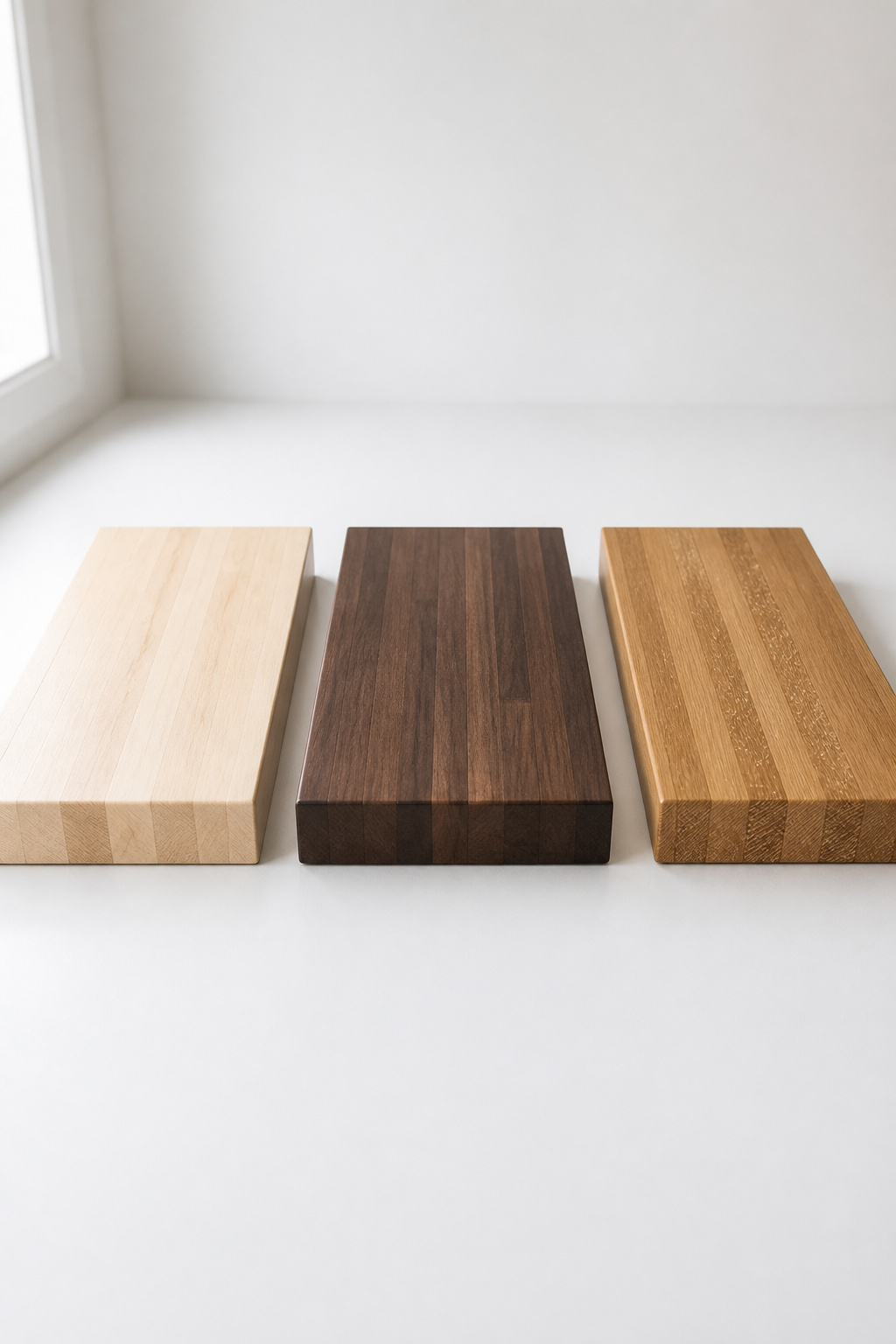
Before any sample board, ask three plain questions. They narrow a confusing field to two or three honest candidates, summarised here at a glance. For construction, finishing and cost, see the complete butcher block countertop guide; this article handles species.
| Species | Janka hardness | Tone over time | Relative cost | Best use case |
|---|---|---|---|---|
| Hard maple | 1,450 lbf | Pale to honey-amber, slow | $40–$60/sq ft | Everyday prep and chopping |
| White oak | 1,360 lbf | Warm honey-amber, predictable | $60–$120/sq ft | Near water, humid kitchens |
| Walnut | 1,010 lbf | Lightens slightly | $75–$300/sq ft | Premium prep island |
| Cherry | 950 lbf | Darkens fast to red-brown | $50–$275/sq ft | Warm look, patient owner |
| Hickory | 1,820 lbf | Bold light-to-dark contrast | Above maple | Rustic, heavy use |
Will you cut directly on the surface or always use a board?
This decides how much hardness you need. Hard maple is the professional-butcher standard — hard enough to resist gouges, not so hard it chews up your knife edge — while walnut and cherry are softer and show knife marks sooner. So if you chop daily, choose maple; if the counter mostly stages and serves, a softer species is fine.
What colour and grain character do you want in ten years, not now?
Species age in different directions, at different speeds. Cherry is the most photosensitive North American hardwood: roughly 80% of its colour shift happens in the first 6–12 months. Maple yellows slowly toward honey; white oak warms predictably. So buy for the ten-year colour, not the delivery-day one.
What is the honest budget for materials and long-term care?
Maple is the baseline at $40–$60 per square foot; walnut typically costs 40–60% more, often $75–$300. Species, as SlabWise’s analysts note, is the single biggest factor in your final price.
Maple Butcher Block: The Hard-Wearing Value Default
For most kitchens, I recommend maple and stop there. It is not the most beautiful wood on the bench, but it is the most forgiving — and forgiving is what a working counter needs most.
Why maple is the kitchen workhorse of butcher block species
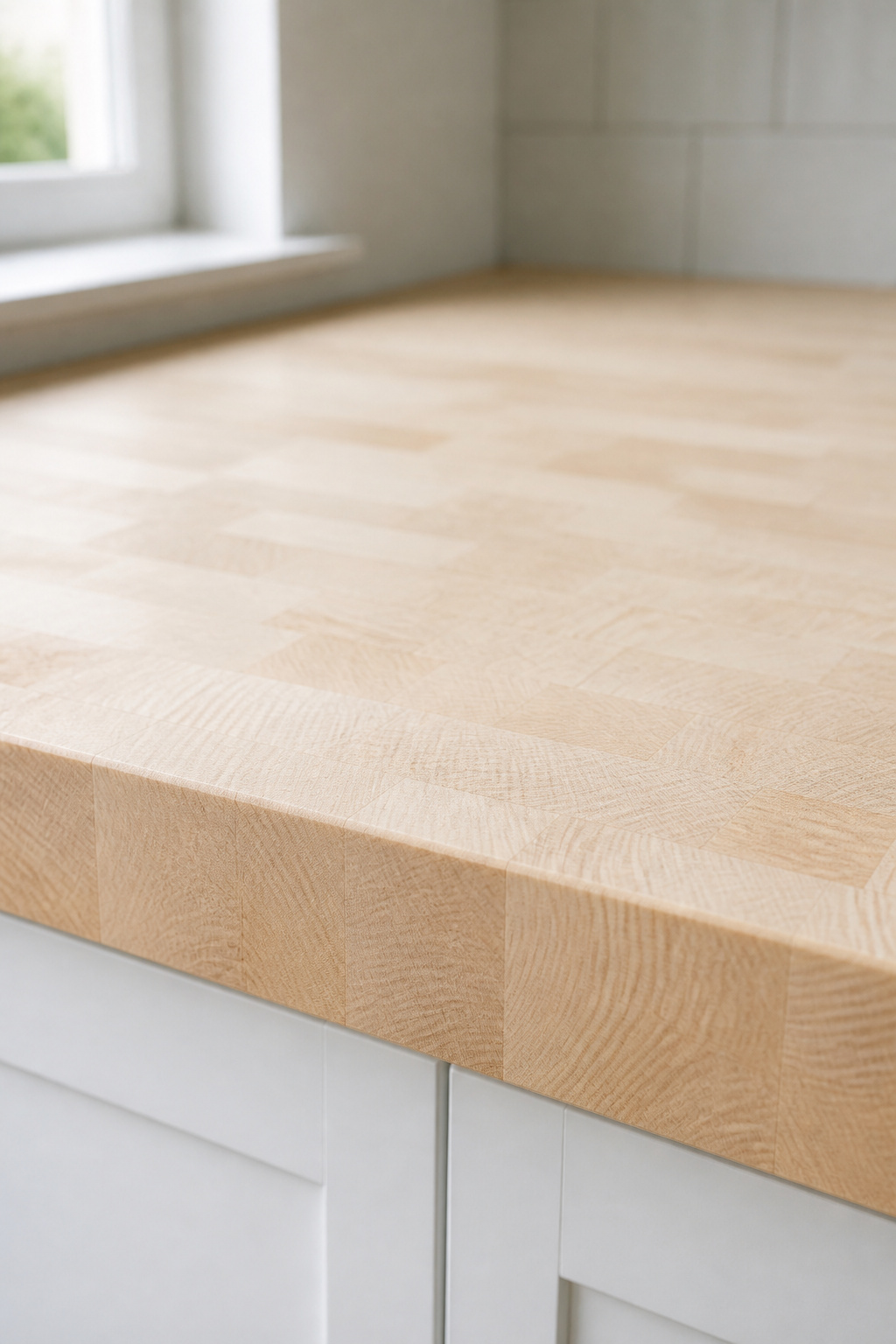
Hard maple’s 1,450 lbf rating puts it above walnut, cherry and white oak. Its tight, closed grain absorbs less water and gives bacteria fewer micro-channels — which matters on a surface scored by knife cuts. As Forever Joint Tops notes, butchers have trusted maple for generations because it stays gentle on knife edges while resisting deep cuts — and it is the cheapest high-hardness species.
Colour and grain character: pale and tight, years one through ten
New maple runs from creamy white to off-white, reliably the lightest of the common species, and yellows only gently toward amber-honey over years — nothing like cherry’s first-year drama. One caution: oil-based finishes push it toward an orange-yellow cast, so choose a water-based finish to keep the pale tone.
Where maple falls short: limited warmth, stains show differently
Maple is honest about its limits, so I will be too:
- In warm, farmhouse or cream-toned kitchens it can read clinical rather than cosy.
- Dark stains from coffee, red wine and berries show more plainly on pale maple than on walnut, where the tone disguises them.
- The tight grain that resists bacteria also makes maple harder to sand and refinish than open-grain woods.
Walnut and Cherry: Premium Warmth for the Kitchen That Earns It
When aesthetics lead the decision, the conversation turns to walnut and cherry. Both buy warmth that maple cannot give; both ask you to accept a little softness in return.
Walnut: rich tone, straight grain, softer than maple
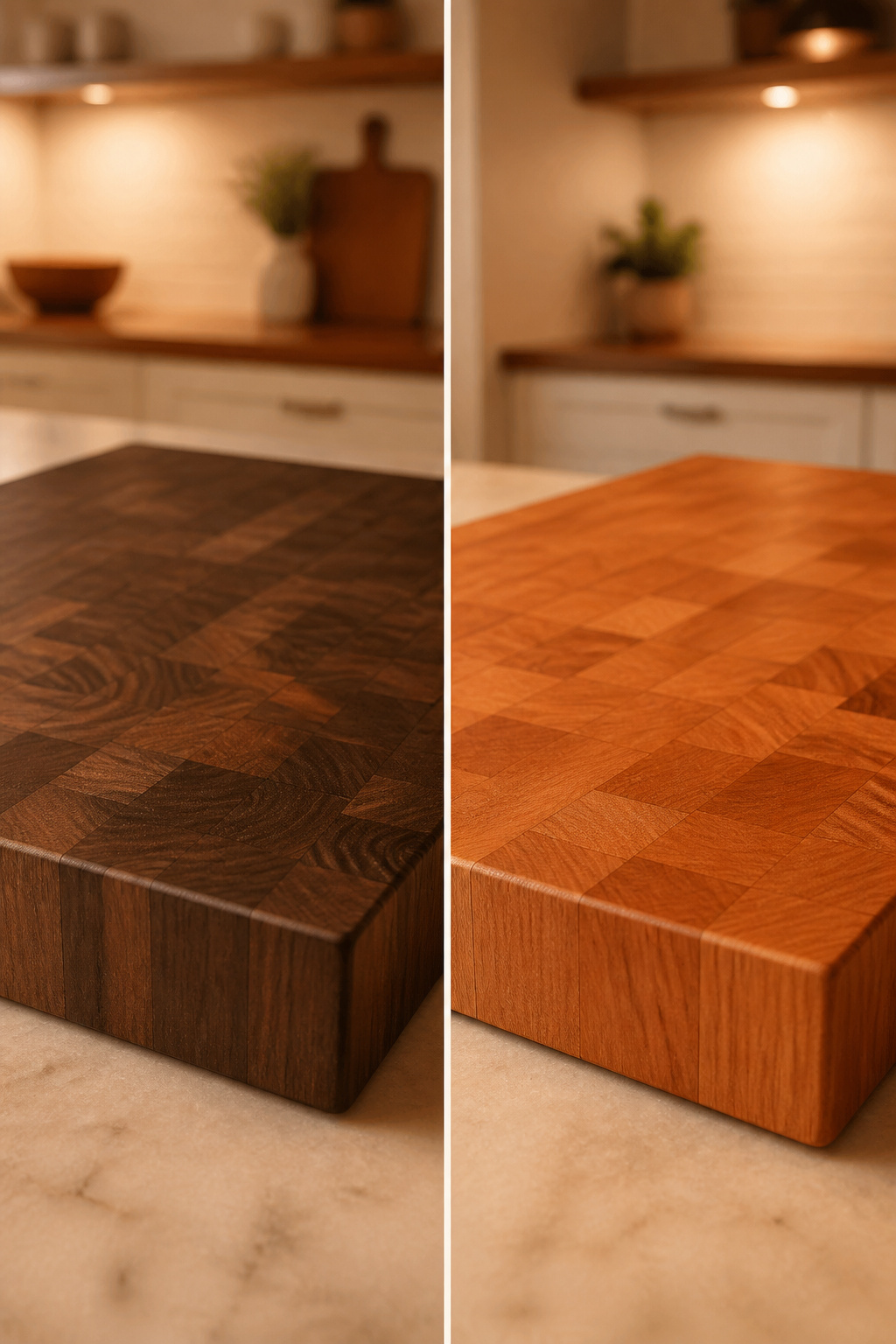
Black walnut is roughly 30% softer than maple, so it shows knife marks more readily — which matters far less on a prep island than on a chopping block. Its heartwood is dramatic from day one: medium to dark chocolate, sometimes with grey or purplish notes, a depth no other domestic species matches at installation. Reported by ButcherBlock Co, walnut is also unusual in lightening slightly with age — the reverse of most species, though noted by fewer sources. The premium is real at 40–60% over maple, so most designers use it on a single island. When you do, match the wood tone to white cabinets so the warmth reads deliberate.
Cherry: lightens as it ages — what that means for a kitchen
Cherry is the softest common species at 950 lbf, and the most photosensitive. Phenolic compounds react with light, carrying the surface from pale salmon at install to deep reddish-brown — roughly 80% of that shift lands in the first year. One trap: anything left on the counter during those months blocks the light and prints a paler patch. Still, as Thos. Moser’s cabinetmakers say, that evolution is a feature — cherry looks better in five years than at install.
When the premium cost of walnut and cherry is the right call
Walnut earns its premium on an island centrepiece in a warm or mixed-material palette; cherry earns it when you want the mature reddish-brown and will wait for the patina. Neither belongs under heavy daily chopping — that is maple’s job, and its extra hardness protects the investment there.
Oak Butcher Block: Moisture Resistance and Open Grain
Oak is the species people most often misread. Its moisture story is real but specific to white oak, and its open grain carries a care implication closed-grain woods do not.
Why oak’s open grain makes it thirstier than maple
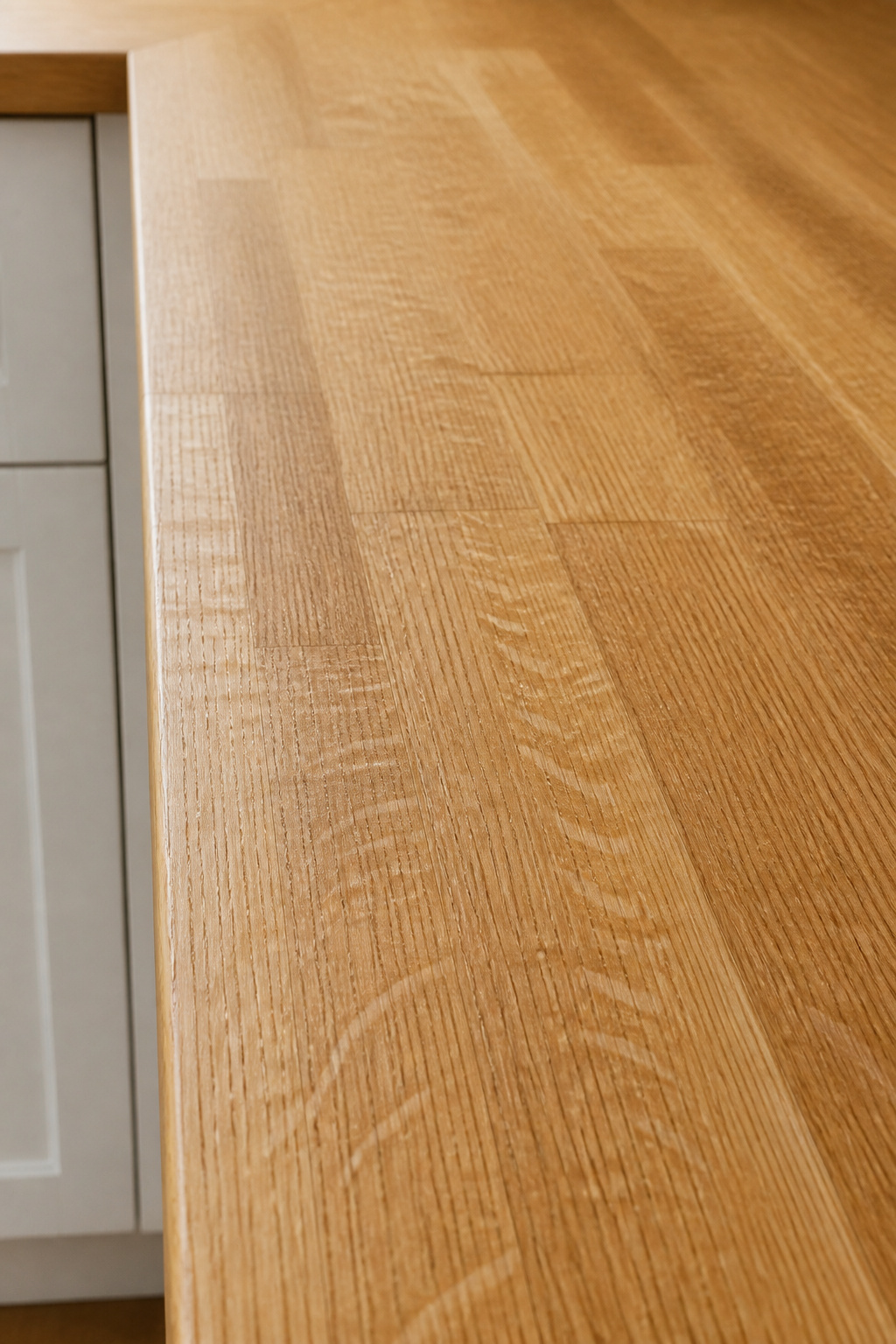
Oak is open-grained — its vessel pores visible to the naked eye, unlike maple’s closed surface. So it drinks more oil to stay sealed, gives bacteria more open channels to colonise, and warps more readily with moisture cycling. Oak’s reputation for toughness, then, comes with a maintenance bill: it needs oiling more often than maple, not less.
The moisture resistance advantage and where it matters
The redeeming trait belongs to white oak alone. Its pores are blocked from within by tyloses — cellular outgrowths that seal the grain, not a finish on top, the same property that lets white oak hold whiskey and wine in barrels. So at a prep-sink perimeter, white oak manages moisture better than any other commonly stocked domestic species — though it is no substitute for proper sealing.
Red oak vs white oak: which is actually better for a countertop
The two oaks are not interchangeable. Red oak lacks tyloses entirely; its pores stay open, making it genuinely unsuitable near a sink, and it carries a pinkish undertone and louder grain that is harder to place. White oak shows fine silver-grey medullary ray flecks on quartersawn faces — a quiet, Scandinavian-friendly figure. So for a countertop, white oak is the correct choice; red oak is better left to flooring and furniture.
Hickory, Teak, and the Alternatives Worth Knowing
Three more options complete the picture, each with one honest verdict.
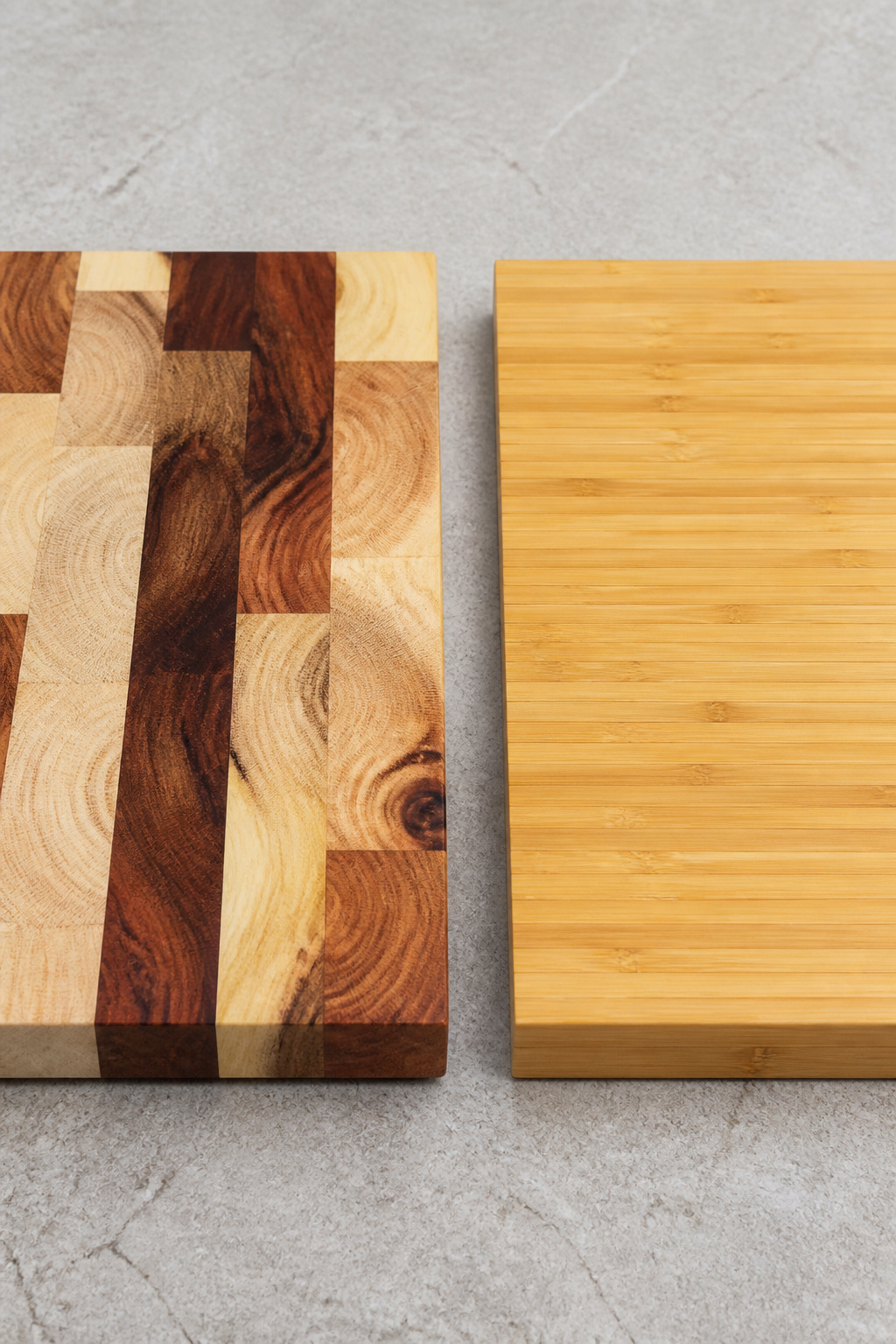
- Hickory is the hardest domestic species at 1,820 lbf — dent-resistant and tough under heavy use. But the hardness cuts both ways: its density dulls knives and tools faster than softer woods, part of why it costs more than maple to fabricate (a directional point, not a measured figure). Its cream-to-reddish-brown contrast suits rustic kitchens but fights a minimalist scheme. Verdict: buy it for toughness, not a Nordic palette.
- Teak is oil-rich, spill-resistant even unfinished, and unmatched for humidity stability. Indoors it makes little sense, though: it runs $100–$200 per square foot, and one trade source puts its silica content above 1%, enough to dull knives quickly. Verdict: worthwhile outdoors, rarely justified inside, where white oak gives similar moisture resistance for far less.
- Bamboo is not wood at all — it is a grass (family Poaceae), cut into strips and laminated with adhesives, closer to plywood than timber. It rates around 1,380 lbf on Janka, but that test was designed for solid wood, and the laminate behaves differently under load. Food safety therefore depends on the adhesive: reputable US makers test below 0.05 ppm formaldehyde, while cheap imports may not. And if water reaches the joins, the layers can delaminate — you cannot sand it back to a food-safe surface. Verdict: genuinely sustainable (3–5 years to maturity versus 50-plus for oak), but vet the adhesive before you buy.
Butcher Block Species and Grain: Choosing Both Together
Species and grain are not two decisions but one.
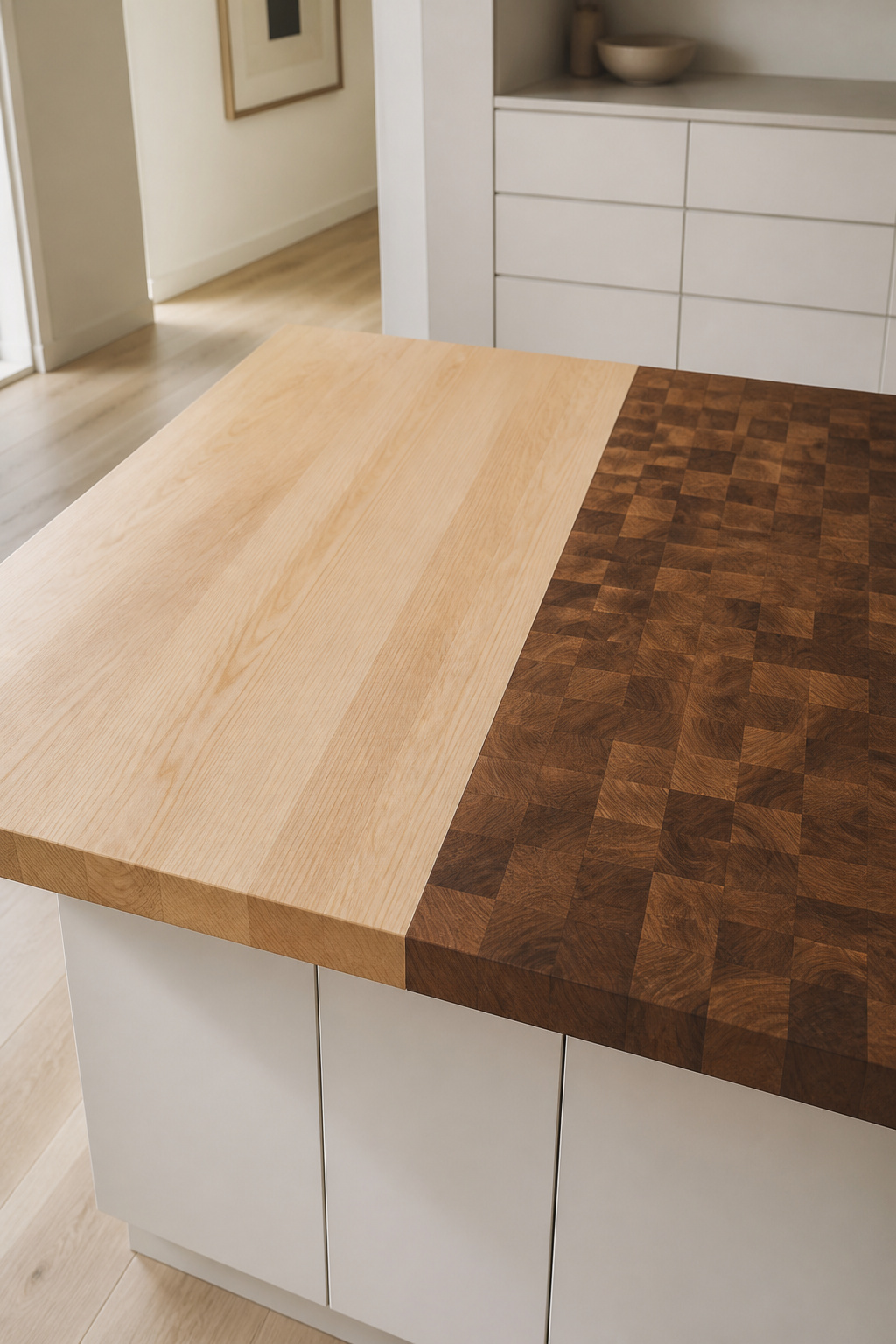
Why species and grain construction are the same decision
End grain self-heals under a knife but its open pores demand more frequent oiling, so a soft, porous species like walnut in end grain magnifies the care burden. Once you have settled the species, then pick the grain construction that suits how the counter is used.
The combinations that make sense in a real kitchen
A few pairings simply work:
- Maple edge grain — the practical default: hardest value species, most durable everyday build.
- Walnut edge grain — the premium upgrade that stays manageable, since the straight surface seals more easily than end grain.
- White oak edge grain — the best moisture combination, tyloses and all.
- Maple end grain — the classic butcher’s block, for a counter that genuinely chops.
The one combination Henrik would not buy
One I would steer you away from: walnut end grain as a primary daily-use counter. It pairs the softest commonly specified species with the most maintenance-hungry construction at the highest price — a surface that shows heavy use and demands constant care. It belongs as an occasional prep block, not a full kitchen run. Cherry face grain is the other to avoid for the same reason: lovely as furniture, wrong as a countertop.
So choose the species for how you cook and how you want it to age, match it to the right grain, and the counter rewards the thought for a decade. That is the Nordic test for any material worth buying: not whether it dazzles new, but whether you still want it in the worst light of the year.
FAQ
Is maple or walnut better for butcher block countertops?
Maple (1,450 lbf Janka) is harder than walnut (1,010 lbf), so it is the better choice for a primary chopping surface and a tighter budget. Walnut is better when looks lead, since its chocolate tone is dramatic from day one. But it costs 40–60% more, which is why most designers use it selectively on an island.
What is the hardest wood for butcher block?
Hickory is the hardest common domestic species at 1,820 lbf Janka — well above hard maple (1,450 lbf), white oak (1,360 lbf) and walnut (1,010 lbf). Brazilian cherry (Jatoba) at 2,350 lbf is harder still but an exotic import. Hickory’s hardness has a cost, though: it dulls tools faster and its bold grain suits rustic over minimalist kitchens.
Does butcher block wood change colour over time?
Yes, but direction and speed vary by species. Cherry darkens fastest, shifting roughly 80% of its colour in the first 6–12 months. Maple yellows slowly toward honey-amber, while walnut is unusual in lightening slightly with age — a characteristic noted by fewer sources than the other species’ colour shifts. Finish matters too: oil-based finishes accelerate maple’s yellowing, whereas water-based finishes preserve the lighter tone.