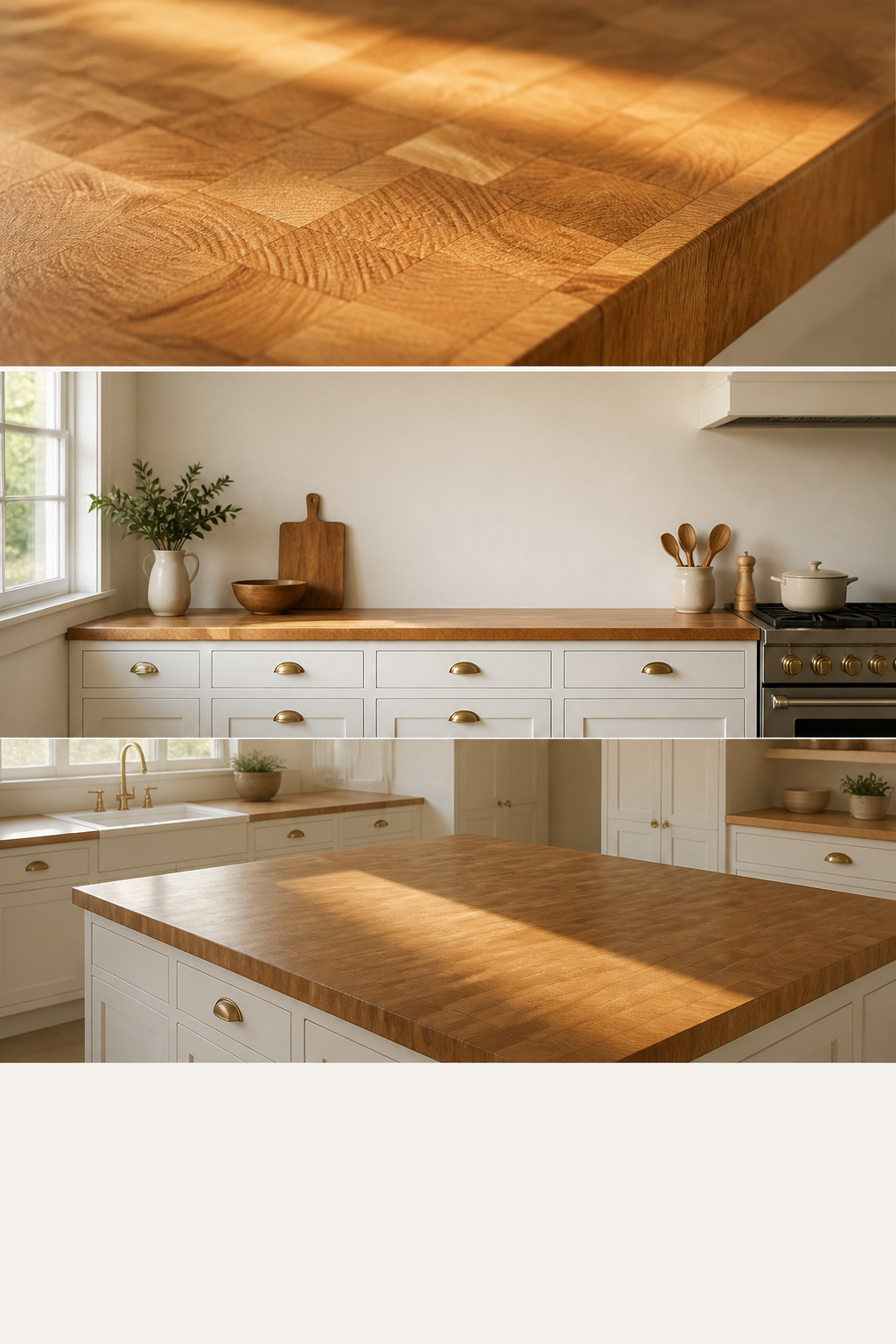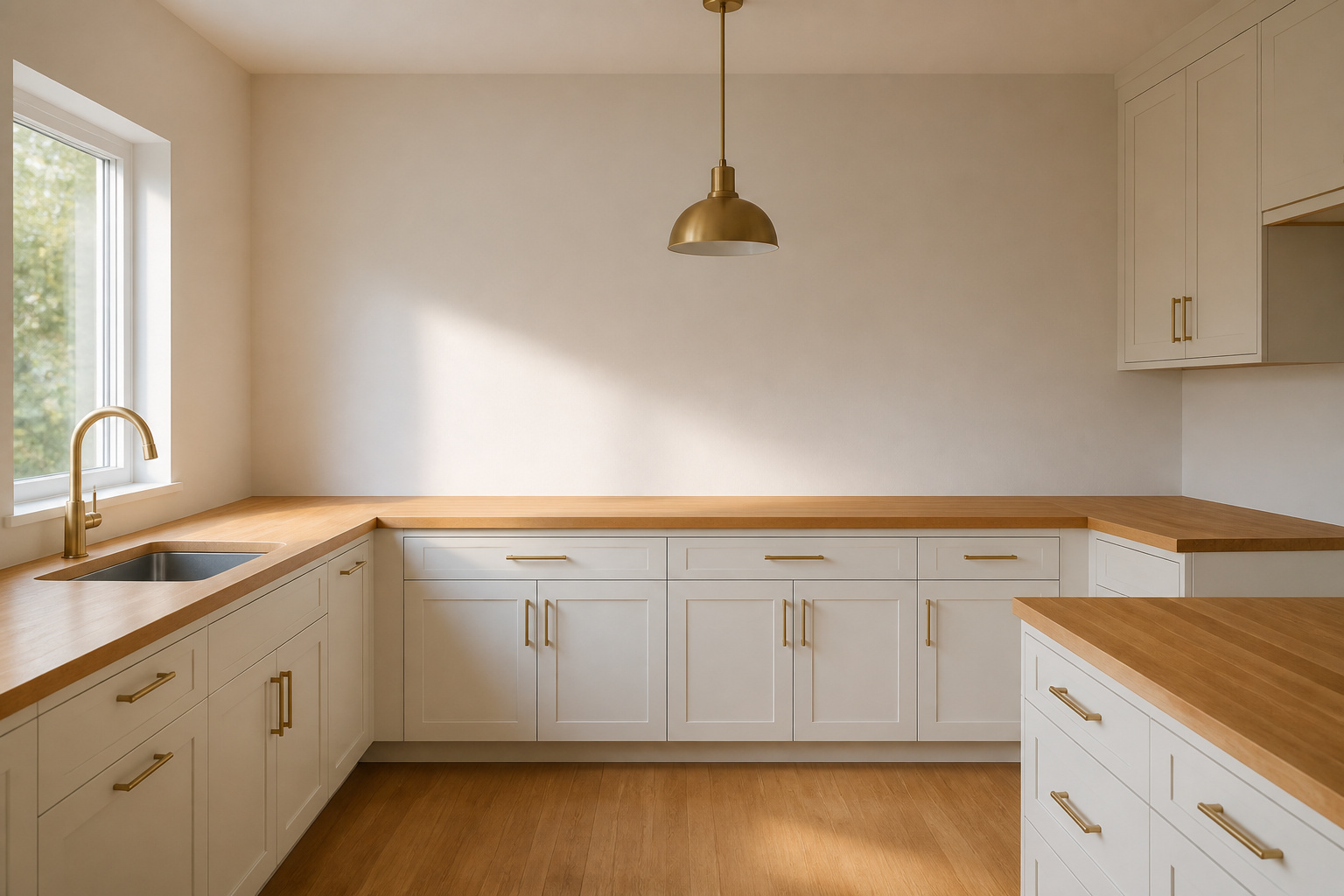
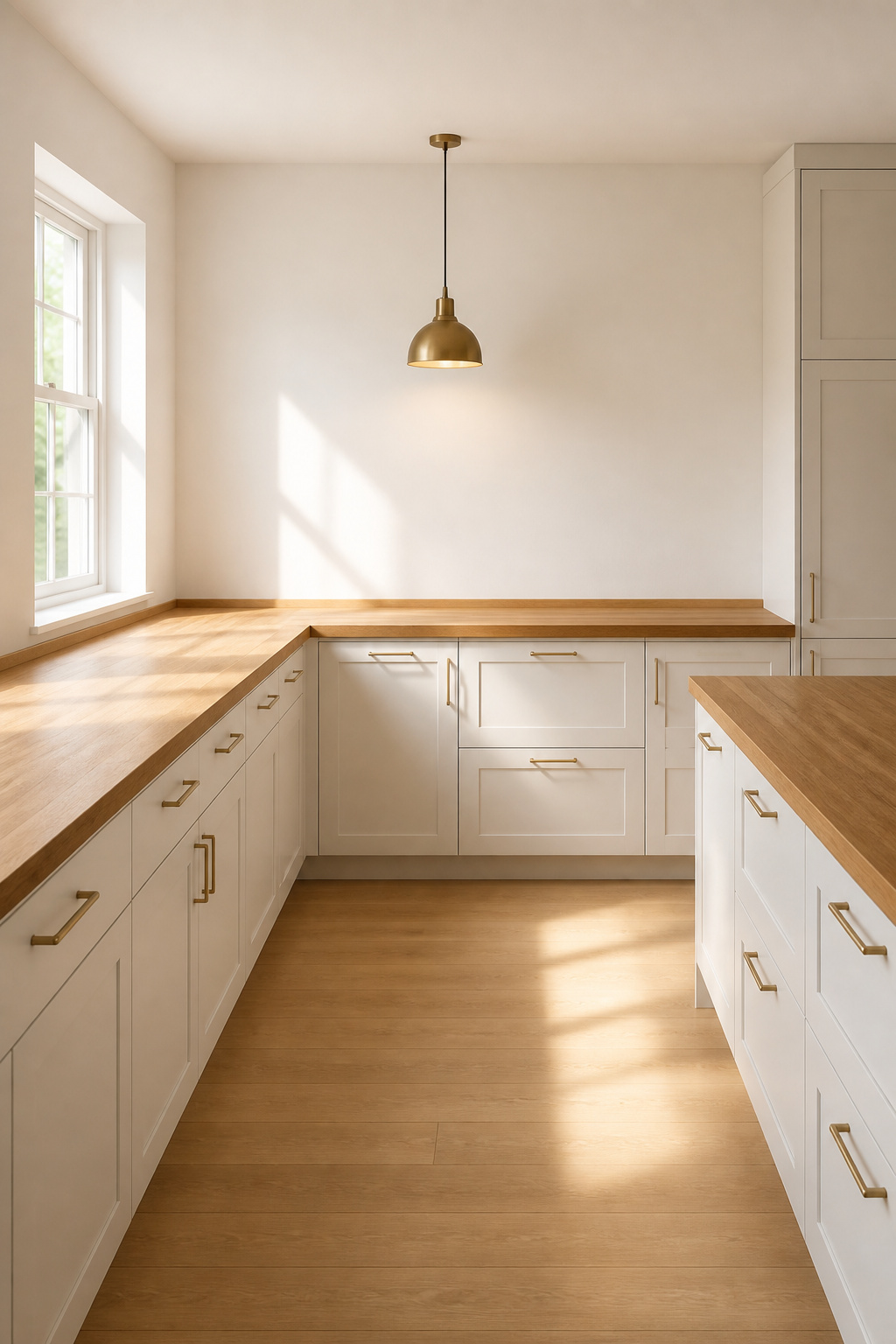
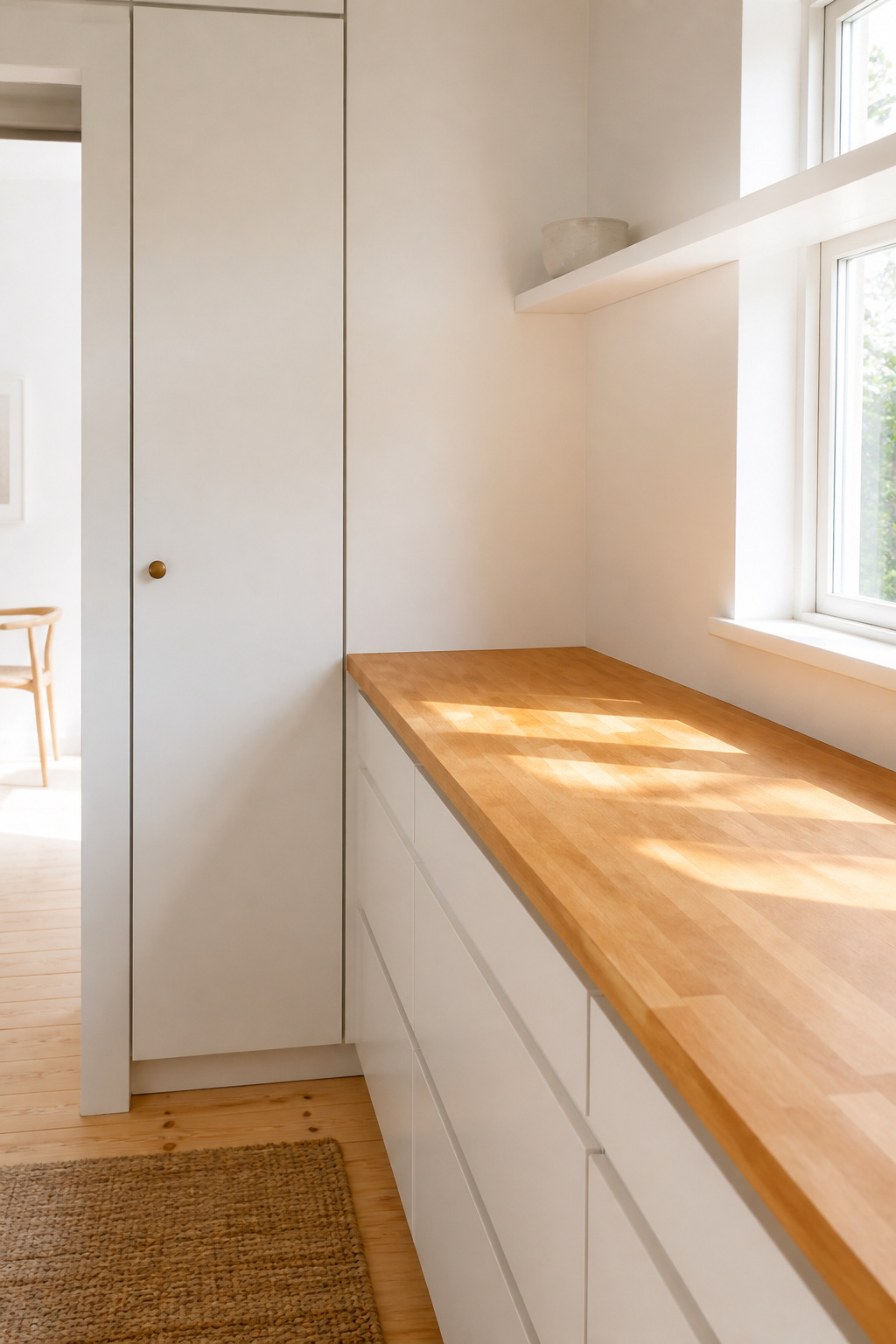
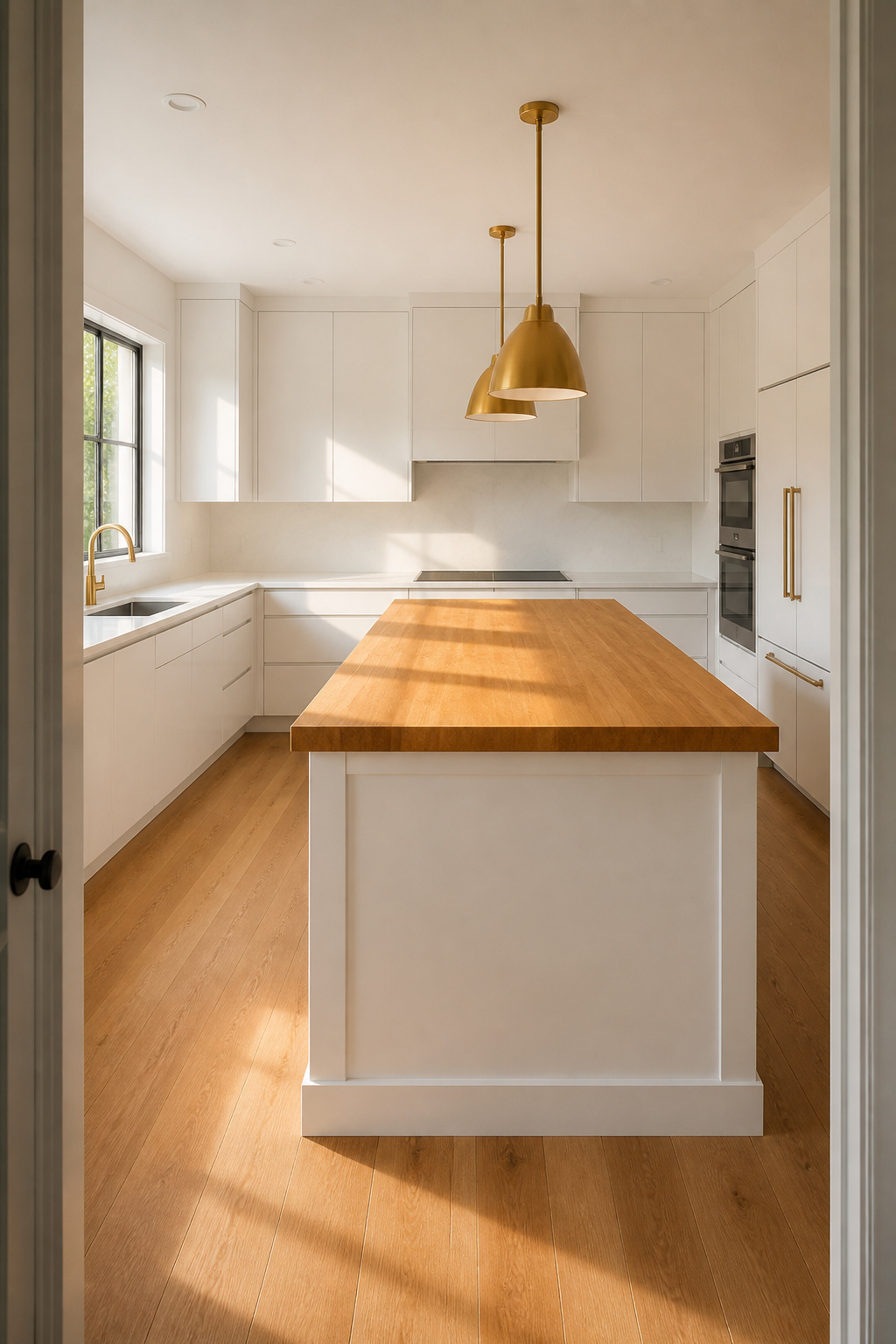
Stand in the doorway of the kitchen you are picturing. The cabinets are white, but not a hard, clinical white — a soft one that holds the morning light rather than throwing it back. A run of honey-amber wood catches that same light along the counter, the grain warm under your hand, and no pattern competes for the eye. The room feels calm, lived-in, quietly warm. That feeling is the whole point of putting butcher block with white cabinets — and it is more easily lost than people expect.
TL;DR
- Butcher block corrects the coldness an all-white kitchen develops; the one rule is that the wood tone and the cabinet white must balance, not compound.
- Match warm cream cabinets with a cooler, neutral wood, and crisp pure white with a richer, darker species like walnut; brass or satin nickel hardware holds the scheme, matte black only as an accent.
- The most common version of this pairing puts the wood on the island rather than the perimeter — it is where warmth reads best and where the material earns its higher care requirement.
My grandparents’ summer cottage on the Stockholm archipelago had unpainted pine on nearly every surface and one open shelf of crockery. Nothing matched in the showroom sense, yet it never read as busy — every warm tone belonged to the same family. That is the discipline a white kitchen with wood needs. Get it right and the room resolves; get it wrong and three warm surfaces argue.
Why Butcher Block with White Cabinets Works — and When It Doesn’t
A white kitchen wants to feel clean. Left entirely to white, though, it usually feels colder than clean.
The contrast problem white kitchens develop without warmth
An all-white kitchen without a single warm material reads as clinical. Butcher block is among the most effective correctives because it adds warmth and organic texture at once, without adding clutter — a light maple counter against white shaker cabinets lands both polished and approachable. Interior designer Lauren Gilberthorpe puts it simply: choose colours with warmth, so the pairing feels inviting.
What wood adds that tile, stone and paint cannot
Wood’s grain creates a depth paint and tile only imitate: a pale maple surface catches light differently across the day, so the room reads lived-in rather than showroom-flat. For construction, sealing and care, see everything about butcher block counters; here the concern is only how it reads against white.
The one situation where the pairing fights itself
Wood is not the failure mode — too many competing warm tones is. A warm-yellow cabinet, a honey counter and a warm oak floor can merge into one muddy mass, not warm but busy. The principle designers return to: stick to one temperature family. Keep the cabinet white gently warm and the wood clean honey, and the pairing resolves.
Matching Wood Tone to the White: Warm, Cool and Crisp
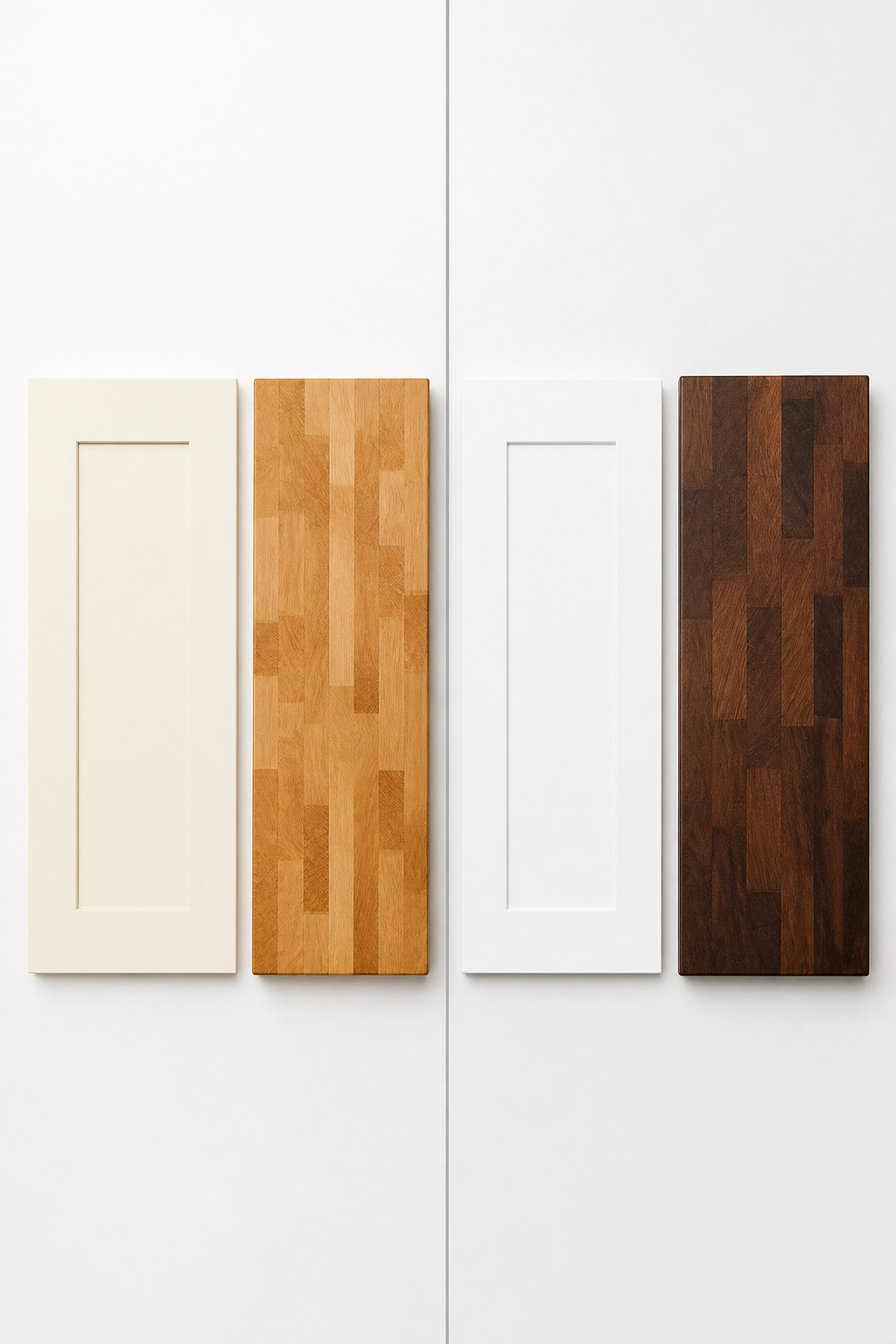
This is the decision the whole kitchen turns on. White is not one colour, wood is not one tone, and the temperature of one must answer the other. The pairing I work from:
| Cabinet white | Recommended wood | Tone to avoid |
|---|---|---|
| Warm cream / off-white (e.g. F&B Pointing) | Cooler, neutral wood — light maple, natural white oak | Heavily orange-honey species |
| Crisp pure white / high-gloss | Richer, darker wood — walnut, dark oak | Pale faded honey (too low contrast) |
| Near-neutral white (e.g. SW Alabaster) | Works with warm or cool wood | Strong red-orange undertone |
Warm whites (cream, off-white) need a cooler wood to balance
A warm cream like Farrow & Ball Pointing sits around 81 LRV — very warm. On cabinets it needs a cooler, more neutral wood — lighter maple or natural white oak — or the scheme tips into one yellow note. A near-neutral white like Sherwin-Williams Alabaster is more forgiving, working with either.
Crisp whites (pure white, high-gloss) can carry a richer, darker wood
With a crisp, cooler white the logic reverses: contrast is the point. Walnut against stark white reads high-end and deliberate, because nothing is ambiguous about which element is warm. The cooler the white, the richer the wood can be.
The wood tone that reads as clutter — and how to avoid it
One tone fails more than any other: red-orange wood — some aged maple, much pine — against a cool pure white, which strips out the warmth and leaves only the orange. A simple test sorts your white first: hold bright paper against the cabinet. Slightly yellow means warm; slightly blue-grey means cool. The counter should balance that reading, not echo it — and choosing the wood tone covers which species lands where.
Hardware and Fittings: Keeping the Kitchen Calm
Hardware is small, and often treated as an afterthought — yet it quietly ties or breaks the scheme, because metal has a temperature too.
Brass and unlacquered metals: the warm-white pairing that holds
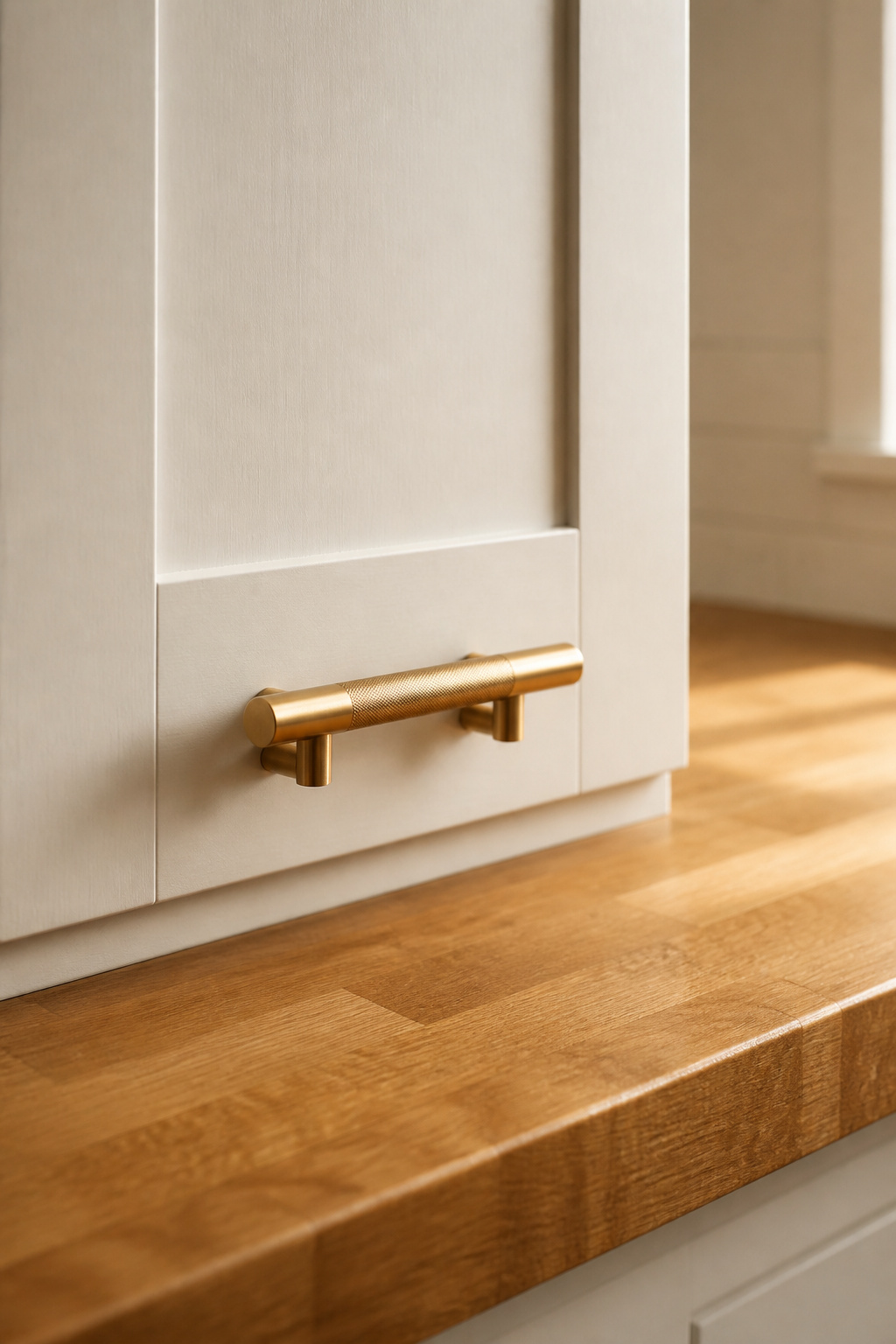
Brass is the natural companion to warm wood — both sit in the same yellow-warm family. Unlacquered brass goes furthest: it develops a patina that coordinates with the ageing of an oiled butcher block, the surfaces growing older together. The combinations I reach for on white kitchen projects:
- Unlacquered or brushed brass with a honey maple or oak counter — the most cohesive warm trio.
- Champagne bronze where the wood is dark or richly toned and full brass would be too much.
- Satin nickel where stainless appliances are in the scheme and the wood should keep the warmth to itself.
Matte black in a warm-wood kitchen: when it works and when it fragments
Matte black can add welcome dimension to white shaker cabinets — but only when the wood is a lighter, cooler honey, where the black reads as an anchor. Against a deeply warm walnut counter and a cream cabinet, it becomes a third temperature statement, and the scheme fragments. It is also a painted finish that chips in daily use. So I keep black to accents.
The fewer-handles rule I use on white kitchen projects
This is less a rule than a habit, drawn from Nordic restraint: the wood grain is the feature, so the hardware should not compete with it. Satin nickel gives the most neutral option — a light contrast that lets the butcher block hold attention — and fewer, better-placed pulls keep the eye where it belongs. Mixed metals are fine; just choose one dominant finish.
Backsplash Choices for a Butcher Block and White Cabinet Kitchen
The backsplash is the third material in the triangle. When the first two are strong, the third should defer.
Subway tile: the reliable neutral that doesn’t compete
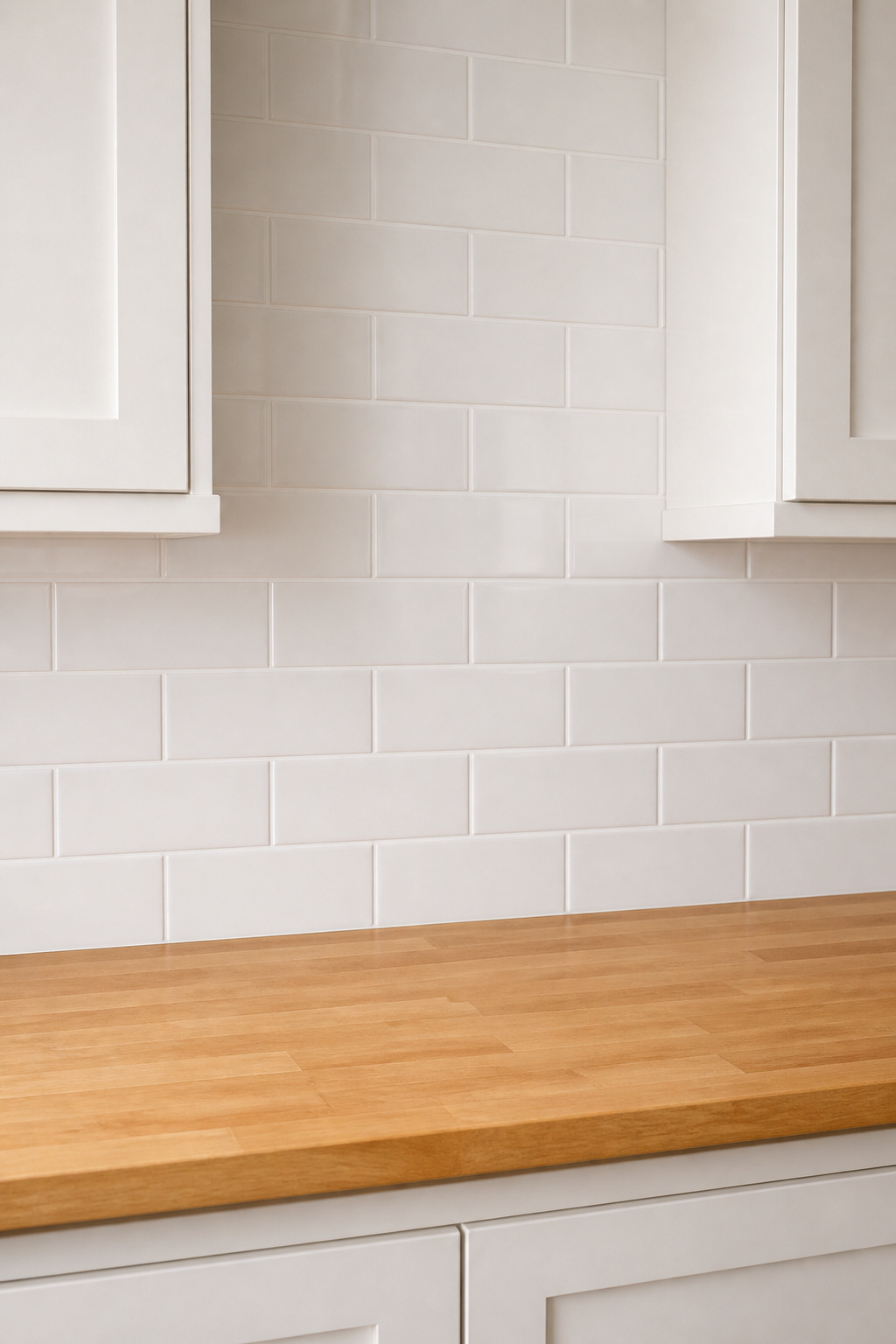
White subway tile remains the gold standard here. Its clean lines complement the cabinets and let the butcher block’s grain do the talking, and it is cheap and easy to wipe. The grout shifts the mood: white grout stays quiet and Scandinavian, while black grout adds graphic, farmhouse contrast.
Natural stone tile: when it adds depth, when it crowds
Stone can add depth, but it is the easiest backsplash to get wrong. Heavily veined travertine in warm brown and gold becomes a third warm material beside the wood and cabinet, and the room crowds. It works here when it stays light and quiet — cream or grey limestone, or marble with subtle veining. Pattern belongs on a single accent wall, never the full perimeter behind a wood run, where it fights the grain.
Painted wall as backsplash: the move that keeps the wood prominent
My own preference, and the most Scandinavian option, is the quietest: a plain painted wall. Nordic kitchens often extend the cabinet colour up the wall rather than tiling, so the upper field reads as calm and architectural and full attention falls on the wood grain. It is also lower-cost and lower-maintenance — use eggshell or satin in the splash zone, never flat matte.
Where to Put the Wood: Perimeter vs Island vs Both
You do not have to wrap a kitchen in wood to get its warmth. Where it lands changes how much you need.
Wood perimeter, stone island: the less common but valid reversal
Running butcher block around the full perimeter connects the wood with the floor and creates a warm surround, leaving a stone island as the cooler, harder-wearing anchor. It is less common, but valid — keep the wood tone consistent across both surfaces so it reads as a choice.
Wood island in a white-cabinet kitchen: the 2026 standard and why
The data here is clear. In the Houzz 2026 Kitchen Trends Study, wood countertops jumped 12 points over the past year to 39% to claim the top spot for islands; white followed at 19%, with engineered quartz still dominant on the perimeter. The logic is functional and visual: the island is where most prep happens and the most visible single surface in the room. Put the wood on the island covers the layout.
All-wood counters in a white kitchen: when it earns the commitment
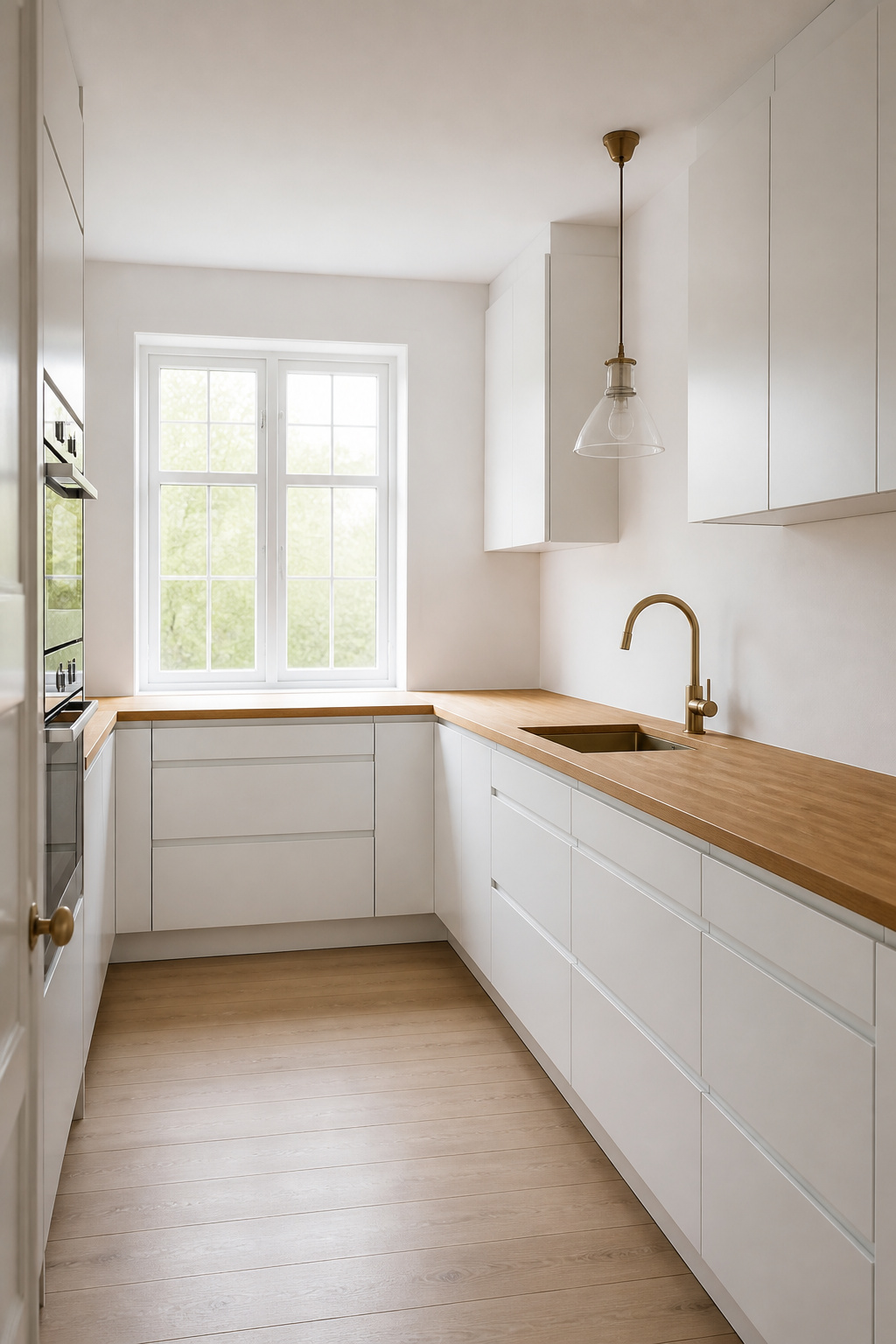
All-wood works best in smaller kitchens, where a shorter run reads as a feature — a long L or U of wood in a large kitchen starts to read as a cabin. Design practice points to light species here: pale maple, white oak or birch keep the wood reading as natural material rather than colour, and in a small kitchen they can make the room feel more spacious.
The White-Wood Kitchen That Stays Calm Over Time
Come back to that doorway. The calm kitchen stayed calm because nothing in it was chasing a trend it would tire of.
Why the scheme should be plannable to last ten years
A kitchen should be plannable to last ten years. Trendy colours last five to seven years, classic ones fifteen to twenty-plus — and the same split runs through materials and hardware. White cabinets with natural wood is among the most documented enduring pairings — white still held 28% of renovations in 2026 even as wood tones surged past it. As Carla Bast Design frames it, classic white with natural materials endures; heavily styled white with trend-specific accessories does not.
The three choices that date quickly (and the three that don’t)
Three choices age fast: over-accessorised open shelving, shiplap or barn-door accents, and one metal finish matched across every faucet, fixture and pull. Three that hold:
- A simple cabinet line — shaker or flat-panel, both with decades behind them.
- One restrained hardware finish in a muted metal.
- A quiet backsplash, subway tile or painted wall, that lets the wood speak.
Quality is the quiet fourth: a well-kept butcher block that earns a patina outlasts a laminate wood-look that cannot age.
My closing principle for the warm-white kitchen
The Nordic instinct is quality over quantity: one wood tone, one hardware finish, one backsplash material, and real restraint with accessories. There is a test for it: remove one element, and if the room looks cleaner rather than emptier, it was never earning its place. The warm-white kitchen you pictured in the doorway is reached through subtraction more than addition. Choose few things, choose them with care, and the room stays calm for a decade.
FAQ
Do butcher block countertops go with white cabinets?
Yes — it is one of the most documented kitchen pairings, precisely because white cabinets alone can read as cold and butcher block’s warm grain corrects that without adding clutter. The one condition is balance: a warm cream cabinet needs a cooler, neutral wood, while a crisp pure white can carry a richer species like walnut.
What colour hardware looks best with white cabinets and wood countertops?
Brass, unlacquered or brushed, is the most cohesive because it shares the warm temperature family with the wood, so white, wood and brass read as one resolved scheme. Satin or brushed nickel is the safe neutral, letting the wood hold the warmth and coordinating with stainless appliances. Matte black works only as an accent, not the sole finish.
Is butcher block too casual for an all-white kitchen?
No — perceived casualness comes from species and execution, not the material. Walnut against stark white reads high-end; light maple or white oak against crisp white reads contemporary and considered. The markers of formality are hardware quality, backsplash restraint and cabinet profile, all unrelated to whether the counter is wood or stone.