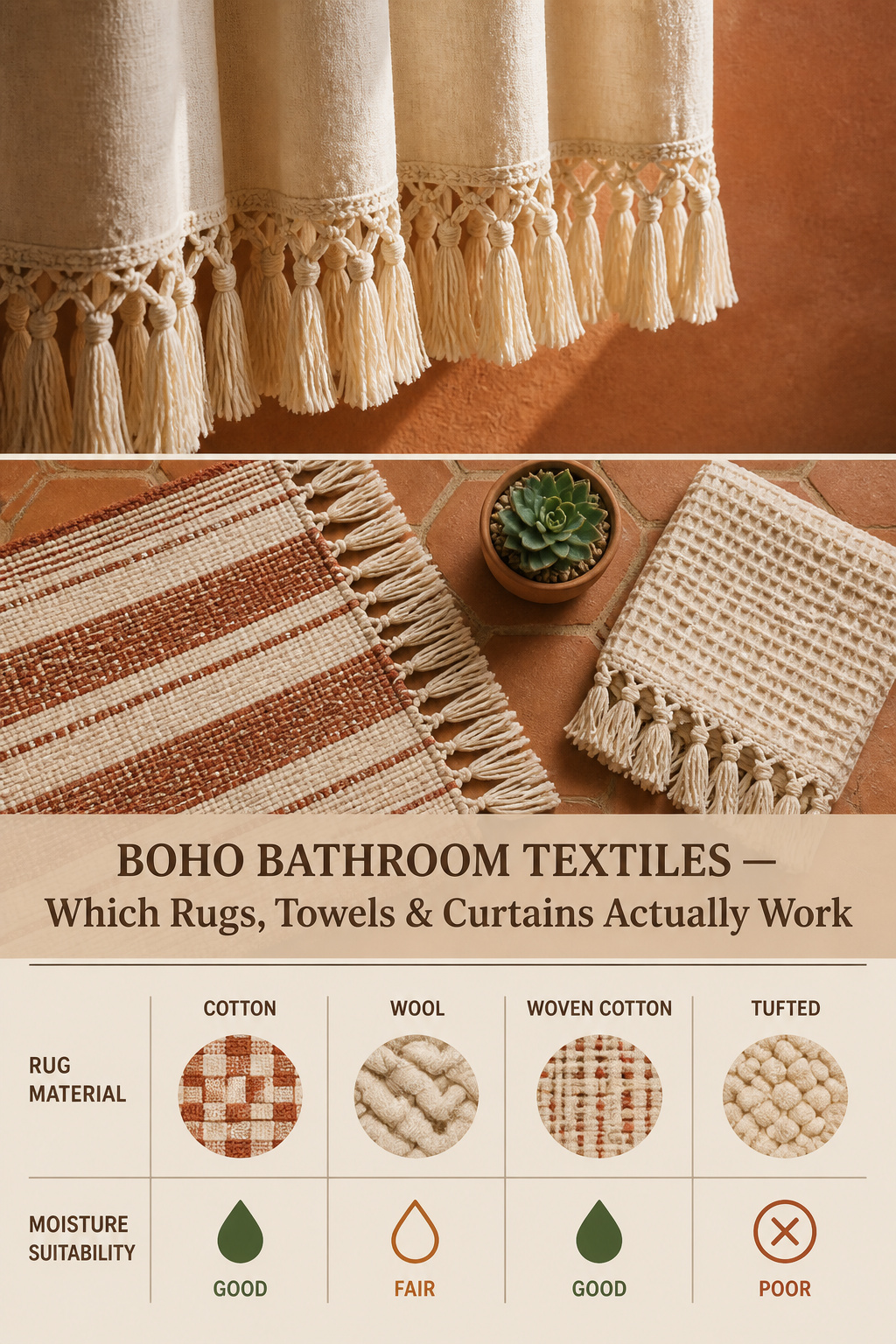

There is more textile sold for a bathroom than anyone could sensibly use — fringed curtains, tufted mats, tasselled towels, woven everything — and most of it will not survive the room it is sold for. So this is not a gallery of everything you could buy. It is the shorter list of what actually earns its place: the boho bathroom textiles that hold the warmth, tolerate the steam, and quiet a room rather than crowd it. The sorting matters most with rugs, where the most boho-looking fibre is also the one that fails fastest.
TL;DR
- Skip jute despite its boho look — it absorbs moisture from the air alone, can’t be machine-washed, and grows mould in a bathroom; machine-washable woven cotton is the practical pick, with wool as the natural-fibre upgrade in a well-ventilated room.
- Layer textures, not clutter: interior designers cap a bathroom at three textures and no more than three pattern styles, all sharing one earthy palette — that shared palette is what separates collected from chaotic.
- A fabric shower curtain needs a separate waterproof liner and must be spread wide to dry after every shower, with the fan run 20–30 minutes; bunch it and it moulds within weeks.
Why Layering Boho Bathroom Textiles Creates the Feel
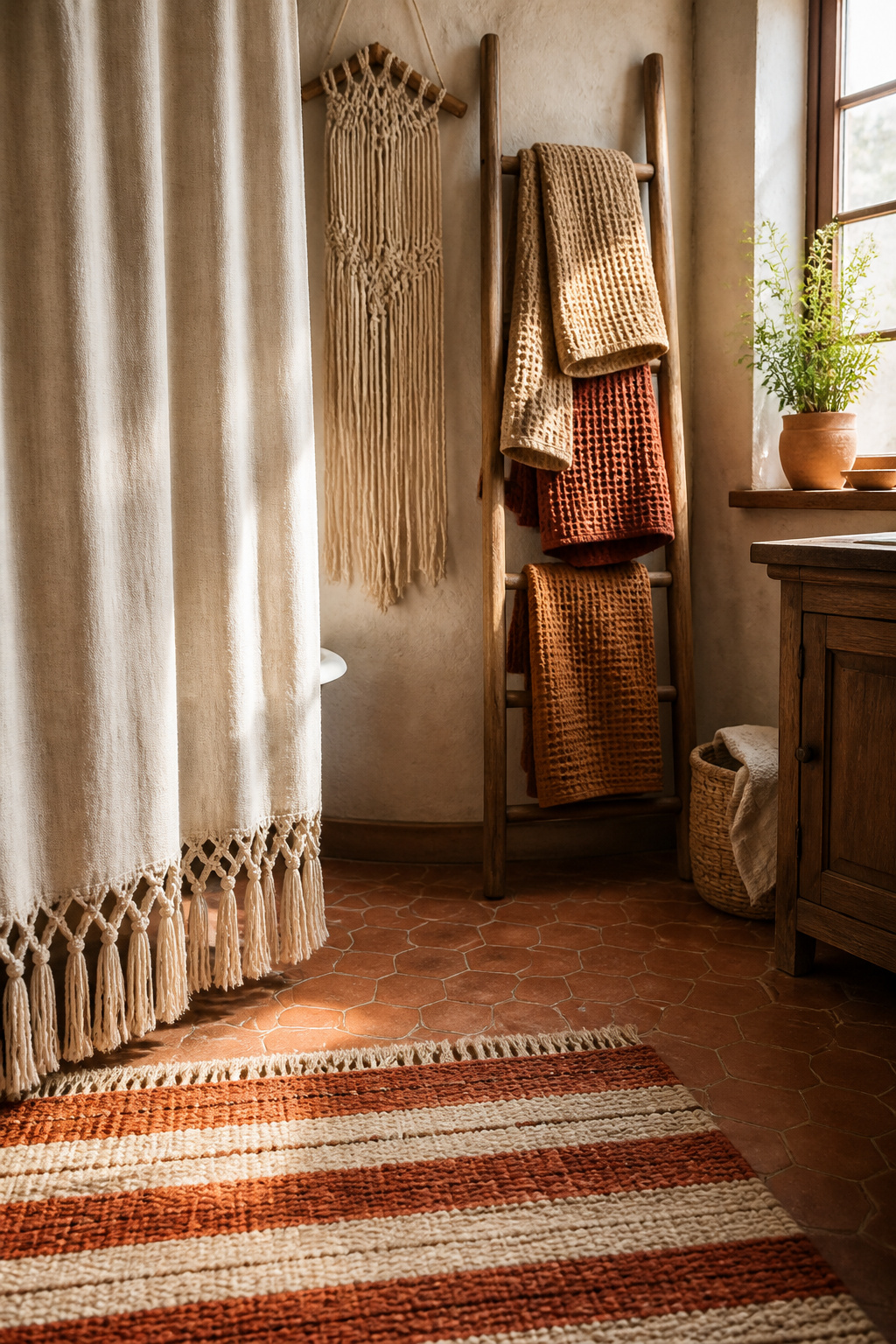
Notice first what a layered bathroom does to you, before you notice a single piece in it. A room of smooth tile and hard porcelain holds you at arm’s length. Add a woven rug underfoot, a soft towel within reach, a length of fringed fabric catching the light — and the room softens around you. That softening is sensory before it is visual, and it is the whole reason the boho bathroom feels the way it does.
Texture works on the nervous system, not only the eye. Rough against soft, matte woven against smooth plaster — that contrast is what designers identify as the defining lever in bohemian interiors, more than colour. A wet room with textural variety creates the spa-like calm that purely tiled surfaces never can.
Layered and cluttered are not a matter of quantity but of relationship. A room reads as layered when every piece connects back to a shared palette; cluttered when each piece only answers to itself. The discipline is a texture count — three is plenty for a bathroom, and no more than three distinct pattern styles. Thin flat-weave textiles — dhurries, kilims, cotton flatweaves — layer best because they lie flat and don’t stack visual bulk.
Set your two-to-three colour palette first — one neutral base, one or two warm accents — before you bring home a single rug. Textiles are the cheapest way to test that palette, and the palette is the groundwork everything else stands on, covered in full alongside the palette behind the textiles. For how textiles sit within the wider style, see the full guide to bohemian bathroom decor.
Boho Bathroom Rugs: Jute, Wool and Woven Cotton
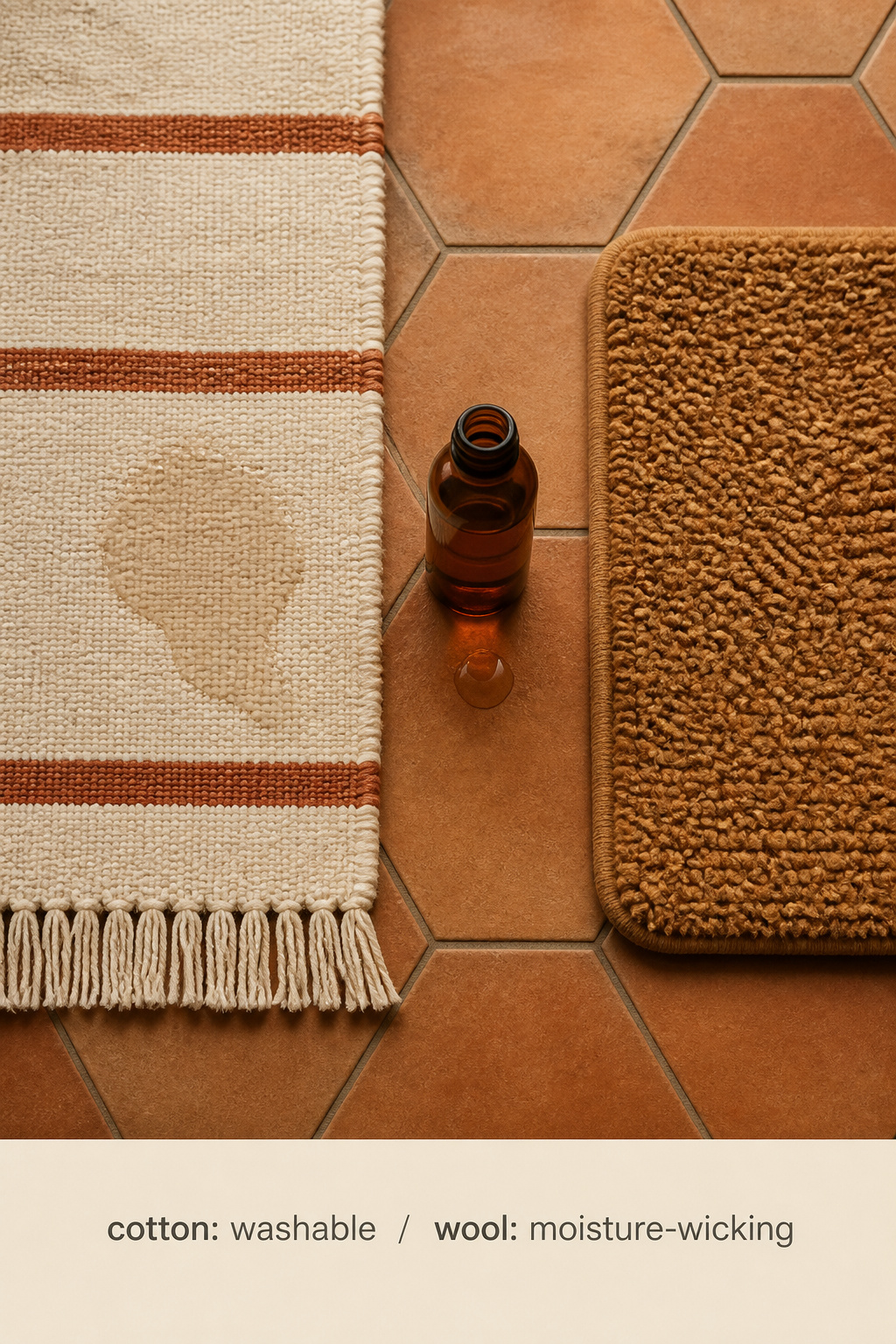
Here is where the sorting matters most, because the rug most people reach for is the wrong one. Read the moisture and washability columns first; in a wet room those two decide everything.
| Material | Texture / look | Moisture & mildew suitability | Washability | Best use |
|---|---|---|---|---|
| Jute | Coarse, natural, the quintessential boho look | Poor — absorbs humidity from the air alone, browns, weakens and grows mould | None — dry-compound cleaning only, never machine-washed | Dry rooms only; a powder room with no shower if ventilation is excellent |
| Wool | Dense, warm, slightly nubby underfoot | Good — naturally moisture-wicking, waxy fibre resists mould and bacteria | Specialist or gentle wash; hang to dry after heavy use | The natural-fibre upgrade for a ventilated bathroom |
| Woven cotton | Soft, flatweave, takes kilim and stripe patterns | Good — handles splash and foot moisture when washed regularly | Machine-washable; wash weekly in a busy bathroom | The practical everyday boho bathroom rug |
| Tufted cotton | Plush, absorbent, soft pile underfoot | Moderate — absorbent, so needs frequent washing to stay fresh | Machine-washable; dries slower than flatweave | A soft step-out mat where it can dry between uses |
Jute: the natural-fibre anchor — and why it stays outside the bathroom
I learned this one the hard way. My first dedicated sitting space was a 4×6-foot corner of a rented Chicago apartment, defined by a single jute rug, a cushion and a paper screen — and I loved that rug enough to assume it belonged everywhere. It does not belong in a bathroom. Jute is highly porous: it absorbs moisture rapidly, and even without direct water it draws enough humidity from bathroom air to brown, weaken and grow mould. Rug specialists are blunt — keep jute, sisal and seagrass out of bathrooms and any high-humidity room, because the held moisture becomes “an optimum breeding ground for mold and mildew.” It can’t be rescued by washing either: jute takes only dry, low-moisture cleaning, never a machine wash. Keep it for the bedroom, with a shower-free powder room the only exception — and then only with excellent ventilation.
Wool and woven cotton for softness underfoot
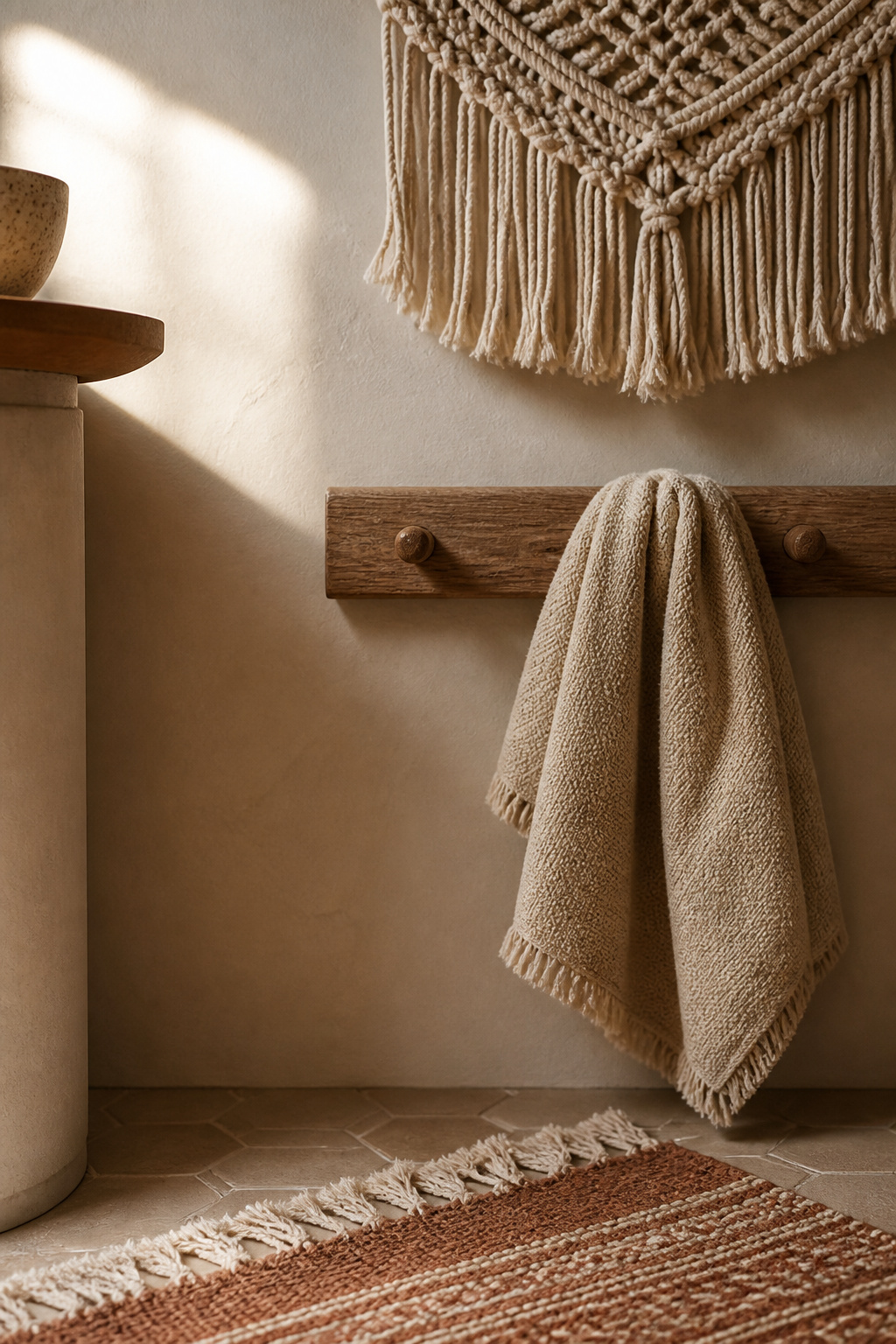
Wool is the natural-fibre answer jute pretends to be: it wicks moisture, absorbing and releasing it without feeling damp, and its waxy surface resists mould, mildew and bacteria. For most people, though, machine-washable woven cotton is the practical first choice: softer than jute, gentler on the budget than wool, and washable — which decides it, since a rug that absorbs shower splash and foot moisture needs to be washed weekly in a busy bathroom. Woven flatweave cotton in kilim-inspired patterns gives the whole jute look without the humidity risk. The honest rule: find the wash label before you buy.
Two layered rugs works only within strict limits: both layers must be thin, fast-drying and machine-washable. In a small bathroom under fifty square feet, skip layering entirely — a single well-chosen rug reads more intentional than a pair crowding the only free floor.
Boho Shower Curtain Ideas: Fringe, Tassel and Pattern
If the rug is the decision that needs the most care, the shower curtain is the one that gives the most back for the least effort. It is the fastest single-piece transformation in a bathroom — it changes the room’s whole character without touching a wall.
Fringed and tasselled curtains as the room’s focal point
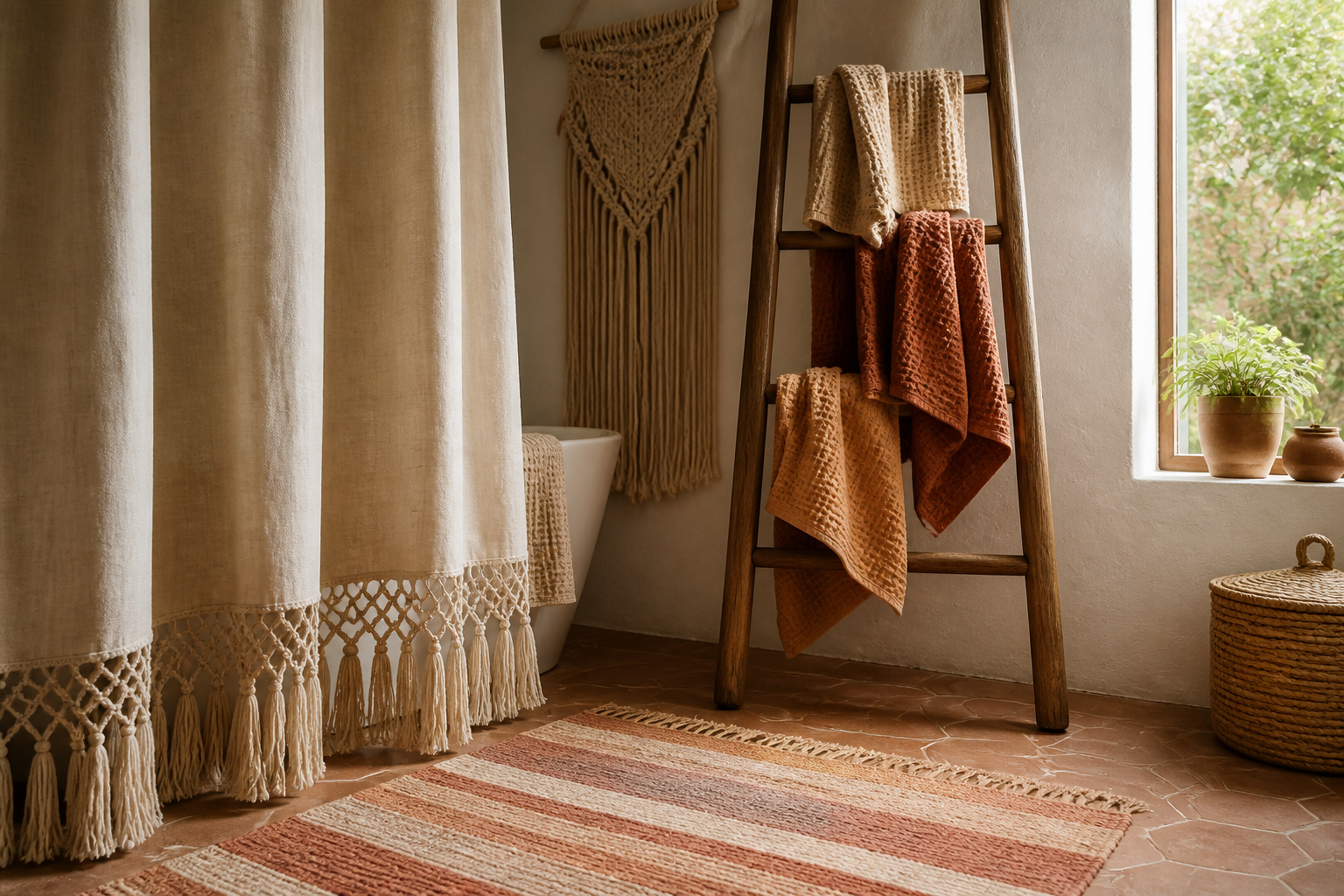
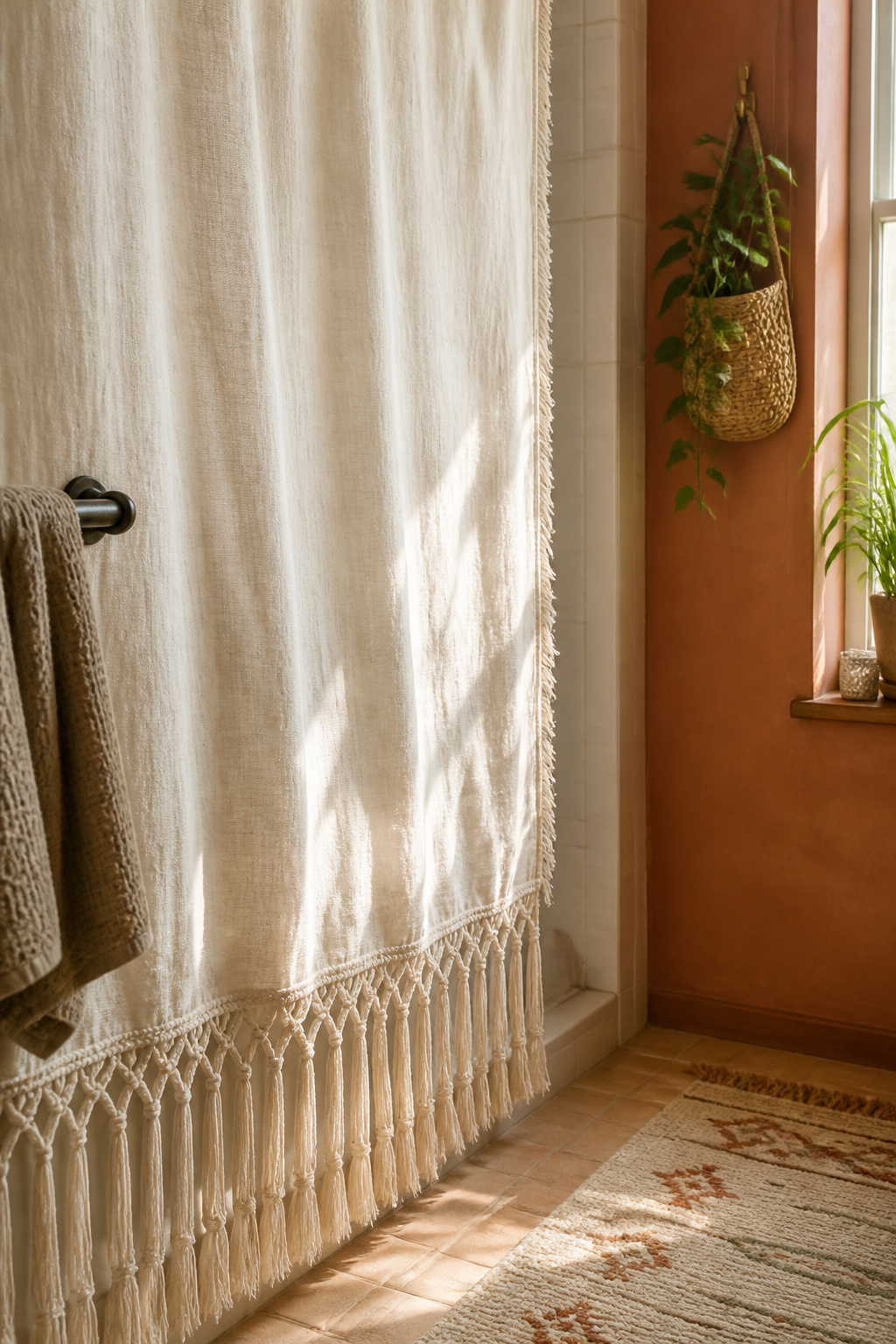
A tasselled curtain in warm terracotta or sandy beige, with knotted fringe along its edges, reads as a textile art piece rather than a functional screen — the handmade feel that anchors the boho look. Cultural prints do the same work: block-print, mandala, ikat all turn a curtain into the room’s focal point, on the condition that the walls and floor stay quiet enough for it to be seen. Pattern scale has to answer to the room’s size: small-scale prints suit a small bathroom; large-scale prints need a larger room or very plain surround. Let the curtain carry the dominant pattern, run the towels and rug at roughly half its scale, and add solid accessories that pull a colour from it.
Fabric weight, liner choices and the mould reality
This is the part the photographs leave out. A cotton or linen curtain is not waterproof, and without a separate waterproof liner it will soak, fail to dry and grow mildew — so the liner is not optional. Mould prevention is a short routine: run the fan during every shower and for 20–30 minutes after; spread the curtain fully open, never bunched, so every surface dries; wash fabric liners weekly in hot water. Hemp dries faster than cotton and resists mould better. Keeping two or three liners in rotation means one is always clean while another is in use. Spread the curtain wide the moment you step out, and most of the problem never starts.
Towels, Hand Towels and the Texture Stack
Towels are the textile layer most people forget, and the one that asks the least in return — no fixtures, no commitment. In a rented bathroom they do as much work as any fixture, swapped seasonally for almost nothing.
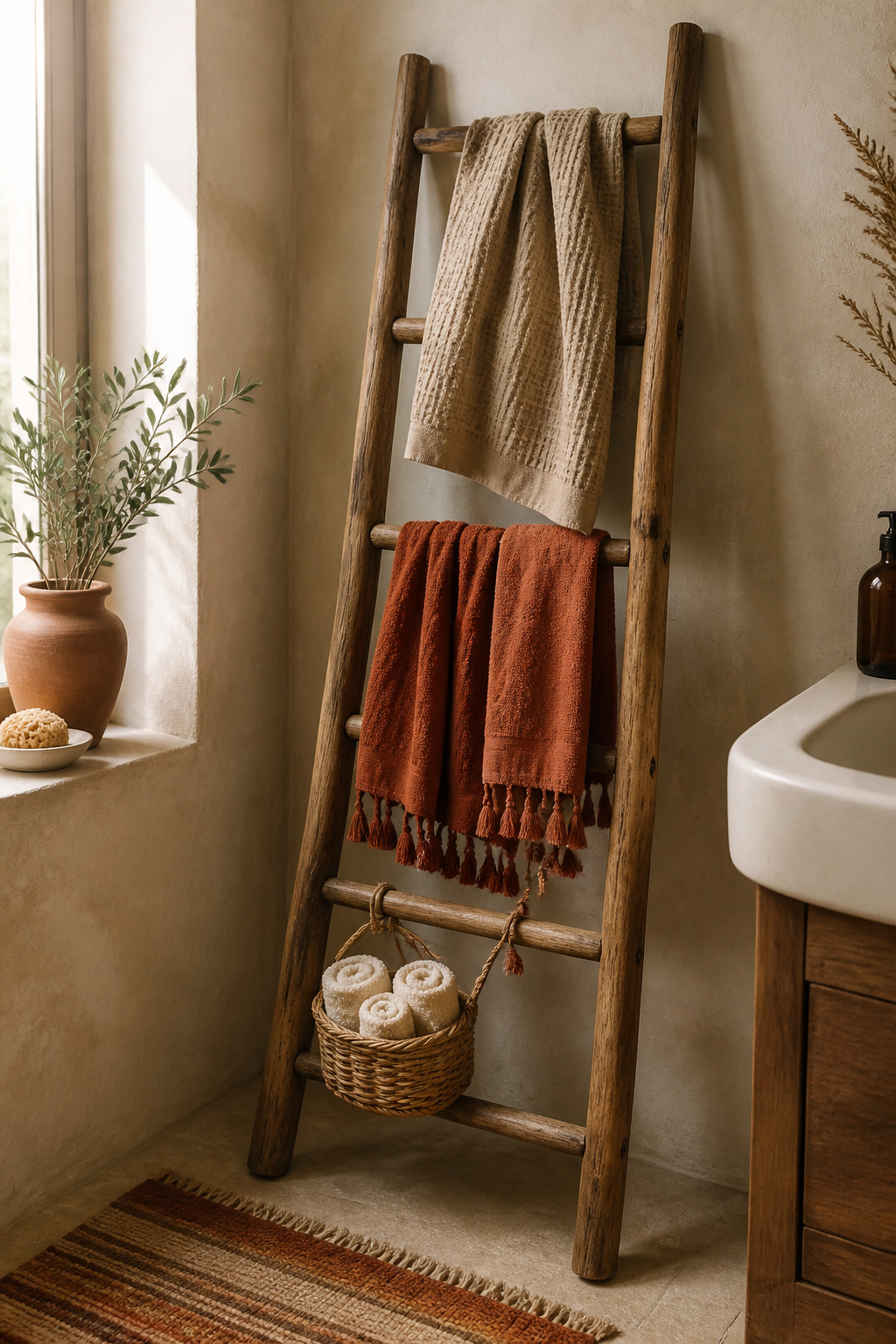
- Choose waffle-weave over flat terry — the raised grid texture absorbs efficiently, dries noticeably faster thanks to better air circulation, and reads as tactile detail; flat terry adds nothing to the room’s texture story.
- Add tasselled hand towels as the easy accent — sold in cotton, typically 16 by 30 inches, they work on any standard ring, bar or hook with no new hardware; loop one through a ring with the tassel end forward so the detail faces the room.
- Let the hand towel carry the boho detail, the bath towel the background — a tasselled hand towel beside a plain waffle bath towel layers instead of competing.
- Drape, don’t fold into tight squares — a loose fold that shows texture, or a draped hang that lets the fabric fall, reads as collected rather than hotel-formatted.
- Layer colour within the earthy palette — rust over sand, cream over terracotta builds depth on a ladder or bar without needing any pattern at all.
- Add a natural-material vessel — a wicker or rattan basket of rolled washcloths at a ladder’s base contributes the texture layer that completes the stack.
A leaning wooden ladder is the most boho-natural display, the towels draped loosely rather than squared off. Hang one towel loosely today and notice how much warmer the room reads.
Choosing and Combining Textiles Without Overwhelm
The real skill in a boho bathroom is knowing when to stop. Everything so far adds; this section subtracts.
Three textures is the working number for a bathroom: smooth, woven, and one rough note such as macrame or rattan. Three well-chosen textures in contrast create more sensory interest than six in competition. For pattern, one organic print, one geometric, one solid — three that interact because each speaks a different visual language. One large-scale showstopper (usually the shower curtain) with secondary patterns kept smaller; two large patterns at the same intensity unsettle a room. A common earthy palette grounds the arrangement.
Before any new textile comes in, take one existing piece out and see whether the room is better without it. If it is, the room was already complete. A second check: let your gaze land naturally and notice what it finds first. A settled room offers a clear sequence — curtain or rug first, towels second, the wall accent third. If it lands on several things at once, the pieces are competing. Boho is collected, not accumulated, and the difference is entirely intention.
Textiles You Can Make Yourself
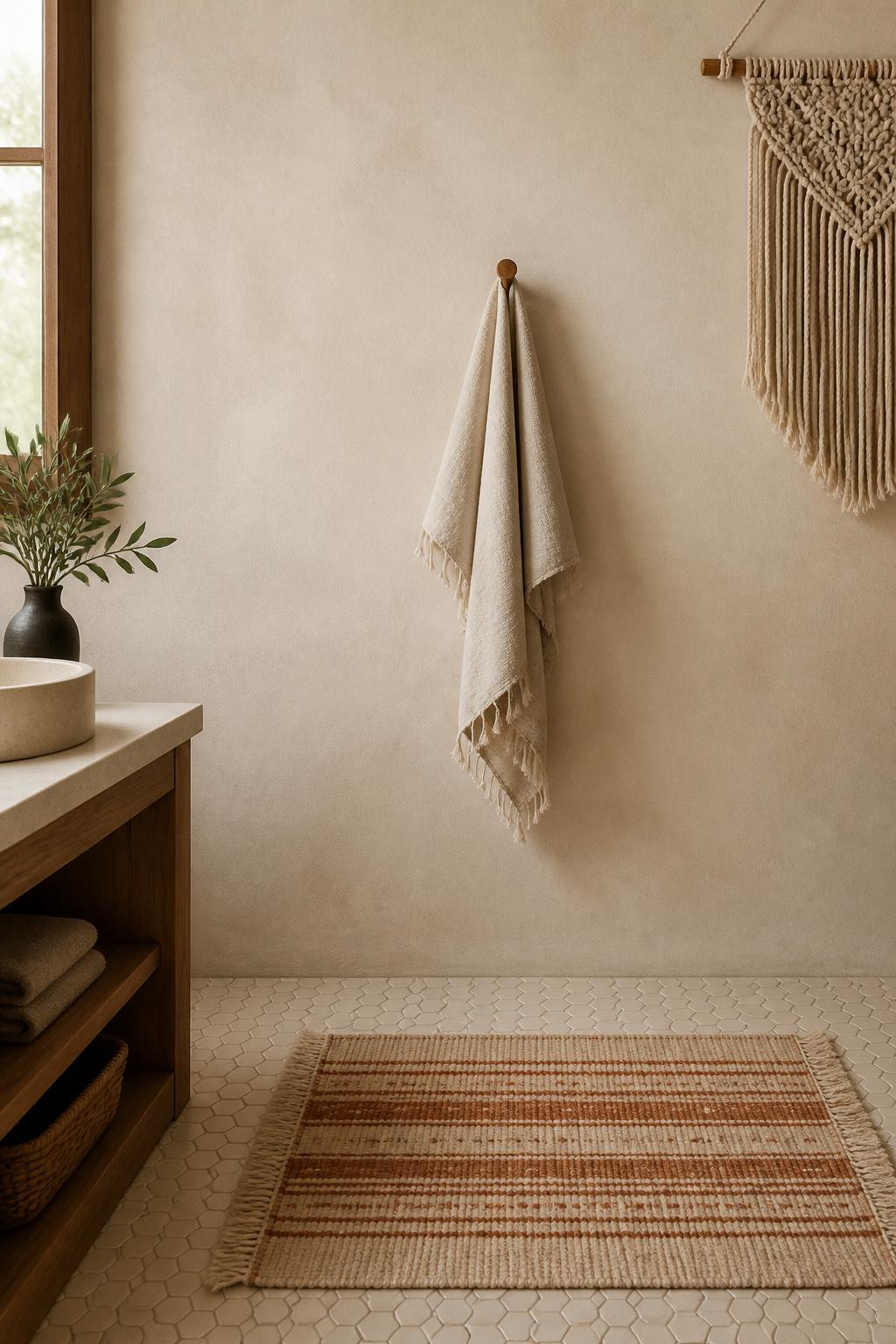
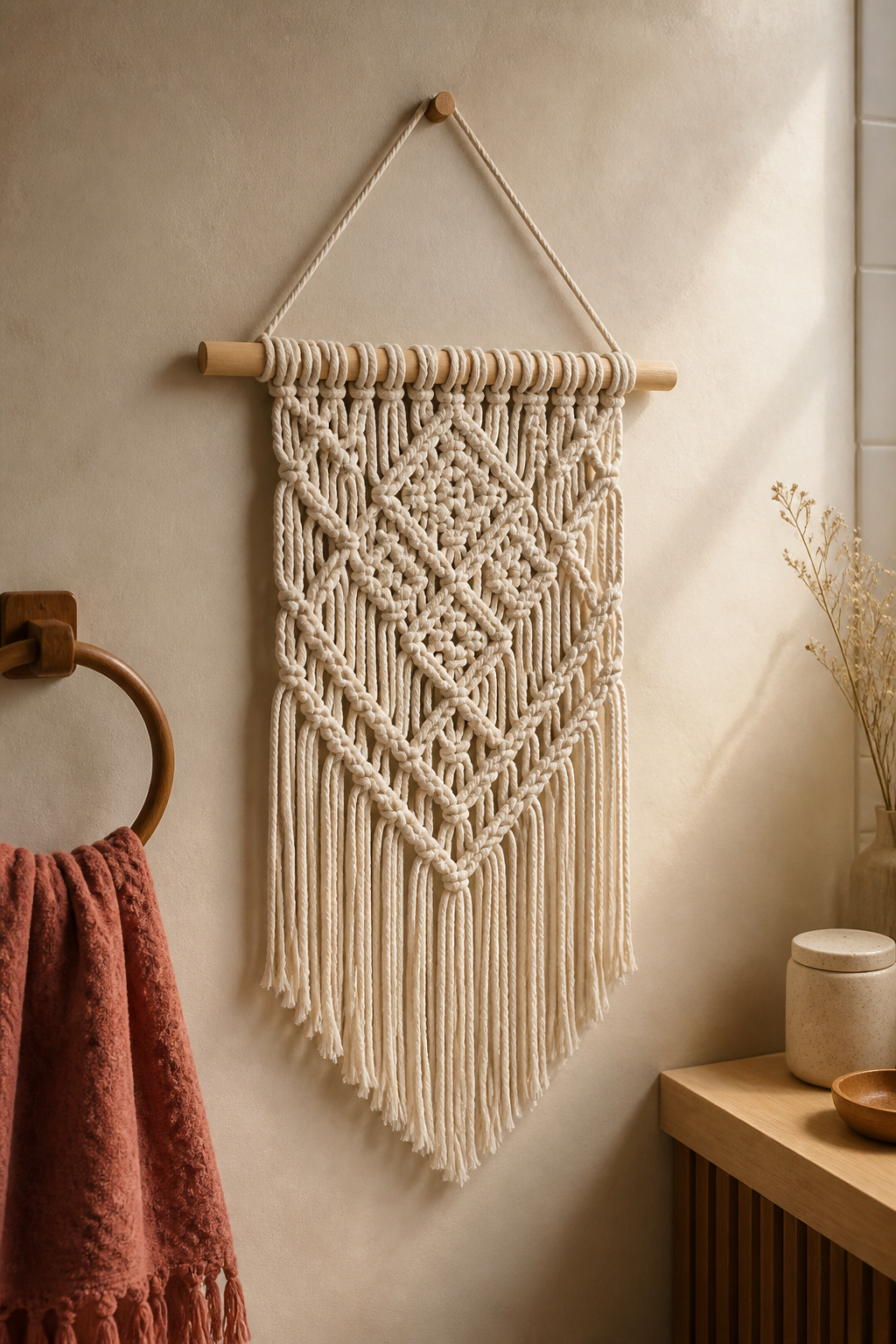
The most personal layer in a boho bathroom is the one you make. A handmade piece carries a quality no shop-bought textile replicates — the texture of hand-knotted cord against plaster is the “this was made” signal authentic boho rests on.
Macrame is genuinely beginner-accessible: a small wall hanging comes together in around fifteen minutes with nothing but cord, scissors and a dowel. Cotton cord is soft and comes in colours; hemp is coarser and reads aged. For a curtain upgrade that needs no sewing, tie pre-made tassels straight onto the shower hooks — under five minutes, fully reversible. Give a handmade piece the room’s most prominent vertical surface — above the towel bar, opposite the mirror — not a secondary spot where its making goes unseen. Keep it to one per small bathroom; two compete and dilute the signal. The macrame and woven projects that belong in this layer are what make your own woven pieces covers in full.
The boho bathroom textiles that belong are fewer than the marketplace suggests, and the choosing is mostly subtraction. Wash-test the rug before anything else; let one bold piece lead and keep the rest quiet beneath a shared earthy palette; spread the curtain wide to dry every single day. Hold to three textures, three patterns, one palette, and the room will read as collected rather than crowded.
FAQ
What kind of rug works best in a boho bathroom?
Machine-washable woven cotton is the practical first choice: it gives the earthy boho look in kilim-inspired patterns or natural stripe, tolerates bathroom humidity, and washes weekly as a shower-room rug must. Wool is the natural-fibre upgrade — it moisture-wicks and resists mould in a ventilated room. Avoid jute, which grows mould and can’t be washed.
How do you style towels in a bohemian bathroom?
Drape towels loosely over a wooden ladder’s rungs rather than folding them tight — the casual hang shows texture and reads as collected, not hotel-formatted. Layer contrasting colours within an earthy palette, rust over sand, and use tasselled hand towels nearest the door for the detail seen first. A basket of rolled washcloths completes the stack.
Can you use a cotton shower curtain without it going mouldy?
Yes, with routine care. Hang a separate waterproof liner behind it, spread the curtain fully open after every shower rather than bunching it, run the fan for 20–30 minutes, and wash the curtain and liner weekly in warm water. Keeping two or three liners in rotation means one is always clean and dry while another is in use.