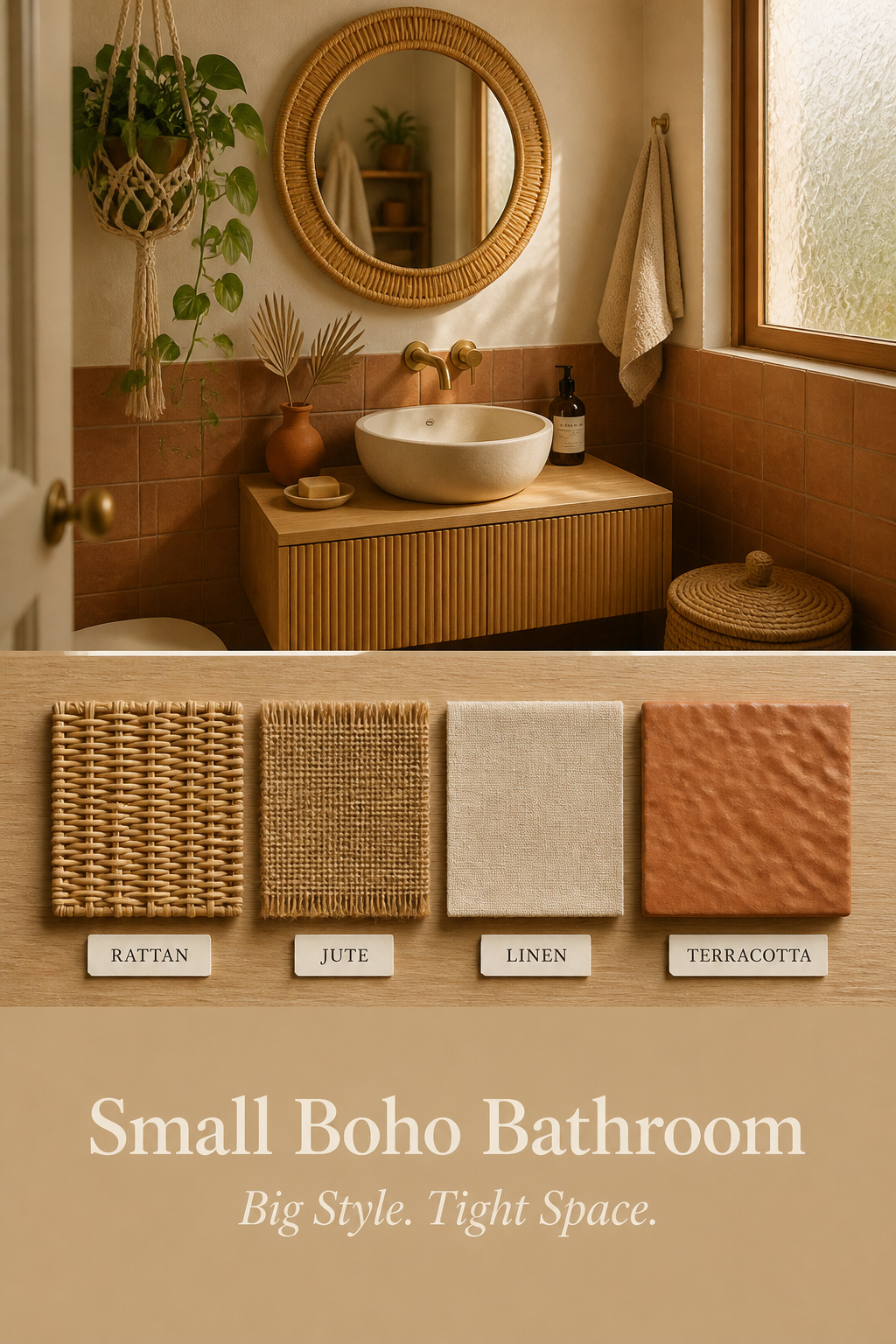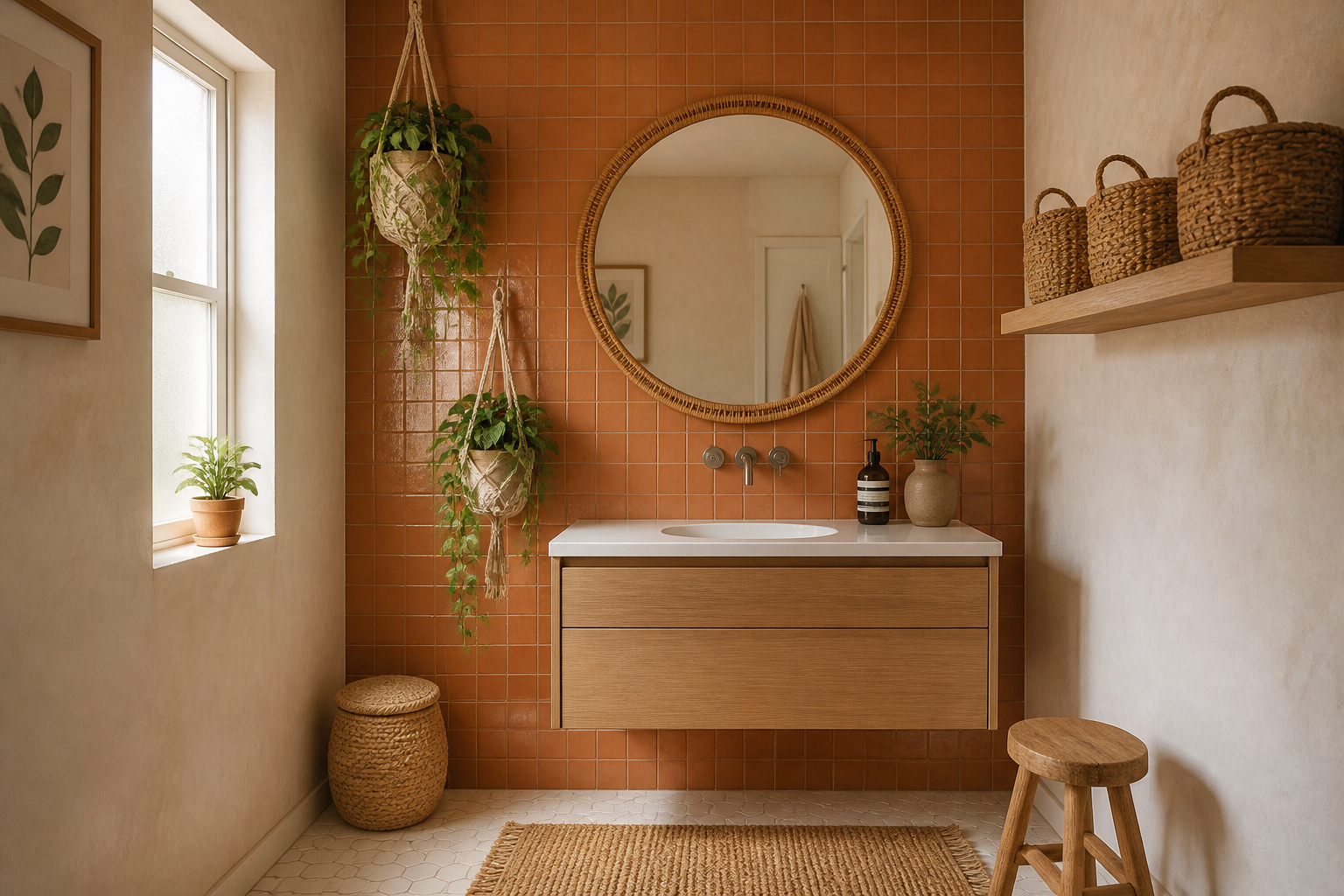
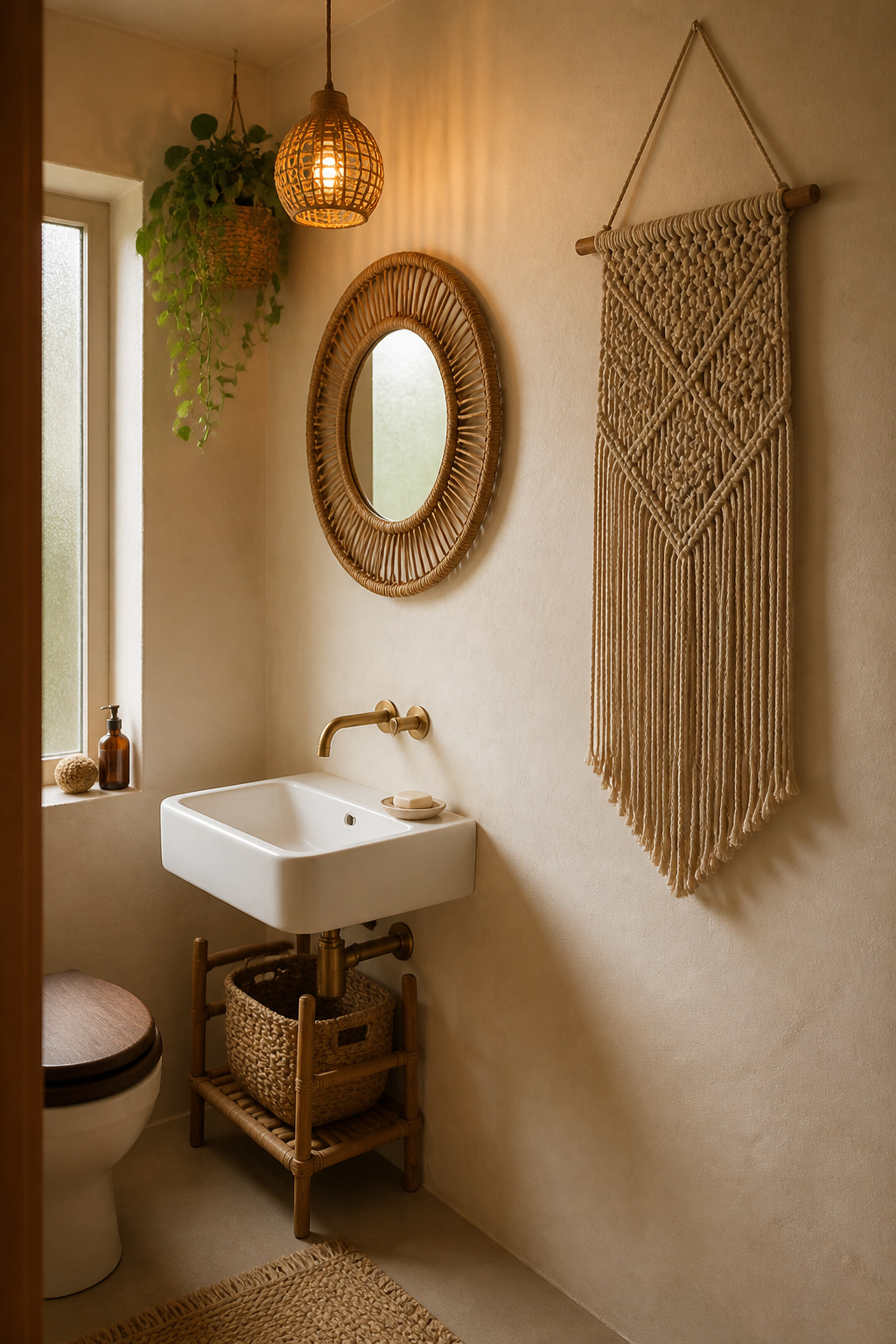
A small bathroom feels like a problem because of one quiet assumption: that boho means more, and more needs room. Picture the before — a plain mirror, one flat overhead light, blank walls, a space that reads as exactly its own size. The after is the opposite room: the same four walls, but the eye now travels — up a trailing plant, across a mirror, to a single patterned wall — and the room breathes larger than its footprint. A small boho bathroom isn’t a watered-down version of the look; it’s the container that forces the editing the look has always needed.
TL;DR
- A tight room does the curating for you: keep one patterned surface, two or three textures, and let vertical space carry the rest — character without floor clutter.
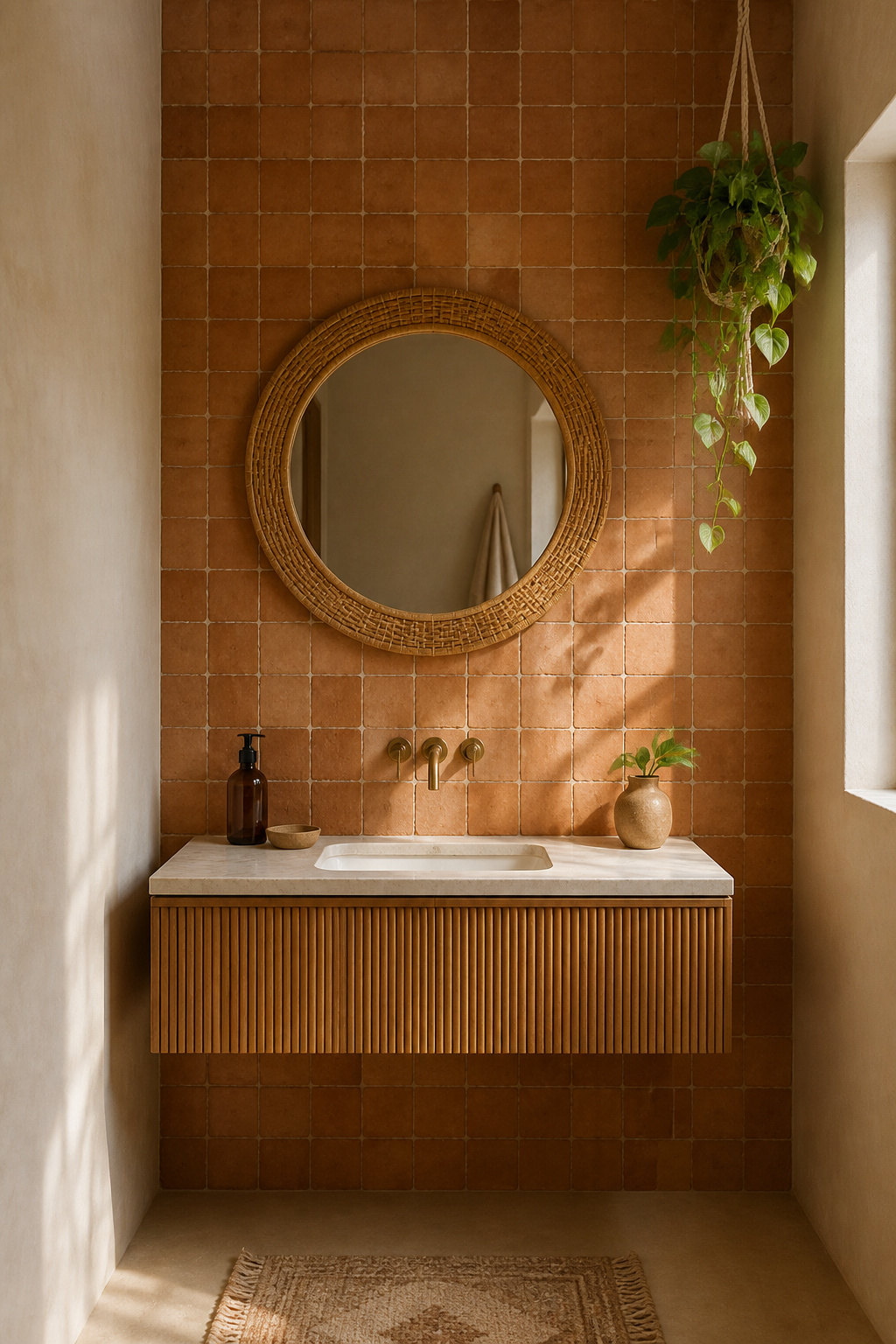
- For pattern, large-format tile (12×24 inch and up) on floors and quiet walls reads as more space; confine handmade 4×4 zellige to a single accent wall, grout matched close to the tile.
- A round rattan mirror hung opposite a window and warm 2700–3000K layered light are the two free square metres — they expand the room and carry the boho style at once.
The Small Boho Bathroom Problem (and Why It’s Not a Problem)
Why small rooms are actually easier to pull off in boho style
Start with the feeling you want when you walk in: held, not hemmed in. Boho’s own toolkit gets you there more easily in a tight room than a large one. Hanging plants, wall-mounted macrame, open rattan shelves, a textured mirror — these add their interest in the vertical plane, where a small bathroom has space to spare, rather than on the floor. The earthy palette helps too: beige, clay and sage are low in chroma, so they recede and the walls feel further away than they are.
The single shift in thinking that changes everything
Stop asking how do I fill this space? and start asking where do I want the eye to travel? A mirror that bounces light, a plant that draws the gaze up, one patterned surface that holds attention — each gives the eye somewhere to go without adding to the floor. The whole of this article sits inside that one move, set within the wider boho bathroom ideas guide.
Tonight, remove one object from the surface that feels busiest — and sit with what remains for a day before deciding whether it comes back.
Pattern Scale in a Small Room: Getting It Right
Pattern is the lever that most directly changes how big a small bathroom feels, and the common advice — small room, small tiles — has it backwards. Large-format tile carries fewer grout lines, so a surface reads as one calm plane rather than a grid; the larger the tile, the greater the sense of space. The table below weighs the four scales you’ll choose between — a working approach, not a rulebook, since your room’s light and layout have the final say.
| Scale tier | Size | Where it works | Risk | Boho example |
|---|---|---|---|---|
| Small repeat | 1×1 to 3×3 inch mosaic | Shower floor only, or a 3–4 inch border around a plain mirror | Dense grout lines fragment the eye and shrink the walls | White hex shower floor, sand grout; terracotta border framing the mirror |
| Medium repeat | 4×4 to 6×6 inch zellige / cement | One accent wall only — behind the vanity or in a shower nook | Overwhelms if it spreads past one surface; match grout to tile | Handmade terracotta zellige on the vanity wall; cement tile in the nook |
| Large format | 12×24 to 24×48 inch | Floors and quiet neutral walls | Low risk, but reads less boho — needs rattan and textile accents | Limestone-look porcelain floor, matching grout, woven accessories above |
| Mixed / patchwork | Combining scales | Only with caution, one pattern per zone | Competing patterns across zones create shrinking noise | Hex floor + plain walls + one zellige accent — no repeat between them |
Small repeating patterns versus large statement tile
The mechanism is grout, not taste. Tiny mosaic introduces a dense web of joints that breaks the field into fragments — which is why designers reserve it for shower floors, where slip resistance needs the small format. Grout colour matters as much as size: match it close to the tile and the joints all but vanish; contrast it and you draw every line and pull the walls inward.
The single pattern focal point approach
Choose one surface and commit — the shower’s back wall or the wall behind the vanity, both read from across the room and leaving the rest neutral. Handmade 4×4 zellige is the one small-repeat format that belongs in a tiny room, because its hand-thrown variation reads as organic texture rather than a hard geometric repeat, kept to a single face. The full case for zellige and patterned boho bathroom tile is its own guide.
Mirrors and Light: The Two Free Square Metres
Mirrors as a boho element that also enlarges the room
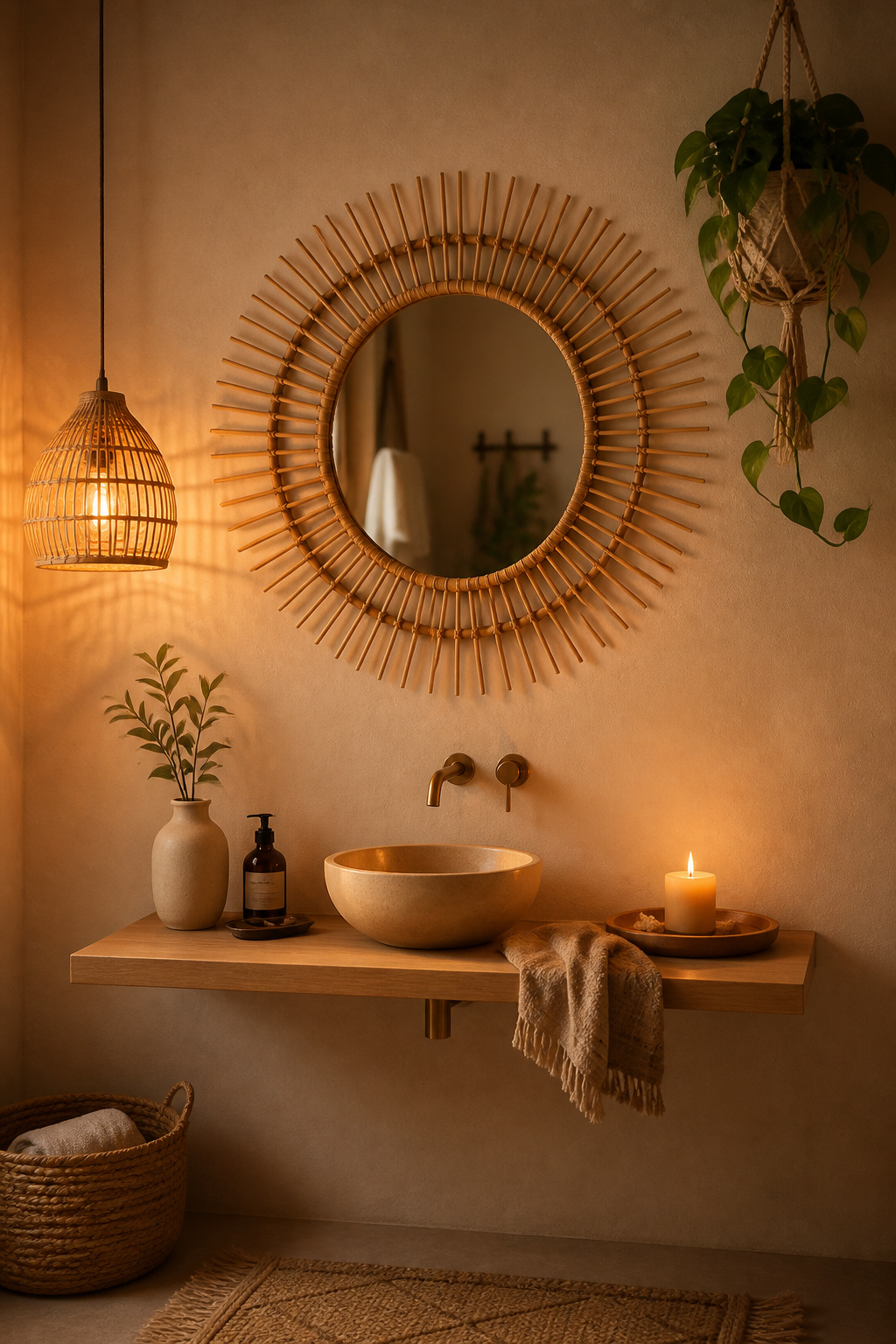
A mirror is the only object that gives back floor area it never takes. Hung opposite or beside the window, it bounces daylight deep into the room and softens the boundary — and a round rattan or carved-wood frame does this while serving as the room’s wall art. Keep it to scale: roughly 65–70% of the vanity width and a hand’s width above the tap, so the frame doesn’t dominate a compact wall.
Warm layered lighting in a small space
Then change the light, because the single cool overhead is what makes most small bathrooms feel clinical. Swap it for warm LEDs in the 2700–3000K range — the temperature that animates rattan, jute and warm plaster instead of greying them out. Layer it in three: ambient (a woven pendant), task (sconces flanking the mirror, centred 60–66 inches from the floor per NKBA guidance), and accent (a candle on the vanity). The varying heights and warmth give the room depth a single bulb erases, and a rattan pendant throws patterned shadow across the ceiling, so it reads taller than it is.
Maximising natural light without a big window
When the window is small or frosted, work with what arrives. Frosted adhesive film holds privacy without blocking daylight — kind to a rented room. Soften it with a sheer linen panel in pale cream. In a windowless room, a warm-spectrum LED mirror stands in for the daylight you don’t have.
Vertical Storage and Greenery in a Compact Bathroom
The answer to the storage worry is rarely on the floor — it’s on the wall, from counter-height to ceiling, the most underused surface in a small bathroom. Each strategy below earns its keep twice: it stores or softens, and its material — wood, rattan, cotton rope — feeds the earthy palette.
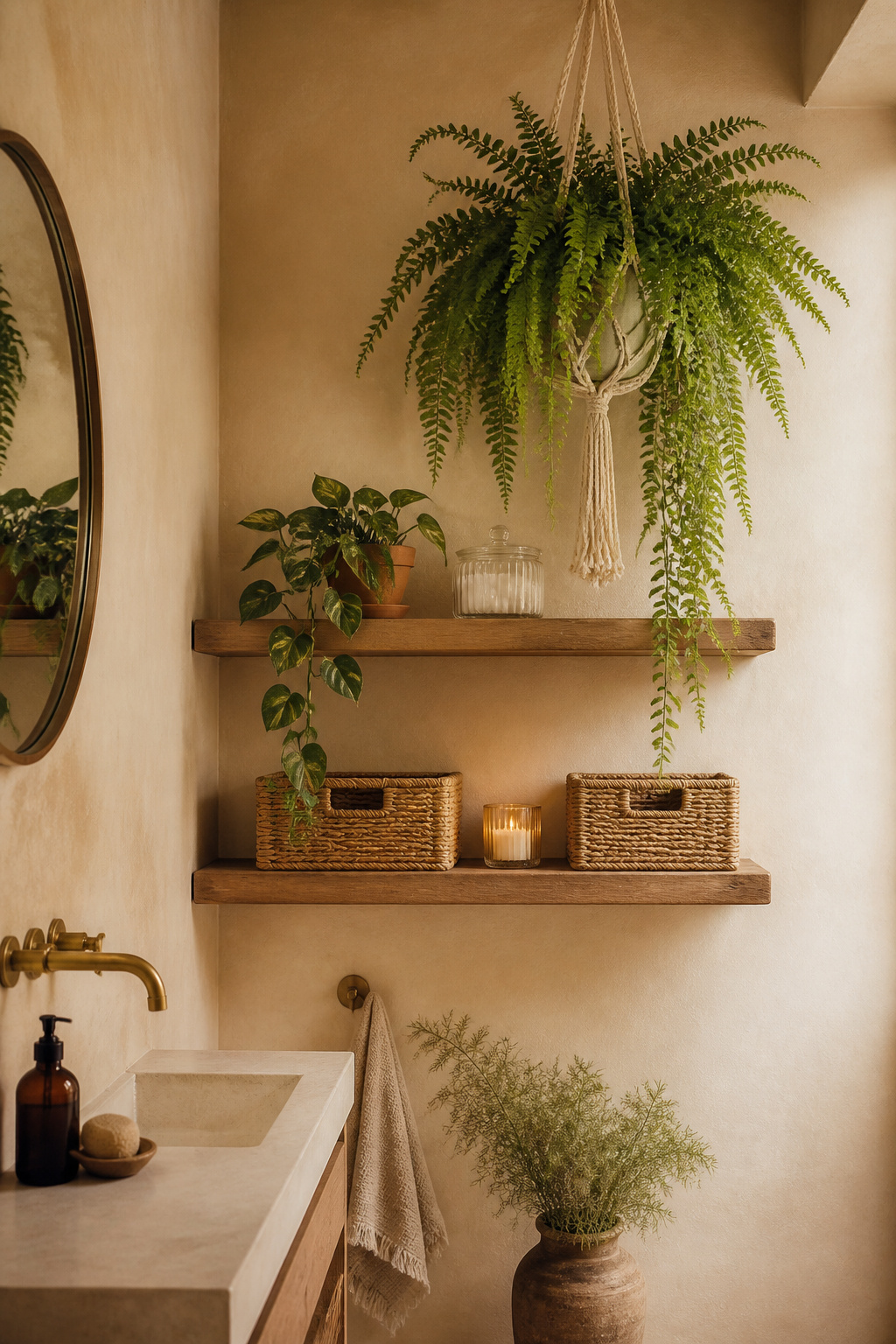
- Floating wood or rattan shelves at 6–8 inch depth — stay close to the wall and preserve clearance below; mix concealed baskets low with open display above, spaced 10–12 inches apart so each reads as its own layer.
- A leaning ladder shelf in rattan or natural wood — no drilling, a 14–18 inch footprint barely more than a chair, baskets on the low rungs and folded towels above.
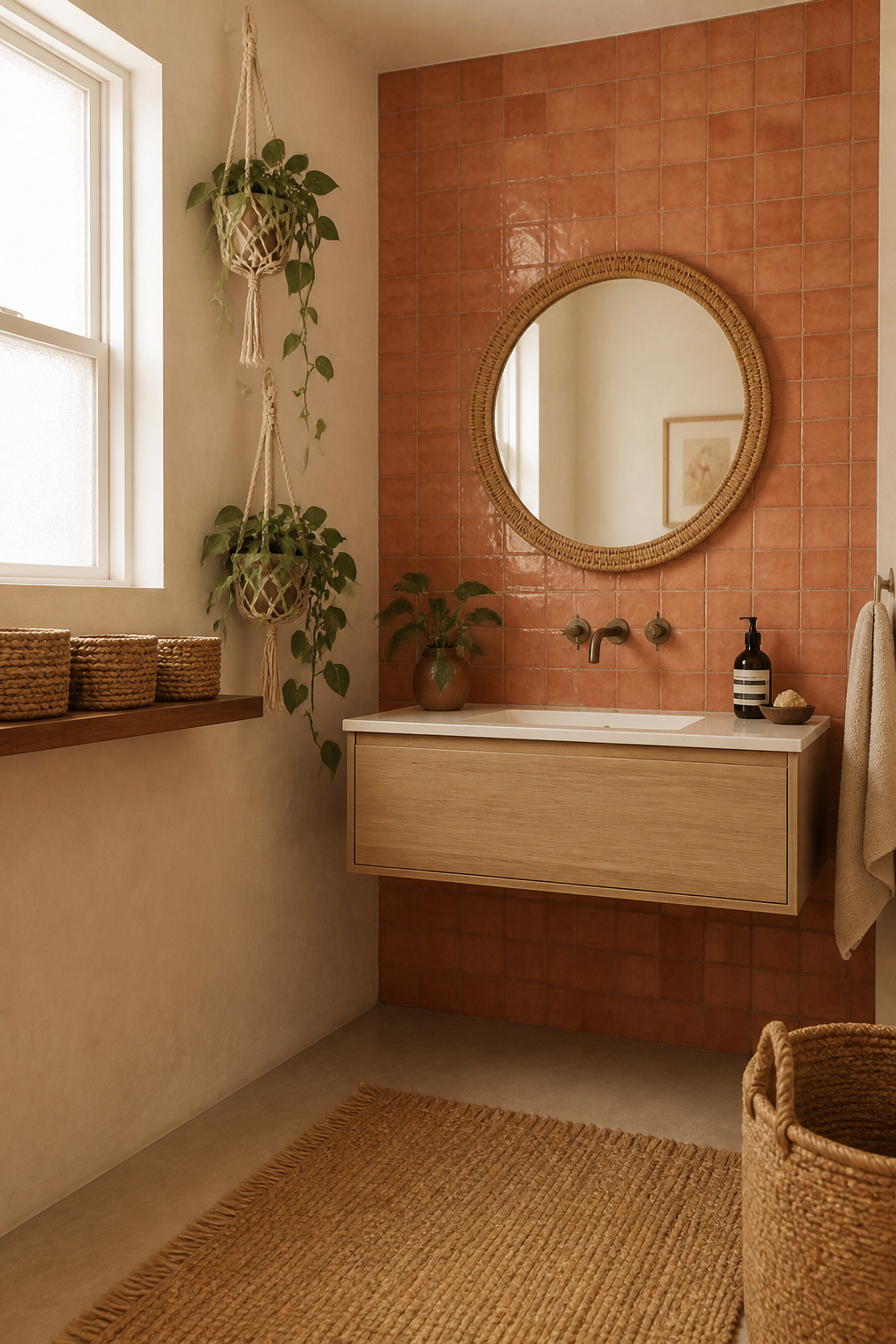
- A macrame wall planter with trailing pothos or fern — zero floor space, handmade rope texture, and it puts a humidity-loving plant exactly where the steam collects.
- A tall rattan or wicker laundry basket — earns its floor space by reading as a vertical sculptural piece, its weave adding to the material palette.
- An over-door hook rail or behind-door bar — deploys the back of the door, a whole unused plane, with no change to the walls; holds robes, bags, or a hanging plant.
Trailing plants as vertical design without taking floor space
A macrame hanger holding a trailing pothos fills the upper third of the room and touches the floor not at all; hang two at five and six feet and the eye climbs the composition. Which species survives your light and humidity is its own decision — our guide to plants that suit tight spaces walks through it.
Choosing Two or Three Textures Instead of Ten
Why restraint in a small boho room reads as confidence
Three or four materials, repeated through the space, read as intentional — the repetition itself signals a confident hand, where more than that feels like a sample board. The instinct to subtract is right here: before a new texture comes in, find the element already doing that job less well, and let it go.
Picking the right three: the anchor, the contrast, the accent
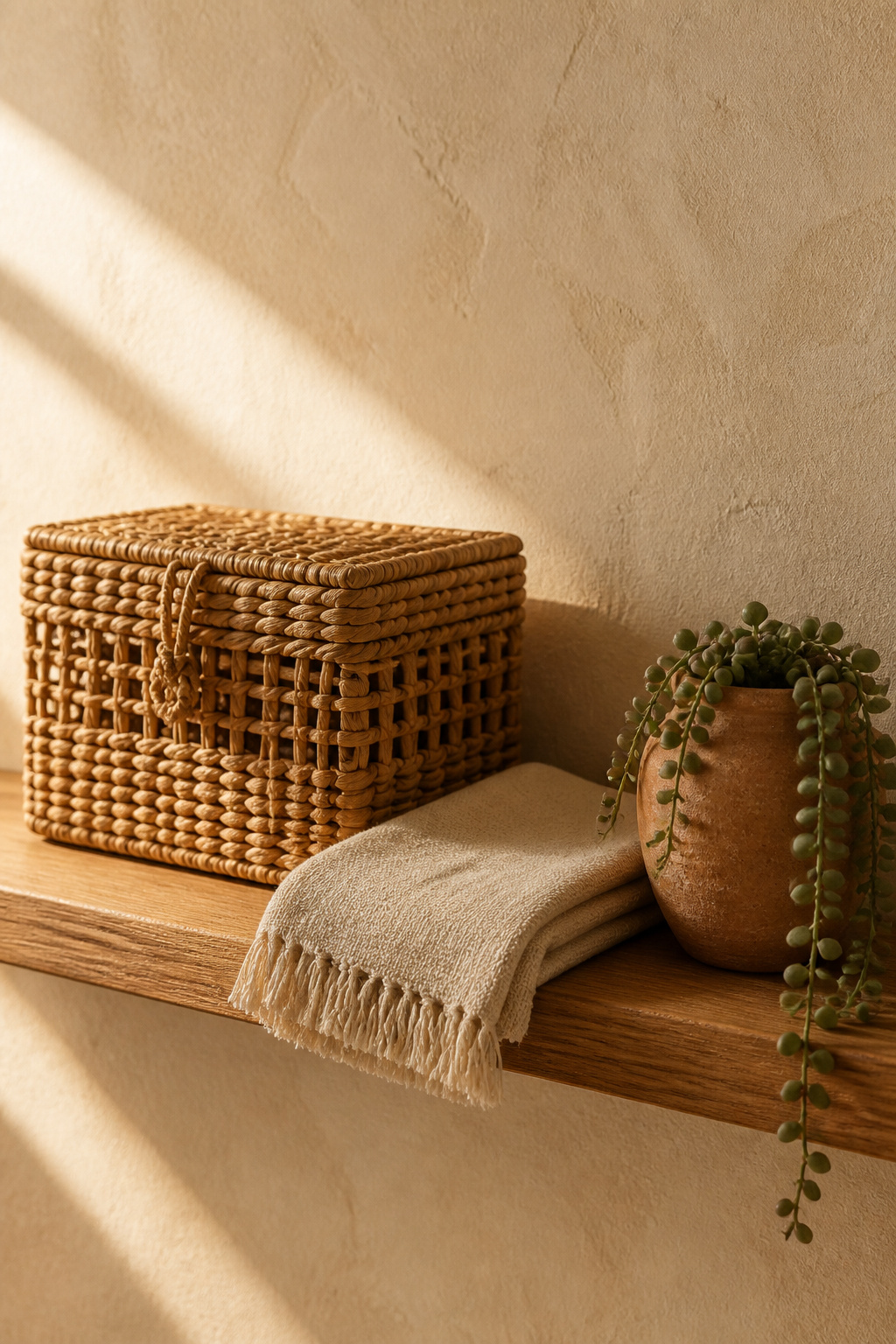
Choose three roles, not three things. The anchor is the dominant material — rattan, wood, or the single tiled wall. The contrast reads differently against it: where rattan is rough and open, linen is smooth and tight. The accent appears in small doses, a fringed towel or a hammered ceramic dish. What holds them together is colour: keep all three in the warm cream-to-oat range and a rattan basket, a woven cotton mat and linen towels feel unified however much their surfaces differ.
What to leave out when the room is small
Glass, chrome and plastic go first: they catch hard light, draw the eye to plumbing joints, and dilute the earthy, handmade register. Textiles are the other risk — a patterned rug, a fringed curtain, a linen towel and a woven mat are four soft textures fighting in a small space, so let one, usually the mat, stay a plain neutral.
Pick up the one chrome or plastic accessory and set it outside the door; the room will already feel calmer.
Rental-Friendly Moves for a Small Boho Bathroom
No-damage approaches for rented rooms
Most of this look can be built without touching the structure. Leaning ladder shelves, freestanding rattan étagères and over-door hook rails give storage and texture with not a hole drilled, and swapping a glass screen for a flowing linen curtain on the existing rail changes the room with no tools. One caution: adhesive picture strips lose a good share of their hold in warm, humid air, so treat their stated weight as generous and lean or freestand anything heavier than a light frame.
Temporary wallpaper and peel-and-stick tile accents
Removable peel-and-stick wallpaper and tile, in moisture-resistant formulations, give a patterned surface without commitment — a Moroccan-pattern strip behind the mirror reads as a feature wall you can take down. The commonly shared removal method is to warm the adhesive with a hair dryer, then peel a corner back slowly while keeping it warm rather than pulling cold. Treat that as best-practice guidance, not a guarantee — much of it comes from the brands themselves, and it only behaves on a dry, primed, smooth surface.
Accessories that do the heavy lifting
In a rented bathroom the accessories carry the look: a fringed shower curtain, a woven cotton mat, a rattan mirror, one woven hanging, and a trailing plant in a woven holder get you most of the way with no structural work. A woven tray on the vanity does quiet double duty, corralling clutter and screening non-boho bottles behind one natural surface — all of it reversible, none of it permanent.
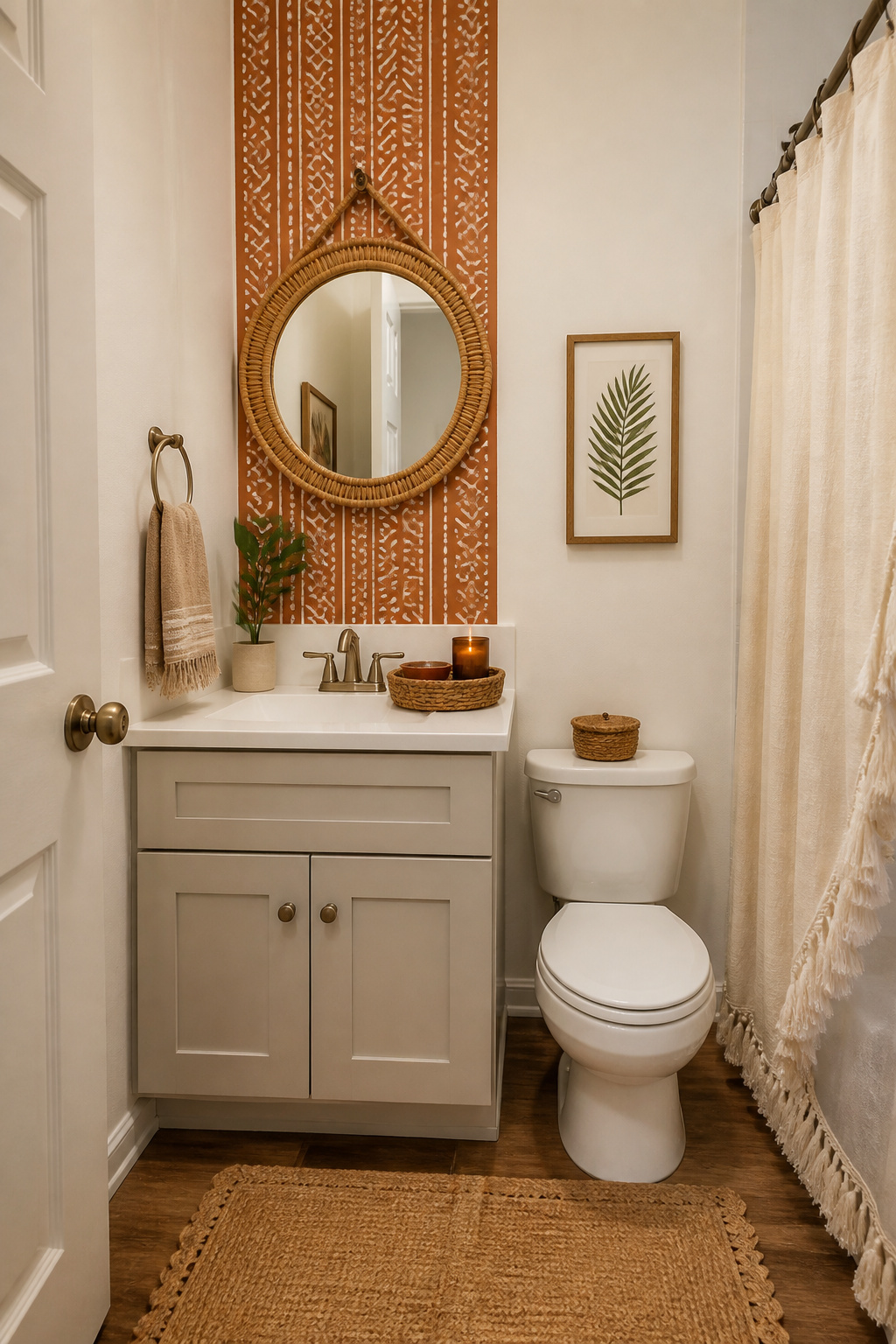
The small boho bathroom you pictured at the start was waiting on subtraction, not square footage: one patterned wall, a mirror set to catch the light, the warmth of the right bulb, and a handful of textures in the same warm family. The room was always large enough to feel calm. It only needed you to stop filling it and start composing it.
FAQ
How do you make a tiny bathroom look boho without it feeling cluttered?
Hold the active texture palette to three materials — one anchor like rattan or wood, one contrast like linen or woven cotton, one accent like terracotta — and repeat them rather than adding new ones. Choose vertical storage over floor storage, and confine pattern to a single surface while the remaining walls stay a quiet earthy neutral.
What tile works best for a small boho bathroom?
Large-format tile, 12×24 inch or bigger, on floors and neutral walls reduces grout lines and reads as a continuous, larger surface. Handmade 4×4 zellige in terracotta or warm white is the signature boho tile, but only on one accent wall with closely matched grout. Reserve small mosaic for shower floors, where slip resistance needs it.
Can you do a boho bathroom in a rented flat without losing your deposit?
Yes. A fringed shower curtain, a rattan mirror on a rated adhesive hook, a leaning ladder shelf, a macrame hanging and a trailing plant build the look with no structural change. Moisture-resistant peel-and-stick wallpaper adds pattern and removes cleanly from dry, primed walls when warmed first — though results vary, so test discreetly.