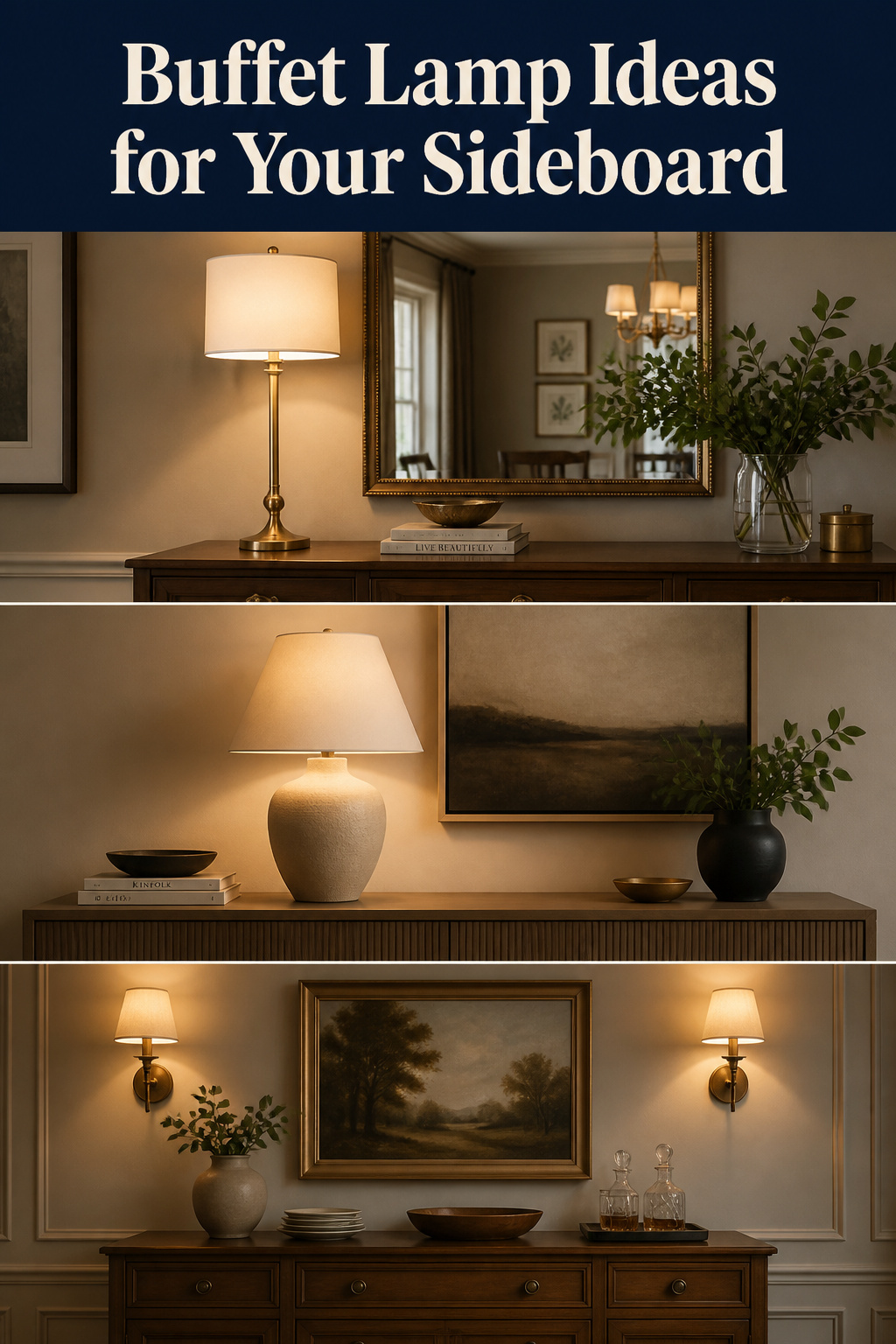
A sideboard can photograph beautifully at noon and fall flat at eight in the evening, when the overhead fixture is doing all the work and nothing on the surface holds light or pulls the eye to a focal point the way a lit shade does. That is a lamp problem, and buffet lamps are the answer the category makes maddeningly hard to shop for — hundreds of styles, contradictory height advice, product photos that flatter a lamp at a scale you will never replicate at home. Happily, the decisions that matter are few, and most are governed by numbers rather than taste.
TL;DR
- Buffet lamps stand 32–36 inches tall (base plus shade, measured from the surface up); that height puts the shade at seated-diner eye level and holds the combined sideboard-plus-lamp height within the 58–64 inch target.
- A matched symmetrical pair suits formal, wider sideboards; one lamp balanced by a tall object suits modern rooms and narrow surfaces under 48 inches.
- Run buffet lamps at 450–800 lumens, 2700K warm white, on a trailing-edge LED dimmer so one lamp serves both cleanup light and dinner mood.
What a Buffet Lamp Actually Does (It Is Not Just Decoration)
A buffet lamp does two jobs at once, and most people credit it with only one. It is a soft, atmospheric light source — and a structural object, the tallest reliable vertical you can put on a sideboard without crowding it. Skip it and you have not just left the room dim; you have left a flat display with no anchor.
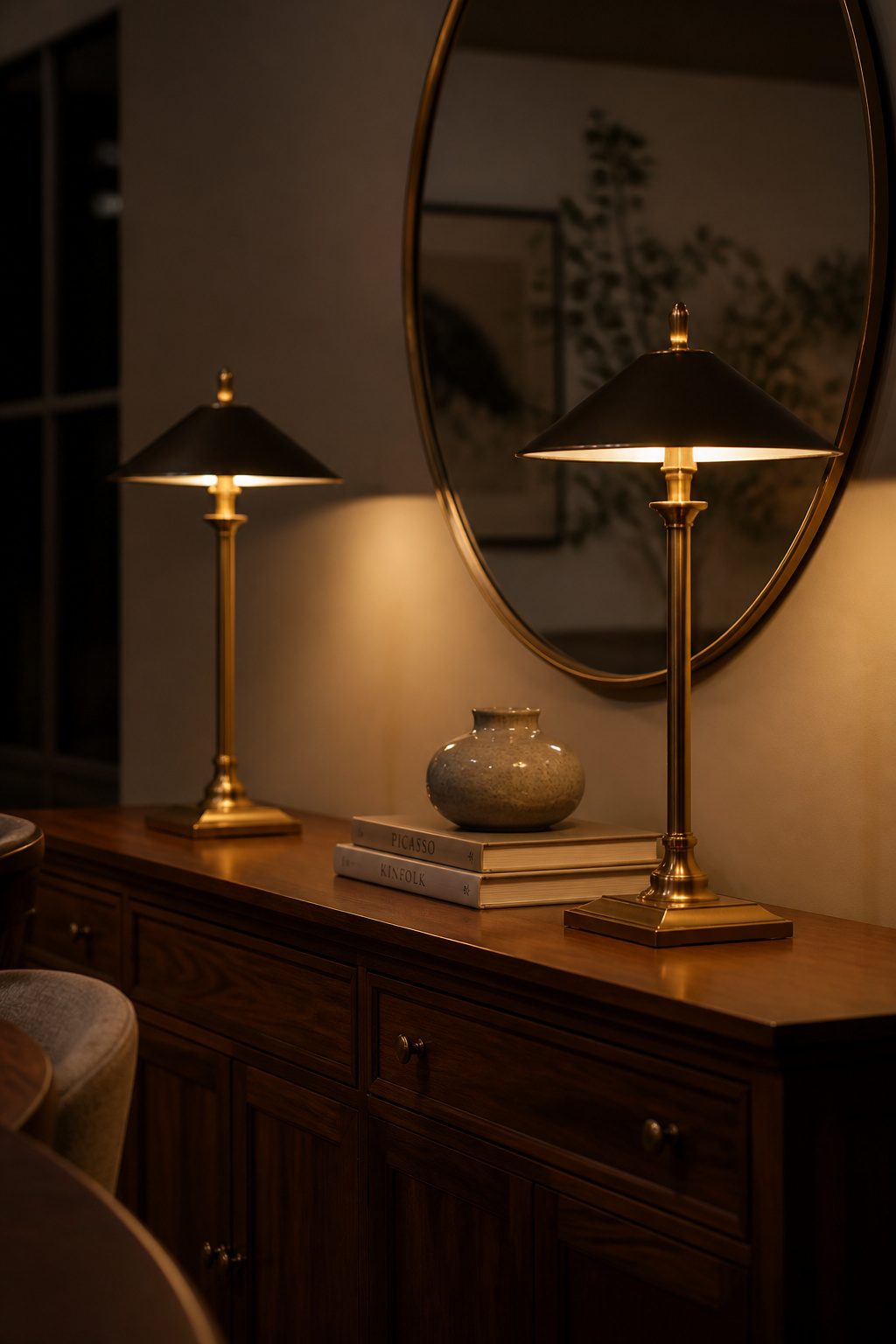
The dual role: height-builder and mood light
Unlike a standard table lamp, which runs 24 to 30 inches and spreads light for a reading task, a buffet lamp stands 32 to 36 inches on a slim base with a narrow shade. That profile lets it rise above the vases and frames around it and cast a focused glow across the surface without eating the space other objects need. It lights a scene, not a page. As designer Linda Merrill puts it, placing lamps on a buffet is “both function and form — and form and function need to play nice together to work.”
Why a sideboard without a lamp is a styling problem
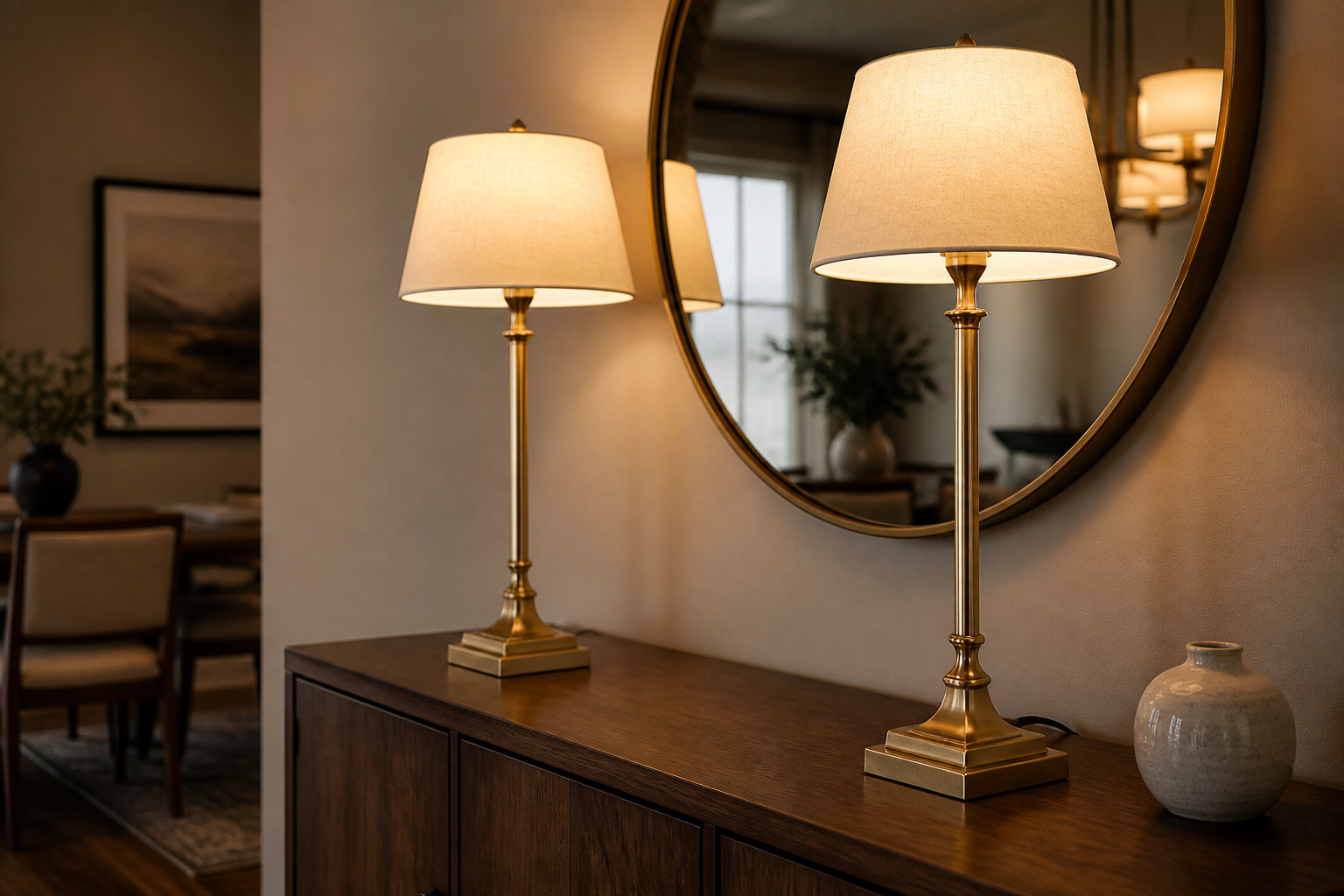
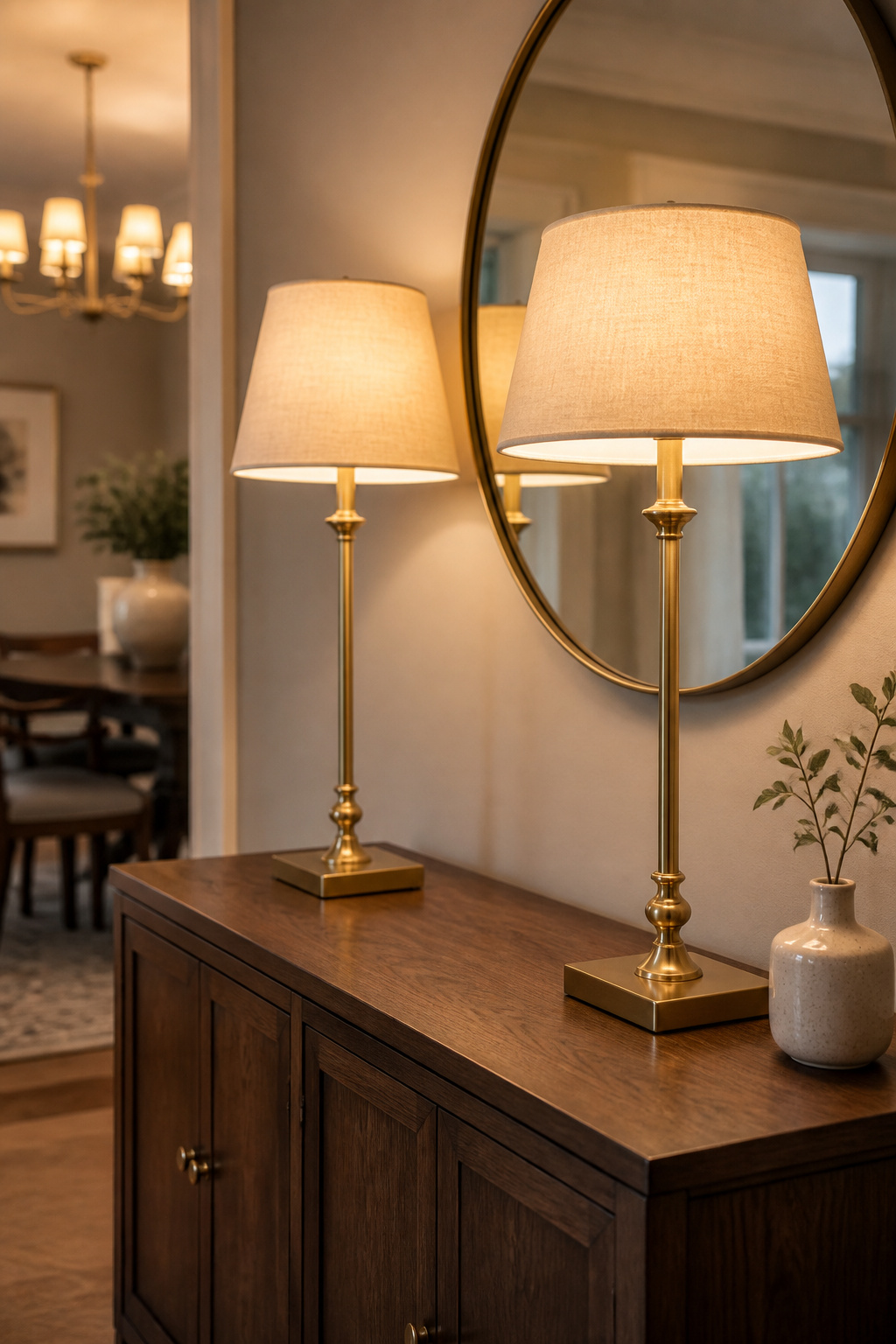
A buffet lamp builds the top tier of the height layering that the sideboard styling fundamentals rest on. A matched pair flanking a mirror echoes the thin lines of the sideboard’s legs, a vertical continuity the eye reads as intentional. Without that vertical, the surface has nothing tall enough to lead the eye, and the display reads as scattered.
How lamps change the room’s evening character
Watch a restaurant after dark: the overhead light drops and the warmth shifts to the lamps and sconces around the edges. You can run the same move at home. A dining room needs at least three independent light sources to feel balanced — central fixture, perimeter accent, and any task light — and the buffet lamp is your perimeter layer, what turns the sideboard from furniture you pass into the thing that sets the mood.
The 32–36 Inch Height Rule: Why This Measurement Exists
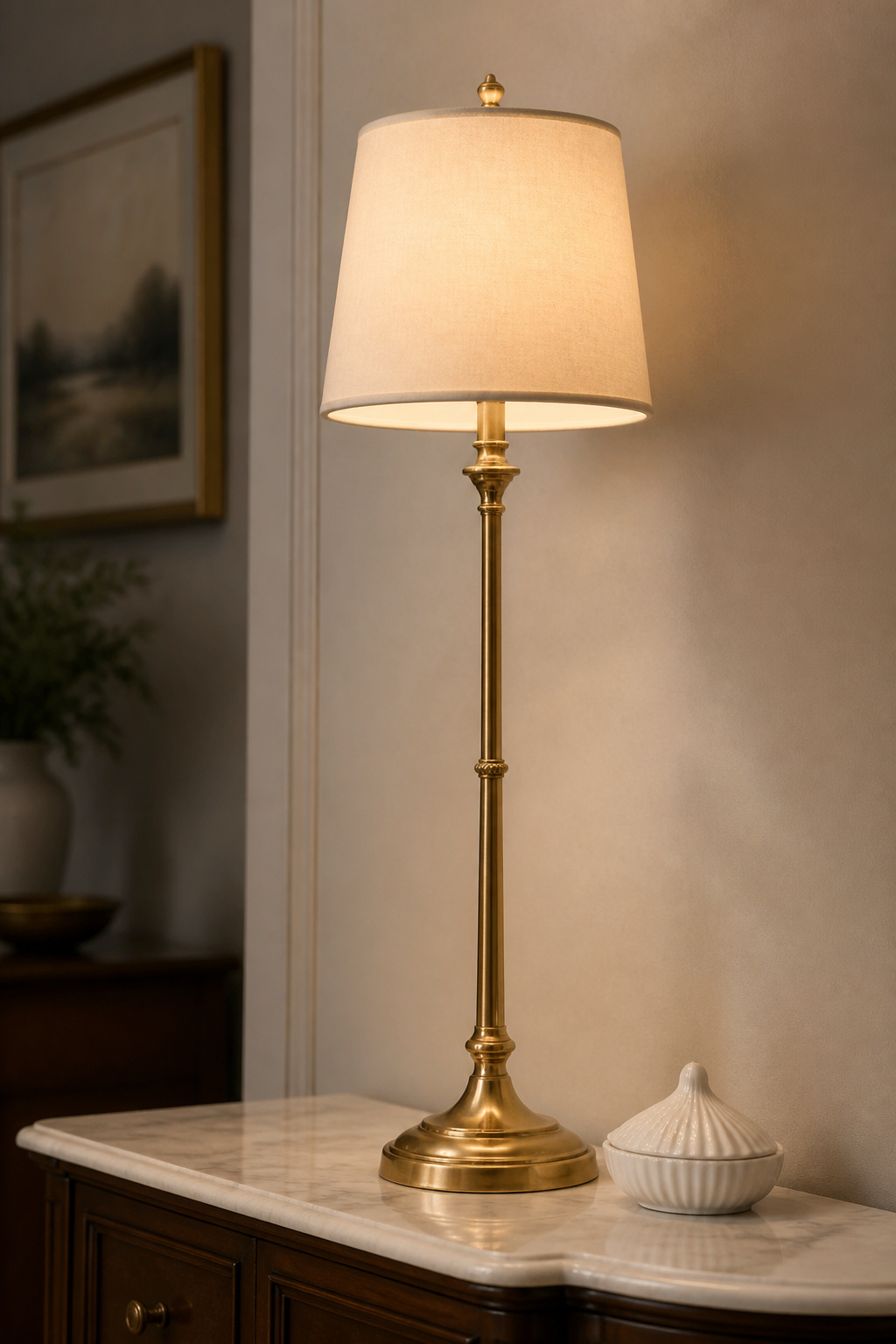
Take one number from this article: 32 to 36 inches. It is the professional standard developed specifically for buffets, sideboards and consoles, and the thing people most often get wrong — usually by grabbing an ordinary table lamp four inches too short for the job.
Where the standard comes from
The number solves a sightline problem. On a standard 34-to-36-inch sideboard, a lamp in this range puts the shade at or just above the eye level of a seated diner — enough warm glow to register, not so much that a bulb glares at them. The secondary check is combined height: lamp plus surface should total roughly 58 to 64 inches.
How to measure: surface to top of shade
The quiet error that undoes good intentions is measuring the base alone. Total lamp height means base plus shade, surface to shade top. While the tape is out, check the shade against the base — the diameter should run roughly double the base width, the 1:2 ratio that keeps a slim lamp from looking top-heavy. The table below is the reference to shop against.
| Measurement | Target | What it governs |
|---|---|---|
| Total lamp height (base + shade) | 32–36 in | Shade clears surface objects, sits at seated eye level |
| Combined lamp + sideboard height | 58–64 in | Light distribution without glare |
| Proportional check (taller furniture) | 65–70% of furniture height | A 42-in credenza takes a shorter 27–29 in lamp |
| Shade diameter vs base width | ~2:1 | Balance of the lamp’s silhouette |
What happens below 30 and above 38
The failures are specific. Below 30 inches the shade sinks beneath standing eye level and gets swallowed by any taller vase or frame — present, but no longer the anchor. Above 38 the lamp looms in the sightline of a seated diner facing it. The exception: a shorter 24-to-30-inch lamp is right on a taller 40-to-42-inch sideboard, or as a deliberate underscale choice when other tall objects carry the height.
Symmetrical Pairs vs Balanced Asymmetry: Choosing the Right Configuration
With height settled, the next question is how many lamps and where. The principle underneath both answers is the same: the two ends of the sideboard must carry equal visual weight, whether or not the objects are identical.
When a symmetrical pair is correct
A matched pair flanking a mirror or central artwork makes what Merrill calls a picturesque visual unit — the eye reads it as one composed scene, the historically correct choice for formal rooms. It works best on wider pieces with room to set the lamps well apart:
- Set each lamp toward its end and let the centre breathe — there is no published inch figure for the gap on a wide 60-to-72-inch sideboard, but lamps too close read as cluttered.
- Keep the lamps outside the edges of the mirror or art, so the wall element keeps priority and the lamps frame it from below.
- Keep each base to roughly a third of the surface width or less, leaving room for the rest of the display.
When one lamp plus an object beats a pair
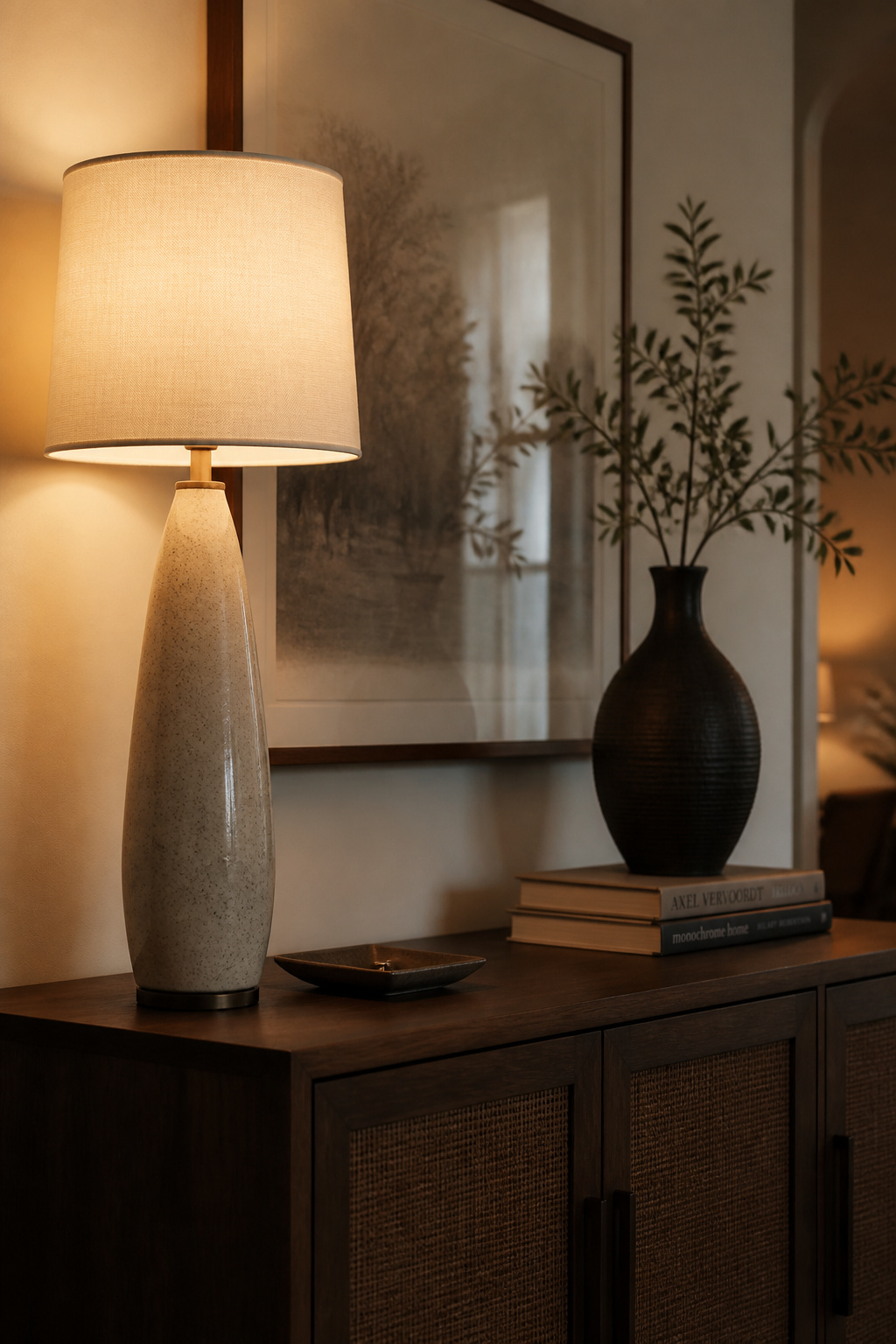
In a modern or transitional room a matched pair can feel stiff. Balanced asymmetry usually reads better: one sculptural lamp on one end, its height answered on the other by a tall vase, a stack of art books, or art set slightly off-centre. The lamp lights; the object balances. As Merrill notes, “centered and balanced is fine, but maybe a little bit boring — don’t be afraid to shake things up.” A directional or sculptural base looks awkward mirrored and far better alone.
The width rule
Width often decides. On a narrow sideboard under 48 inches, one well-placed lamp reads more cleanly than two forced too close. One lamp is enough whenever the rest of the surface is doing height work.
Shade Shape, Base Proportion and Material: The Matching Logic
You can have the height and configuration right and still own a lamp that looks wrong, because the shade and base are where proportion and finish either resolve or quietly clash.
Shade shape and visual weight
A buffet shade is taller than it is wide — a narrow cylinder or empire, not a broad low drum — which preserves the slim silhouette. Shape also steers the light. A drum shade throws even, diffused light in all directions and suits modern rooms where clean geometry is the point. An empire shade, wider at the bottom, directs light downward into a warm pool and reads more traditional.
Base material and finish matching
A lamp’s finish belongs to the same vocabulary as the room’s other metal — cabinet hardware, chandelier, mirror frame — so the safest move is to carry the chandelier’s finish through to the lamp. Mixing metals works, but on purpose: a brass lamp under a nickel chandelier holds together only if the brass repeats somewhere else. Material carries character too — crystal reads formal and refractive, ceramic earthy and artisanal.
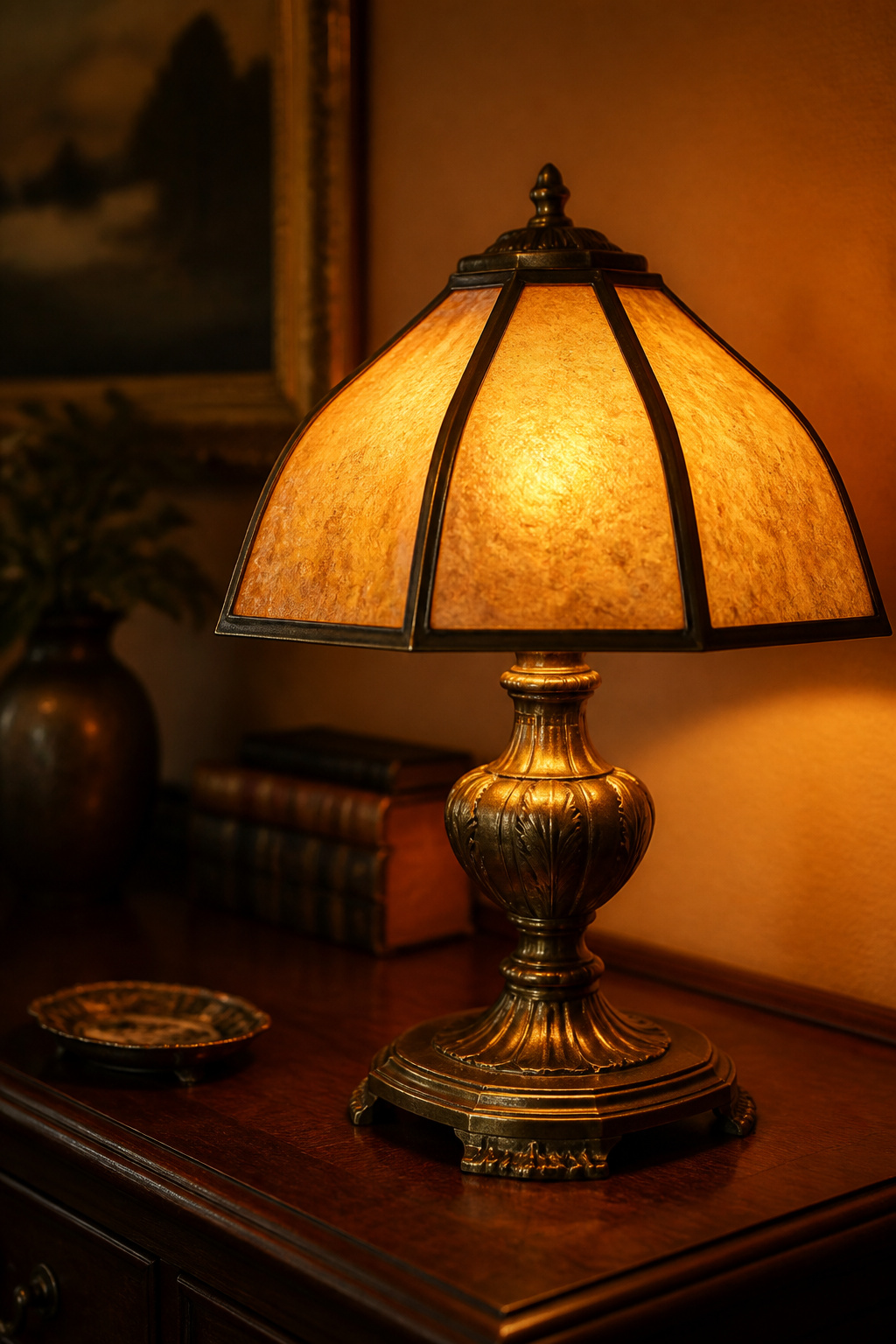
Shade material: linen, cotton and mica
This is the decision I weigh most carefully, because it changes the quality of the light, not just its quantity — the same instinct that governs a good reading lamp. Linen diffuses softly through its weave for a warm, textured glow, the standard for transitional rooms. Cotton, especially a cream empire shade, throws a clean, versatile light. Mica is the one worth knowing: thin mineral panels that transmit an amber glow closer to candlelight than any fabric, handsome on antique brass. One note from ergonomics — a very opaque shade in an already-dim room gives less light than you expect, so match the shade’s translucency to how much work the lamp must do.
Alternatives to Buffet Lamps: Sconces and Picture Lights
Table lamps are not the only way to light a sideboard. If yours serves food regularly, or is too narrow to spare the footprint, the light can come off the surface and onto the wall.
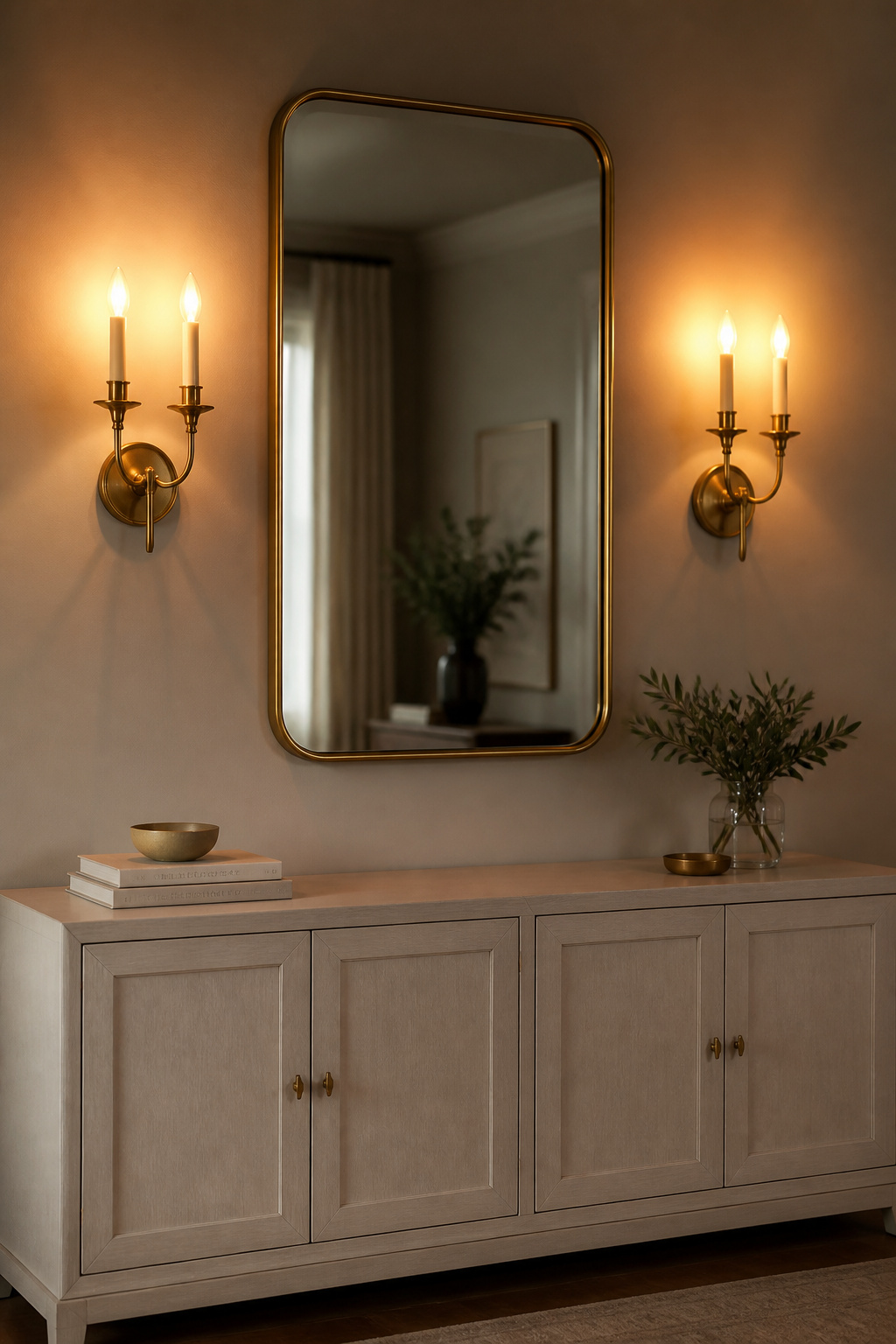
Wall sconces flanking the sideboard
A pair of sconces frees the whole surface while still giving the warm perimeter light a lamp would. Mount the fixture centre at 60 to 66 inches from the floor — standing eye level, above a seated diner’s sightline — and set them 4 to 6 inches out from the sides of the mirror or art they frame. Downward-aimed sconces focus light on the surface without shining into anyone’s eyes.
Picture lights: the directional option
A picture light is made to wash a single artwork or mirror. Mount it 6 to 7 inches above the frame and size it to 50 to 75 percent of the artwork’s width — too small underlights, too large reads like stage lighting. At home, run it at 2700K warm white (not the cooler 3000K museums use) with a colour-rendering index of 90 or above. Use LED: it runs cool, risks no heat or UV damage, and dims cleanly.
Combining a buffet lamp with sconces or picture lights
The most resolved rooms layer these rather than choosing one. A single lamp plus flanking sconces reads as sophisticated rather than busy in a longer room. When a picture light already lights the art above, the surface lamp is off the hook for the wall zone and can be something more sculptural. How those pieces relate to what hangs above the buffet is one composition, lamps and wall element together. Lighting at the wrong height or in a mismatched finish is one of the common styling mistakes worth heading off before you buy.
Dimming and Evening Mood: Making the Lighting Work Across the Day
A correctly chosen, correctly placed lamp is still only half the tool until it can change brightness. Dimming lets one lamp serve the bright cleanup after dinner and the low amber glow during it — the same fixture, two different rooms.
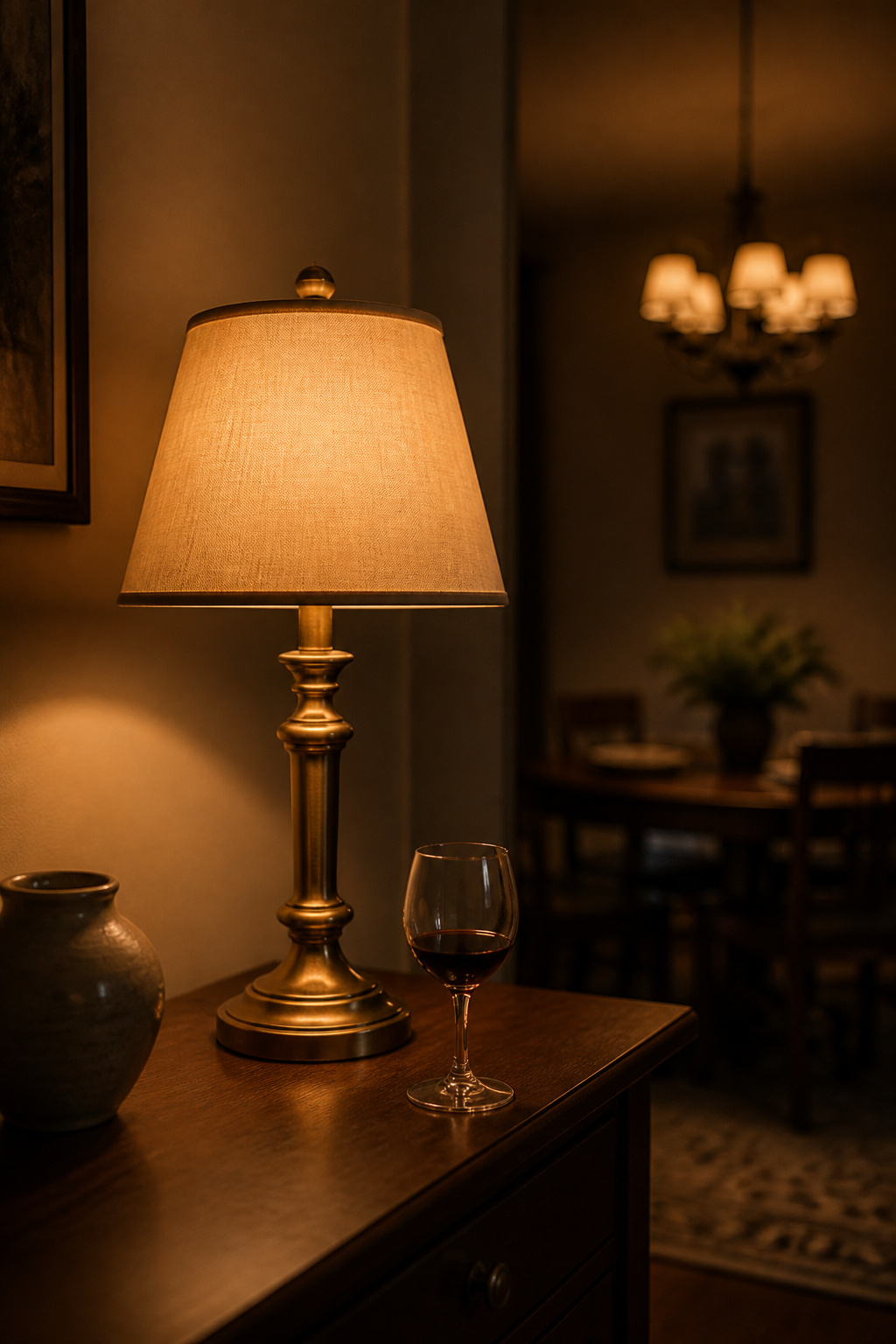
Why buffet lamps need a dimmer
A dimmer is a small expense for an outsized return on atmosphere, but it has a catch with LEDs. They need a trailing-edge (electronic low-voltage) dimmer for smooth, silent control; older leading-edge (TRIAC) dimmers make LEDs flicker and buzz across a narrow range. Specify trailing-edge and the bulb dims softly all the way down. For a plug-in lamp that cannot be wired to a dimmer, a three-way switch is the simpler fallback.
The lumen range for sideboard lamps
Here my reading-light habits transfer straight to the dining room: aim for a number, not a guess. A 60-watt-equivalent LED at around 800 lumens, 2700K, suits most rooms where the buffet lamp is the main perimeter source. For pure atmosphere, 450 lumens — roughly a 40-watt equivalent — is the cited sweet spot. The range matters because dark-walled rooms drink light: a standard room wants 30 to 40 lumens per square foot, a dark one 40 to 50, and that gap is best closed by adding perimeter sources, not by overdriving the chandelier.
How it integrates with the lighting plan
The buffet lamp is one voice in a three-part plan — overhead, perimeter, accent — and the voices must agree. Put each layer on its own dimmer circuit, and match colour temperature across the room; 2700K lamps under a 3000K chandelier give an uneven, slightly clinical warmth the eye notices without naming. To approach true candlelight, a 2200K extra-warm LED filament bulb is the closest LED gets to a low incandescent’s amber.
There is a reading chair I have owned for fifteen years and re-upholstered twice rather than replace, and living with it taught me that good light is never bought once and forgotten — it is dialled in until the space feels right at the hour you actually use it. A buffet lamp is that discipline at sideboard scale. Land the height in the 32-to-36-inch band, choose a pair or a balanced single by the width and formality of your piece, match the shade and finish to the room, and put the whole thing on a warm dimmer. Do that and you have not merely lit a sideboard — you have a surface that holds together at noon and, more to the point, at eight in the evening, when a dining room is actually lived in.
FAQ
How tall should buffet lamps be on a sideboard?
The professional standard is 32–36 inches of total lamp height, base plus shade together, measured from the sideboard surface to the top of the shade. As a secondary check, lamp and sideboard combined should total 58–64 inches. For non-standard furniture heights, the proportional rule is 65–70% of the furniture’s height — a 42-inch credenza, for example, suits a 27–29 inch lamp.
Do buffet lamps need to match?
Not always. A matched pair is the traditional choice and suits formal or heritage dining rooms, giving symmetry and balance. In modern and transitional rooms, lamps need not match exactly — a shared finish or shared material creates cohesion even when shapes differ. Some sculptural lamps look better single than forced into an awkward pair.
Can you put just one lamp on a buffet instead of two?
Yes. One lamp works well when the other end of the buffet carries height another way — a tall vase, stacked art books or a sculptural object that balances the visual weight. A single lamp suits transitional and modern rooms especially, and on narrow sideboards under 48 inches it reads more cleanly than two lamps crowded too close.