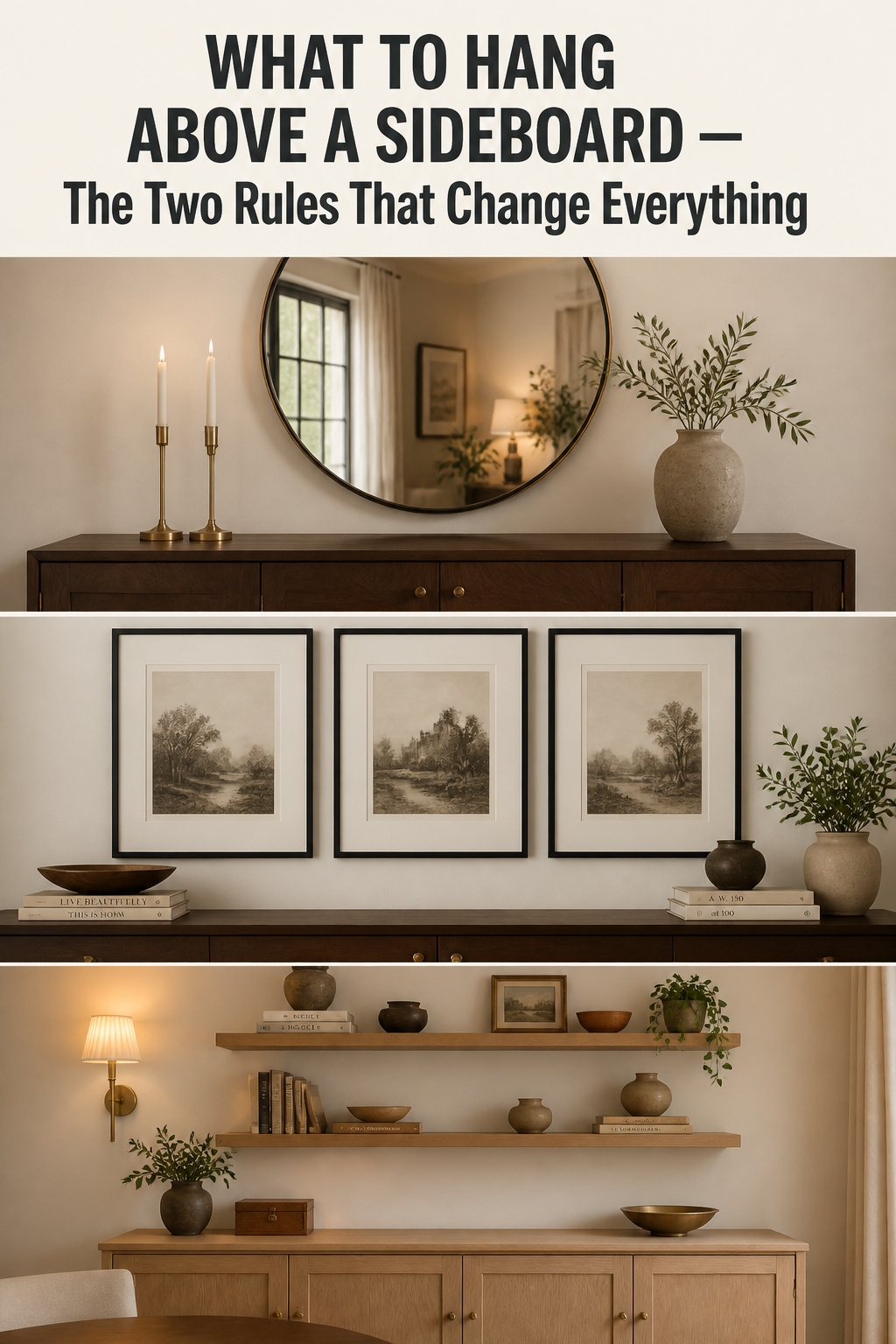
Most advice on what to hang above a sideboard ends at “hang it where it feels right” — which is roughly as useful as telling someone to shelve their books wherever the spine looks happiest. There are, in fact, two numbers that decide whether the wall above your buffet reads as deliberate or as an afterthought, and almost no decorating guide mentions either. Get them right and a mirror, a single canvas, a gallery cluster or a set of shelves all snap into place. Get them wrong and the most expensive artwork in the room looks like it wandered up there by accident.
TL;DR
- Leave a 4–6 inch gap between the sideboard top and the bottom of the frame, and size the piece to two-thirds to three-quarters of the furniture’s width — a 60-inch buffet wants a 40–45 inch mirror or canvas, never one wider than the furniture.
- The same two rules govern a mirror, a single artwork, and a gallery wall treated as one shape; choose between them by what the room lacks (light and depth favour a mirror, personality favours art).
- Match the format to the room: mirrors win in small or dim rooms, a single large piece anchors busy or spacious ones, and gallery walls need a wall at least 48–60 inches wide to breathe.
The Two Rules Nobody Tells You About Hanging Art Above a Buffet
In my years cataloguing a university special-collections library, I learned that nothing on a wall is ever placed by instinct — every frame, every case, sits at a measured height for a reason. Domestic walls deserve the same courtesy, and above a sideboard the reasons resolve into two numbers.
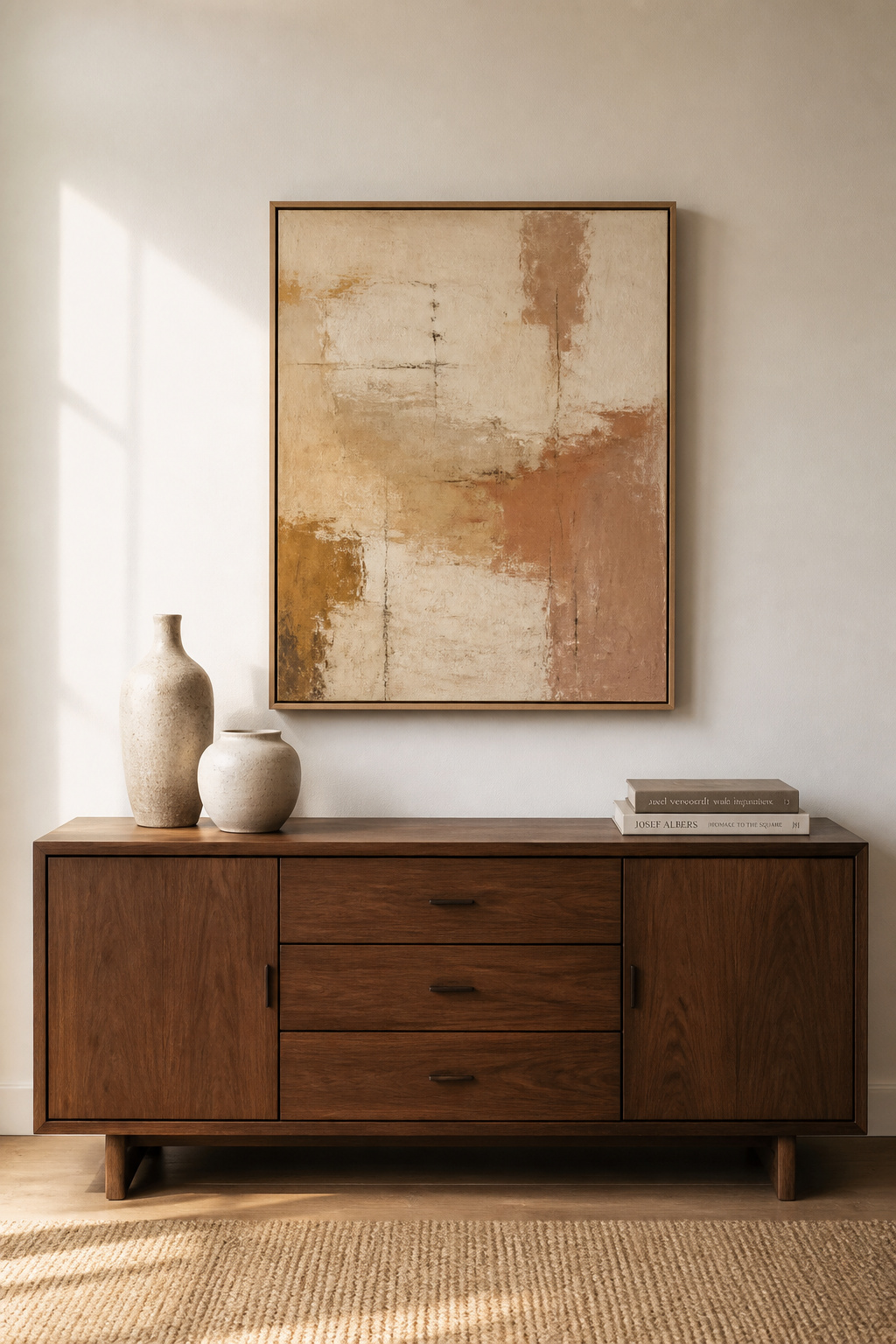
The 4–6 inch gap: why this number and what happens when you ignore it
The bottom edge of your mirror or frame should sit four to six inches above the sideboard surface. Furniture-maker Edward Martin calls this the most widely accepted starting point, and the logic is purely relational: a gap under four inches makes the art look as though it is resting on the sideboard, while a larger one lets it float off on its own, severing the visual tie between the two pieces. Interior designer Joshua Jones nudges this to six to ten inches when the surface carries lamps or seasonal accents, so they don’t crowd the frame.
You may have met the gallery “rule of 57” — centring art 57 inches off the floor. Above furniture, ignore it. The clearance to the sideboard is the controlling measurement; the centre height simply falls where it falls.
The width ratio: two-thirds to three-quarters the furniture’s width
The piece above should span two-thirds to three-quarters of the sideboard’s total width, and never more than the furniture itself. The arithmetic is friendly: a 60-inch sideboard calls for roughly 40–45 inches of mirror or canvas; a 72-inch piece wants 48–54.
| Sideboard width | Target art/mirror width (⅔–¾) |
|---|---|
| 48 in | 32–36 in |
| 60 in | 40–45 in |
| 72 in | 48–54 in |
Go narrower than 60 percent and the piece reads as an afterthought; match the furniture exactly and, as Martin puts it, the mirror “ends up shadowing it, making the entire wall feel flat and heavy.” When two sizes tempt you, Jones is blunt: the larger one almost always looks more intentional once it is up.
Why these rules hold across mirror, artwork and gallery formats
The two numbers are format-agnostic, which is the genuinely useful part. A gallery wall obeys them too — you simply apply the width rule to the cluster’s outer footprint rather than to any single frame, treating the whole arrangement as one shape. (Note that gallery clusters work best with the lowest frame sitting 6–10 inches above the surface, rather than the 4–6 inch minimum, to give the cluster visual breathing room.) The principles underpin every option below; for the broader surface-styling logic these sit on top of, our complete guide to styling a sideboard covers the rest.
Mirror Above the Sideboard: When It Wins and When It Doesn’t
A mirror earns its place above a buffet by doing something no painting can: it manufactures light and depth.
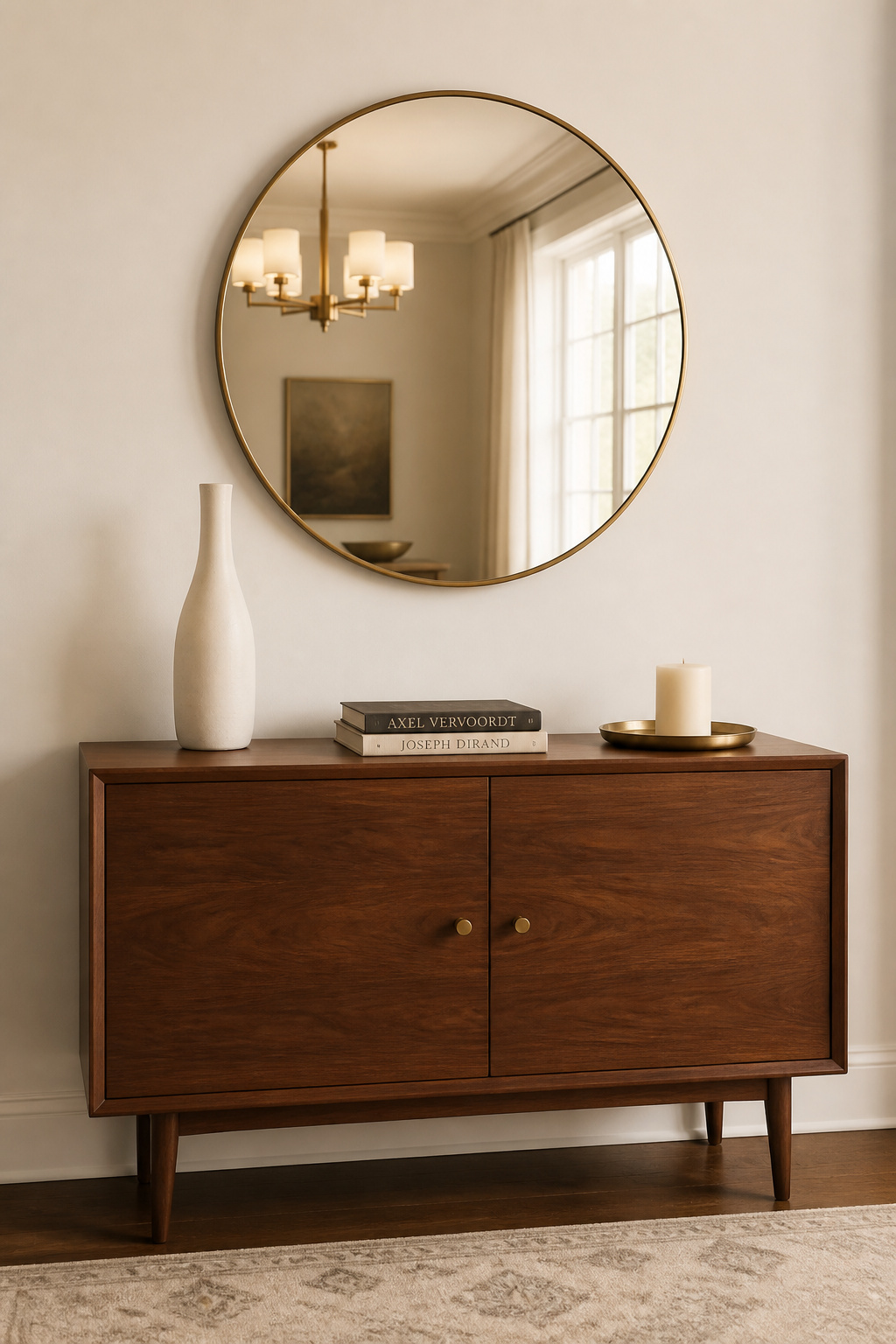
What a mirror does that artwork can’t
Hung opposite a window or a chandelier, a mirror bounces illumination into the room’s dim corners. In a small dining room — say nine by ten feet — a 48-by-36-inch mirror facing the main light source can read as a 25–35 percent gain in perceived depth, because the eye stops registering the wall as a boundary. At night the trick changes character: candlelight and a chandelier caught in glass produce an almost cinematic glow, which is precisely why formal rooms reach for mirrors when they entertain.
Choosing the right frame weight
Match frame density to furniture density. A thin profile of half an inch or less suits a low, clean-lined credenza; a thick carved or gilded frame belongs only on a substantial traditional piece, where a wispy frame would look unmoored. A round rattan or oak frame lends transitional warmth; brass or black metal reads formal. The rule is symmetry of mass, not of shape.
The cases where a mirror fails
A mirror reflects whatever sits opposite it, so what it reflects matters as much as its size. Aim it at a blank wall, a doorway or a cluttered corner and it faithfully doubles the disappointment. It also doubles your surface display — tall sculptural objects read beautifully twice over, but a scatter of small trinkets becomes twice the clutter. Edit the surface before you commit to the glass.
Single Large Artwork: The Case for One Strong Image
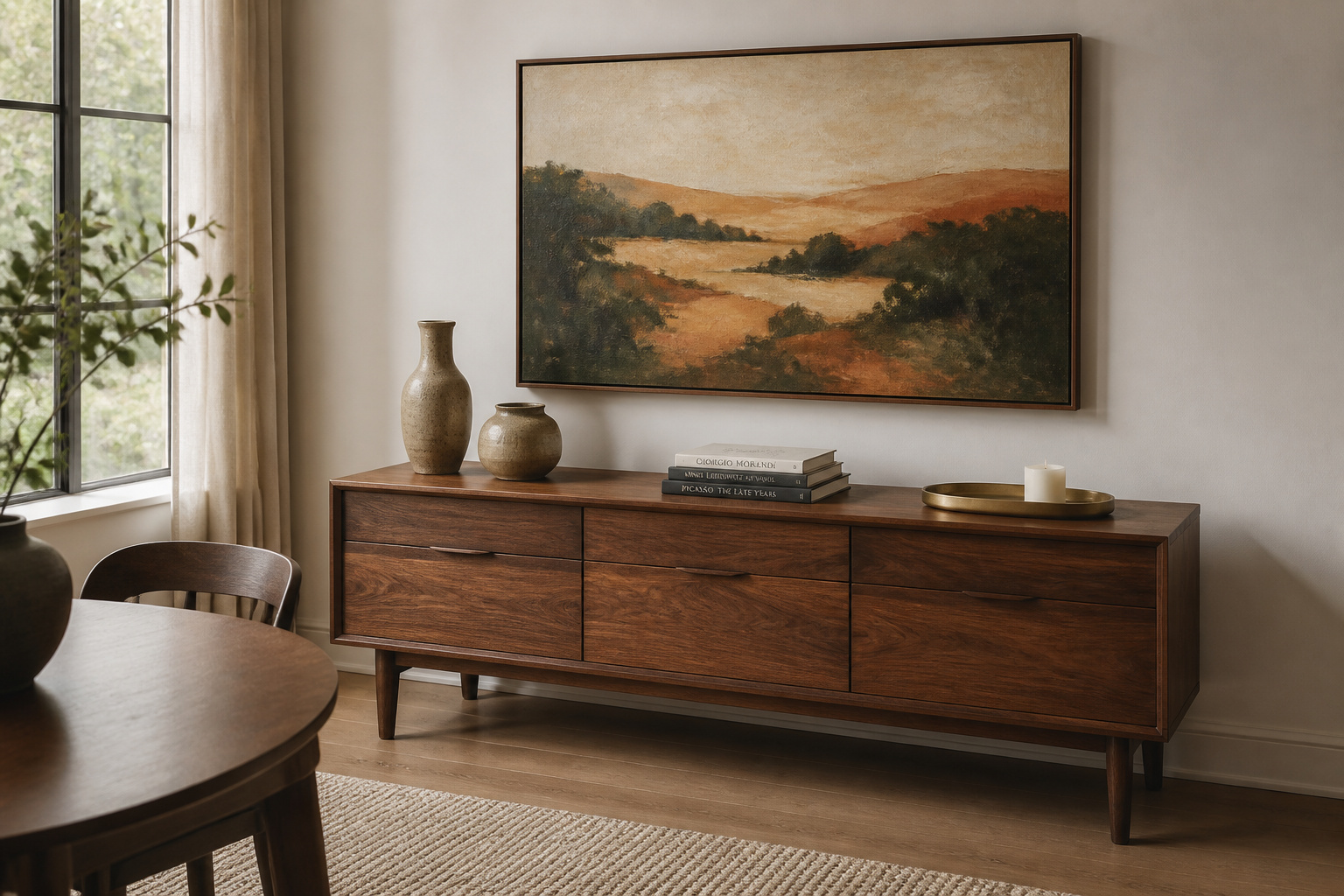
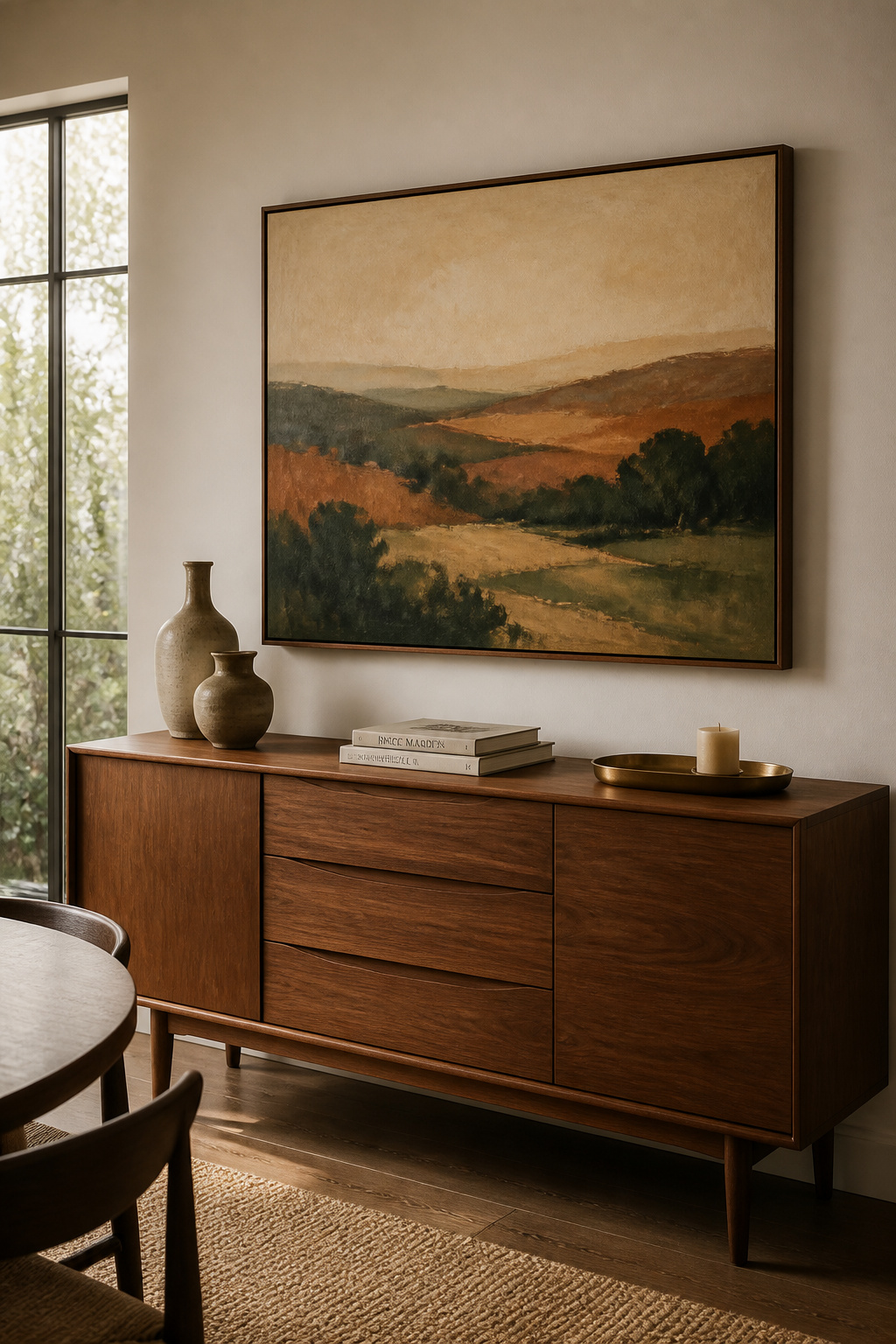
A dining room is already loud with chairs, table legs and light fixtures. Against that noise, one calm canvas usually outperforms a wall of small frames.
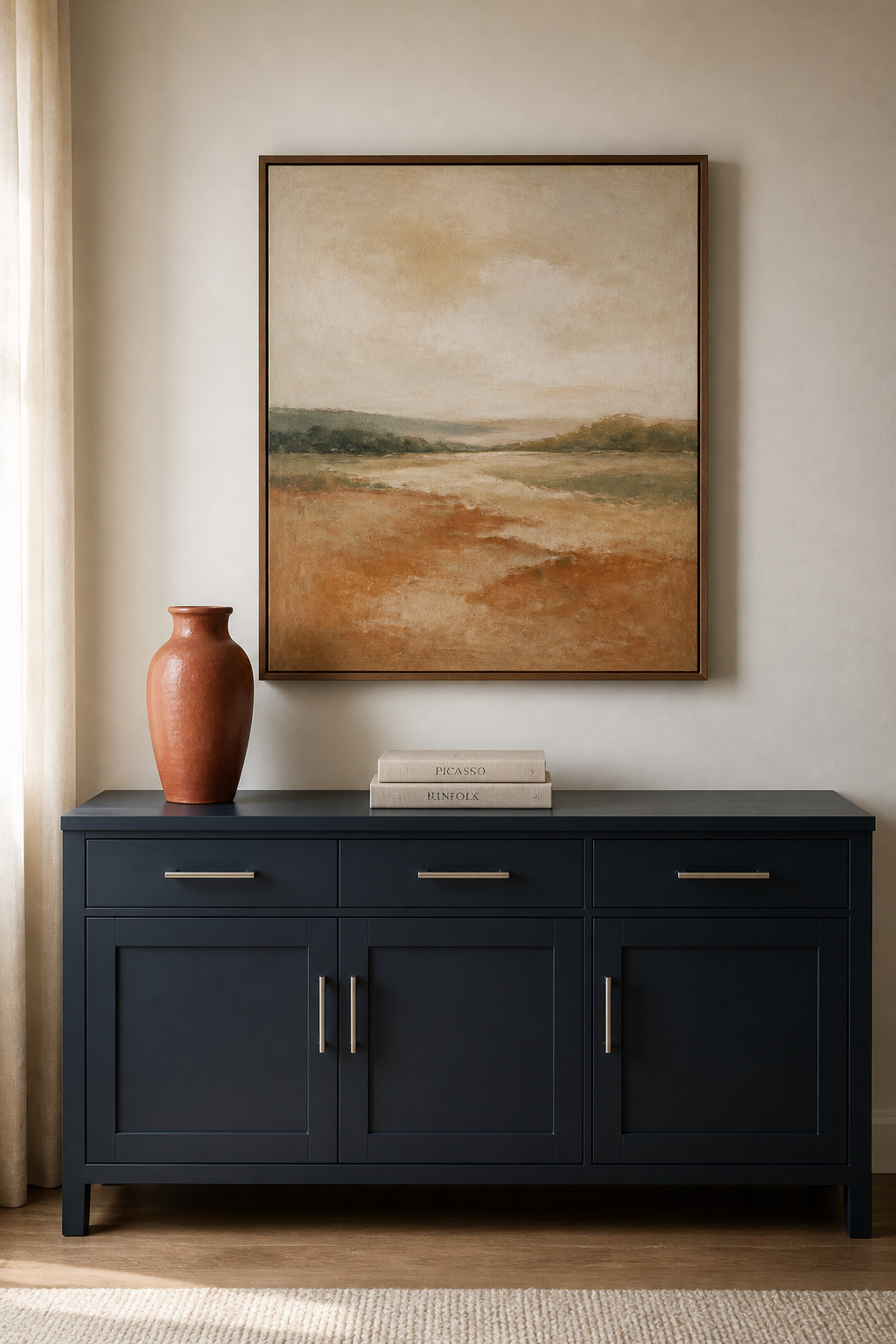
Why large-format art beats a collection
Every styled room needs a single place for the eye to rest, and one large piece supplies that anchor instantly where a collection fragments it. Jones puts it as proportion over measurement: the artwork “should support the furniture below it rather than compete with it.” For a standard 160–180 cm sideboard, a 70-by-100 cm landscape or a 50-by-70 cm portrait both land inside the two-thirds target.
Subject and palette that converse with the surface
The art needn’t match the room, but it should converse with it — pull one or two colours from the canvas that echo something already in the room (a chair cushion, the curtains, the table grain) and let the rest introduce something new. Warm tones (ochre, terracotta, gold) suit a room built around eating; they read as appetite and conversation where cool blues read as calm. Treat wall and surface as one composition: a tall vase below echoing a vertical mark above is the kind of rhyme that makes a vignette look composed.
Frame width relative to visual weight
Scale the moulding to the canvas. Above 24 by 36 inches, a half-inch frame looks flimsy; a 2–3 inch profile gives a large piece the structural presence to hold together at scale. Leave eight to ten inches of clearance above the surface so lamps and vases have room beneath the frame — and if you like to rotate art with the season, buy one good frame with an easy-open back and swap only the insert.
Gallery Wall Above a Buffet: Making a Collection Read as One
A gallery wall tells a story a single piece can’t — but it is the hardest of the four to execute, and it fails loudly when it does.
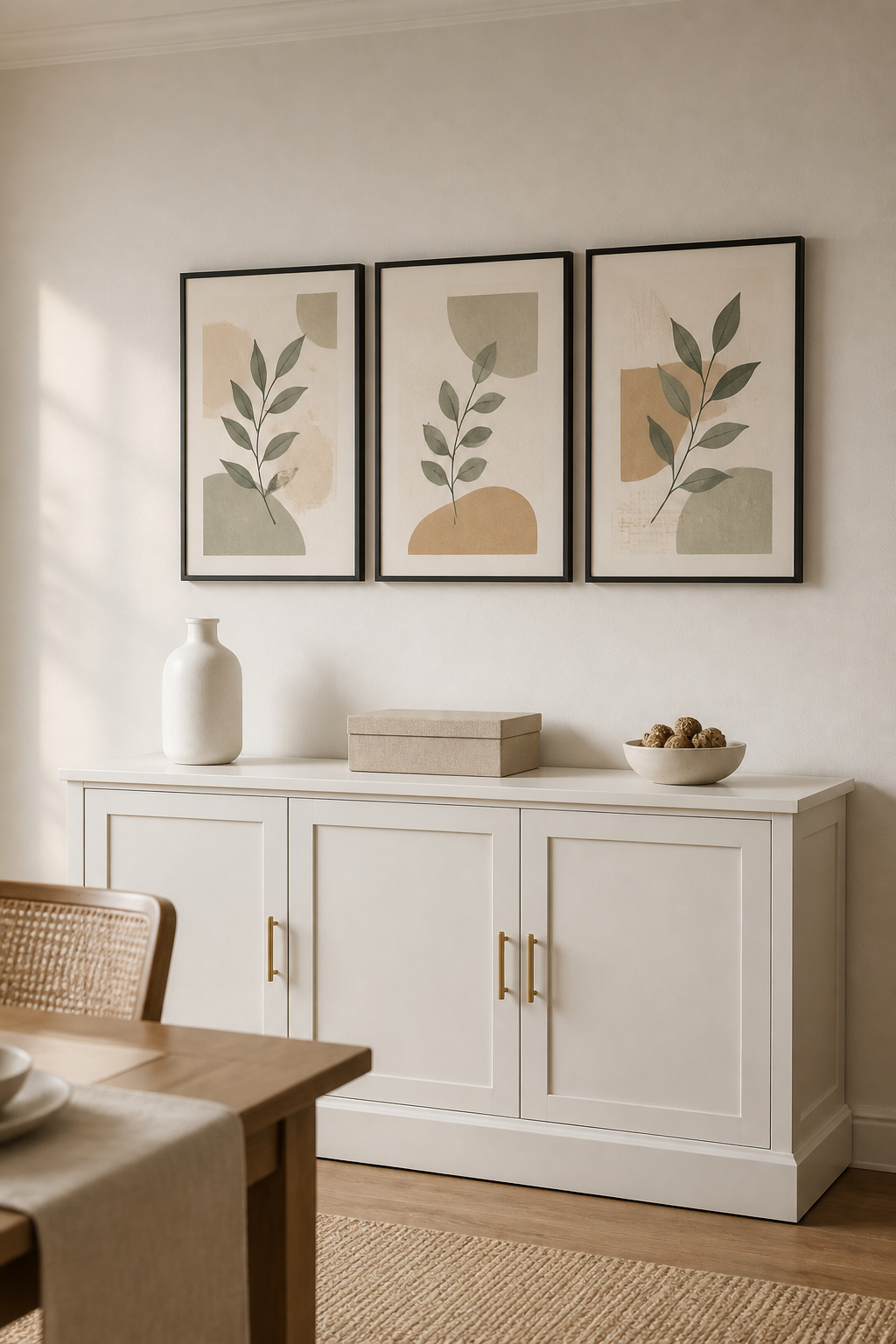
When it works and when it competes
Reserve the gallery for a wall at least 48–60 inches wide, above a clean-lined sideboard that won’t fight the frames. On a narrower wall, beside a doorway, or over a heavily carved buffet, a single piece wins; the cluster competes with the furniture instead of completing it. The arrangement itself follows a short sequence:
- Lay every frame on the floor first and shuffle until the composition reads as one mass.
- Trace each frame onto kraft paper, cut the shapes, and tape them to the wall to preview before you drill.
- Anchor the cluster on one larger focal frame so the eye has somewhere to land, then build outward.
- Centre the cluster’s bounding box over the centre of the sideboard, spanning two-thirds of its width.
The spacing that holds it together
Leave two to three inches between frames on every side. Closer than that feels cramped; wider and the arrangement disintegrates into separate floating pieces that no longer read as one. The single biggest cause of a chaotic gallery wall is mixed frame finishes — black, gold, white and oak quarrelling on one wall cancel any calm you were after. Unify by finish or by profile. The easiest clean format is a horizontal row of three or four same-size prints, which reads almost like one panoramic image above a wide buffet.
Shelves and Sconces: When the Wall Does More Than Display
Sometimes the wall should earn its keep with storage or light, not just pictures — which is where shelves and sconces come in.
Floating shelves as a second display tier
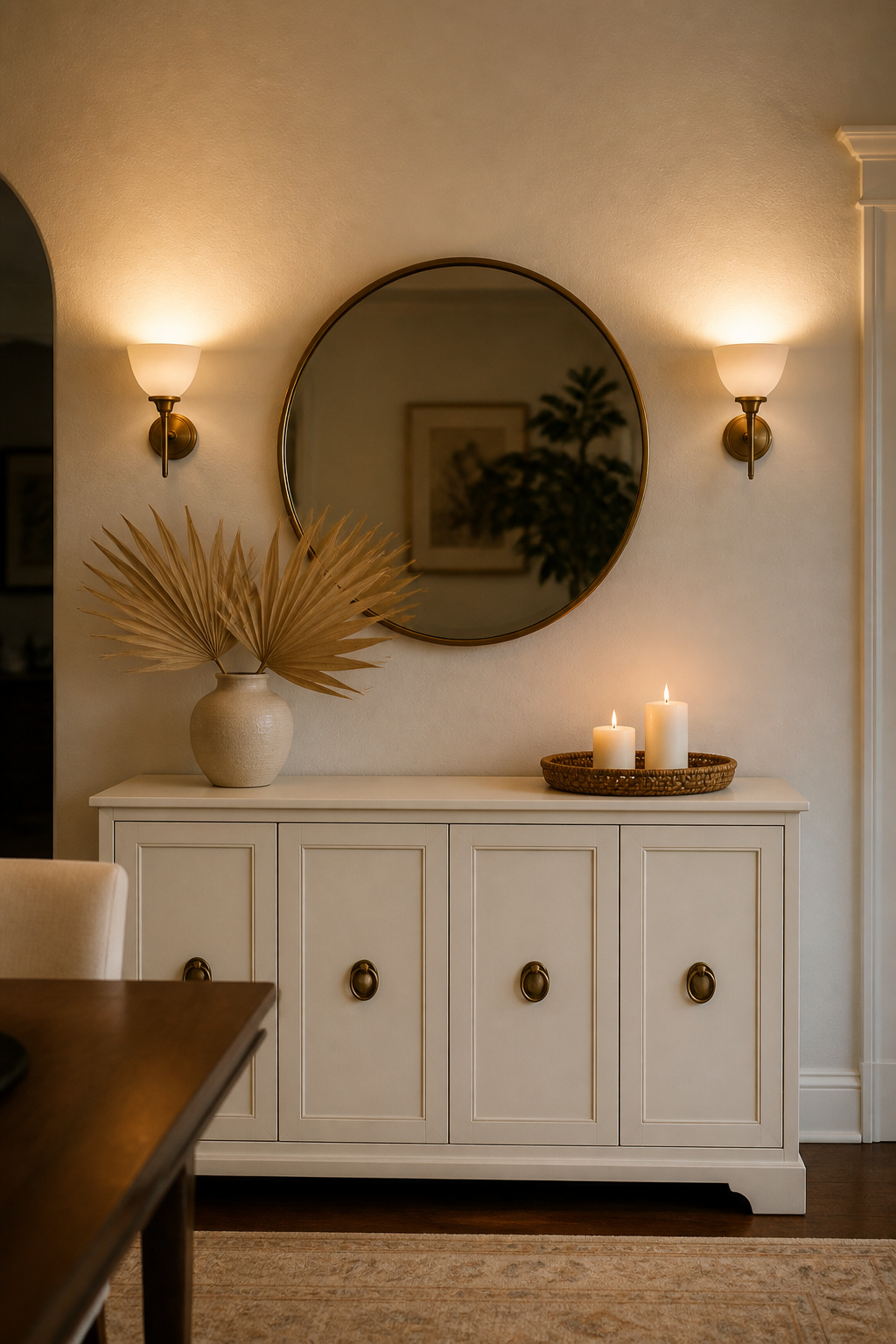
A library is wherever the shelves and the light agree, and the wall above a sideboard is no exception. Mount the first shelf roughly 20–24 inches above the surface, and make 10 inches your default depth: enough for books, ceramics, candles and a trailing plant, shallow enough not to intrude. Eight inches handles light decorative pieces only; reserve 12 for actual dishes.
Sconces as decor and lighting
A pair of sconces flanking the buffet frames it and lights it for serving. Mount the fixture centres 60–66 inches from the floor — eye level standing, above the sightlines of seated diners — and set them four to six inches outside the sideboard’s edges. Put them on a dimmer; the swing from bright family supper to candlelit dinner is the whole point.
Combining the elements
The unifying detail is finish. Sconces flanking a mirror, or a picture light over a single canvas, only read as designed when brass meets brass and black meets black. For a picture light, editorial sources such as Chris Loves Julia suggest mounting it six to seven inches above the frame, using a warm 2,700K bulb and a CRI of 95 or higher, so the art doesn’t take on a cold cast — sensible practice rather than a published standard, but worth following. Get the height or finish wrong here and you’ve simply created one of the hanging mistakes to avoid.
Which Option Fits Your Room: A Decision Guide
With the two rules settled and the four options understood, the choice comes down to three variables — scale, style, and how often you plan to change things.
Room scale and ceiling height
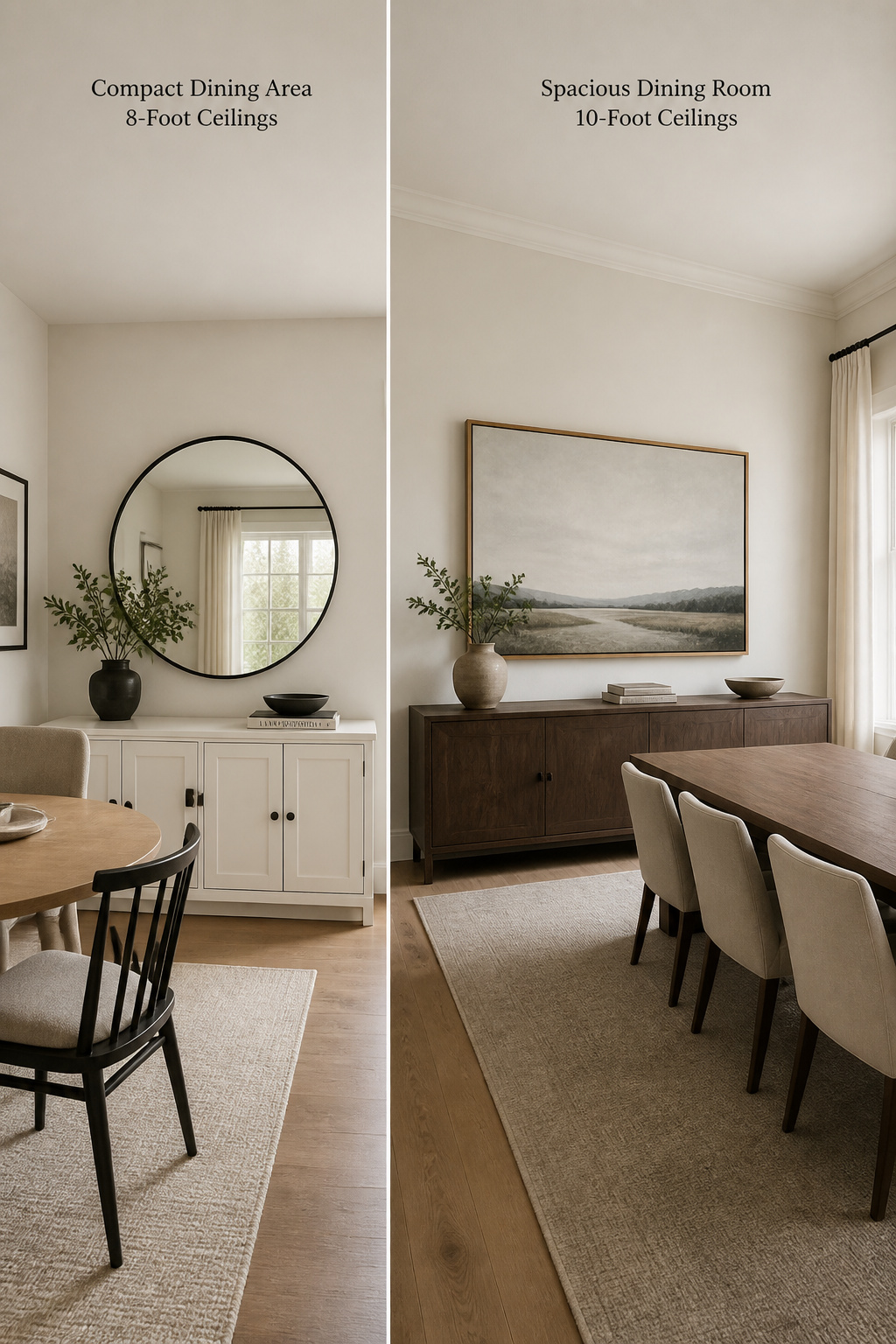
Scale should decide before taste does. In a small room or under eight-foot ceilings, the mirror is the most powerful move: it adds that perceived 25–35 percent of depth where a gallery wall would only add clutter. A large room over 12 by 14 feet gives a single large canvas the air it needs to anchor the wall. With ceilings above nine feet, lift the piece slightly above the standard gap, or the composition reads bottom-heavy.
| Room condition | Best wall treatment |
|---|---|
| Small / dim / 8 ft ceiling | Mirror — adds light and depth |
| Spacious / 12×14 ft+ | Single large artwork |
| Tall wall, 9–10 ft ceiling | Vertical or oversized mirror, lifted slightly |
| Wide clean wall, 48–60 in+ | Gallery cluster |
Style context
Farmhouse and traditional rooms carry a wood-framed mirror or a matched-frame gallery; a frameless mirror looks incongruous against a carved or painted piece. Modern rooms want a single thin-framed or gallery-wrap canvas, or a simple round mirror — a multi-frame gallery contradicts the restraint. Transitional rooms take any option, provided the proportions hold.
Seasonal flexibility
A mirror is the most season-proof choice: it stays fixed while the accents below it change. A single artwork in an easy-open frame swaps with the calendar via the insert alone. A gallery wall is the least forgiving to rotate — reserve it for a wall you intend to leave settled, and handle the changeovers through seasonal refreshes of the surface instead.
The empty wall, then, is not a guessing game. Hold the gap at four to six inches, size the piece to two-thirds the furniture, and let the room tell you whether it needs light, an anchor, a story, or a working surface — and you will hang the right thing the first time.
FAQ
How high should you hang a mirror above a sideboard?
Leave a gap of 4–6 inches between the top of the sideboard and the bottom edge of the mirror frame, which keeps the mirror visually tied to the furniture rather than floating above it. In rooms with ceilings over 9 feet, lift it one to two inches more. On a standard 34–36 inch sideboard, the mirror’s centre then lands naturally around 57–65 inches.
What size art should go above a buffet?
Artwork above a buffet should span two-thirds to three-quarters of the furniture’s total width — about 40–45 inches over a 60-inch buffet, or 48–54 inches over a 72-inch one. Anything under 60 percent reads as an afterthought; anything wider than the buffet looks unstable. For 30–36 inch buffets, choose art 24–36 inches tall.
Should you use a mirror or artwork above a dining room sideboard?
Choose a mirror if the room lacks light or feels cramped, or if it will reflect something beautiful like a window or chandelier — mirrors add 25–35 percent of perceived depth and glow at dinner. Choose artwork if the room feels flat or a mirror would only reflect a blank wall or clutter. Stand opposite and check the reflection before deciding.