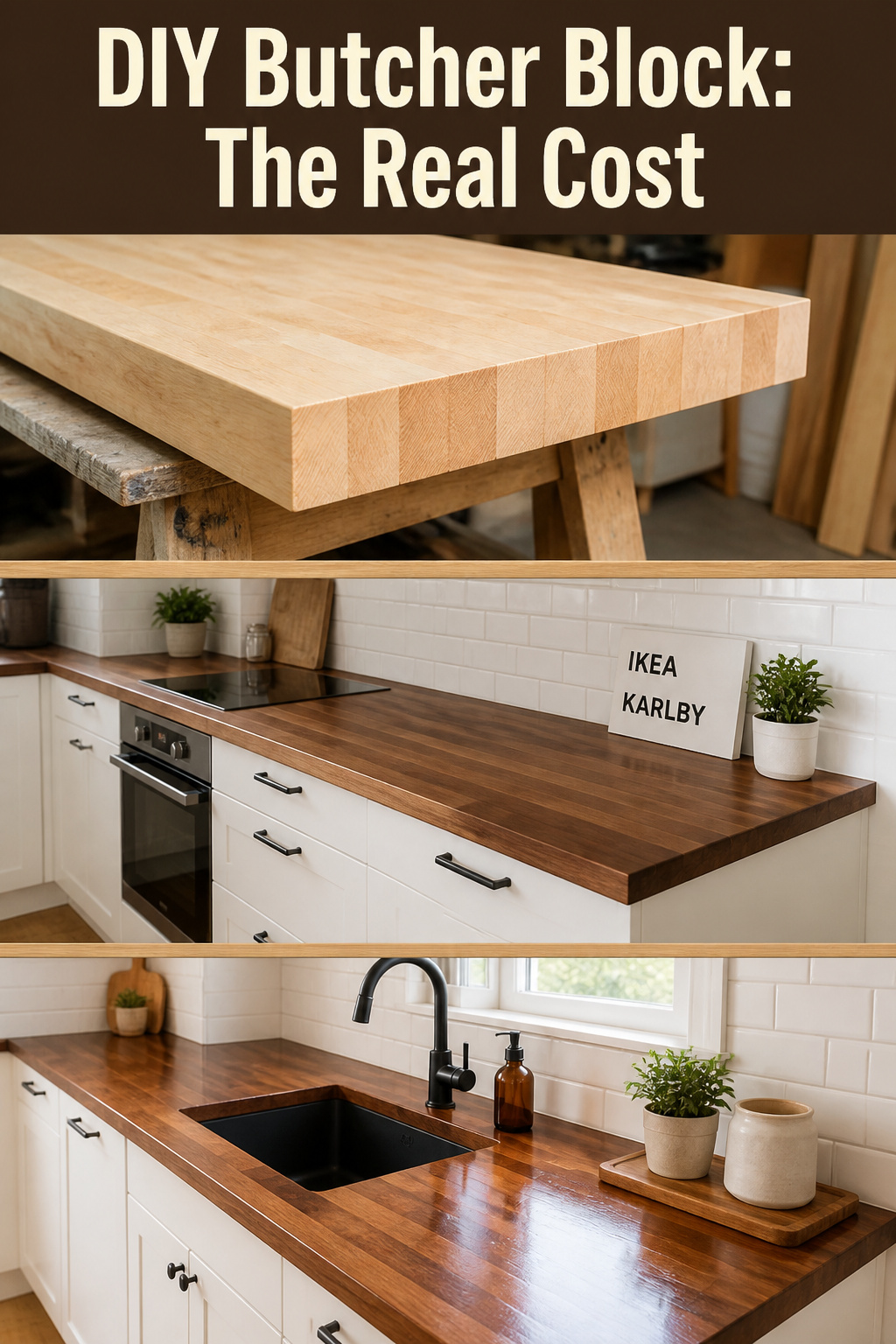
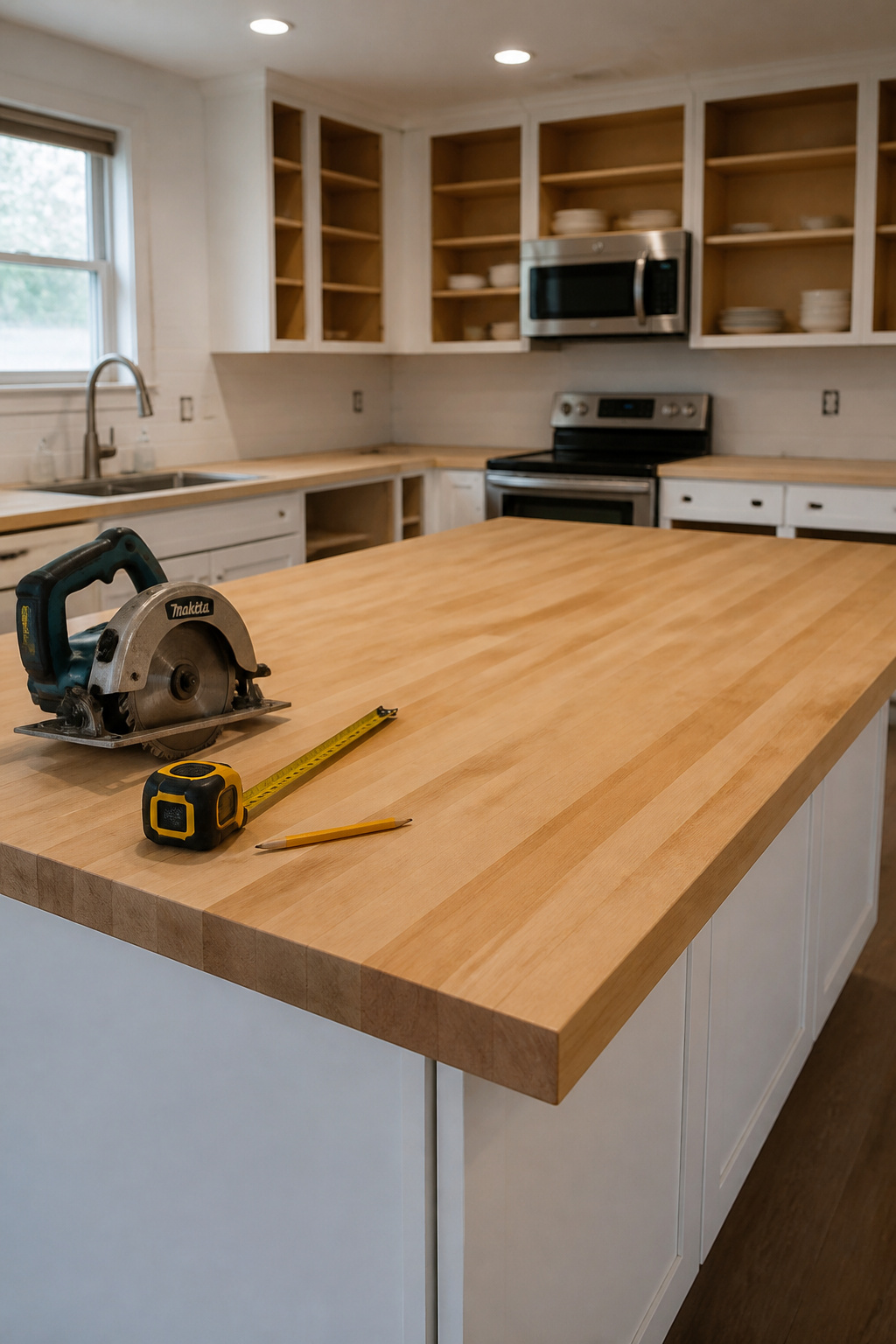
I built my sister a kitchen island out of stock maple for $212, and her family still calls it “the showroom one.” That number sticks because it sounds impossible — and it is, once you add a sink, a corner seam, or a contractor’s truck in the driveway. The honest butcher block countertop cost depends entirely on which version of the project you’re doing. So let’s price all four: raw material, IKEA, a pro install, and the weekend-with-a-circular-saw version that got my sister her island.
TL;DR
- Material runs $20–60/sq ft for most kitchens; pro install lands at $67–94/sq ft (Homewyse, May 2026), so an average 30–40 sq ft kitchen totals $1,500–$6,000 installed.
- IKEA wood tops cost $199–379 per slab (veneer over particleboard, not solid wood) — cheap and proven, but no undermount sinks.
- A confident builder doing a single straight run with a drop-in sink can DIY for around $300 in materials and save $800–$1,500 over a pro.
Every figure here is a US national average. Urban markets like NYC, SF, and LA run 30–50% above; rural areas come in 15–25% under. Price your own quotes against your own zip code, not the country.
What Butcher Block Countertops Cost per Square Foot in 2026
Start with the sticker, then we’ll break it apart. Material-only butcher block runs $30–70/sq ft for a standard 30–40 sq ft kitchen — call it $900–$2,800 before anyone picks up a tool. Add labor and the installed national number lands around $50–150/sq ft; the guide to butcher block countertops covers where it all fits. Two things move the number more than anything: wood species and grain construction.
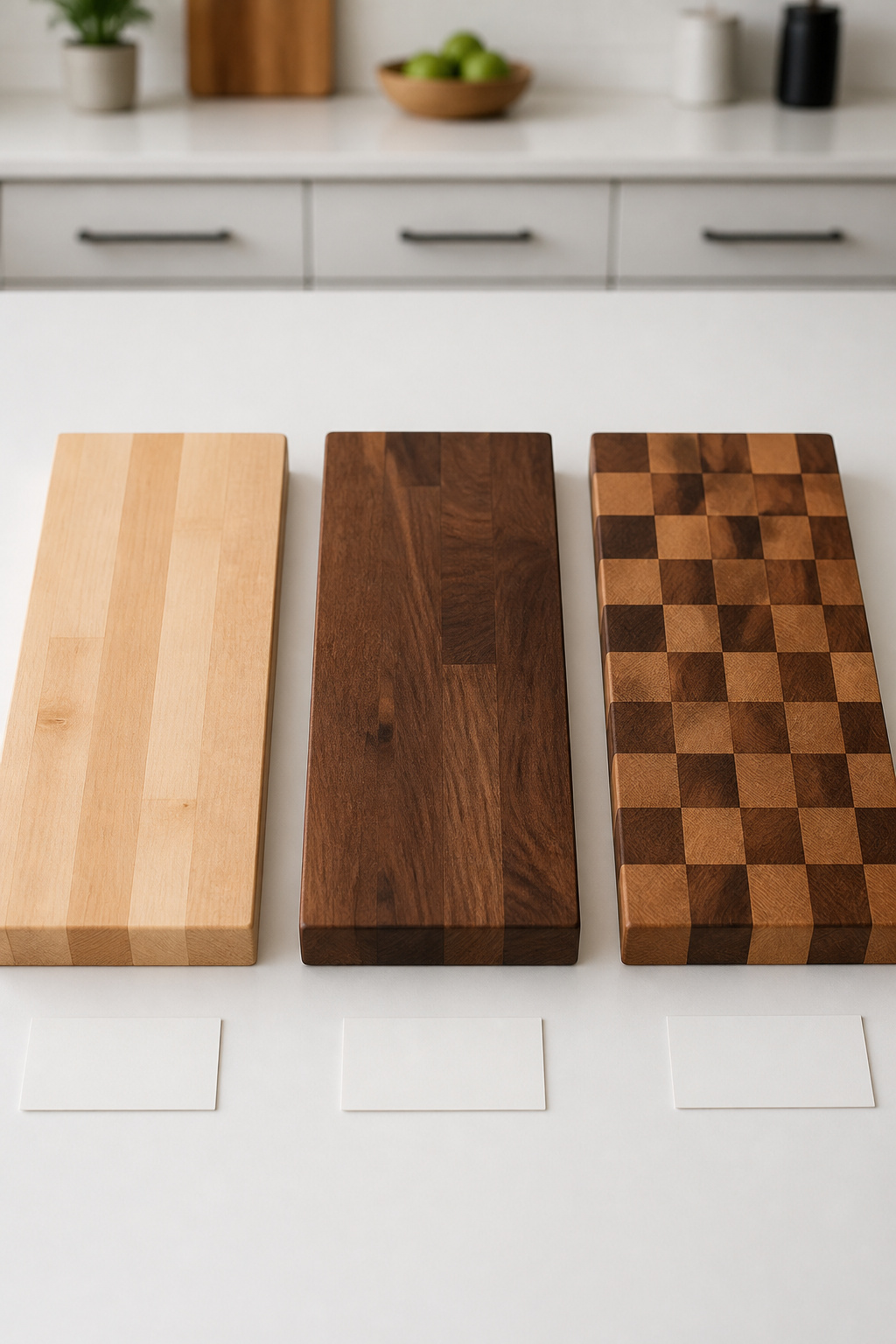
Here’s the material picture by construction and species:
| Option | Material cost (installed/sq ft) | What drives it |
|---|---|---|
| Face grain | $30–200 | Cheapest build; marks easily |
| Edge grain | $40–150 | The workhorse default; durable, widely stocked |
| End grain | $50–350 | Most labor to cut and glue; checkerboard look |
| Red oak | $15–50 | Budget entry; softer, thirstier |
| Maple | $40–80 | Standard; 1,450 Janka, scratch-resistant |
| Walnut | $75–300 | Luxury tone; softer (1,010 Janka) |
Material cost range: $20–60/sq ft and what moves the number
Thickness, the edge profile, and raw-vs-pre-finished are the levers here; a custom bullnose or live edge alone adds $30–50 per linear foot. The line item people forget: job supplies — fasteners, caulk, sealant, glue — add $100–250 to any install. Budget it now so it isn’t a surprise at the register.
Edge grain vs end grain: where the price difference lands
Edge grain runs $40–150/sq ft, the everyday durable choice. End grain — the checkerboard — runs $50–350 because cutting and gluing all those short pieces is far more labor-intensive. The cost doesn’t stop at purchase: end grain drinks two to three times as much oil during break-in, so the upkeep is heavier too.
Species premium: maple vs walnut vs oak in dollars
Hard maple is the default for a reason — 1,450 Janka hardness and the widest stock on the shelf, at $40–80/sq ft. Red oak is the budget pick at $15–50, softer and thirstier. Walnut is the splurge at $75–300; gorgeous, but at 1,010 Janka it marks faster, so you’re paying for looks, not durability. Since species swings the number this hard, read up on how species affects price before you commit.
IKEA Butcher Block Countertops: The Honest Case
IKEA deserves a straight answer, not a sneer. Their wood tops are genuinely cheap and genuinely proven — and they are not solid butcher block. Knowing exactly what you’re buying is the whole game.
What IKEA sells, what it costs, and which sizes
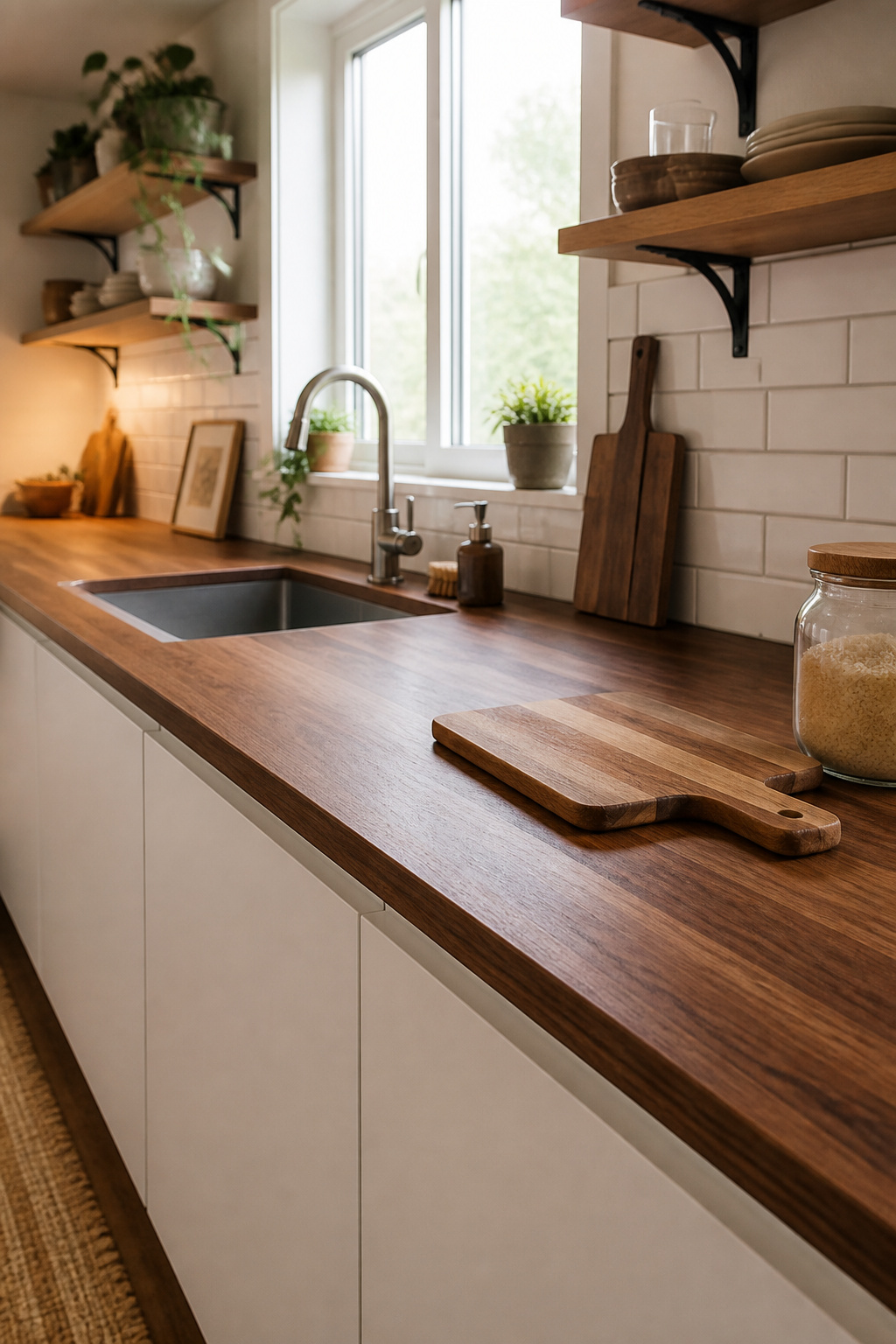
IKEA’s wood tops run $199–379 per slab as of June 2026. KARLBY in oak or birch is $199 at 74 inches; walnut is $249; the KARLBY island top (74×42 in) is $279. All are 25-5/8 inches deep in 74 or 98-inch lengths, so most small-to-medium runs need no custom cutting.
The real-world quality comparison with specialty lumber
Here’s the catch: KARLBY is a 1/8-inch real-wood veneer over a particleboard core, not solid wood. You can only lightly sand a scratch — never plane or resurface it like solid maple. It scratches more easily, and the particleboard core can’t carry an undermount sink without added backing — drop-in only. Still, two KARLBY slabs for a 20–25 sq ft kitchen run $398–498, well under solid maple’s $600–1,750 for the same area, and one owner reported 20 years and 10-plus rental tenants before replacement on twice-a-year oiling.
When IKEA is genuinely the right call — and when it isn’t
IKEA is the right call for a rental, a budget first-home you’ll upgrade in 7–10 years, or an island top you need fast and cheap. As long-term KARLBY owner Heather Thibodeau of The Heathered Nest puts it, they’re “super resilient and very economical” on twice-yearly oil — “the scratching issue is real, but so is the price.” It’s the wrong call if you want an undermount sink, plan to chop on the surface, or expect to refinish over 30-plus years. One firm rule either way: oil it, never polyurethane it — film finishes crack on veneer.
Pro Install Cost: What Contractors Charge in 2026
If you’d rather hand it off, here’s the baseline for your buy-vs-DIY math.
Labour rates: ~$67–94/sq ft installed and what’s included
Homewyse’s May 2026 national estimate puts standard professional installation at $67.08–94.27/sq ft. That covers a real scope: 1.75-inch maple with a penetrating oil finish, templating, a basic edge, one sink or faucet cutout, securing, and cleanup. Labor-only runs $20–80/sq ft. If a general contractor supervises the trade, add 13–22% for coordination overhead.
What adds cost: sink cutouts, custom edges, tight corners
The base quote covers one cutout; past that, each item is its own line:
| Project element | Typical cost add |
|---|---|
| Extra cutout (each) | $100–200 |
| Old countertop removal | $50–300 |
| Custom edge profile | $30–50 per linear foot |
| Plumber disconnect/reconnect | $200–400 |
The plumber line is the one people forget: someone has to disconnect the sink and reconnect it after, and that’s $200–400 you didn’t see coming.
How to read a countertop installation quote
A clean quote itemizes material, labor, edge profile, cutouts, removal, and supplies separately. If it’s one bundled number, ask for the breakdown — a “material + labor” line at $70/sq ft can hide a 30–50% material markup. Quotes also exclude tax, permits, plumbing, and overhead, so add 15–25% for the true total. Get three quotes on identical specs before comparing.
DIY Butcher Block Install: The Step-by-Step Process
Butcher block is DIY-friendly compared to stone, but it’s an intermediate project, not a beginner one. The sequence runs in order:
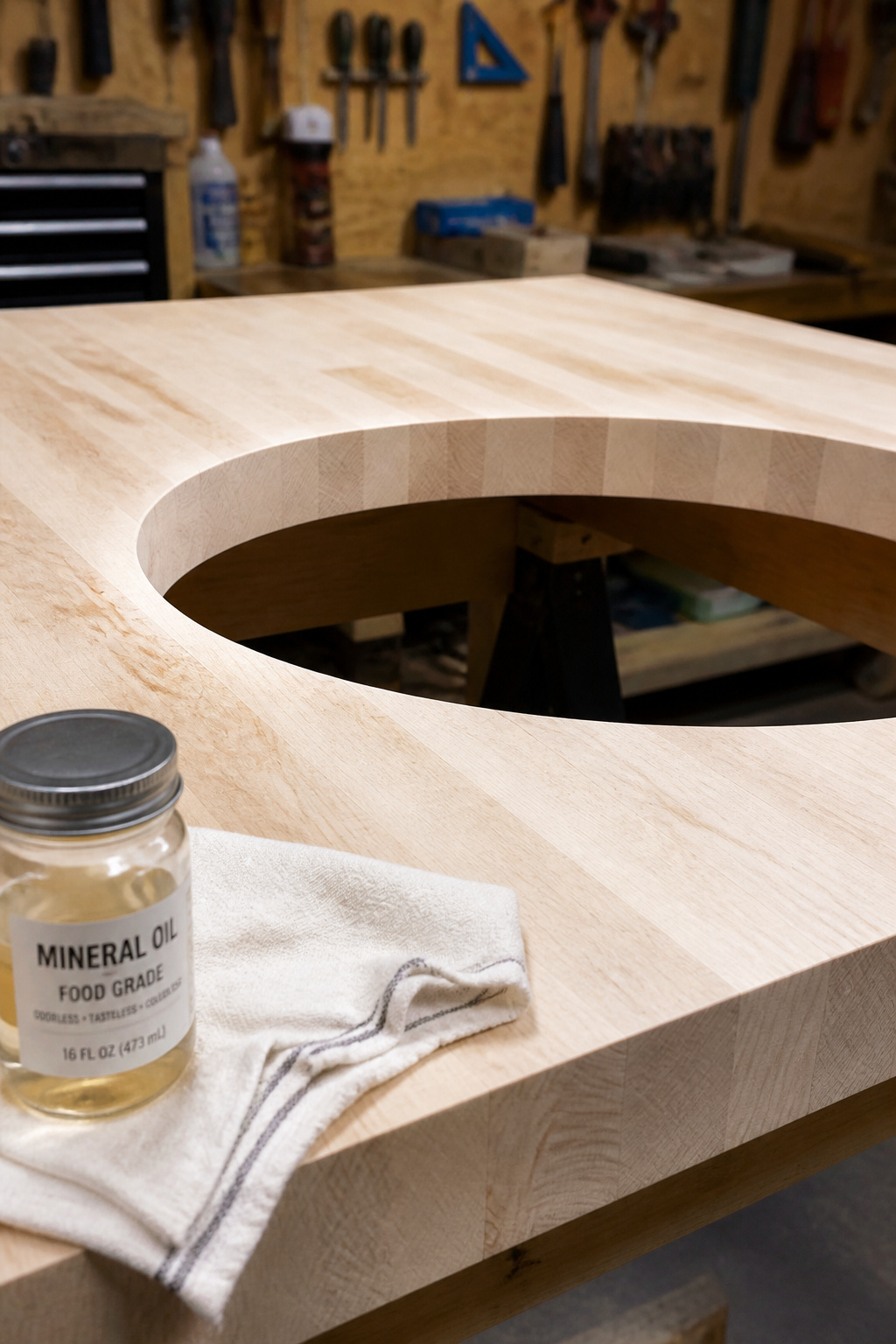
- Acclimate the slab on 2×4 risers for 48–72 hours; install within a week of delivery.
- Template, cut, and seal the slab — the three hard steps, broken down below.
- Sand with 120-grit and fasten for wood movement.
Measuring and templating: where DIYers lose the most material
The template is where you catch the kitchen’s lies — most corners aren’t square, and the plywood template surfaces that before you cut anything expensive. Plan a standard 1–2 inch front overhang; anything past 8 inches perpendicular to the grain, like bar seating, needs bracket support, with corbels every 24 inches.
Cutting to fit, the sink cutout, and edge finishing
Here’s the mistake paragraph. The first sink cutout I watched a beginner attempt, the jigsaw wandered a quarter-inch outside the line on the visible face — and a $200 slab became scrap. Cut on the bottom face, go slow, stay inside the line. Then seal that cutout’s end grain, the top cause of warping at sinks: installers on the Fine Homebuilding forum recommend 3–5 coats of food-safe mineral oil, or a thinned-epoxy wash, worked in before fitting, because once the sink’s in you can’t reach it. For the full wet-zone treatment, see sealing the sink cutout. For cooktops, John Boos’s guidance adds a heat-insulating strip around the opening — single-source, but cheap insurance.
Attaching the top: figure-8 fasteners, and why not screws
Wood moves — a 25-inch-deep top shifts up to 1/8 inch across the seasons — so never glue or silicone it down. Figure-8 fasteners solve it: one side screws to the cabinet frame, the other pivots against the top, one at each corner. Leave a 1/8-inch expansion gap at the wall too, hidden by a backsplash or caulk. Skip it and the slab cracks across the grain in its first winter.
The Real DIY Cost: What a Weekend Project Actually Runs
Now the honest money. Family Handyman benchmarks a standard DIY install at $300 — but that number has assumptions baked in, and the assumptions are where budgets break.
The $300 small-kitchen benchmark and what it assumes
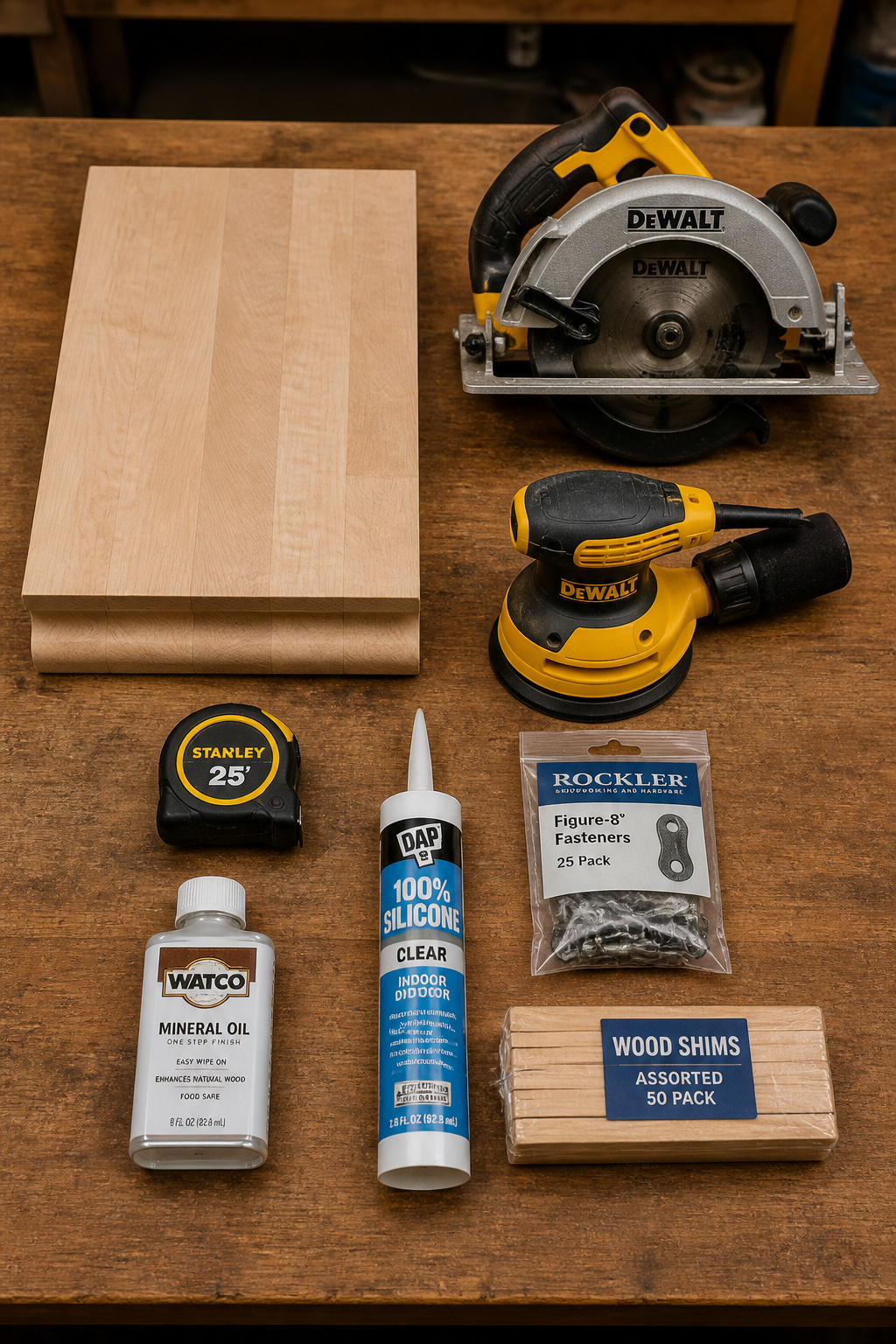
The $300 assumes a 7-foot single run (about 20 sq ft), a pre-finished big-box maple slab, no sink cutout, and that you already own the tools. The realistic material breakdown for that 20 sq ft:
| Item | Cost | Notes |
|---|---|---|
| Pre-finished maple slab (74×25) | $150–200 | Big-box store |
| Mineral oil / sealant | $15–20 | One pint covers 400+ sq ft |
| Figure-8 fasteners (10-pack) | $10–15 | For wood movement |
| Silicone caulk | $8 | One tube |
| Shims + sandpaper | $13–17 | — |
That’s $196–260 in materials. Plan for 10–15% waste — buy 22–24 sq ft for a 20 sq ft counter.
Tools you’ll need vs tools you can rent
A basic no-cutout install needs a circular saw, tape, framing square, drill, level, orbital sander, and at least four clamps. Buying all of that new runs $250–400. So rent what you’ll only use once:
- Track saw or circular-saw guide: $30–50/day
- Jigsaw (for the sink cutout): $20–30/day
- Orbital sander: $25–35/day
A full one-day package from Home Depot or Lowe’s runs $75–100 — cheaper than buying for a one-time job.
Where a beginner should stop and hire out
Hire out the moment your kitchen has angled corners, an L- or U-shape needing a seam join, or an undermount sink. The sink cutout is the highest-risk DIY step, so for an undermount, a pro templating-and-cutout service at $100–200 is almost always worth it. DIY stays clean for a confident builder on a single straight run with a drop-in (or no) sink, where the savings land at $800–1,500 on a 20 sq ft project.
Is DIY Butcher Block Install Worth It?
Two questions decide it: how complicated is the kitchen, and how many builds you have under your belt.
The math: DIY vs pro at different kitchen sizes
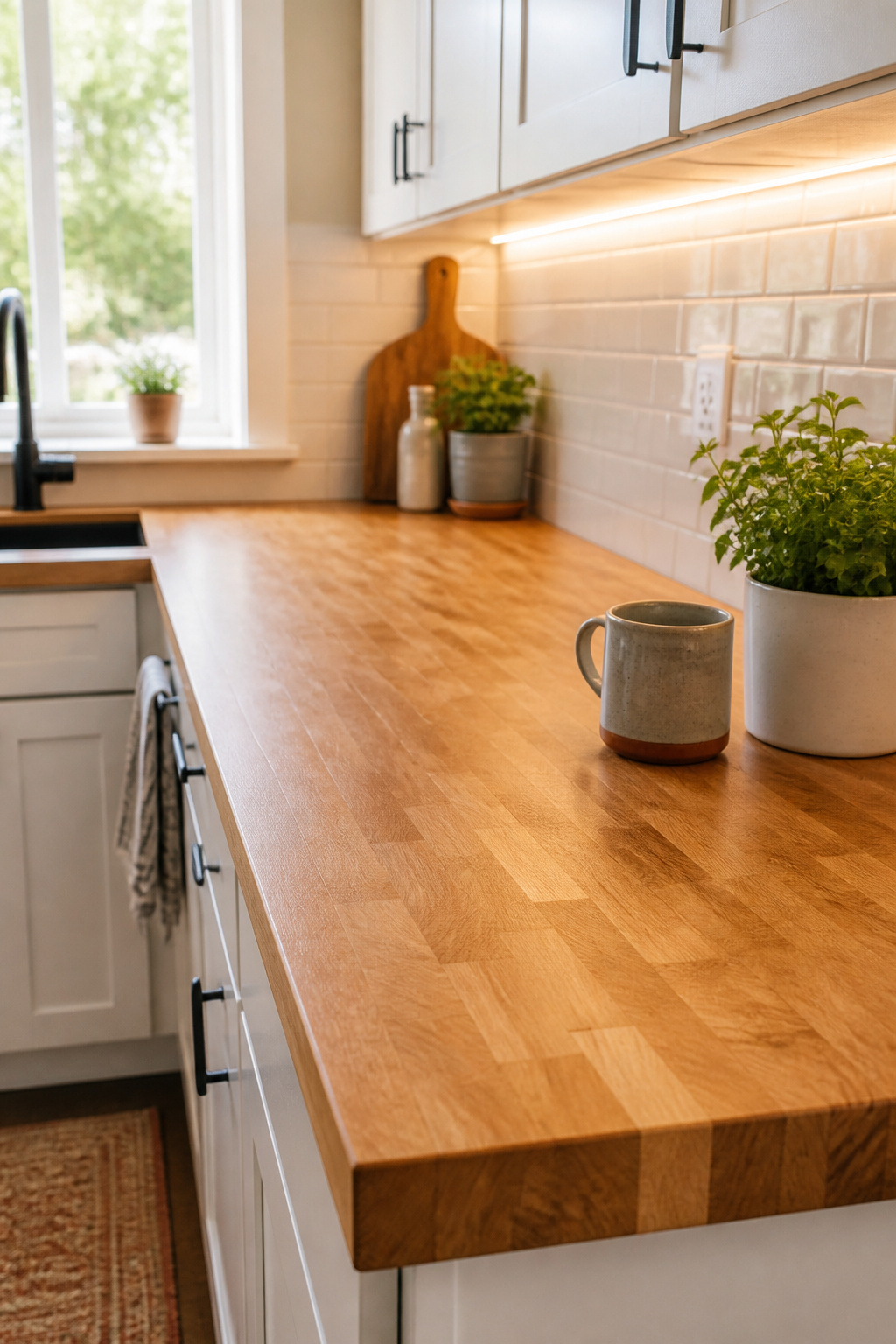
On a 20 sq ft single run with a drop-in sink, DIY runs about $625 all in against $1,340–1,880 for a pro — a $715–1,255 saving. A 30 sq ft L-shape with a corner seam and undermount sink climbs to $950–1,050 against $2,000–2,800; the saving’s still real, but so is the risk of a $150–250 slab if the cut goes wrong. By a 40-plus sq ft U-shape with multiple seams, the pro’s $2,680–3,770 is increasingly the smart money.
Skill level check: first build vs some builds vs confident builder
Here’s the rating, the way I rate every project:
- First build (no woodworking background): don’t. A mis-cut opening or failed seam on a $150–400 slab is too likely. Hire it, and watch.
- Some builds (confident with a circular saw, has done tile or laminate): viable for a straight single run with no undermount sink. Budget for one trip back to the store.
- Confident builder (comfortable with a jigsaw, router, level, biscuit joiner): clearly your call. A full kitchen, corners and cutout included, is a weekend with the right kit, and $1,000–2,000 in savings is realistic.
The one task that always earns its pro fee
The corner seam. Joining two pieces at a tight, flush miter takes a biscuit joiner, a router jig, or a miter-bolt system — and a visible gap there is a permanent defect you’ll see every day. Even if you DIY everything else, hire out just the corner cut and seam as a shop service for $100–300, then install the pre-joined slab yourself. That hybrid keeps the bulk of the savings and buys out the task most likely to bite you. A butcher block top lasts 20-plus years installed right; a botched seam that opens in year one is the expensive way to learn that.
FAQ
How much does it cost to install butcher block countertops?
Professional installation runs $67–94 per square foot for standard work (Homewyse, May 2026) — materials, templating, a basic edge, one sink cutout, and cleanup — so a 30–40 sq ft kitchen totals $1,500–6,000. DIY on the same kitchen runs $300–600 in materials, saving $1,000–2,000 for a confident builder on a straight run.
Is IKEA butcher block countertop good quality?
IKEA wood tops (KARLBY, PINNARP, SKOGSÅ) are thick veneer over particleboard, not solid butcher block. The real-wood surface needs the same twice-yearly oiling and has proven durable for 15–20 years with care. The catch: they scratch more easily, can’t be deeply refinished, and won’t support an undermount sink without added backing.
Can a beginner install butcher block countertops themselves?
A simple single run with no sink cutout is doable for someone who’s used a circular saw and works methodically; Family Handyman rates it intermediate, with a 2–3 day commitment. A true beginner should hire out or start with no cutout, corners, or seams. Renting tools ($75–100/day) beats buying ($250–400) for one job.