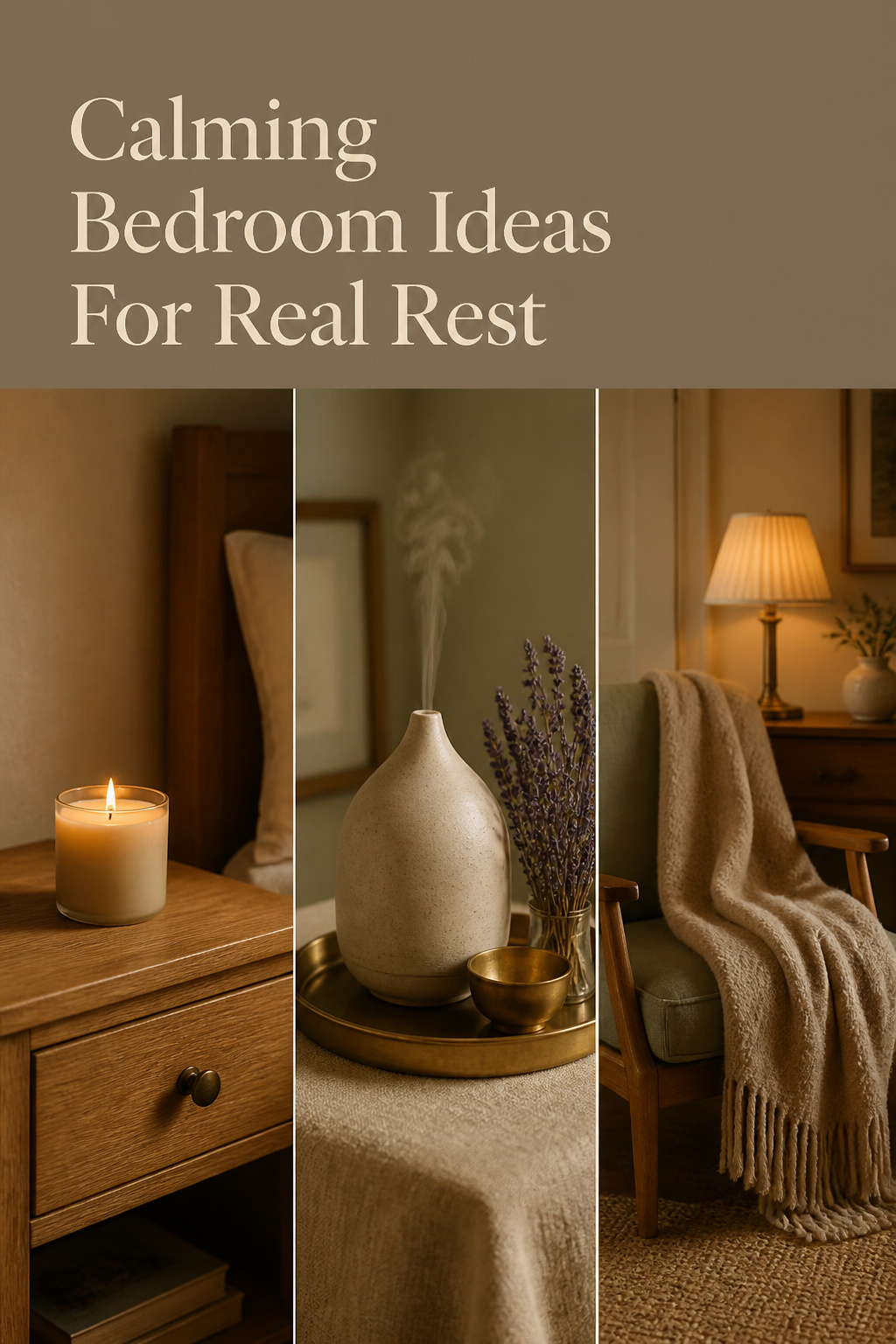
Most calming bedroom ideas start with how a room looks — the throw, the palette. I want to start elsewhere: with what the room does to you once the lights are off. Environmental psychologist Roger Ulrich found that our surroundings trigger automatic, measurable stress responses — in blood pressure, cortisol and muscle tension — independent of how attractive a space is. The gap between a room that photographs as restful and one that actually rests you is the whole of this article.
TL;DR
- A room can look cozy and still keep you keyed up. Judge each change by whether it lowers a real stressor — light, noise, temperature or clutter — not by how well it photographs.
- The best-evidenced levers are physical: hold the room near 65–68°F and 30–50% humidity, clear the surfaces (clutter tracks with higher cortisol and poorer sleep), and add a calming scent like lavender as a light, passive layer.
- Claim a small wind-down corner and keep screens out well before bed. Consistency, more than the specific ritual, is what trains the body to feel sleepy on cue.
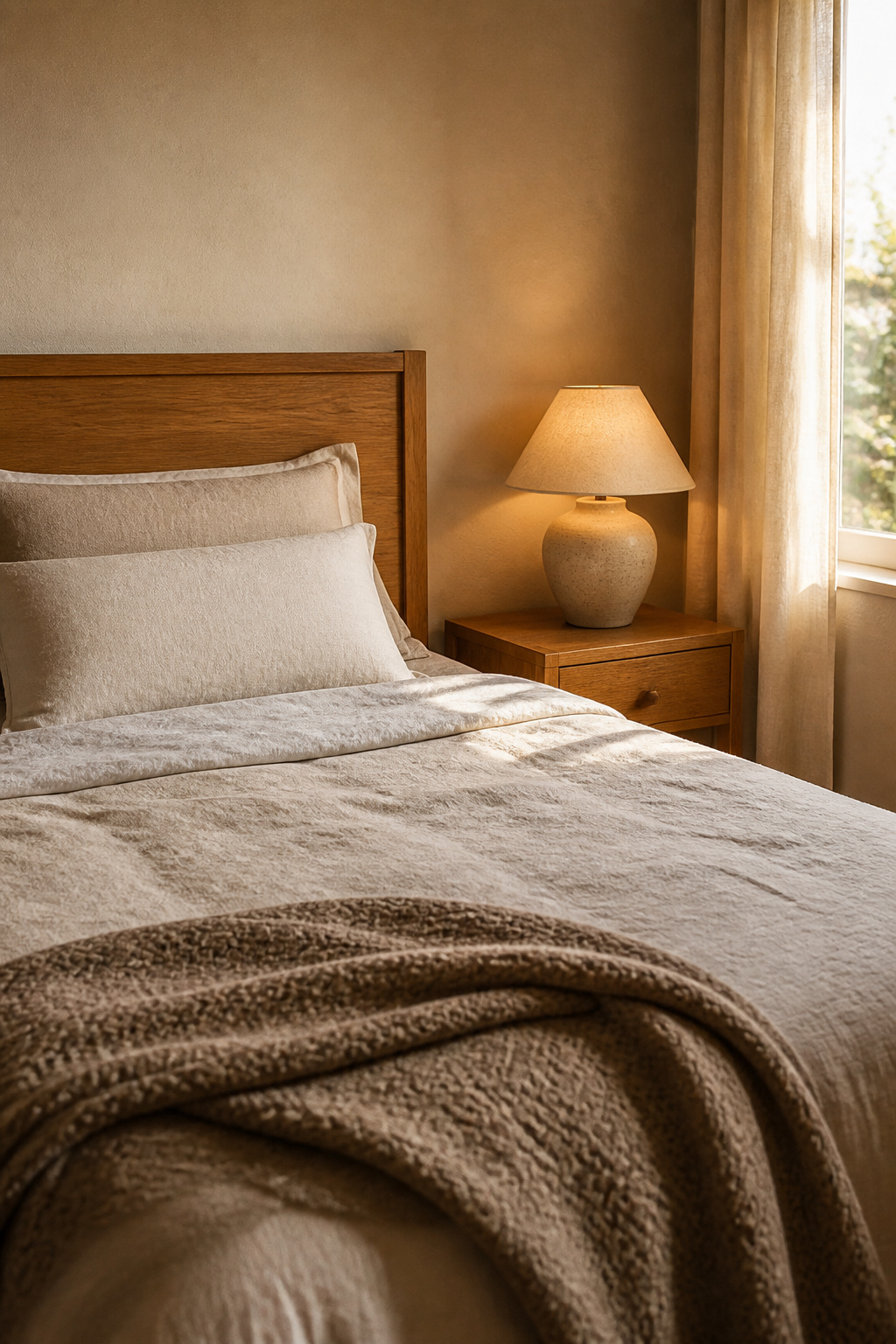
Calming Bedroom Ideas Start Where Cozy Stops
Coziness is something a photo can show. Calm is something the body registers with the eyes closed.
Where a warm-looking room can still fail at rest
Under Ulrich’s Stress Recovery Theory, the mechanism isn’t aesthetic. A room low in visual complexity, with a quiet sense of enclosure, helps switch the nervous system into rest-and-digest mode; a dense, overstimulating one holds the body in low-grade stress instead. A space can carry warm light and still say nothing about scent, sound, temperature or mess.
The deeper question: what should this room do for you
Women who described their homes as cluttered carried measurably higher cortisol through the day than women who called their homes calm and restorative — and clutter also correlates with more insomnia and poorer sleep. So the question shifts. Not “does this look warm,” but “does this quiet an actual stressor”: a light, a noise, a temperature swing, a pile of demands.
The senses most decor ignores
Scent, sound and temperature all shape sleep, yet none of it shows up in a styled photo. Clutter, meanwhile, splinters attention and eats working memory. My long-held position: scent and sound are design materials equal to color, and most rooms are decorated as if two of the five senses weren’t there. Tonight, stand in the room with your eyes shut and notice what it sounds and smells like.
What to Remove Before You Add Anything
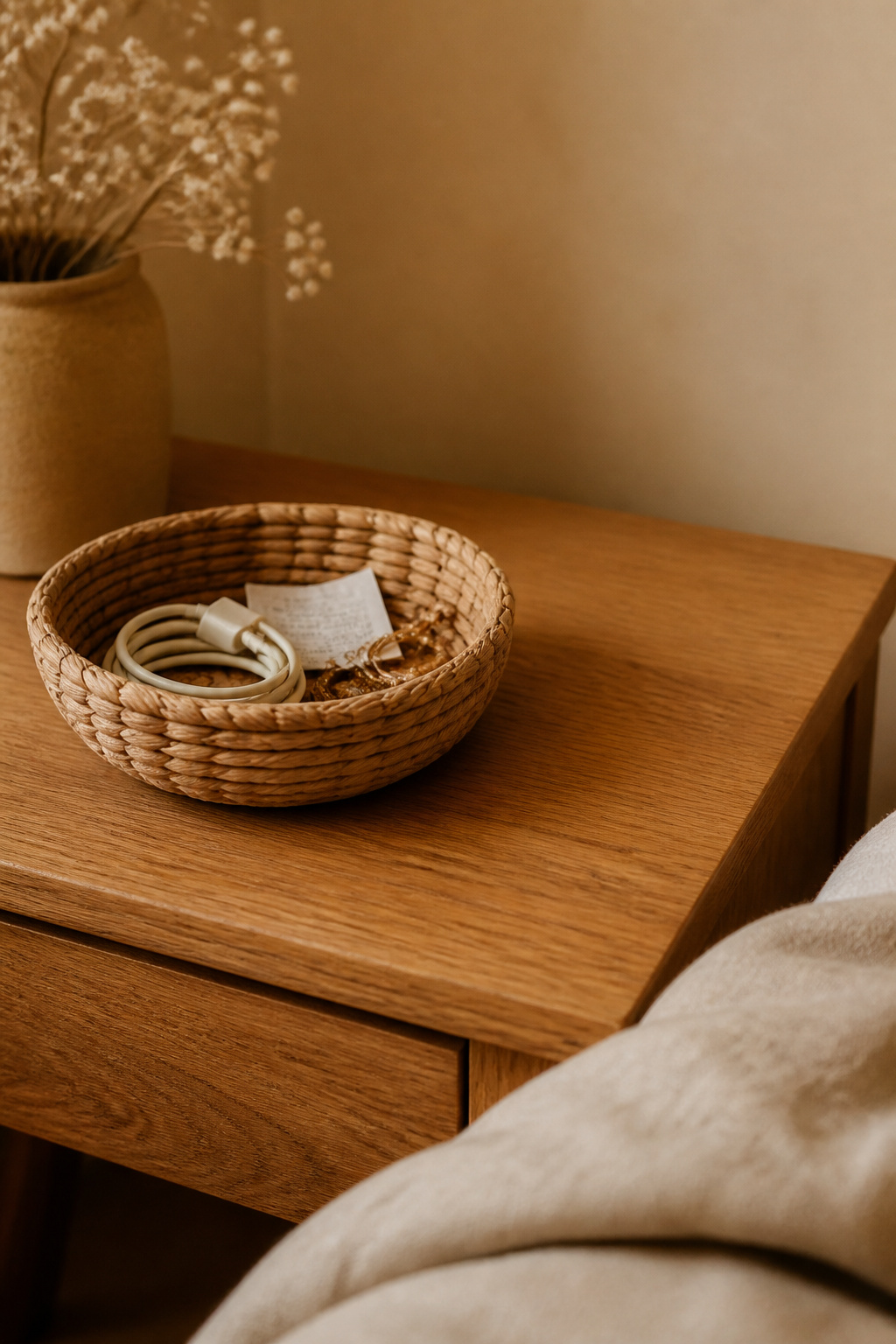
Before a single calming object goes in, something has to come out — removal is the highest-leverage move, and it costs nothing.
The doorway test
Stand in the doorway and look the way a first-time visitor would. From the threshold, the surfaces that have quietly become storage announce themselves — and people do think more clearly and feel less irritable in an organized room than a cluttered one. My rule at the door: if an object needs an explanation, it has drifted from styling into storage.
Objects that ask something of you
A visible reminder of an unfinished task keeps the brain half-on and stops it powering down. An object “asks something of you” when it stands for a decision you still haven’t made:
- a stack of mail or paperwork waiting to be dealt with
- work clothes or a gym bag draped over the chair
- a laptop, a charger, or anything work-related
- a book you’re unsure you’ll finish, or a gift with no home yet
Sleep hygiene guidance is consistent on this: keep devices and work out of the bedroom entirely.
Subtracting before styling
A full nightstand competes for the very attention a calming ritual needs to work. So the sequence matters: clear a surface to nothing, live with it empty a few days, then add back only what earns its place. Pick one surface this week and take everything off it.
Scent as a Design Material
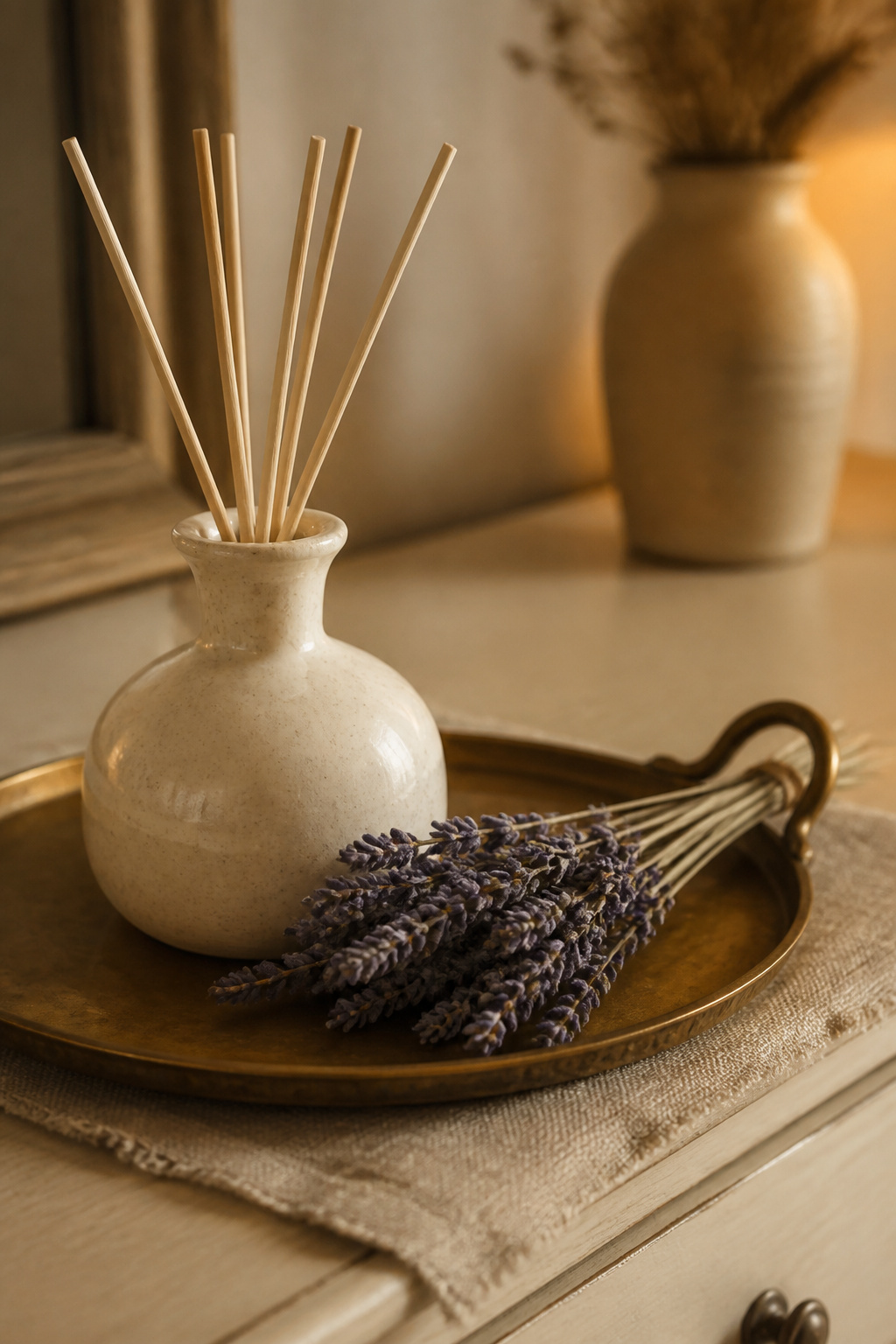
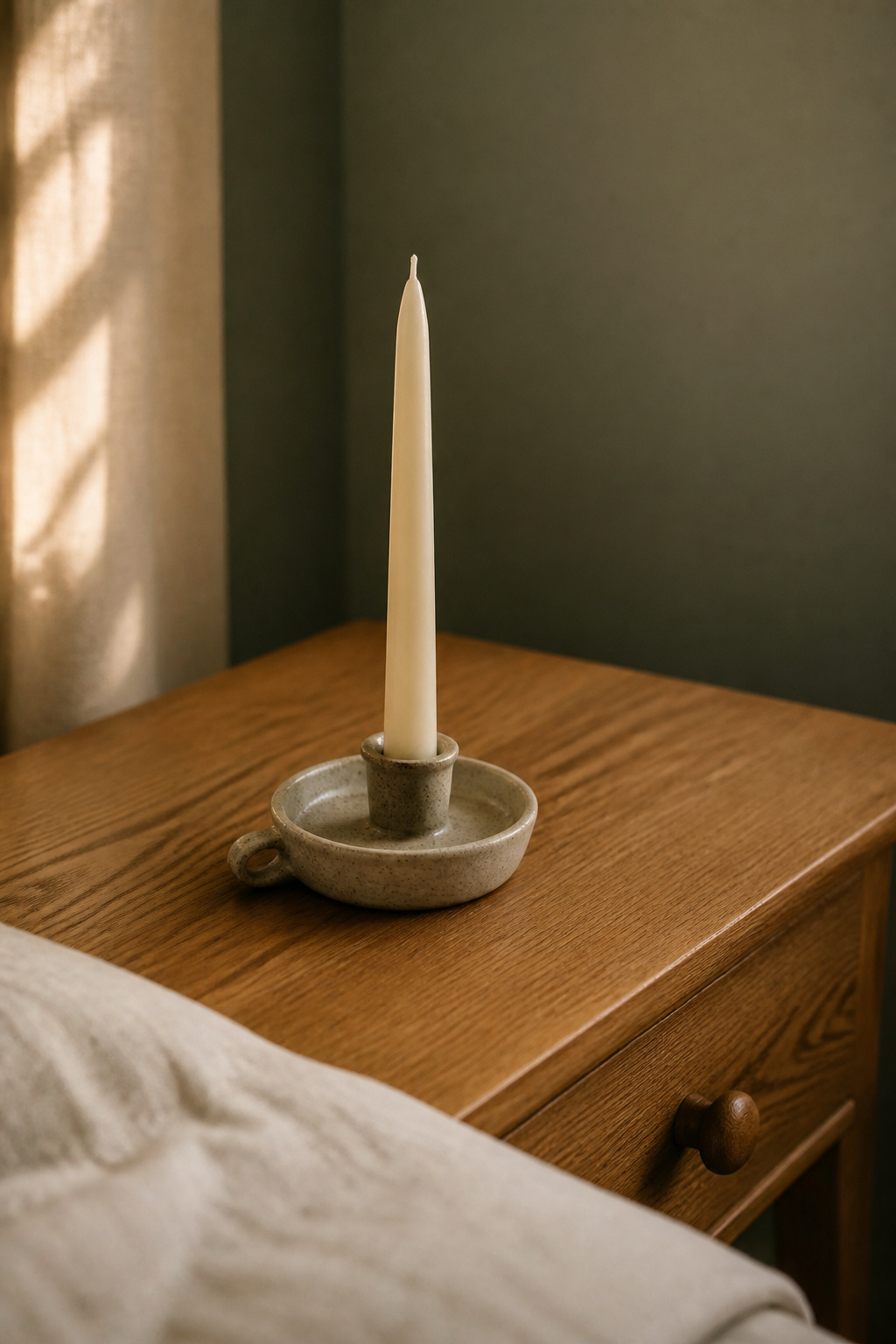
Why do we pick paint with such care but leave scent to whatever candle was on sale? It’s the one calming layer that adds nothing to look at, working below conscious attention so it never competes for visual space.
Why scent is treated as decor, equal to color
Your sensitivity to odor drops at night as part of the circadian rhythm, encouraging sleep, while the scent in the room shapes how quickly you fall asleep and how well you stay there. That’s a genuine lever almost nobody uses on purpose.
Choosing a scent that settles rather than stimulates
Lavender has the most research behind it — a calmer heart rate, lower blood pressure and, in one study, deeper sleep and a more refreshed morning after pre-bed exposure. A separate pilot recorded lavender raising slow-wave sleep and delta activity on EEG while lowering wakeful alpha waves, but from just nine adults in a single-blind study, so I hold it lightly. The wider evidence is similarly preliminary, and none of it replaces treatment for a sleep disorder.
| Scent | What the research suggests |
|---|---|
| Lavender | Calmer heart rate and blood pressure, deeper sleep — though the EEG signal is a 9-person, single-blind pilot |
| Damask rose | Improved sleep quality in hospital-based research |
| Roman chamomile | More total sleep time for older adults in managed care |
| Jasmine | Better sleep efficiency — more of your time in bed spent asleep |
| Citrus, peppermint | Stimulating; keep these for daytime rooms, not the bedroom |
Simple, low-maintenance ways to introduce it
A calming room shouldn’t hand you a chore. Passive delivery — a reed diffuser, a light linen spray, or a small sachet of dried lavender near the pillow — avoids one: no flame, no hum. Because smell is already muted at night, keep it faint and constant: a strong dose right before bed becomes its own stimulus.
Sound and Quiet: Designing What You Don’t Hear
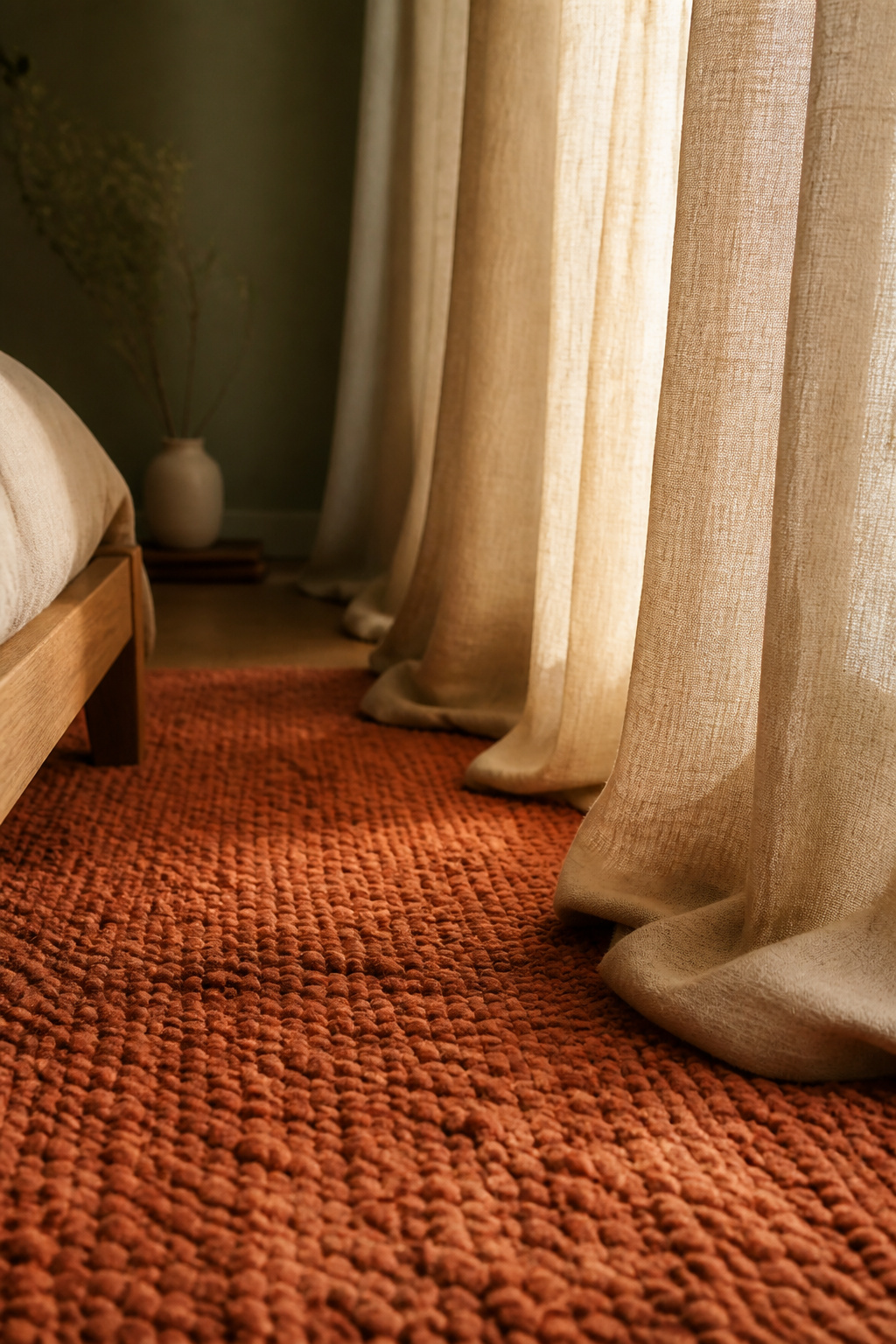
Quiet is designed, not wished for. Every hard surface throws sound back; the calm ones absorb it.
Soft surfaces that quiet a room
Thick, dense textiles soak up the sound energy that bare walls, glass and floors reflect. One flooring source reports a thick-pile rug over foam underlay lowering reflected sound by as much as 30%, and multi-layer pile up to 40%, plus heavy curtains. I’d read those figures as directional, not settled — they come from a single trade source with no standardized acoustic rating.
Masking noise without adding stimulation
White noise is where honesty matters, because the evidence is mixed. A recent systematic review found the research quality inconsistent and asked for more study before it’s broadly recommended. Even so, individual studies show real effects — adults falling asleep roughly 38% faster, and both New York City residents and hospital patients sleeping better, with a machine running.
What silence actually requires
If you use a masking sound, keep it gentle. Sustained noise at 70 decibels or more — city-traffic loud — can become hazardous over time, so aim for the volume of a quiet conversation, machine across the room, not beside your head. Check it by ear: in one review, 65% of machines tested could play louder than recommended. For quiet without a device, the same soft layers pair with the room’s warm bedroom lighting — the textures that soften light also soften sound.
Temperature, Air and the Body’s Signals for Sleep
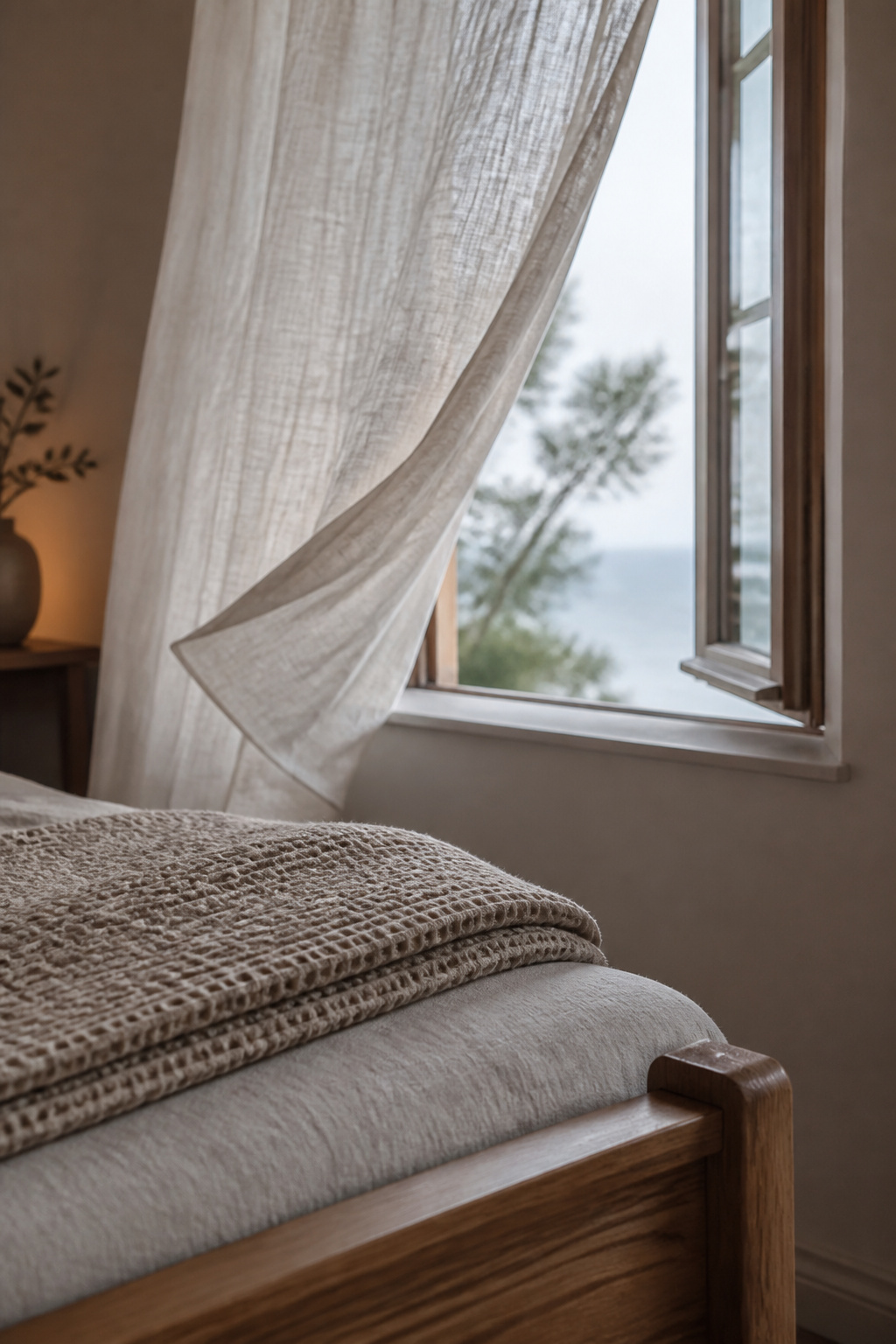
At 65 to 68°F a bedroom works with the body instead of against it — and of every lever here, this one has the firmest ground under it.
Why a slightly cool room reads as restful
The Sleep Foundation and Harvard Health land independently on that same window, roughly 18.3–20°C, for adult sleep. Core temperature starts dropping about two hours before sleep, timed with melatonin’s release, so a cool room works with the shift. The body sheds heat partly through the hands and feet; a too-warm room blocks that and trims the slow-wave and REM sleep that leave you rested.
Airflow and bedding weight together
Humidity matters alongside heat, and it gets ignored. Aim for 30–50% relative humidity; 60% is the upper limit most sources agree on. Above it, wakefulness climbs and deep NREM and REM sleep shrink, and damp air aggravates asthma and invites mold; too dry, and you get itchy eyes and a sore throat. Ventilation comes first — a cracked window, a fan, blinds closed against the sun — paired with breathable linen or cotton percale rather than heat-trapping synthetics.
Small changes with an outsized effect on sleep
Because the target is only a few degrees and a narrow humidity band, the fix is usually small: a thermostat nudge, a cracked window, or a heavier duvet swapped for linen. A cheap hygrometer takes out the guesswork, showing where the humidity actually sits rather than how the air feels. Change one of those tonight.
A Small Wind-Down Corner
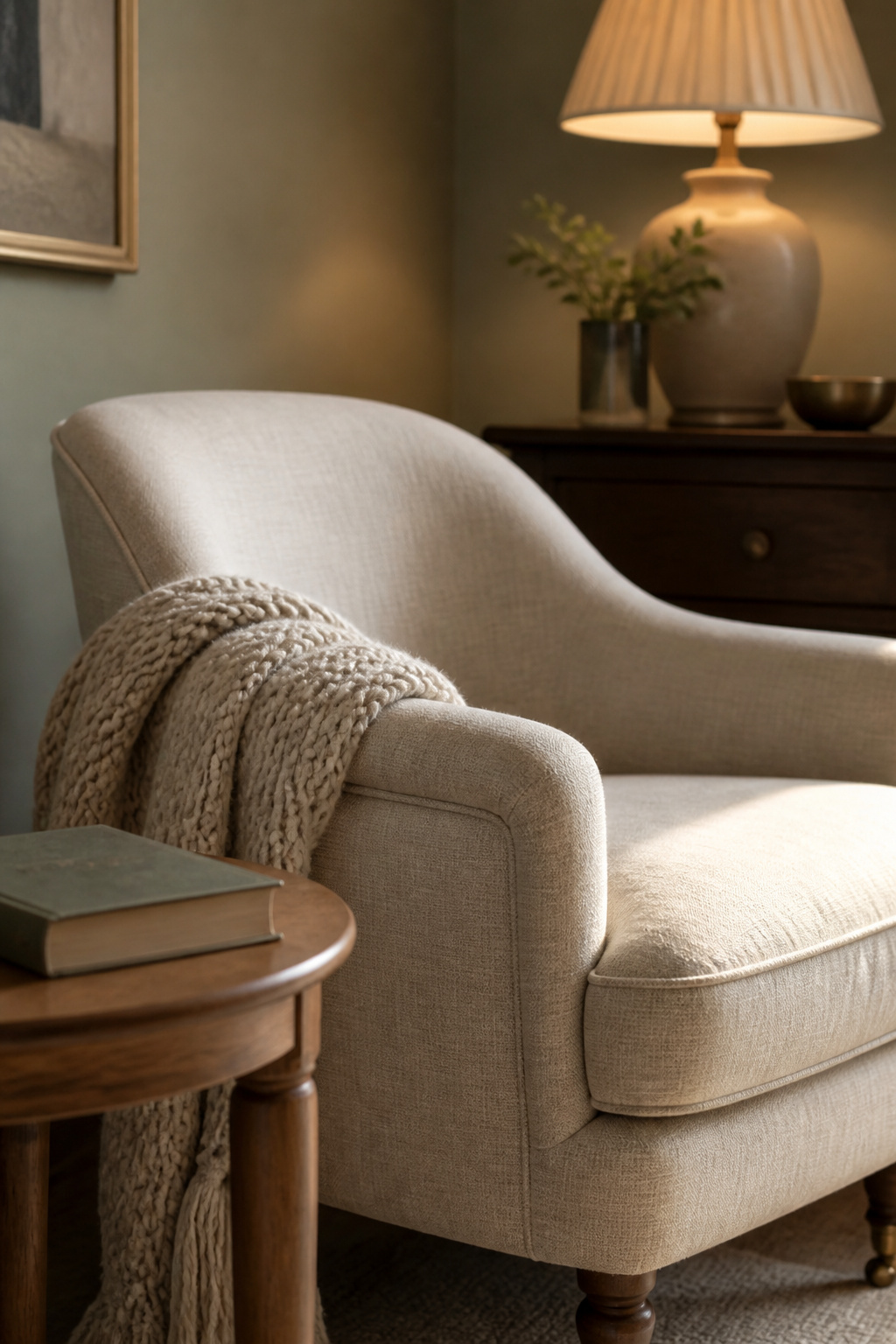
My first real sitting space was a corner of a rented Chicago apartment — a single jute rug, a cushion on the floor, and a folding screen to close it off. It was barely a few feet across, and it taught me what I still believe: a claimed corner, done sincerely, does more for a practice than a whole room done for show.
Claiming a corner for the transition to sleep
Sleep hygiene guidance is consistent on reserving a window before bed — the Sleep Foundation suggests 30 minutes to two hours, Harvard Health at least a full hour — away from stimulating activity. Harvard frames the bedroom as a “sleep sanctuary”: somewhere light, noise and temperature are controlled for rest. A small chair or floor cushion, a soft throw and one warm, dimmable light are enough to claim the corner; the fuller seating decisions belong to this silo’s guide to a bedroom reading nook.
What belongs there and what doesn’t
What belongs is low-stakes: reading something undemanding in soft light, gentle stretching, a few minutes of mindfulness, or writing tomorrow’s tasks down to clear them from your head. What doesn’t is the phone, the tablet, the laptop, the TV — their blue light suppresses melatonin and signals to the brain that it’s still daytime, so put screens away well before you sit down, ideally two to three hours ahead.
A single practice to close the day
The specific activity matters less than doing it consistently. Keeping the same bedtime and wake time, weekends included, trains the body to feel tired at the same point each night. A short, repeatable ritual — a line in a notebook, a few slow breaths, one gentle stretch — gives the body a reliable cue that the day is done. That’s the room this article opened toward: not one that merely looks warm, but one where scent, sound, temperature and a claimed corner all point toward sleep. Layered over the broader cozy bedroom styling guide, it turns a good-looking bedroom into one that actually rests you.
FAQ
What scents actually help you fall asleep?
Lavender has the strongest support: research links it to a calmer heart rate, lower blood pressure and deeper sleep. Damask rose, chamomile and jasmine have each improved sleep quality, total sleep time or efficiency in individual studies. The evidence is still preliminary and population-specific, so treat scent as a gentle layer, not a cure.
Does a white noise machine really improve sleep quality?
The evidence is genuinely mixed: a systematic review found the research quality inconsistent, while individual studies saw adults fall asleep about 38% faster and both city residents and hospital patients sleep better with it playing. Keep the volume near a quiet conversation, machine across the room, not beside your pillow.
What’s the best bedroom temperature for restful sleep?
Both the Sleep Foundation and Harvard Health point to 65–68°F (18.3–20°C) for adult sleep, matching the body’s natural pre-sleep temperature drop. Pair that with 30–50% relative humidity to avoid the disrupted sleep stages linked to humid air and the dryness linked to overly dry air.