
Your round pedestal dining table rocks every time someone leans on it, so you fold a coaster, wedge it under a foot and blame the floor without testing it. That’s the mistake. Or you decide it was a cheap table and start shopping for a new one. Either way you’ve skipped the checks, and you end up with a table that still rocks or money spent replacing one that needed a wrench.
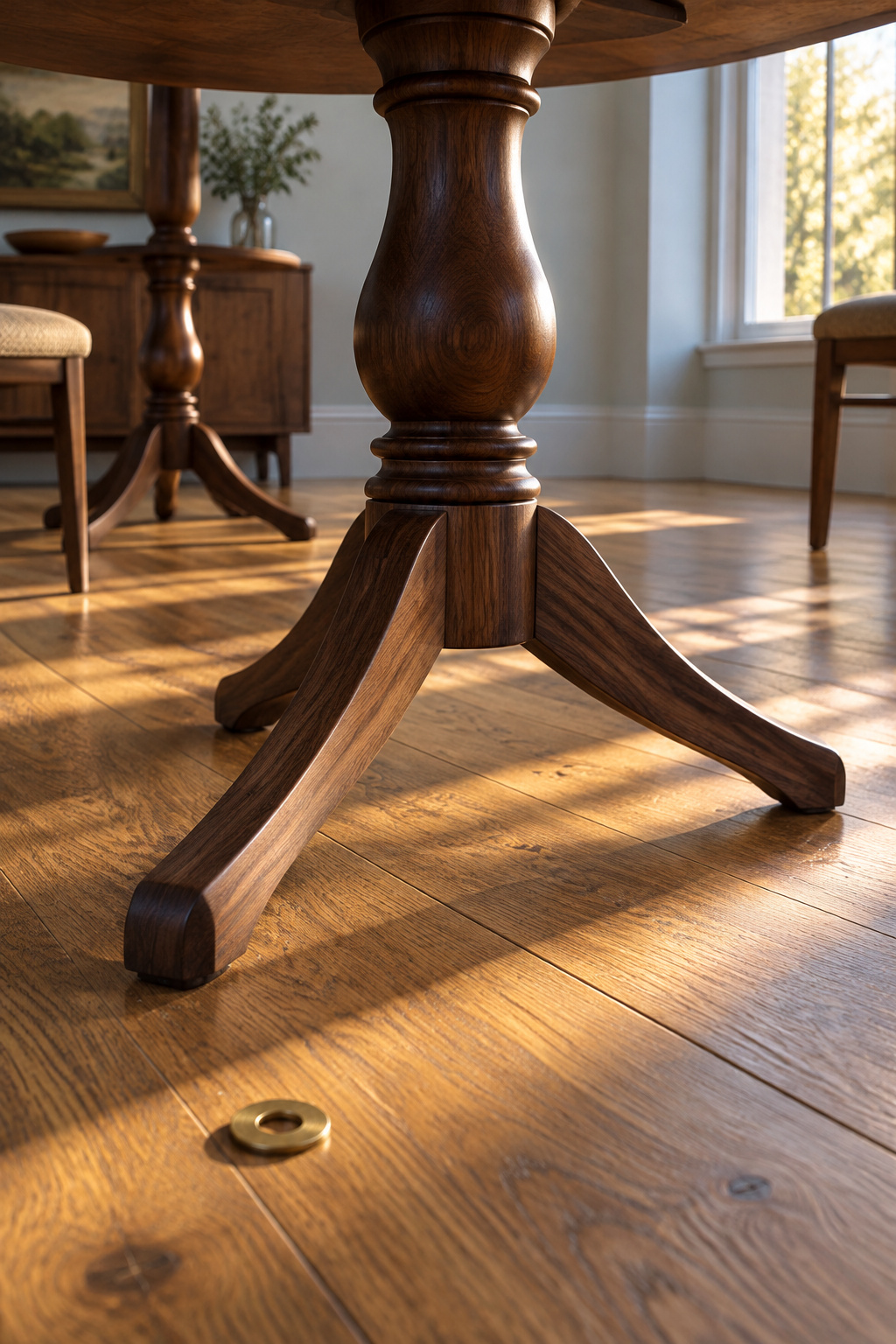
Nobody has counted how often a wobble is the floor and how often it’s the table, so work through it in order. Floor first, because it’s free. Then the glides or levelers on the feet. Then the plate and center bolt that hold the column to the top. Run it that way and you’ll know what you’re fixing, and what to look for in the next base you buy.
TL;DR
- Rule out the floor first: move the table to another spot, and if the wobble stays on the same foot it’s the table; if it jumps to a different foot, it’s the floor.
- After the floor, check glides and levelers, then the mounting plate and the hanger bolts through the column; makers’ own sheets say this hardware loosens over time and should be re-tightened by hand, never over-tightened.
- There’s no standard for how far a pedestal’s feet must spread; makers pair tulip bases at about 39 to 61 percent of the top’s diameter, so press on the rim before you buy.
Buying: A Round Pedestal Dining Table Needs Knee Room for Every Chair
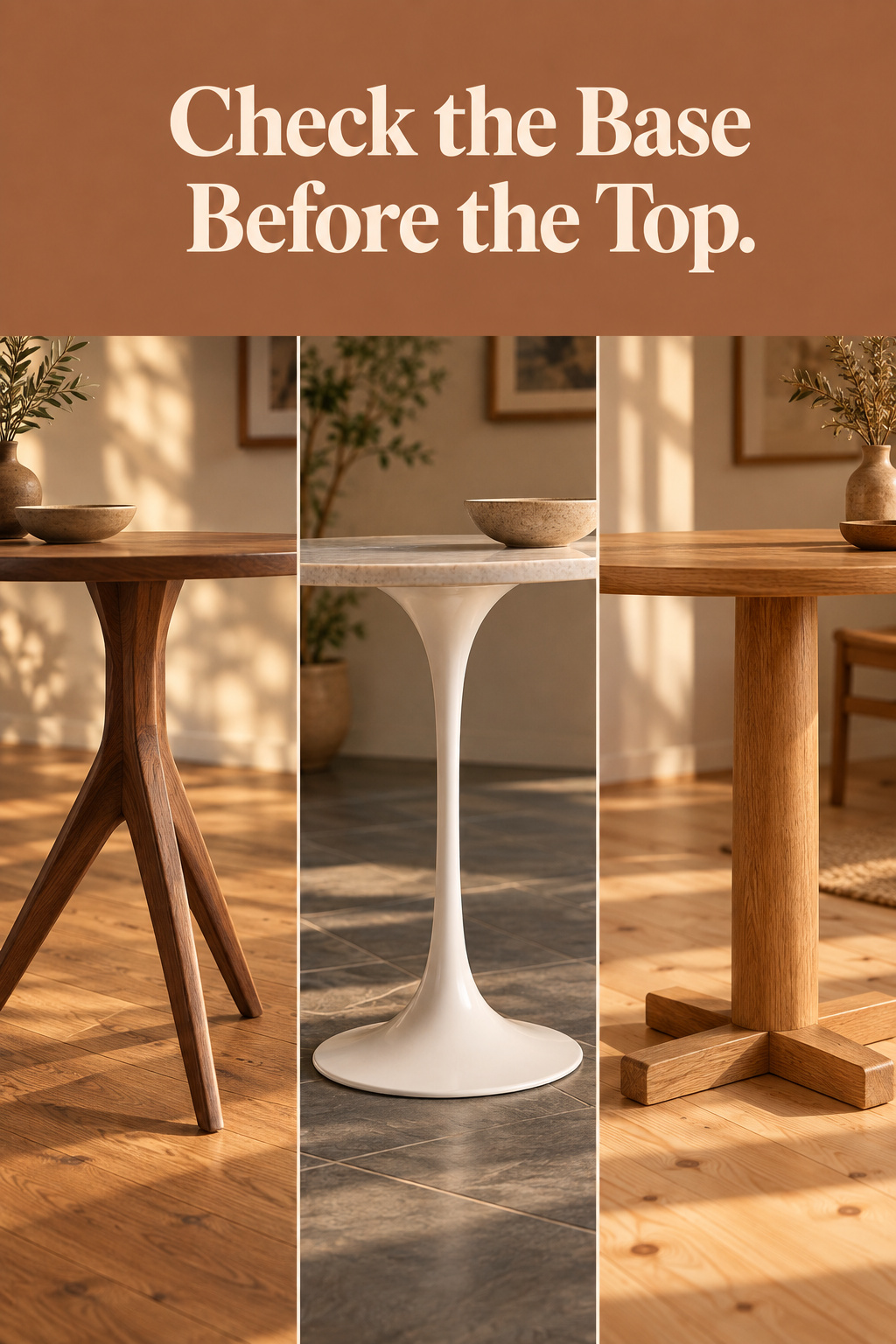
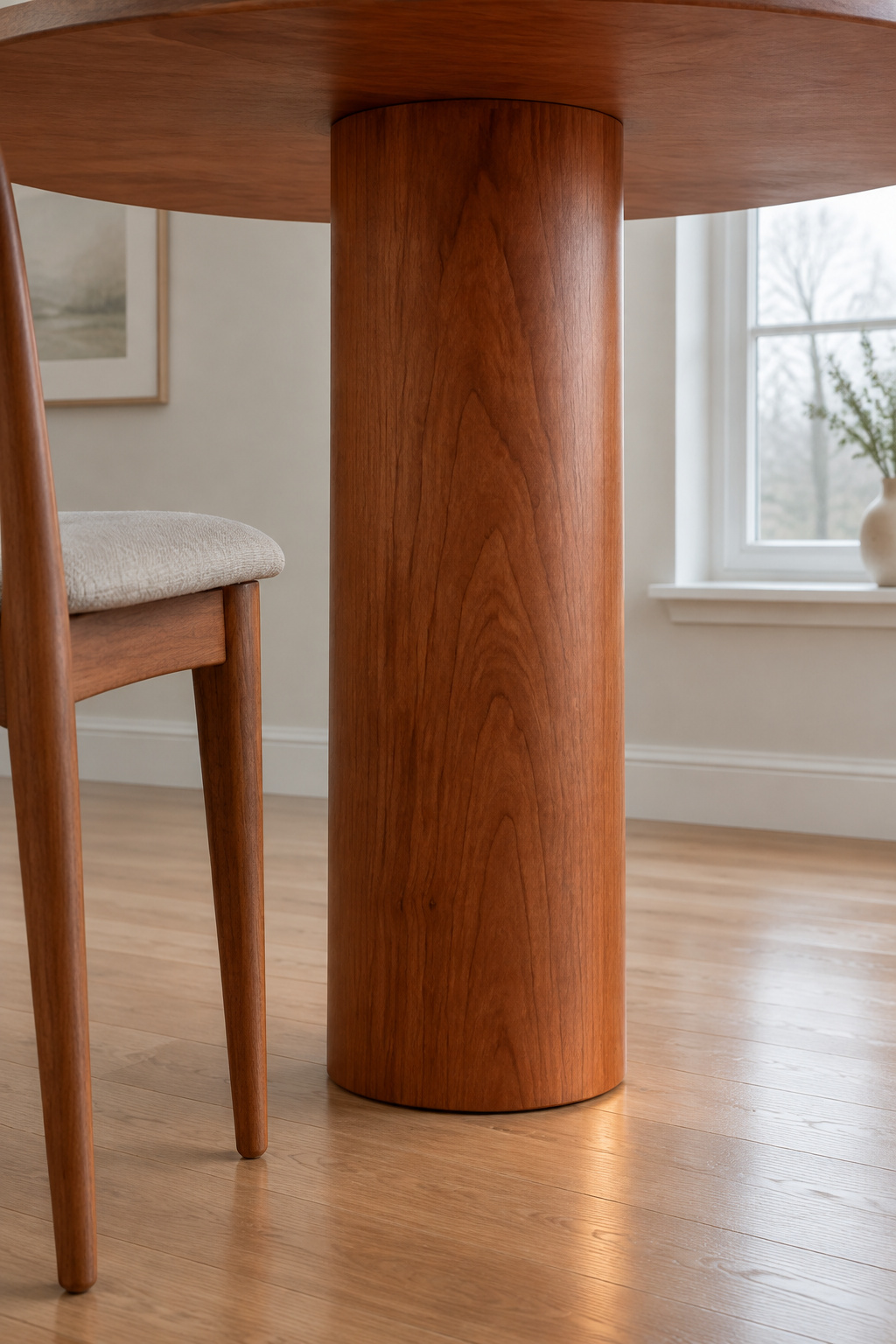
Start with what’s under the top. A central base leaves the whole rim free, so chairs go anywhere and an extra guest doesn’t end up straddling a leg. Four legs fix where the chairs go and leave awkward spots around a circle. The catch is that a pedestal still takes floor space, and a wide foot sits right where your feet want to land.
| Base | Knee room | Chairs all round | Stability |
|---|---|---|---|
| Single pedestal on a broad foot | Limited by the foot and column, not an apron | Yes, the rim is leg-free | A four-footed base can rock like four legs |
| Tulip (flared disc) | Open under the top; the disc takes floor space | Yes | Depends on base size and weight for the top |
| Tripod or splayed feet | Feet must reach near the rim, so they meet knees and chair legs | Mostly | Three feet can’t rock on an uneven floor |
| Double pedestal | Built for long rectangles and ovals | Not really a round-table base | Made for a long top |
| Four legs with an apron | Set by the apron’s lower edge | No, legs fix the seats | Can rock when one leg is short |
Knee room on two real tables: one tulip pedestal lists 28 inches of clearance under a 29.5-inch-high table, and a standard farmhouse table puts the bottom of its apron about 25 inches off the floor. That’s roughly 3 inches more for your thighs under the pedestal, across two different products, so measure the one in front of you.
Overhang matters too. One base maker says about 10 inches from base edge to top edge is comfortable and 14 lets chairs slide almost all the way under; a 48-inch top on a 20-inch base gives (48 − 20) ÷ 2 = 14 inches. A table against a bench is a different question, covered in our banquette table size guide.
Buying: How Far the Feet Must Spread for the Top You Chose
There is no standard ratio of base to top for a pedestal table. John White, the shop manager at Fine Woodworking, put the principle plainly: the narrower the base, the less stable the table, and to be stable the bottom has to reach out close to the perimeter of the top. He was answering a question about a long rectangular top, so take the principle, not his number.
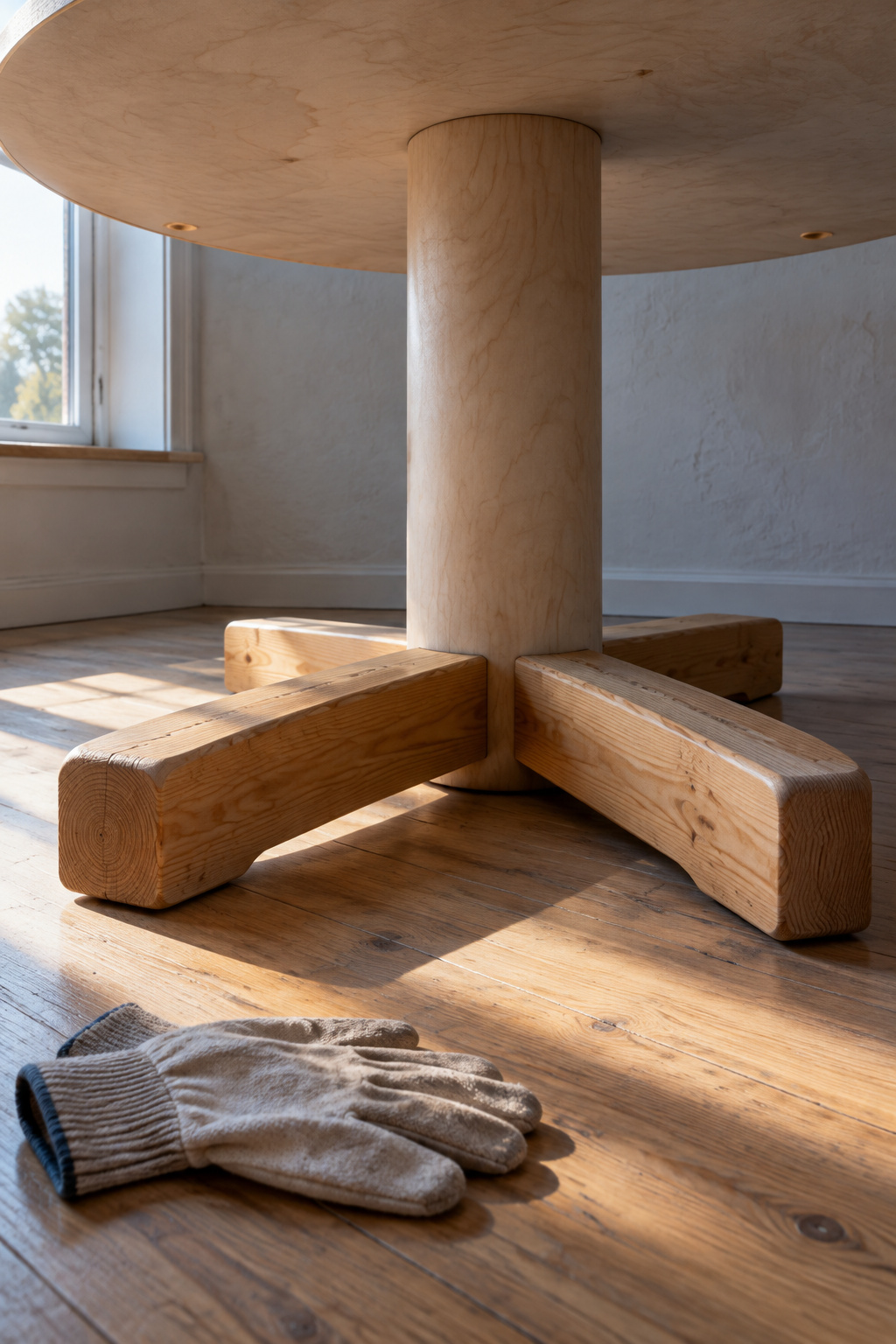
Makers’ own pairings show how wide the range runs. One sells the same 25.5-inch tulip base under a 42-inch top and a 56-inch top, which is 61 percent and 46 percent of the diameter. Another puts a 27.55-inch base under tops up to 70.86 inches, about 39 percent. They differ because the tops and bases differ in weight and material.
The European test method presses down near the edge, on the side most likely to go over, and the table must not tip. You can do a rough version in any store: lean on the rim the way a guest does when they stand up.
A heavy top changes which base is safe, so before you choose stone, read how heavy a stone round top gets.
Tulip bases and the tipping question
A tulip base has no arms, so its footprint is a plain circle. Some makers state a maximum top for each base, such as 28 inches on one small base and 40 on the medium. That stated maximum is the closest thing to a rule you’ll get, and it applies to that base only. Marble tulips are sold bolted, and one maker of oval versions warns against leaning hard on the long ends, which levers on the central fixing. If a base looks too light for its top, believe your eyes.
Buying: Showroom Checks Worth Doing Before You Pay for the Base
Bring your hands and a tape measure. Buying from a listing, ask the seller the same things.
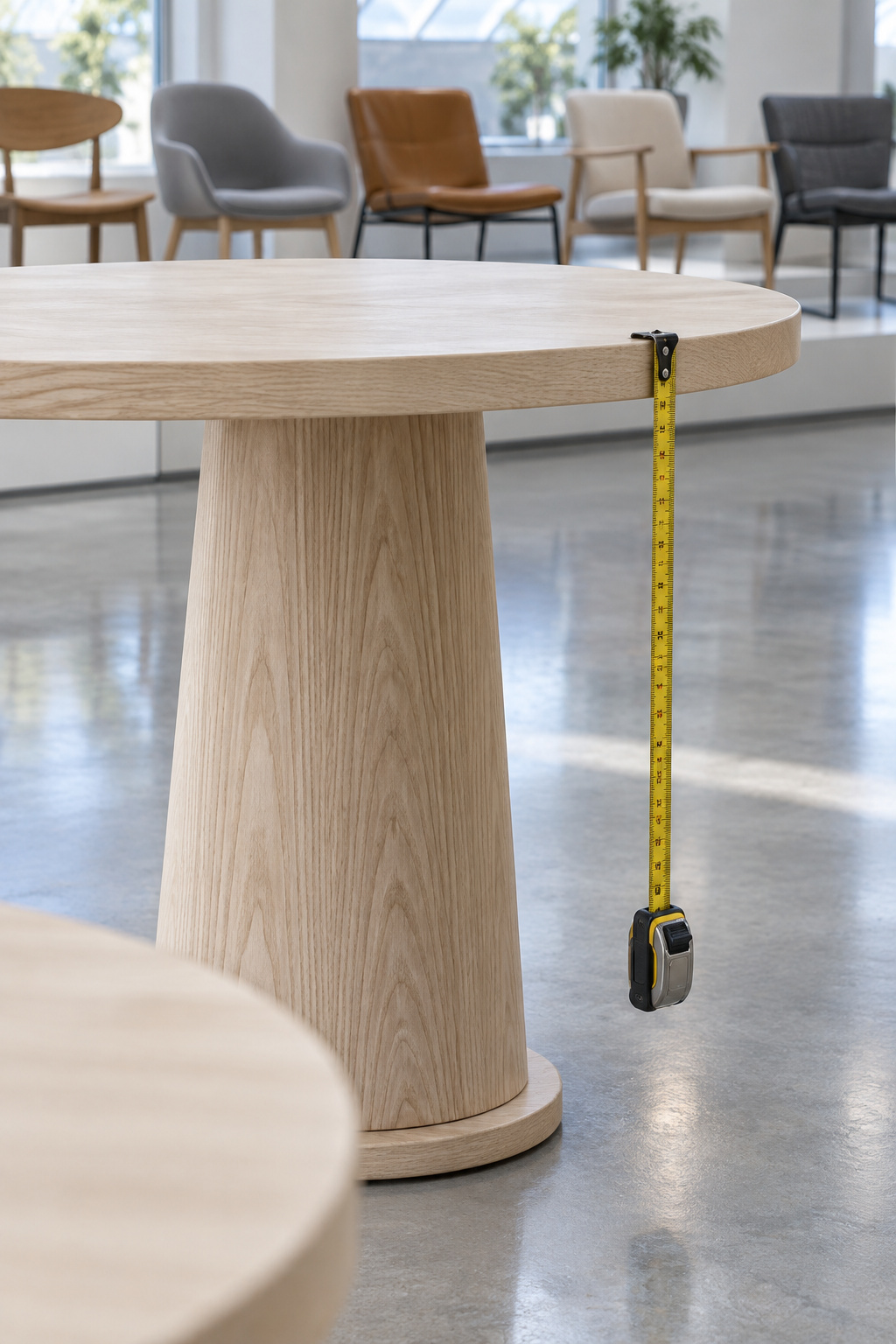
Rock it side to side by the rim. Any movement where the column meets the top or the foot is a fail. Press down near the edge, first over a gap between feet and then over a foot; it should stay put, not lift, rock or slowly tilt. Look under the top for a plate bolted to the underside, because glue and dowels alone is a fail. Kneel and measure: seat to tabletop should be about 10 to 12 inches, so sit in your chair, see where your feet land, and check that armchair arms slide under. Ask what joins the column. “Sturdy pedestal base” says nothing; a listing that names bolts and a clearance figure does. Last, check the feet. Levelers or glides pass; bare wood means you’ll be adding them.
Fixing: Rule Out the Floor Before You Touch a Screw
I tell people a crooked shelf is usually a crooked wall, not a crooked shelf. Tables work the same way, according to Lowe’s project expert Hunter Macfarlane: they usually wobble because the legs are uneven or the floor isn’t flat. So the floor goes first.
- Rock the table and note which foot lifts.
- Move it to another spot in the room and rock it again.
- If the wobble stays on the same foot, the table is off. If it moves to a different foot, the floor is off.
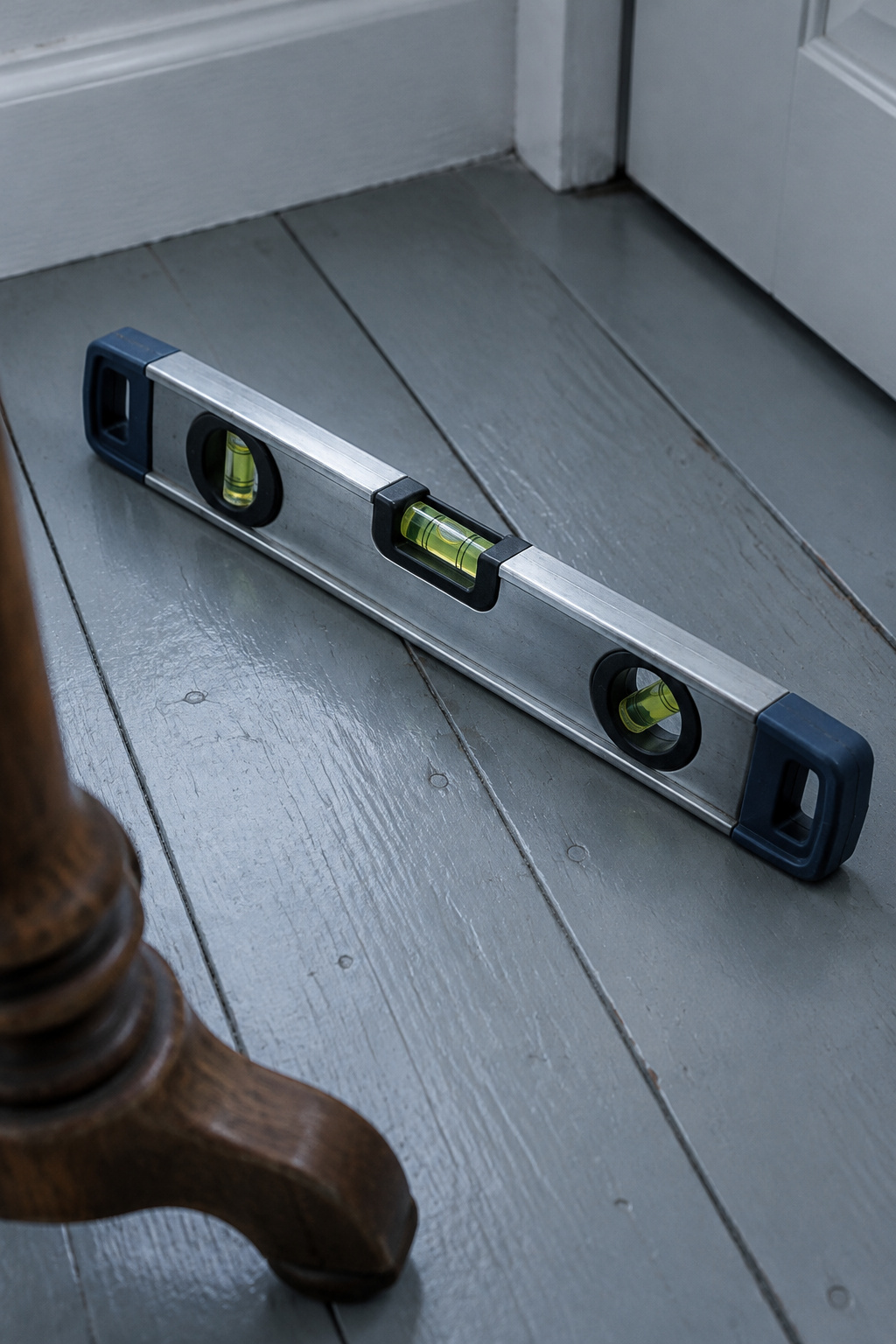
- Lay a level on the floor beside the table, then one on the top. Watch the bubble on the top while someone leans on the rim.
- If you can, set the table on a surface you know is flat. As Gary Rogowski put it in Popular Woodworking: “If it sits flat on my bench, then it’s flat. If it moves to the floor and rocks, it’s the floor.”
A tripod can’t rock, because three feet always share the weight. A four-footed pedestal base rocks just like four legs.
Only when the wobble follows the room is it the floor, and even then, parking the table in the one spot where it stops rocking isn’t a fix. Adjust the levelers. I keep a level, shims and a box of spare screws behind the seat of the truck.
Fixing: Foot Pads First, Then the Center Bolt and Plate
Foot pads and glides
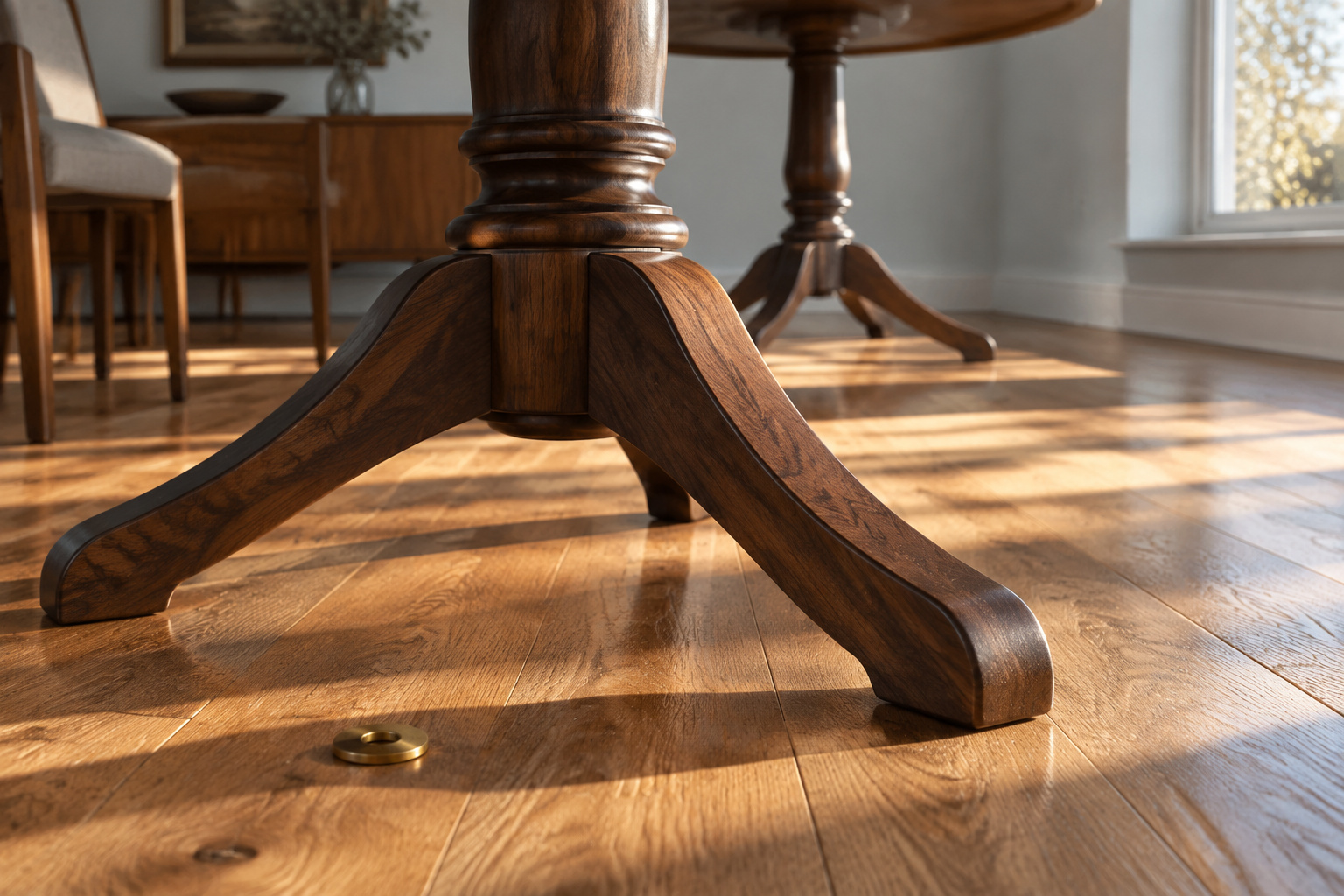
Look at the feet. Replace missing glides, because worn or uneven ones can cause a wobble on their own. Adjustable levelers turn counter-clockwise to come out; on a leg with an adjustable foot, the leg sits about 1/4 inch or more off the floor. You may never get a table perfectly level, but you can stop the rocking, and you redo it whenever the table moves. No levelers? Nail-on glides, then washers under the low foot until it’s steady.
The center bolt, plate and column joint
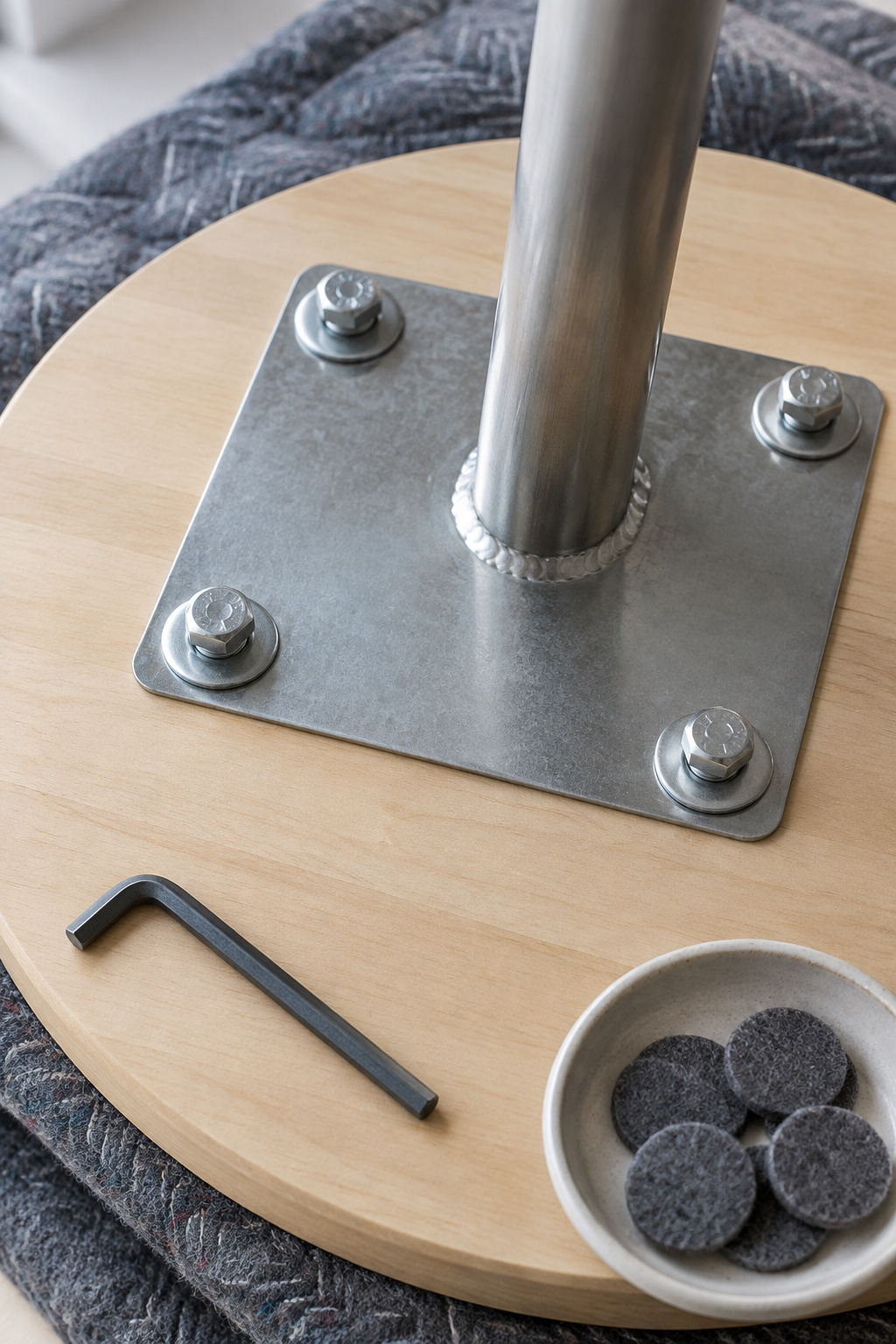
Store-bought pedestals typically go together the same way. A mounting plate bolts to the underside of the top with Allen bolts and lock washers, and hanger bolts in the post pass through the plate and the feet, held with nuts. Makers’ sheets say two things: hardware loosens over time, and don’t over-tighten. Snug each bolt with a hand tool. A little slop at that joint is magnified at the rim, so a small looseness under a big top feels like a big wobble.
The mistake at this step is force. People crank the bolt into a solid top until the wood crushes or splits. Or they find a loose dowel joint and pour in glue, which won’t take the slop out of a round tenon worn oval. A fitted dowel can, or epoxy mixed with fine sawdust, which needs 24 hours before the table is used.
Antique pedestals may have no bolts at all, and that’s a pro job. So is a cracked column, in my judgement: I wouldn’t glue and hope on the part carrying the whole top. The same plate matters if you’re putting your own top on a bought base, since the plate and the listed top size decide what the base carries.
Pedestal for Chairs, a Base Built for Heavy Tops: The Rules to Buy and Fix By
The short version, in the order I’d use it:
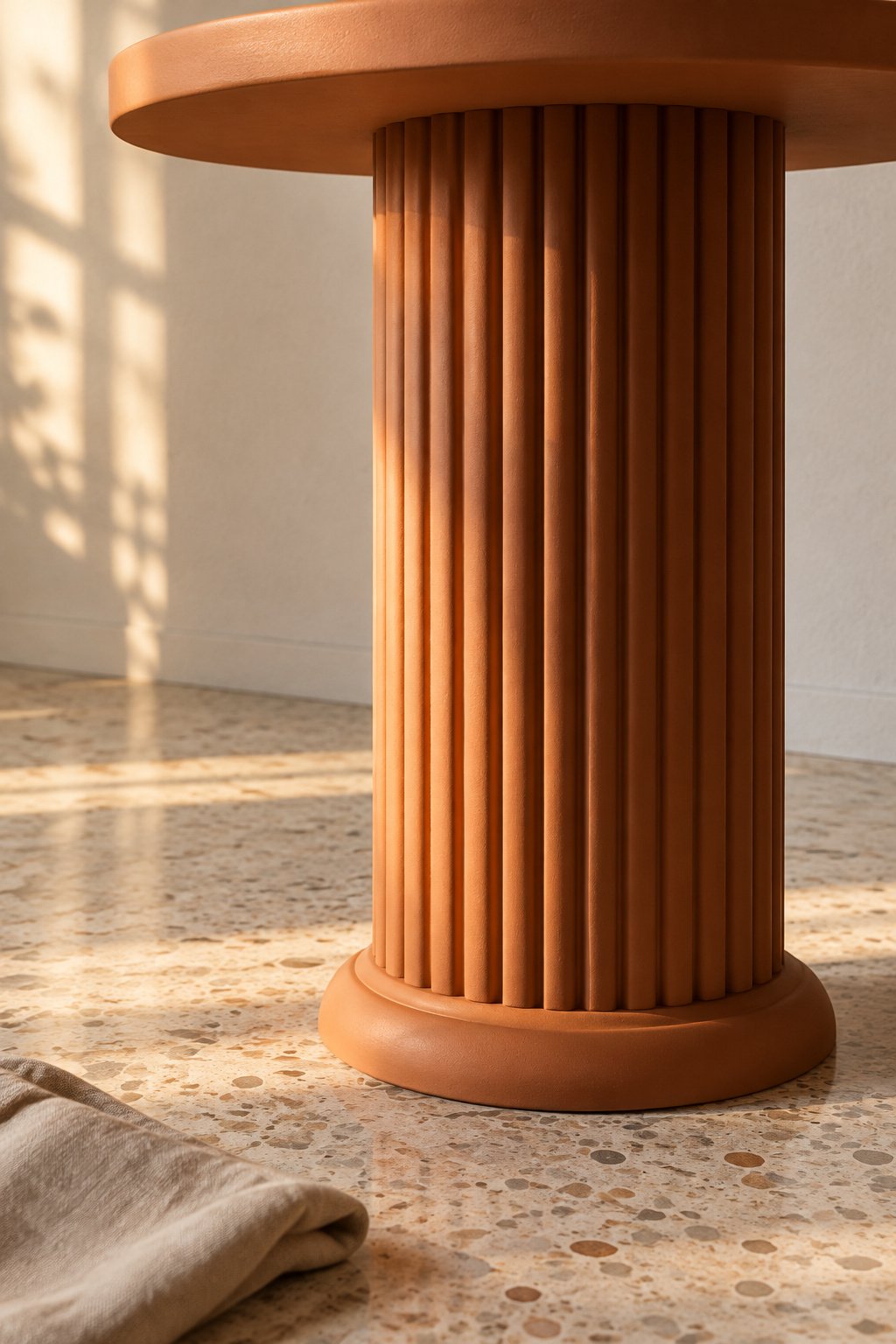
- Choose the base before the style.
- Pick a pedestal when you want chairs all the way round.
- Rule out the floor first; it’s free.
- Check glides and levelers next, then the plate and bolts, tightened by hand.
- Match the feet to the top: press on the rim and read the maker’s maximum top size.
- Don’t buy on looks, and don’t shim a table whose bolt is loose.
That leaves heavy tops, and here the sources don’t agree. A WoodWeb contributor says a heavier top steadies a three-legged pedestal, because the weight counterbalances anyone leaning on the edge. Tablebases.com says a heavy top on a light base raises the center of gravity and can tip it. Neither settles it for me. What I take from both is one rule: match the base to the top’s weight and diameter, with a base built for that top, wider, heavier or with more than one column. Shape, size and chairs get decided around it; here is how the base fits the rest of a round table plan.
FAQ
How do I move a pedestal table without damaging the column joint?
Lift it rather than drag it, holding it by the base, because scooting stresses the joint and can catch on carpet. The exception is one maker’s heavy marble tulip tables, which it says to slide a little at a time, one side then the other. Follow your maker, then re-check the levelers and bolts once it’s in place.
Can I repair a cracked pedestal column myself?
I wouldn’t. A loose joint is a home repair: re-tighten bolts, or refit a worn dowel with a new dowel or epoxy and sawdust, which needs 24 hours. A crack in the column that carries the whole top is a pro job or a replacement base, and an antique with no bolts should go to a pro too.
Will a pedestal table wobble on carpet?
It can. Carpet padding can hide a slight wobble, so a table that’s steady on carpet may rock on a hard floor in another room. On thick carpet a single disc base can rock, because it has no second or third contact point. Put pads under the feet to limit dents, and set levelers where the table will stay.