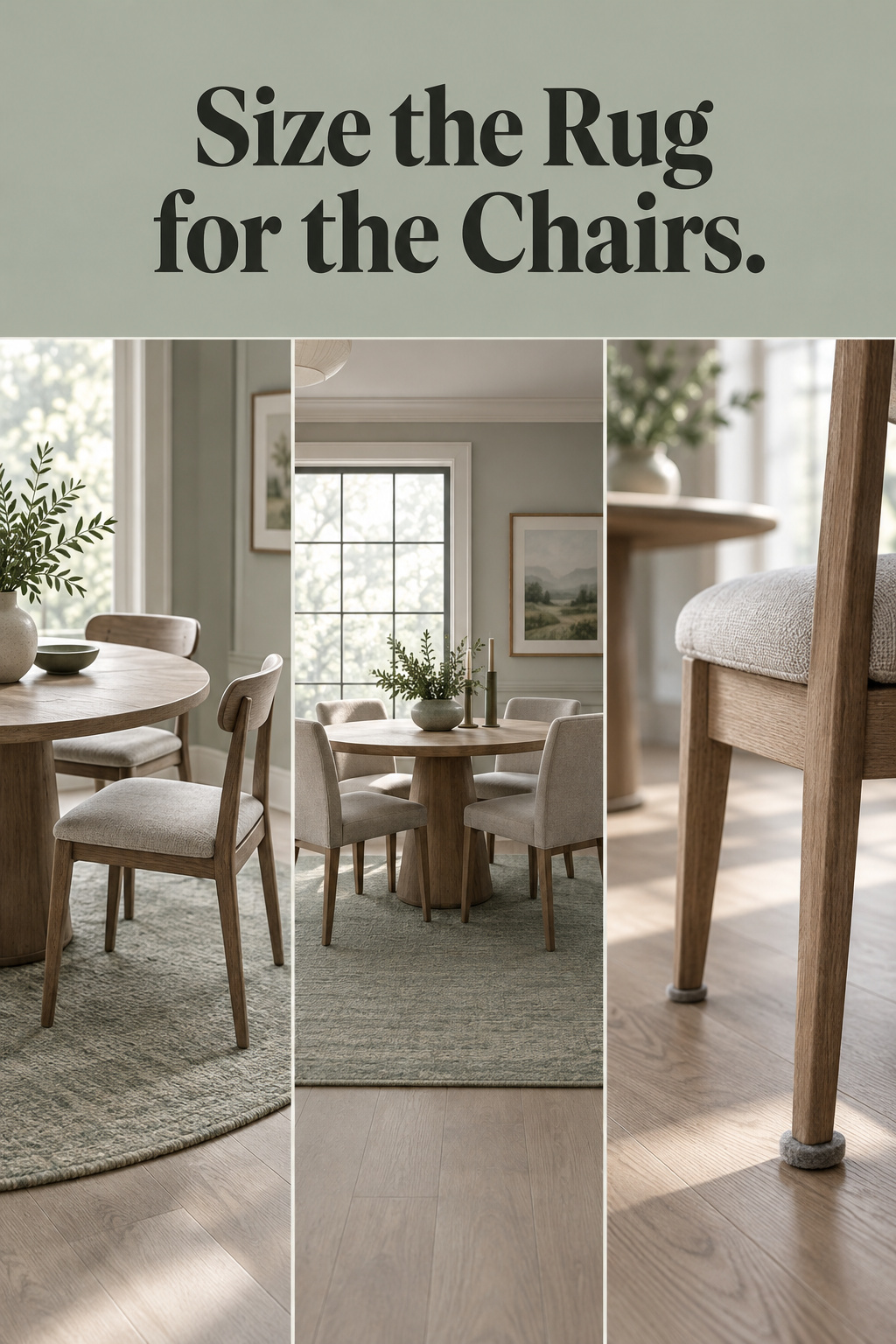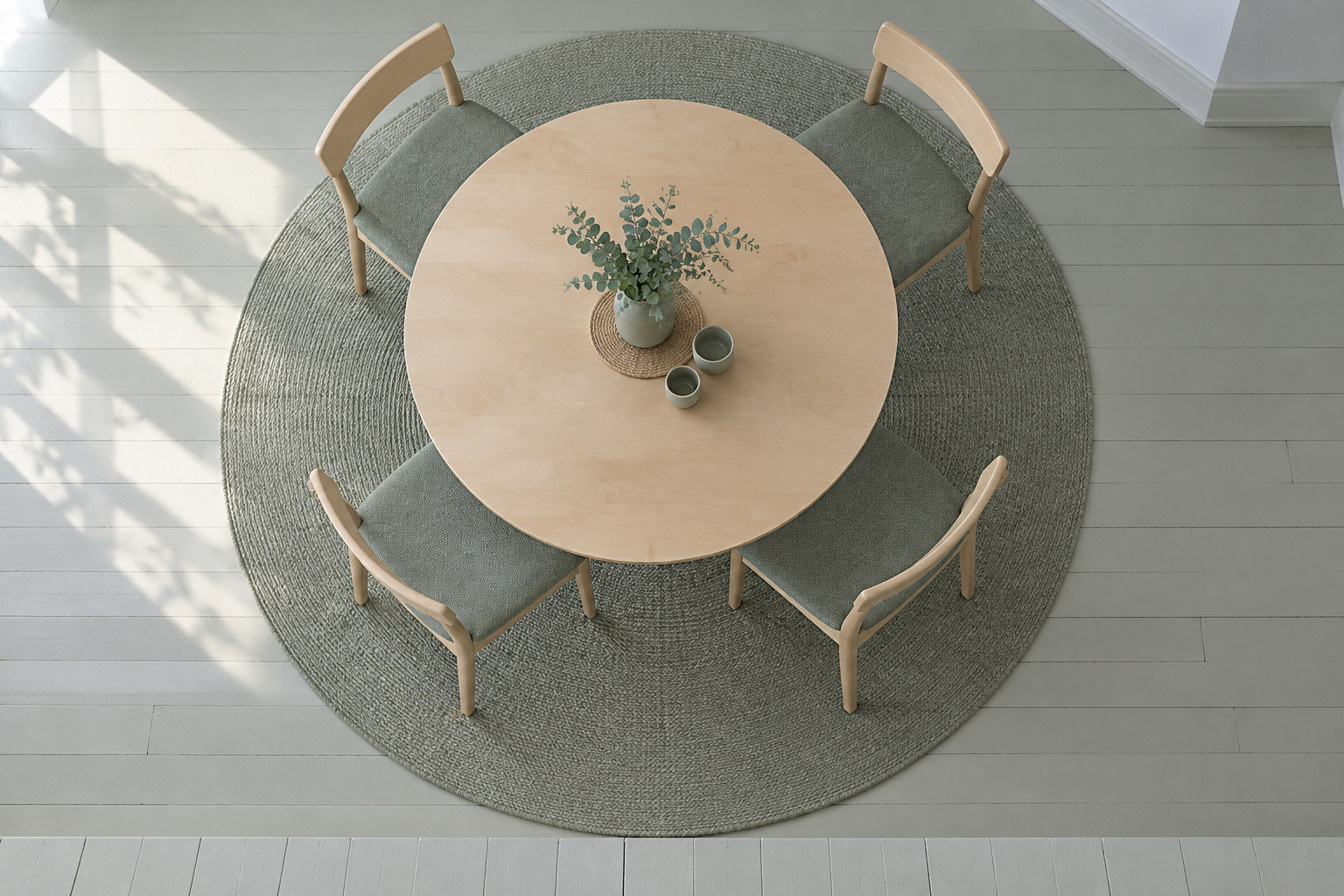

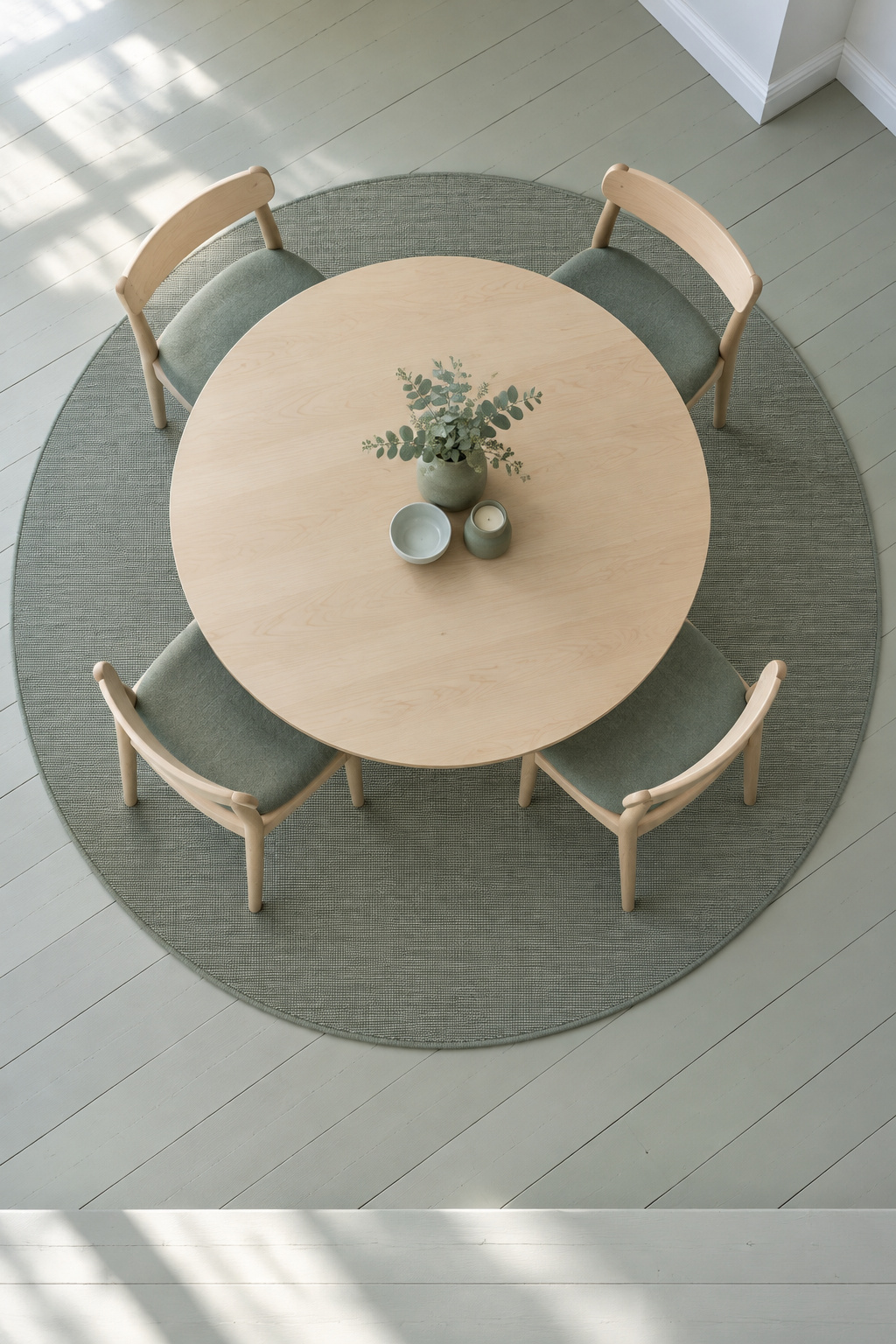
Forty-eight inches. That is what you add to the diameter of your table before you buy a rug under a round dining table: 24 in on every side, because that is roughly how far a chair travels when someone sits down or gets up. Most of us pick a round rug to echo the round table, in a size that looks tidy, and the chairs walk off it at the first meal. The table never moves. The chairs do, and the rug is there for them.
TL;DR
- Size the rug at your table’s diameter plus 48 in (24 in on every side), or plus 60 in if your chairs have arms, so a pushed-back chair keeps all four legs on it.
- A 36 in table needs 84 in (7 ft), which in practice means an 8 ft round; a 48 in table takes an 8 ft round exactly; a 60 in table needs a 9 ft round, widely sold but missing from some ranges.
- Choose flat weave or low pile so chairs slide and crumbs come out, and if the right size won’t fit the room, leave the floor bare and put felt pads under every chair leg.
Why the Rug Is There for the Chair Legs, Not the Table
A dining room should feel settled when people stand up from it. We live in the upper unit of a two-flat, with my parents below, and a chair dragged back across our boards makes a short, dry scrape they hear downstairs. That small sound is one of the things a dining rug is for.
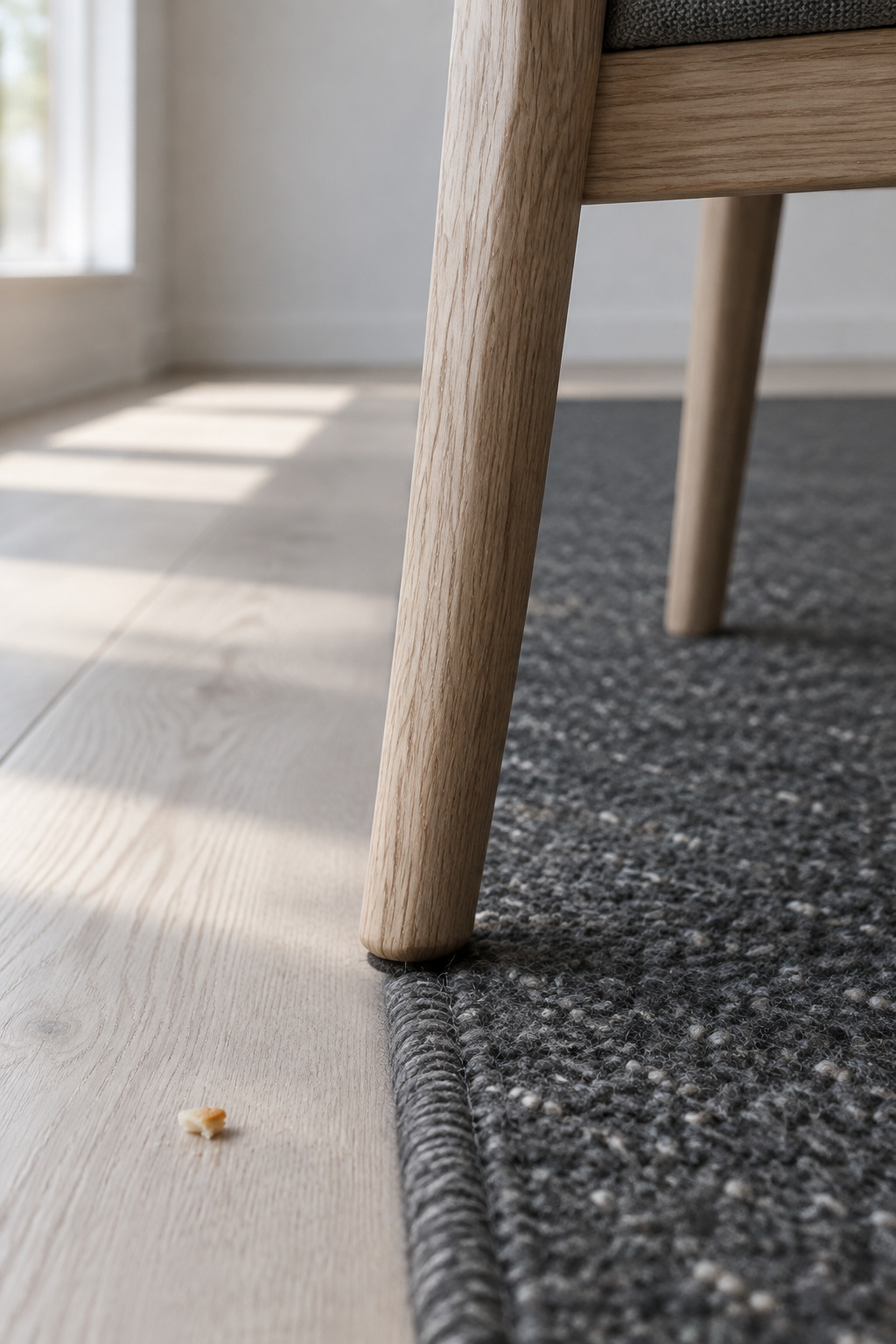
Wear starts in the same place. A chair leg puts a seated adult’s weight on a tiny patch, crushing pile over months and wearing fibers with every drag, all of it where the chairs travel. A rug that covers only the table’s footprint protects the one spot nothing touches.
A Canadian flooring association advises area rugs on hard floors, and a Scottish government leaflet on noise between flats adds felt pads under chairs and tables. I hold that sound matters as much as light. In a busy household, soft surfaces do more than any color.
That job sets the rug’s size. If a rug can’t be big enough for it, leave the floor bare.
Size It in Four Steps: Table Diameter Plus the Pushed-Back Allowance
You need a tape measure, painter’s tape and one of your own chairs.
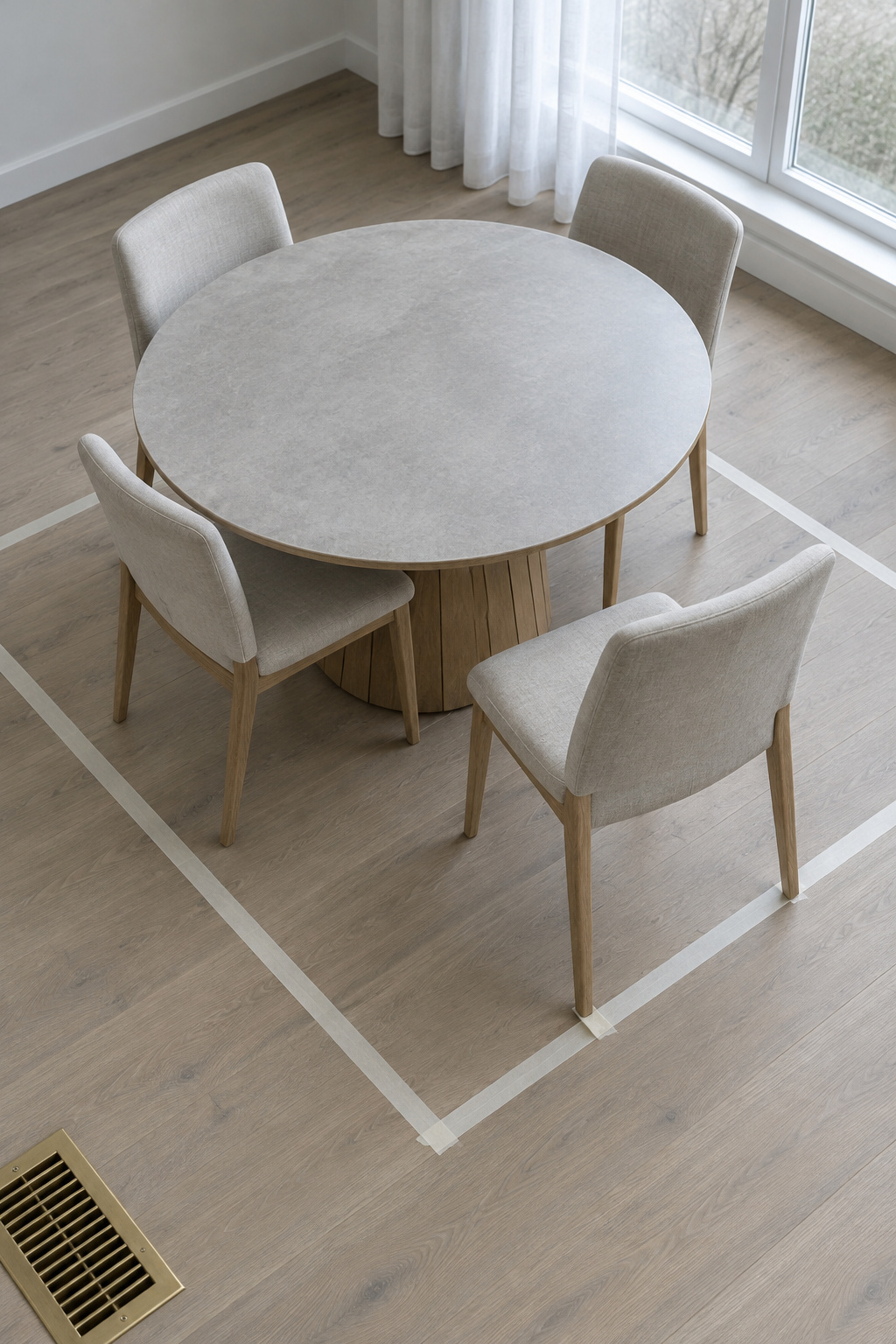
- Measure the table’s diameter. If it extends, measure it with the leaves in.
- Add 24 in on each side, which is 48 in on the diameter. If your chairs have arms or sit wide, add 30 in a side instead, 60 in in total.
- Tape that circle or square onto the floor around the table before you buy anything.
- Pull a chair back as far as you would to stand up, and look at the back legs. They should sit inside the tape with a little to spare.
The fourth step measures your chairs rather than an average one. For a number, measure from the table edge to the back legs of that pushed-back chair and add about 4 in (10 cm). If it comes out larger than 24, trust your chair.
You will see 18 in a side suggested for tight rooms. I see it differently: at 18 in, a chair pushed back a little hard lands on the edge. Before you tape anything, be sure of finding your table’s real diameter and chair reach, since every number here starts from those two.
A Rug Under a Round Dining Table at 36, 48 and 60 Inches
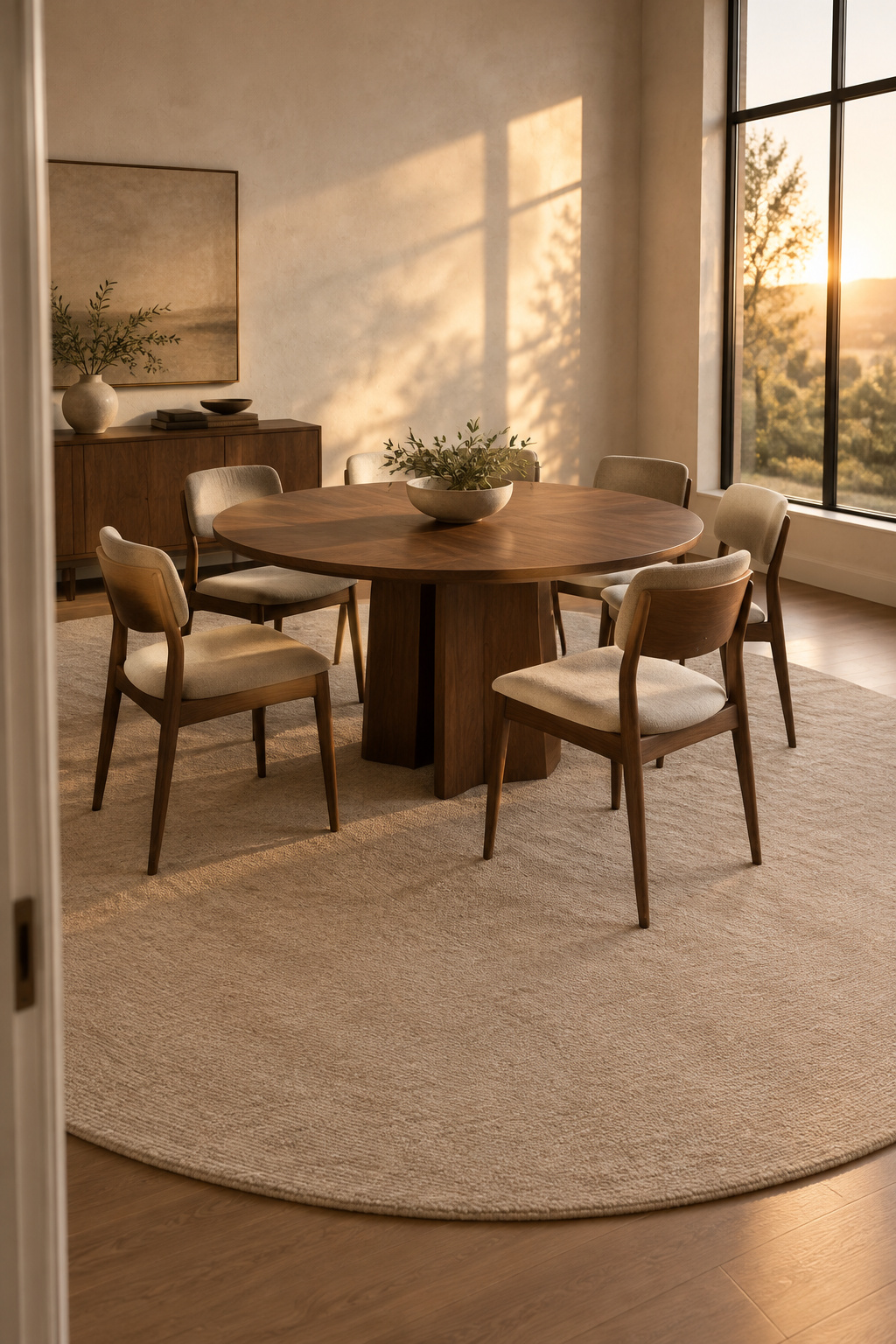
Here is the allowance on three common round tables, with the rug you can actually buy.
| Table diameter | Rug needed (table + 48 in) | Round rug to buy | With armchairs (table + 60 in) |
|---|---|---|---|
| 36 in | 84 in (7 ft) | 8 ft | 96 in (8 ft) |
| 48 in | 96 in (8 ft) | 8 ft | 108 in (9 ft) |
| 60 in | 108 in (9 ft) | 9 ft, or 10 ft | 120 in (10 ft) |
The 48 in table is easy: an 8 ft round fits exactly, and 8 ft rounds are listed in every size chart. The 36 in table needs 7 ft, so buy the 8 ft. The 60 in table is harder: a 9 ft round is widely sold, though not by everyone, and with armchairs it is 60 + 60 = 120 in, a 10 ft round.
Then check the room. With the usual 36 in clearance behind each chair, a table needs a room as wide as its diameter plus 72 in. A rug of diameter plus 48 in then leaves 12 in of bare floor to each wall, about the border rug sellers suggest anyway. A 60 in table with a 9 ft rug wants a room at least 11 ft wide (60 + 72 = 132 in).
A 6×9 is a long-room answer. It is 72 in wide, so under a 48 in round it leaves 12 in to each long edge, half the allowance.
Round, Square or Rectangular: Let the Room Pick the Shape
Does a round table need a round rug? No. Rug sellers say round, square and rectangular all work under one, and IKEA says you don’t necessarily need a round one.
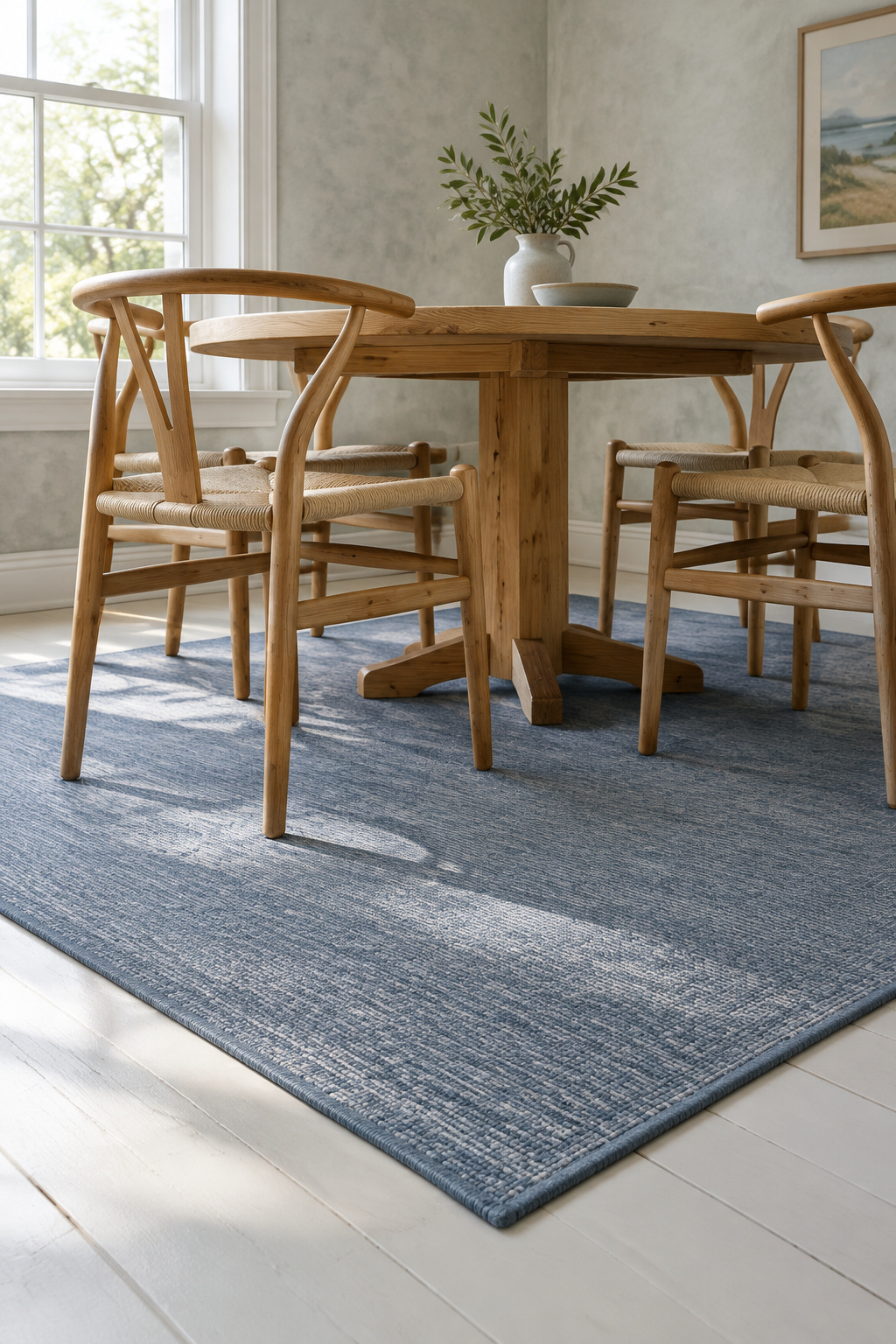
Round is the usual choice, and it softens a room of straight lines. In a square room, a square rug follows the walls and covers more floor: an 8×8 is 64 sq ft against about 50 for an 8 ft round, roughly a quarter more. In a long or open room, a rectangle sits better. Make it about 4 ft wider than the table’s diameter and keep the full pull-back on the long sides; under a 60 in round, a 9×12 works.
Will a square rug’s corners get in the way? Not at this size. From the center of an 8 ft square to a corner is about 68 in (48 × 1.414), while a pushed-back chair at a 48 in table reaches 48 in from the center: 24 in of radius plus 24 in of travel. The corners sit beyond every chair, and only cut the chair path when the square is too small to begin with.
If the table itself is still undecided, settle round or rectangular in a square room first. Layering one rug over another is a different idea, covered in our guide to boho dining room rugs.
Low Pile or Flat Weave: What Lets Chairs Slide and Crumbs Come Out
Notice where your shoulders go when a chair sticks as you pull it out. Chair feet sink into high pile, and crumbs settle there. IKEA and Wirecutter’s testers land in the same place: flat weave or low pile under a dining table, because chairs slide and the rug is easy to clean. There is no agreed height for low pile; if a chair slides back without catching, it is low enough.
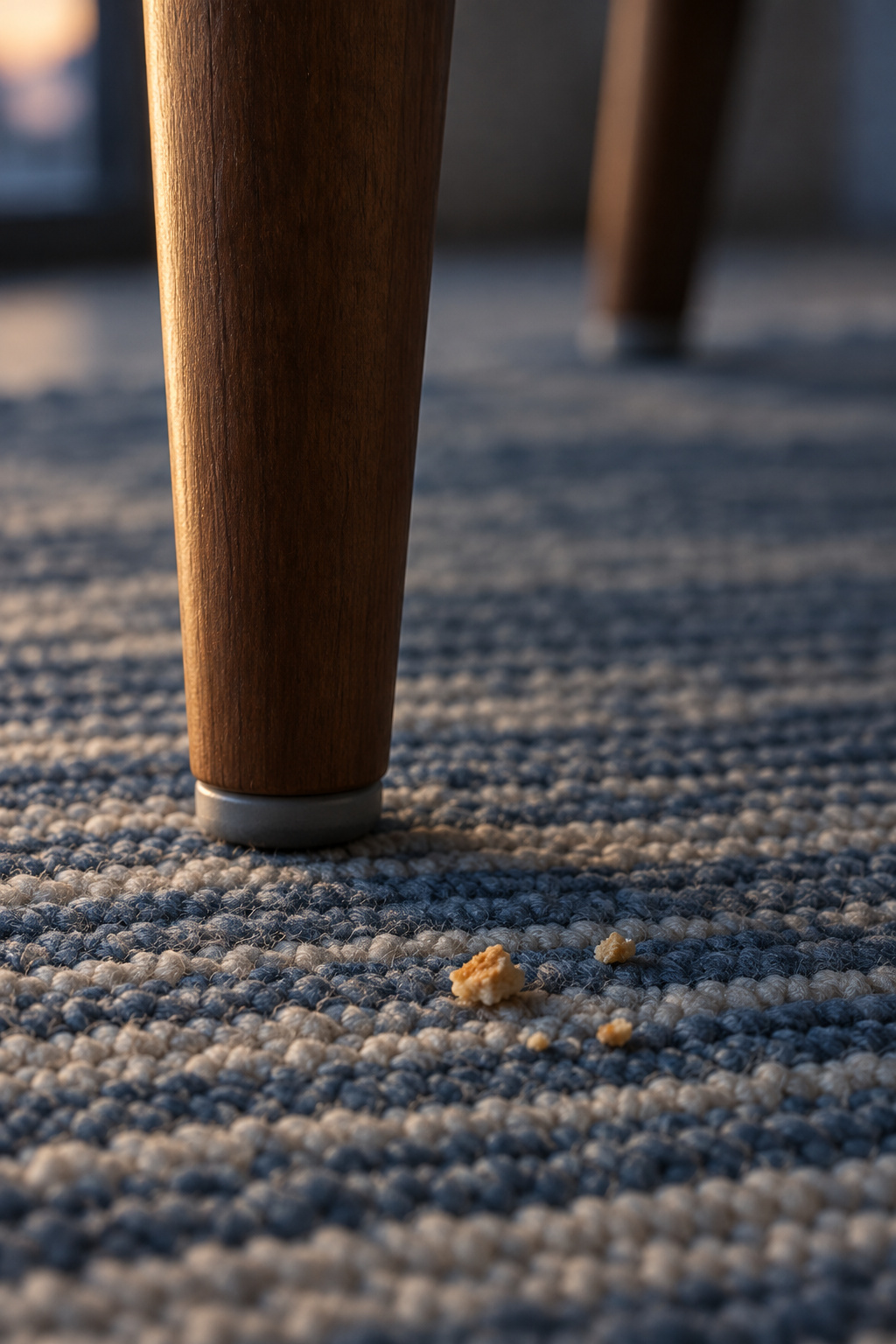
What to prefer, and what can leave:
- Prefer flat weave, jute, sisal or short-pile wool; polypropylene where spills are frequent, since it resists water and mildew.
- Prefer a bound or serged edge.
- Avoid shag, deep pile and long tufted rugs, where chairs sink and food lodges.
- Avoid fringe in the chair path; legs catch on it.
- Avoid jute and hemp in a damp room.
Vacuum weekly with the flat nozzle, never a beater bar.
One trade-off: a flat weave absorbs less airborne sound than thick pile. Its quiet comes from chairs no longer scraping a hard floor, which is the noise that matters here.
When No Rug Beats a Small Rug: Felt Pads and a Bare Floor
A rug that is too small is worse than none. Chairs end up with two legs on and two off, they catch on the edge as people stand, and a wear line forms where the legs cross it. If your room can’t take table plus 48 in, a bare floor is the calmer answer. Let it be a little empty.
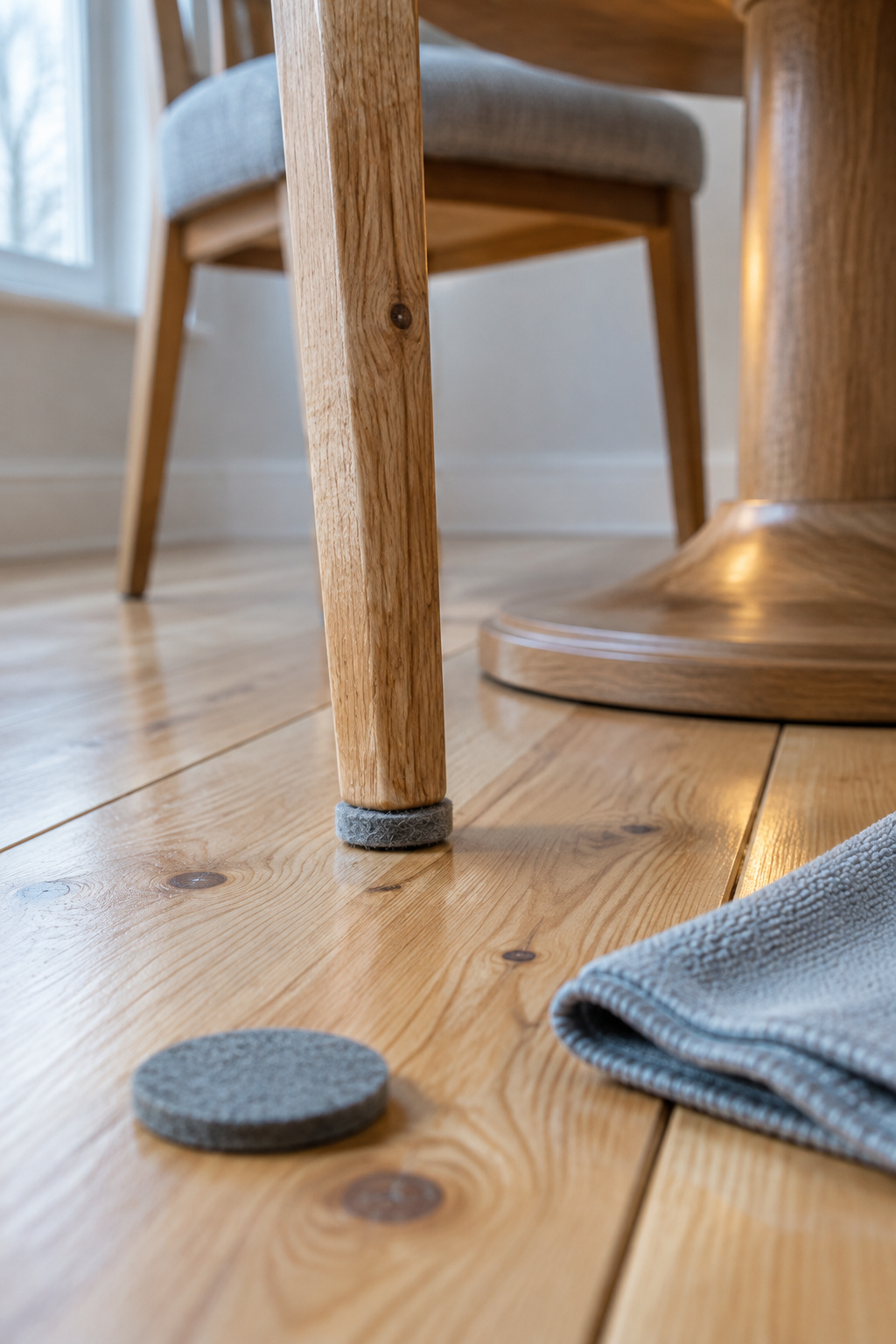
On a bare floor, hardwood makers ask for felt pads under every chair leg that touches the floor. Felt has its own catch: it hardens, soaks up moisture and picks up grit, and grit in felt scratches the floor it should protect. Check and clean the pads, and replace any that have hardened or fallen off. On vinyl plank, use heavy-duty felt rather than plastic glides, which can scratch.
The cheapest version is also the one you can undo: felt pads and a few weeks of bare floor before you buy a rug. For the decisions that come before the floor, start with the whole round-table plan. Then pull a chair out as if you were standing up, and look at where its back legs land. That spot sizes your rug, or tells you not to buy one.
FAQ
Do you need a rug pad under a dining room rug?
Yes. A pad stops a loose rug creeping under chair legs, bunching and sliding, and it protects both the rug and the floor. On hardwood, a felt-and-rubber pad is the safe choice. Cut it about an inch inside the rug’s edge. Round rugs need one most, since they have no long edge to hold them still.
Can you put a dining room rug over wall-to-wall carpet?
Yes, as long as it sits on a pad. Use a felt pad rather than rubber, which can’t grip carpet fibers and can trap moisture. The sizing rule doesn’t change: the rug must be big enough that every chair leg stays on it.
Will chair legs damage a rug over time?
Yes, slowly. Chair legs crush the pile where they rest and wear the fibers where they drag, and a line forms at the edge if the rug is too small. Wide glides, at least 1 in (25 mm) across, spread the load. Check them every few months, and turn the rug once a year.