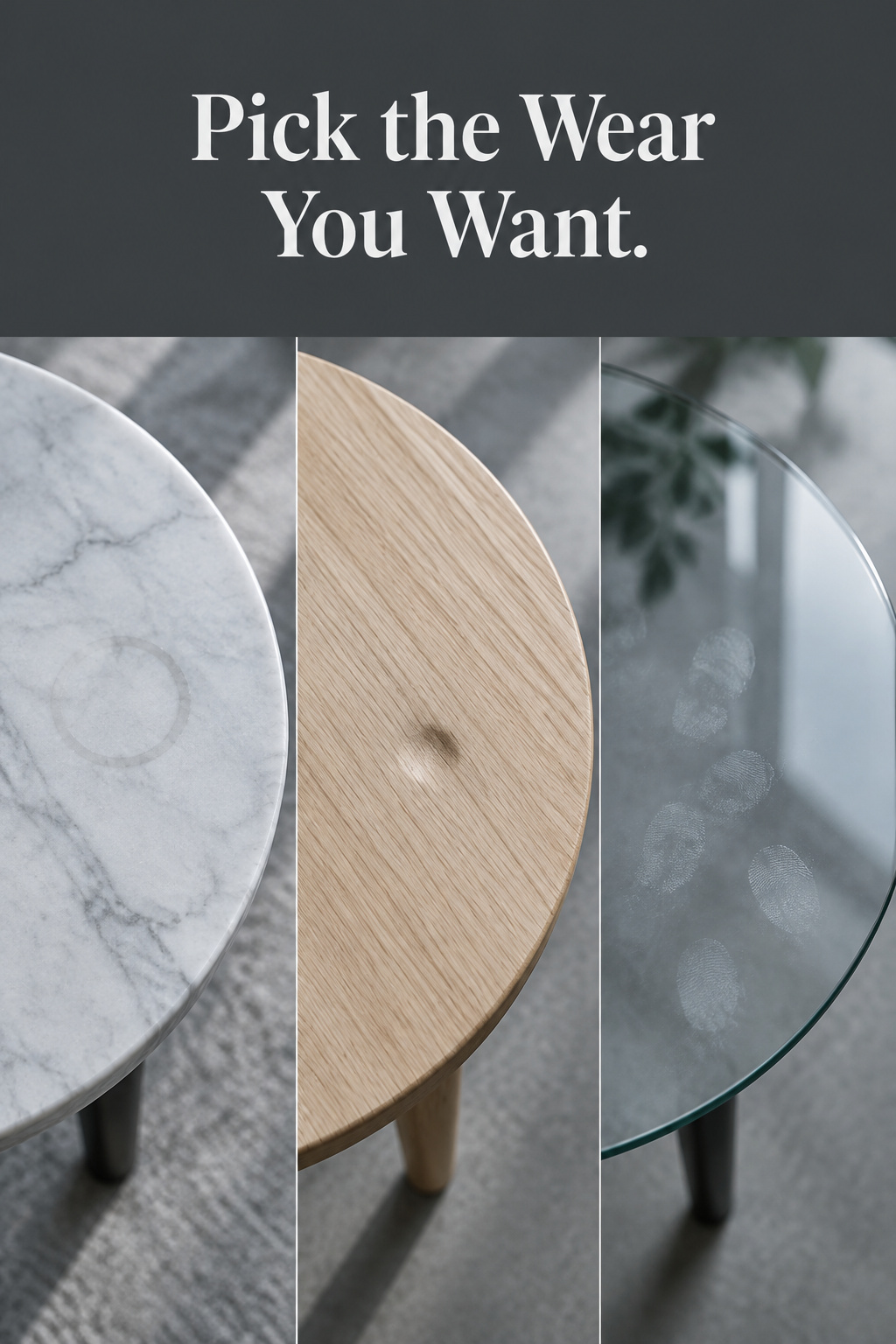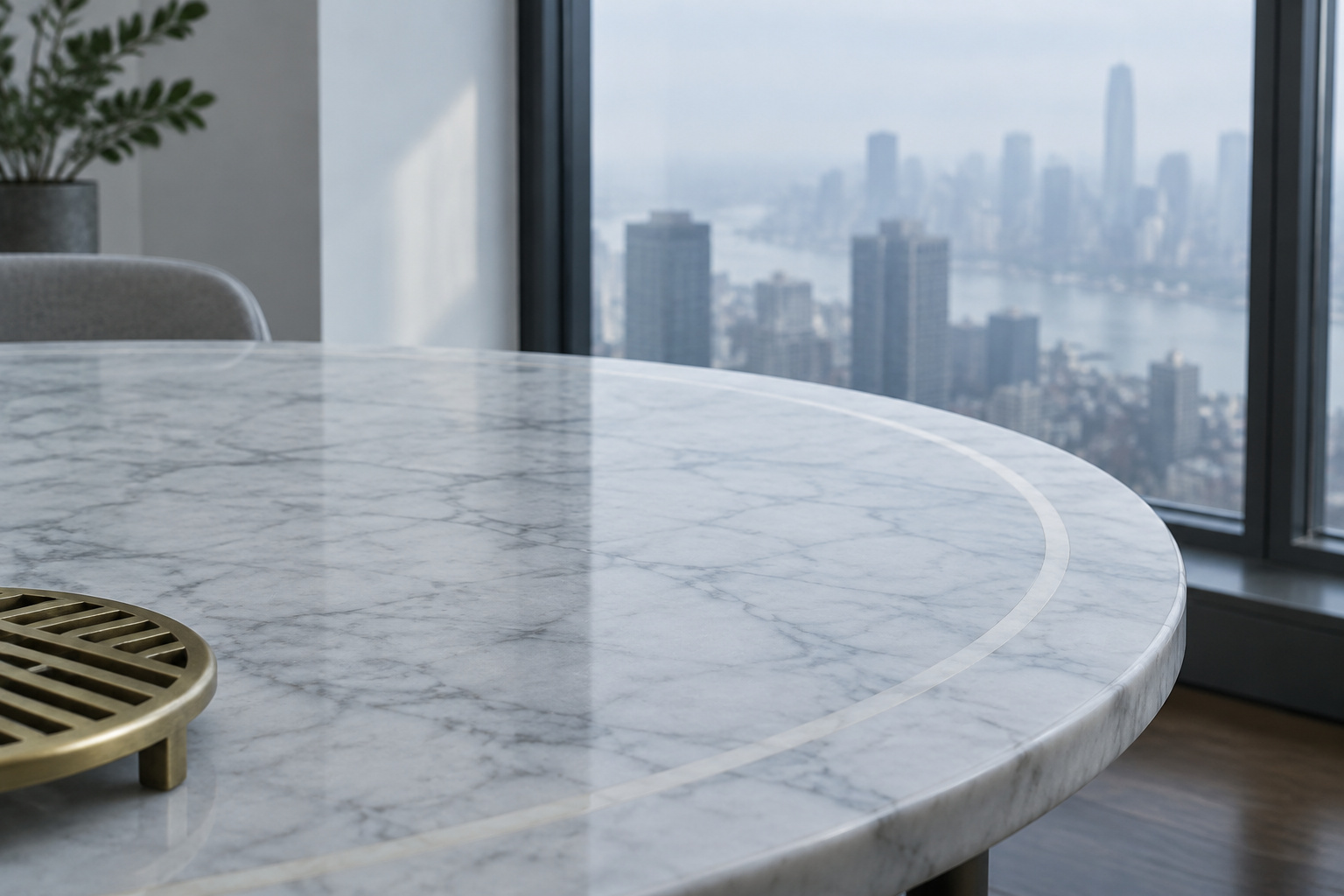

The Marble Institute of America says two different things about the same mark. Its restoration manual says an etch cannot be removed by cleaning, polishing or resealing; it has to be ground out to the depth of the damage. Its consumer care guide says a light etch on polished marble can be rubbed out with polishing powder and a damp cloth. Both are true, and the gap between them is most of what you need to know before choosing between a marble vs wood round dining table.
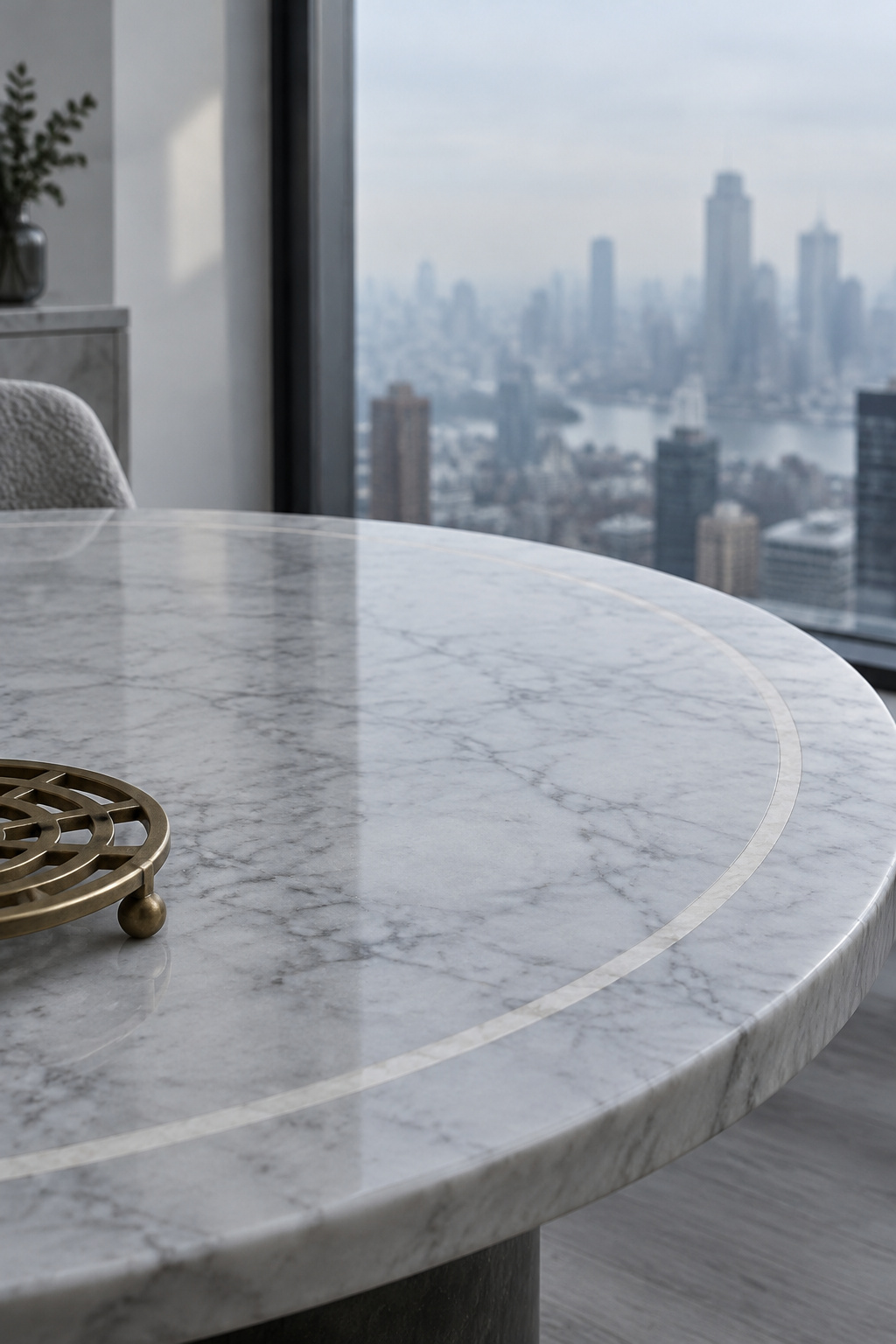
Comparison pages give each material a column of pros and cons, which hides the question I would ask first: how will this top age in your house, and which of that aging can be undone? Sealing marble does not stop etching, and only one common round top can be made new again with sandpaper.
TL;DR
- Marble and travertine etch wherever acid sits, sealed or not; a light etch on polished stone can be polished out, a deeper one needs the stone re-honed.
- Solid wood is the only top you can sand back and refinish yourself; veneer’s face layer is about 1/42 in (0.6 mm) thick, and one sanding can take a quarter to a third of it.
- Glass doesn’t etch or stain but shows every print, and a dining top under 44 in high should carry a safety-glass mark under ASTM F2813, a voluntary standard.
Marble vs Wood Round Dining Table: Which Wear Will You Live With?
In a showroom, a polished marble round looks like it will never change. The lights are kind and nobody has set down a glass of wine. That’s furniture for a photograph. At home every top records how it is used, and the useful difference is whether the mark can be undone, and by whom.
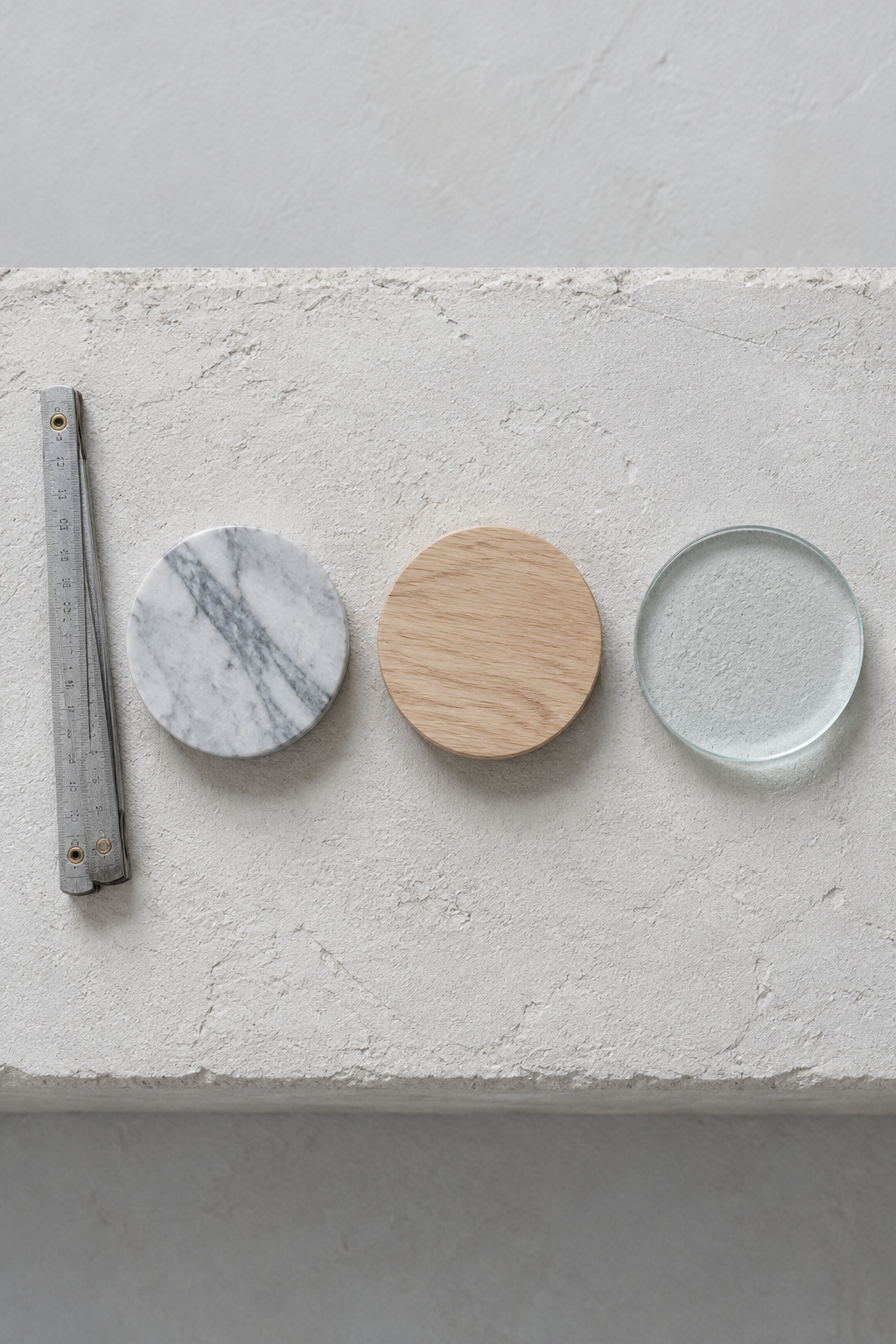
Here is how the six common tops compare, with what a 48-inch round of each weighs (a dash means no published weight):
| Top | What shows | Can it be renewed? | 48 in top weighs about |
|---|---|---|---|
| Marble | Dull etch rings from acid; stains if spills soak in | Light etch: polish. Deeper: re-hone | At least 127 lb at 3/4 in, 170 lb at 1 in |
| Travertine | Etches like marble; open holes collect dirt unless filled | Same as marble | — |
| Solid wood | Dents, rings, worn finish | Yes: sand and refinish, or re-oil | Roughly 53 lb (oak, 1⅛ in) |
| Veneer | Dents, rings, worn finish | Barely: the face layer is too thin to sand back | — |
| Glass | Fingerprints, scratches | No; it does not etch or stain | 80 lb at 1/2 in |
| Sintered stone or ceramic | Very little; edges can chip | Rarely needed | 76 lb at 12 mm, top only |
For most households I would pick the solid wood row, because it is the only wear you can reverse with your own hands on a Saturday.
Marble Etches, and Sealing Does Not Stop It
Picture a dinner with six people, a bottle of wine and a bowl of lemon wedges. By morning there is a pale, dull ring where a glass stood. It is not a stain. Wipe it and nothing changes.
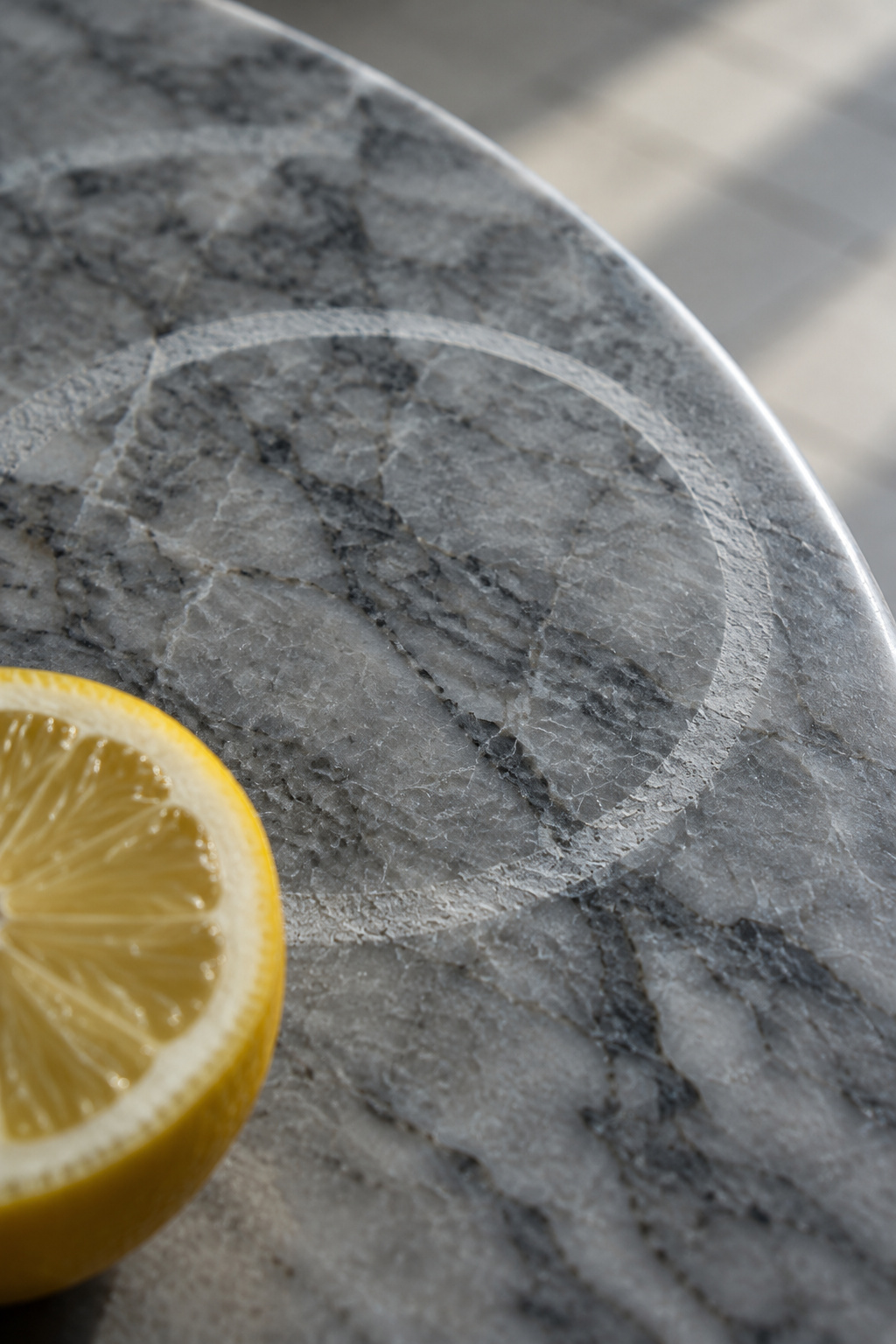
An etch is acid dissolving the calcite at the surface of the stone. A sealer works below the surface, slowing how fast a spill soaks in, which is why it helps against stains. Lemon juice doesn’t need to soak in. It eats the surface it lands on, and no sealer stops that. Wine, coffee, vinegar, juice and milk all etch marble, and so do many ordinary spray cleaners.
How bad the ring is depends on depth and finish. A light etch on polished marble can sometimes be rubbed out with marble polishing powder. A deeper one, which can reach a millimeter or more, has to be honed out by someone who restores stone. A honed top hides etching better than a polished one, and etches show most in direct sun, but honed marble stains more easily.
Buy marble only if your household can call the rings patina. If you want a leaf as well, start with round tables that extend.
Travertine is limestone and etches the same way
Travertine is sold beside marble and often called travertine marble, but it is a limestone, formed on land around hot springs and in caves. The stone trade classes it as marble because it takes a polish. Its chemistry is the same calcium carbonate, so it etches the same way. It is also more porous, roughly 3 to 12 percent against marble’s 0.5 to 3, and its open holes collect dirt unless filled.
Solid Wood Is the Only Top You Can Renew
Run a thumbnail along the edge of an oiled oak top and you feel the grain carry on around the corner, the same wood all the way through. It dents and takes rings, and all of it can be sanded to bare wood and refinished. An oiled finish can be recoated over worn patches without sanding the whole top.
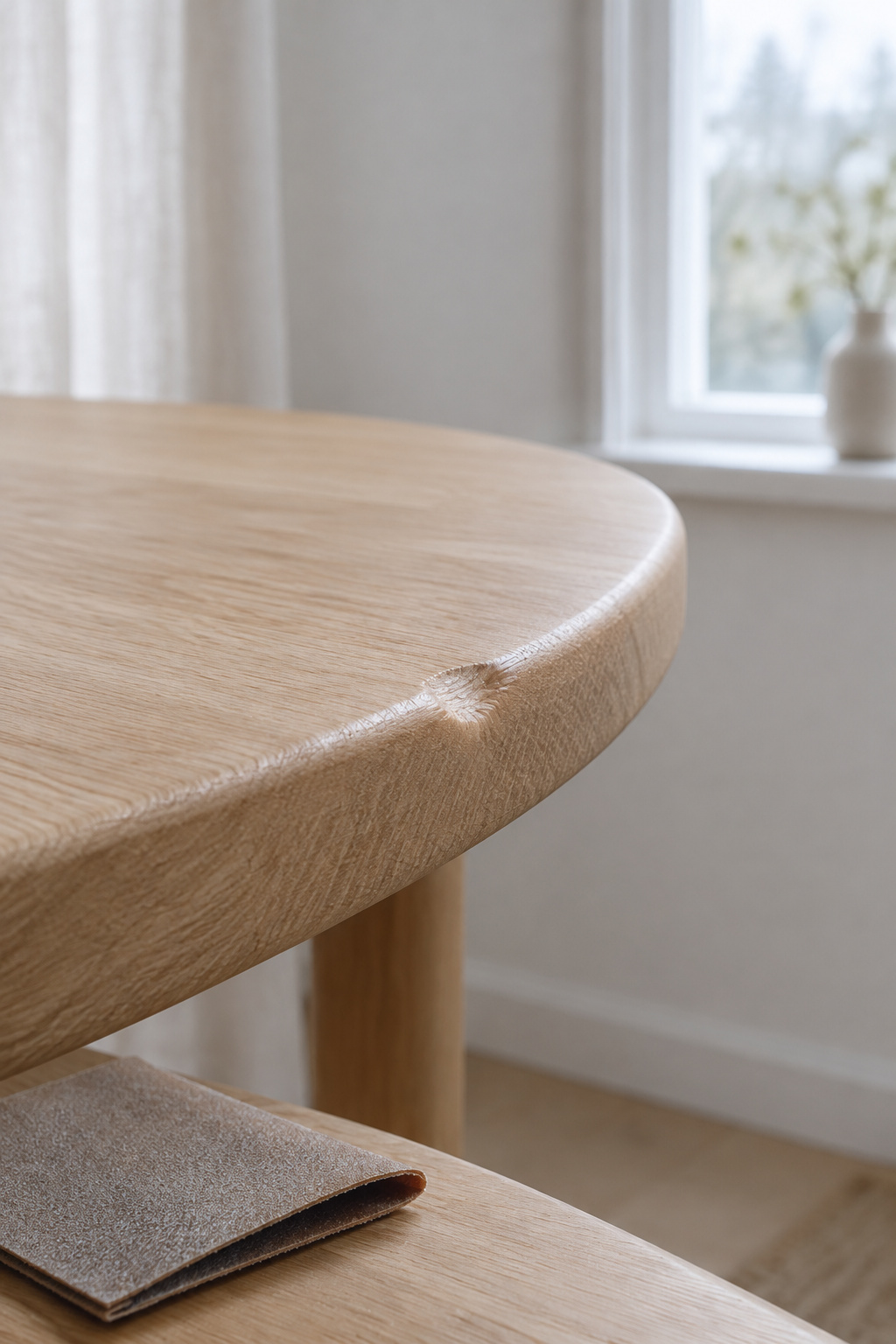
I sharpen one good chef’s knife on Sunday evenings, because that is what owning something good asks of you, and an oiled table asks about the same.
Veneer cannot be sanded back, so read the edge
Most “Scandinavian” furniture sold in the US is pale veneer pretending to be wood. Buy fewer pieces of actual wood. Veneer is real wood, but only a face layer about 1/42 in (0.6 mm) thick over a core, and a single prep sanding can remove 0.006 to 0.008 in of it, a quarter to a third. Sand through it and the repair is over. One maker puts the starting price of a solid hardwood dining table with decent joinery at roughly $1,000 to $2,500, and says anything sold as solid wood under about $600 to $800 is almost always veneer over something else.
Before you pay, look at the edge and the underside. The two-tone dining table articles cover telling solid wood from veneer and the best finish for a kitchen table. I would buy one solid top before three veneer ones.
Glass for Small Rooms, With Caveats
At four o’clock on a winter afternoon, low light across a glass top shows every hand that has touched it since breakfast. That is glass’s wear: prints, and scratches like any glass. It does not etch and it does not stain.
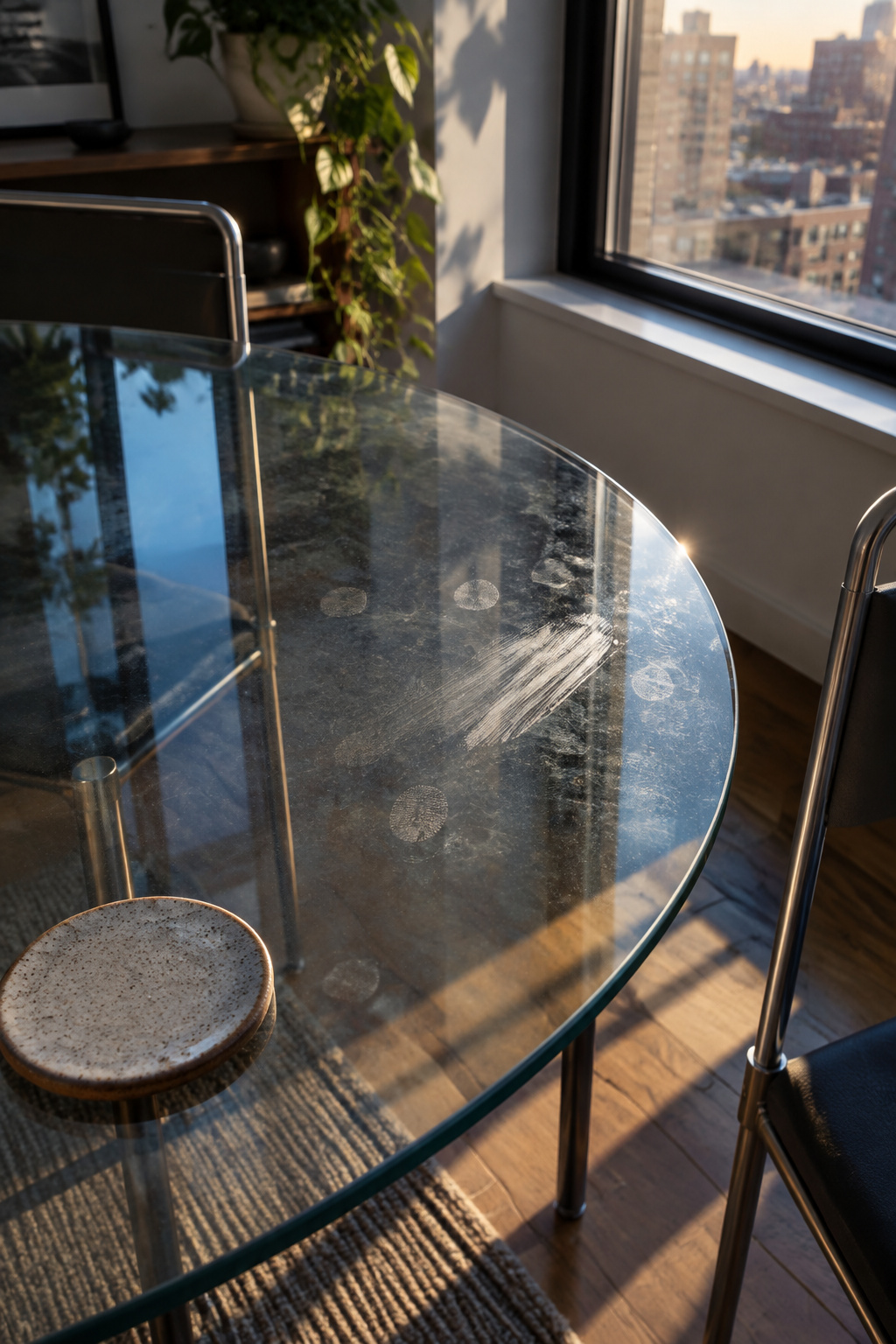
In a small room I find a glass round gives back space: the eye travels through the table to the floor, so the room feels less full.
Check the glass itself. ASTM F2813 calls for tempered or laminated safety glass in any unenclosed table top under 44 in high, dining tables included, and each panel should be marked as safety glass meeting the standard. Tops of 9 sq ft or more must meet the higher Class A; smaller ones at least Class B. A 48-inch round is 12.6 sq ft, so Class A; a 36-inch round is 7.1 sq ft, so Class B. The standard is voluntary, which is the reason to look for the mark rather than assume it. Tempered glass is no more scratch resistant than ordinary glass, and I would watch the rim, where glass gets knocked.
Sintered stone and ceramic, in one paragraph
Sintered stone and ceramic tops, at a Mohs hardness of 7 and water absorption of 0.02 percent on one maker’s sheet, resist almost everything marble suffers. The Worktop Fabricators Federation calls them possibly the most hardwearing of all stone options against staining, acid etching and scratching. The weak points are sharp edges, so look for an eased or chamfered one, and weight: the material is close to marble’s weight for its thickness, and the saving comes from the thinner slab, 12 mm on an entry-level dining top.
The Base Has to Carry the Stone
Weight decides what a top can sit on. The risk is a thick marble round on a slim single column.
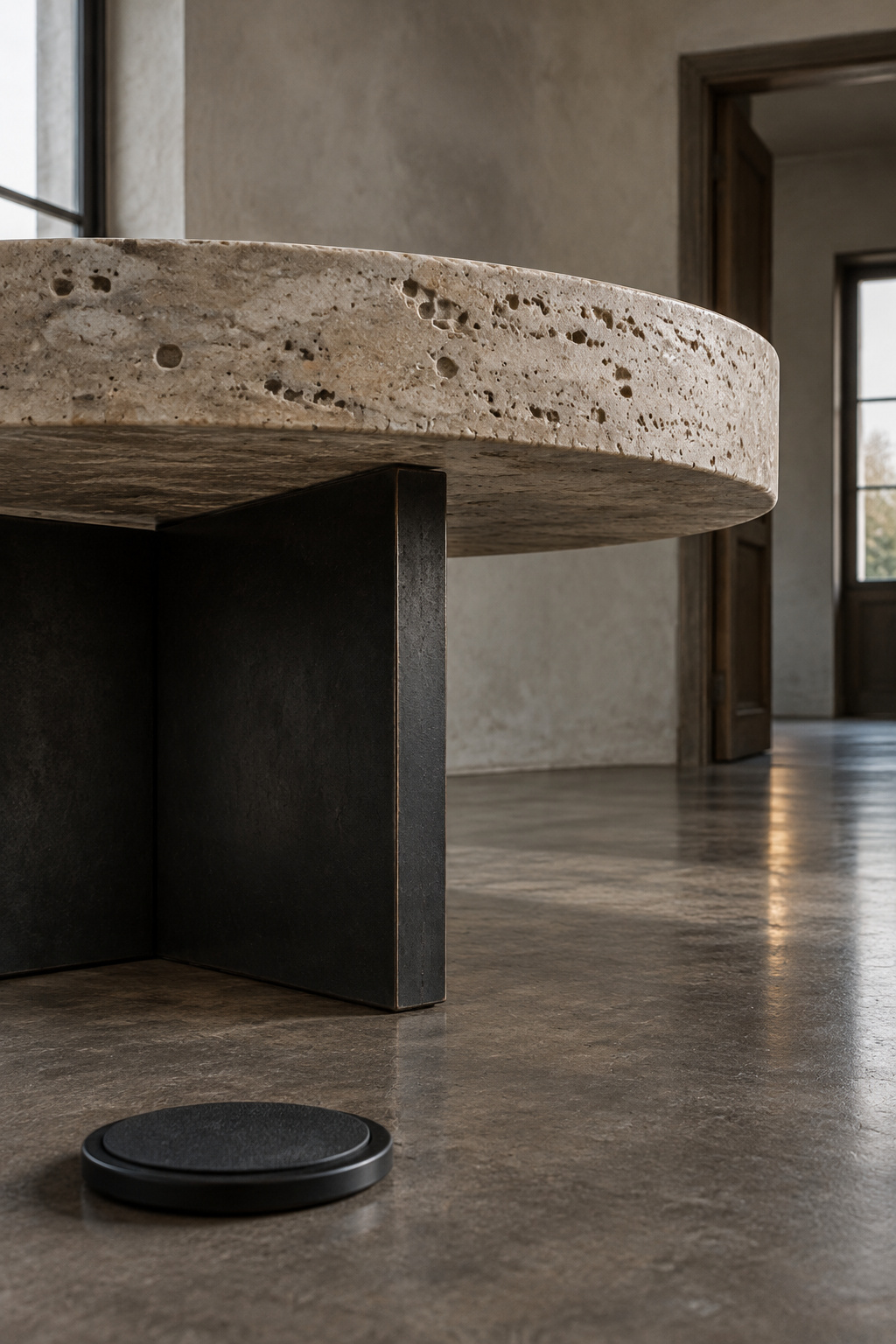
The marble figures in the table above are floors, worked from the lowest density the marble standard, ASTM C503, allows (162 lb per cubic foot). A 48 in round at 3/4 in is 0.785 cubic feet of stone, and 0.785 times 162 is 127 lb. Real marble can run about 10 percent heavier. At 60 inches the numbers climb quickly: about 199 lb for a 3/4 in marble top, about 398 lb at 1½ in. The same size in 1/2 in glass is about 126 lb, in 1⅛ in oak roughly 83 lb, and in 12 mm sintered stone about 118 lb for the top alone. One retailer’s 44-inch marble top weighs 183 lb and needs two people to lift it.
Stone does not flex. It fastens to the base through threaded inserts or epoxy-bonded blocks underneath, and one stone supplier wants brackets once an overhang passes about 150 mm (5.9 in). The base should be heavy cast iron, steel or solid wood made for the job. Match stone to a wide, heavy base, and read about a base that can carry a marble top before you trust a single column with one.
Which Round Top Fits Which Household
No one has ranked tops by household, so what follows is my judgment, built on how each material behaves.
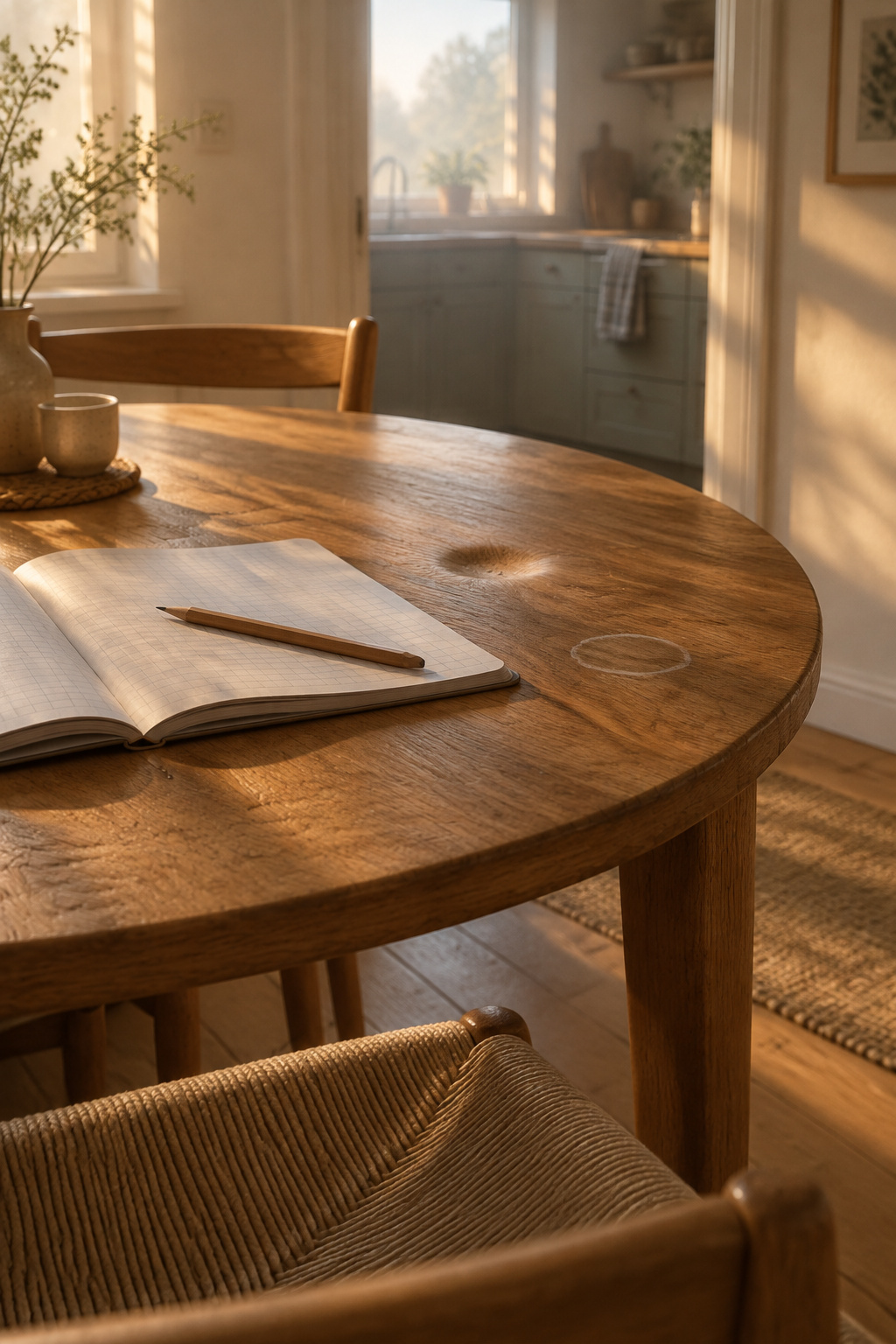
A family with young children meets milk and juice at every meal, and both etch marble. Buy solid wood; sand the rings away when the children are older. If you cannot face any upkeep, sintered stone is the honest second choice.
If you rent and move every few years, buy solid wood too, at a size you can carry. A marble top will be the thing you dread on moving day.
If you entertain often and love stone, buy marble with your eyes open. Choose honed if you would rather hide etches than stains, and decide now that the rings are the table’s record of dinners.
That showroom marble round will look the same in your dining room on the day it arrives. In ten years it will look like the meals you ate at it. Choose the top whose marks you would choose on purpose, then check its edge and its base. The full order of decisions, from size to shape to base, is set out in round dining tables, decision by decision.
I know wood from living with it, and the judgment about which wear a household will accept is mine. What I have told you about etching, honing and stone weight comes from the stone trade and its standards. I have never re-honed a marble top, and I would call someone who does it for a living.
FAQ
Can you put hot dishes on a round marble dining table?
Use a trivet or a mat. Marble can take a moderate amount of heat, but a hot pan is more likely to scratch it, and a scalding pan on a very cool top can crack it through thermal shock in extreme cases. Watch the drips too: sauce or a wet pot base can carry acid that etches.
Is a marble-look top worth buying instead of real marble?
It is, if you want the look without the etching. Sintered and ceramic tops are printed to look like marble, are non-porous, need no sealing and resist heat, scratches and acid. They are not marble, though, and they weigh close to it for the thickness. Look for an eased edge, since sharp edges chip.
How do you clean a round glass dining table without streaks?
Dust it first with a dry microfiber cloth so grit doesn’t scratch the glass. Spray lightly with equal parts distilled water and white vinegar, or a glass cleaner, wipe with a clean lint-free microfiber, then buff dry with a second cloth. Skip abrasives and don’t soak the surface, which leaves streaks.