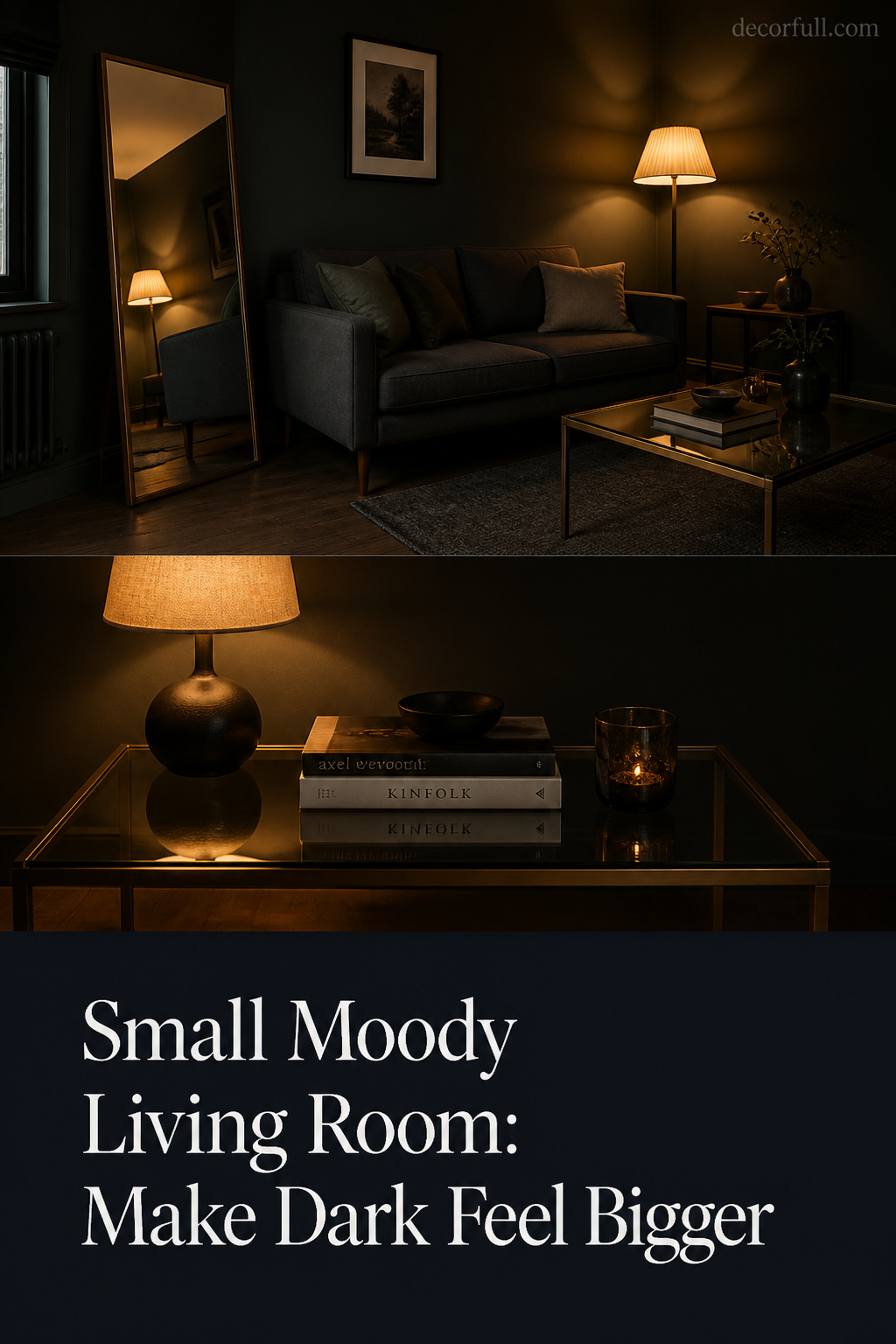
The most common fear about a small moody living room is also the wrong one. People believe dark paint will shrink the room into a cave. It will not. I keep one habit that proves it: I photograph rooms at seven in the morning in February, in the worst light of the year. A small room I had drenched in deep green held together in that grim light; a pale room down the hall fell flat and grey. Dark color was not the problem. Light, and what fills the floor, almost always is.
TL;DR
- Dark paint does not shrink a small room; clutter, a single overhead light and bulky furniture do. Commit to one color on walls and ceiling so the boundaries dissolve.
- Keep furniture on legs with 4 to 6 inches of clearance, run at least three warm 2700K light sources at different heights, and place one large mirror opposite the brightest source.
- Choose a muted dark hue — forest green, soft charcoal or warm navy — over near-black, then edit hard: in a dark room, visual noise compounds and never recedes.
Why Dark Colors Do Not Shrink a Small Living Room
What actually makes a room feel small
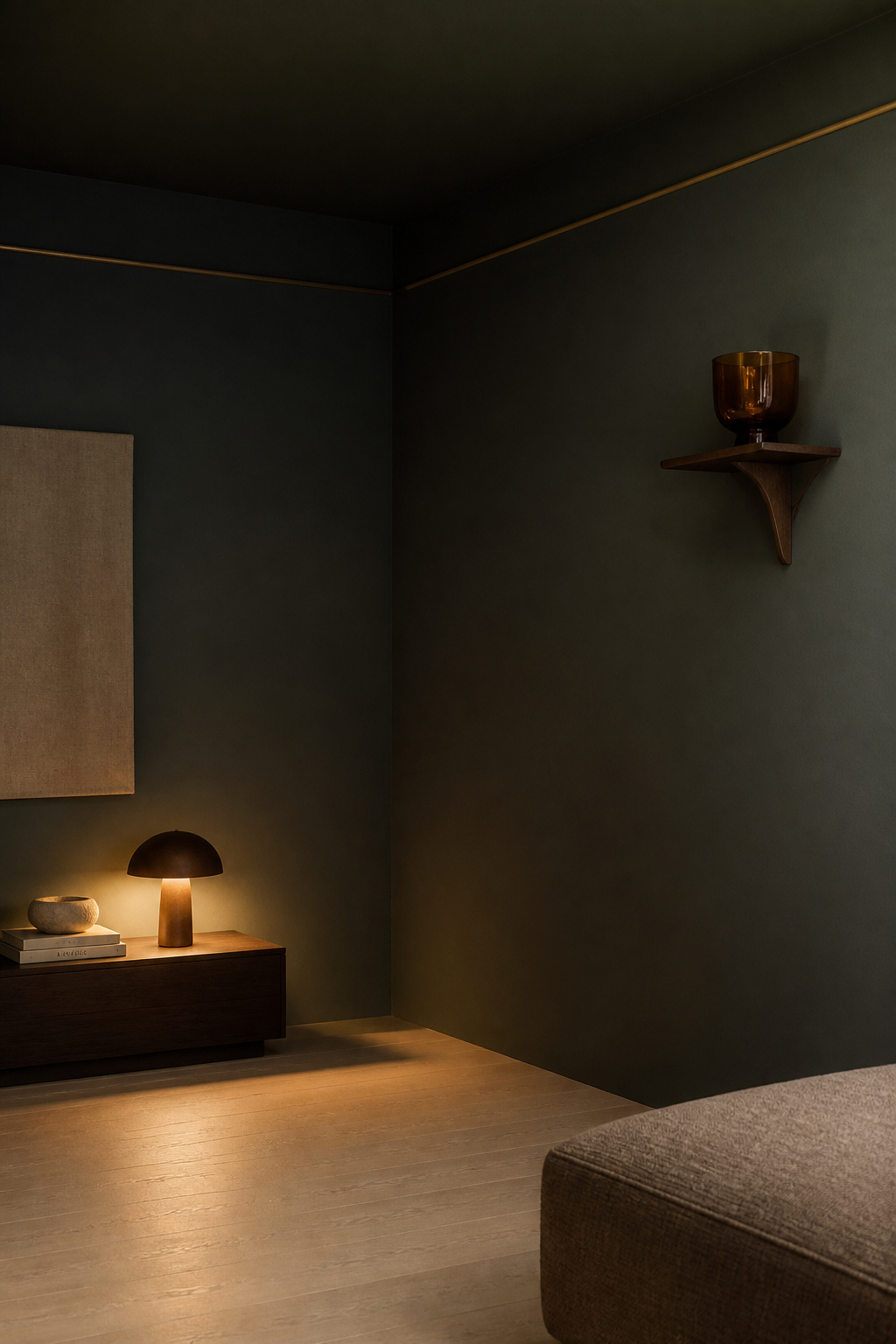
A room feels small for three plain reasons: clutter, poor lighting and broken sight lines, not wall color. Too many objects create visual noise; a weak light pools shadow in the corners; bulky furniture chops the floor into fragments. Used well, dark color does the opposite: as designer Lichelle Silvestry notes, it can make a room appear larger and taller.
The Nordic case: small rooms, dark winters, rich interiors
Scandinavian design reached dark interiors by constraint. Long winters in small apartments forced warmth and depth from material and light rather than square footage. The New Nordic palette — deep blues, greens and charcoal — appears in homes as small as 57 square meters.
The one condition where dark does compress a space
Dark walls compress a room under one failure: a single overhead light, or none. The walls absorb what little there is, the corners fall into shadow, and that is the cave — not the paint. As Naomi Astley Clarke says, “If you’re going to paint a room a dark colour, my advice is to commit and paint all the walls.” For how color, light and texture fit together, the moody living room design guide sets the order.
Where to Place Dark Surfaces in a Small Living Room
The one-dark-surface rule for beginners
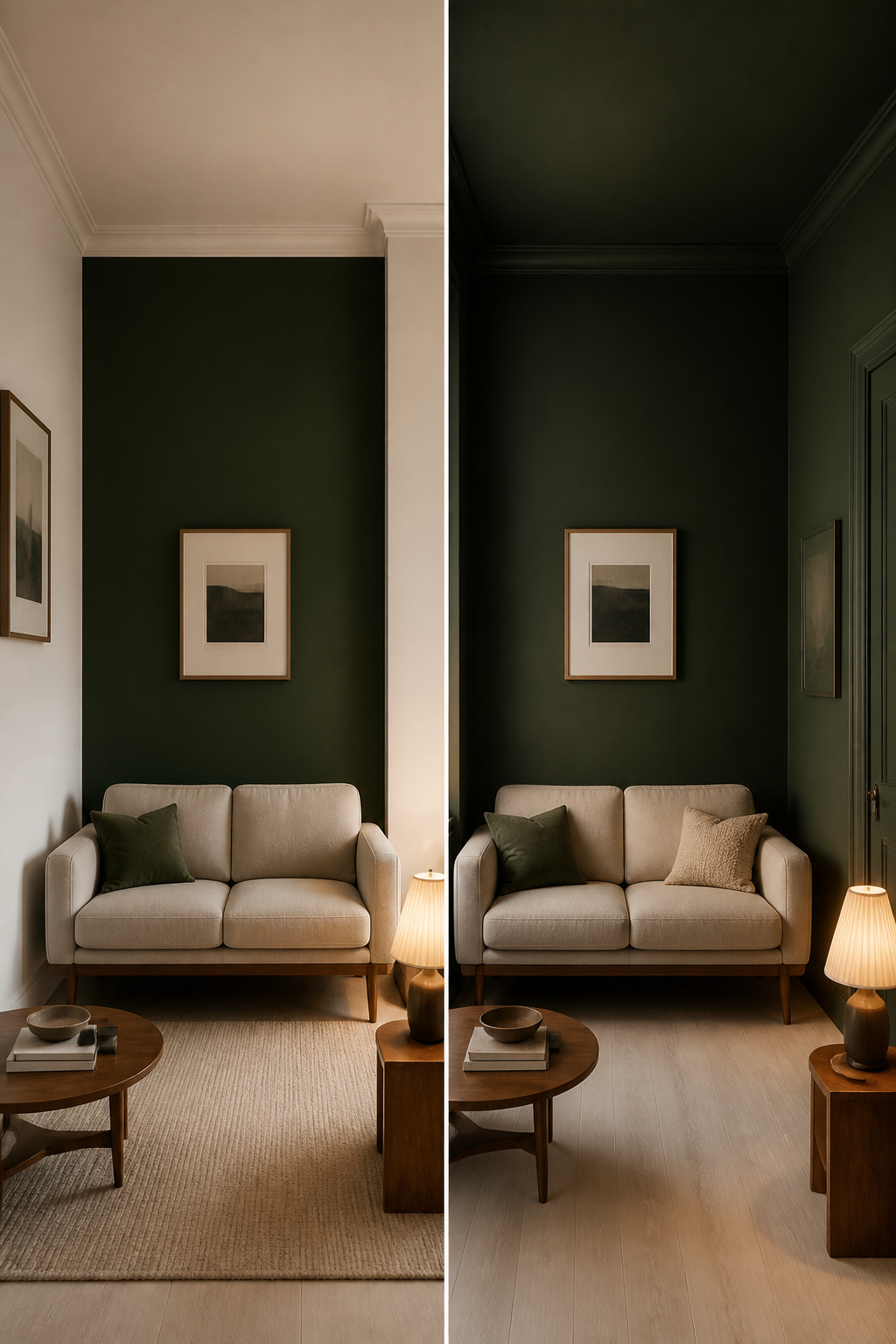
If you are not ready to drench the whole room, place your one dark surface deliberately. Silvestry’s first choice is the wall that gets the most natural light; for an accent, pick the wall farthest from the entry so the dark recedes. Carry that color onto its trim too, since white trim reads as unfinished. For hues that hold up under lamplight, see these moody paint colors.
Accent wall versus full drench
For a small room, I commit to the full drench. The same dark hue across walls, ceiling and woodwork removes the transitions that make each wall read as a separate boundary; an accent wall does the reverse. Choose a muted, complex dark — deep forest green, soft charcoal or warm navy — since muted tones build depth without overload.
Floor and ceiling color: the dimensions people forget
Floor and ceiling decide how tall a small room feels. A heavy dark floor can compress the vertical under an 8-foot ceiling, so pair dark boards with a pale rug. As a design principle, a dark ceiling over pale walls creates a contrast line — a lid pressing down — while in a full drench it reads as part of the envelope. Astley Clarke confirms it: a ceiling in the wall color makes a small room feel larger.
Furniture Scale and Placement: The Variables That Matter More Than Color
Color gets the blame, but scale does the damage. Get the pieces right and dark walls behave.
Oversized furniture as the real cave-maker
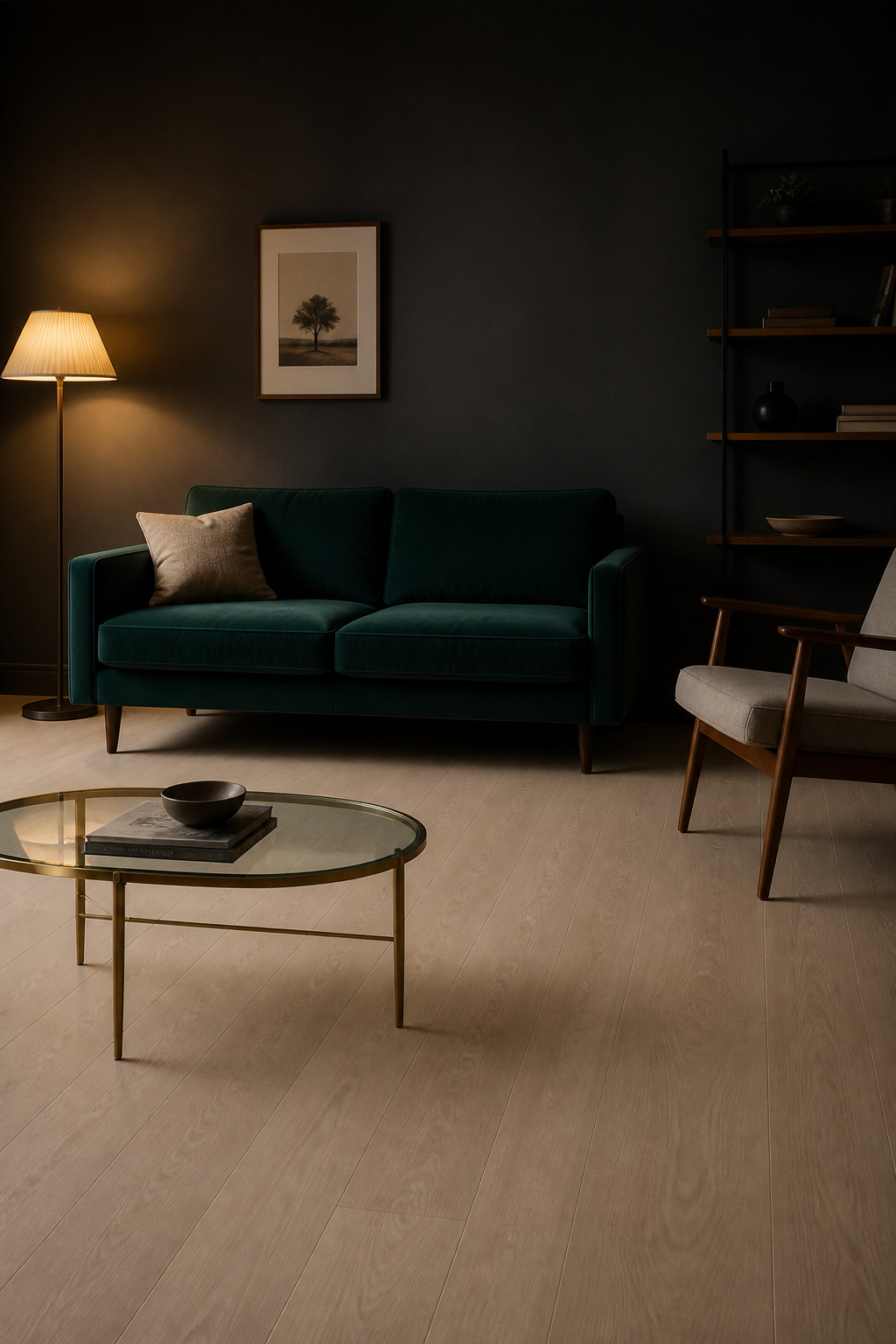
Deep, bulky sofas — 38 to 42 inches deep — are the usual culprit. They eat floor disproportionately and hide it, even though the floor is often the lightest, most reflective plane you have. Keep seat depth to 36 inches or less; fewer larger pieces beat many small ones.
Leg furniture versus solid bases
This is the one decision I commit to without exception: buy furniture on legs. Even 4 to 6 inches of clearance lets light and floor tone run continuously beneath each piece, which a solid base never allows. Designer John McClain says exposed legs give “the illusion of more floor space, which instantly opens up the room.” If you own a legless sofa, offset it with a glass table.
Arrangement: keep a clear sightline
Pushing everything against the walls is the small-room instinct, and it is the wrong one. It builds a perimeter of bulk around a trapped center. Pull pieces off the walls and angle them toward a focal point instead. Protect the sightline from the entry to the far wall: allow 36 inches of walkway and 18 inches around the coffee table. Keep the lightest floor plane visible from the door, because that patch of light reads as open first.
| Furniture type | Small-room verdict | Reason |
|---|---|---|
| Sofa over 36 in deep / sectional | Avoid | Eats floor; hides the reflective floor plane |
| Sofa or chair on tapered legs (4–6 in) | Buy this | Floor reads continuously beneath; feels open |
| Solid-base or skirted sofa | Offset with a glass table | Breaks the floor line; anchors heavily |
| Glass-and-brass coffee table | Buy this | Keeps floor visible; bounces lamplight up |
Mirrors and Reflective Finishes: Redistributing Light in a Dark Room
Mirror placement that multiplies light
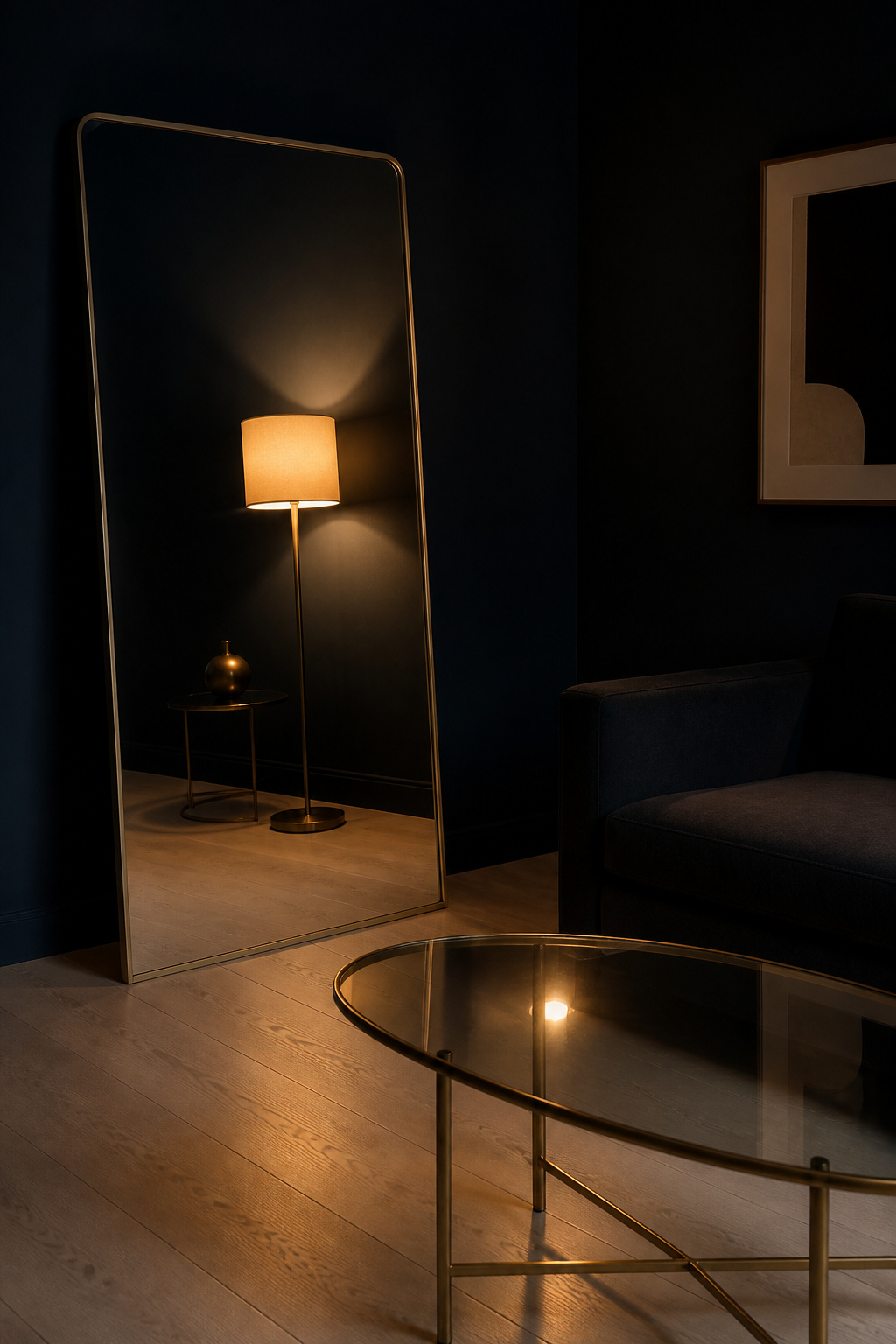
A mirror does not add light; it redistributes what you already have. Place one opposite your window, where it can lift perceived brightness by close to two visual stops, or behind your brightest lamp. A large leaning mirror — 70 inches or taller — beats a small hung one: it reflects a full-height slice of the room and the apparent footprint doubles. Stop at one or two.
Glossy versus matte in a small moody room
Combine both. Matte walls absorb light and kill glare; reflective furniture surfaces bounce point-source lamplight back into the room. Matte dark paint reflects 0 to 5 percent of light; eggshell reflects 10 to 25 percent and reads lighter. In a low-daylight room with fewer than three sources, step the walls up to satin — around 25 to 35 percent reflectance.
Glass tables and metallic accents
A glass-topped coffee table earns its place twice: it bounces lamplight upward from the floor with no extra fixture, and its transparent top never interrupts the floor plane. Warm metals — brass, brushed gold — catch 2700K lamplight and articulate the room so it reads as three-dimensional rather than flatly dark. Group them near the light sources; brass isolated in a dark corner reads cold. For the lighting itself, start with layered cozy lighting.
Even Lighting: Why a Small Moody Room Needs More Light Sources, Not Fewer
How uneven light creates depth in the wrong direction
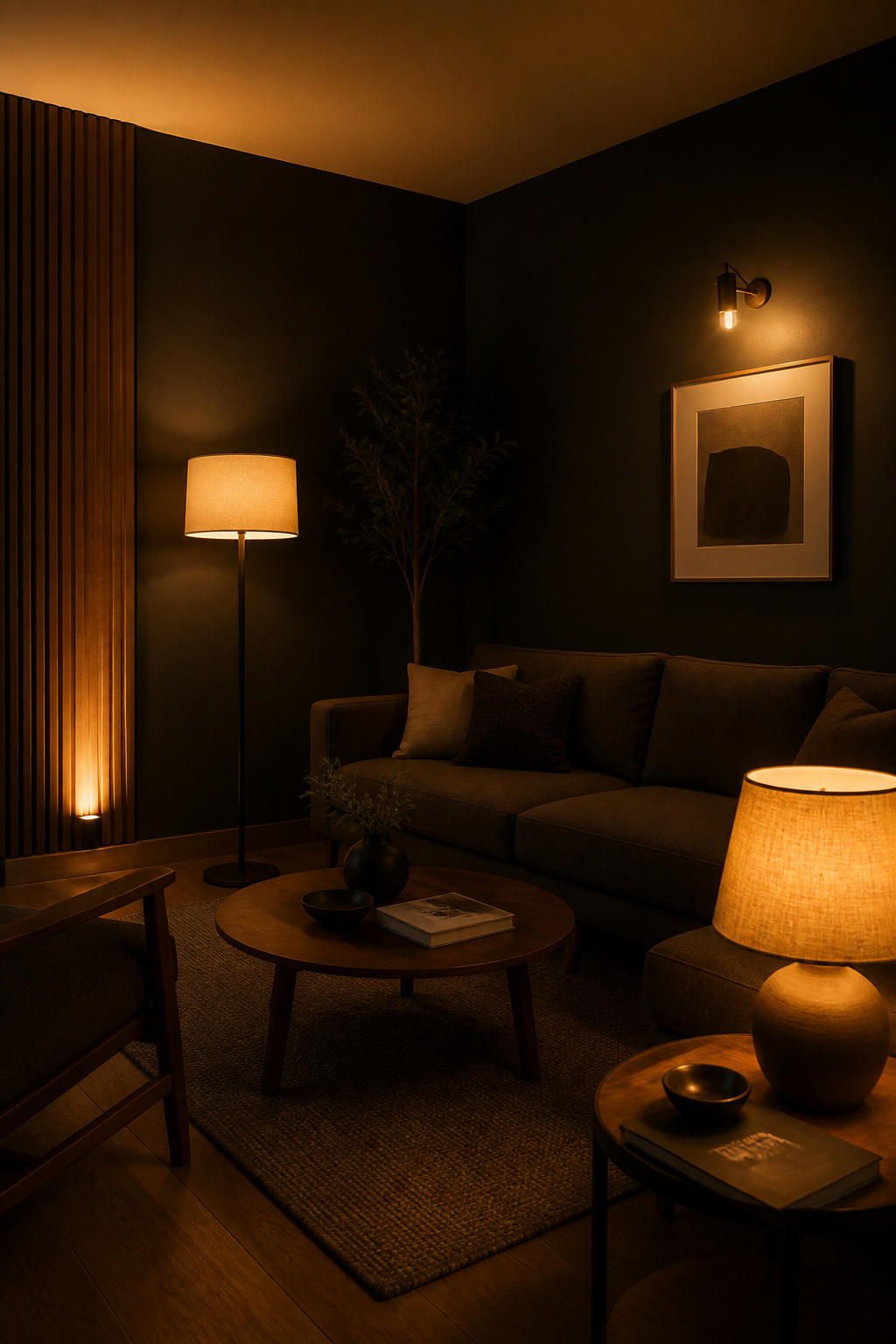
Light is the first material of any room, and in a small dark one it determines everything. A single overhead lights the center of the ceiling and leaves corners in shadow; on dark surfaces that pooling is extreme, so walls seem to close in and the ceiling to drop. Corner uplighting — a small floor uplighter aimed at the wall-to-ceiling junction — is the most direct fix. Dark walls absorb 10 to 30 percent more light than white ones, so add sources rather than overdrive one.
The minimum number of light zones
Three zones is the professional minimum: ambient at 150 to 250 lux on a dimmer, task at 300 to 500 lux for reading, and an accent layer for depth. In a dark room the ambient should be the weakest; a windowless room needs a fourth source. The starting kit:
- Floor uplighter into a corner, to kill the shadow that makes the room feel small
- Floor lamp with a shade, for ambient fill at standing height
- Table lamp on a low surface, for warmth at seated level
- Wall sconce by the reading position, for directional accent
Keep bulb temperature consistent
Run every source at 2700K. Warm white animates dark color and makes velvet and wood feel rich. Mixing temperatures quietly wrecks a moody room: a 2700K lamp beside a 4000K one makes one wall look rich and the other grey. Keep all sources within 300K. Use trailing-edge dimmers with LED bulbs.
The Restraint Principle: What to Leave Out of a Small Moody Living Room
Clutter as the greatest threat
Restraint is the hardest lesson here. In a pale room visual noise recedes; in a dark room it does not, because surfaces absorb rather than reflect. Cluttered spaces tend to feel harder to relax in — and in a dark room the visual effect is plain: too many objects make the space feel smaller. The fix is not bareness but spacing. A shelf with breathing room reads as curation; the same shelf crammed reads as storage.
Accessories and art: the edit that lets the room breathe
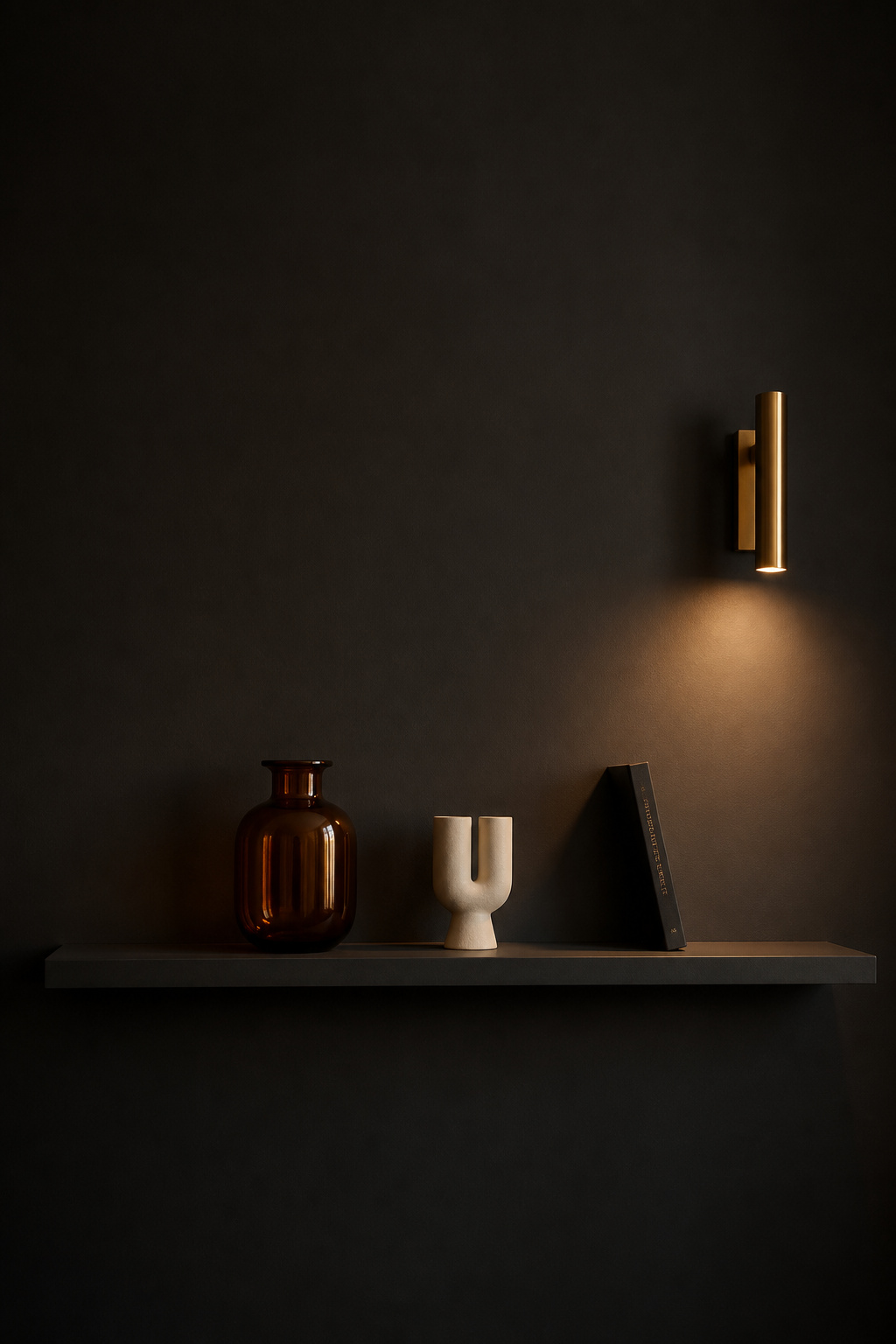
One large piece of art beats a gallery wall here: a single 30-by-40-inch piece holds a focal point with breathing room around it, while many small frames create noise at this scale. Choose art with a lighter ground — a pale botanical or an abstract with cream — since dark-on-dark goes flat against a dark wall. A white ceramic or a brass object gives the eye somewhere to rest; one sculptural plant adds a living vertical without adding clutter.
Emptiness as rest
Empty surface space is not a failure of decorating; it is evidence that everything present was chosen. The Scandinavian standard is “exactly the right amount of everything” — no more than what is used and loved. Make the restraint structural: lidded baskets, closed media units, an ottoman that stores. A storage system you have to fight is failed design.
Begin with one decision. Pick the color and commit it to every wall and the ceiling; the legs, the lamps, the mirror and the edit follow once the envelope is settled. Then photograph it on a grey morning, and if it holds in that light, it will hold in any.
FAQ
Can you have a moody living room in a small apartment?
Yes, and a small room often works better as a moody space than a large one, because dark surfaces read as intimate and jewel-box-like at small scale. Commit to a full drench rather than one accent wall, use furniture on legs to keep the floor visible, and run at least three warm light sources at different heights.
What dark color makes a small room feel bigger?
Deep forest green and soft charcoal with warm undertones are most consistently recommended: dark enough to dissolve boundaries, muted enough to feel warm under 2700K lamplight. Apply the same color to walls and ceiling so the junction disappears; that boundary dissolution is what most reliably makes a small room feel larger.
How do I make a moody room feel cozy without it feeling cramped?
Four tactics together: furniture on legs to keep the floor visible; at least three 2700K sources at different heights; a large mirror opposite the main light source to double apparent depth; and ruthless editing of accessories, since visual noise compounds compression. Warm darks feel cosier than cool ones because lamplight animates their undertones.