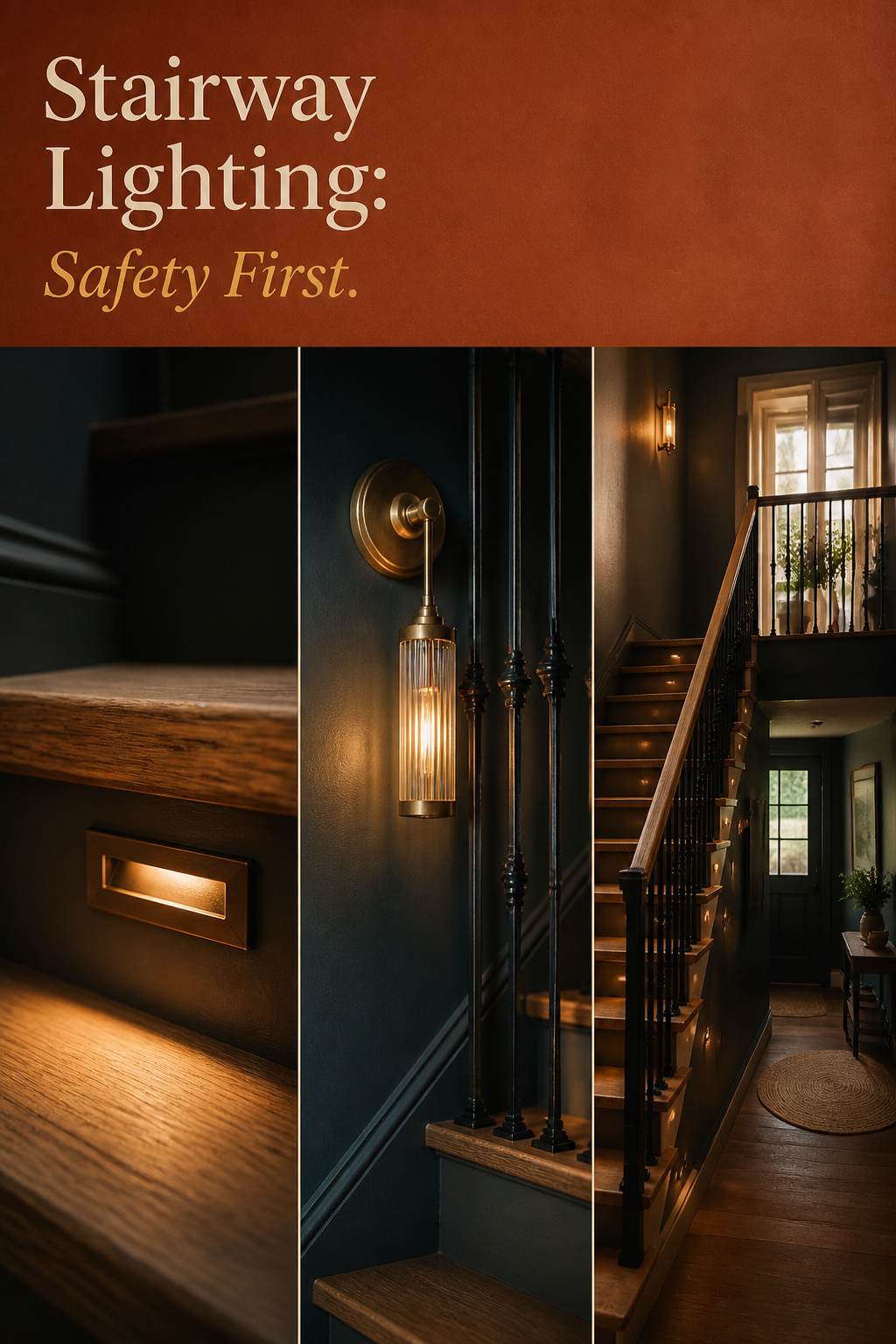
A lighting engineer designing a staircase for daily use works toward about 100 lux at the tread. Code asks for roughly 11 lux (one foot-candle at the centre, under IRC R303.7), about a tenth of comfortable. Most stairway lighting ideas skip both numbers: a stairwell gets shopped like a small room, fixture first, brightness never measured. I run it the other way round: safety numbers first, then atmosphere on top.
TL;DR
- IRC R303.7 sets the floor: 1 foot-candle, about 11 lux, at every tread and landing centre. NFPA 70 adds a wall switch at each floor level once a flight has six risers.
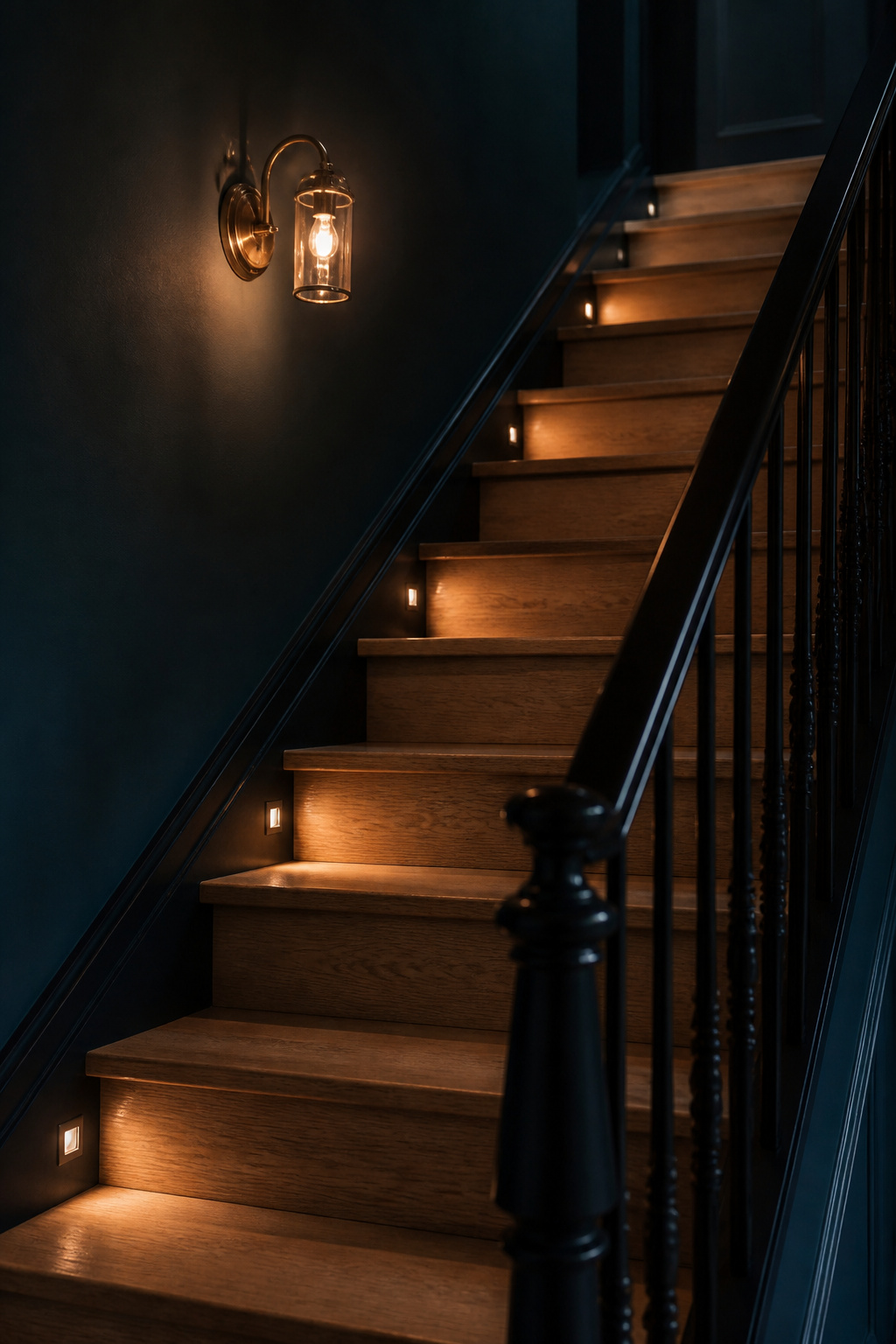
- Tread fixtures do the real work: 50-150 lumens each, spaced 6 to 8 feet, top and bottom steps always lit.
- Atmosphere layers on top of the safety baseline. Paint treads dark and you tighten the tread lighting rather than brighten the ceiling fixture.
Stairway lighting ideas start with a safety system
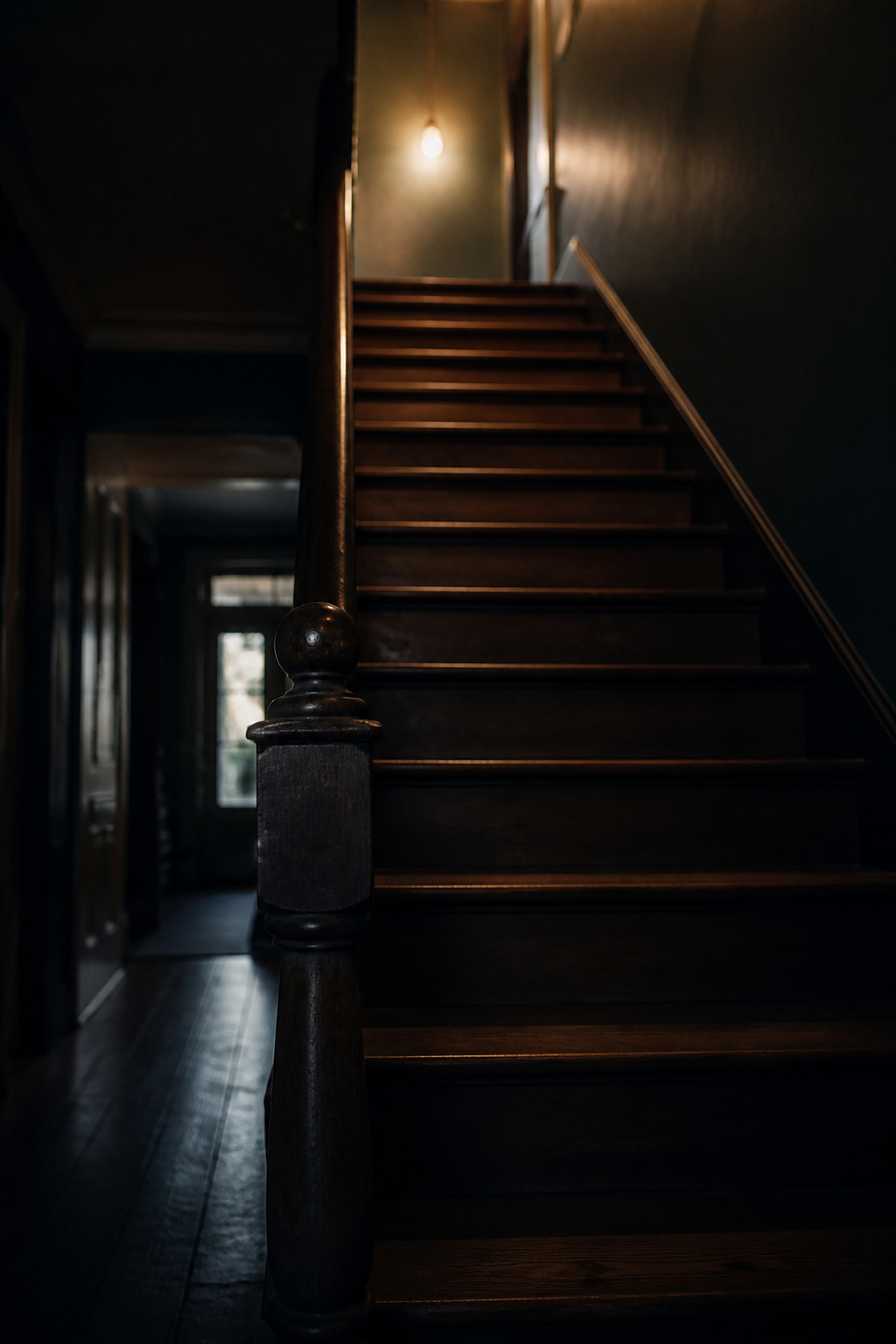
You can hear an under-lit staircase: someone slows over the last three steps, then a foot taps for a tread that has already run out.
Why stairs are where in-home falls concentrate
U.S. hospitals reported over 2.6 million injuries in one recent year from falls on stairways, ramps, landings and floors, with national medical costs passing $50 billion. Stairs alone sent more than 93,000 children under five to emergency departments each year from 1999 through 2008, about one every six minutes.
The decorating-first mistake most stairway lighting guides make
Most guides open with fixture style and stop there. A staircase can wear a good sconce and still fail at the step: one fixture mid-flight lights itself, not every tread. This is the one place in a house where I’d fit a light I didn’t love, if that’s what it took to see the step edge.
What to cover first, in the order that actually matters
Landings and switching first, then tread lumens and spacing, then warmth and retrofits, dark paint last. Everything past halfway is additive.
What code actually requires at top and bottom landings
NFPA 70, the National Electrical Code, sets six risers as the threshold: with lighting outlets on an interior stairway of six or more risers, a wall switch is required at each floor level.
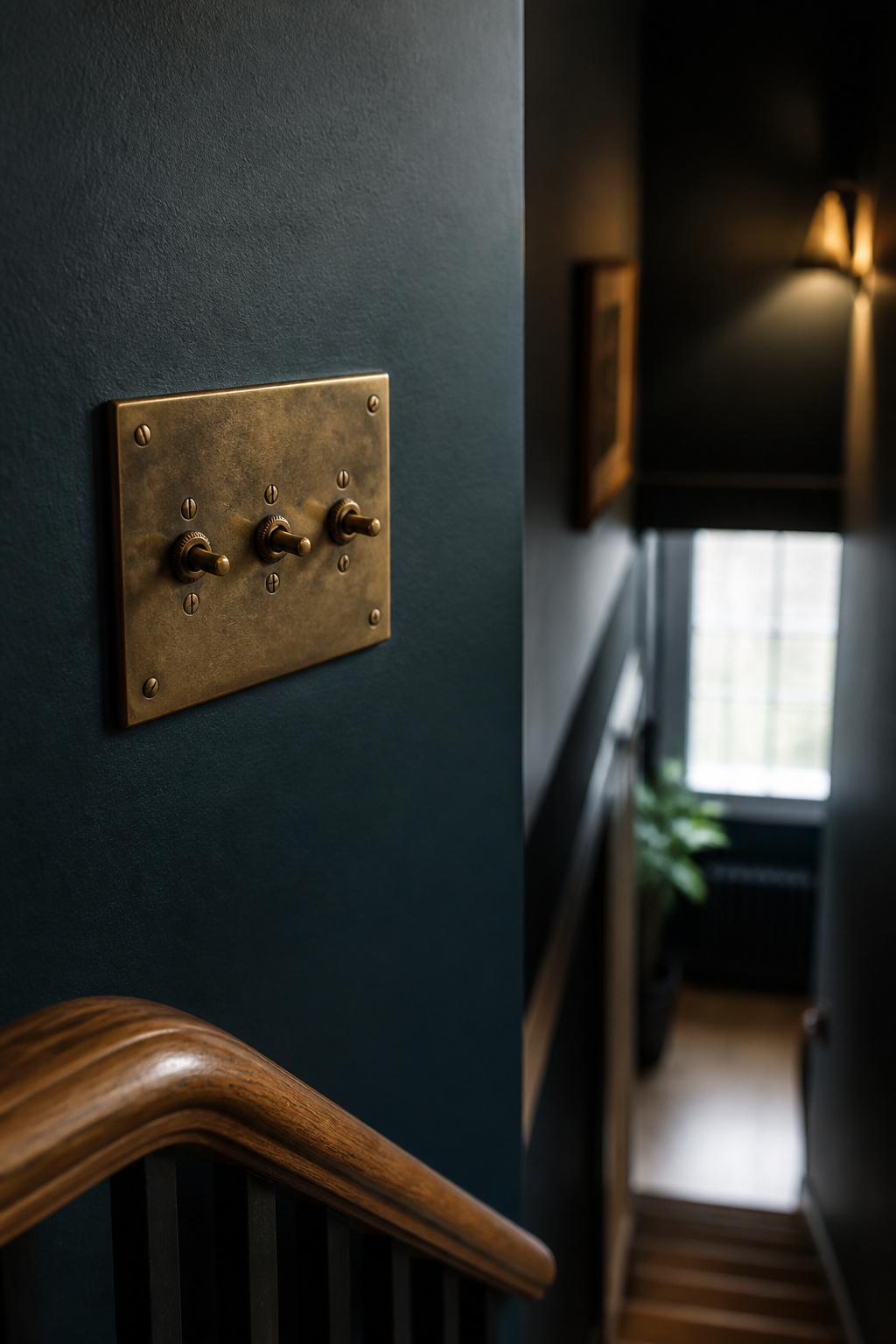
Switch placement at each landing
Canadian code sets the same switch requirement lower, at more than three treads, and three-way switching covers both ends without a second circuit.
Illumination levels code expects on landings
IRC Section R303.7 requires a minimum of 1 foot-candle, about 11 lux, at the centre of each tread and landing. That’s what an inspector checks for, not what a lighting designer aims at: stairs in regular use are commonly designed nearer 10 foot-candles.
What changes for stairs without a ceiling fixture
Code specifies a level, not a fixture. A stair with no ceiling light still has to hit 11 lux at tread centre, and sconces, step lights or a landing pendant each qualify if the light lands there. Vaulted or open-tread stairwells measure at the darkest step, not the nearest.
Tread and step-level lighting: spacing and lumen guidance
Lighting every third or fourth step and calling the flight done is the common failure. Dark treads between fixtures are the ones a foot misjudges.
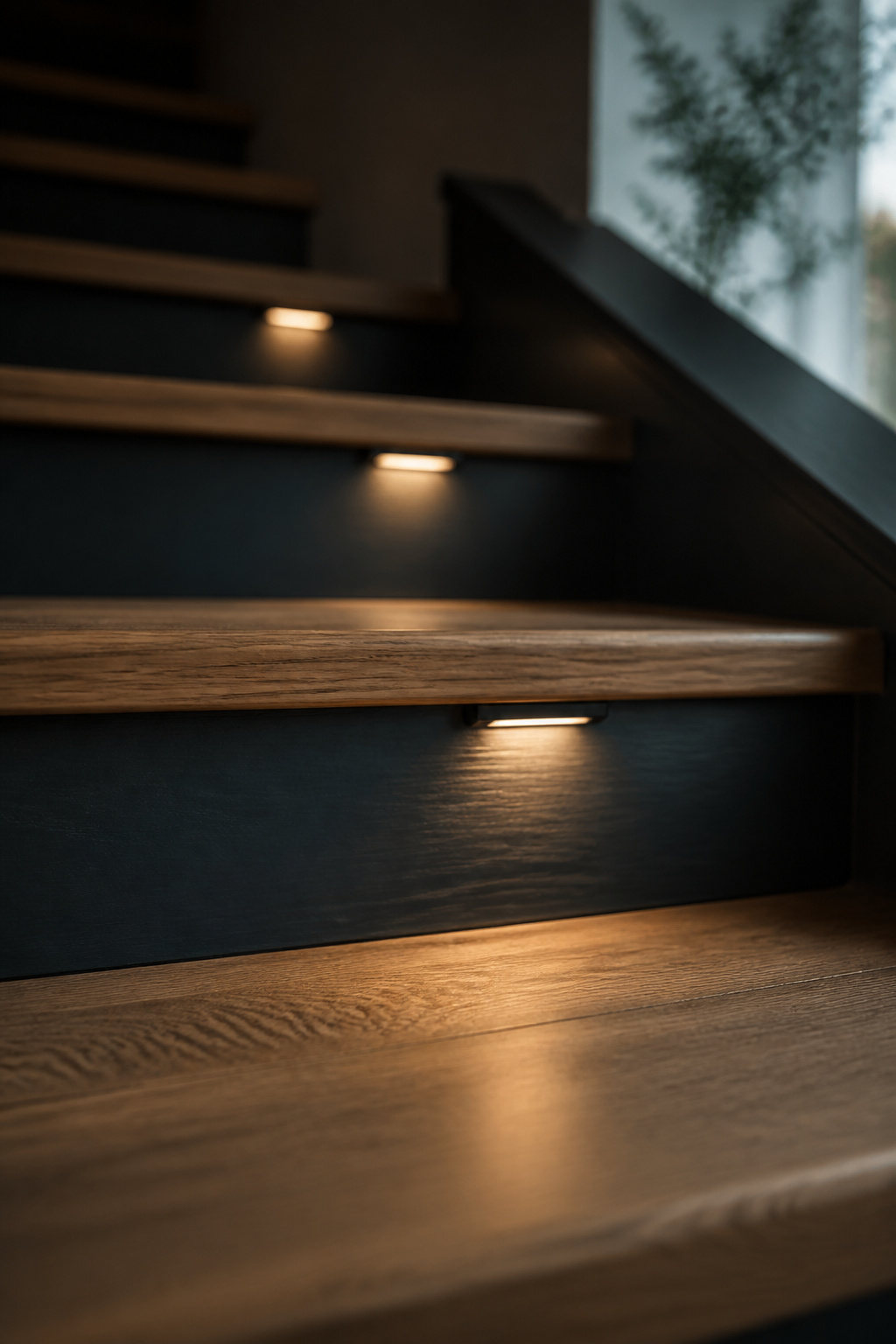
Lumen ranges that light a tread without glare
Recessed step lights run 50-150 lumens per fixture: every step for intensive lighting, every other for a softer effect, top and bottom always lit. Keep colour temperature between 3000K and 4000K. Fixtures span $7-$180, most practically $15-$67.
Spacing step lights so there are no dark treads
LED stair lights are commonly set at 6 to 8 foot intervals. A rough whole-stair check scales output at about 100 lumens per square foot, so a 20-square-foot run wants near 2,000 lumens. The working figures:
| Measure | Figure | Where it applies |
|---|---|---|
| Code minimum illumination | 1 foot-candle (~11 lux) | Centre of each tread and landing (IRC R303.7) |
| Comfort target, stairs in daily use | ~100 lux | Tread surface |
| Step light output | 50-150 lumens per fixture | Every step, or every other step |
| Fixture spacing | 6-8 ft along the run | LED step and stringer lights |
| Uniformity ratio | About 3:1 brightest to dimmest | Across one flight |
Even light across the flight matters more than raw brightness; that last row is the one worth keeping.
Riser lights vs stringer-mounted lights
Riser lights sit in the vertical face of each step, throwing light down onto the tread below, the most direct route to a tread-centre reading. Stringer lights run along the open side in one line: fewer fixtures to wire, less control per tread. Mount either 6-12 inches above the tread.
Layering ambient light onto the safety baseline
What this light is for at ten at night differs from a weekday morning, so plan two settings.
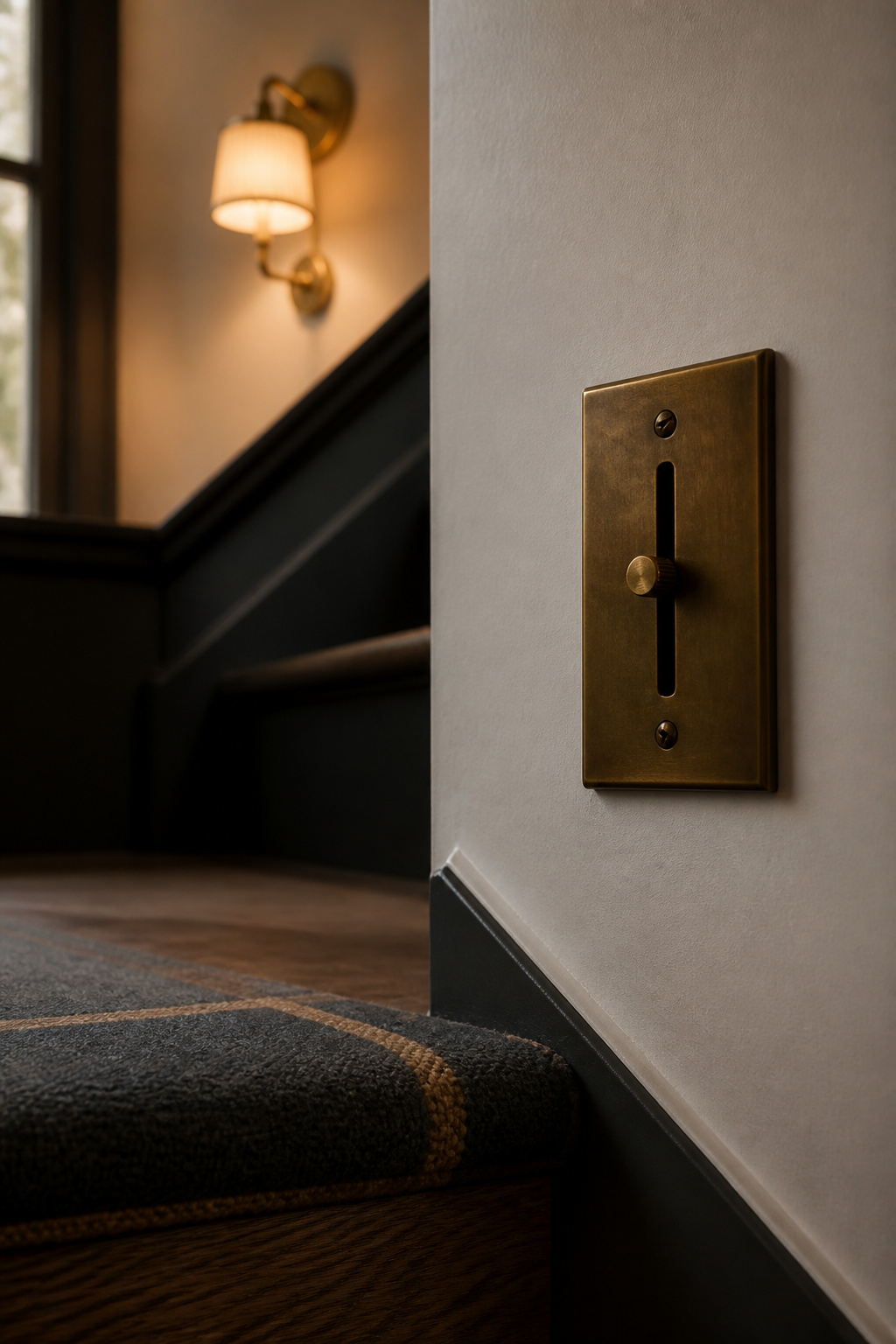
Adding a warm ambient layer without washing out the safety numbers
Warm white at 2700-3000K is the standard specification for stair-adjacent light; 5000K and up reads clinical in a transitional space. That fixture sits on top of compliant tread light. If a pendant is the only source, the darkest tread must still clear 11 lux on its own.
Dimmers and layered switching for day vs night use
A basic dimmer runs roughly $80-$200 installed, a smart one $80-$250 or more. Three-way smart dimmer kits let both landings control brightness, keeping the required switching intact. LEDs want trailing-edge (ELV) dimmers. Leading-edge models buzz or flicker on most LED stair fixtures.
Where mood lighting is allowed to lead
Once the minimums are met, atmosphere can lead: a warm sconce, a dimmed pendant, an accent grazing the runner. The test is behavioural: can the flight be walked confidently, without pausing or squinting, on both settings.
Sconces and fixtures that do both jobs
A sconce can handle safety and warmth at once, and its mounting height is where most go wrong.
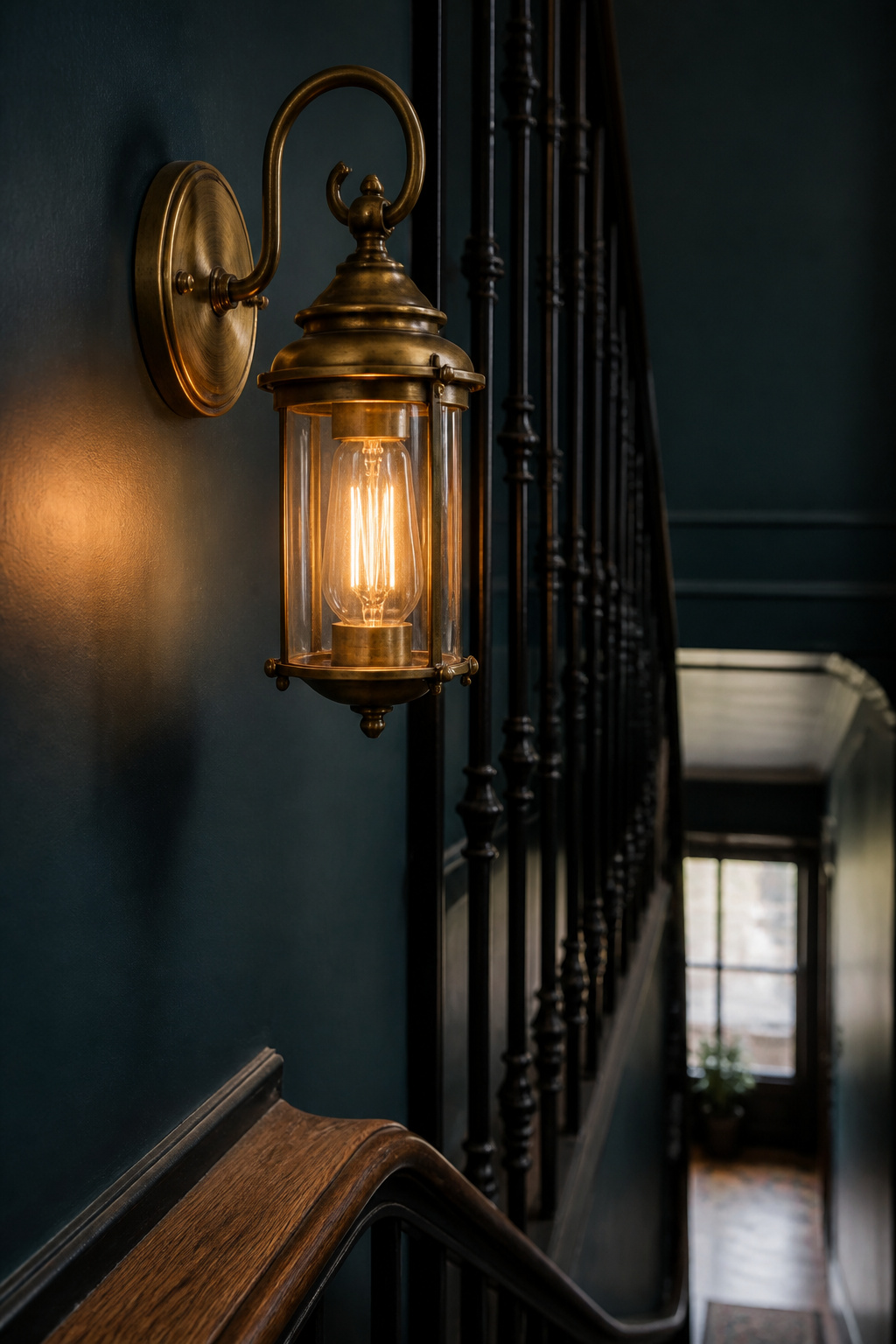
Wall sconces that meet code and add warmth
Stair sconces are measured from the tread directly below the fixture, not the room’s floor. Trade guidance puts the height at 60-66 inches above that tread, spaced 6-8 feet apart. That is a starting point, not a settled standard, since it rests on a single source.
Fixture placement relative to the handrail
IRC R311.7.8 requires a handrail on any flight with four or more risers, continuous, 34 to 38 inches above the tread nosing. Sconces at 60-66 inches clear that zone.
Choosing finishes that read intentional, not accent-only
Aged brass and black iron both hold up beside painted risers and oak treads. Match the family already on the stair rather than introduce a third metal.
Retrofit options when you can’t run new wiring
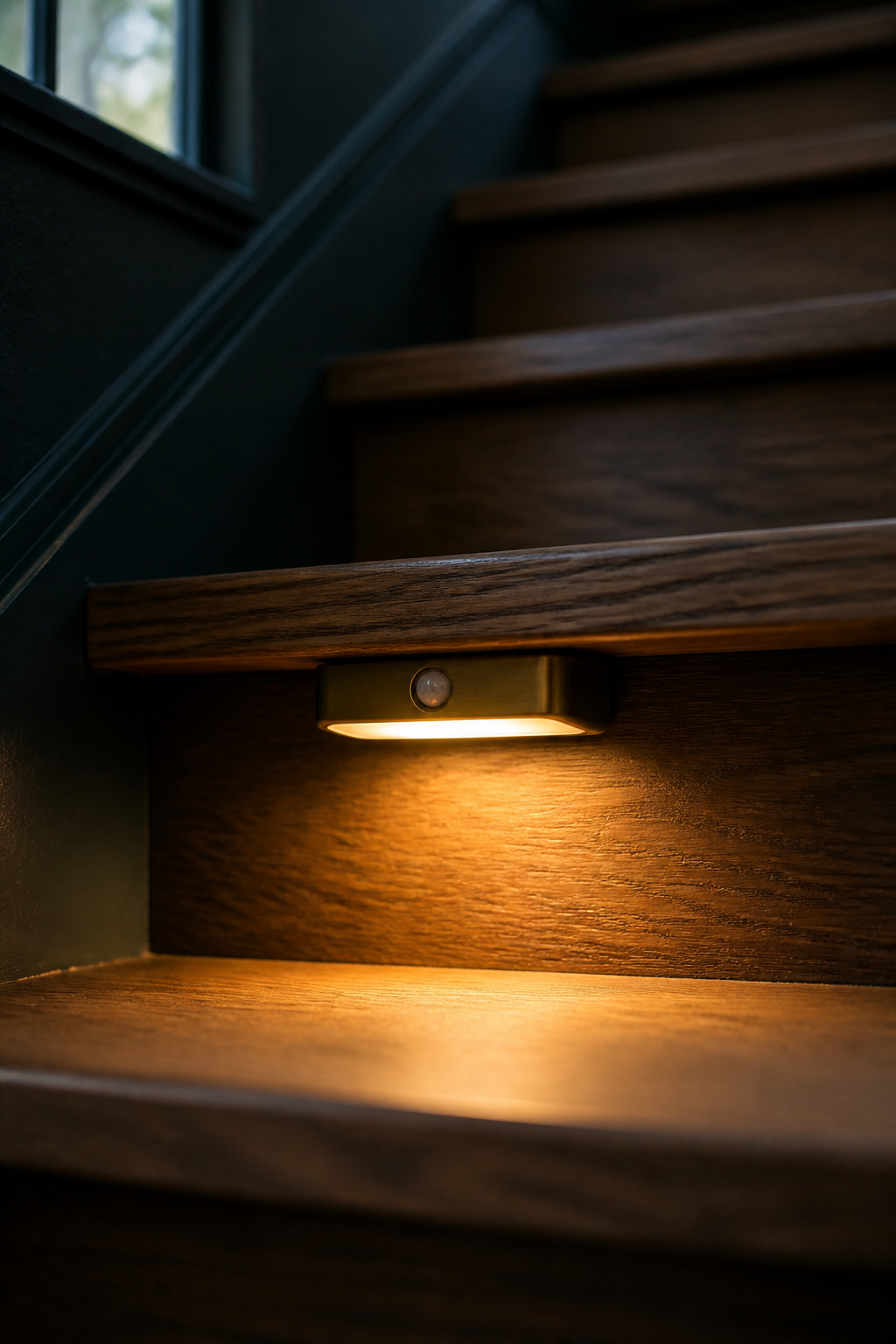
A rechargeable wireless sconce runs about 200 lumens per bulb, roughly 50 hours per charge, recharged about weekly at a few hours a night.
Battery and plug-in step lights that still meet spacing guidance
Battery fixtures sit below hardwired output, so plan with the actual figures:
- A basic battery puck light: about 50 lumens.
- A battery closet-style light (4x C-cell): about 100 lumens at 4000K.
- A battery LED strip with sensor (3x AA): about 80 lumens over roughly 19.6 inches.
The 6-8 foot spacing still applies: stick-on motion-sensor lights sell in multi-packs of three to six to cover a full flight without dark treads between units.
Smart switches and motion sensors as a wiring workaround
Smart three-way switch kits, Kasa’s among them, add app or voice control to an older stair circuit without a neutral wire in every box. Most sensor lights also carry an adjustable timer and dimmer, so they hold a dim standing level and brighten on approach.
What a retrofit route can’t fix
Battery and plug-in fixtures cannot satisfy the NFPA 70 switch rule, so a flight of six-plus risers with no switched circuit still needs an electrician. They also rarely match a hardwired 50-150 lumen step light, so a dark stairwell needs them denser: every tread, not every other.
Dark treads and visibility: what changes when you paint stairs dark
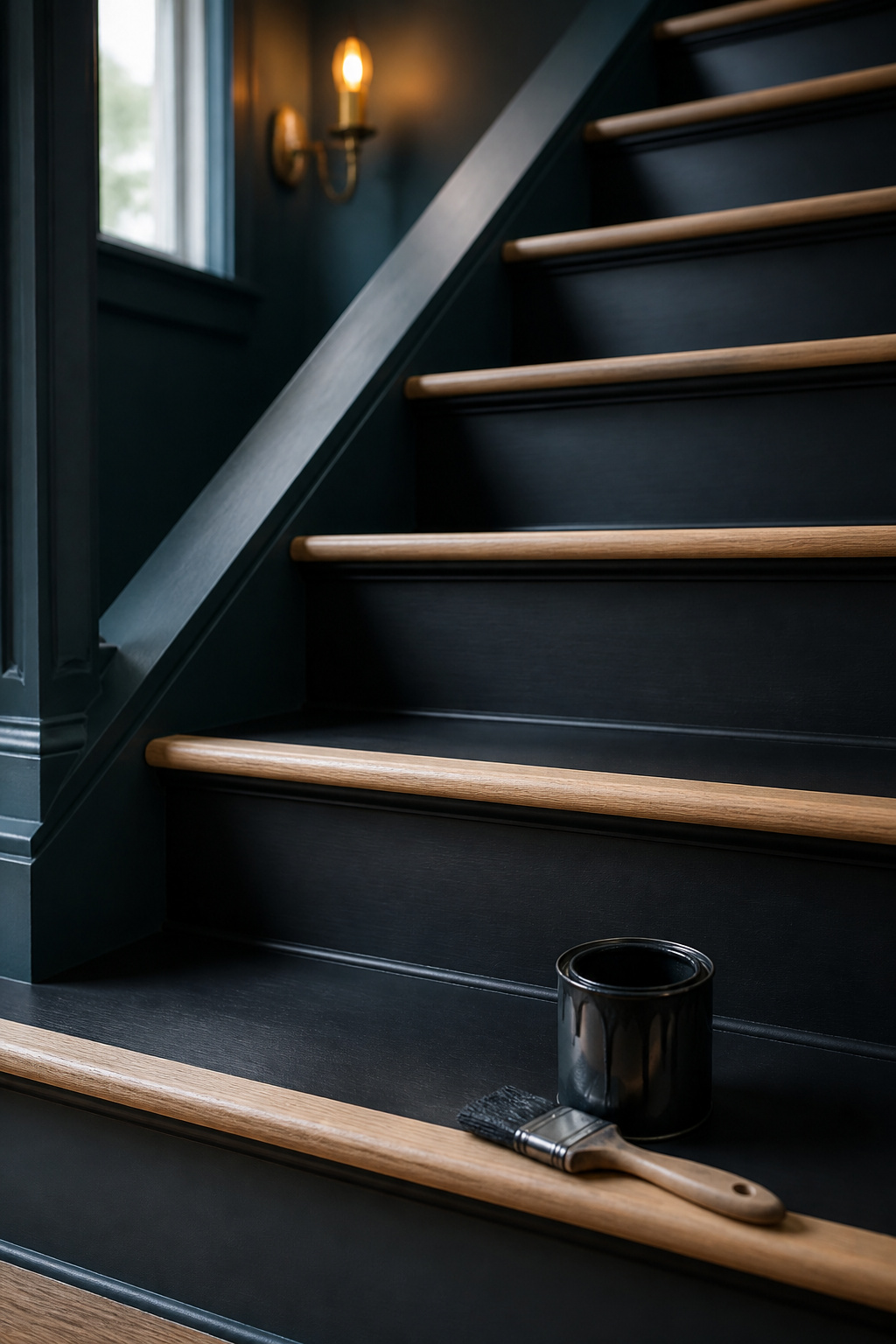
Paint changes the arithmetic: a charcoal tread returns far less of the light reaching it, so a fixture that read well over oak can leave the same step under-lit.
Why dark-painted treads change the visibility math
A gap of 30 points or more in light reflectance value (LRV) between tread and nosing is the accepted threshold for adequate low-vision contrast, and a black tread sits around LRV 4-5. So the nosing wants a pale, single colour at 30% luminance contrast or better. If the scheme is open, weigh dark tread schemes and visibility alongside the fixture list.
Compensating with tread-level light, not more ambient light
The instinct is a brighter ceiling fixture, but that is the wrong lever: ambient light bounces off walls and ceiling, not the surface that needs it. Tighten the fixture spacing instead, or move up within the 50-150 lumen band. A pale nosing then helps twice: it meets the contrast guidance and gives the step lights a brighter surface to hit. The wall counts too, so a panelling plan should settle what the light is for first.
Checking your finished scheme in low light
Walk the flight at night with only the stair’s own fixtures on: every step edge should be visible without pausing to feel for it. Photograph it too, no flash, no room lights. Eyes dark-adapt and forgive a dim step; the camera doesn’t. Fix that tread first; stair renovation ideas room by room covers the rest.
Numbers first, then warmth
A staircase is the one part of a home where light is structural. In a country where the sun gives up mid-afternoon, you learn that early or you live badly.
Distilled: meet 1 foot-candle at the darkest tread, switch it at both landings, then space 50-150 lumen fixtures at 6 to 8 foot intervals, top and bottom steps lit. The sconce, finish and dimmer come after, when nothing depends on them. Avoid a fixture bought before the flight is measured, the only source dimmed below the minimum, a leading-edge dimmer on LEDs, and a stick-on pack mistaken for a switch.
Next time you pass the switch, kill the hallway and landing lights and leave the stair on its own. Whichever step makes you slow down tells you where the next fixture goes.
FAQ
Is stairway lighting required by code?
Yes. IRC Section R303.7 requires interior stairways to have artificial light of at least 1 foot-candle, about 11 lux, at the centre of each tread and landing. Where lighting outlets serve a stairway of six or more risers, NFPA 70 also requires a wall switch at each floor level.
How many lumens do you need for stair lighting?
Recessed step lights typically output 50-150 lumens per fixture, fitted to every step for intensive lighting or every other step for a softer effect. As a whole-stair check, total lumens scale at roughly 100 per square foot, so a 20-square-foot run wants about 2,000 combined — well above the 11 lux code minimum.
Can you add stair lighting without hardwiring?
Yes. Battery-powered stick-on step lights with motion sensors are sold in multi-packs so a full flight can be covered at the same 6-8 foot spacing used for hardwired fixtures. Rechargeable wireless sconces give roughly 200 lumens per bulb for about 50 hours per charge — but no retrofit satisfies the NFPA 70 switch rule.