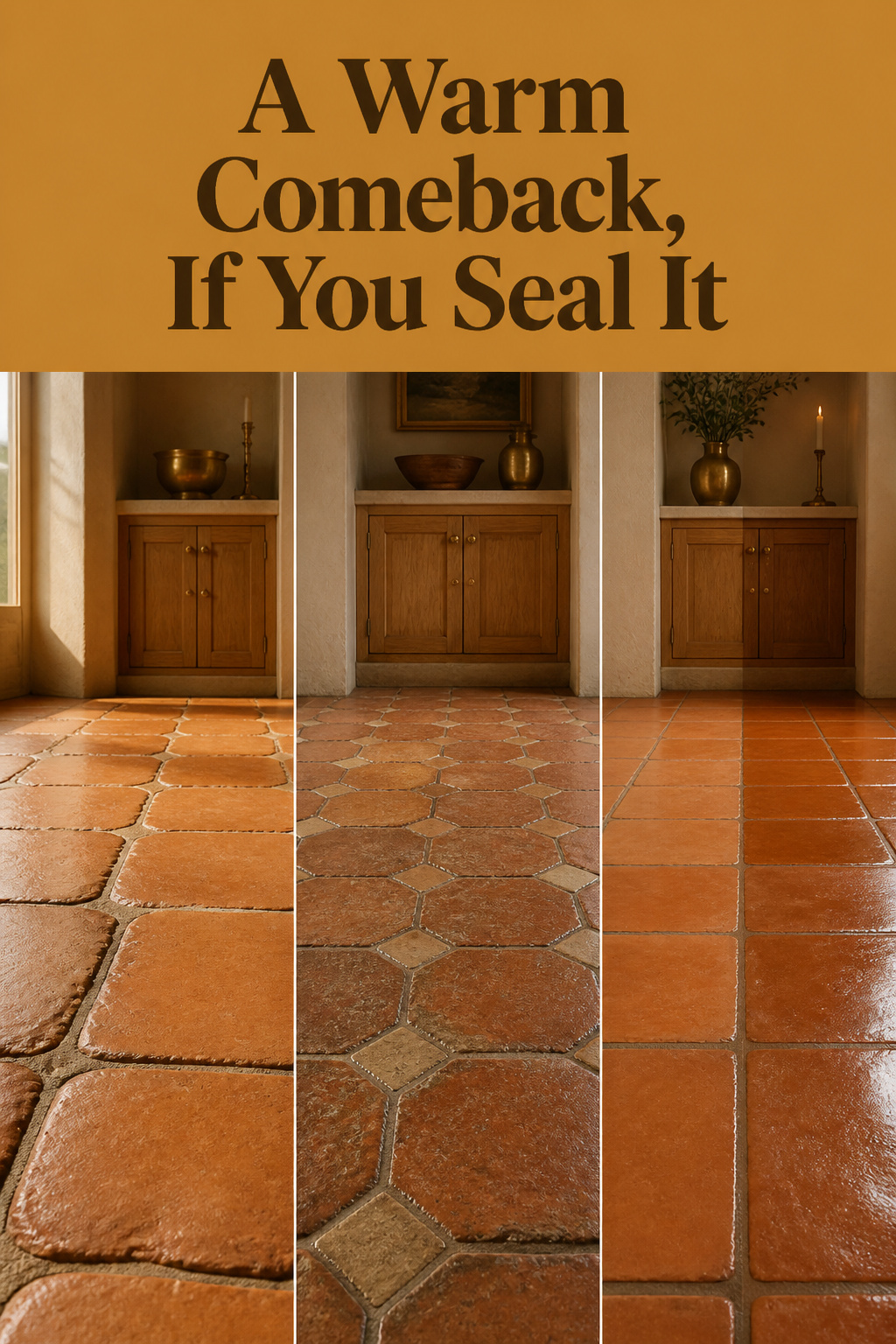
Terracotta kitchen floor tile has a reputation it did not earn. The orange tile that covered country kitchens through the 1980s was cheap machine-made stock, laid fast and often left unsealed, and clay has paid for that decade ever since. Helen Parker, creative director at deVOL, puts the bad rap squarely on those mass-produced eighties floors. Clay’s comeback makes nearly every demand about finish.
TL;DR
- Handmade, machine-pressed and saltillo are not one material. EN ISO puts handmade clay at 6–10% water absorption (AIIb) or above 10% (AIII); ANSI A137.1 calls anything over 7% non-vitreous.
- Sealing runs on two clocks: a cosmetic topcoat refreshed 2–3 times a year, and the base sealer underneath redone every 3–5 years.
- No Janka, PEI or Mohs rating exists for unglazed clay, and no published wet DCOF figure either. A durability number quoted for terracotta came off a porcelain sheet.
The Material the 1980s Ruined
What Went Wrong the First Time
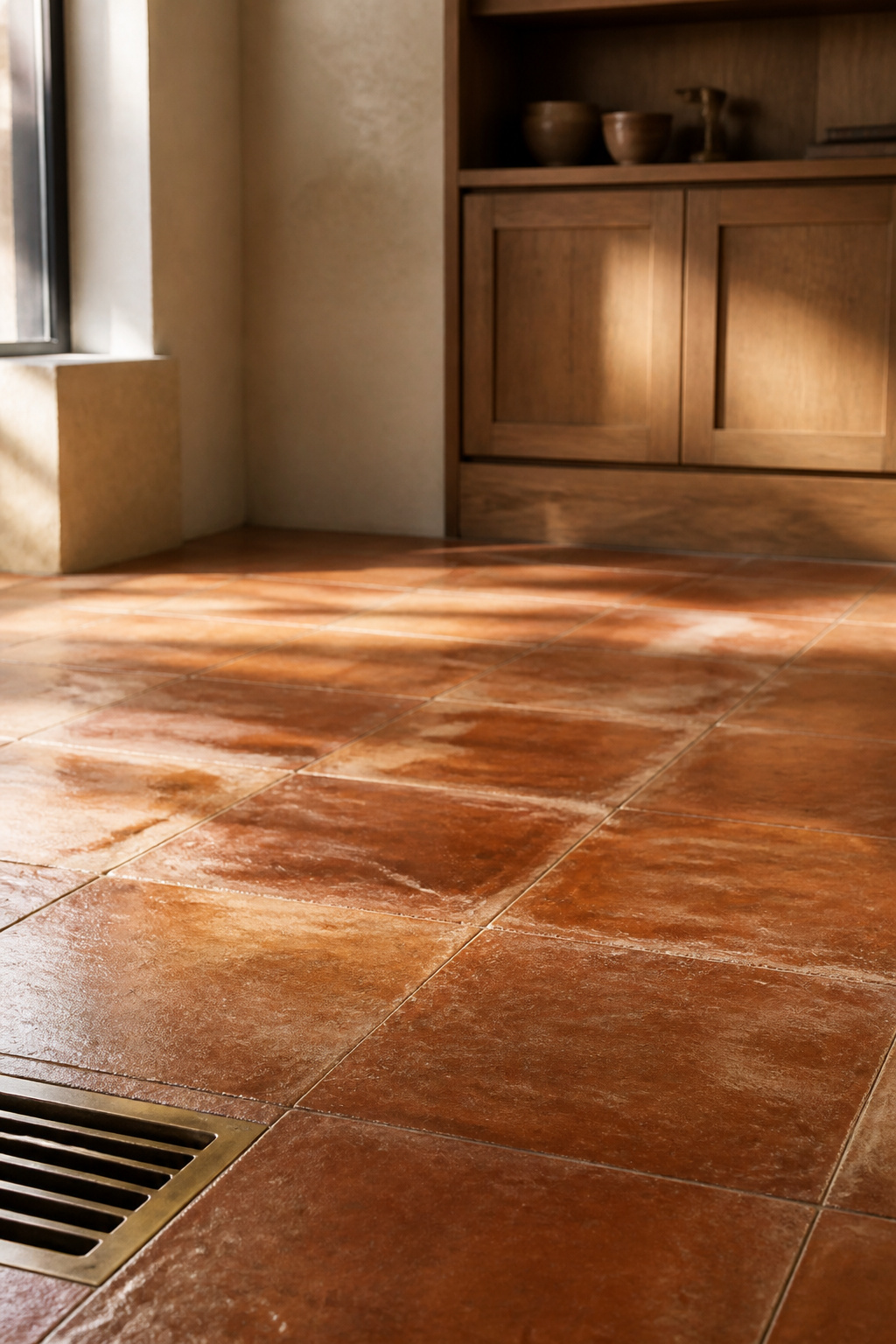
What saturated those kitchens was cheap, uniformly orange machine-pressed tile — colour-flat by design, the opposite of what people want from clay now. Styling was only half the damage. No sealing culture existed around it either, so those floors stained within a few years and the material took the blame.
Why 2026 Is Different
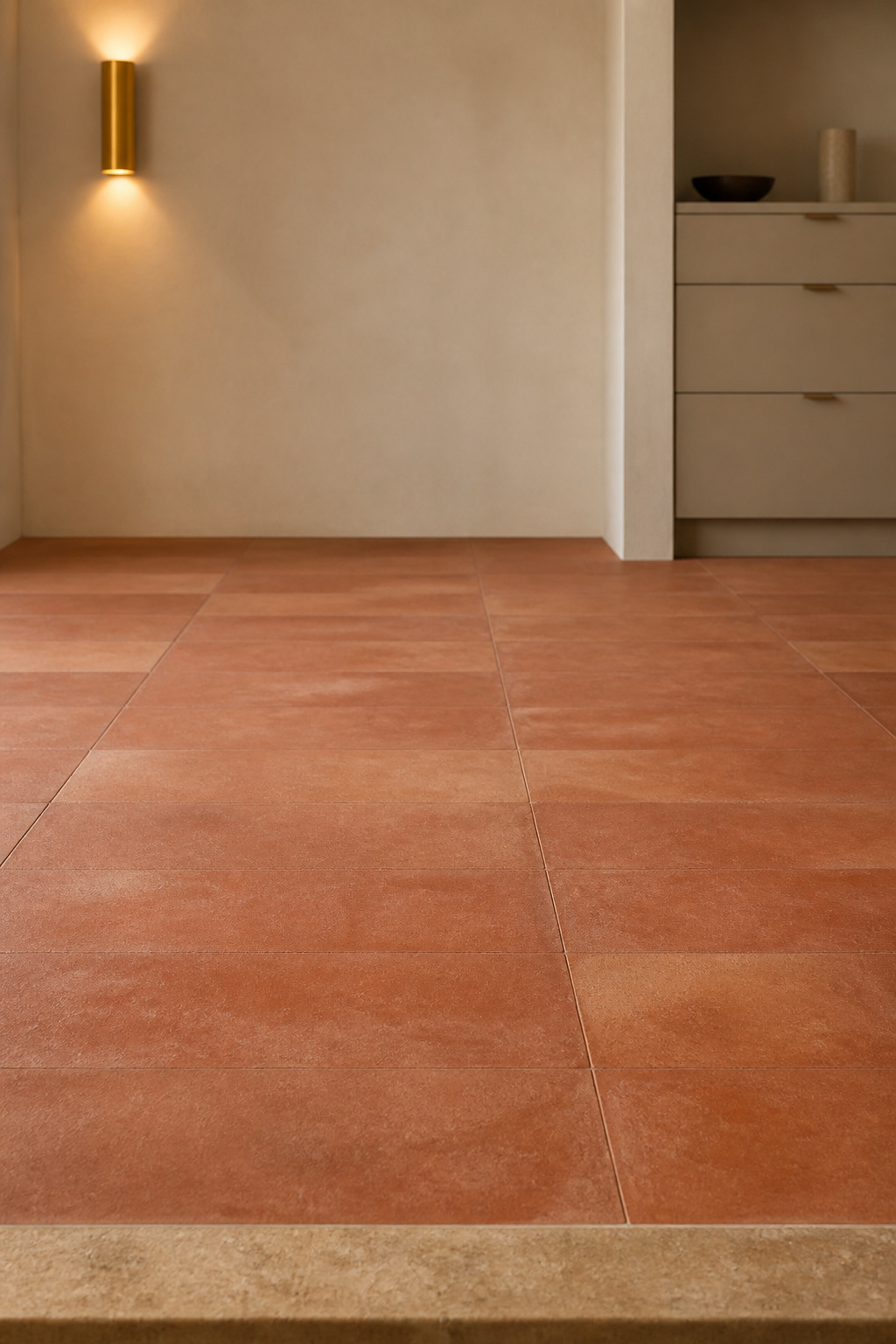
Today’s clay arrives in muted, curated tones rather than one orange, and designer Cara Woodhouse ties that to a move away from safe all-white interiors. Styling decides the rest. Terracotta with greige plaster, unlacquered brass and inset cabinetry stays contemporary; under shiplap and a fake beam it lands in Tuscan pastiche. Tess Carver sets clay against every other option in the wider kitchen flooring picture.
Handmade, Machine-Pressed and Saltillo: Not the Same Material
| Type | Tell-tale detail | What it means for treatment |
|---|---|---|
| Handmade Mediterranean | Tooling grooves underside, irregular edges, over 10mm thick | Pre-seal before grout; check door clearance |
| Machine-pressed (quarry) | Uniform grid or honeycomb back, usually a maker’s stamp | Lower waste; still non-vitreous, still sealed |
| Mexican saltillo | Lime pops, Coahuila riverbed clay, very high absorbency | Budget two to three extra sealer coats |
Notice what is missing there. No hardness number, because none is published: PEI covers glazed ceramic and porcelain only, and unglazed clay is graded by unstandardised in-house systems. No tested wet slip figure exists for terracotta either.
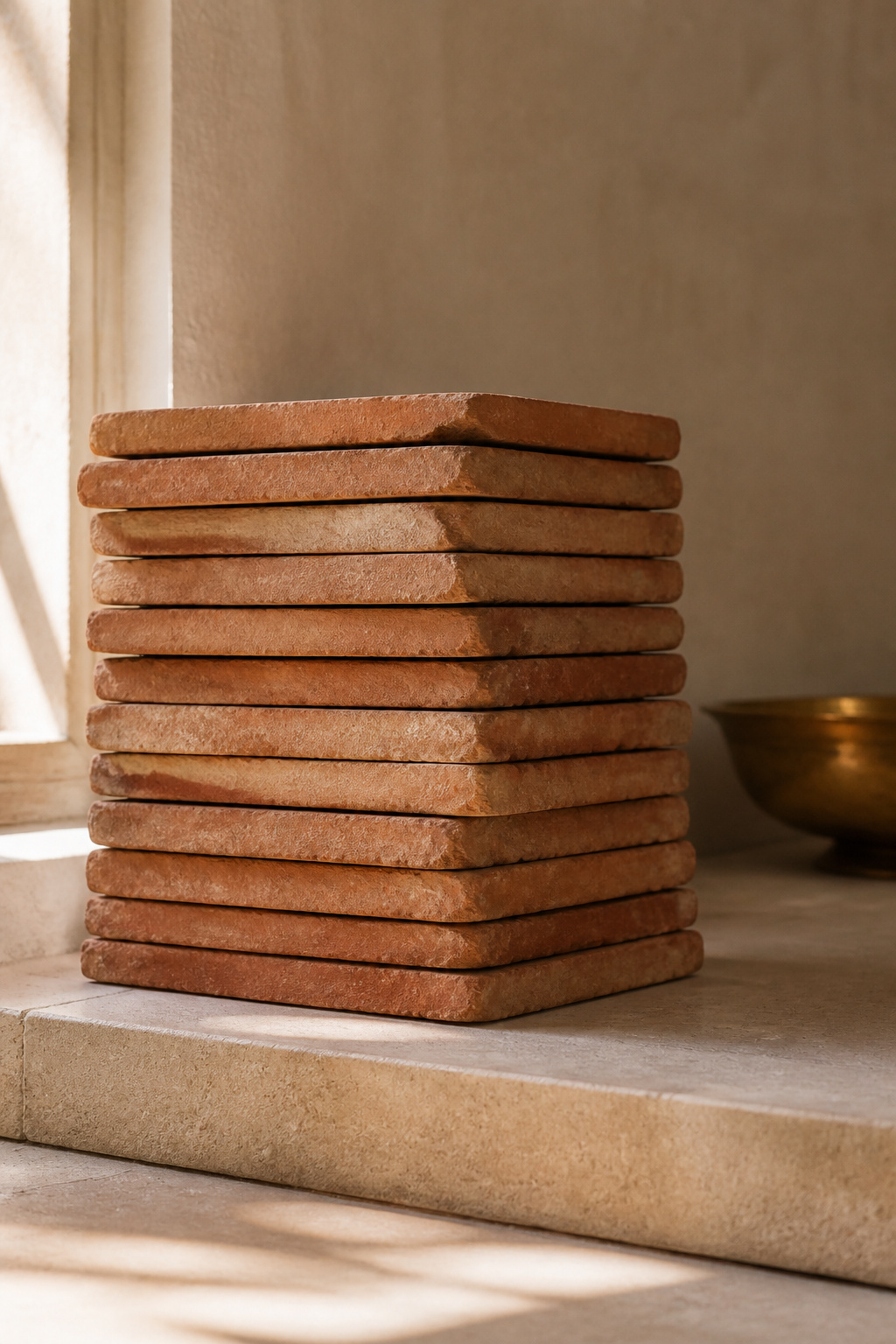
Handmade Mediterranean Terracotta
Turn a tile over. Artisan tiles are shaped plastically, so the underside carries parallel tooling grooves. The thickness — over 10mm, roughly 3/8 inch — is a renovation measurement, since door clearance answers to it.
Machine-Pressed Terracotta
Machine-made tile carries a maker’s stamp on the back, which is the fastest way to grade unlabelled stock. Its consistency buys a lower-waste installation and costs the variation people choose clay for.
Mexican Saltillo
Saltillo is name-protected by geography: genuine tile uses riverbed clay from Coahuila, Mexico. It is the thirstiest of the three, since the first sealer coat vanishes into the surface. Lime pops, small indentations left where minerals expanded during firing, are characteristic of authentic handmade tile rather than defects. Clay is nearly always laid in a pattern: see the patterns clay tile is laid in.
Sealing Terracotta Kitchen Floor Tile Is the Whole Story
At nineteen I stripped an oak chest with whatever solvent was on the shelf. It lifted the finish, the colour beneath it, and every claim I had to knowing what I was doing. The carcass survived; its surface never did. Sealing clay has that shape — an afternoon’s decision, sitting permanently on the only part anyone touches.
Choosing a Sealer
| Sealer | What it does | What it costs you later |
|---|---|---|
| Penetrating | Soaks into the pores, blocks stains, stays matte | Wears down, then reapplied over itself |
| Topical (finish) | Sits on top as a film, builds sheen, covers grout | Must be stripped off, not recoated |
| Linseed oil and beeswax | The traditional finish, predating factory sealers | Needs the most frequent reapplication |
The first two are a pair, not alternatives. Fired Earth’s guide, produced with Mapei, sequences them: a penetrating sealer before grouting, so grout pigment cannot stain the porous body, then a topical finish over tile and grout once the grout cures. Choose the film knowing you have committed the floor to stripping.
How Many Coats and How Often
- Let the tile dry a minimum of 7 days after installation. Trapped moisture undermines everything above it.
- Apply the penetrating sealer before grouting, allowing 4 to 8 hours’ drying.
- Grout, then let cement-based grout cure 48 to 72 hours.
- Apply the topical finish, recoating within 2-hour windows on very absorbent tile. Light traffic returns about 2 hours later.
- Keep traffic minimal for a week while the sealant oxidises.
Saltillo coat counts come from two guides that disagree, so take them separately. Clay Imports calls for 2 to 4 coats, each thinner than the last; Today’s Homeowner gives 2 to 3, and 24 to 48 hours before furniture.
Resealing is where the confusion lives, because two clocks run at once. A cosmetic topcoat is routine maintenance, refreshed 2 to 3 times a year; the base sealer beneath it is a 3-to-5-year job. Ca’ Pietra specify 3 years for their own system — their interval, not a universal one.
What Happens If You Skip It
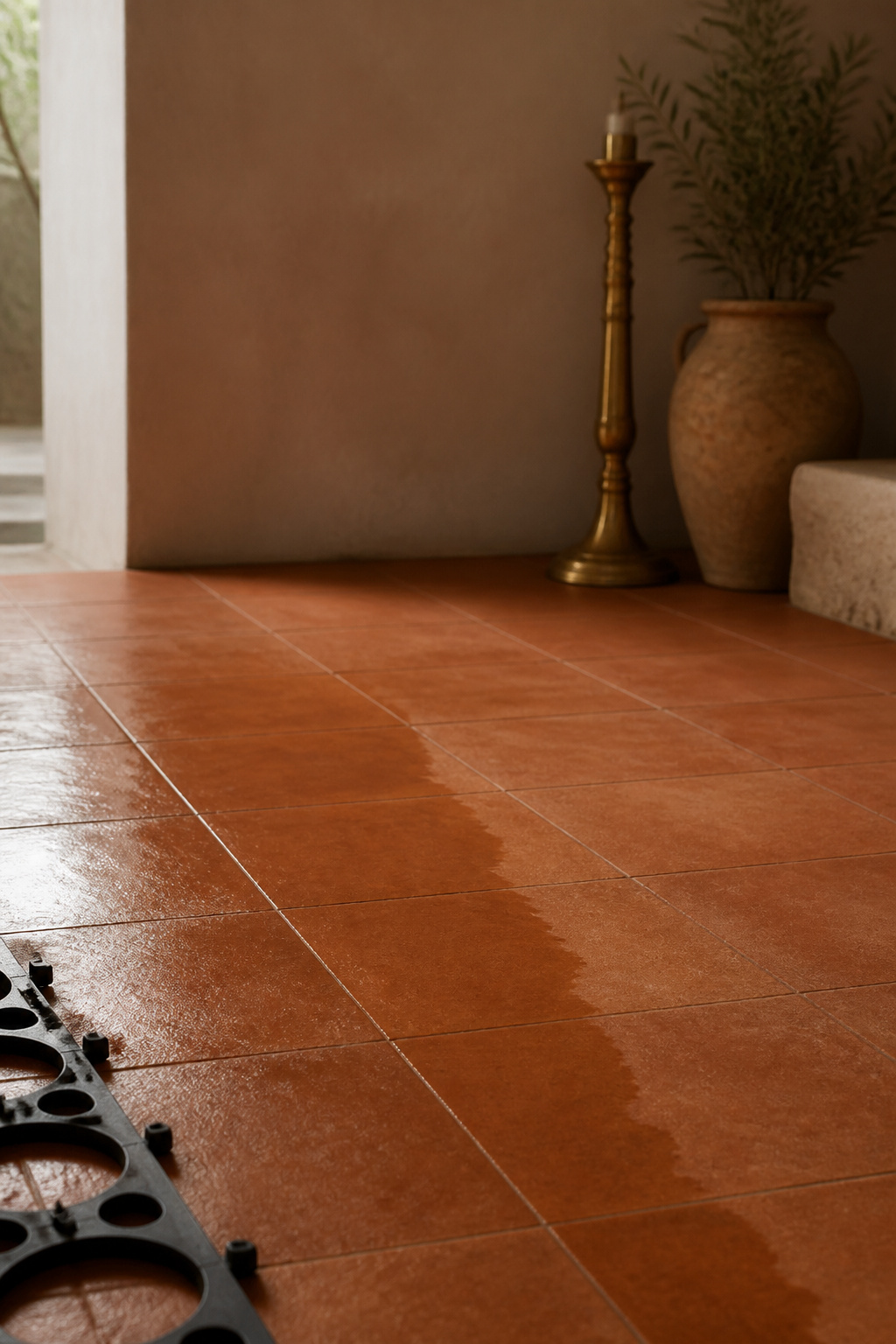
Unsealed clay absorbs rather than sheds, so anything with colour in it risks staining the tile body. On a sealed floor, splash water on it: beading means the seal holds, darkening means reseal. Fired Earth note salt bloom can surface even on a well-kept floor after the 28-day cure. Brush it off — never seal over it.
What an Unsealed Floor Does in Front of a Hob
Oil and Acid Staining
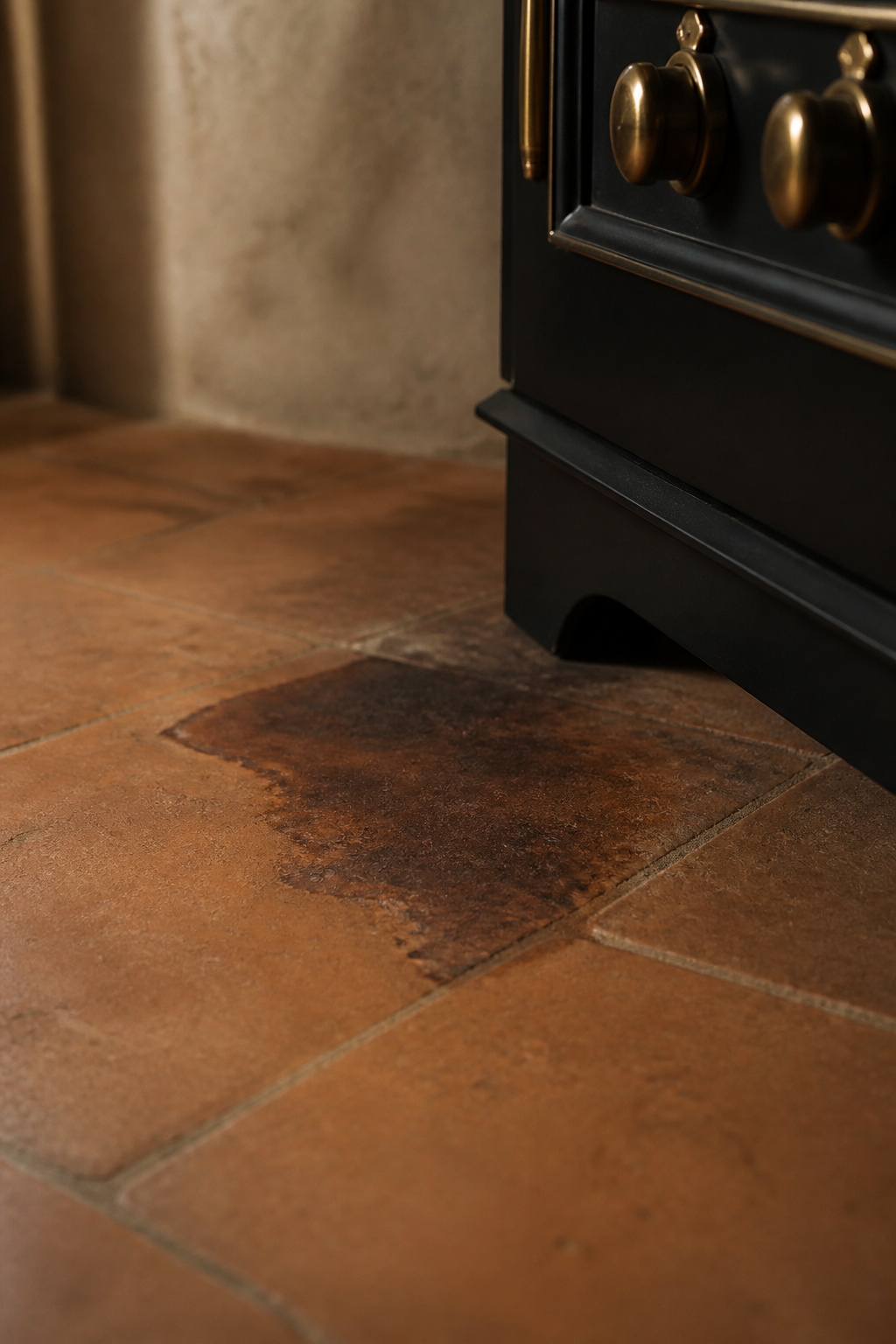
Oil behaves differently on clay than on porcelain. The tile’s capillary structure pulls liquid inward instead of holding it up for a cloth, which is why the metre in front of a hob is where sealing earns its keep. FILA’s protocol works in two tiers: blot and wash fresh oil within hours, while set oil needs a dedicated remover that dries to a white powder as it draws the oil out.
Grease in the Grout
Grout beside a range is a second porous surface stacked on the first, which is why the pre-seal comes first. Fired Earth advise against slurry-grouting terracotta, recommending joint-by-joint work instead. That 48-to-72-hour cure is the vulnerable window. Tess Carver covers how clay tile stacks up against the alternatives.
Patina: Why the Wear Is the Point
How Patina Develops Over Years
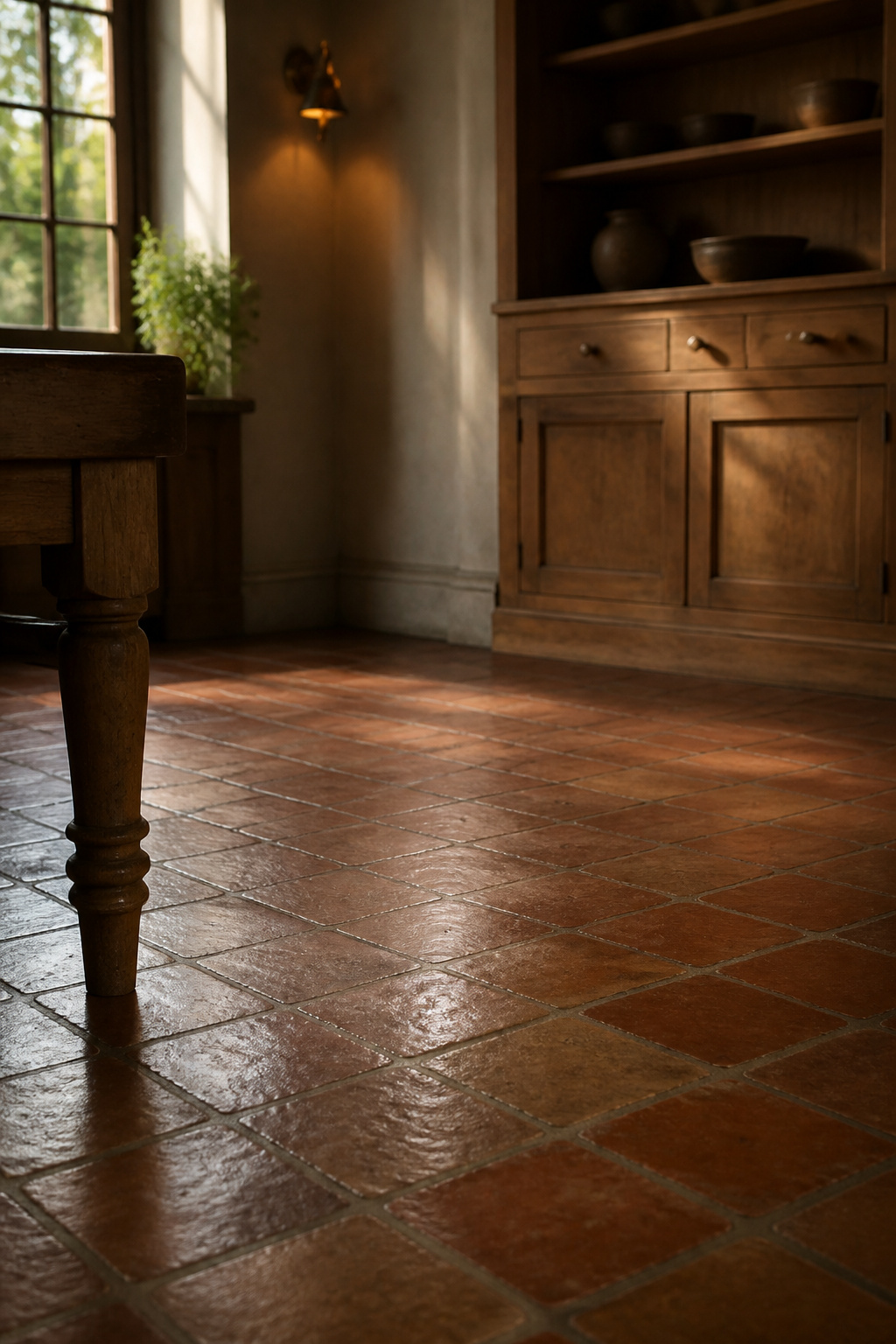
Why choose a floor that visibly ages? Because patina cannot be manufactured, and clay is one of the few materials that makes the real thing accessible. It comes from light, moisture and feet over years, softening colour where people walk. Applied distressing, by contrast, is a costume. Sealer choice shapes the result, since wax and oil finishes deepen with age where acrylics do not.
Distinguishing Patina From Damage
Patina develops gradually and evenly along the traffic pattern, softening finish and sheen without touching the tile’s integrity. Damage is sudden and local — chips, cracks, gouges — and feels rough underfoot. Lime pops belong to neither, since they happened in the kiln. Grazzie Wilson of Ca’ Pietra has the line I keep: terracotta lives and grows old with you.
Terracotta Over Underfloor Heating
Thermal Mass as an Advantage
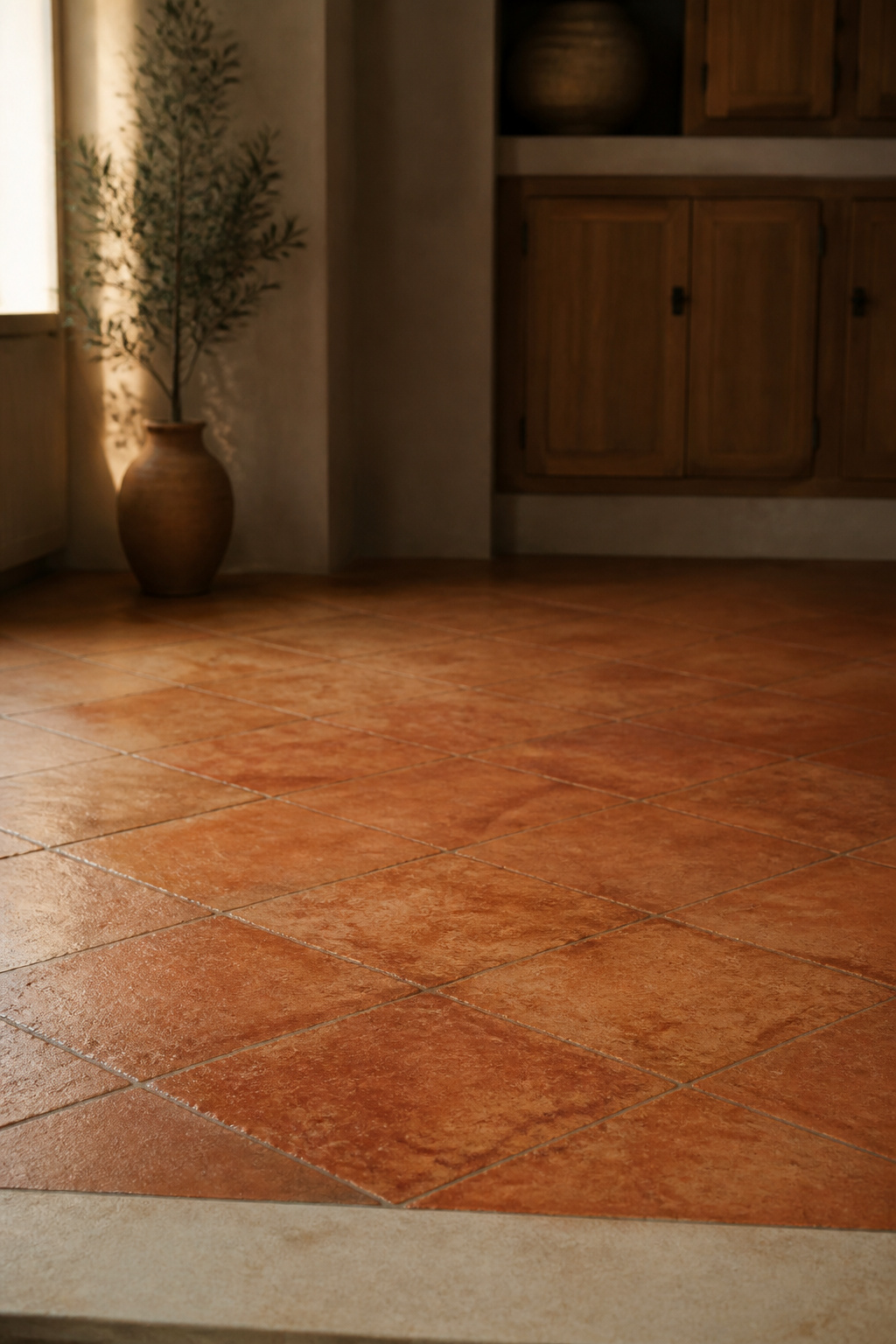
Clay stores heat slowly and keeps radiating after the system switches off. Wilson makes a separate point: its porous nature aids heat conductivity, which is why she calls the pairing well suited. Those are two mechanisms — surface conductivity and stored mass — working together, not one figure. Fired Earth still advise against tiling continuously over runs longer than 5 metres.
Sealing Considerations With Heat Cycling
Fired Earth specify keeping underfloor heating off, or at 15°C maximum, during tiling and for a minimum of 14 days afterwards. Then raise it 5°C per day to the working maximum, and bring it down at the same rate. An anti-fracture membrane is required — Mapeguard UM 35 — and pieces under 5×5cm fall outside it. Nobody publishes a maximum safe surface temperature for terracotta.
The Porcelain Look-Alike, If You Want the Colour Without the Maintenance
What Porcelain Terracotta-Look Gets Right
- The same burnt-sienna and dijon tones, in hexagon, brick and octagon formats echoing clay’s traditional shapes.
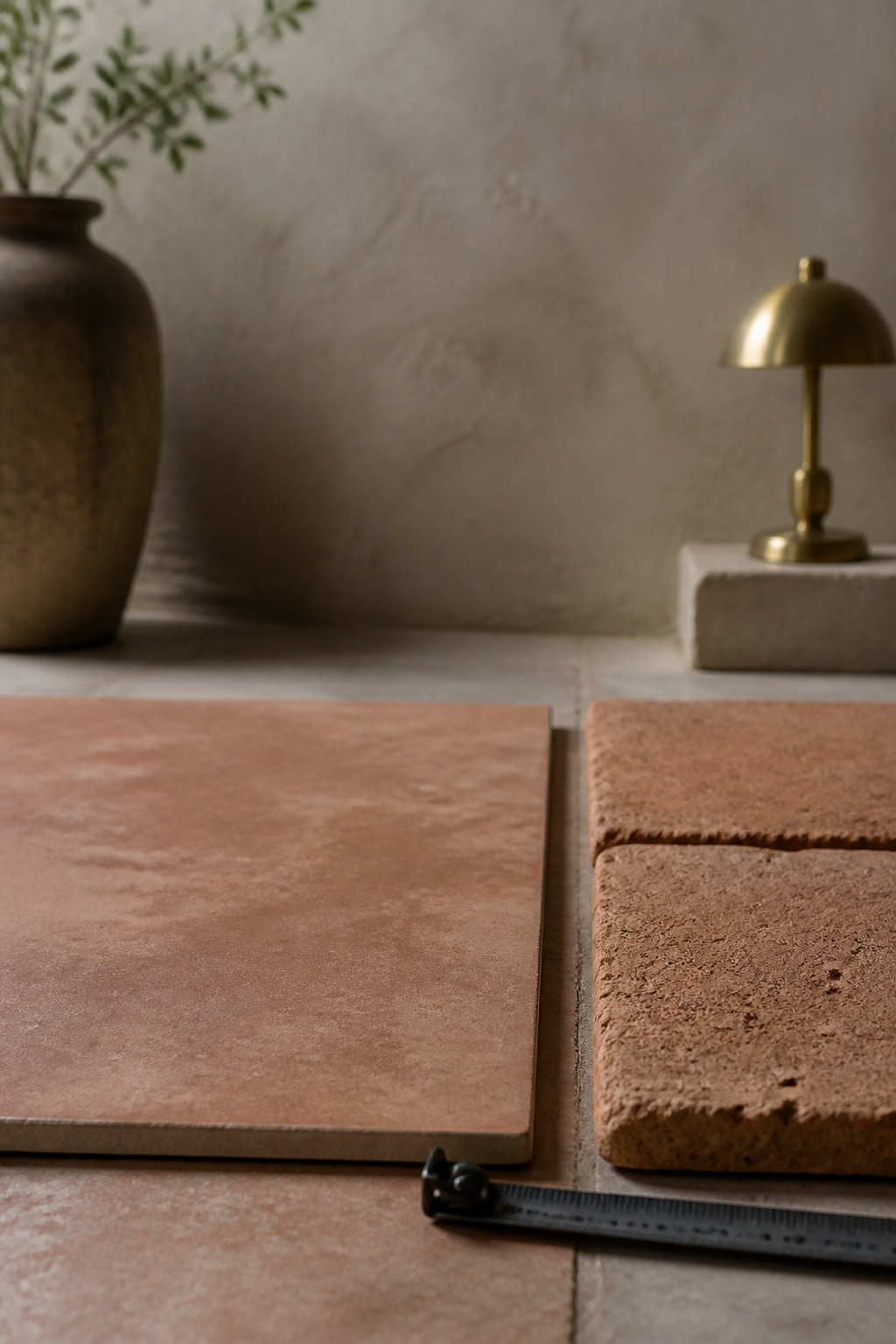
- Vitreous or impervious absorption, generally under 3% and often at or below 0.5%, against clay’s non-vitreous 7%-plus. No sealing regimen at all.
- Cheaper-but-higher-lifetime-cost for clay against pricier-upfront-but-lower-maintenance for porcelain. Nobody publishes a matched comparison, so treat that as a direction.
What It Can’t Replicate
- Tile-to-tile variation. A printed surface repeats; a hand-shaped tile does not.
- Patina, which needs a porous surface aging under real use — the property porcelain is engineered to remove.
- Probably some thermal mass, since a vitrified body heats and cools faster. I have not seen that tested.
Identify what you are buying, because the three clays behave differently before a tile is cut. Seal in the manufacturer’s sequence rather than your own — dry, pre-seal, grout, cure, finish — and keep the topcoat’s two-to-three-times-a-year refresh separate from the base sealer’s three-to-five-year job. Then let it wear. Clay is the rare floor that improves under a household rather than merely surviving one, and that schedule earns it.
FAQ
Is terracotta tile cold underfoot without heating?
Tile and stone are not colder than the room. Their density draws heat from skin more slowly than wood or vinyl, which reads as cool underfoot, and terracotta is no exception unheated. Electric radiant heat changes that at a low daily running cost. No source supports clay feeling warmer than porcelain.
Can terracotta tile be used in a kitchen with pets?
No source evaluates clay for pet households the way porcelain, ceramic and stone are routinely compared, so treat confident answers sceptically. What is documented: terracotta is softer than porcelain and chips under dropped weight, so claw marks show sooner. Its unglazed matte surface offers more traction than glossy glazed tile.
How do you fix a chipped terracotta floor tile?
Minor chips take a colour-matched epoxy or clay filler, sanded flush once cured and resealed to blend. Badly broken tile is chiselled out with its grout, the substrate cleaned, a new tile set in fresh thin-set and regrouted. Replacement tiles run $5–$20 each, labour roughly $40–$100 per hour.