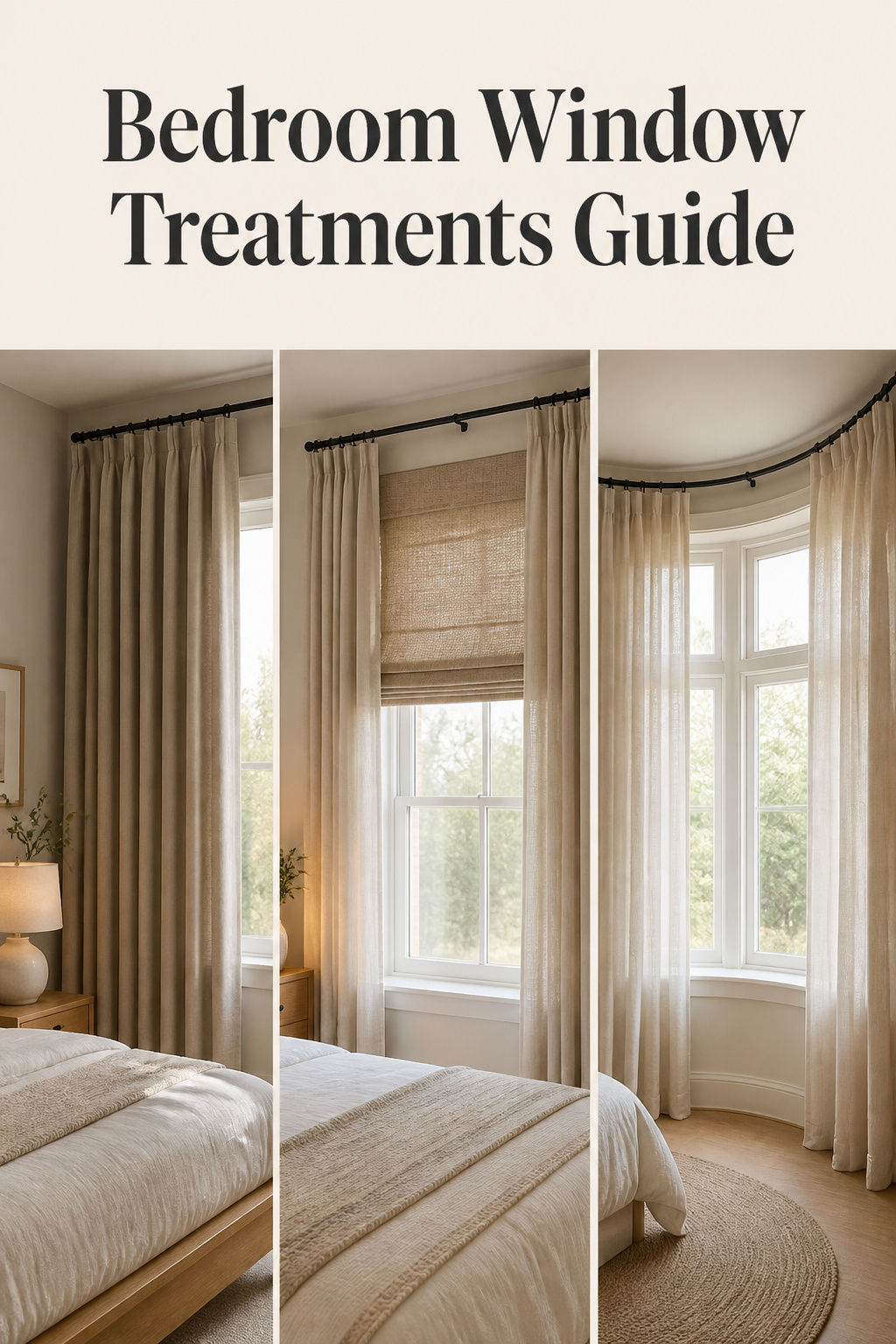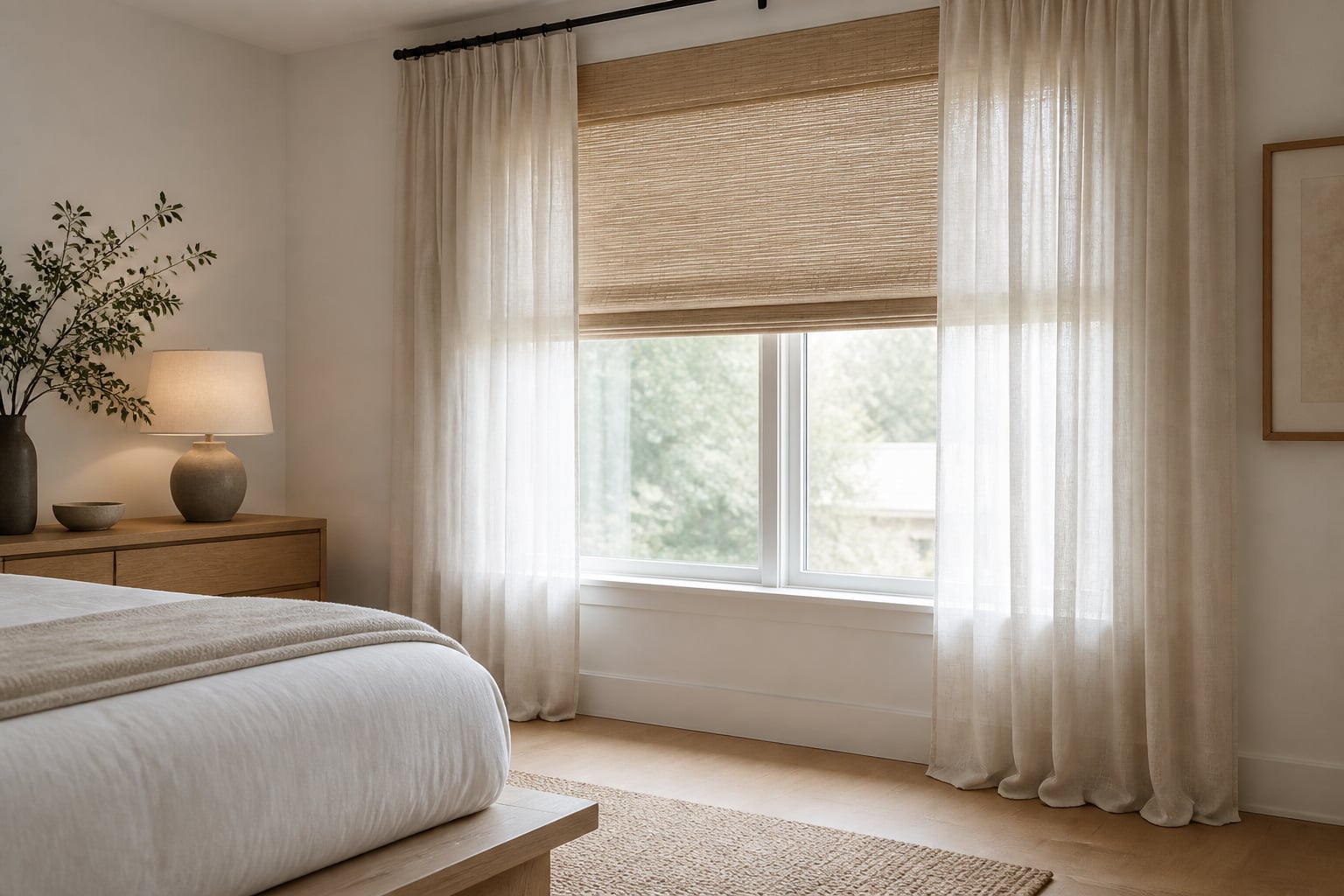

Stand in a window-treatment aisle, or scroll one online, and the trouble is not too little choice. It is too much. Curtains, blinds, roller shades, cellular shades, blackout, room-darkening, layered sets — every one photographed to look like the obvious answer, every retailer confident it sells the right thing. What almost none of them tell you is which bedroom window treatments your particular room needs, or why. That is the gap this guide closes. My grandparents’ summer cottage on the Stockholm archipelago had one plain linen panel at each window and nothing else, and it was exactly enough — because the choice was made by how the room was used, not by how the fabric looked in a catalogue. Bedroom window treatments work the same way. Decide what the window has to do first, and the field of options narrows to a handful, then to one.
This guide surveys every category at overview depth and, where a decision needs real detail, points you to the deep-dive guide that covers it. Read it top to bottom for the full map, or jump to the section that matches your problem. Either way, you should finish able to name your top priority, pick the category that serves it, and know exactly which guide to open next.
What Your Bedroom Window Treatments Actually Need to Do
A bedroom window is not a living-room window. It has a different job, and the job should decide the treatment. Most people shop the other way around — they find a fabric they like, then hope it performs. That is how a beautiful curtain ends up letting in the streetlight it was bought to block.
Light control comes before style
Sleep is what a bedroom is for, and light is what interrupts it. So light control leads every other consideration here. The categories sort cleanly by how much light they stop: blackout shades and curtains block roughly 85–99% of incoming light through the fabric itself, while light-filtering or room-darkening options cut 70–90%. For a bedroom, a nursery, or a guest room where better sleep is the goal, blackout is usually the stronger fit; room-darkening suits rooms that still want some daytime brightness. The remainder — the difference between a dark-grey room and a truly black one — depends on how the treatment is installed, not just the fabric grade.
Style is not banished. It simply comes last, applied inside whichever category can do the light job. A room that photographs well but glows at 5am has been decorated, not designed.
Insulation and sound as daily-use factors
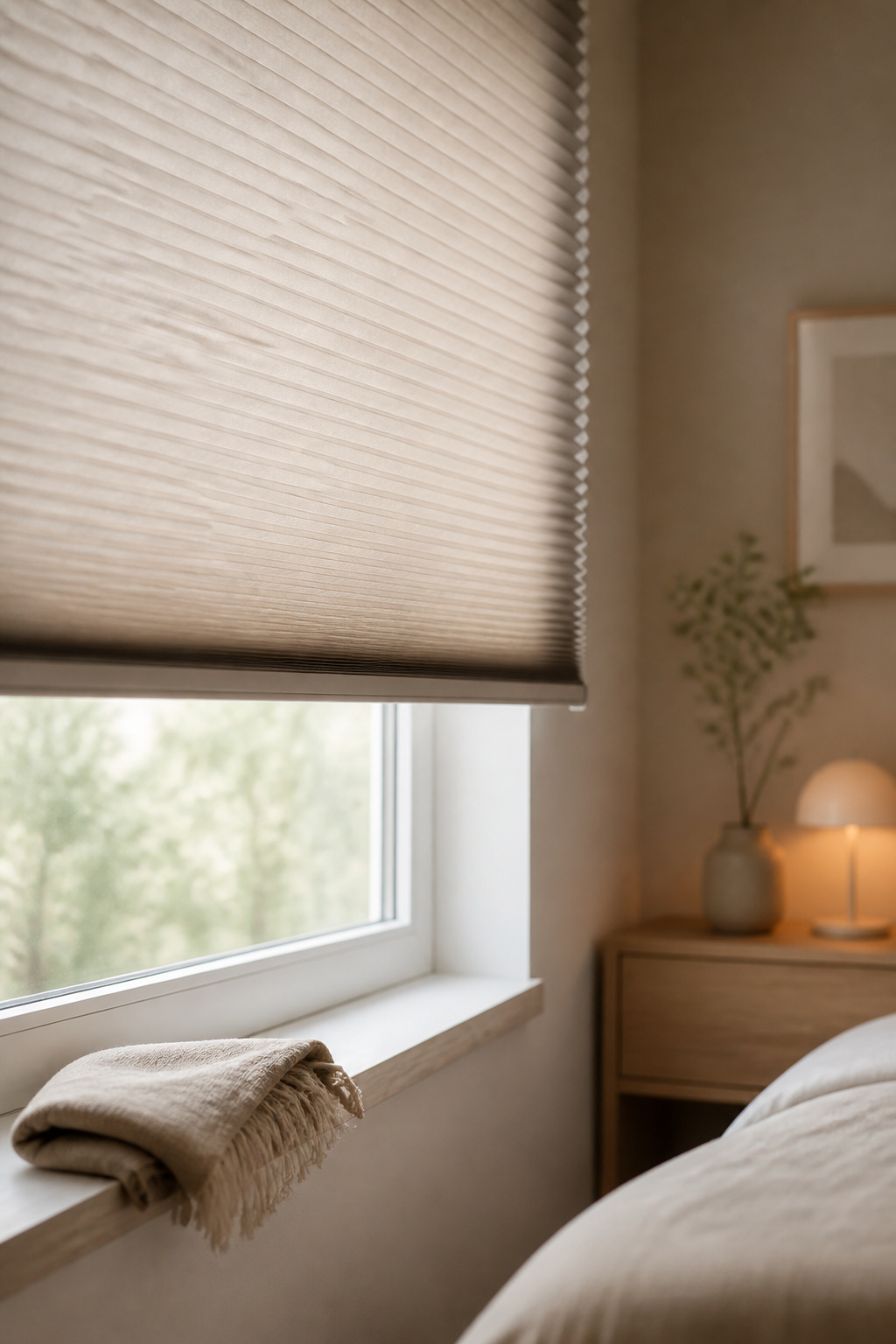
The second job is warmth, and it is measurable, not marketing. A single-pane window has an R-value of about 1; a properly installed insulated curtain can raise that window’s effective R-value as high as 6. Cellular honeycomb shades trap air in their cell structure and carry R-values of roughly 2.0–5.0 — double-cell constructions (3.25–5.0+) outperform single-cell (2.6–3.5). The U.S. Department of Energy notes that curtains with a thermal lining can cut heat loss through a window by up to 25%, and tightly installed cellular shades can reduce it by 40% or more in heating season. In a cold-climate bedroom, that is not an abstraction. It is the difference between a wall you sit near in winter and one you avoid.
Sound rides along with the same dense construction. The multi-layer fabric that blocks heat also dampens outside noise — not soundproofing, but a real reduction that matters for a street-facing bedroom. Weigh it as a daily-use factor, because you live with it every night, not just on the day you install it.
The four priorities that should drive every choice
Before you shop, rank four practical filters: light control, insulation, sound dampening, and maintenance. Maintenance is the one buyers skip and later regret — roller and cellular shades wipe clean, while dry-clean-only drapery carries an ongoing cost few people budget for. Style is the fifth filter, and it applies last, inside whichever of the four wins.
One honest note runs through the whole field: no single treatment does everything well. Layering a hard treatment (a blind or shade) with a soft one (a curtain) is repeatedly the way to get precise light control plus the insulation and visual warmth fabric adds. Hold that in mind as we walk the categories — the winner is often a pair, not a single panel.
Curtains, Blinds, or Shades: How the Categories Compare
Three categories cover almost every bedroom window, and each has one clear strength. Knowing where each wins is most of the decision. Here they are side by side, read as a map of trade-offs rather than a ranking:
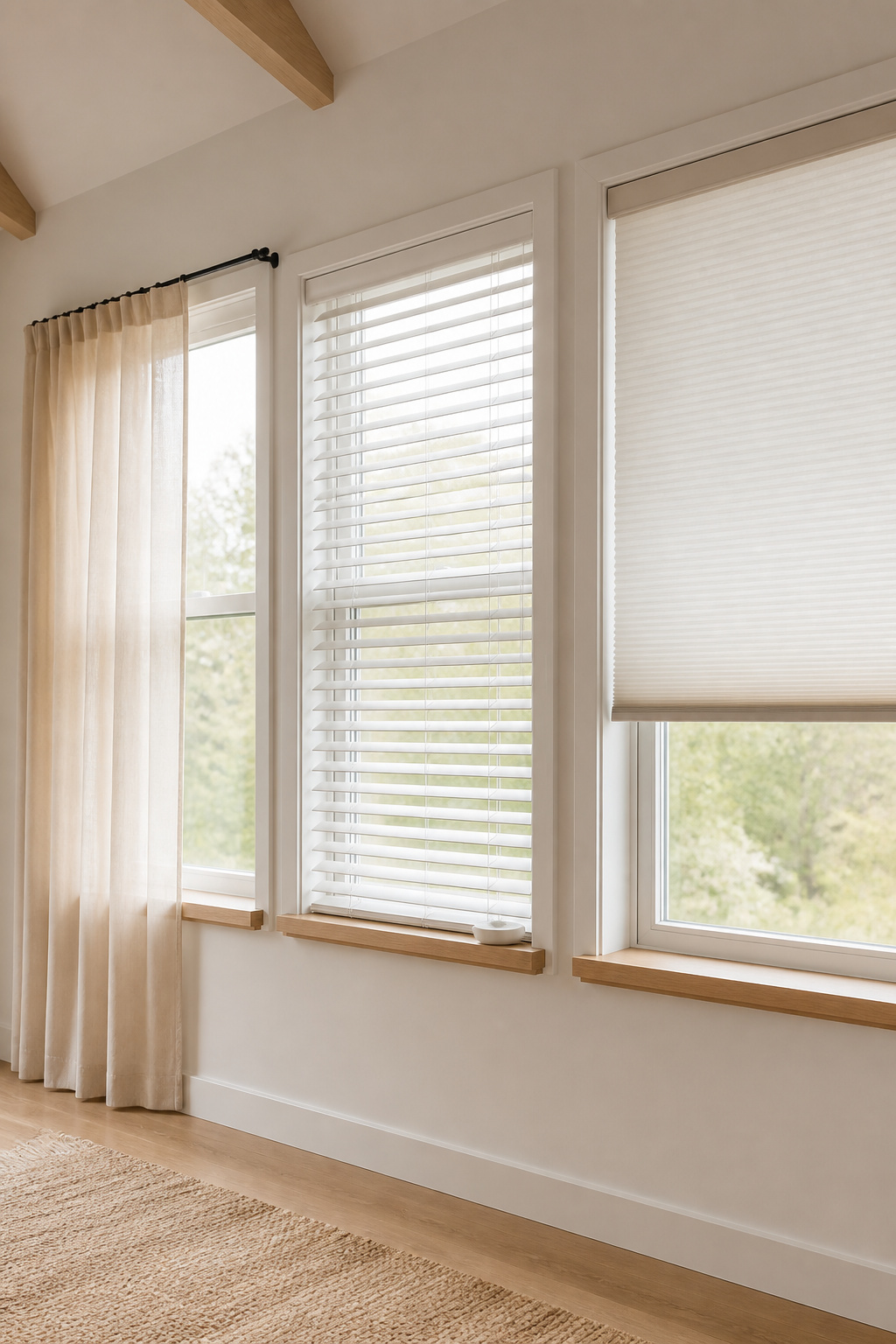
| Category | Light control | Insulation | Maintenance | Wins in |
|---|---|---|---|---|
| Curtains | Blackout fabric near-total; best real-world edge seal | Thermal-lined up to R-6 fitted; ~10% winter heat-loss cut loose-hung | Wash or dry-clean; fabric traps dust | Darkness, warmth, softness |
| Blinds | Precise, incremental via slat tilt; perimeter gaps leak | Low on their own (near R-1) unless lined | Wipe-clean slick surface | Precise daily adjustment, low upkeep |
| Cellular shades | Solar to blackout range; edges still leak | Strongest single category; trapped-air cells | Wipe-clean, low-profile | Insulation in a compact profile |
Light control and blackout potential
Blinds give the most granular control of any category: tilt the slats for soft diffused light, full brightness, or full coverage from one treatment. But closed blackout curtains block light more completely than most blinds can, because curtains have no slat gaps to leak through. Shades span the full range — solar for a soft filter, light-filtering to cut glare, blackout for a near-total block — so you choose the shade to the light job. For a bedroom chasing darkness, the fabric grade matters less than whether the treatment seals at its edges.
Insulation and sound dampening
Curtains reduce summer heat gain by roughly 33%, but because they hang loosely at the sides they cut winter heat loss by a more modest 10%. Cellular shades are purpose-built for insulation, which makes them the strongest single-category performer for temperature control. The trap to avoid: assuming a whole category insulates. Standard blinds and unlined curtains both sit near R-1 on their own — performance is a function of construction (lining, cell structure), not the category name on the box.
Maintenance and lifespan
Ease of upkeep runs, best to worst: roller shades, then cellular shades, then machine-washable curtains, then dry-clean-only curtains, then horizontal blinds. Blinds have a hard, slick surface a microfibre cloth clears in seconds, where fabric traps dust in its weave and pleats. Dry-clean-only drapery carries the highest ongoing cost — worth naming before you buy, not after.
Where each category wins
The Shade Store’s editorial team puts the split plainly: blinds are structured, low-maintenance, and precise, built for rooms that need reliable light control; curtains are soft, design-forward, and thermally rich, built for rooms where atmosphere and insulation matter most. Cellular shades win where insulation matters in a low-profile package. When two of those pull at you equally, the answer is to layer — which is the next section. For the full side-by-side, including cost per year and lifespan by material, read curtains vs. blinds vs. shades compared.
Layering Two Treatments for Function and Look
Layering sounds like decorating for its own sake. It is not. A second layer is a function the first cannot perform, and adding it is a decision rather than a flourish. In a bedroom, the pairing usually earns its place — because darkness and daytime softness are two jobs one panel can’t cover.
When one layer is enough
Start honest: not every window needs two treatments. A single blackout curtain, or a single blackout cellular shade, is enough when the room has no real daytime brightness need and you are not after a decorative layer. The two-layer approach earns its complexity mainly when day-to-night flexibility and style both matter. Rooms with limited wall space or a tight budget are better served by one well-chosen layer, since a second layer roughly doubles the hardware and fabric cost.
Base layer plus decorative layer
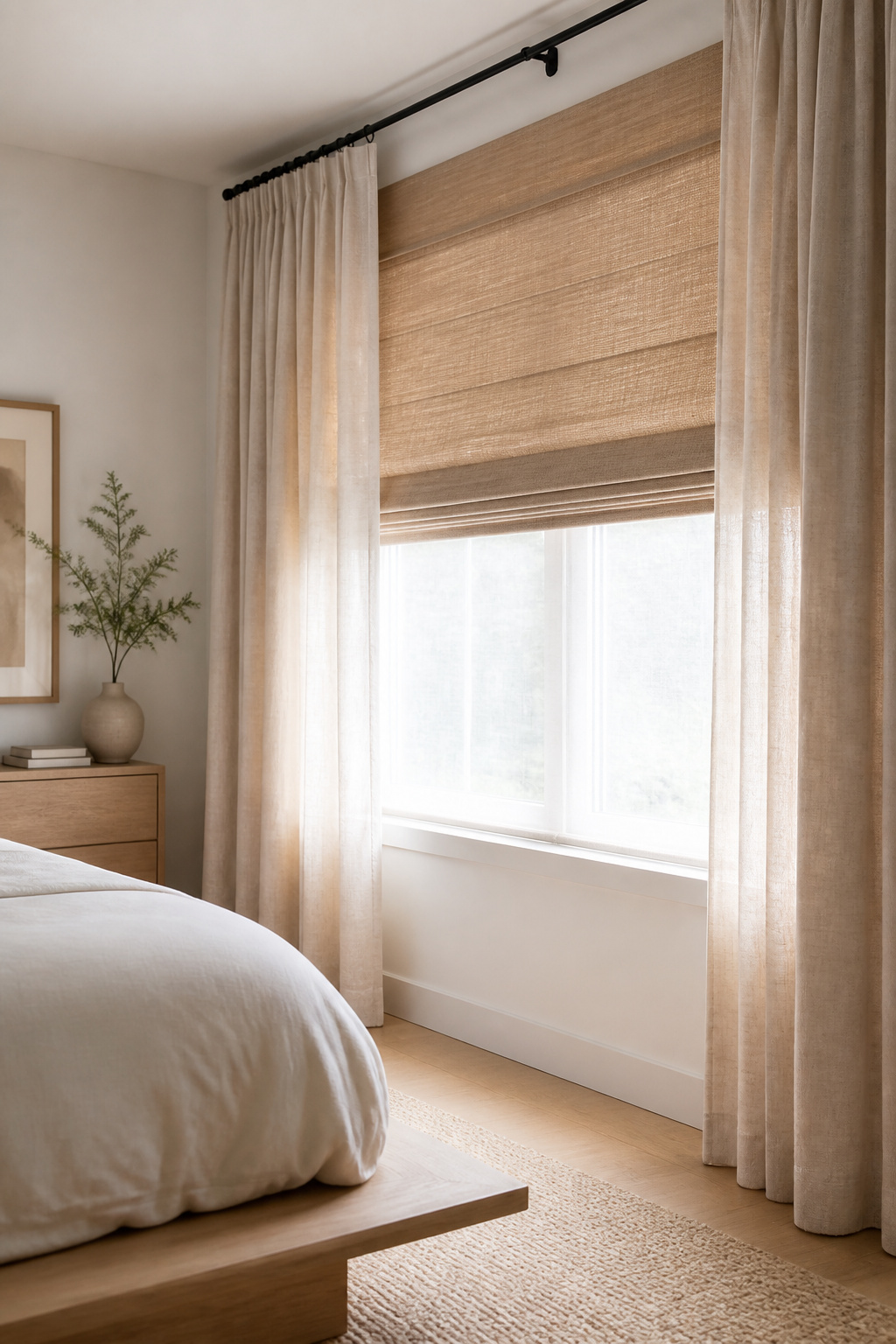
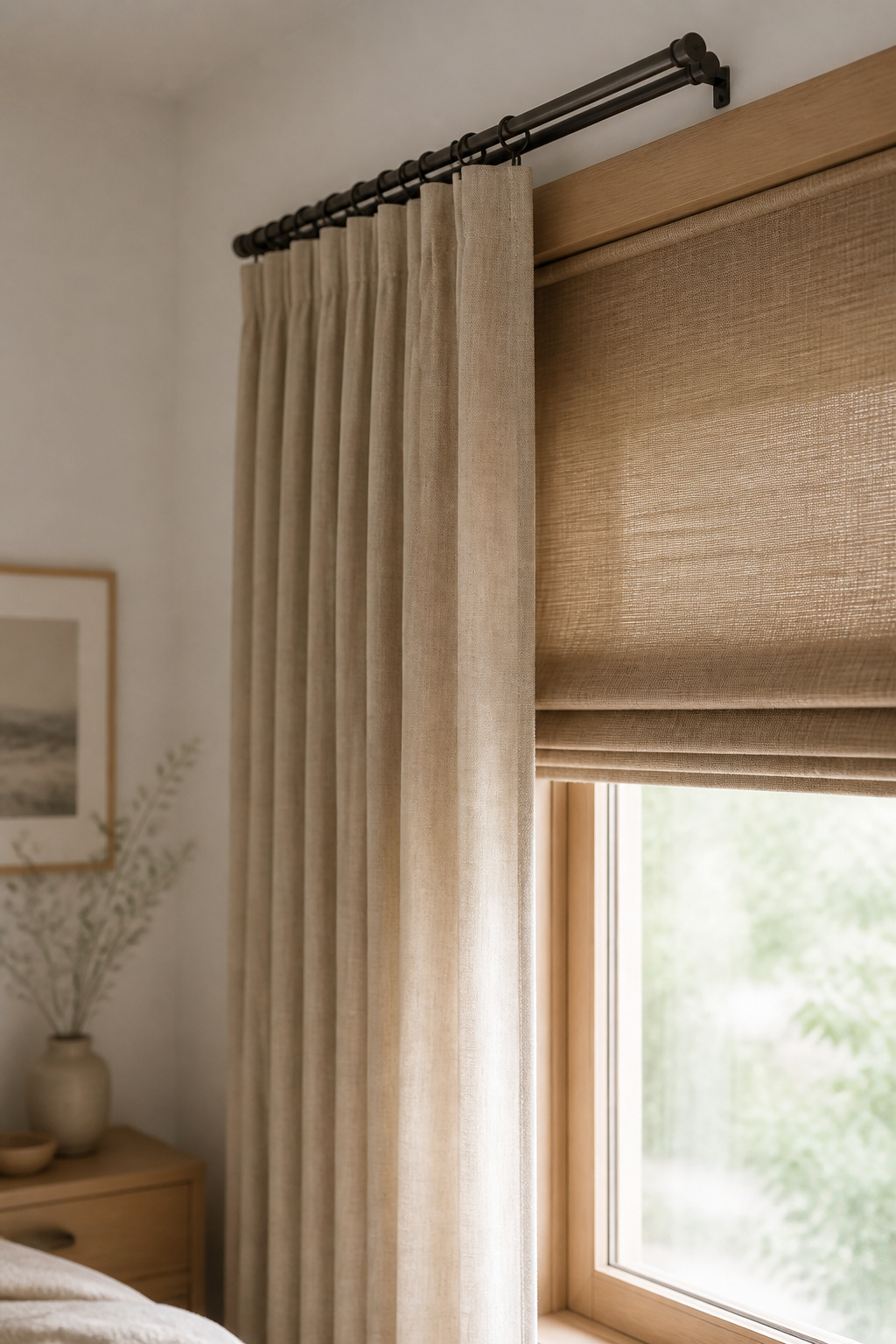
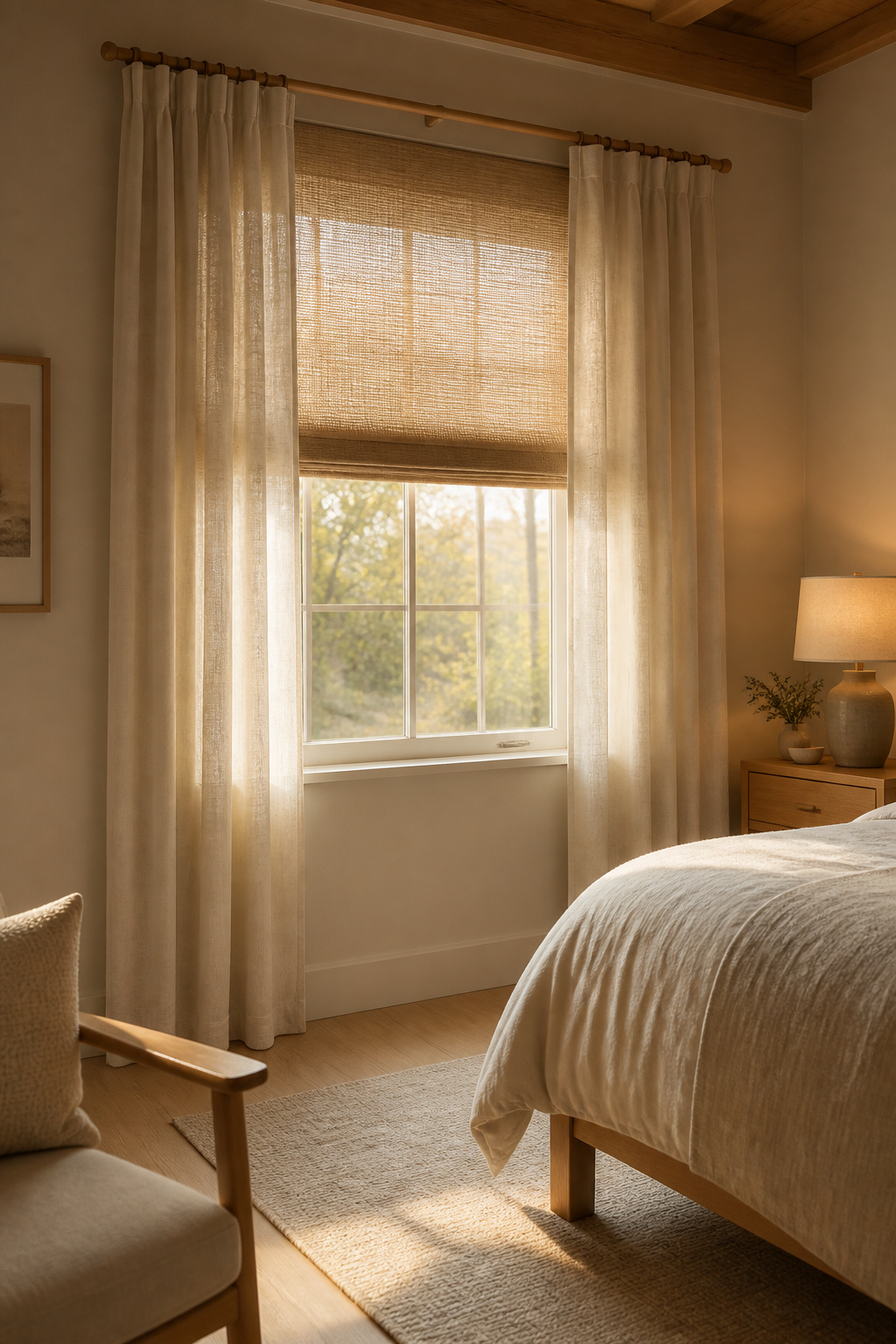
When you do layer, the structure is fixed: a functional base — a roman shade, cellular shade, or roller shade — does the light and privacy work, and a heavier decorative curtain adds softness, depth, and warmth on top. The classic bedroom pairing runs a light-filtering roller or solar shade as the daytime base with blackout drapery layered over it for nighttime darkness. As 3 Day Blinds’ guide notes, blackout curtains over a roman or roller shade give the strongest combination of privacy and light control a bedroom window can hold. The drapery over the base also stops drafts, adding a layer of insulation neither treatment gives alone.
Hardware for a two-layer setup
The mistake that undoes layered windows is mounting both treatments on one rod — they then can’t move independently. A double curtain rod solves it, letting each layer glide past the other without tangling. The base often mounts inside or close to the frame, while the decorative layer hangs higher and wider on the outer rod. Sold specifically for this job, double-rod hardware is the small part that makes the whole setup work. For the full technique — base choice, contrast, and mounting order — see how to layer curtains and blinds.
Getting the Hang Right: Height, Width, and Length
Here is the least glamorous truth in this whole guide: how you hang a treatment matters more than which one you buy. The same panel, moved a few inches, is the difference between a room that reads tall and one that reads squat. Three numbers govern it — height, width, and length — and they apply across every category.
Why near-ceiling mounting matters
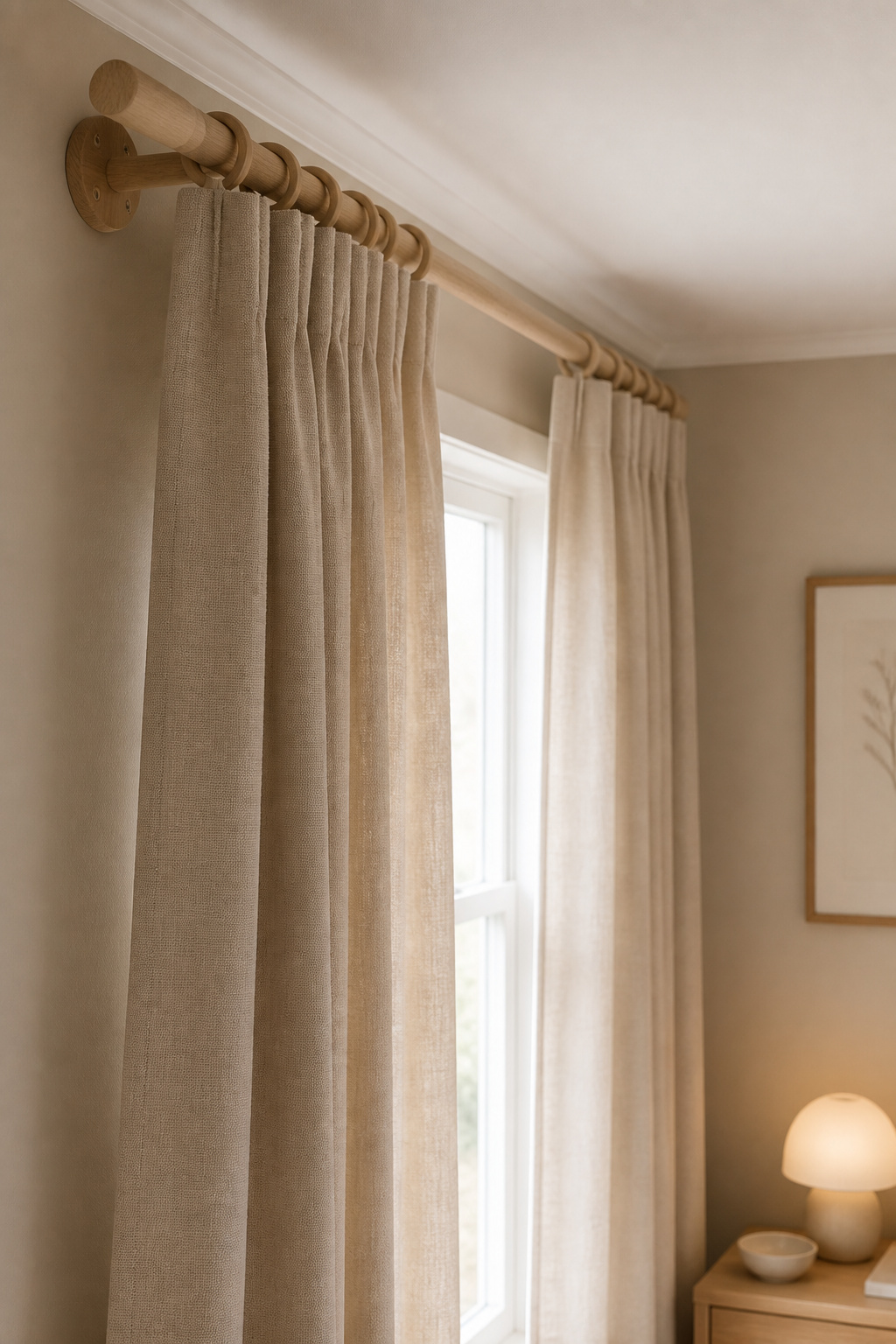
Do not mount the rod just above the window frame, however logical that feels. Hang it 4–6 inches below the ceiling or crown moulding instead, so the eye travels the full wall and the room feels taller. A useful second rule mounts the rod halfway to two-thirds of the way up the wall between the window top and the ceiling when there is generous space above the trim. For standard 8-foot ceilings, sit the rod roughly 3–5 inches below the ceiling; for taller 9–10-foot ceilings with a low window, 8–12 inches above the window trim reads better. The window did not move. Your eye’s sense of the room’s height did.
The width multiplier rule
Fabric has to read as lush, not thin. Curtain panels should total two to two-and-a-half times the width of the window — the 2x–2.5x fullness rule — so the fabric gathers into proper folds rather than stretching flat. The rod should also extend past the frame on each side, so panels stack fully off the glass during the day and let the morning light in. That is why the multiplier applies to fabric, not just rod length: you are buying enough cloth to look full and to clear the window when open.
Length: floor-skim vs. puddle
Length divides into three named looks. A skim (or kiss) uses the exact rod-to-floor measurement, or about a quarter-inch above the floor, for a crisp, tailored finish that suits nearly any room. A break adds about an inch, for a slight fold like dress trousers at the shoe. A puddle adds 1–3 inches or more, pooling the fabric 3–6 inches beyond the floor for a formal, dressier register — better in a bedroom than a high-traffic room. “We prefer a quarter of an inch above the floor for a crisp, tailored look,” interior designer Katie Davis told Homes & Gardens, and for a bedroom that wants calm over drama, that is my default too. The precise per-window measurements — and why panel length is the one number you take last — are covered in how to hang curtains the right way.
Choosing Blackout for Better Sleep
Blackout is not one thing. It is a technical category with real tiers, and treating “100% blackout” as a finished-room promise is where buyers go wrong. This section gives you the overview; the sleep science behind it lives in the dedicated guide.
Blackout percentage explained
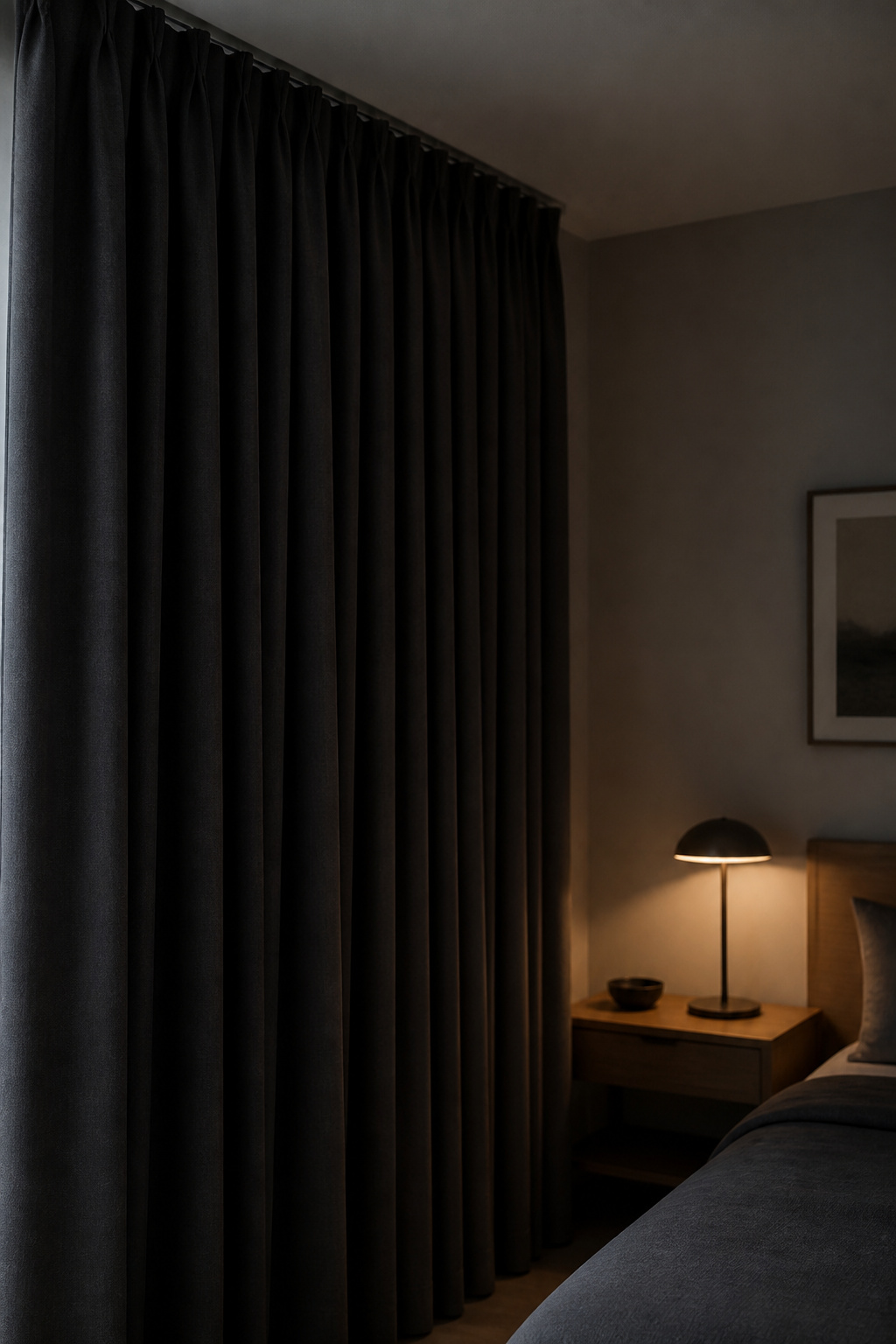
Most blackout-labelled curtains block 85–99% of light through the fabric. But “100% blackout” describes the fabric’s construction, not the room — light still leaks around the edges, top, and gaps regardless of grade. True 100% blackout fabric comes from one of two builds: a dense coating applied to the back, or a core of tightly packed yarns sandwiched between face layers that absorbs light rather than merely blocking it. Either way, the finished darkness is decided at the edges, which is why hanging matters as much as fabric.
Fabric weight and heading style
Weight tells you what you are getting. Blackout curtains typically run 200–400 GSM; blackout lining alone adds roughly 100–200 GSM, and thermal interlining another 80–150 on top. Heading style then decides the seal at the rod. Pleated headers — pinch pleat, goblet — use two to three times more fabric than flat panels, which increases both fullness and coverage. Grommet and tab-top styles, by contrast, leave small gaps between each ring where light enters, making them a weaker choice than pinch-pleat or rod-pocket for true blackout. The header is not just a look. It is a light seal.
Blackout vs. room-darkening
Room-darkening curtains use a lighter-density liner and filter roughly 70–90% of light — a genuine middle ground, not a failed blackout. If some daytime brightness is welcome, that middle ground may be the right call. Whichever you choose, the three failure points are the same: side gaps (panels too narrow), top gaps (rod mounted too low), and bottom gaps (curtains too short). Fix those with hardware, not more fabric. For the full sleep-first logic — matching blackout percentage and heading to your specific light problem — read Aisha Patel’s guide to choosing blackout curtains for sleep.
Small Windows and Tight Budgets
A small window is not a problem to compensate for. It is an invitation to do less, well. The instinct to pile on fabric — an extra layer, an oversized panel, a valance to look finished — is exactly what makes a small opening read crowded. Emptiness used on purpose is rest for the eye, and a modest window is where that principle pays off fastest.
Treatments that read as spare, not crowded
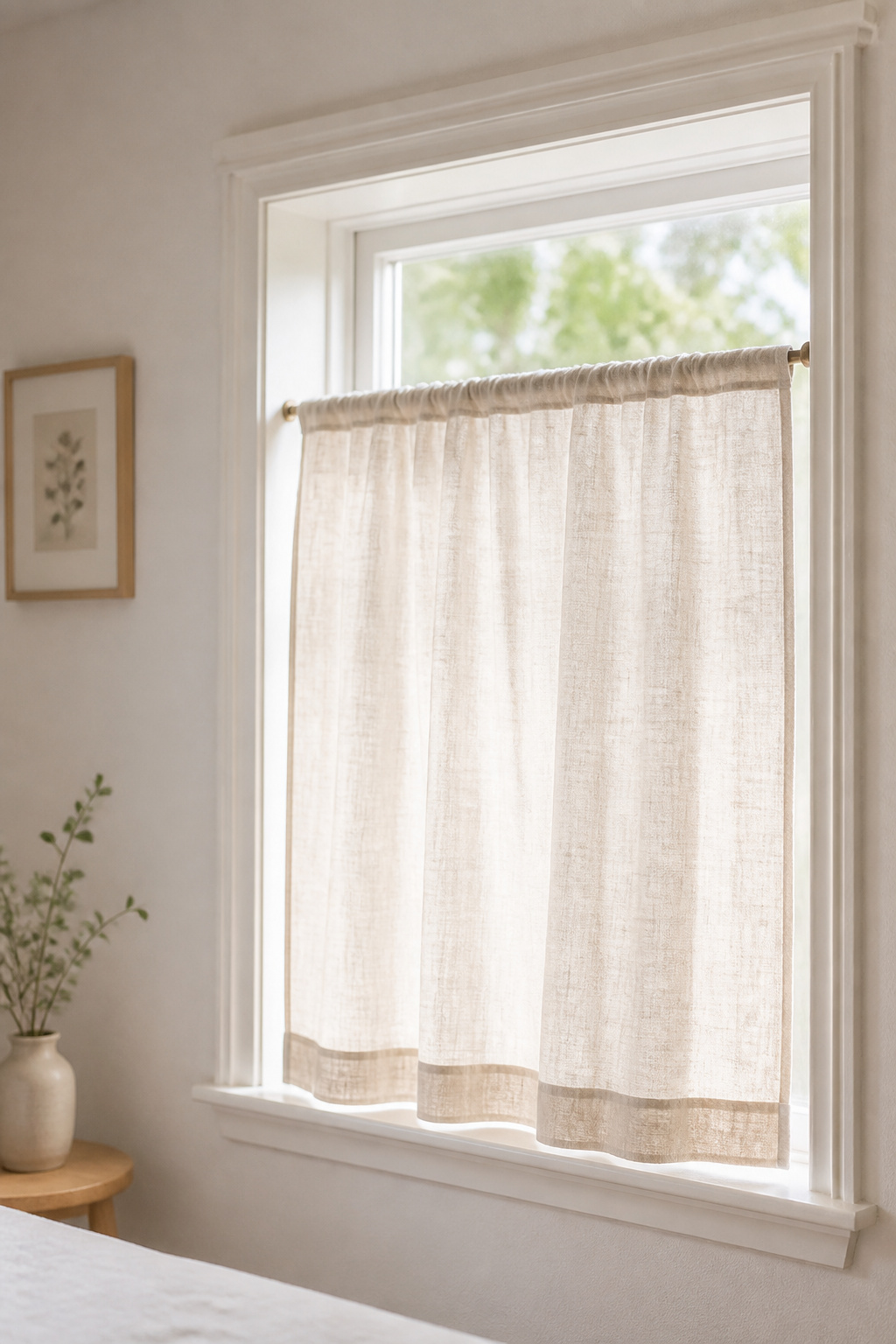
Lightweight, sheer-leaning fabrics create a feeling of openness where heavy drapery visually shrinks the wall. Roman shades read clean and tailored and fit snugly within the frame, needing no wall clearance on either side. Short curtains — sill-length or apron-length — save fabric and read as intentional rather than skimped, where full-length panels can overwhelm a compact opening. On a small window, the spare choice is not the cheap choice. It is the correct one.
Low-cost materials worth choosing
Budget does not mean cutting corners on look. Linen, voile, and cotton blends are affordable and small-window-friendly; muslin is especially budget-friendly and takes dye well if you want to customise it. Canvas painter’s drop cloths make a genuine low-cost substitute for retail curtain fabric — durable, with a neutral texture that works across most styles. Repurposed tablecloths or napkins clipped to a tension rod give patterned, higher-end-looking fabric at a fraction of the cost, with no drilling required. Quality here is about choosing one honest material and hanging it well, not spending more.
When less is genuinely more
Café curtains use less fabric than full panels and suit smaller openings, trading full coverage for lower cost. On a small window a single well-chosen treatment is the budget-appropriate default, since layering roughly doubles both hardware and fabric spend — the reverse of the general advice to layer. One panel, hung high and a little wide, does more for a small bedroom than two panels ever will. For the full set of tactics on constrained windows, see Aisha Patel’s small bedroom window ideas on a budget.
Nurseries and Kids’ Rooms: Safety Comes First
This section is the one place in the guide where style does not come fifth. It does not come at all until safety is settled. A window treatment in a child’s room is a safety decision before it is a design one, and the standard behind that is not advisory.
Cordless and code-safe options
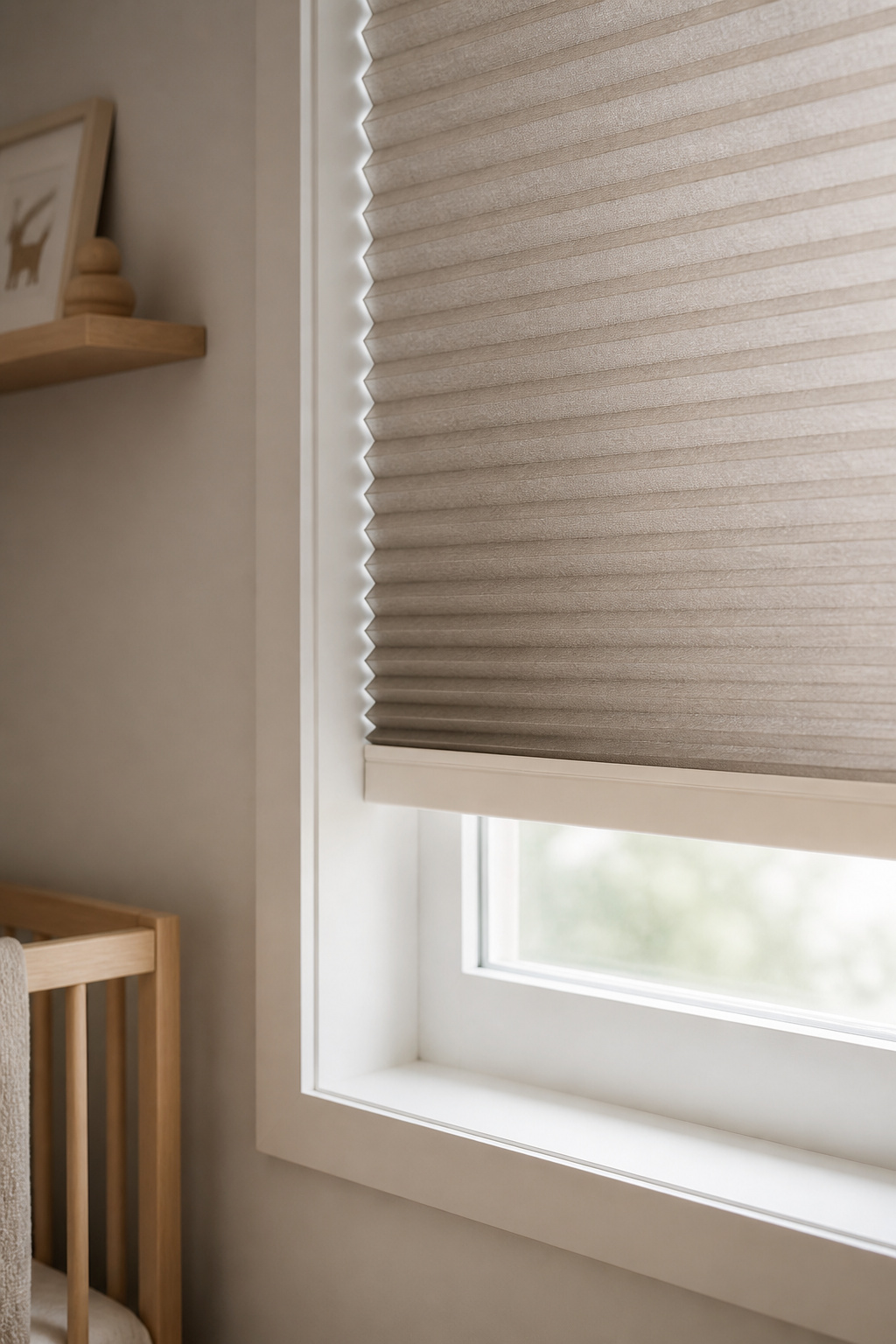
As of June 1, 2024, virtually all window coverings manufactured and sold in the U.S. — stock or custom — must meet the ANSI/WCMA A100.1-2022 standard, which requires coverings to be cordless or to have cords that are inaccessible or extremely short. The CPSC determined that accessible operating cords longer than 8 inches on custom coverings pose an unreasonable strangulation risk to children 8 and under, and states plainly that cordless coverings, or those with inaccessible cords, are the only safe option in homes with young children. This is not a preference to weigh against looks. It is the floor.
Blackout for consistent naps
Nap-time light control is one of the most requested nursery features, which makes blackout coverage a functional priority here rather than a style choice. The same blackout percentages and light-leak principles from the main bedroom sections apply directly — with cordless operation as the added, non-negotiable layer. A cordless cellular blackout shade meets both needs at once: no exposed cords, near-total darkness, and insulation in one low-profile treatment.
Choosing for the toddler years
Beyond cordless hardware, CPSC guidance recommends moving cribs, beds, and furniture away from windows and any covering cords, ideally to another wall. The reason this section leads with the standard is stark: on average, roughly nine children under age 5 die every year from strangulation in window blind, shade, or drapery cords. “Window cord strangulation is often silent,” the CPSC notes, “so a parent or caregiver nearby may not realize a tragedy is unfolding until it’s too late.” Sofia Martinez-Chen’s dedicated guide covers stage-adaptive picks and the full safety detail — read nursery and kids’ room window treatment safety before you choose.
Dressing an Unusual Shape: Bay and Bow Windows
Every rule above assumes a flat, rectangular window. A bay or bow breaks that assumption, and it is worth flagging as the architectural exception rather than discovering it at the checkout. The shape changes the hardware, and the hardware changes everything downstream.
Why standard rods don’t work
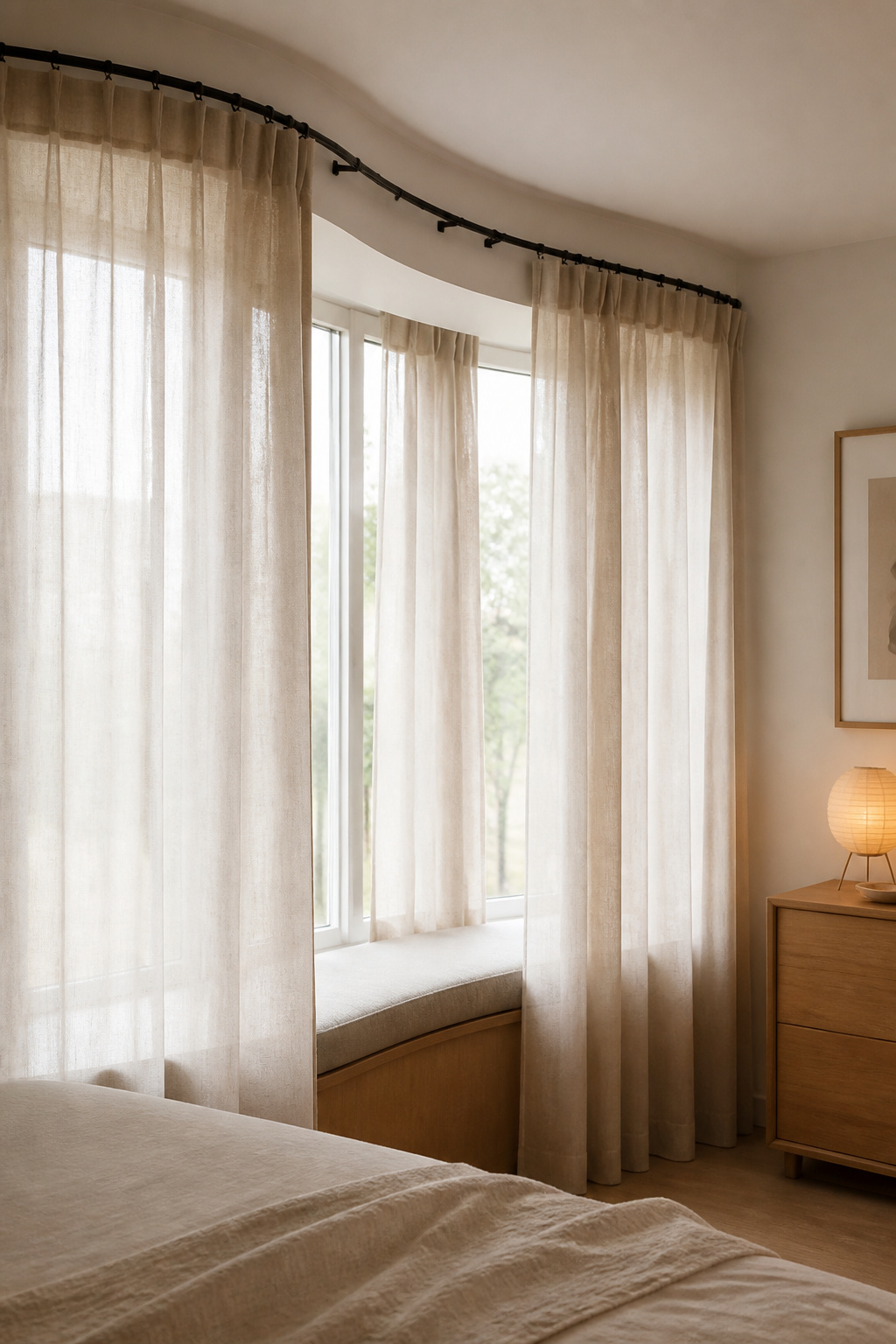
A bay window is genuinely several windows: three or more panels set at fixed angles — commonly 30, 45, or 90 degrees to each other, with 135 degrees cited as a standard overall bay angle. A straight rod cannot follow those angles, which is why standard single-rod advice leaves bay owners stuck. The fabric has to bridge corners a straight rod simply skips.
Curved track basics
The fix is a curved or bendable track built for the job. Bendable aluminium tracks can be forward- and reverse-bent by hand on-site to match a bay’s angles or a flat run — a typical spec bends to around a 4-inch radius. For an L-shaped or bay layout, total track length is the sum of the curtain widths across each individual section, not a single straight-line measurement. Get that sum right and the panels glide around every corner instead of jamming at the joins.
Proportion across multiple panels
Fullness has to hold around the bend, so install from the centre section outward toward the side panels. Working centre-out prevents fabric bunching at the angled joints and lets you adjust distribution panel by panel, since each angled section may need slightly different fullness to look balanced. It is a specialist job with its own logic — Rachel Blackwood’s guide walks the curved-track choice and per-pane proportion in full, so start there with bay window curtain ideas.
How to Choose: A Simple Decision Framework
Everything above narrows to one question and a short sequence. You do not need to weigh forty options. You need to name your top priority, match it to a category, then check your window shape and budget. Here is the framework, in order.
Rank your priority: light, insulation, sound, or style
Start where the room hurts most. If your top priority is sleep and light control, start from blackout percentage and heading style — pinch-pleat, sized wide and high. If it is temperature or sound, start from cellular shades or thermal-lined curtains. If it is precise daily adjustment, start from blinds. Style is real, but it applies inside whichever of these wins, not against it. And when two priorities genuinely tie — most often light control plus style, or insulation plus softness — layering is the answer, because no single-layer treatment optimises for both.
Match your window shape and budget
Now check two constraints the priority ranking can’t override. Shape first: a standard rectangular window takes any category, but a bay or bow window needs curved-track hardware regardless of what you hang on it — confirm that before choosing fabric or slats. Budget second: a small window or a tight budget favours a single, well-chosen treatment in a lightweight, low-cost material over a layered setup, reversing the general advice to layer. Two constraints, checked in order, and the field is down to one answer.
Where to go deeper
Each guide in this silo answers one branch of the framework, so open the one that matches your situation. For the head-to-head, read curtains vs. blinds vs. shades compared; to combine two treatments, how to layer curtains and blinds; to install any of them correctly, how to hang curtains the right way. For darkness and sleep, see choosing blackout curtains for sleep; for a small or budget window, small bedroom window ideas on a budget; for a child’s room, nursery and kids’ room window treatment safety; and for an angled window, bay window curtain ideas. You came in facing a wall of options with no way to sort them. You leave with one priority named, one category chosen, and one guide to open next. That is the whole decision — the rest is measuring.