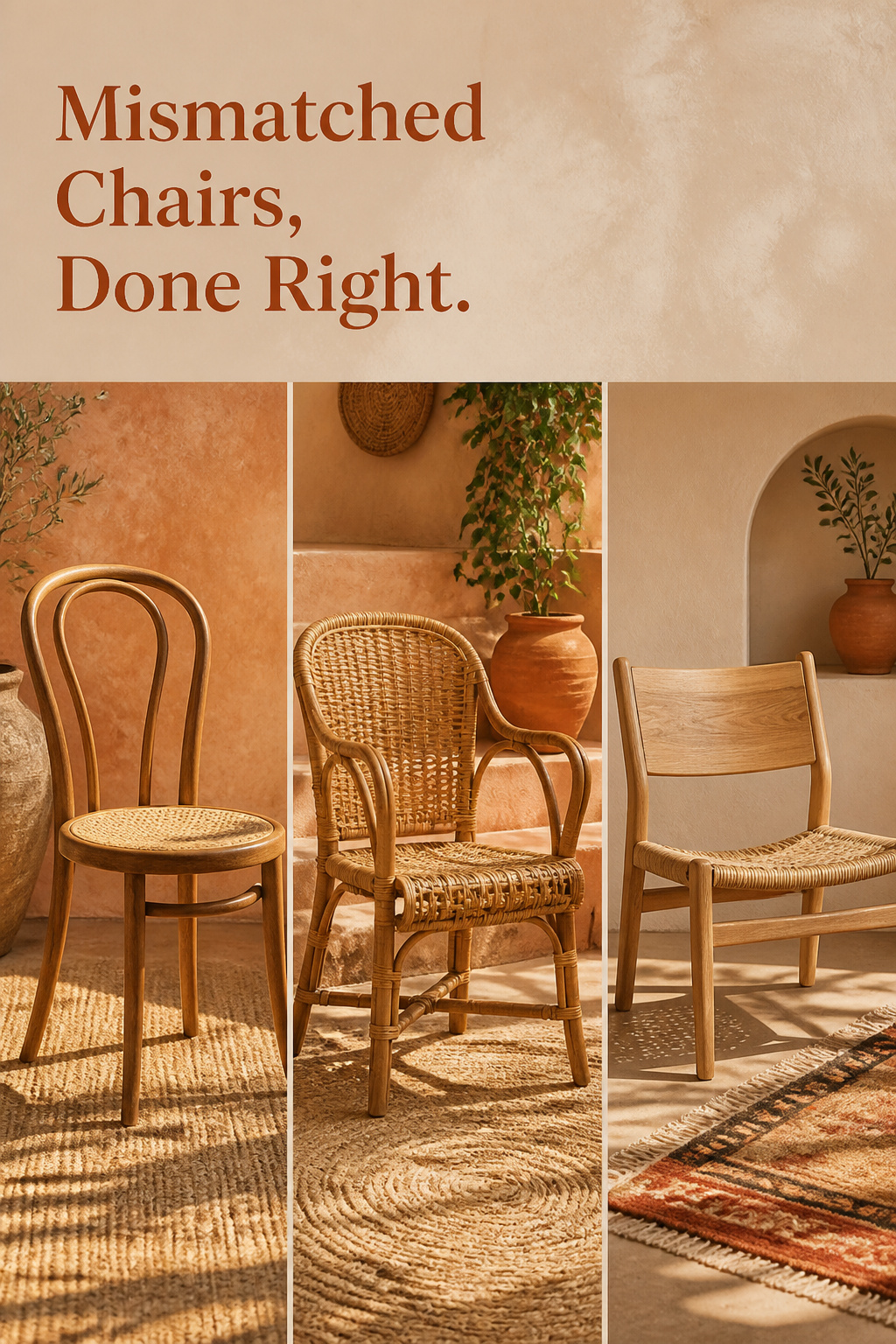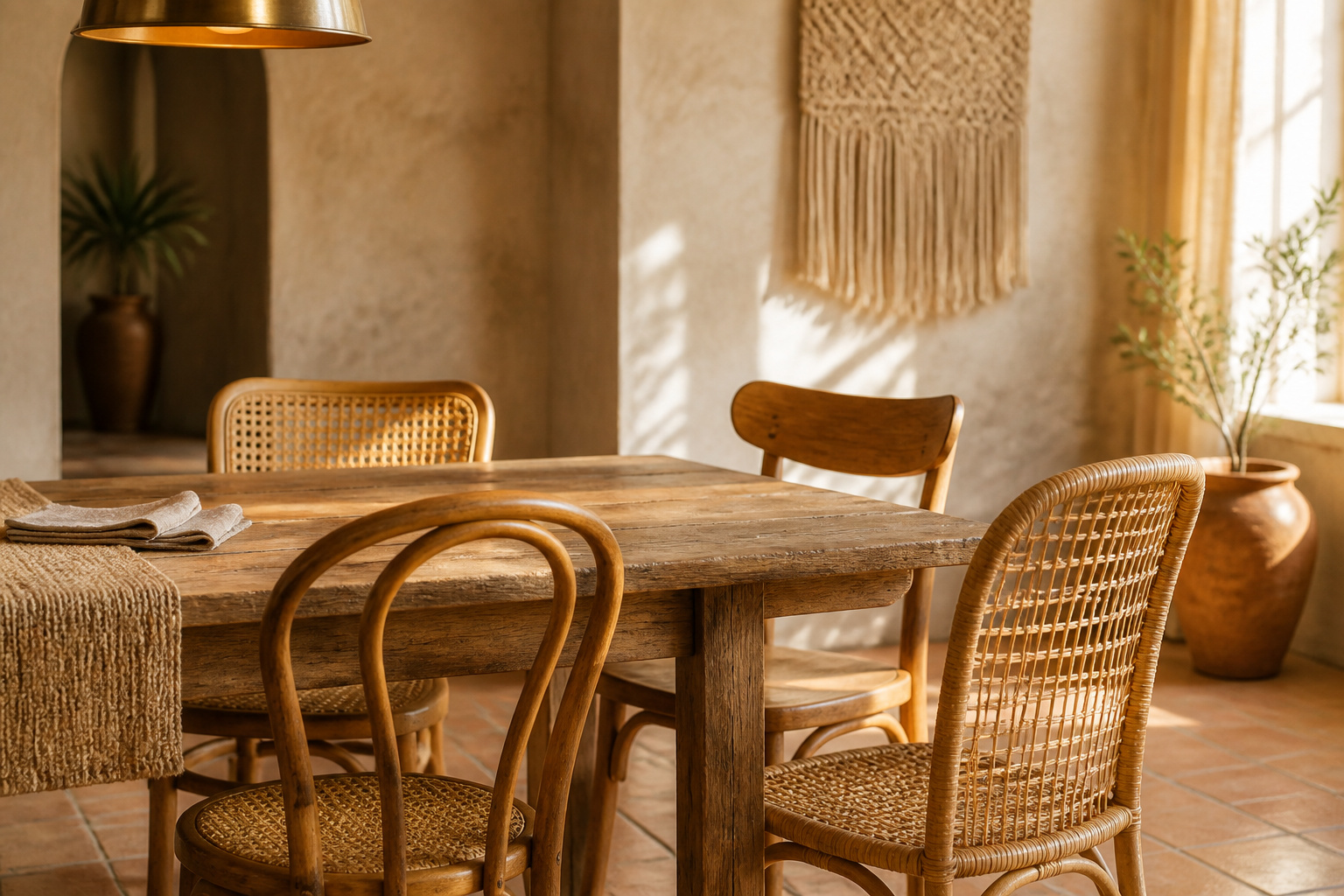

Here is the belief almost everyone starts with: a dining set should match, and mismatched chairs are what you settle for when you can’t afford six of the same. That instinct is backwards. Mismatched boho dining chairs are not a compromise — the deliberate mix of one vintage, one rattan and one modern chair is the single most repeated styling move in boho dining rooms, a technique with rules, not a leftover pile. Get the one rule right and it looks like a collection assembled with care; get it wrong and it looks like a garage sale.
TL;DR
- A mismatched set works when one thread — shared seat material, shared wood undertone, or a repeated leg shape — runs through every chair; without it, the mix looks accidental.
- Keep seat heights within 2 inches of each other (the standard is 17–19 inches) and cap the table at two or three distinct chair styles.
- Build it one anchor piece at a time from thrift stores, estate lots and marketplaces; inspect the joinery and do a wobble test before you buy the finish.
Why ‘Matching Set’ Is the Wrong Goal for Mismatched Boho Dining Chairs
The boxed set sells itself on convenience — six identical chairs, one delivery, no decisions — but a matching set gives you the one thing a boho table doesn’t want: uniformity.
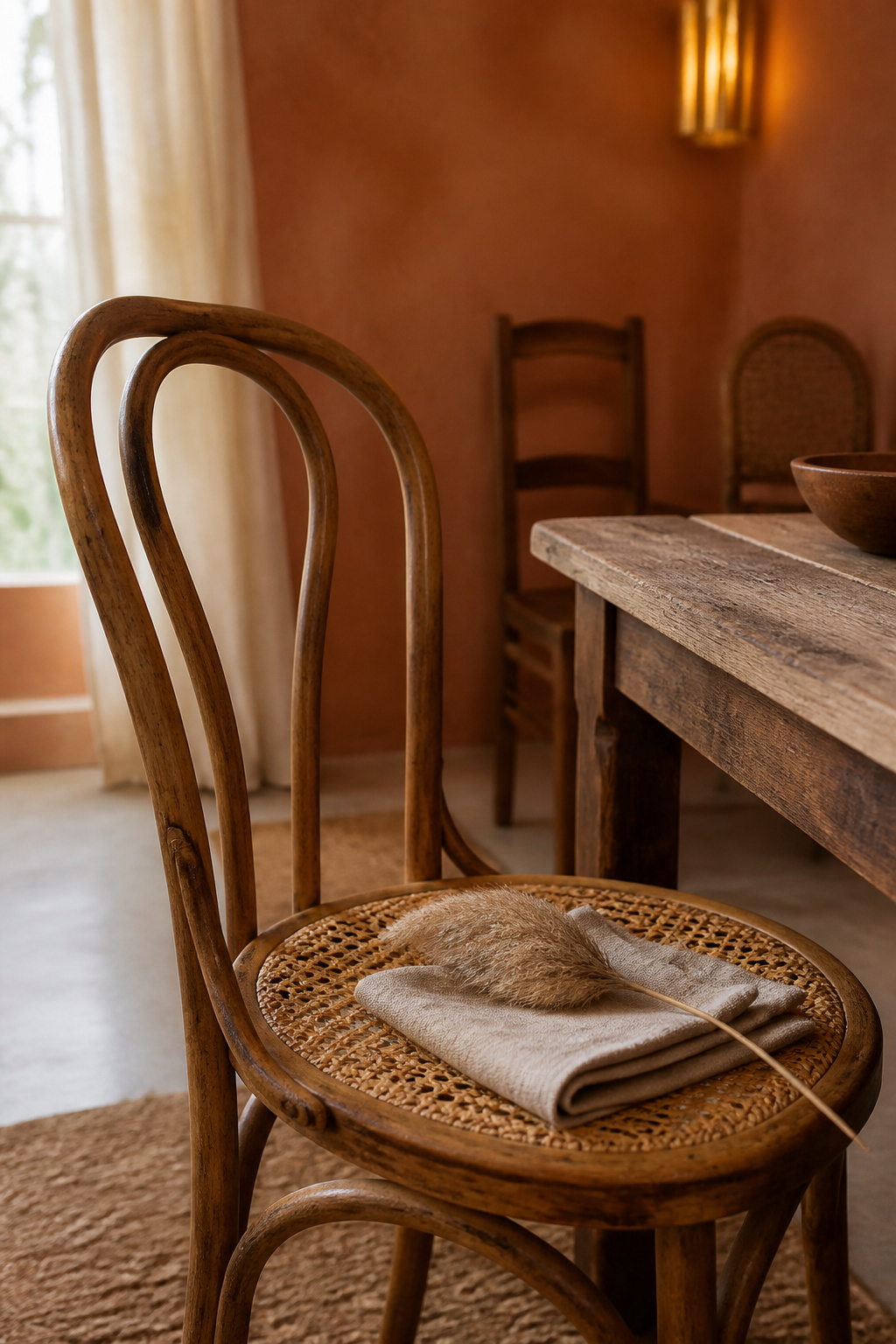
The belief that drives most first-time buyers to a boxed six-chair set
The matched look announces a set that was ordered, when a boho room wants the opposite impression — pieces that were gathered, the collected-over-time character no matching set can replicate.
What top-ranking boho dining rooms actually do instead
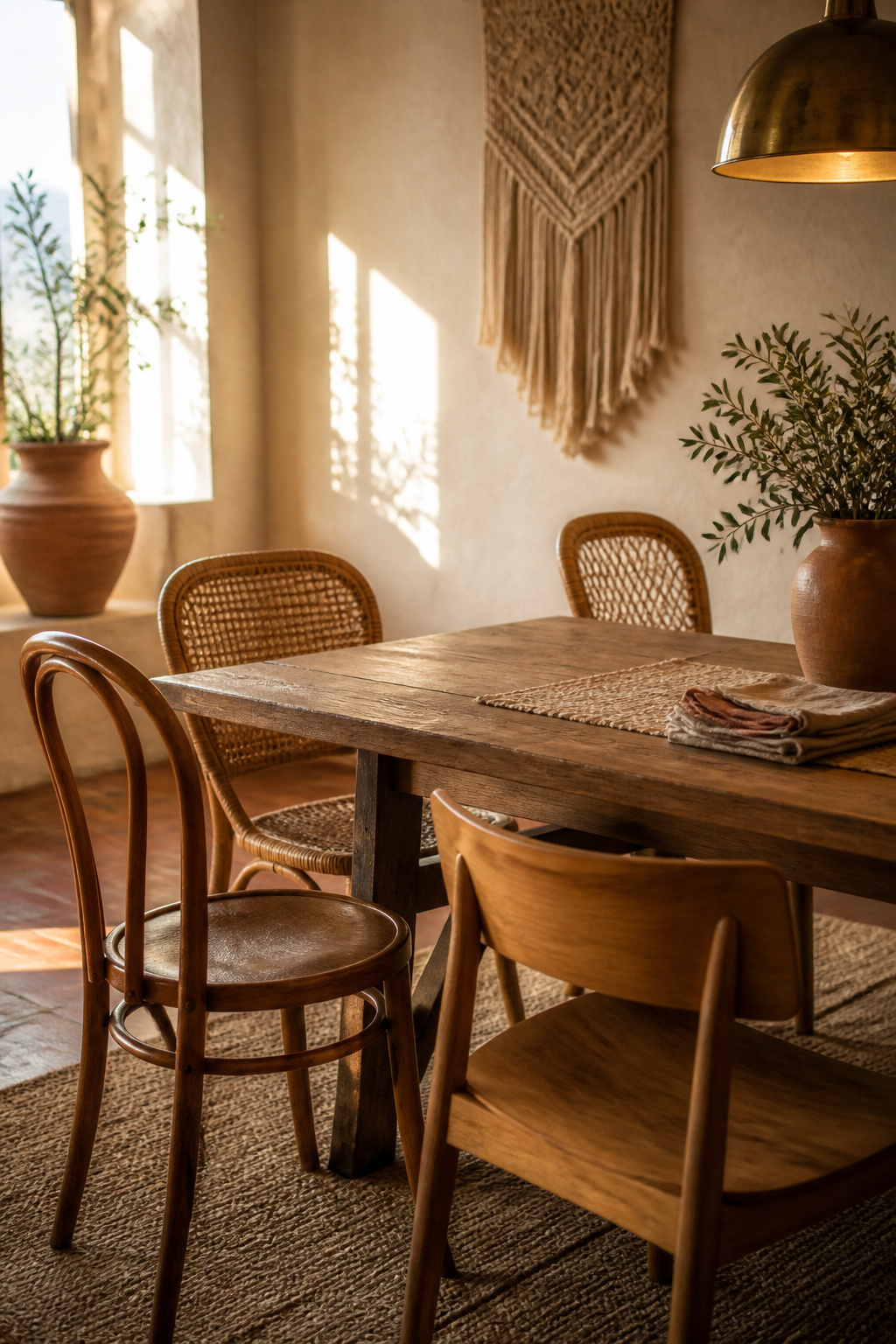
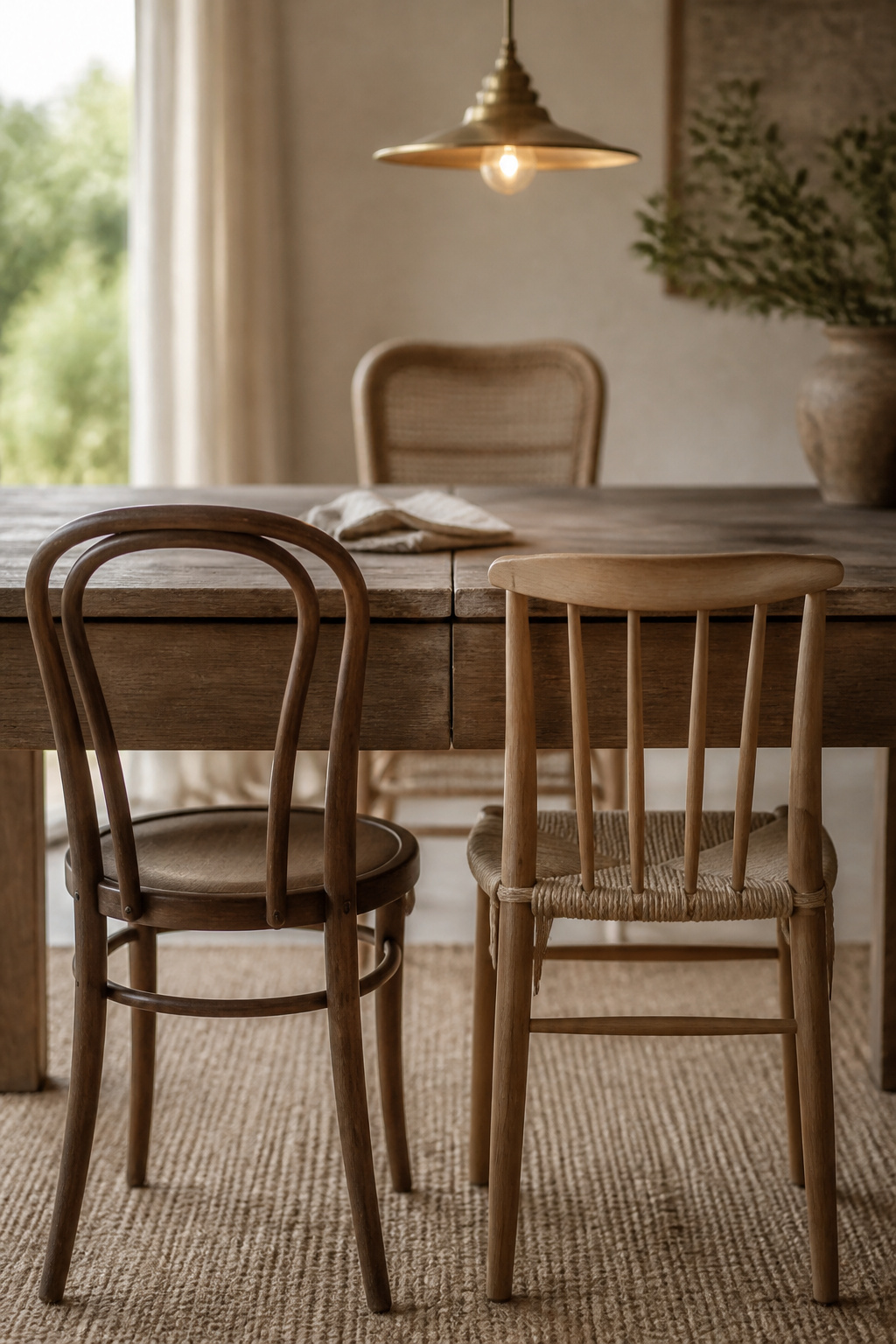
Look at the boho dining rooms that rank and the same move recurs: one modern chair, one vintage, one rattan, around a single table — Studio McGee treats the mix as the design statement; Emily Henderson’s studio frames it as a deliberate technique with rules, not a random assembly.
The one thread that separates ‘collected over time’ from ‘picked up wherever’
Restoration taught me to look for the thread that ties disparate pieces to one hand or one era, and a mismatched chair set needs exactly that. The common mistake is assuming mismatched means everything different; unrestrained variety overwhelms the eye, and the fix is deliberate repetition, not more difference.
The Unifying Rule: Pick One Thread and Repeat It
The rule is one thread, repeated — not a matching set, a coherent one. There are three reliable ways to draw it, and you only need one.
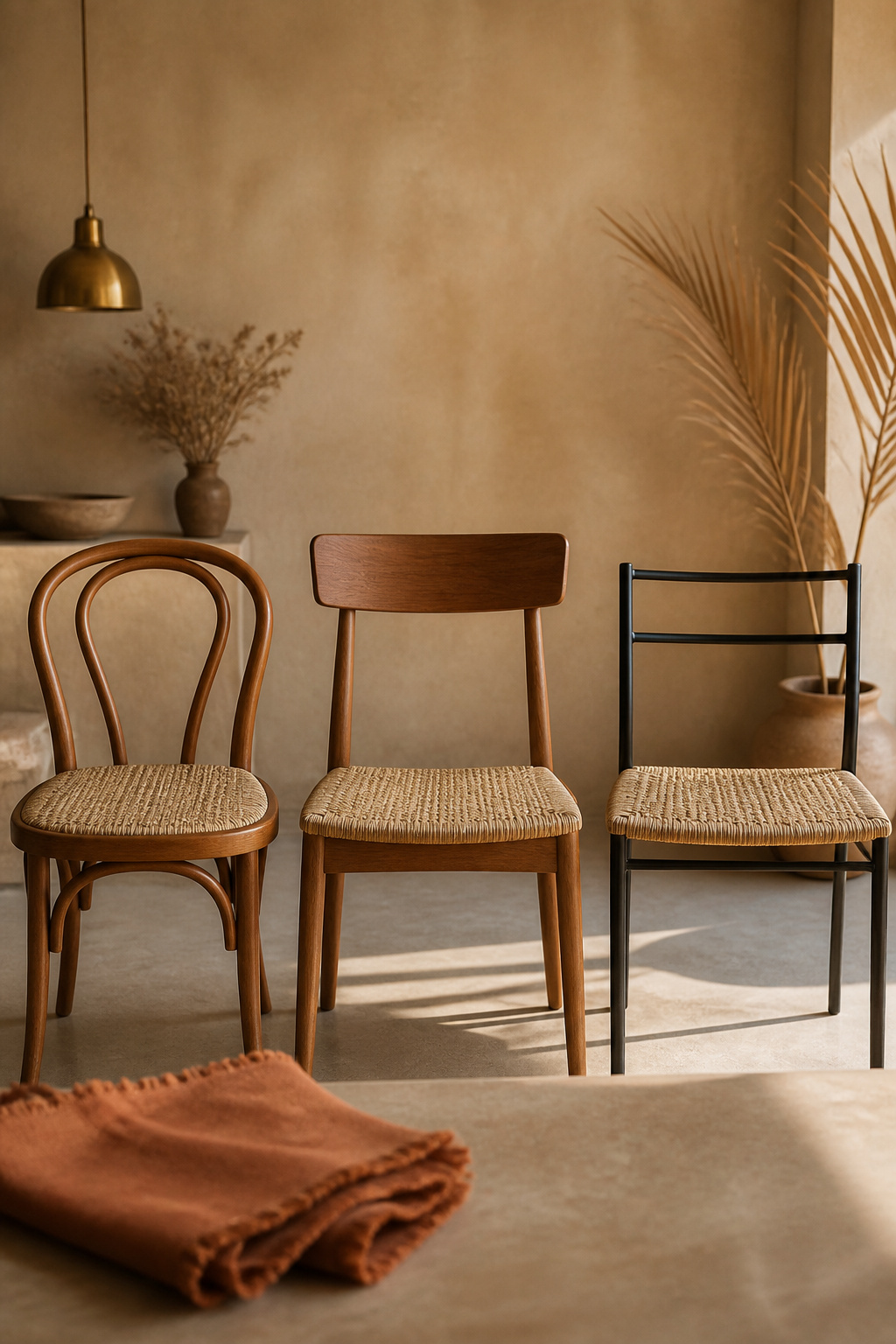
Shared seat material as the simplest unifying device
The easiest thread is material. Chairs in the same family — all wood-tone seats, or all natural-fiber seats — read as one set even when the frames have nothing in common. Cane and rattan are the boho workhorses: a woven cane seat can sit on a bentwood, ladder-back or modern metal frame, and the run hangs together because the weave repeats. The frames are free to argue; the material keeps the peace.
Shared color or undertone across otherwise different chair styles
If the material varies, let undertone carry the thread instead: warm-toned woods — oak, pine, cherry — pair with warm-toned rattan, cooler woods like ash or maple with whitewashed or gray-stained rattan. When two tones genuinely clash, a single painted chair becomes a practical bridge rather than a third combatant.
Repeated texture or leg shape as a subtler third option
The quietest thread is a shared silhouette: when material and color already vary, a consistent frame gesture — all tapered legs, or all curved backs — can bind the set instead. Whatever thread you choose, repeat it: per Havenly’s design guide, a unifying material or finish should appear in at least two, ideally three, places, or it registers as a stray.
Vintage, Rattan and Modern: What Each Brings to the Mix
The classic three-way mix isn’t arbitrary — each chair type carries a distinct job, and knowing it tells you what to hunt for.
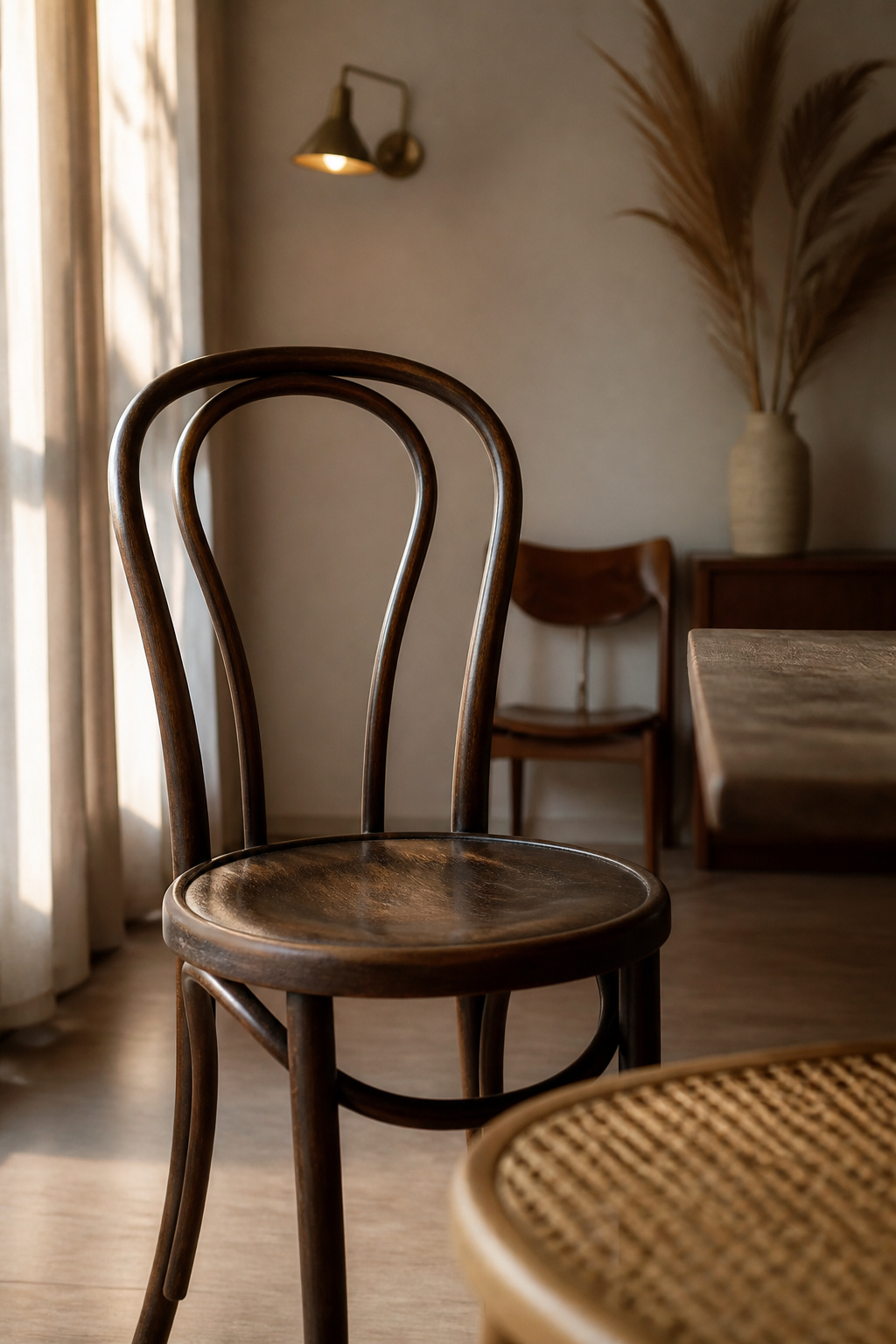
Vintage bentwood or carved chairs as the anchor piece with real provenance
Start with a vintage chair — it carries the history the rest of the mix borrows from. My usual pick is a bentwood café chair: those curved frames trace to Michael Thonet, born 1796, who pioneered the steam-bending process behind them, and by 1930 his company had sold over 50 million of its flagship chair — real pedigree hiding inside a thrift-store find. Darker walnut-stained examples, like the Czechoslovakian Drevounia chairs, lean Bohemian Art Deco.
Rattan and cane chairs for the woven texture the style leans on
Rattan is the load-bearing texture of the whole look — a palm relative native to Southeast Asia, with cane referring to the woven skin of the vine you see across seats and backs. Most vintage rattan dates to the 1960s-70s boho-hippy years; it fell from favor through the chrome-and-glass 80s and 90s, then returned in the late 2010s alongside boho’s revival — why it feels native to the style.
One modern chair as the quiet counterweight that keeps the room livable
The modern chair earns its place by doing the least — one clean, low-back wood chair that keeps the vintage and the rattan from turning the table into a period set. Hold the table to two or three distinct styles total; pairing super-modern, mid-century and a farmhouse pedestal all at once reads as noise, not curation.
Proportion and Comfort: The Rules That Keep It Usable
A mismatched set has to work as furniture, not just photograph well — and a handful of hard tolerances, the numbers I check with a tape measure before I fall for a finish, keep it comfortable. Ignore them and you get a set that looks collected but sits like a jumble.
| Tolerance | The rule | Why it matters |
|---|---|---|
| Seat height | 17–19 in floor to seat; keep every chair within 2 in of the others | Diners sit at the same level; below this, the mix feels uneven at the table |
| Seat-to-table clearance | 10–12 in between seat top and table underside | Standard against a 29–30 in table; keeps knees comfortable |
| Backrest height | Vary by no more than 2–3 in across the set | Prevents a visibly “zig-zagged” skyline of chair backs around the table |
| Armrest height | At least 1 in below the table apron | A 26 in apron needs arms no higher than 25 in, or the chair won’t slide under |
| Style count | Cap at 2–3 distinct chair styles | More overwhelms the eye instead of looking curated |
Seat height tolerance before a mixed set feels uneven at the table
Seat height matters most: hold every seat within 2 inches and every diner sits level, which is exactly why the rest of the styling can vary with abandon.
Arm height and table clearance across different chair styles
Armchairs are where mismatched sets quietly fail — the real test is whether the arms clear the apron, that skirt of wood beneath the surface, not just whether the chair fits under the tabletop.
How many head-of-table or accent chairs a set can carry
The cleanest approach: two distinct chairs at the heads, a more uniform style down the sides. They read as intentional accents rather than a second set, provided they still share a curve, color or finish with the rest.
Grounding the Mix With the Right Rug
There’s one last thread, underfoot: a rug — a patterned kilim especially — bridges eras the way a shared seat material does, pulling unmatched chairs into one visual whole.
A quick preview of the layering technique that unifies chairs and floor
The boho approach is usually layered — a large neutral jute or sisal base with a smaller vintage kilim on top — just make sure the pattern echoes your chairs’ unifying thread rather than fighting it. Sizing, placement and sourcing is its own subject, handed off in full to layering a rug under your dining chairs.
Sourcing Chairs That Mix Well Without Overspending
The whole approach is affordable because you’re not buying a set — you’re hunting individual chairs at set-of-one prices.
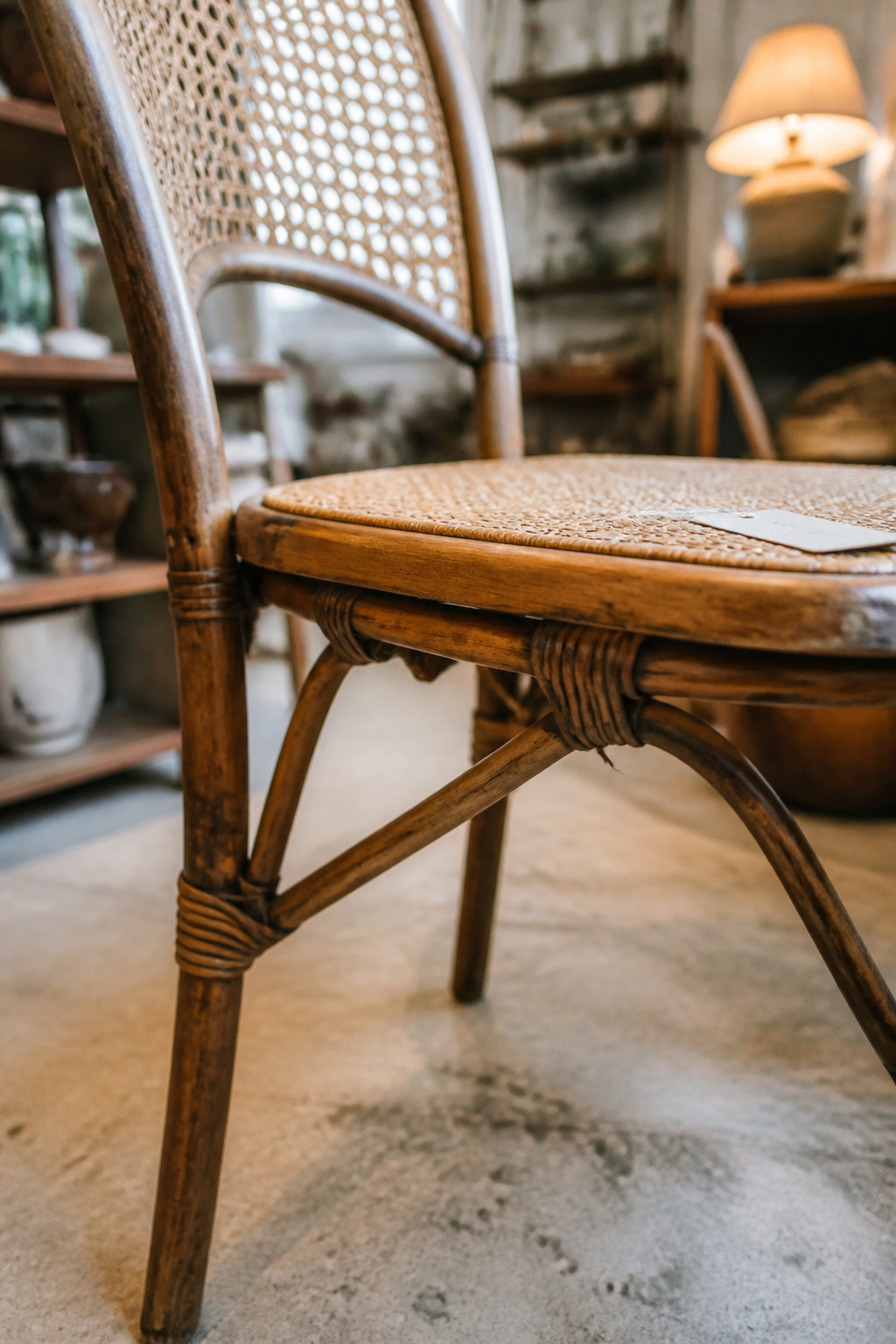
Where to find vintage and rattan chairs secondhand
Vintage bentwood and rattan come through overlapping channels: consignment shops curate, flea markets reward haggling, thrift stores offer the widest variance, and Facebook, eBay and Chairish sit in between. A bentwood chair can sometimes turn up under $50 at a thrift store, though that’s the lucky end now that pricing has climbed. Vintage rattan sets run roughly $200 to $2,000+ depending on condition and maker, with McGuire, Ficks Reed and Heywood-Wakefield at the top.
What to inspect before buying a used chair
A chair’s future lives in its joints, not its finish — look for dovetail, mortise-and-tenon or dowel joinery rather than staples and nails that loosen over time. Then run the field test I use on every rescue chair:
- Wobble test. Sit in it and check that all four legs stay flush to the floor without sway — the fastest read on sound joinery.
- Joint check. Eyeball the leg-to-seat joins for a cut joint versus a bracket or screw doing the work alone.
- Seat integrity. On upholstered seats, press the base from underneath — a sag there is discomfort the cushion hides.
A flawless finish over a loose frame means a repair within a year; a sound frame under a tired finish lasts.
Building a mixed set over time rather than in one trip
Don’t complete the set in a single afternoon. Grow it one chair at a time, filtering each by “does it fit the thread,” not “do I like this.” Our guide to sourcing mismatched chairs on a budget covers the money side, and the pillar on boho dining room ideas sets the seating in the wider room.
So the thing you couldn’t do before — trust a mismatched set to read as collected, not accidental — comes down to one choice and a tape measure: pick your thread, repeat it, hold every seat within 2 inches, and buy your anchor chair first so the rest can answer to it. The chairs won’t match; they were never supposed to.
FAQ
Do all mismatched dining chairs need to be the same height?
Not identical, but very close. Seat height should stay within about 2 inches across the set, and the standard range is 17 to 19 inches from floor to seat. Backrest height can vary a little more — within roughly 2 to 3 inches — to avoid an uneven chair line. As long as seat height holds, everything else can vary.
Can you mix wood tones with painted or rattan chairs in a boho dining room?
Yes. There’s no rule against multiple wood tones in a room; the requirement is intentional repetition of a color or material at least two to three times, not avoidance. Matching undertones helps most — warm woods with warm rattan, cooler woods with whitewashed rattan. A painted chair works as a practical bridge between two tones that would otherwise clash.
How many different chair styles is too many around one table?
Cap the table at two or three distinct chair styles total; beyond that, the set overwhelms the eye instead of looking curated. The most common structured approach is the anchored one: two standout head chairs at either end plus a coordinated style along the sides. Combining super-modern, mid-century and farmhouse styles all at once is specifically too many.