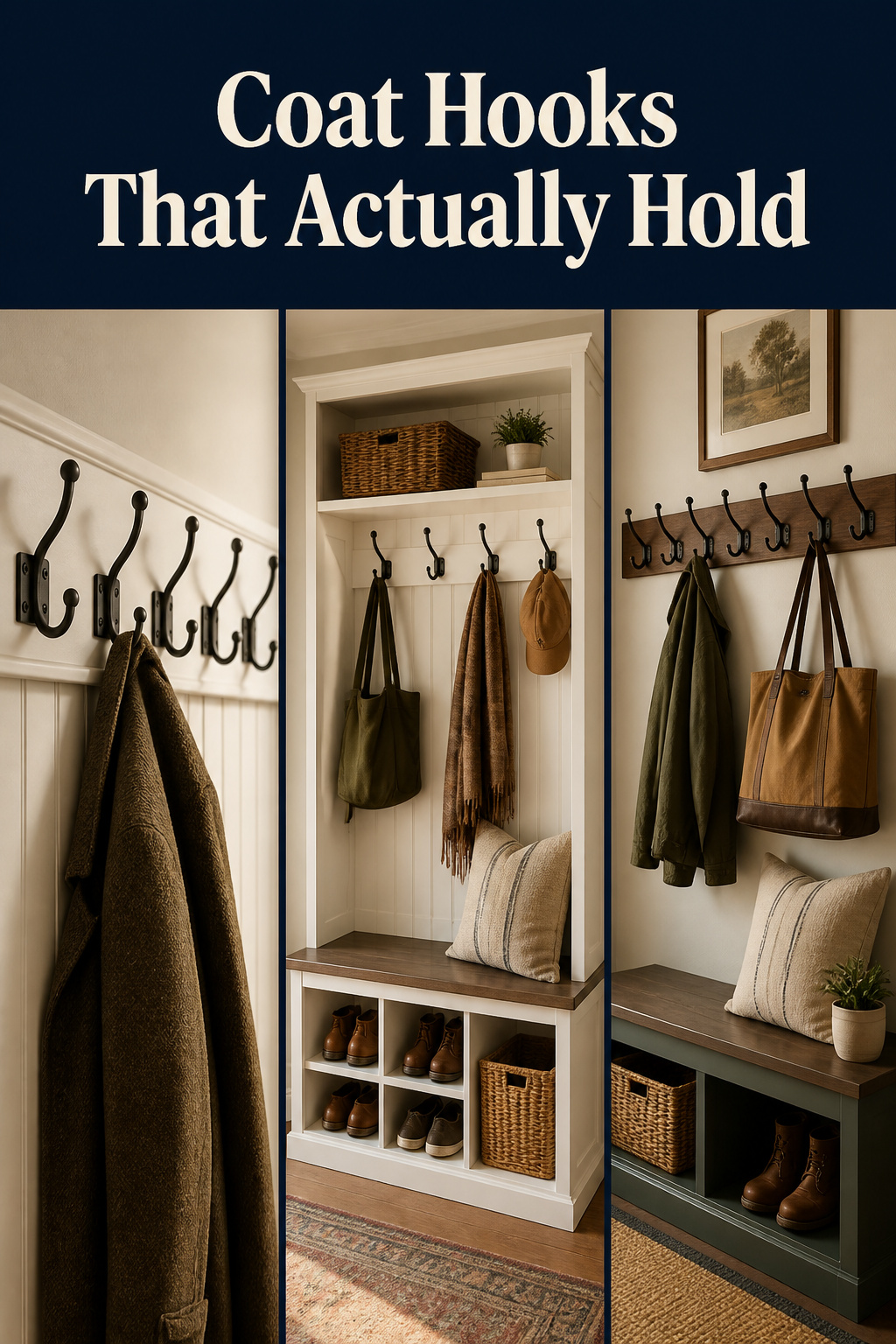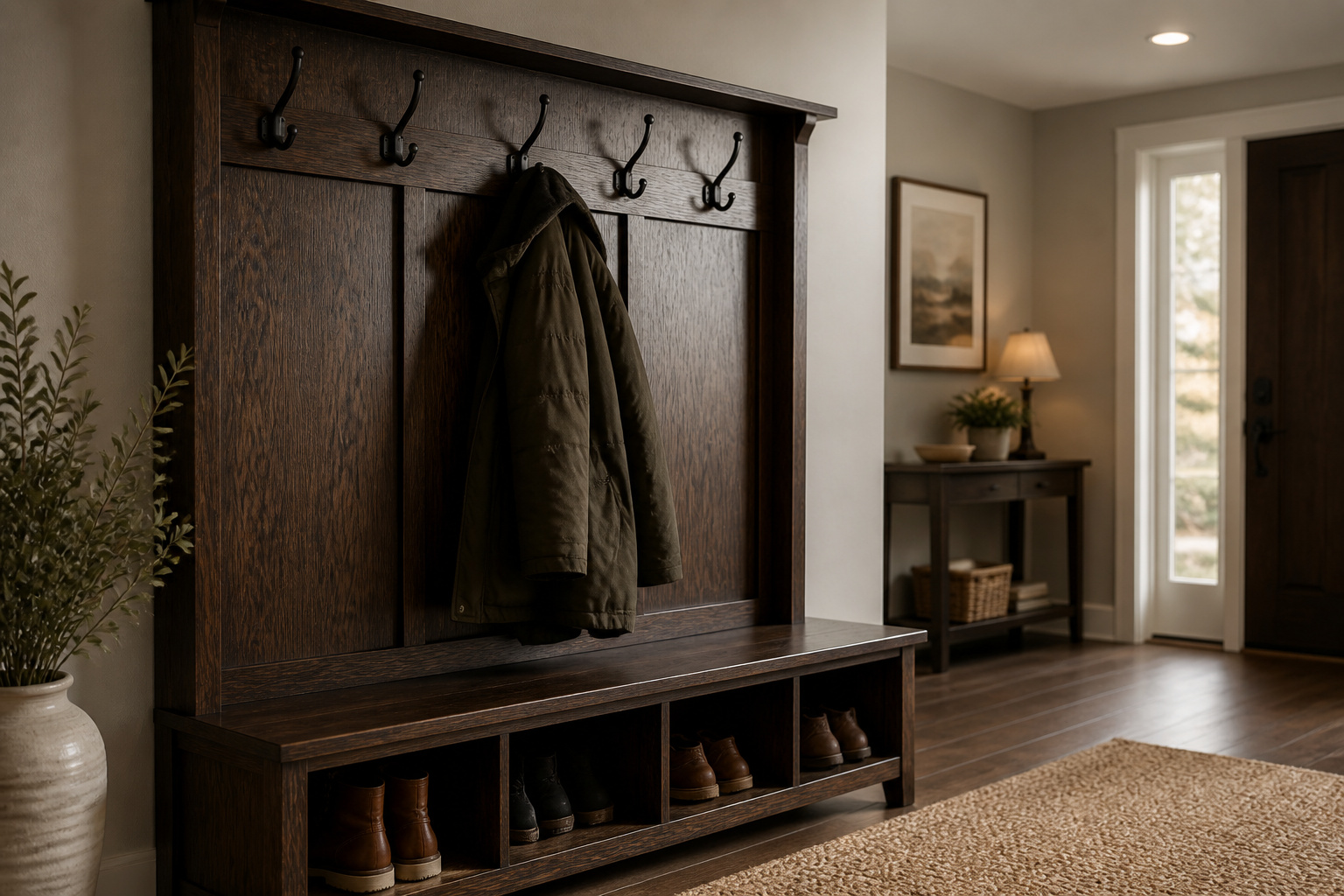

Most people buy a hall tree thinking it’s a coat rack with a bench bolted on. It isn’t. A good entryway bench with coat hooks is a vertical storage system, and whether it works comes down to two numbers nobody checks: how high the hooks sit, and what’s in the wall holding them up. Get those wrong and you’ve got coats on the floor and screws pulling out of drywall within a year.
TL;DR
- Mount adult hooks 60–66 inches from the floor; above a bench, that’s 40–42 inches above an 18–20 inch seat, so coat hems clear the cushion.
- Every hook needs a stud or a rated anchor: a 3-inch screw into a stud holds 80–100 lbs, a SnapToggle in 1/2-inch drywall carries ~66 lbs. Skip the plastic kit anchors.
- A DIY 1×6 poplar hook rail costs $20–$50 and takes an afternoon — cheaper and tougher than a budget MDF hall tree, whose hooks are only rated 10–11 lbs.
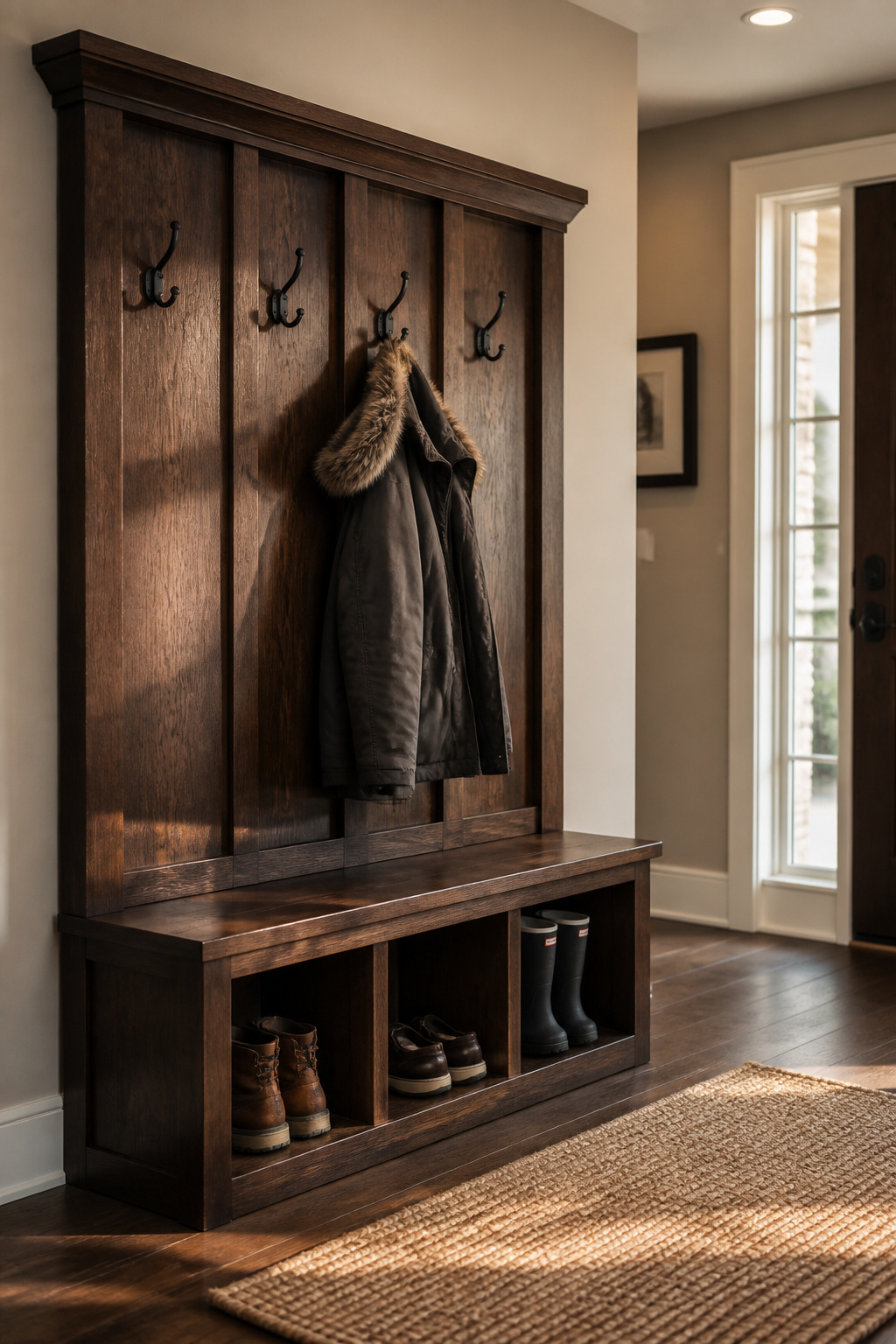
Still working out the bench? Start with the entryway bench sizing and ideas guide first.
Hook Height: The Number That Makes or Breaks a Drop Zone
The test of a real drop zone is whether everyone can hang their own coat without thinking about it. That’s almost entirely a height question.
| User | Hook height (from floor) | Notes |
|---|---|---|
| Adult | 60–66 in | 60 in is best above a 17–19 in bench seat |
| Child (4–10) | 36–42 in | 42 in standard; 36 in for smaller kids |
| Upper row (dual) | 62–65 in | Takes the bulky winter coats |
| Lower row (dual) | 36–42 in | Backpacks, kids’ jackets |
Adult hook height: 60–66in for heavy coats
The non-accessible standard is 60–66 inches above the finished floor, based on average adult shoulder-to-eye height — ergonomics confirmed by accessibility specialists, not a code requirement. At 60 inches, a knee-length coat’s hem sits 18–22 inches above the floor: clear of the bench below.
Above a bench, go lower: subtract the bench height from 60. A 20-inch bench means hooks go 40 inches up the wall. Mount at 66 and they feel too high the second you sit down.
Child hook height: 36–42in so a six-year-old actually uses it
A child won’t reach for an adult hook — they’ll drop the coat on the floor and you’ll pick it up. The fix is a lower row at 36–42 inches. Most guides cite 42 inches as standard; drop to 36 for younger kids.
Multi-row hook rails: how to space two rows without one pulling the other off the wall
For two rows, put the upper at 62–65 inches and the lower at 36–42 inches. Leave at least 20 inches between them — practical consensus, not a codified standard, but it holds up: an adult coat hangs 40–50 inches collar-to-hem and needs that clearance to swing past the lower rail. Space hooks 10–12 inches apart for coats, 15 inches for heavy parkas. Anchor each rail on its own fasteners — never both off the same pair of screws.
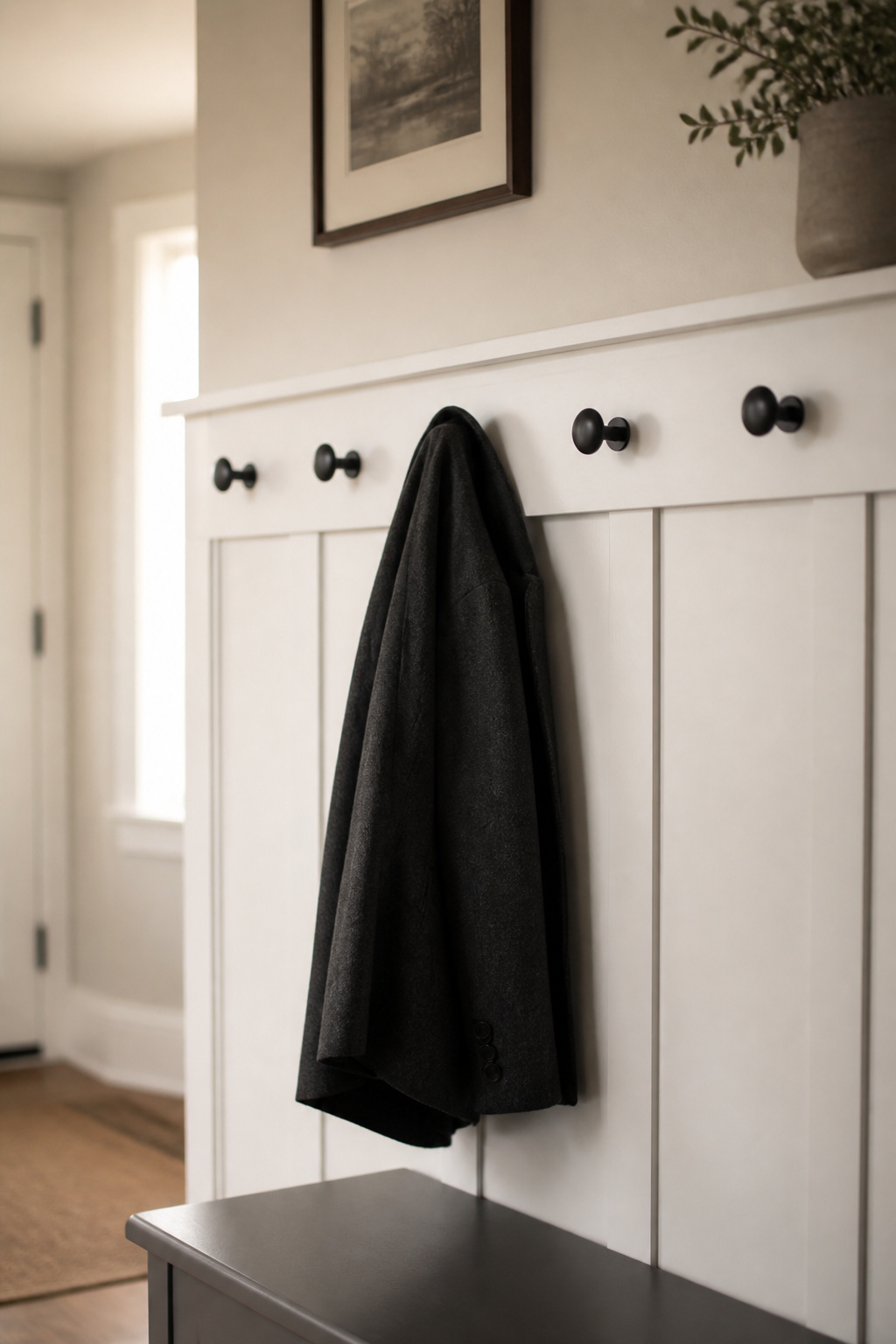
Hall Tree vs Separate Rail-and-Bench: Which Setup Wins
A hall tree isn’t furniture you walk past; it’s one zone doing three jobs — hooks, bench, and shoe storage as a single system. The question is whether you buy it assembled or build it from parts.
| Configuration | Space needed | Anchoring | Price range |
|---|---|---|---|
| Freestanding hall tree | 42–54 in entry width | Anti-tip strap to stud | $80–$3,250 |
| Wall-mounted hall tree | Unit width + studs | Lag bolts into studs | $250–$1,500 |
| Separate rail + bench | Bench depth (14–18 in) | Each piece anchored separately | $130–$380 combined |
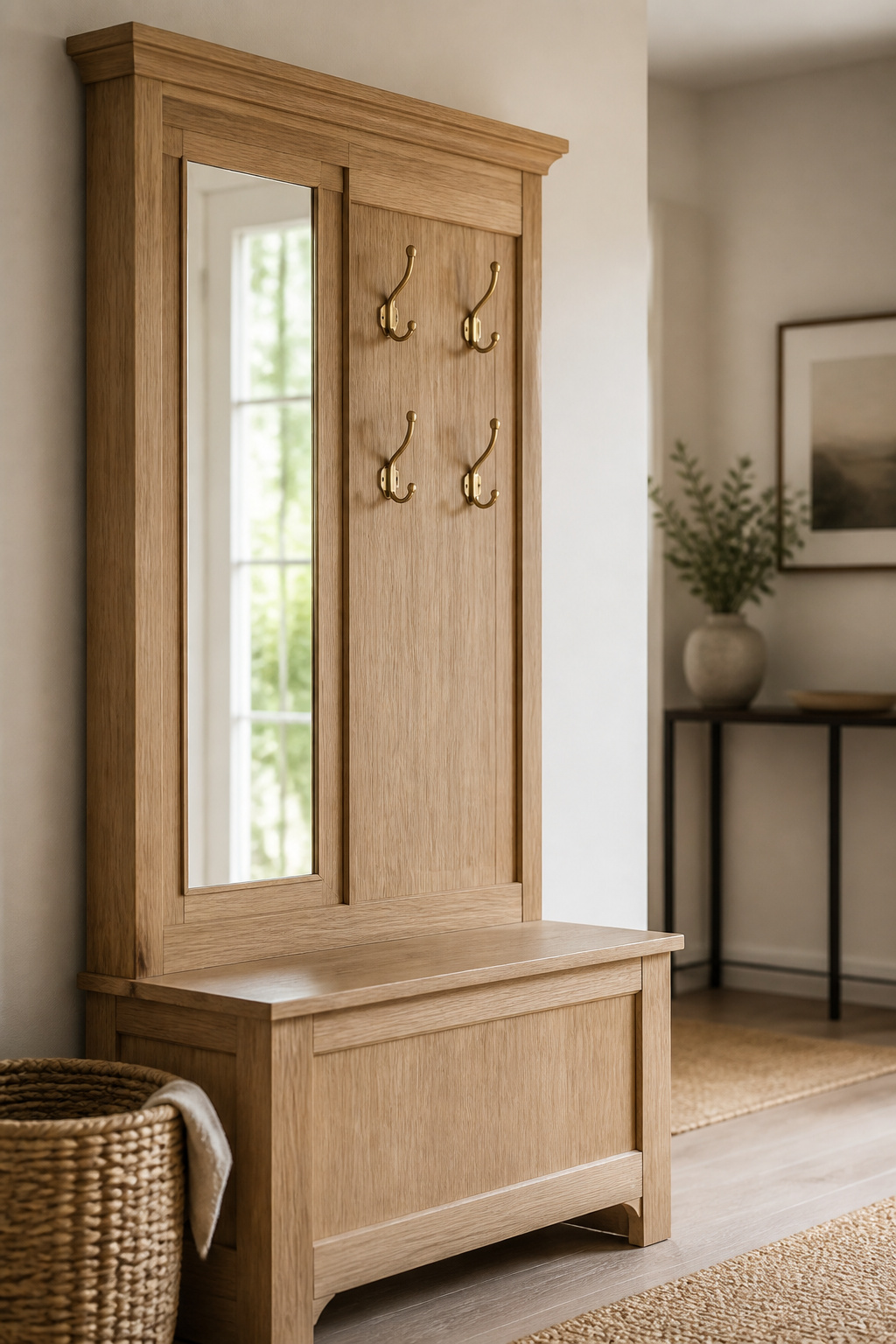
Combined 3-in-1 and 4-in-1 hall trees: what the extra piece is (mirror, shelf, drawer)
A 3-in-1 combines hooks, a bench seat, and shoe storage; a 4-in-1 adds a mirror, enclosed shelf, or drawer tier. Standard models run 61–70 inches tall and 16–18 inches deep — past 20 inches gets awkward in hallways under 40 inches wide. Budget one hook per household member plus 2–4 for guests. Budget MDF ($80–$250) lasts 1–2 years; mid-range pine or rubberwood ($250–$800) runs 3–7 years; solid hardwood ($1,056–$3,250) lasts decades.
Separate rail above a bench: more flexible, harder to match
A $30–$80 rail plus a $100–$300 bench delivers full drop-zone function without the integrated-unit premium, and you can upgrade either piece independently. The trade-off is visual: two pieces read as two pieces. In a style-forward entry that can feel unfinished; in a mudroom, nobody cares.
Wall space, stud location and anchoring: what each configuration demands
A freestanding hall tree needs 42–54 inches of total entry width — 18–30 inches for the unit plus 12 inches each side for hanging coats. Under 4 feet wide, the bench protrudes into the walkway. A wall-mounted rail needs only its own width plus stud access; a 24–30 inch rail usually catches two studs at 16-inch spacing. If studs don’t align, rated toggle bolts fix it.
Anchoring for Heavy Coats: Studs, Toggle Bolts and Weight Ratings
The section nobody reads until a rail is lying on the bench with drywall dust on it. The fix is boring and it works. Skill level: some builds.
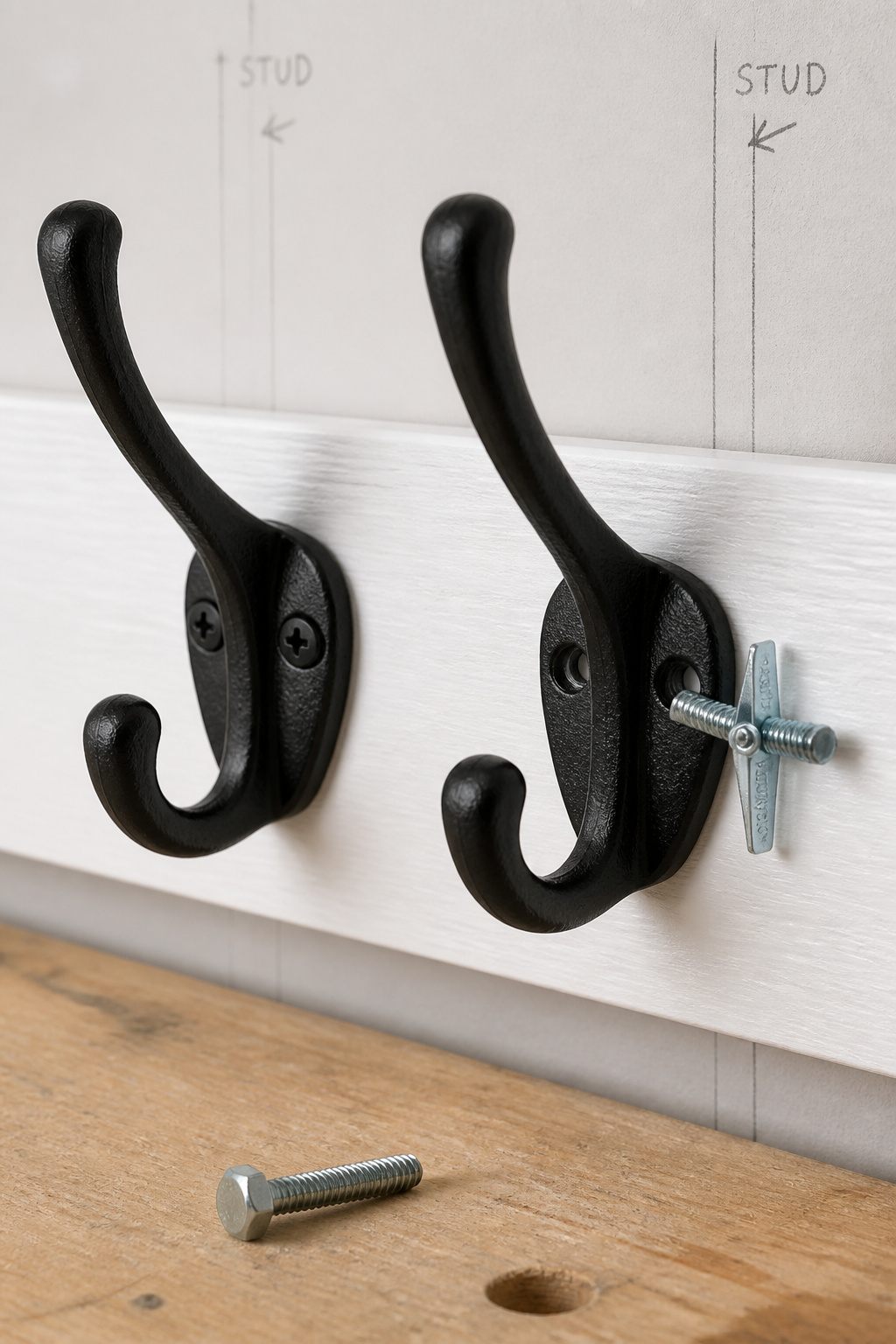
- Stud + 3-inch structural screw — holds 80–100 lbs shear. Use it whenever a stud lands where you need a hook. The gold standard.
- SnapToggle (1/4″-20) in 1/2-inch drywall — 265 lbs ultimate, ~66 lbs safe working load at a 4× factor. Use it when no stud is there.
- Standard toggle bolt — works, but needs a 1/2-inch hole and the wings can’t come out once set.
- Plastic kit anchors — rated 20–30 lbs at best. For pictures, never coats.
Why every coat hook needs a stud or a toggle rated to at least 50lb
Do the load math: a parka runs 3–5 lbs, a loaded backpack 10–15 lbs. One hook carrying both sees 15–20 lbs of sustained pull. Targeting 50 lbs per hook gives a 2.5–3× margin — both options clear it easily.
Finding studs in older plaster walls
Electronic stud finders lie on lath-and-plaster — thick plaster and metallic lath confuse the sensor. Here’s a field technique (a practical trick, not a professional standard): tie a strong rare-earth magnet to a string and drag it slowly across the wall. Where it sticks or swings, a nail is holding lath to a stud. Follow that line vertically, then measure 16 inches each way to find the next one.
Weight ratings on budget hall trees: what the spec sheet doesn’t say
Read the per-hook number, not the headline. Budget MDF hall trees usually list 10–11 lbs per hook — that’s the manufacturer’s stated rating off a spec sheet, not independent testing, so treat real-world performance under daily coats as lower. Watch the bait-and-switch: a sheet bragging “holds up to 180 lbs” is quoting the bench seat’s static load, not the hooks. The failure is predictable — factory hooks in MDF work loose within 12–18 months under shear. Any freestanding unit carrying more than 30 lbs needs an anti-tip strap to a stud.
Turning an Entryway Bench with Coat Hooks Into a Working Drop Zone
You don’t need a commercial hall tree to get its function. Any bench plus the wall above it can become a three-layer drop zone — and building it yourself means it fits your wall and your family.
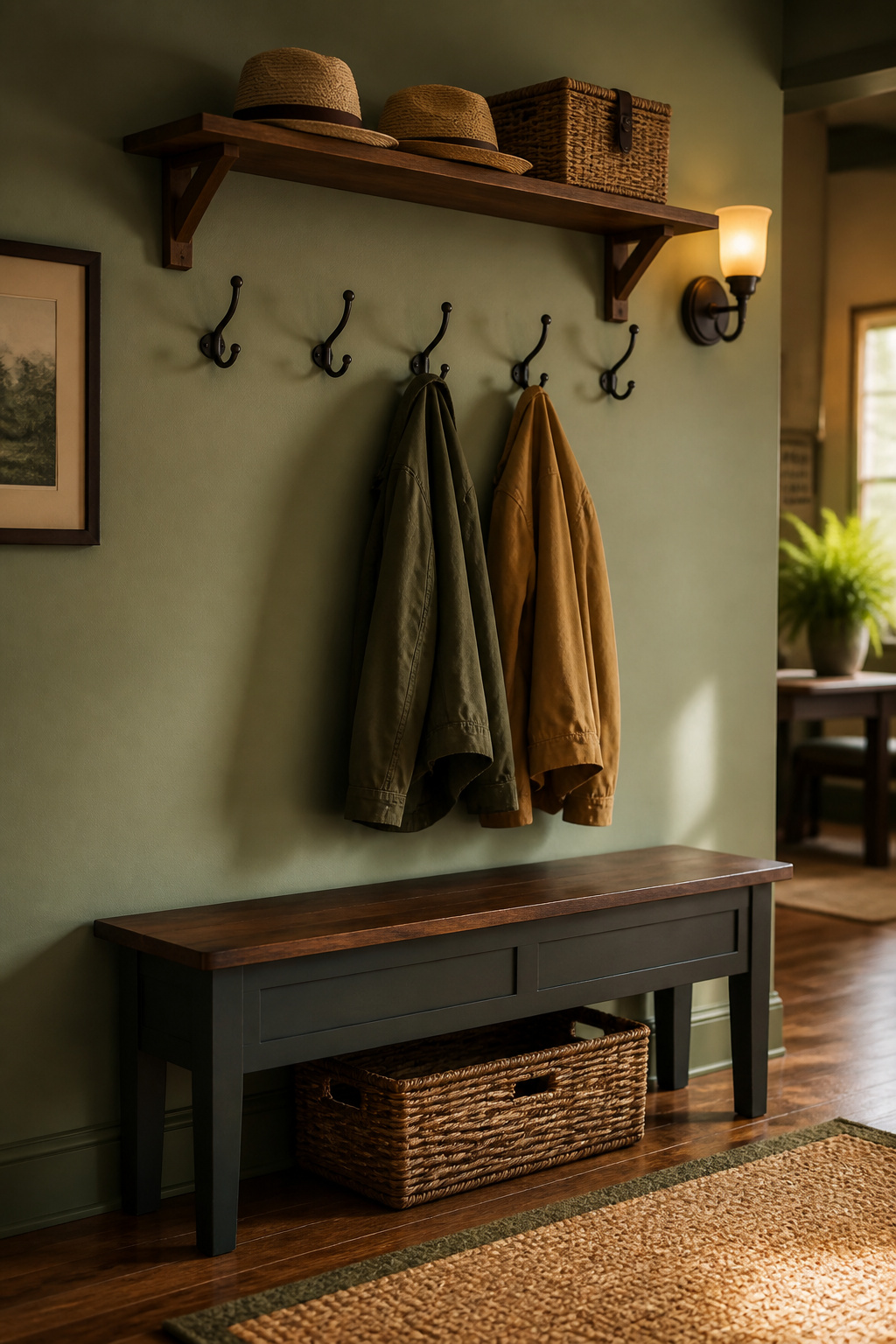
Hook rail + shelf above + bench below: the three-layer system
Three layers, each with one job: bench seat at 18–20 inches for shoe-changing, hook rail at 60–66 inches for coats and bags, upper shelf 8–10 inches above the hooks for hats and overflow. Keep 40–42 inches clear between bench top and hooks so coats hang free. The design principle is simple: every piece serves one step in the sequence — walk in, hang bag, hang coat, kick off shoes. If it doesn’t serve a step, it’s decoration. For a whole family, that per-person stack scales straight into a full mudroom drop zone.
Adding a mirror or chalkboard panel between hooks and shelf
The 6–8 inch gap between hook rail and upper shelf is useful space. A narrow mirror there does double duty: last-look before you leave, and a depth trick that makes a narrow entry feel wider. A chalkboard in the same spot becomes a family message board. Either cuts to width at a glass shop for $30–$60.
Keeping the wall working, not cluttered
One hook per regular person, plus one spare for guests. Any more and extras fill with seasonal coats — the ski jacket in July is the number-one hook-blocker, so park it in a closet. Shoes belong in low bins under the bench; people pull footwear out, they don’t reach up for it. Once the wall’s working, the decorative layer is its own job — style the bench and wall above.
DIY Hook Rail: Adding Hooks to Any Bench in an Afternoon
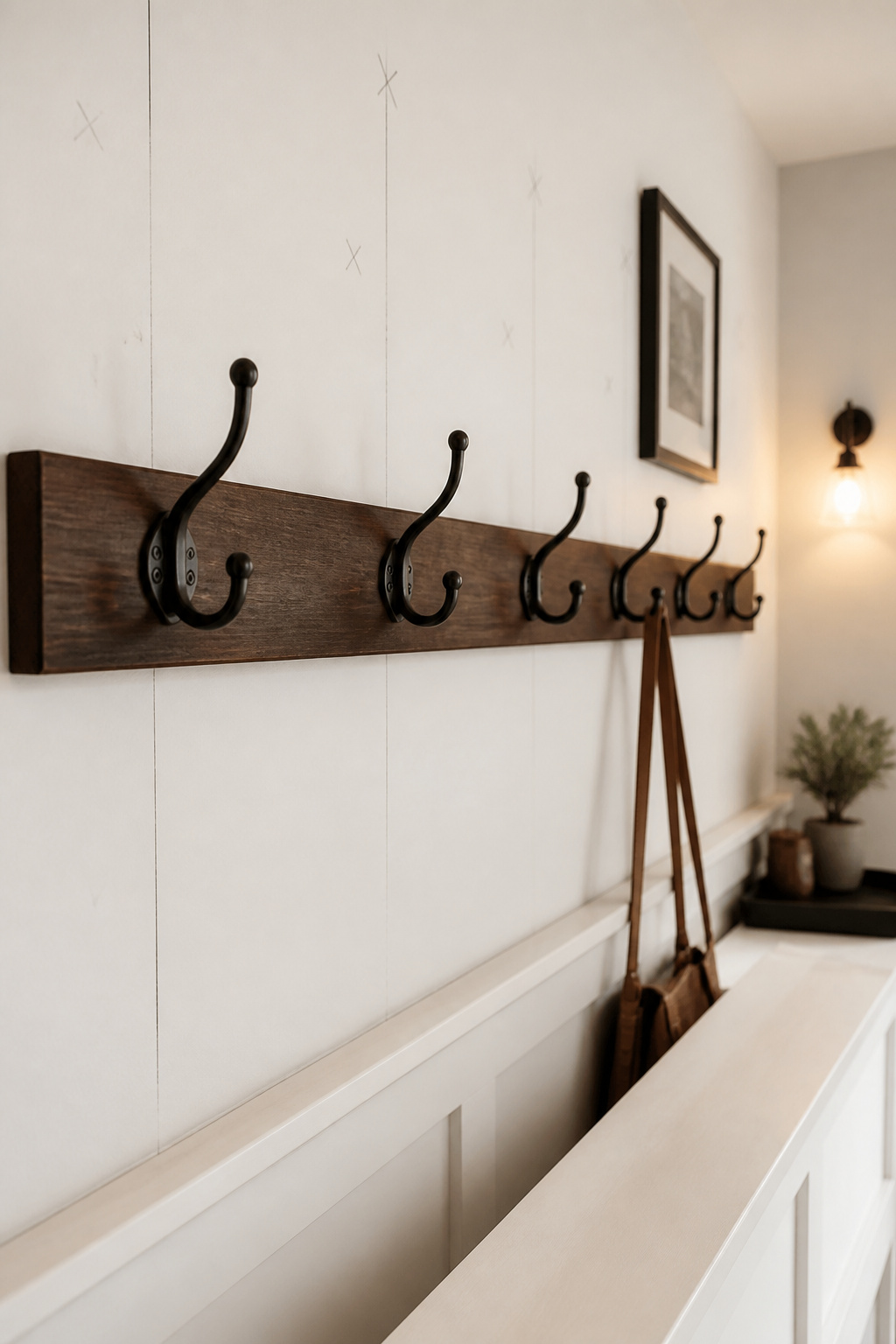
Cost: $20–$50 for an 18–24 inch rail with 3–5 hooks. Time: an afternoon, including drying between coats. Skill level: first build — if you can drive a screw and hold a level, you can do this.
- Pick the lumber. A 1×6 (actual 3/4 × 5.5 in) in poplar or maple holds screws far better than pine or MDF. Pine works; use coarse-thread screws and expect to re-tighten in a year.
- Cut to length. Five hooks at 10-inch spacing need a 48–50 inch board; three at 12-inch spacing fit 32 inches. The store cut counter handles it.
- Sand in sequence. 80 grit → 120 → 150 before stain → 220 between coats. Skip 150 and your stain goes blotchy.
- Finish before mounting. Two coats of spray clear poly on every face, including the back — raw wood against a wall can pull moisture and cup. Matching a stained bench? Test on an offcut first.
- Mark, drill, mount. Find studs, mark centers, pre-drill countersunk holes, hold board level on a pencil line, drive 2.5–3 inch structural screws into studs.
The mistake to dodge: mounting the rail before lining up the hook holes over the wall screws. Shift the rail a couple inches and the hooks cover the screw heads completely — no putty, no plug, no visible fastener. (Jean Levasseur, Popular Science.)
First move: grab a tape measure, find your bench height, subtract from 60. That number — usually 40–42 inches above the seat — is where your hooks go. Mark it on the wall. Buy a hall tree or screw a poplar board to the studs this weekend; height and anchoring are what separate a working drop zone from coats on the floor.
FAQ
What height should coat hooks be in an entryway?
Mount adult coat hooks 60–66 inches from the finished floor — the ergonomic standard from average adult shoulder-to-eye height, confirmed by accessibility specialists. Above a bench, subtract the bench height (usually 18–20 inches) from 60 to get the hook height above the seat, around 40–42 inches. Add a child row at 36–42 inches.
Is a hall tree worth it for a small entryway?
A hall tree is worth it when your entry is at least 42–54 inches wide and you want coats, seating, and shoe storage in one piece. Otherwise a wall-mounted rail plus a slim bench costs less and takes less floor space. In entries under 36 inches wide, skip the freestanding unit entirely — it crowds the passage.
How do you attach a hook rail above an entryway bench?
Locate studs with a stud finder (or a rare-earth magnet on plaster), mark the centers, and pre-drill countersunk holes through the board. Drive 2.5–3 inch structural screws into the studs while holding the board level. Where studs don’t align, use SnapToggle channel anchors, rated around 66 lbs safe working load in 1/2-inch drywall.