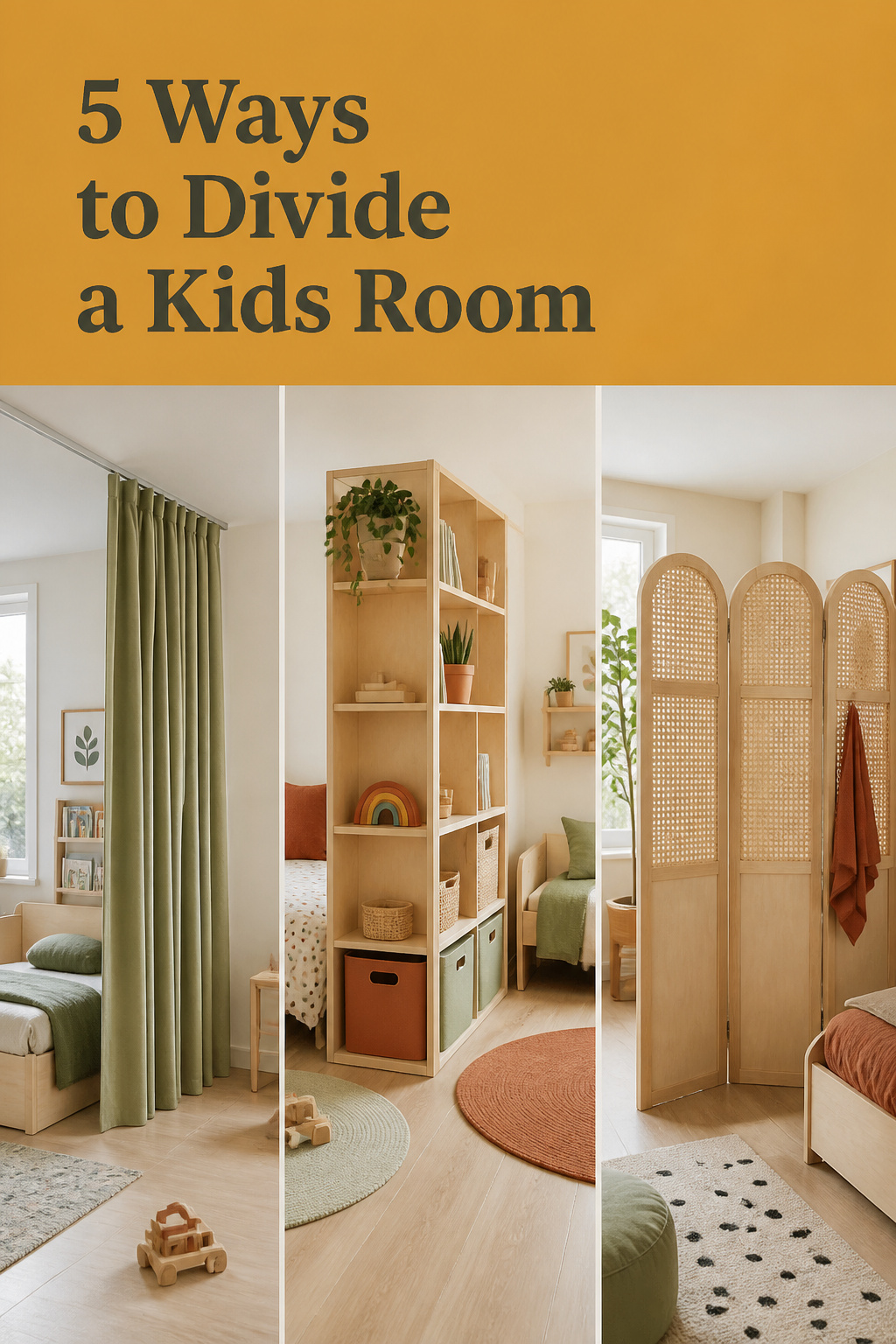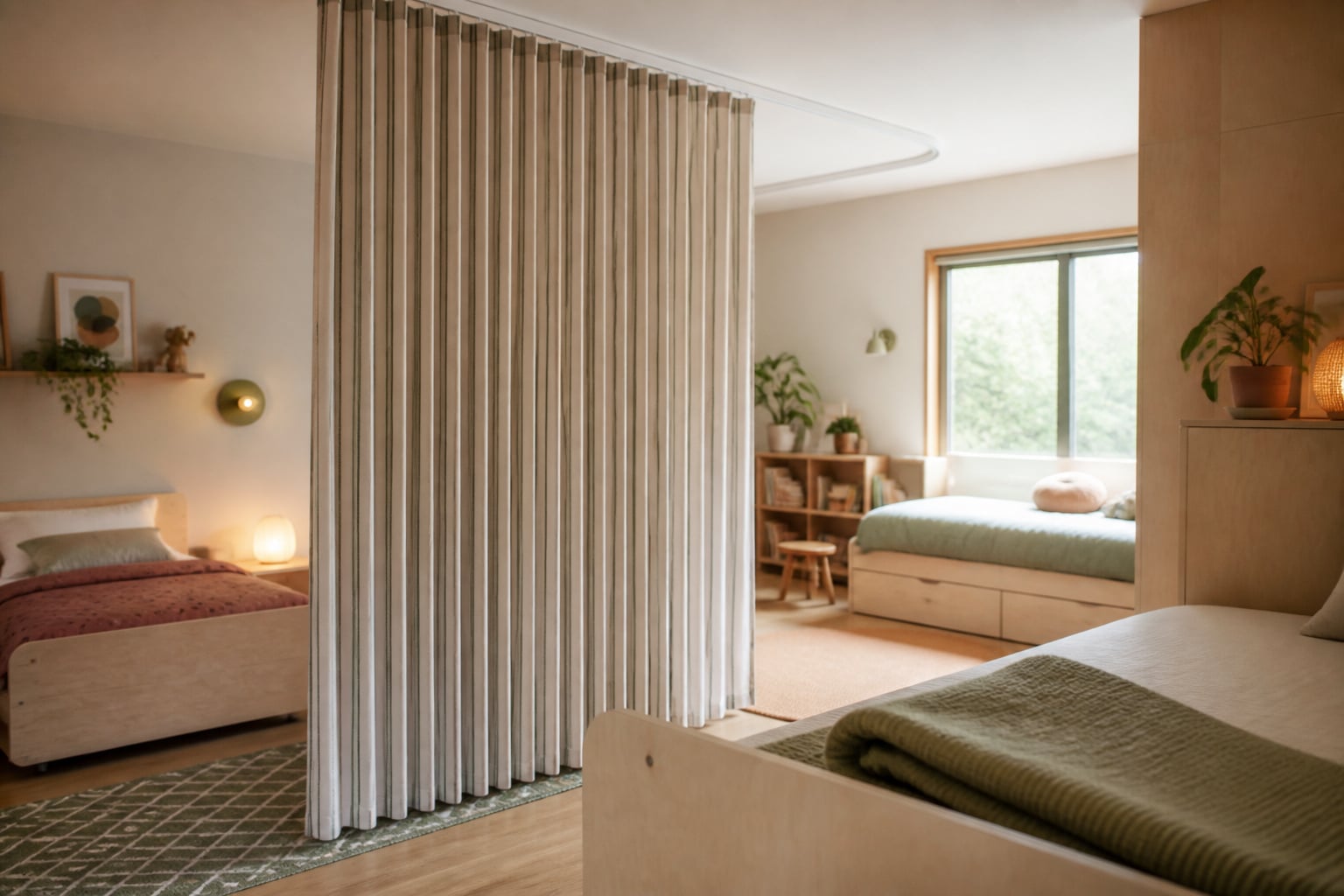

Search kids room divider ideas and you get a wall of photographs: curtains on tracks, canopies, shelving turned sideways, folding screens. Almost none say what the thing costs, how much floor it eats, or what it does to the light — and most were shot in rooms with three windows and one child. I judge a divider on four numbers: price, depth, daylight, and the cost to take it out again.
TL;DR
- The cheapest real divider is a ceiling-track curtain: $35 for a bare IKEA VIDGA track rated to 11 lbs, $70–$225 for a full kit, and near-zero floor depth.
- Open bookcases are excluded from the CPSC’s 16 CFR Part 1261 stability standard, so the most common divider is the one no mandatory test covers. Anchor it anyway.
- Keep everything clear of the escape window: Illinois State Fire Marshal guidance says windows leading outside must be operable and not blocked by furniture.
The Overlooked Cost of a Divider: Light and Floor Space
Which wall is your egress window on? Answer that first — it rules out layouts faster than your budget does.
What “blocking the window” actually does to a room
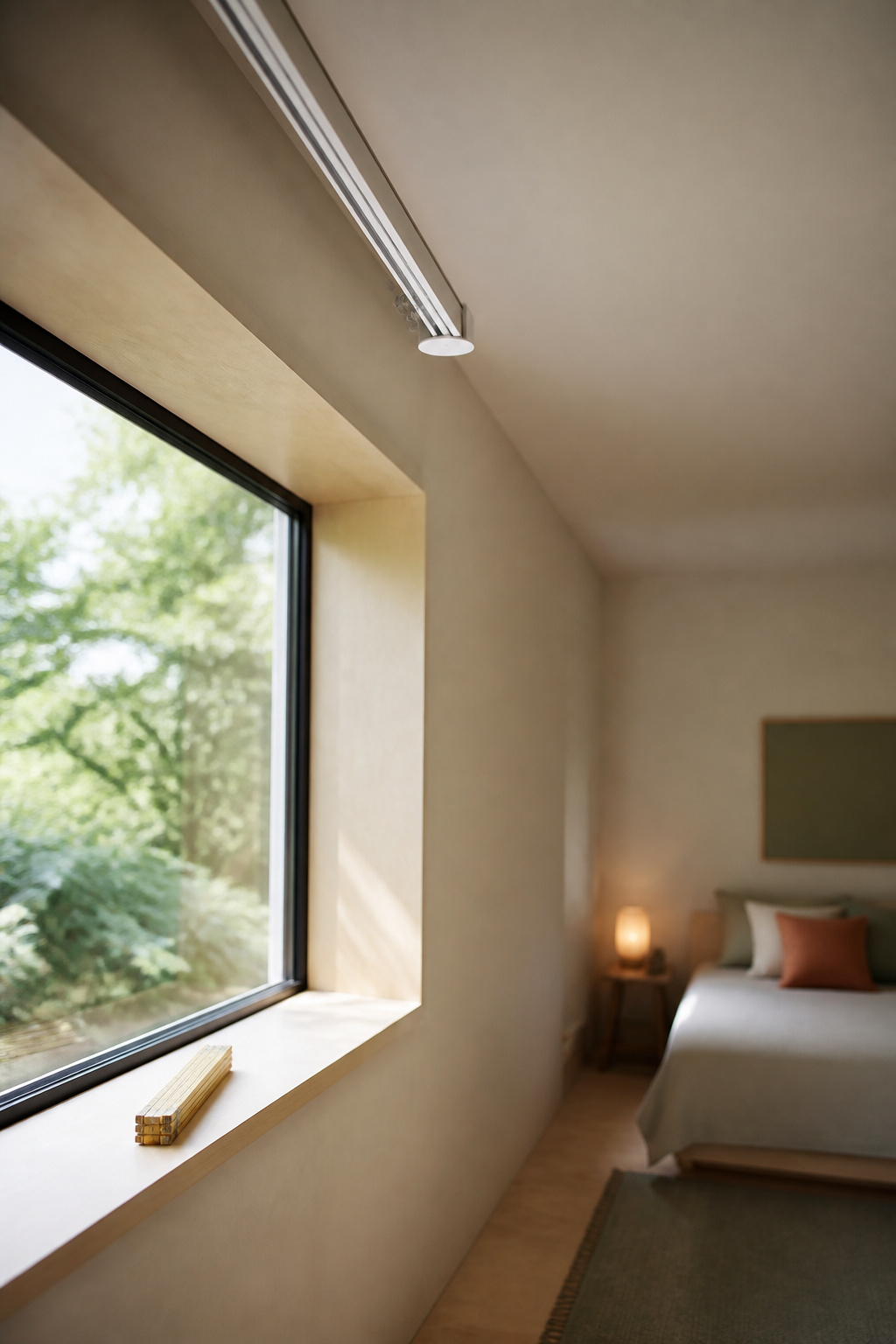
The IRC sets the floor for a bedroom’s escape route: at least 5.7 square feet of net clear opening, sill no higher than 44 inches above the finished floor. What the code does not do is mention furniture — it governs the window itself. The obstruction language comes from a state source instead: Illinois State Fire Marshal guidance says doors and windows leading outside must be operable “and are not blocked by furniture.” A curtain, a canopy, a shelving unit: all furniture.
Daylight is the second cost, and I won’t give you a percentage. Nobody has measured what a bedroom divider does to the light — the research that exists studied office partitions. Treat it as a direction, not a figure. If the beds aren’t placed yet, start with the shared kids bedroom ideas guide; divider placement follows bed placement.
How to measure the floor space a divider really eats
Depth is the number people skip. A ceiling track costs almost nothing. An open-back shelving unit costs over a foot, and on both sides — that depth leaves both children’s halves, not one. A folding screen takes only its panel thickness. Run a tape before you run a credit card.
Five Kids Room Divider Ideas, Compared
Same job, wildly different bills. These five genuinely work in a bedroom.
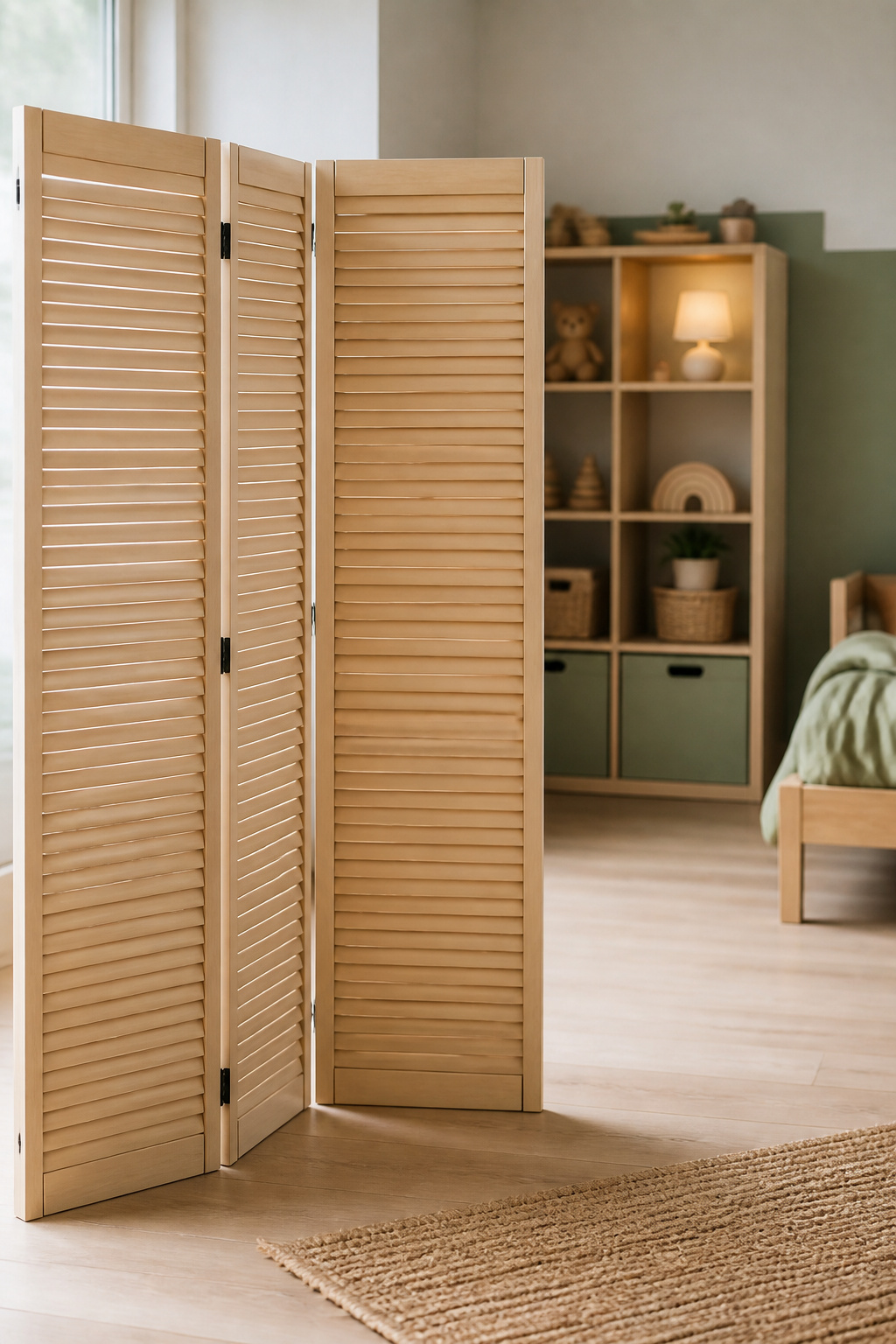
Cost per option
| Divider | Cost | Floor depth | Reversible? |
|---|---|---|---|
| Ceiling-track curtain | $35 bare track; $70–$225 kit | None to speak of | Yes — patchable holes |
| Folding screen | $80–$310; most $80–$200 | Panel thickness | Yes, entirely |
| Back-to-back shelving | $150–$300+ ($179.99 KALLAX) | Over a foot, both sides | Yes, anchors leave holes |
| Pegboard or slat partition | $292–$694 | A few inches | Yes, entirely |
| Half-height framed partition | $10–$20 per linear foot ($20–$32 full height) | Framing plus drywall | No — construction |
Frame that partition yourself and a 10 to 12 foot run is $100 to $300 in materials. That isn’t the expensive part. Unbuilding it is.
Floor space and light each one eats
Fabric is the only divider whose light performance you choose. Blackout-grade fabric blocks 95 to 98 percent of light, up to 99 in premium weaves; room-darkening fabric filters roughly 70 to 90 percent. Shelving and a partition block what they block.
Which options are renter-safe
Portable dividers count as furniture, not construction: no permit, no repair bill. A framed partition is the opposite. Ceiling tracks sit between — screws overhead, fabric comes with you.
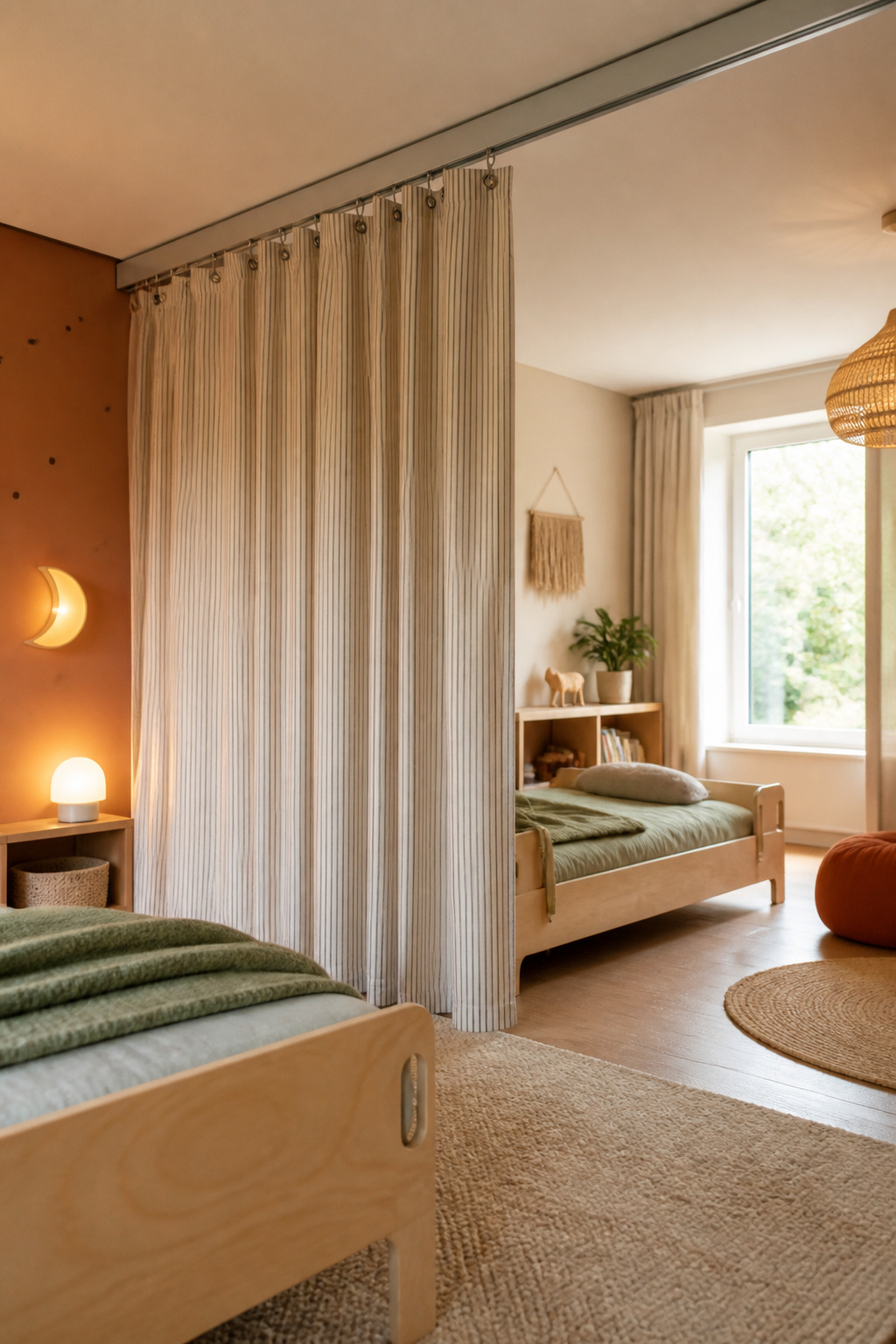
Ceiling-Track Curtains for a Reversible Boundary
Thirty-five dollars. That’s the cheapest genuine ceiling fixing in this article.
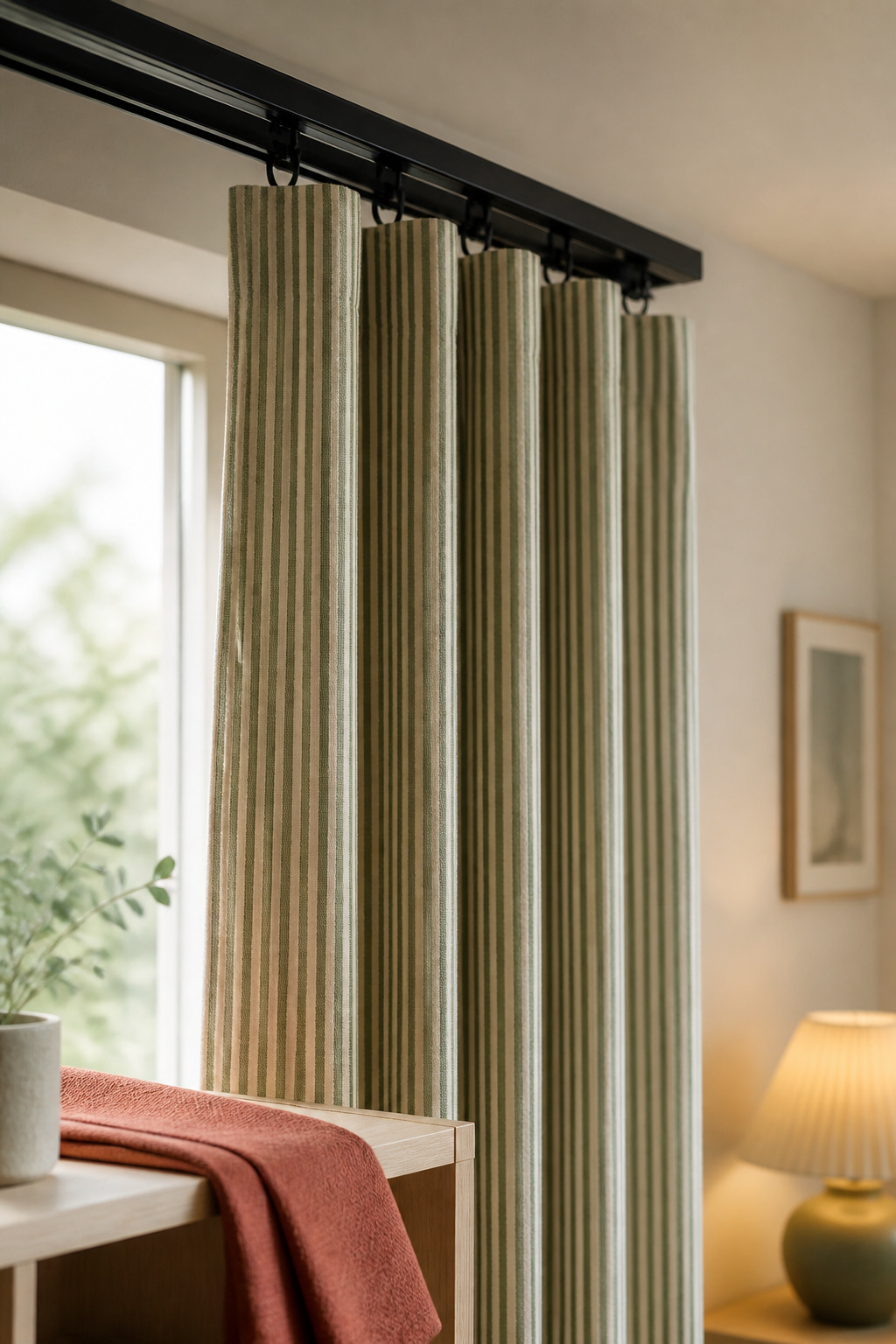
Track types and price
It’s a bare IKEA VIDGA single track set, and the number people miss is its published load rating: 11 pounds, maximum. A full-length blackout panel on a long span walks right up to it. Complete kits run $70 to $225. IKEA’s page doesn’t tell you to find a joist. Find the joist anyway.
The best prep tool I own is also the least glamorous. Running crews, I carried a $40 oscillating multi-tool the guys with the expensive kits called a toy, and it saved every install — trimming the track end that sat proud, cutting the notch nobody planned for. On the jobsite, the tool that finishes the day is rarely the one in the catalogue photo. A stud finder is the same species: twelve dollars, thirty seconds, and the difference between a track that holds and one that comes down with a dinner-plate of drywall attached.
Fabric choices for privacy without blackout
Room-darkening fabric is usually the right call: you block the sightline without turning the far half of the room into a cave. And “100% blackout” describes the fabric, not your installation — a track-hung curtain leaks at top, bottom and sides whatever the label claims.
Sound is where curtain marketing gets loose. Lab testing of acoustic linings puts them at STC 13 to 17; the industry claims STC 20 to 26 for heavy “soundproof” panels. Meaningful soundproofing starts around STC 40. A curtain softens noise; no fabric turns it into a wall.
Bed Canopies and Half-Height Screens
Does the room need a boundary, or does one child need a bed to disappear into? Different problems, different price tags.
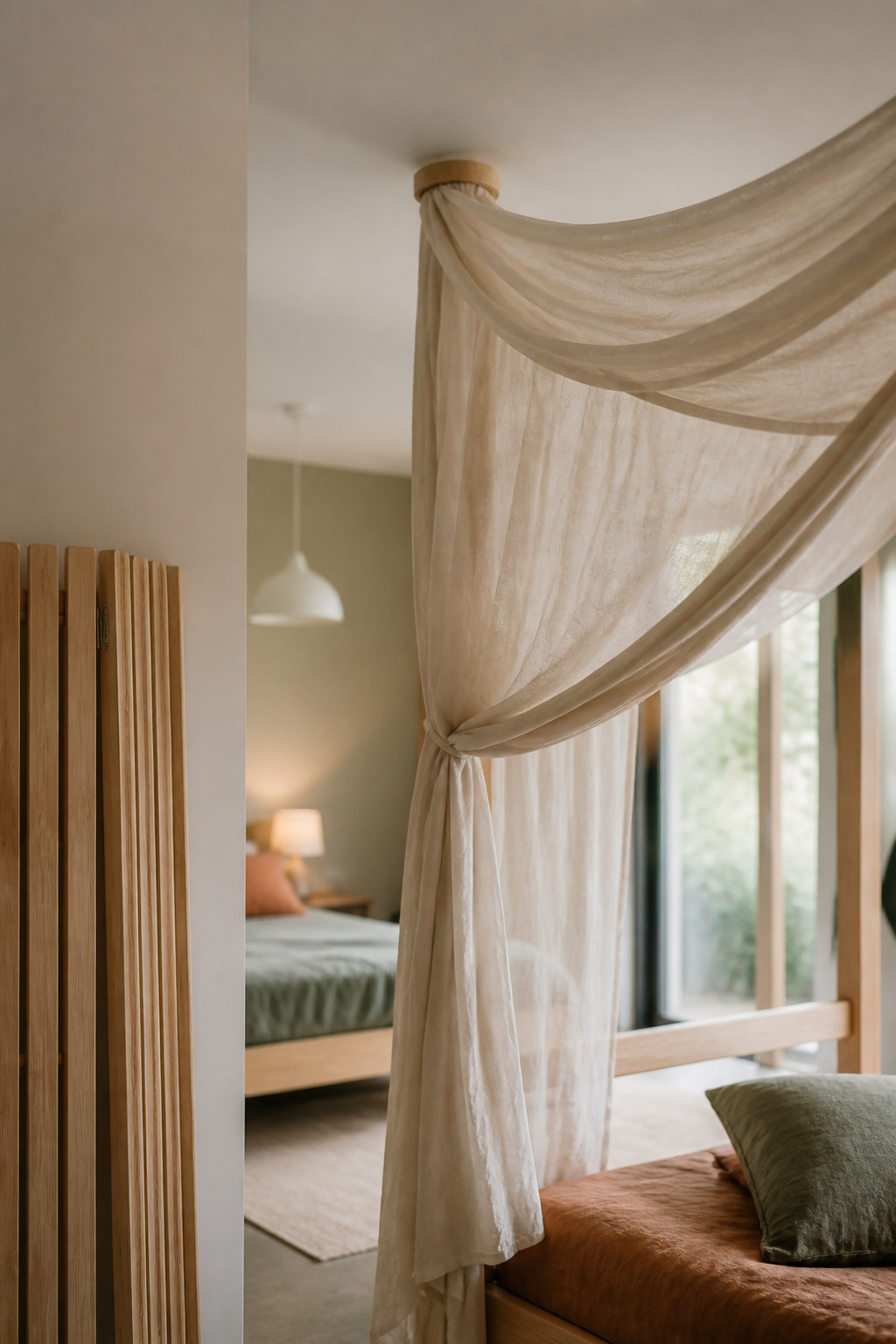
When a canopy is enough
A canopy screens the bed, not the room. It cuts the sightline from the other pillow and gives a kid a den, which for a seven-year-old sharing with a toddler is sometimes the entire ask. It won’t change the light elsewhere.
On cost, the evidence is thin: one documented build at roughly $245 in components. That’s a single example, not a price range, so I won’t set it beside the shelving and partition figures. And a ceiling-track canopy is still a ceiling fixture — the freestanding four-poster frame is the genuinely renter-safe version, because it fixes to nothing.
Folding screens for flexible use
Folding screens run $80 to $310, most two-to-four-panel models between $80 and $200. No fixing, no holes. It’s also the only divider here suited to a room that needs a boundary sometimes — homework hour, getting changed — rather than a permanent split.
Back-to-Back Shelving as a Divider
The piece most families use as a room divider is the piece the federal stability standard doesn’t cover.
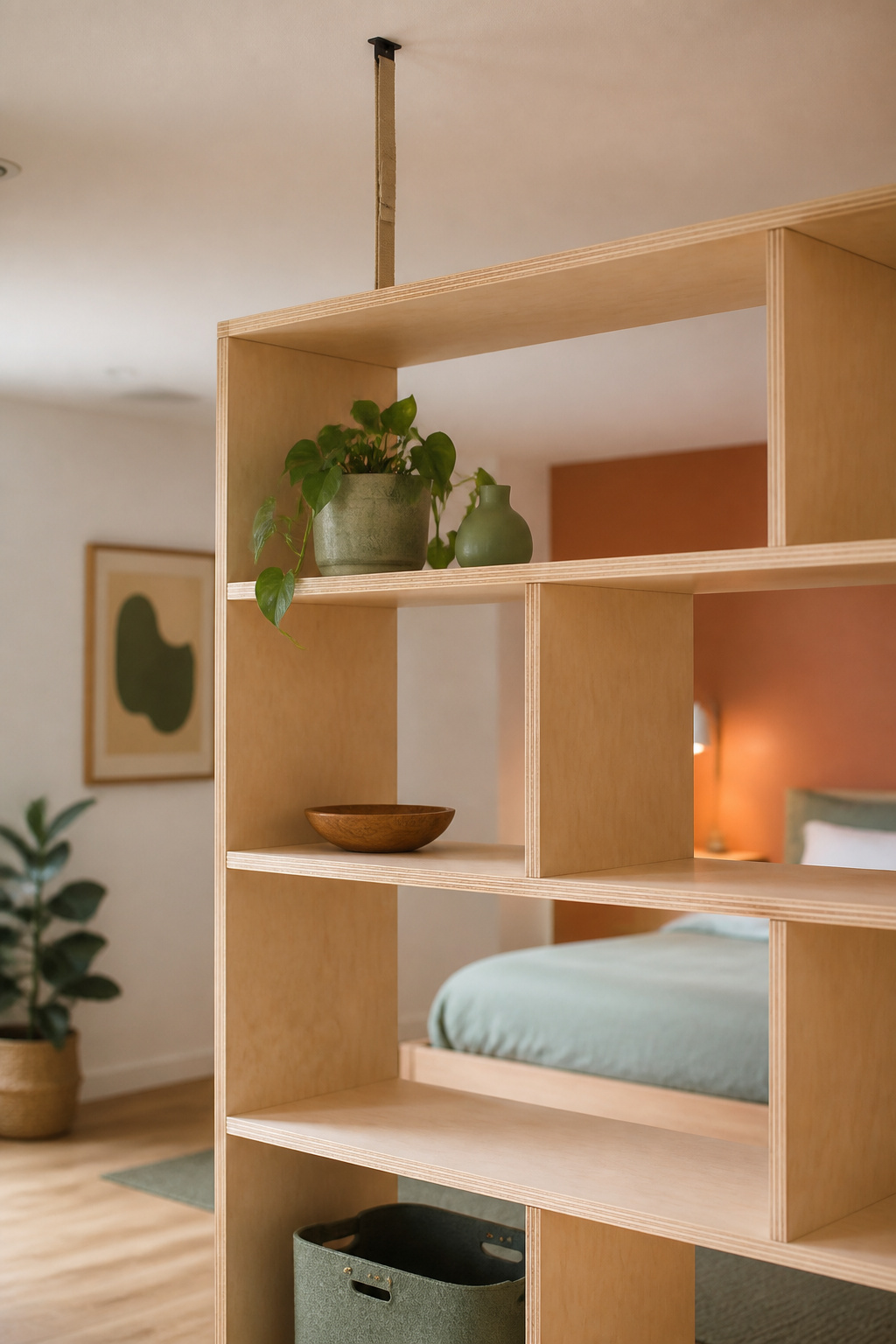
Why shelving is the most common divider
Shelving is popular because it pays twice: a boundary and a storage wall from one $179.99 purchase. IKEA’s own listing carries the tip-over warning in plain text — the unit must be securely anchored, with screws suited to your home.
Now the gap. CPSC’s mandatory furniture-stability rule, 16 CFR Part 1261, doesn’t cover it: open bookcases and shelving are explicitly excluded from that standard’s scope. The exact category most families use as a room divider is the one no mandatory tip-over test applies to. That doesn’t make shelving a bad divider; it makes anchoring your job rather than the standard’s — and a mid-room divider often has no wall behind it at all. Decide where the anchor goes before you buy.
What storage question this raises next
What you anchor into changes the result by an order of magnitude; the lab figures for a strap into a stud against one into bare drywall live in Henrik’s storage piece. It also answers what comes next: once the shelf is the divider, what goes in it and whose is whose. Settle storage that both children can put back first, then hang the fabric.
Renter-Safe Options and Marking Whose Side Is Whose
The deposit rarely dies at the curtain. It dies at the anchor — the wrong plastic plug in soft drywall, holding a panel two kids treat as a swing.
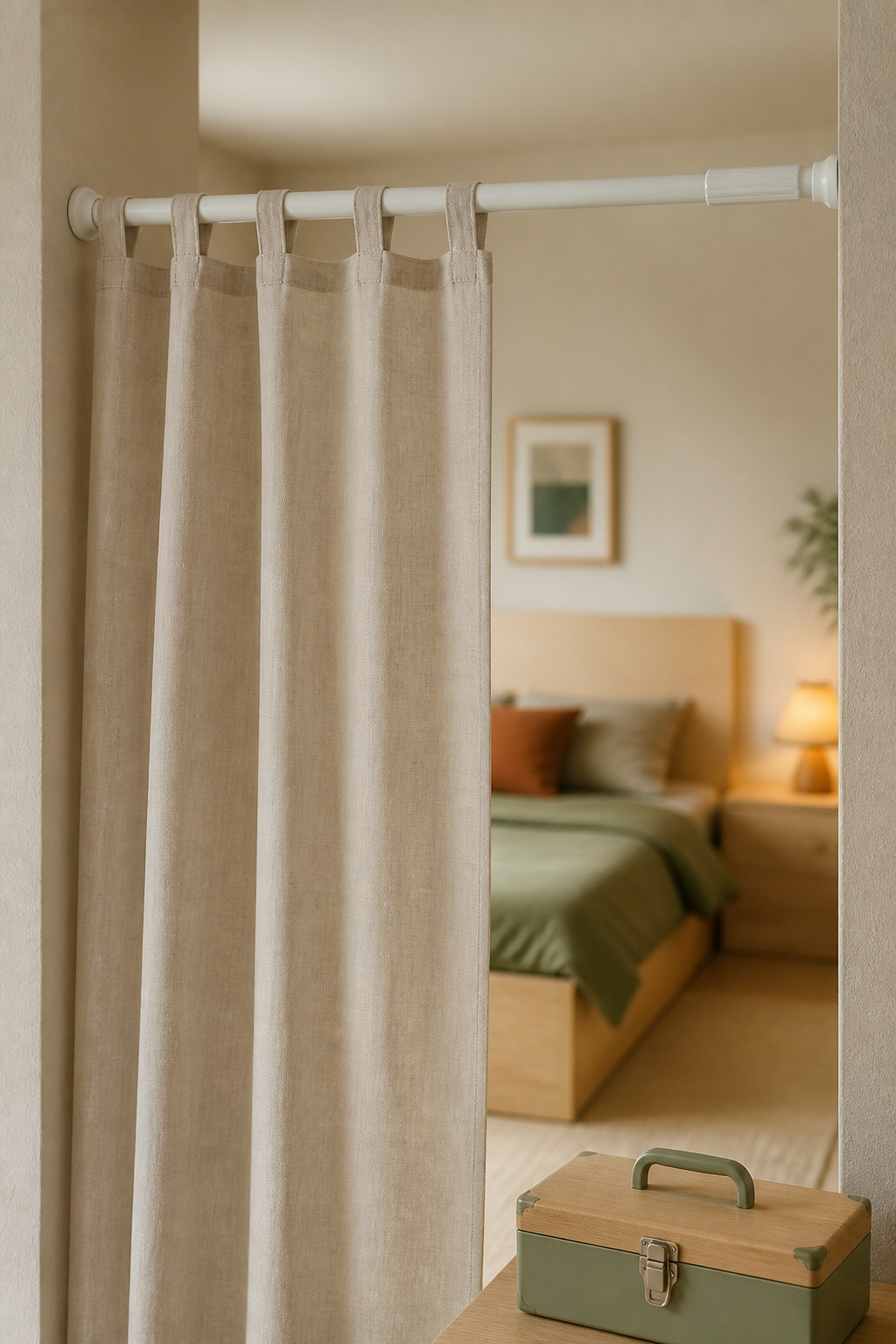
Tension rods and no-drill tracks
Three ways to get a boundary without a repair bill:
- Anchor into a stud, not just drywall. A mid-room divider often has no wall behind it at all, so find the framing before you drill — a stud holds real weight; drywall alone is a guess.
- A spring-tension rod is the only true no-drill curtain. It holds by friction between two facing walls, so it works where the span is short enough to brace across and nowhere else.
- Freestanding beats fixed for renters. Portable dividers run about $3 to $14 per square foot in materials, no permit and no patching.
When color and accent decoration mark the boundary instead
Sometimes the honest math says no divider. In a small room with one window, a barrier costs more in light and floor than the privacy it hands back. A boundary can be marked instead of built, each child with their own accent colour and textiles. Sofia makes the case for giving each child their own accent instead.
Four numbers decide this, in order: which wall the escape window is on, how much floor depth you can lose, what the fabric or panel does to your daylight, and what the thing costs to remove rather than to buy.
For most shared rooms that lands on a ceiling-track curtain in room-darkening fabric — $35 to $225, no floor cost, down in an afternoon. Choose shelving when you want the storage more than the daylight and can plan a real anchor; a folding screen when the boundary only has to exist part of the time. Build a partition only if this is your house and you’ll keep the layout for years, because it’s the one option that costs more to undo than to do.
FAQ
Can a curtain divider actually reduce noise between two kids?
It softens noise rather than blocking it. Lab testing of dedicated acoustic curtain linings shows STC ratings of 13 to 17, while the industry claims STC 20 to 26 for heavy “soundproof” panels. Meaningful soundproofing starts around STC 40. Expect muffled voices, not silence.
What’s the cheapest way to divide a shared kids room?
A spring-tension rod with a single curtain panel, typically well under $75 all-in, because it needs no track, no drilling and no anchors. Portable freestanding dividers as a category run roughly $3 to $14 per square foot in materials — far below a framed partition at $10 to $32 per linear foot.
Do room dividers need to reach the ceiling to work?
No. A half-height divider still gives visual privacy and a sense of territory, but it won’t stop sound or light the way a full-height one does. The office-partition research on daylight and height is directional, not a bedroom measurement — but it points the same way every time: the shorter the divider, the more light reaches the far side.