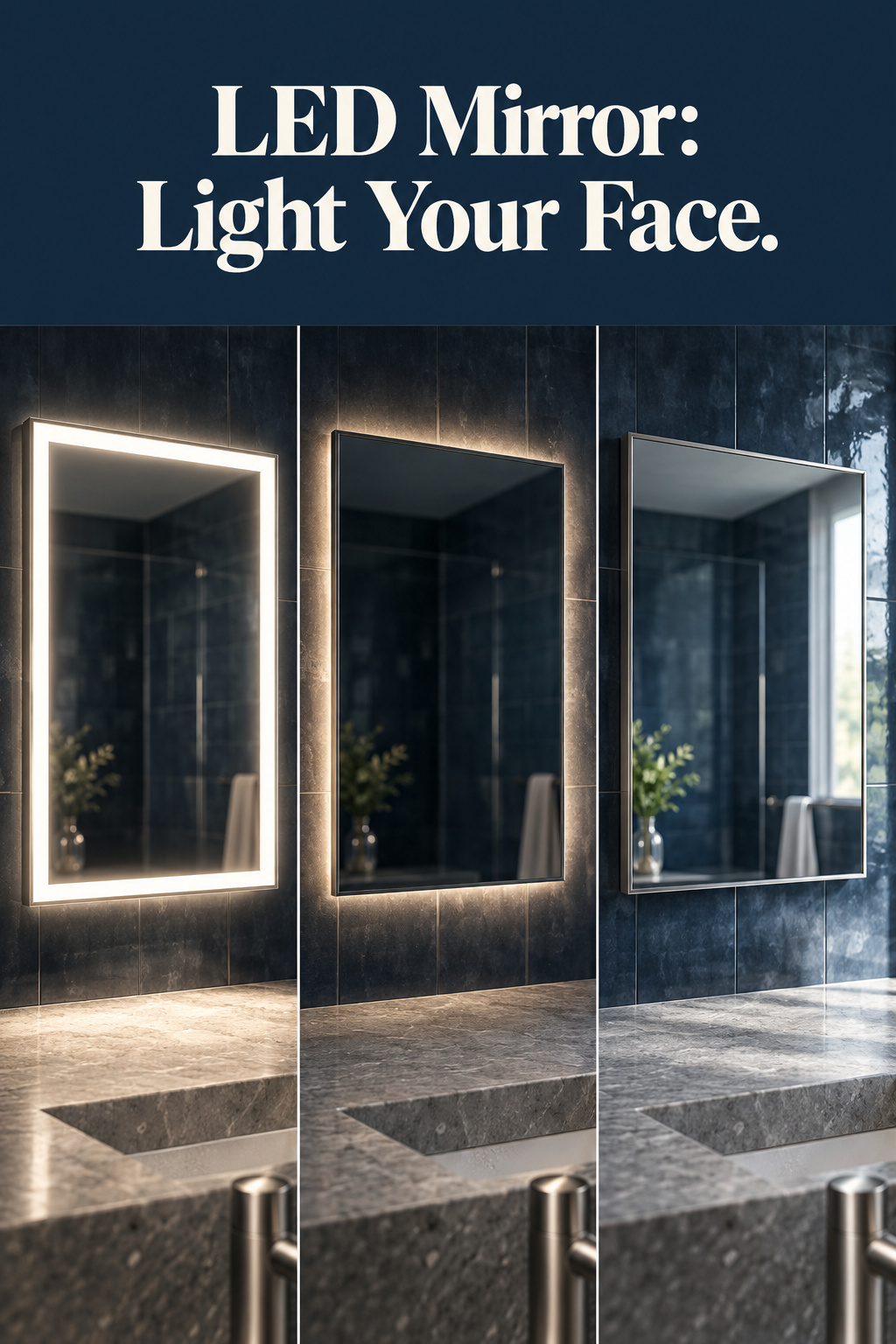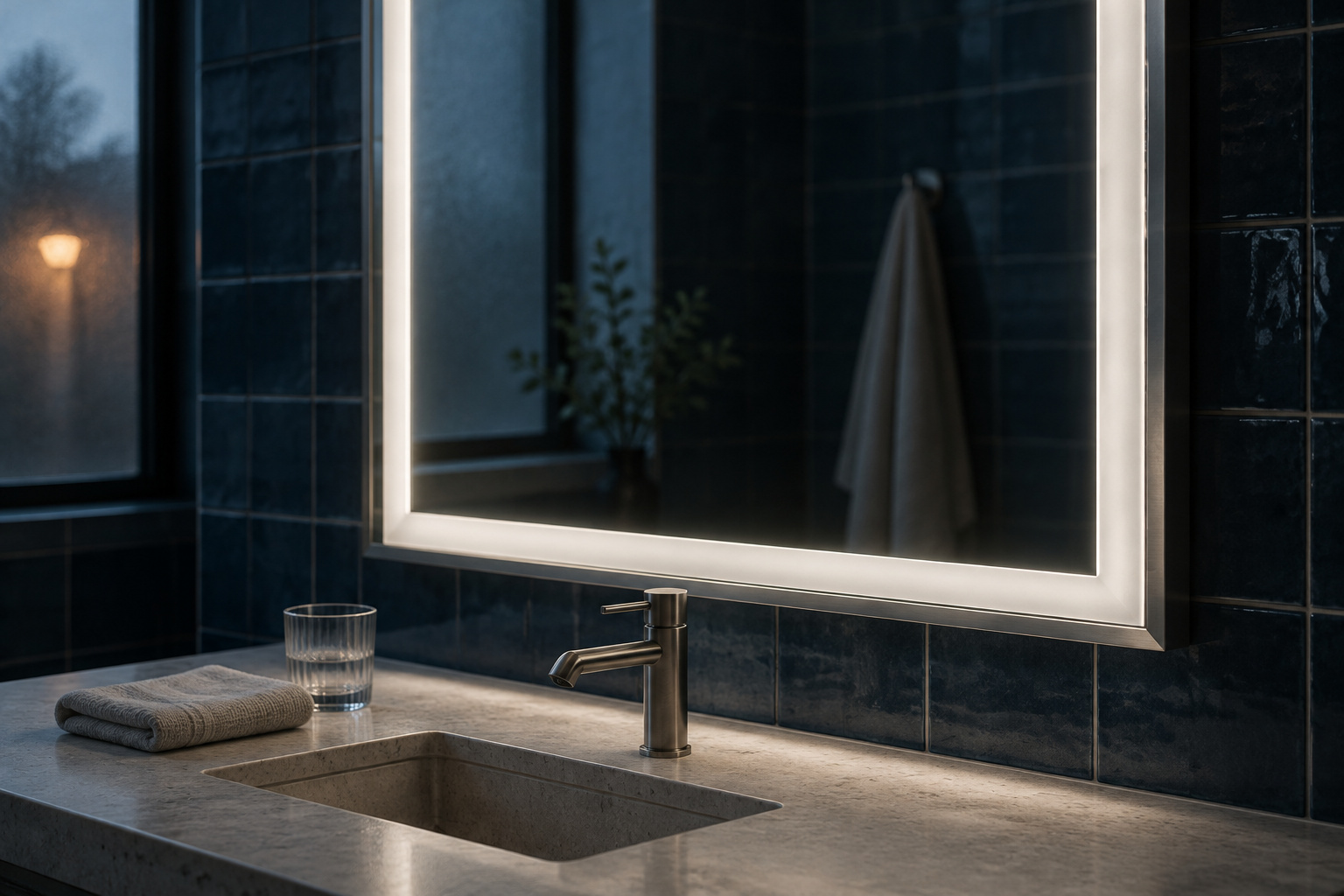
Three hundred and twenty lux. That is what Robern measures 18 inches out from the center of its Vitality mirror. Someone shopping for an LED bathroom mirror usually sees no number like that. They see a glowing outline in a dark room and assume the brighter the glow, the better their face will be lit.
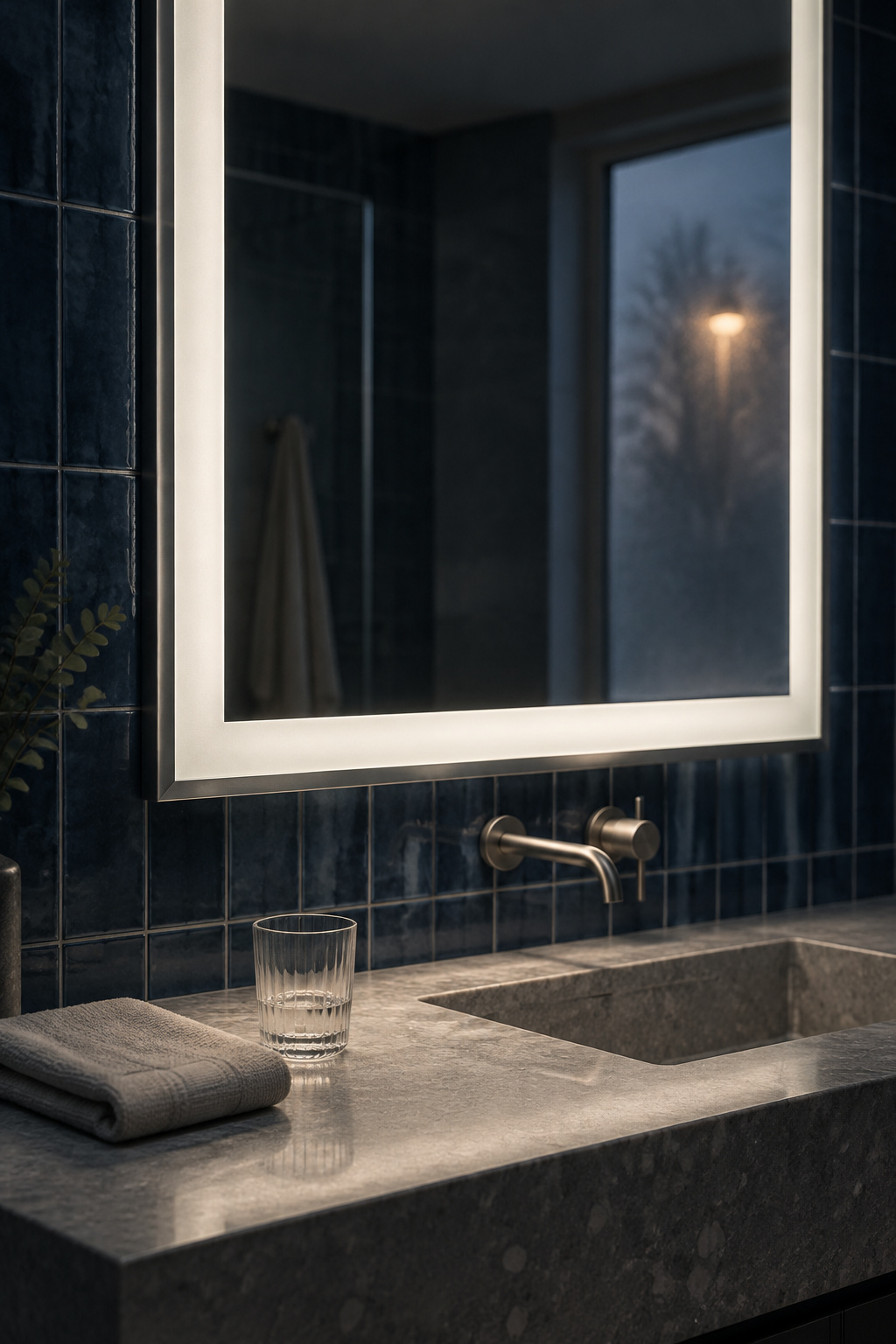
Most of that glow is light thrown at the wall. The light that reaches your face comes from LEDs aimed forward. A lighted mirror is a light fixture first. Judge it by where its light goes, by the wiring your wall allows, and by whether the maker will tell you how good that light is.
TL;DR
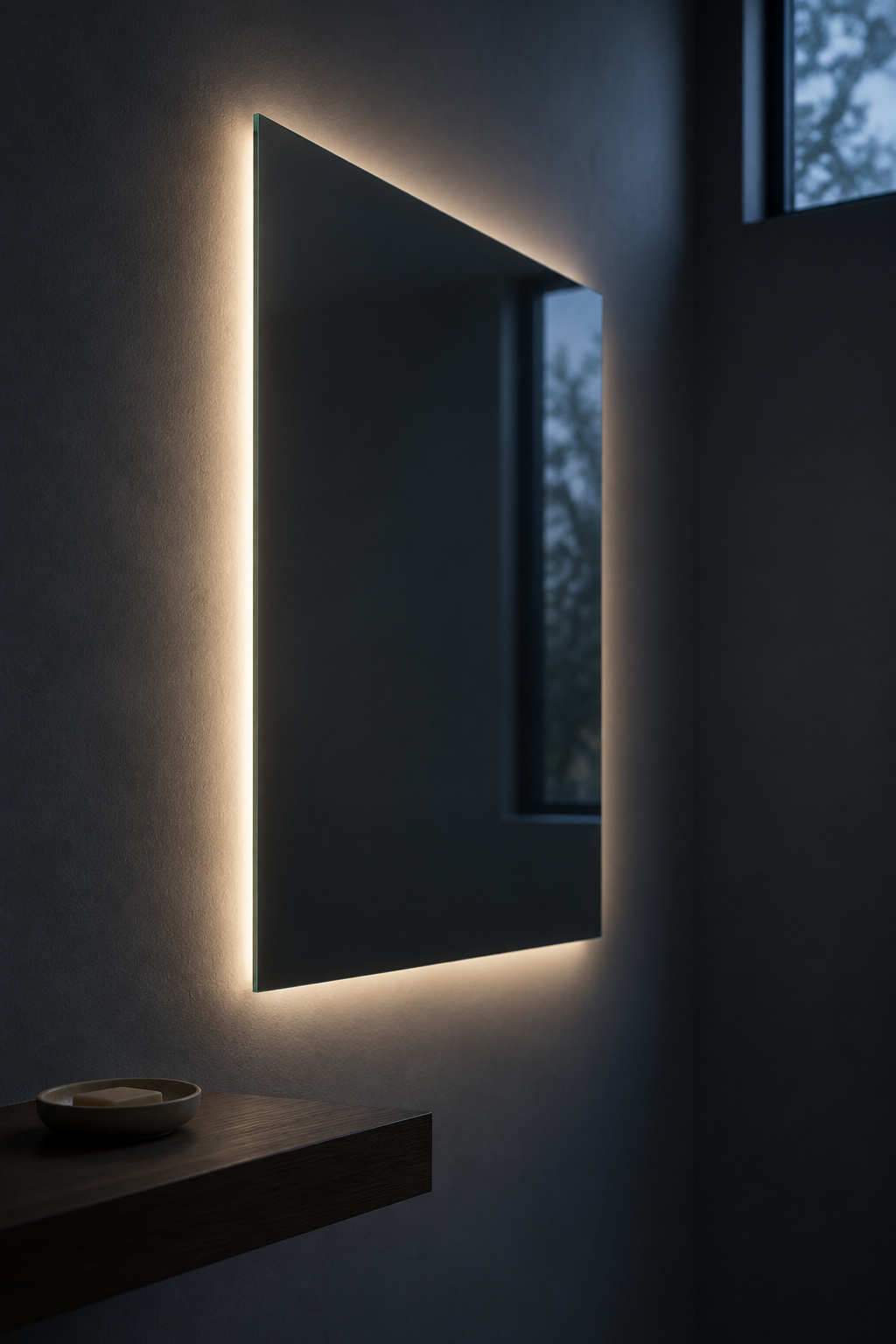
- Judge a lighted mirror by where its LEDs aim. Light sent forward through a frosted band on the glass reaches your face; light aimed back at the wall makes a halo, which is mood light. Read the construction, not the label.
- Ask for two numbers: CRI of 90 or more, and lumens marked as initial or delivered. Robern, Kohler, Electric Mirror, Matrix and Elegant Lighting print CRI; several budget listings give color temperature and wattage and did not state CRI.
- “50,000 hours” is the LEDs’ L70, the time until they fall to 70% of their starting output, not the life of the mirror. Warranties run from one year to seven.
Why the Glowing Halo on a Backlit LED Bathroom Mirror Barely Lights Your Face
One seller’s “backlit” is another seller’s best grooming light, and “edge-lit” has at least four meanings. What doesn’t change from shop to shop is the direction the LEDs point.
| Where the LEDs aim | What gets lit | The job it does |
|---|---|---|
| Forward, through a frosted or etched band on the glass | Your face | Task light for shaving and makeup |
| Inward, from a 45-degree channel in the frame | Your face | Task light |
| Back toward the wall behind the glass | The wall, as a halo | Mood light |
| Into a light-guide plate or a frosted border | Depends on the build | Ask which way it sends the light |
Commit to the first two rows if the mirror is your main light. Robern measures its face-lit mirrors at 275 to 690 lux at 18 inches. A halo can look spectacular and still leave your chin in shadow.
The test costs nothing. Stand at the sink at night with only the mirror on. Look for a shadow under your chin or across your cheeks. If you see one, the mirror is decorating the wall.
It matters because people groom wherever the face light is good. My mother ironed at our kitchen table in Uppsala every Thursday because that was where the light was best. Rooms get used where the light is, whatever the plan says. Hang a halo-only mirror over the sink and someone in your house may end up doing their makeup by the bedroom window.
Can an LED Bathroom Mirror Replace Your Vanity Sconces?
Whether it is bright enough to shave by depends on the mirror.
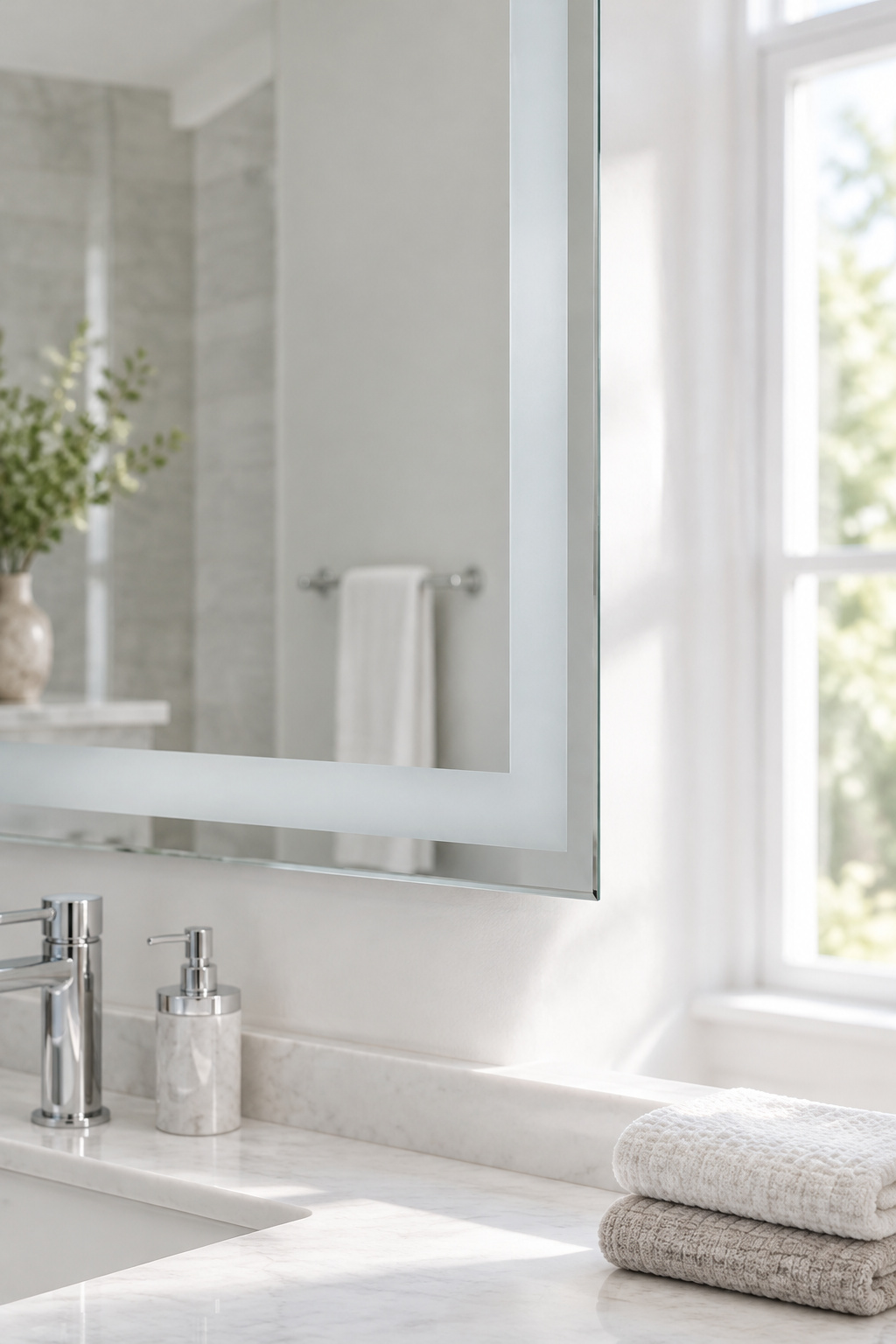
The usual baseline for a single-sink vanity is about 1,600 lumens. Robern’s Vitality 30×40 publishes about 1,810 lumens, a little over that baseline. Elegant Lighting’s 24×30 Genesis prints 1,900 initial lumens and 660 delivered, and 660 is about 41% of 1,600. The sheets aren’t measured the same way, but the biggest number on a listing tells you little until you know which number it is.
My answer is yes, in a small bathroom, for a mirror that sends its light forward and publishes its lumens and CRI. It is no for a mirror that only glows at the wall, and no for one that publishes nothing. A front-lit mirror lights the person, not the room.
Whatever lights the rest of the room, don’t make it the ceiling fixture your face depends on. Overhead lighting is for cleaning, not for living, and from directly above a mirror it exaggerates the shadows under your eyes, nose and mouth. Light at eye level fills them.
If you keep your sconces, the mirror sits between them and has to work within their limits; how the light boxes limit mirror shape shows which shapes fit. Our guide to vanity lighting gives the fixture heights.
Defogger Pad, Dimming and Color Modes: The Features Worth Paying For, and the One Number to Demand
Feature lists on lighted mirrors run long. I brew coffee in a plain filter cone and won’t own a machine with a screen, so a touch panel on a mirror doesn’t win me over. Three features do change what happens at the sink:
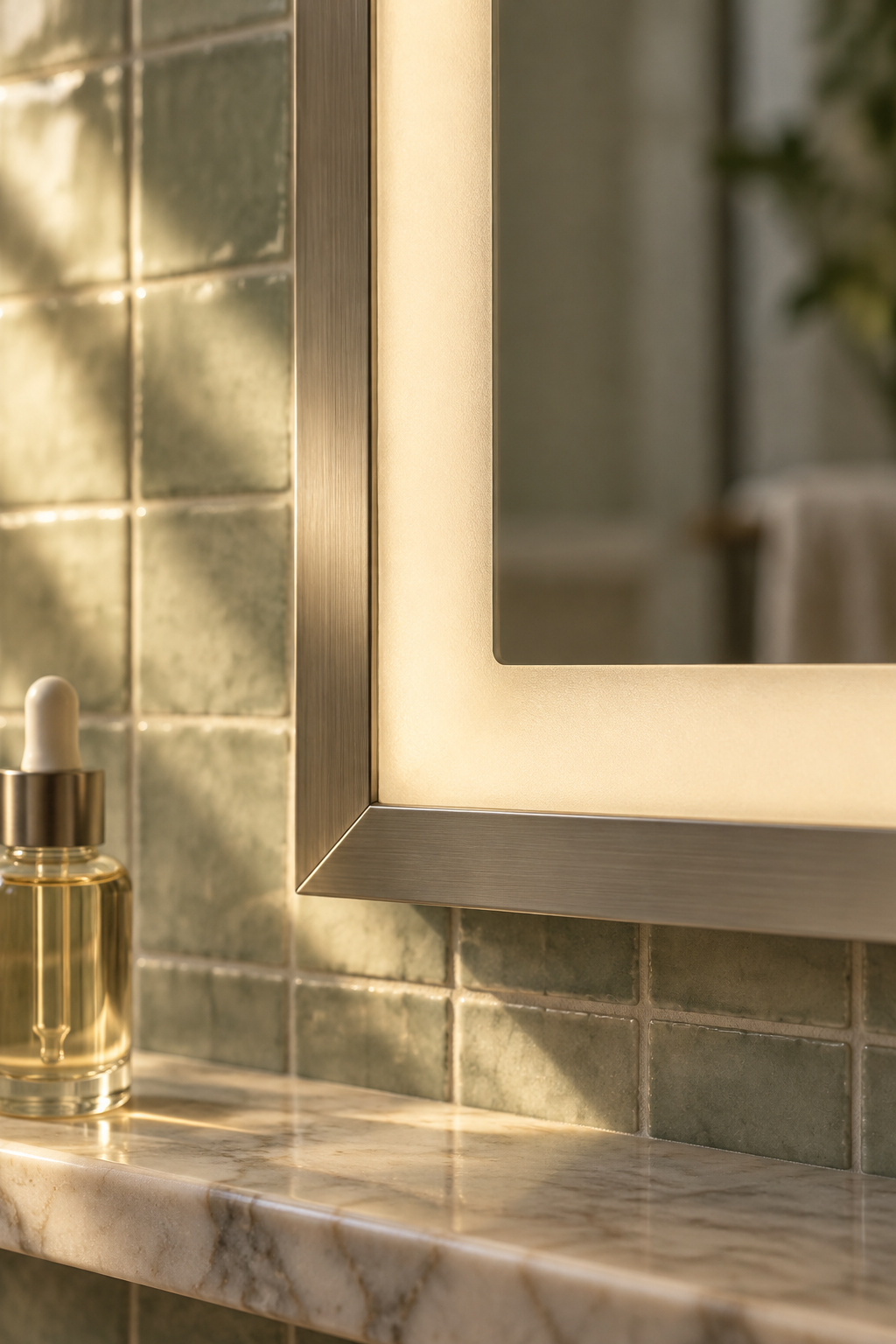
- Defogger. Worth having. On the Vitality 30×40 the LEDs draw 55 watts and the total reaches 85 with the defogger on, so the pad adds 30. Robern wants it powered separately from the lights; some touch mirrors switch the pad off after an hour.
- Dimming. Only as good as the dimmer. Robern lists most Triac and phase-cut dimmers as compatible, while Lutron warns that leading-edge dimmers make LEDs flicker and buzz. Follow the mirror maker’s list, not the dimmer already on your wall.
- Color modes. Budget mirrors offer presets from about 2700 to 6500 K. A list of settings says nothing about how faithfully any of them shows your skin.
The one number to demand is CRI, a 0 to 100 measure of how faithfully a light shows color, where 90 or more is the figure to ask for at a vanity; our guide to bathroom light color temperature explains what CRI and R9 mean for skin tones. Robern and Kohler’s Statuesque print CRI 90+ with R9 50+, Kohler’s Verdera, Electric Mirror and Matrix print 90+, and Elegant Lighting prints 90. When a listing gives color temperature and wattage but no CRI, ask before you buy.
What “50,000 Hours” on an LED Bathroom Mirror Really Measures
The figure is real, but it measures less than the listing implies.
In lighting engineering, an LED’s useful life is usually given as L70: the operating hours until its light output falls to 70% of where it started. The US Department of Energy is plain that this is not the lifetime of the whole fixture. The driver, the optics and the other electronics are left out of it, and in a lighted mirror that also means the touch switch and the defogger pad.
The Illuminating Engineering Society also caps those projections. Its rule allows them to run at most six times the length of the actual test data, so 10,000 hours of testing supports no more than 60,000 hours. Electric Mirror claims a calculated L70 of 140,000 hours for its Radiance mirror. At six times, that needs at least 23,333 hours of test data, and the sheet doesn’t cite the test report.
One budget listing promises that at five hours a day, 50,000 hours means 27 years. The warranty tells you what the maker will stand behind. Kohler gives its Verdera mirror one year. Matrix gives five. Electric Mirror’s current residential sheet gives seven.
The Wiring Behind the Mirror Decides the Model: Hardwired, Plug-In and Damp-Location Listing
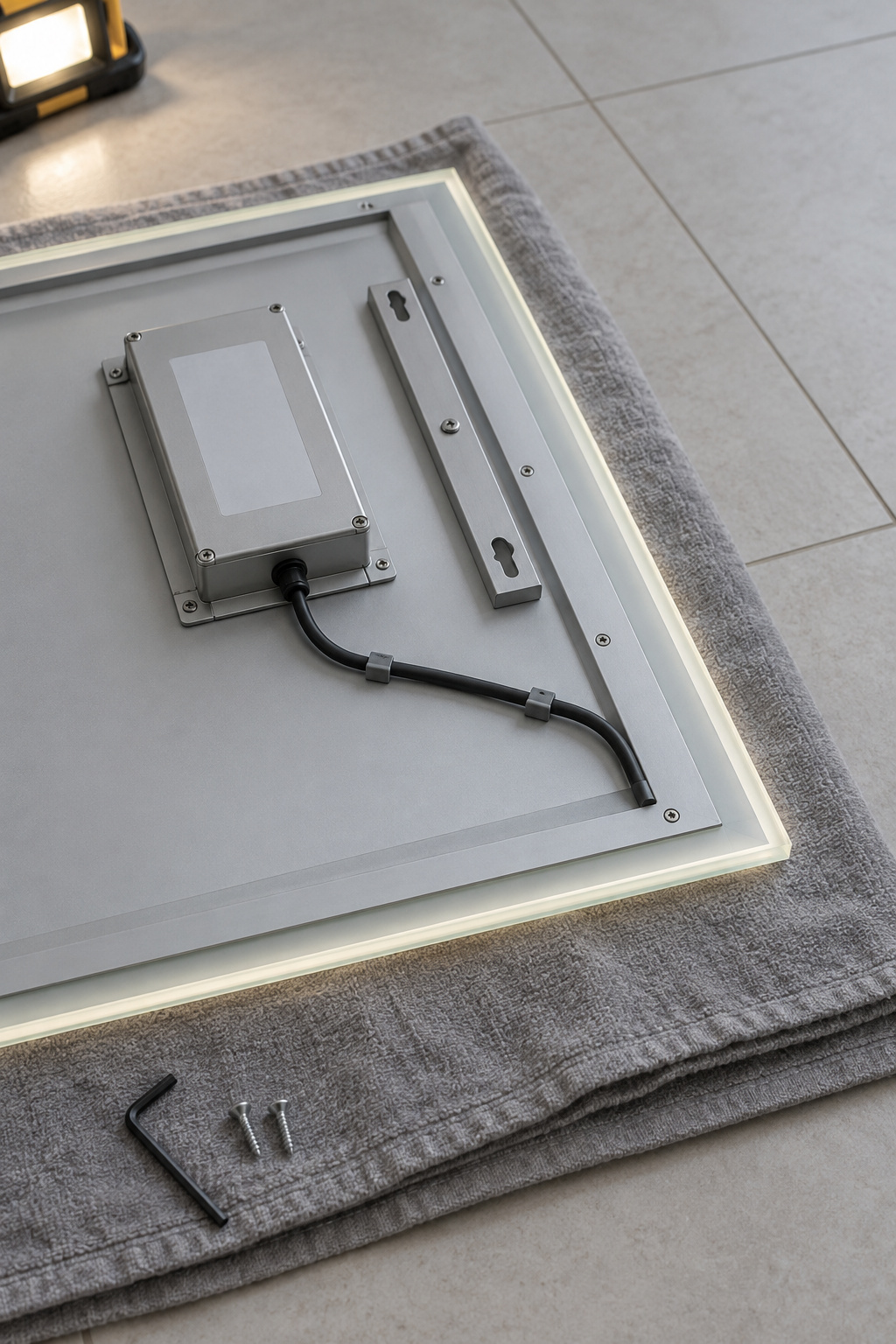
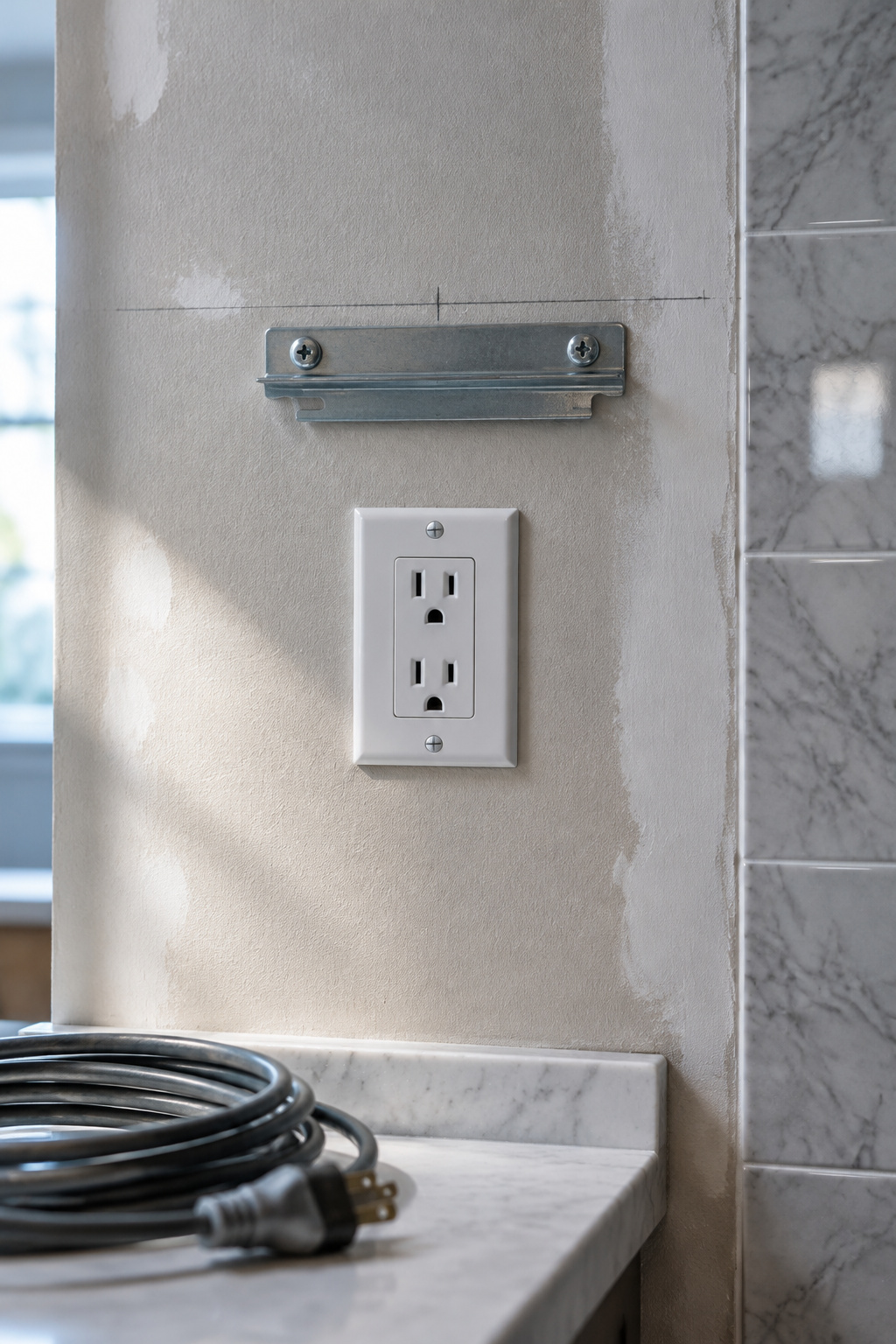
Lighted mirrors come with three wiring routes: hardwired to the supply, a factory cord into an outlet hidden behind the glass, or a cord whose plug can be cut off so the mirror can be hardwired. What is already inside your wall can rule a model out before you look at a photograph.
Hardwired: What an Existing Vanity Box Allows
Electric Mirror’s Radiance wants a 12-inch whip of wire brought out of the wall, a recess for its driver, and a mount to the studs on the cleat it supplies. It hangs one way up only, and Electric Mirror wants a licensed electrician or qualified technician to install it. Hanging a heavy mirror securely sets out which hardware suits which wall.
Several makers, Robern, Kohler and Prominence among them, require a GFCI-protected circuit even for a fixed mirror. The code’s bathroom GFCI rule covers receptacles, not hardwired lights. For a hardwired mirror, GFCI is the maker’s instruction, and you follow it.
Plug-In: Where the Cord and the Outlet Go
Robern’s plug-in mirrors run on a factory cord into an outlet behind the glass, on a 20-amp GFCI circuit. You can unplug it and take it when you move, but an electrician has to put that outlet there first. Some budget mirrors offer both routes: plug into a grounded outlet, or cut off the plug and wire it in. Don’t cut a plug off unless the maker says you may.
Then check the listing. Makers state theirs by standard: UL 962 for Robern and Kohler, UL 1598 for Matrix, each listed for damp locations. Budget listings tend to lead with IP44 instead. An IP rating and a UL damp listing are two different marks, so ask which listing mark is on the label.
What to Buy, What to Skip and What to Ask Before Checkout
Your face is lit by light aimed at it, and the halo is for the room. A mirror you can’t wire, or that won’t state its own numbers, is the wrong mirror however good it looks at night.
Buy a mirror that tells you:
- Which way its LEDs aim, and lumens marked as initial or delivered
- CRI of 90 or more, with R9 where it is given
- Its wiring route, and a drawing of where the outlet or box must be
- The listing standard by name, not only an IP rating
- The dimmers it approves, and whether the defogger has its own switch
- The warranty length, read next to the hour claim
Skip ranking mirrors by feature count. Dimming, touch sensors, motion sensors and color presets appear on mirrors of every kind and say nothing about where the light goes. If the mirror you love only glows, pair it with a proper vanity light. Try it in February, when the mornings are dark, before you decide it is enough.
For the decisions that come before the light, how the mirror hangs and who uses it, start with our bathroom mirror ideas.
I can tell you where light should fall on a face and which numbers to make a seller produce. A new circuit, a new box or an outlet behind the mirror is past that line. That is an electrician’s job.
FAQ
Do LED bathroom mirrors use a lot of electricity?
No. The lighted mirrors on maker sheets and budget listings draw about 24 to 55 watts for the light. At two hours a day, a 36-watt mirror uses about 26 kWh a year and a 55-watt one about 40 kWh. A 30-watt defogger running an hour a day adds roughly 11 kWh a year.
Why does my LED bathroom mirror flicker or hum?
The one cause the maker documents name is a dimmer the mirror wasn’t made for. Check the maker’s list of approved dimmers and fit one from it. Robern also allows a plain on/off wall switch instead of a dimmer. If the mirror still flickers on a plain switch, send it back under warranty.
How do you clean an LED bathroom mirror without damaging the lights or the defogger?
Switch it off or unplug it first. Wipe with a soft cloth, damp or dry, and if you use glass cleaner, spray the cloth rather than the mirror. Mild soap in water is enough. Never use abrasive cleaners, scouring pads, strong bleach or solvents, which can damage the finish and the LED strips.