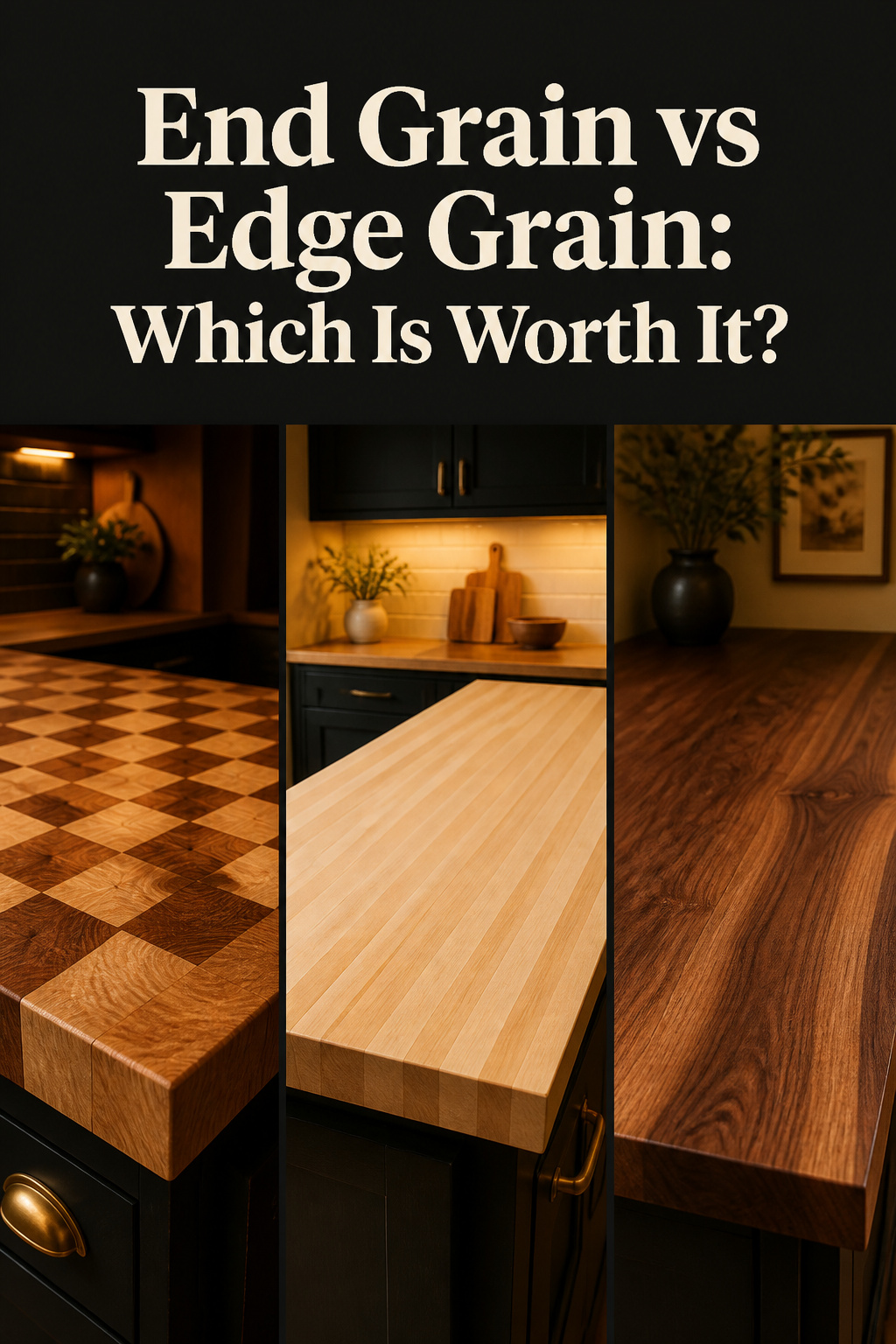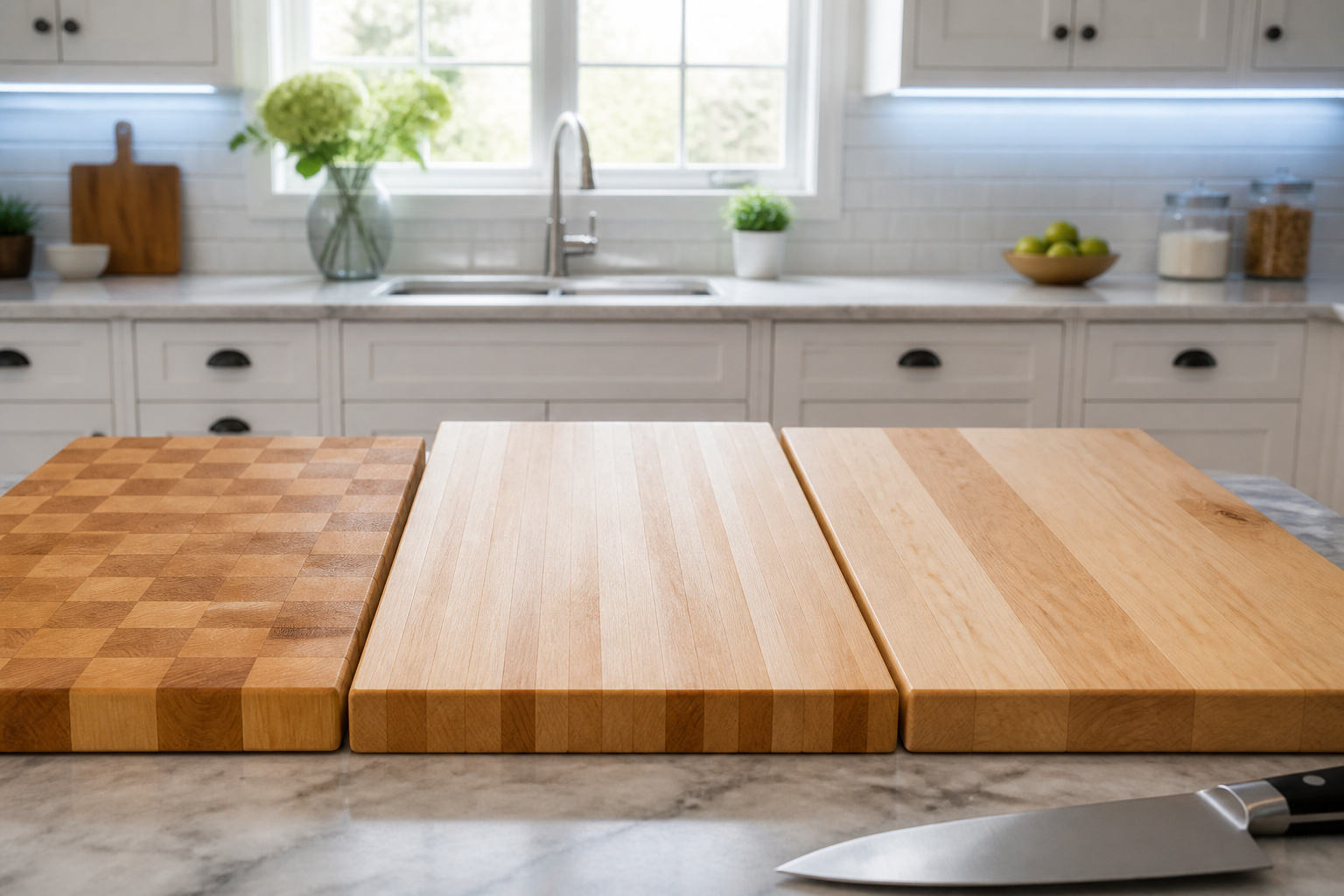

Most people walk into the end grain vs edge grain butcher block decision believing the same thing: end grain is the good stuff, edge grain is the budget compromise. That’s backwards for most kitchens. The difference isn’t quality — it’s which face of the same board you turn up toward the knife. That single choice drives everything downstream: durability, knife performance, oiling frequency, and price.
TL;DR
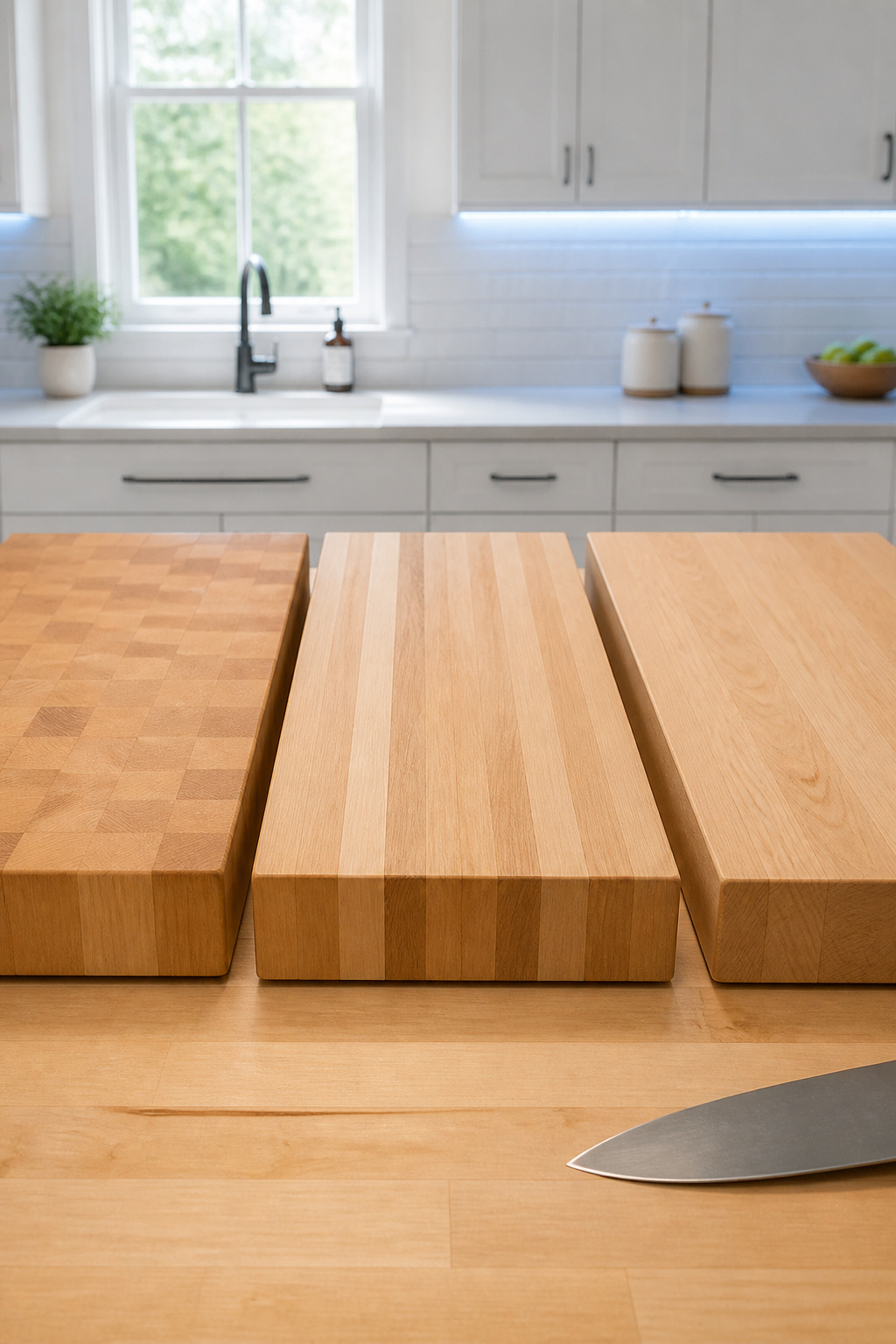
- Edge grain (parallel-stripe look, lumber on its narrow side) is the everyday default: durable, humidity-stable, big-box standard, $40–$150+ per square foot installed in 2026.
- End grain (checkerboard look, cut ends turned up) keeps knives sharper and self-heals marks — but needs monthly oiling, a 2-inch minimum thickness (2.5 inches for a full kitchen run), and runs $50–$350/sq ft, a 50–70% build premium over edge grain.
- Face grain (wide flat plank face) is the cheapest and the most striking — but marks easily and belongs on serving islands, not a daily prep surface.
What the Three Grain Types Actually Mean
All three constructions come from the same tree — only the face pointing up changes. That choice sets durability, knife performance, maintenance load, and price. Here’s the quick reference:
| Grain type | How it’s built | Durability | Knife effect | Care intensity | Price (installed, 2026) |
|---|---|---|---|---|---|
| Edge grain | Strips on their narrow edge, glued side by side | High; stable in humidity | Dulls blades slightly faster; marks stay | Lower — oils slower | $40–$150+/sq ft |
| End grain | Cut ends turned up, glued in a checkerboard | High; warps if neglected | Knife-friendly; marks self-heal | Higher — oils fast, monthly | $50–$350/sq ft |
| Face grain | Wide flat plank face up | Lowest for cutting | Marks and dents easily | Moderate; sand often | $30–$200/sq ft |
That table is the spine of the rest of this article — and the first decision in any butcher block countertops buy.
Edge grain: the long face of the board, the kitchen default
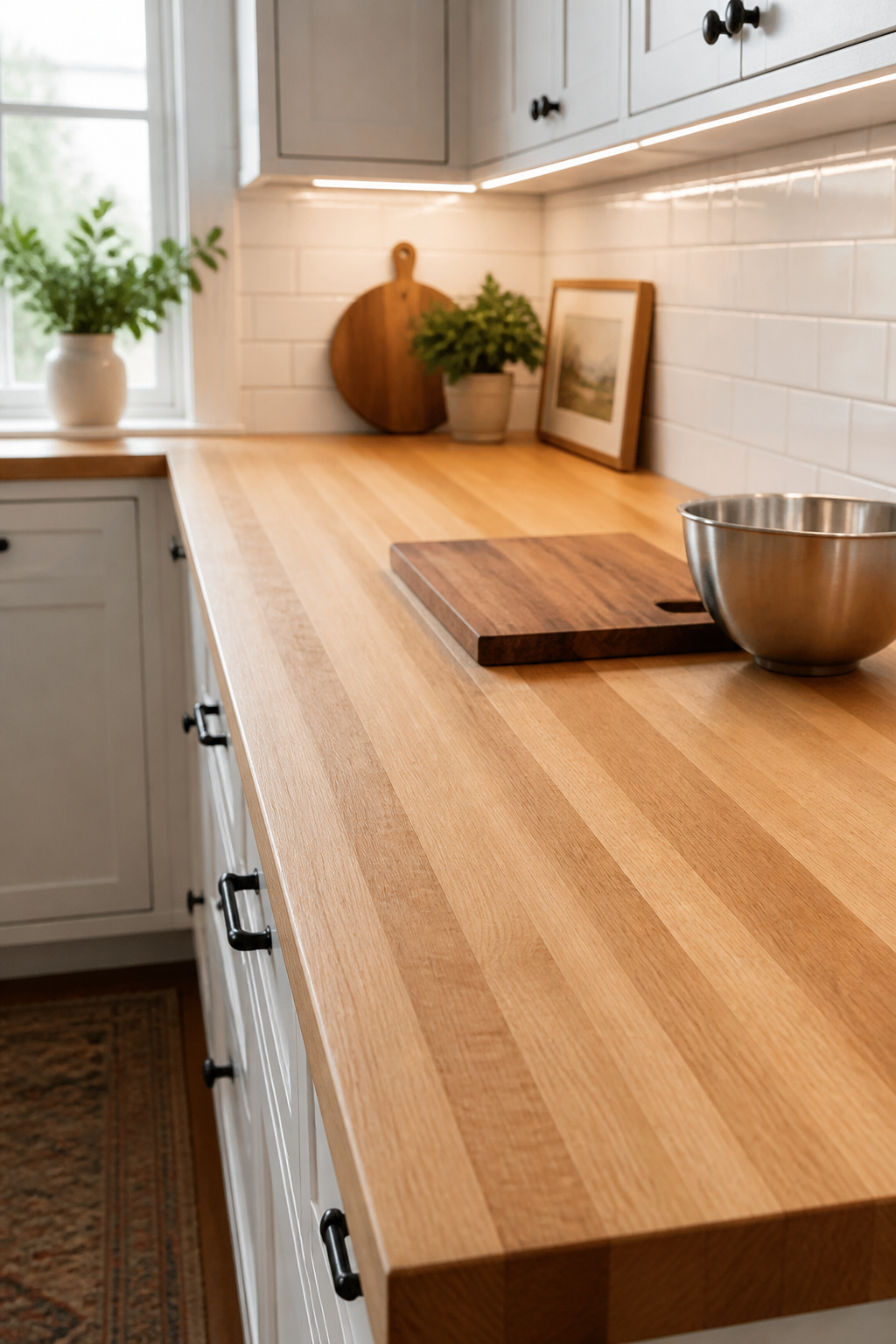
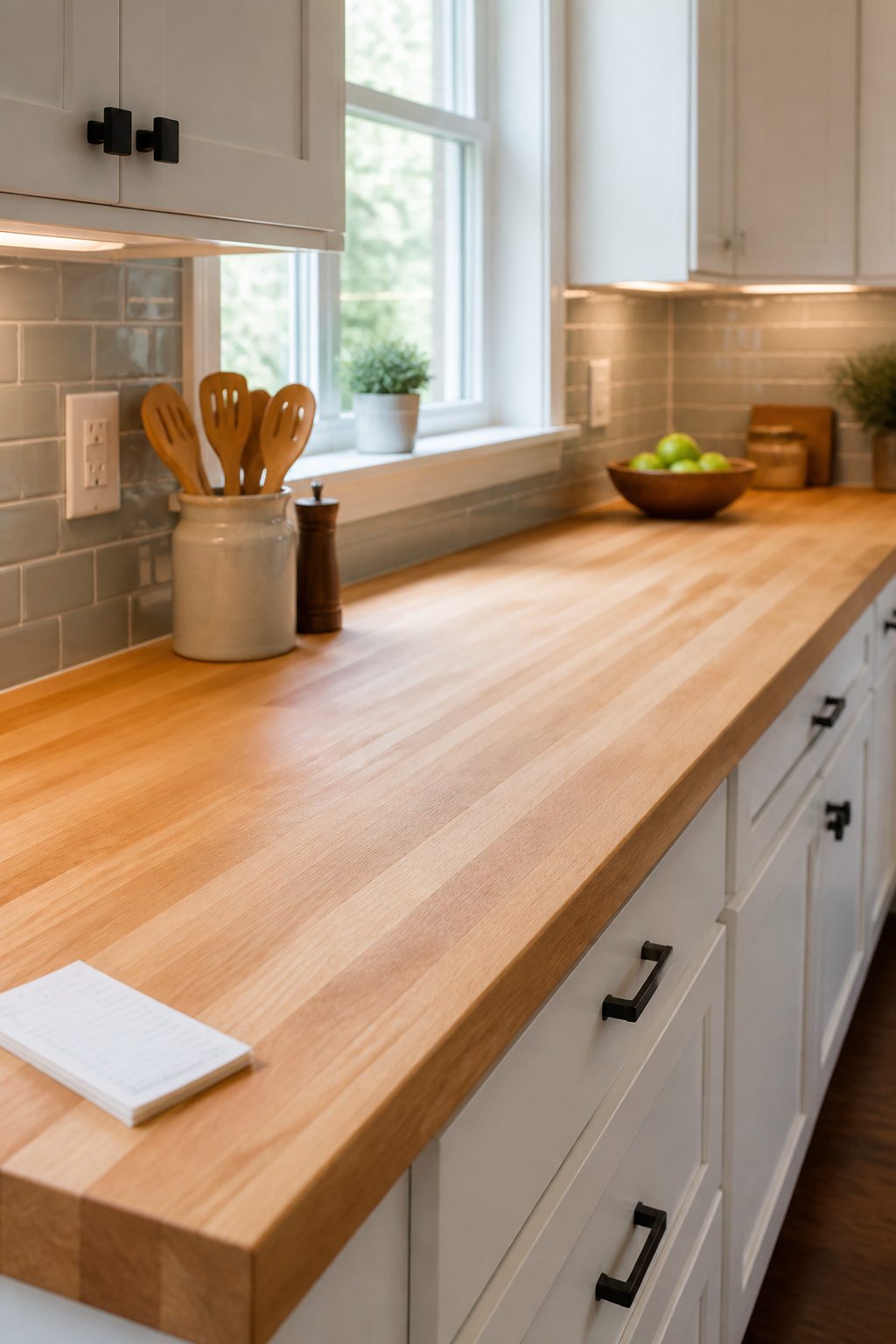
Edge grain stands lumber strips on their narrow edge and glues them side by side, so the long lateral grain faces up. The result is a clean, parallel-stripe surface — like a hardwood floor, no butt joints. It’s the most common residential construction, sold from 1.5 inches thick on up.
End grain: the cut end of the wood, the checkerboard look
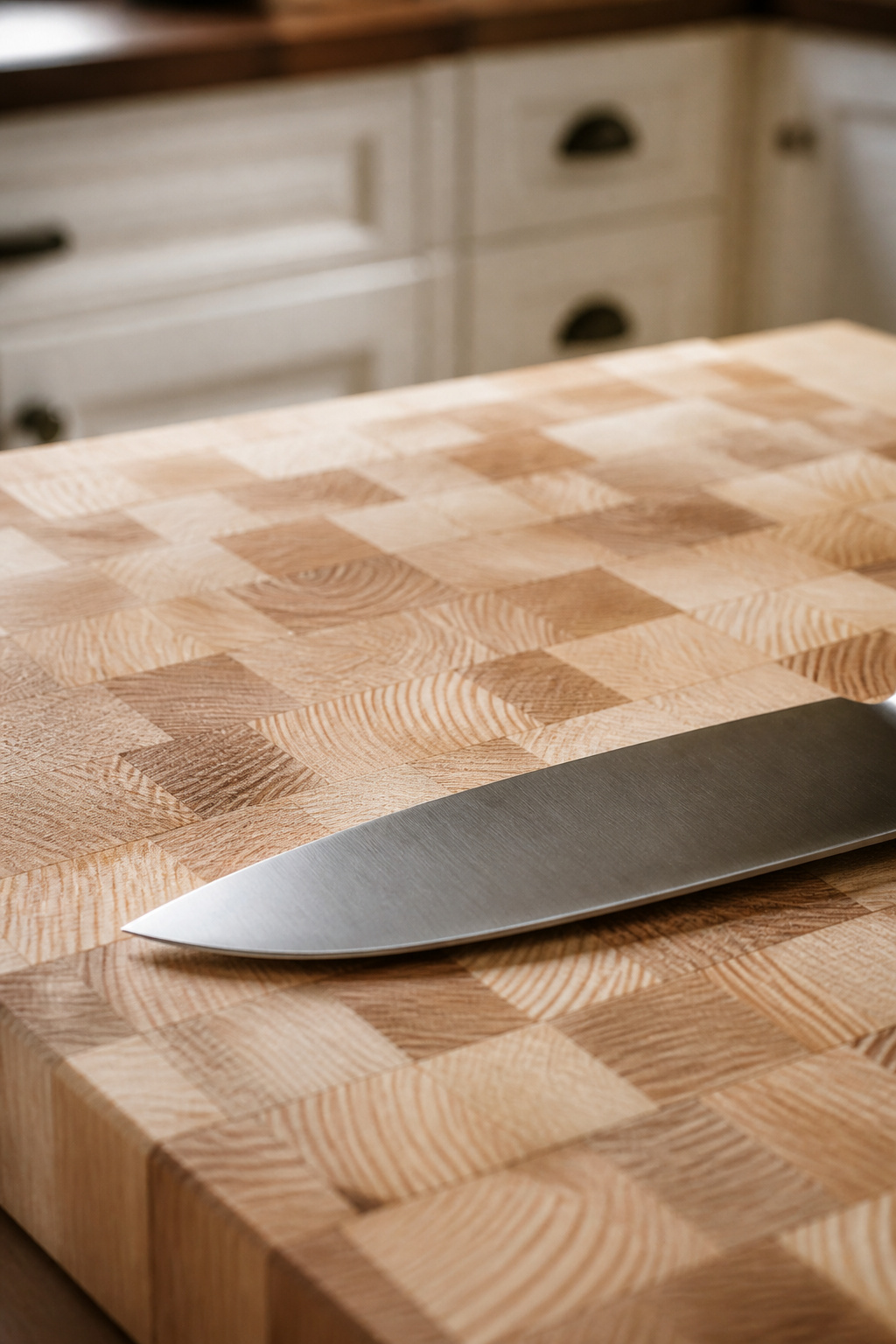
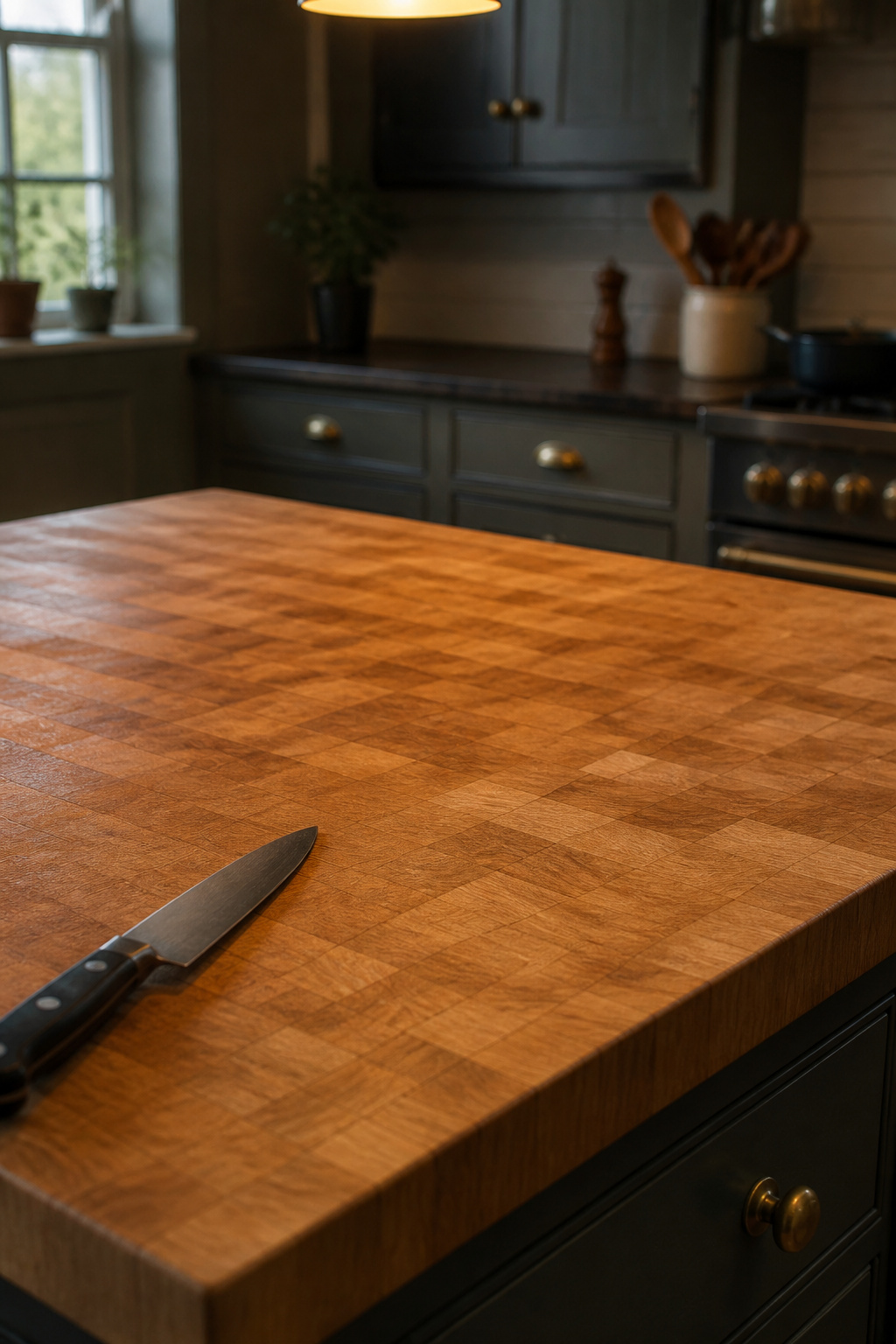
End grain stands each rail on its cut end so growth rings face up, producing the classic checkerboard. It’s the slow build: planks cut into strips, strips cut into blocks, each block rotated 90 degrees and glued in tight alignment. More wood, more waste, more skilled labor.
Face grain: the wide, flat face — beautiful but vulnerable
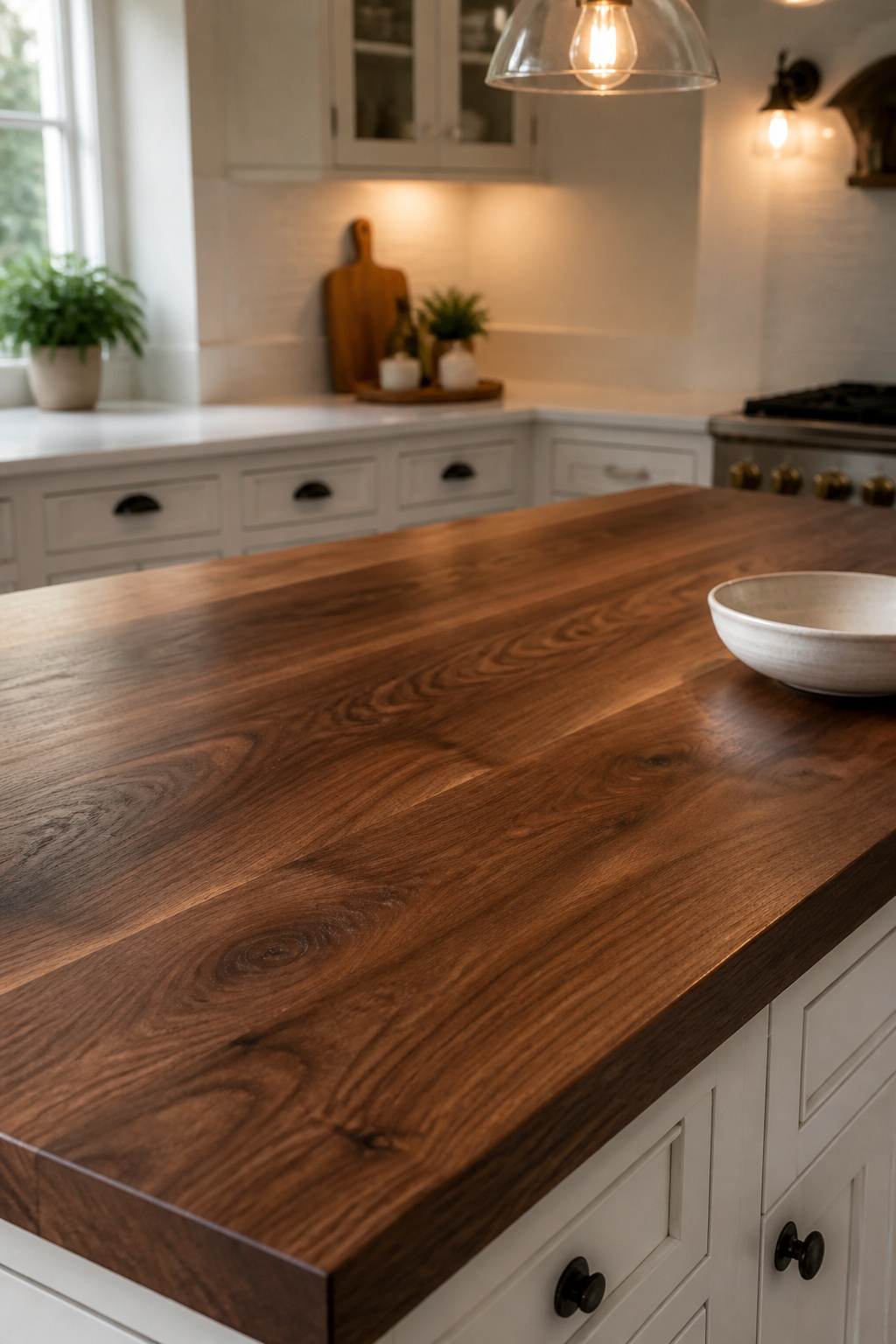
Face grain turns the broad plank face up, giving the most dramatic grain figure and the fewest seams. It’s the cheapest to make — fewer cuts, fewer glue joints. The catch: that wide soft face dents and scars faster than edge grain. It’s the worst of the three for daily cutting.
Edge Grain: Why Most Kitchens Should Start Here
Edge grain isn’t the consolation prize — it’s the sensible default. The honest trade-off is small: it shows knife marks over time and dulls blades a touch faster.
Durability and surface hardness for real daily use
The blade hits lateral fibers like a wall — Armani Fine Woodworking’s description — which means good dent resistance but marks that stay until sanded. Thinner strips also expand and contract less with humidity, so edge grain is less prone to warping or cracking than end or face grain. Bakers get an extra benefit: the harder surface handles dough rolling well.
Lower oil absorption compared to end grain — what that means in practice
Lateral fibers are less porous than end grain’s exposed fiber ends, so edge grain drinks oil more slowly. Quarterly oiling holds for a lightly used top; monthly for daily-use counters. Miss a month and edge grain won’t split at the glue lines the way a neglected end grain top can.
Cost and availability: edge grain’s practical advantage
Edge grain is the big-box standard. Lumber Liquidators stocks Williamsburg Butcher Block Co. maple, walnut and acacia — a 12 ft × 25 in unfinished maple top at $499.99 (roughly $20/sq ft, material only). Installed, edge grain runs $40–$150+ per square foot in 2026 per Angi and HomeGuide. End grain? Home Depot’s end grain filter returns zero in-stock results as of June 2026.
End Grain: The Knife-Friendly Countertop That Costs More Care
End grain earns its reputation on one point — knives — then asks for more in return. The care commitment is real and year-round.
Why knives last longer on end grain — the wood fibre science in plain terms
Vertical fibers let the blade slip between them instead of cutting across. Butcher Block Co. compares it to sliding a knife through raw spaghetti: the fibers part, then spring back. That spring-back is the “self-healing” property — cut marks close up over time, where edge grain holds them until sanded. Armani Fine Woodworking notes the surface distresses more slowly, so it looks newer for longer. The catch: only if you keep it oiled.
The checkerboard look: what it actually looks like after two years of use
The checkerboard develops a rich patina — oils darken the blocks initially, then settle back, and color variation deepens. Self-healing reduces visible wear; it doesn’t erase it. Glue-joint separation from neglect shows more on end grain than edge grain, because the block edges are shorter and the joint pattern repeats in both directions.
Oil absorption and the more demanding care routine
Vertical fiber ends act like open capillary tubes — they pull oil in fast. End grain wants oiling every two weeks for the first month, then monthly at minimum, year-round. Armani confirms: end grain tops release oils faster and need oiling more often. Skip it and that same porosity turns against you — more prone to warping and cracking, especially near heat. Winter is the danger window: indoor air below 25% relative humidity can crack a dry top at the glue lines. (See which wood species to choose and the care routine for each grain type.)
Face Grain: When to Use It and When to Avoid It
Face grain has a clear, narrow job: where looks matter more than daily knife work.
Where face grain belongs: islands where looks trump cutting
Face grain belongs on serving islands, coffee bars, and low-traffic spots. The wide boards reveal dramatic grain and color that edge grain hides, and a film finish like Waterlox or polyurethane suits it better than oil-only.
Why it marks easily and what that means long-term
HomeGuide’s 2026 data calls face grain “not ideal for countertops” — it marks easily because the broad plank face is softer and more exposed than edge grain. You can sand marks out, but you’ll be sanding more often. It’s also more prone to cupping, where uneven moisture across the wide face lifts the center or edges.
The honest cost case for face grain
Face grain is the budget leader — $30–$200 per square foot installed in 2026 — because it takes the least machining. The saving only holds where you’re not cutting. Cutting Edge Doors & Woodworking sums it up plainly: face grain wins on cost and looks; edge grain leads on durability.
Grain Construction and Price: What You Actually Pay
Price tracks construction directly. Here’s the 2026 picture from Angi and HomeGuide:
| Construction | Installed cost/sq ft (2026) | Build complexity | Oiling cadence |
|---|---|---|---|
| Face grain | $30–$200 | Lowest — fewest cuts and joints | Sand more often; film finish suits it |
| Edge grain | $40–$150+ | Moderate — straight glue-up | ~6–8 applications/year |
| End grain | $50–$350 | Highest — blocks cut, rotated, aligned | Monthly minimum (~12/year) |
Edge grain vs end grain price per square foot in 2026
Angi 2026: edge grain $40–$150+, end grain $50–$350 per square foot installed; HomeGuide confirms the same hierarchy. Custom pricing tracks it — Workshop Detroit lists reclaimed maple edge grain from $950 and end grain from $1,220. (ButcherBlockCo shows $30–$40/sq ft; their price page hasn’t been updated since 2015 — treat it as a floor only.)
Why end grain costs more to build and maintain
End grain runs 50–70% more than edge grain — more wood, more machining (strips cut to blocks, each rotated and aligned in two axes), a 2-inch minimum (typically 2.5 inches for structural confidence across a full kitchen run) versus 1.5 inches for edge grain, and Workshop Detroit’s standard 3-inch stock. Upkeep adds more: mineral oil at $8–$10 a bottle, 12 applications a year for end grain against 6–8 for edge grain.
Where to find each construction
Edge grain is the big-box standard — Lumber Liquidators in 8 ft and 12 ft lengths. End grain isn’t a big-box trip: Home Depot’s end grain filter returns zero in-stock products as of June 2026. For end grain, go custom or specialty — Armani, Workshop Detroit, Forever Joint Tops — with 4–10 week lead times.
Which Grain Is Right for Your Kitchen?
Two honest questions pick the grain.
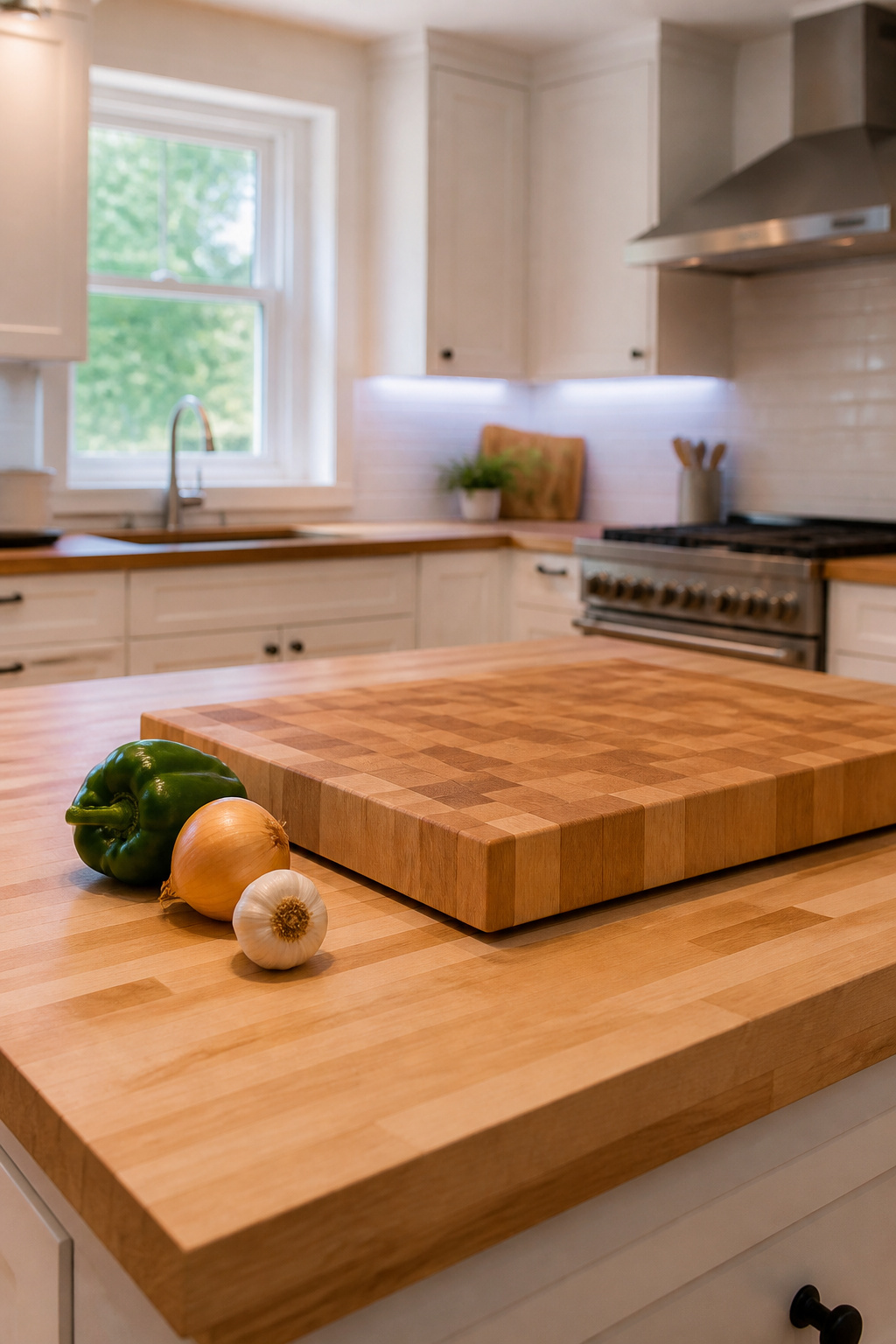
The two questions that decide it quickly
- Will you cut directly on the counter every day? If yes, end grain keeps knives sharper and hides scarring. If you reach for a cutting board, edge grain’s durability and lower upkeep win.
- Can you commit to monthly oiling? End grain requires it; edge grain forgives a missed month. “Probably not every month” means edge grain.
The budget makes the stakes plain: 35 sq ft runs roughly $1,400–$5,250 in edge grain versus $1,750–$12,250 in end grain — a gap of hundreds to thousands, before the first oiling.
The combination most kitchens land on and why
Most kitchens settle on edge grain across the perimeter with a dedicated end grain chopping block or inset cutting section. Edge grain’s price on the bulk; end grain’s knife-friendliness where it earns its keep. Face grain stays off the prep counter — bar or serving island only.
What to do next: species choice and care routine
Grain is half the decision. Species is the other half — hardness, color, cost. The break-in oiling is non-negotiable: food-safe mineral oil weekly for the first month, monthly through year one, stricter for end grain. Settle the grain, then the wood, then the routine.
FAQ
Is end grain or edge grain butcher block better for cutting?
End grain is better for knives: vertical fibers let the blade slide between them rather than across, which keeps edges sharper and reduces scarring, and marks self-heal. Edge grain dulls blades slightly faster and holds marks until sanded. Both beat stone or glass — and for cooks who use a cutting board, edge grain is plenty.
Why is end grain butcher block more expensive?
End grain costs 50–70% more to build: cutting planks into blocks, rotating each 90 degrees, and gluing hundreds of pieces in two-direction alignment means more wood, more waste, and more skilled labor. It also needs a 2–3 inch minimum thickness versus 1.5 inches for edge grain, adding material cost per square foot.
Does end grain butcher block warp more than edge grain?
Yes, when neglected — exposed vertical fiber ends exchange moisture with the air faster than edge grain’s lateral fibers, so humidity swings can warp or crack it, especially below 25% winter humidity. Well-oiled end grain is stable; monthly conditioning maintains the moisture balance and prevents the drying-and-cracking cycle.