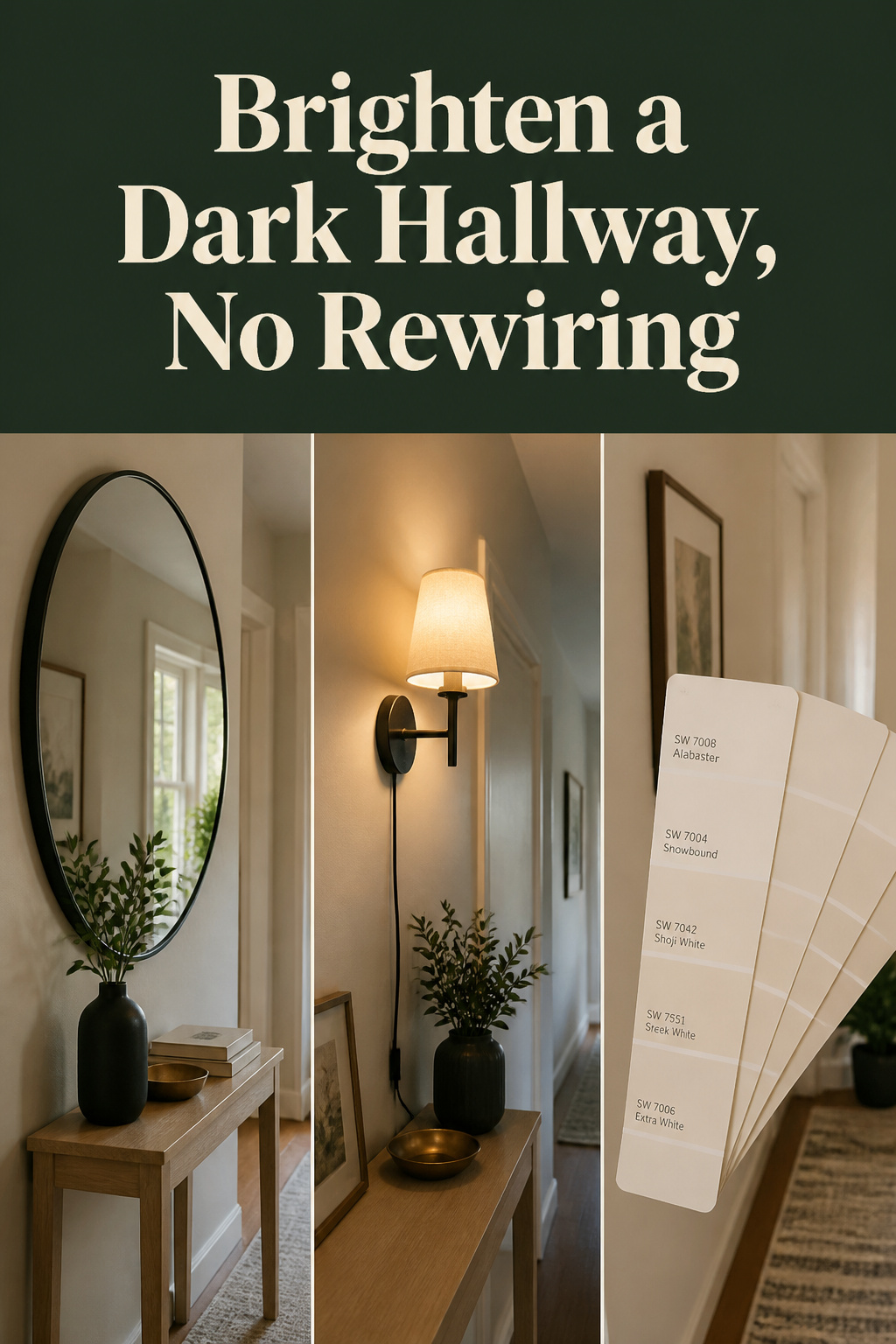
My grandparents’ summer cottage on the Stockholm archipelago had no lamp in its passage. Unpainted pine walls, one open shelf of crockery, and the oil lamps all standing in the main room. The passage was lit by whatever came through the open door, and it never felt gloomy. A passage rarely has light of its own, and the good ones borrow it deliberately. A windowless rental hallway is the same problem with worse borrowing, plus a lease that will not let you run a circuit.
TL;DR
- Aim for 20-30 lumens per square foot at 2700-3000K. A 4×8-foot hallway needs roughly 640-960 lumens total, which one 50-lumen battery puck will never reach.
- Hang the mirror on a side wall facing a light source, never on the far end wall. Opposite a real source it adds up to two visual stops of perceived brightness.
- Paint a warm white at LRV 80 or above, in eggshell rather than flat. Eggshell reflects 10-25% of the light hitting it; flat reflects 0-5%.
What a windowless hallway is fighting
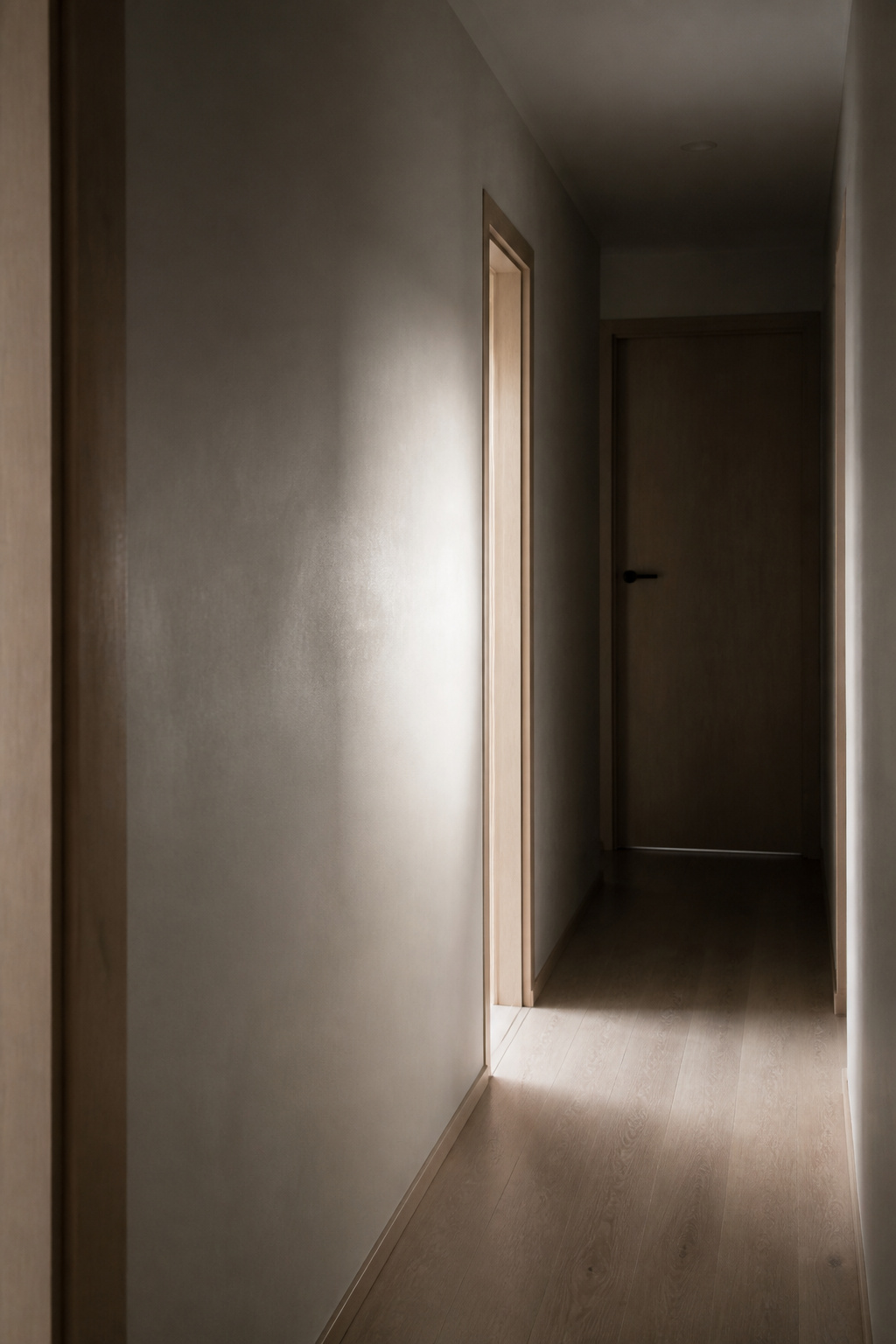
A dark hallway is seldom underlit. Most of them are unlit: no window, no fixture, only what escapes from the rooms on either side.
Borrowed light vs. no light: naming the real problem
A windowless hallway gets no direct daylight at all. Everything it has is borrowed: light travelling in through an open door, a glazed transom, or bounced off a surface. Two jobs follow, at two prices. A mirror redirects light that already exists, for nothing. A fixture adds light, for money. Most advice covers only the second.
A personal read on a hallway that never got natural light
That cottage passage worked because the pine carried what the doorway gave it. I still read a dark hallway in the same order. Where is the nearest real light source? What stands between it and the passage? Which surfaces could carry it once it arrives: door faces, stair balusters, the floor finish? Almost nobody counts them.
What “brighter” means here (lumens, not vibes)
Brighter is a number here, not a mood. Our standard for entry spaces is 20 to 30 lumens per square foot at 2700-3000K, with 5000K and above ruled out. You will also find charts putting hallways at 5 to 15, a walkway minimum, enough not to trip. A windowless hall has no daylight topping it up, so it needs the higher figure.
Mirror placement that multiplies what light you have
A correctly aimed mirror is worth two visual stops before you have spent anything.
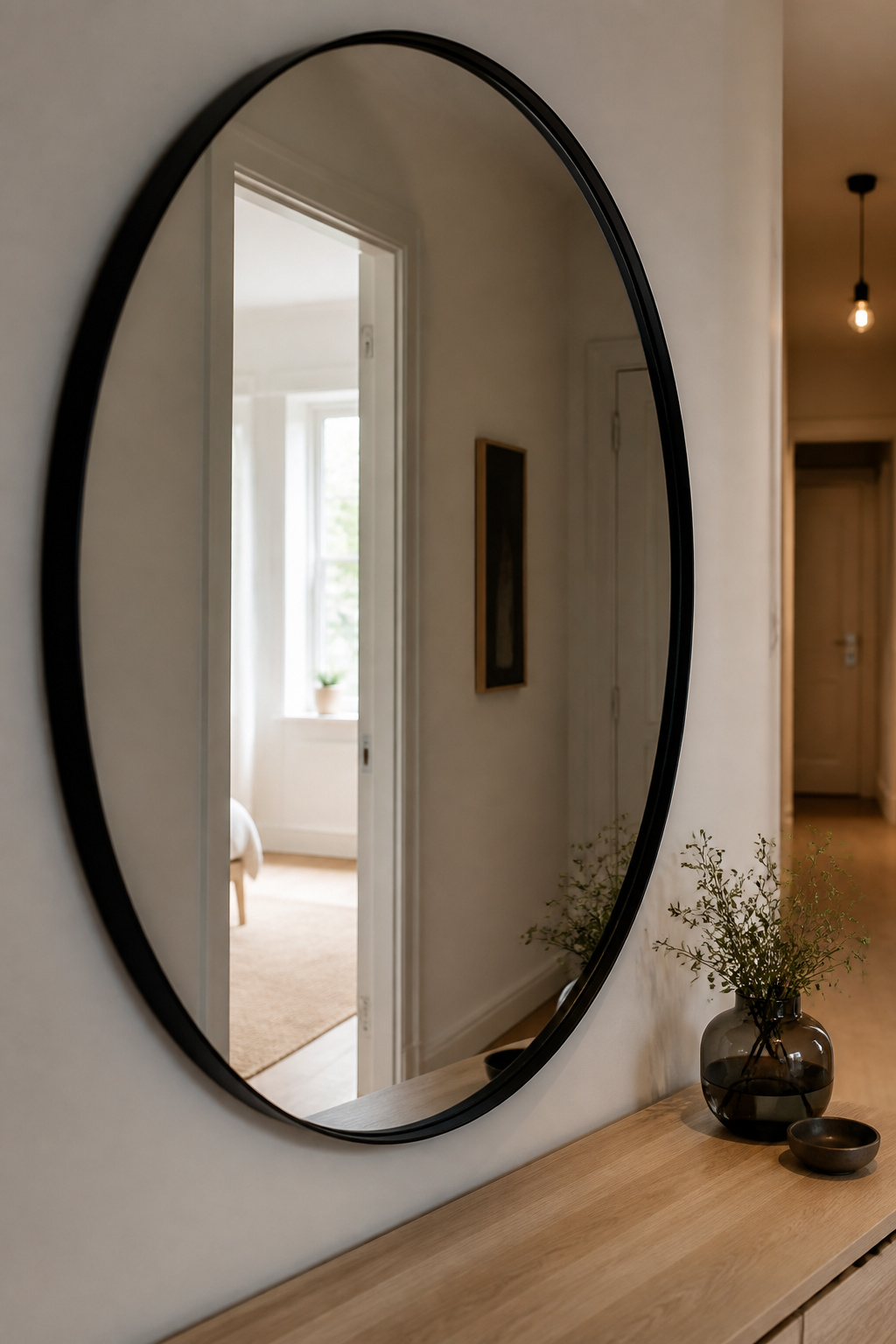
Where to hang a mirror relative to the nearest light source
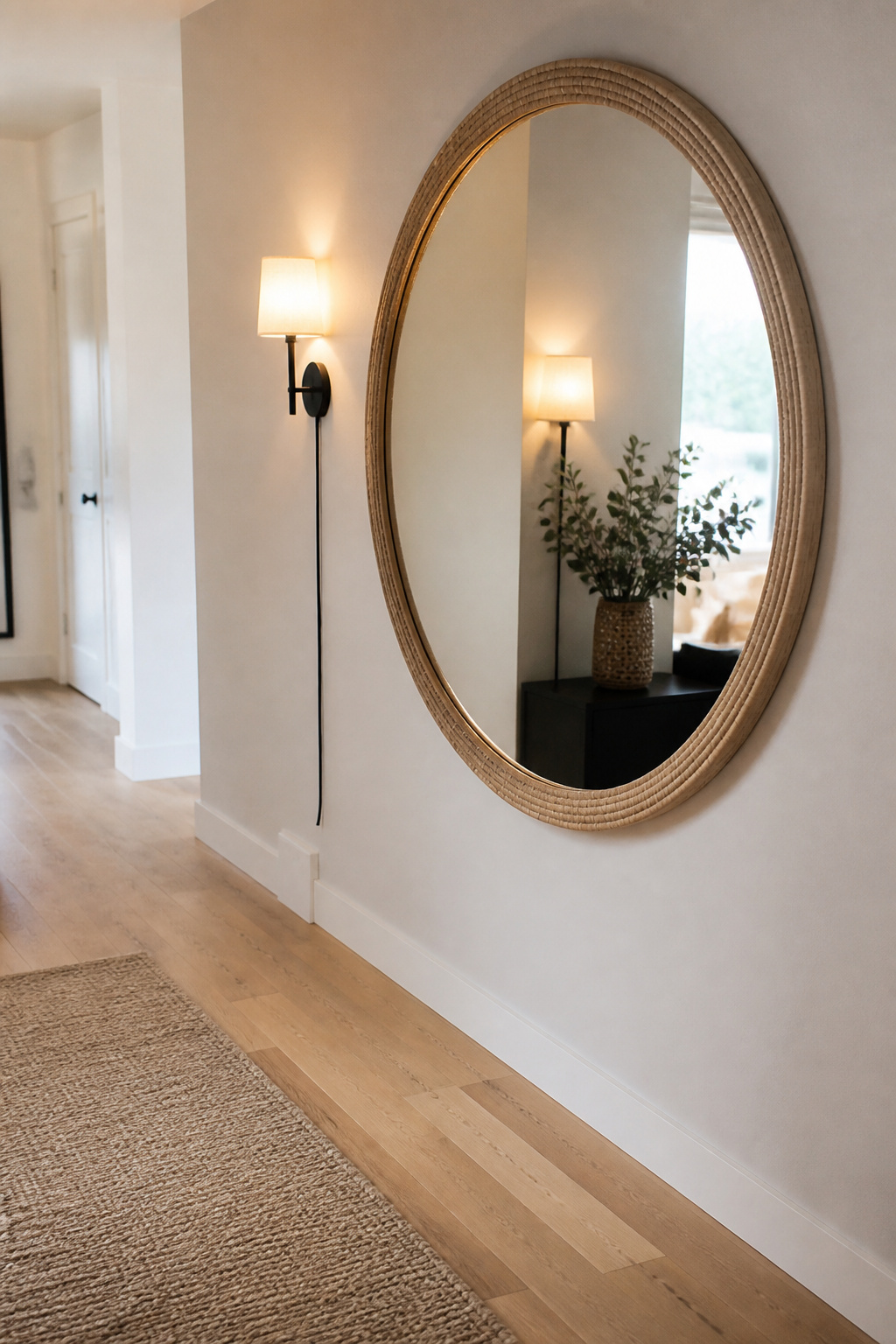
Opposite a window, or behind the main lamp in a dark room, a mirror can raise perceived brightness by up to two visual stops. Amara co-founder Sam Hood calls mirrors “the easiest way to make a space seem bigger and brighter, especially in a hallway.” After dark, stand a table lamp on the console in front of it and let the mirror spread that instead.
Size and shape rules for a narrow hallway
Two-thirds to three-quarters of the wall width is the working proportion. In halls under 59 inches wide, that means a mirror 20-28 inches across and 35-47 inches tall, centred 57-60 inches from the floor. HGTV host Vern Yip leaves a 2-inch border to the nearest wall or ceiling edge. On shape, Sims Hilditch design director Louise Wicksteed reaches for a round mirror to contrast a console table’s sharper lines.
The placement mistake that makes a hallway feel smaller instead
Hanging it at the far end is the instinct, and it is backwards. A side-wall mirror reflects the opposite wall and widens the hall; an end-wall mirror only deepens the tunnel. Designer Elaine Griffin mirrors one side wall instead. Two errors travel with that one: mirrors hung facing each other give infinite reflections rather than double brightness, and a deep frame catches shoulders in a tight hall. Use hardware rated to twice the mirror’s weight.
Plug-in and battery fixtures with real lumen numbers
The first purchase most people make here is a battery puck light, and on its own it is money wasted.
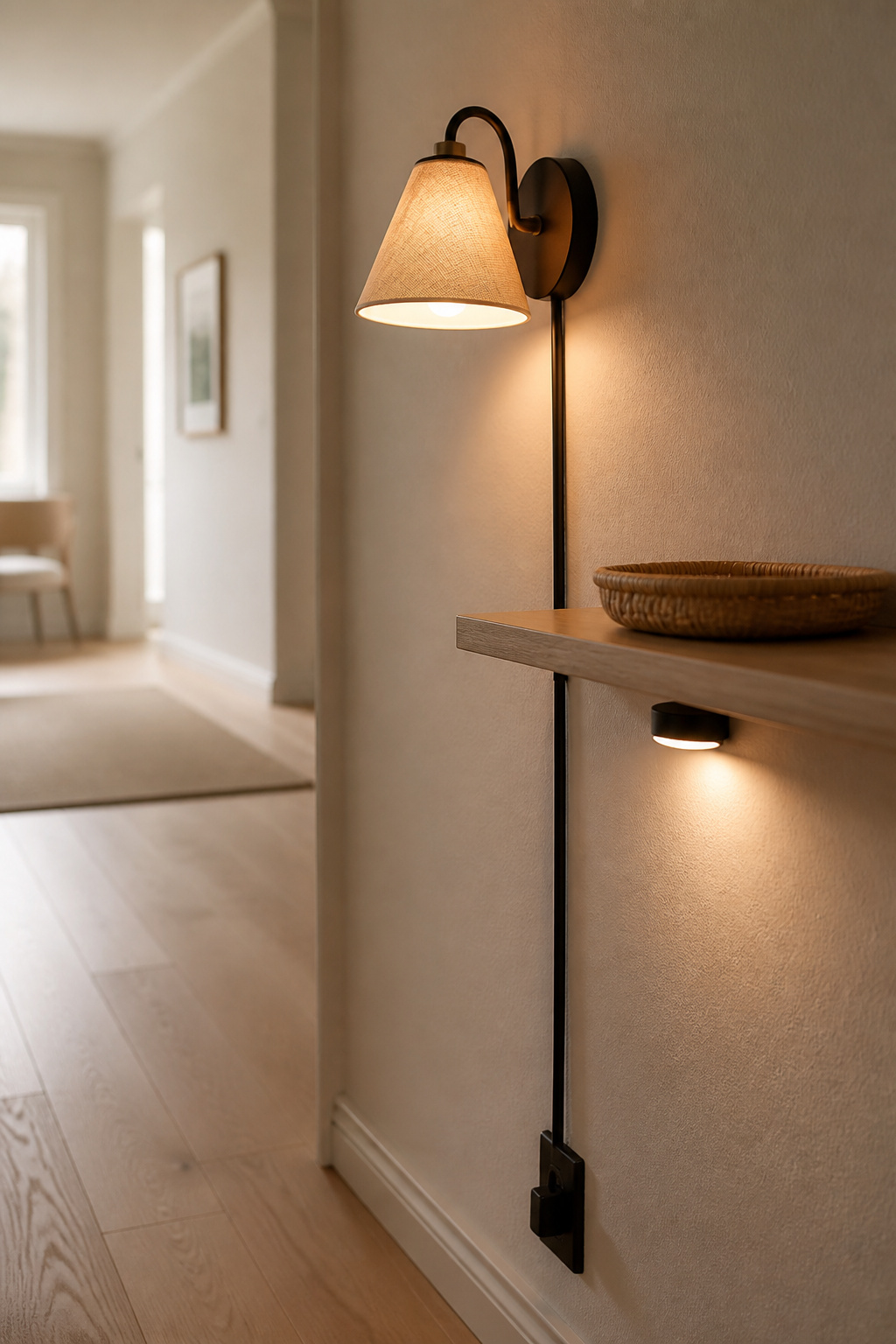
Lumens to look for by hallway length
A 4×8-foot hallway is 32 square feet. At 20 to 30 lumens per square foot, that is 640 to 960 lumens across every fixture in it. A single 50-lumen puck delivers under a tenth of the low end, which is why one changes nothing you can see. Count lumens and colour temperature separately. Keep the second at 2700-3000K, because 5000K and above reads clinical in a space this narrow.
Plug-in sconces vs. battery pucks vs. picture lights
| Fixture | Output | What it is honestly for |
|---|---|---|
| Battery puck (Amazon Basics) | 50 lm | One shadowed spot |
| Battery closet light (Good Earth 7-in, 4x C cells) | 100 lm at 4000K | A shelf, a corner |
| IKEA KÖLVATTEN LED strip with sensor (3x AA) | 80 lm over ~19.6 in | A doorway edge, no tools |
| Rechargeable-bulb wireless sconce | ~200 lm, ~50 hr per charge | Ambient, at a maintenance cost |
| Battery picture light | 150-350 lm by model | Art, or a short wall run |
| Plug-in sconce or swing-arm lamp | 800-1,100 lm by bulb | The ambient layer |
Buy the last row. That number is my own arithmetic rather than a tested fixture, since no maker prints a lumen rating for a corded sconce. The bulb decides it, and an 800-1,100 lumen LED clears the target alone.
The rechargeable sconce is the row I’d talk you out of. It works, at roughly 200 lumens for about 50 hours, then the bulb comes out at eye height for a weekly recharge. Storage that requires discipline is failed design, and lighting is no different. A light you have to remember to charge is one you stop using by February. Run the cord.
Placement height and spacing
Mount the fixture centre 60 inches from the floor (60 to 66 inches under an 8-foot ceiling, low 70s only under a 9-foot one). Space sconces 6 to 8 feet apart along the wall, which lights the mid-wall zone a ceiling fixture misses. In a narrow passage, keep projection under about 4 inches.
Paint and surface choices that bounce light
Which changes a dark wall more, the colour or the finish? Usually the finish, and almost nobody shops for it.
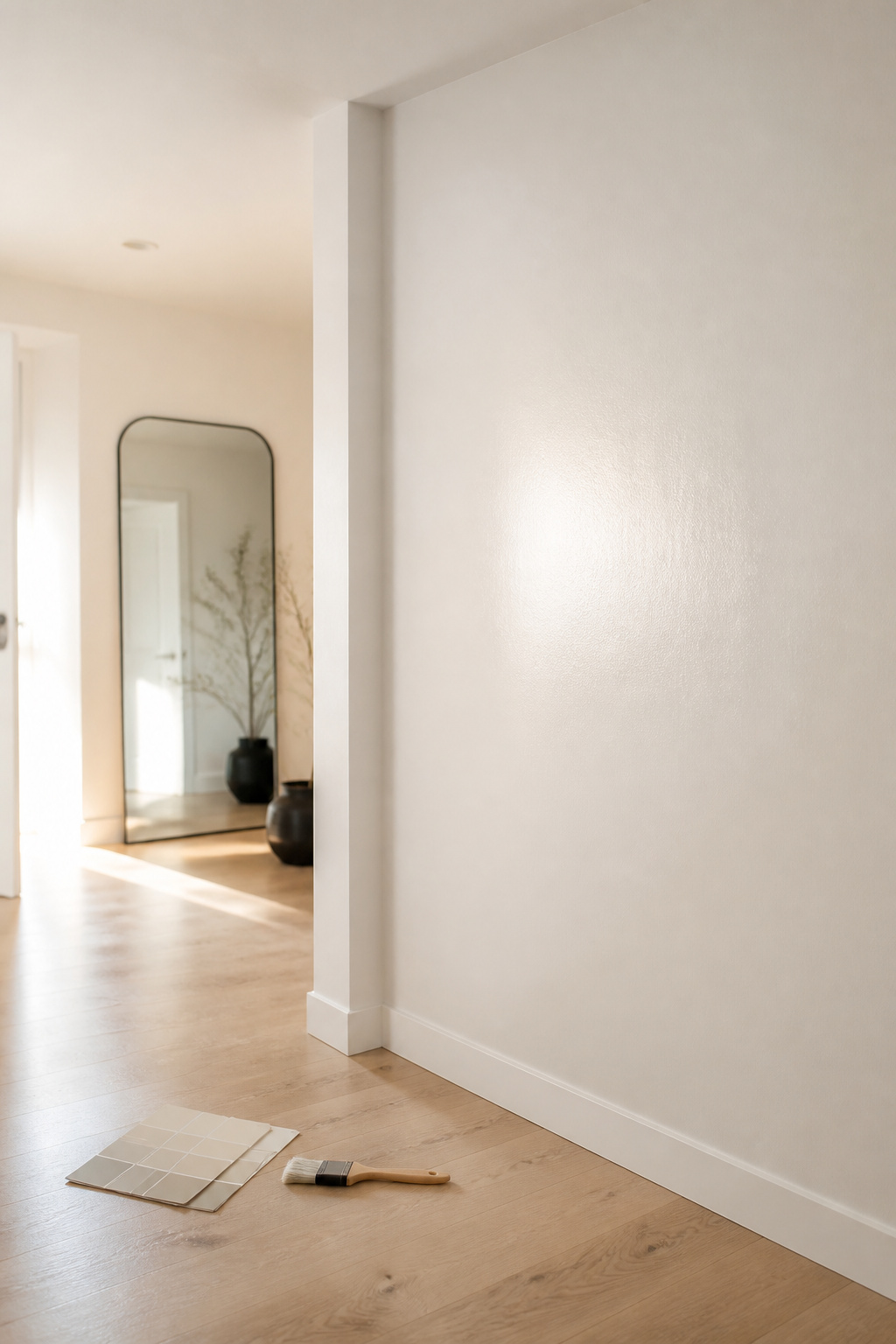
Sheen level and why matte kills a dark hallway
Flat and matte paint reflect 0-5% of the light that hits them. Eggshell reflects 10-25%, satin 25-35%, semi-gloss 35-70%. Eggshell or satin is also the professional standard for entry walls, with trim at semi-gloss, because flat marks under coat sleeves and will not scrub.
Warm white vs. true white for a light-starved space
Jotun’s Nordic Colour Guide sets warm whites at LRV 80 to 90 as the standard for low-natural-light interiors, and their Lady Egg White (code 1001) sits at 84. Benjamin Moore Swiss Coffee OC-45 reads 82. A windowless hall is the extreme case of zero direct sun, so lift the LRV target 5 to 10 points and favour warm undertones over cool. Take 82 or above, warm, in eggshell.
Ceiling color as the fourth light source
A fresh coat of white looks noticeably brighter than an aged one. Use a genuine wall-paint white rather than a tinted ceiling formula, which is built for hiding rather than depth. Keep the sheen flat up there, though: overhead the job is suppressing roller marks and glare.
Layering it together so the hallway feels finished
Do these four in the wrong order and you will pay for two of them twice.
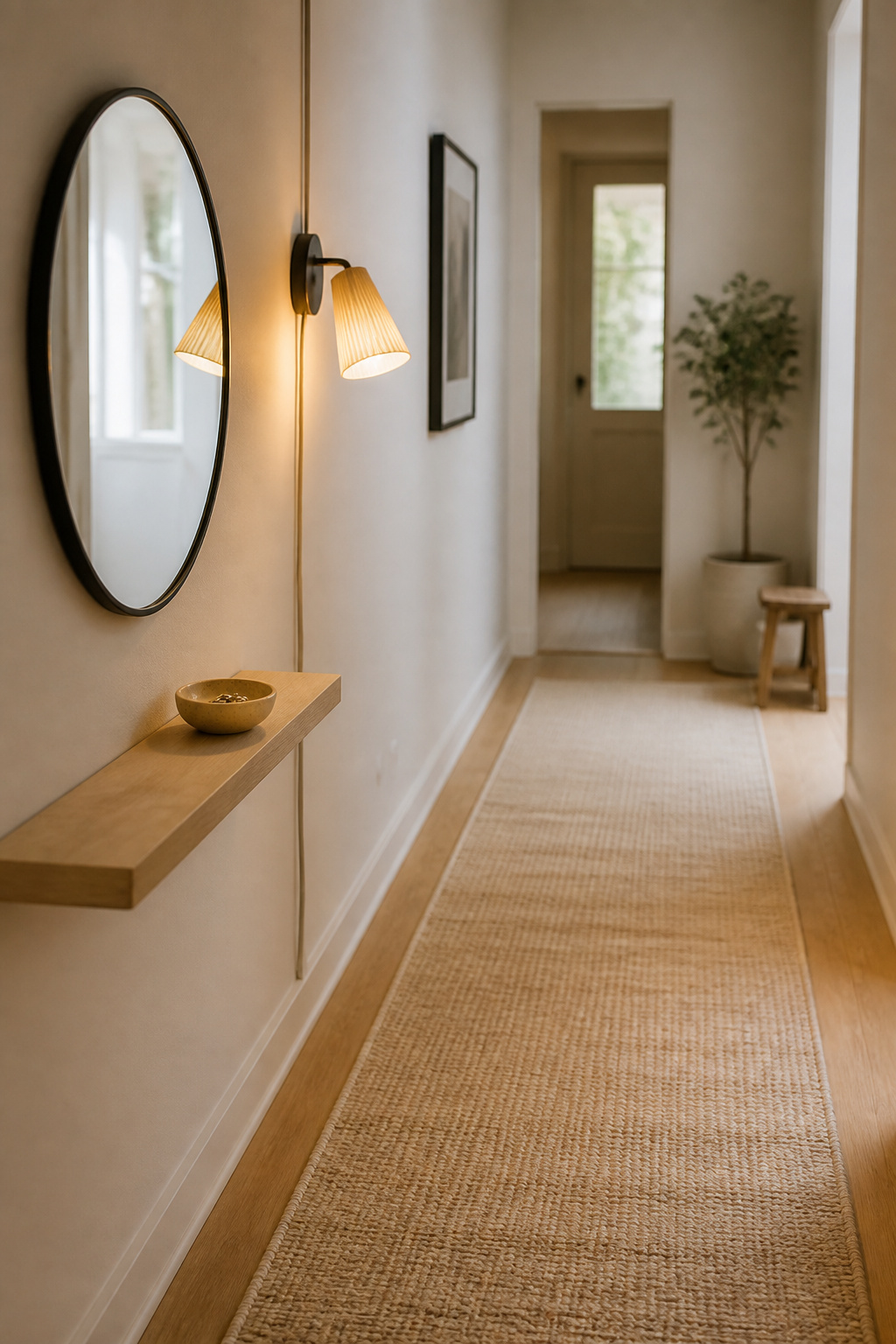
The order to do these four things in
- Mirror first. Free and immediate, and it often reveals that a spot needs no fixture at all.
- Fixtures second. They add the real lumens, and one placed where the mirror can reflect it does two jobs.
- Paint third. A high-LRV white with nothing to reflect still looks flat.
- Rug last. It is the only one of the four that can darken the hall if you choose it wrong.
How a pale, low-pile rug finishes the brightening
Pale and low-pile, for one reason: the floor is a reflective surface, and a rug is the thing most likely to cancel it. Leave 4 to 8 inches of hard floor visible on each side of a runner, plus a 3 to 6 inch gap at the threshold. Size, material and layering live in our guide to rugs that lighten a dark entry.
A quick placement check once everything’s up
Stand at the entrance in the evening, fixtures on. Confirm the mirror still faces a real light source, because a coat rack hung later will block the exact reflection the plan depends on. Then walk it with a bag on your shoulder. Nothing should catch.
How to brighten a dark hallway tonight: where to start
Nothing here needs a delivery, a landlord’s permission, or a free weekend. The first move needs only a hook you already own.
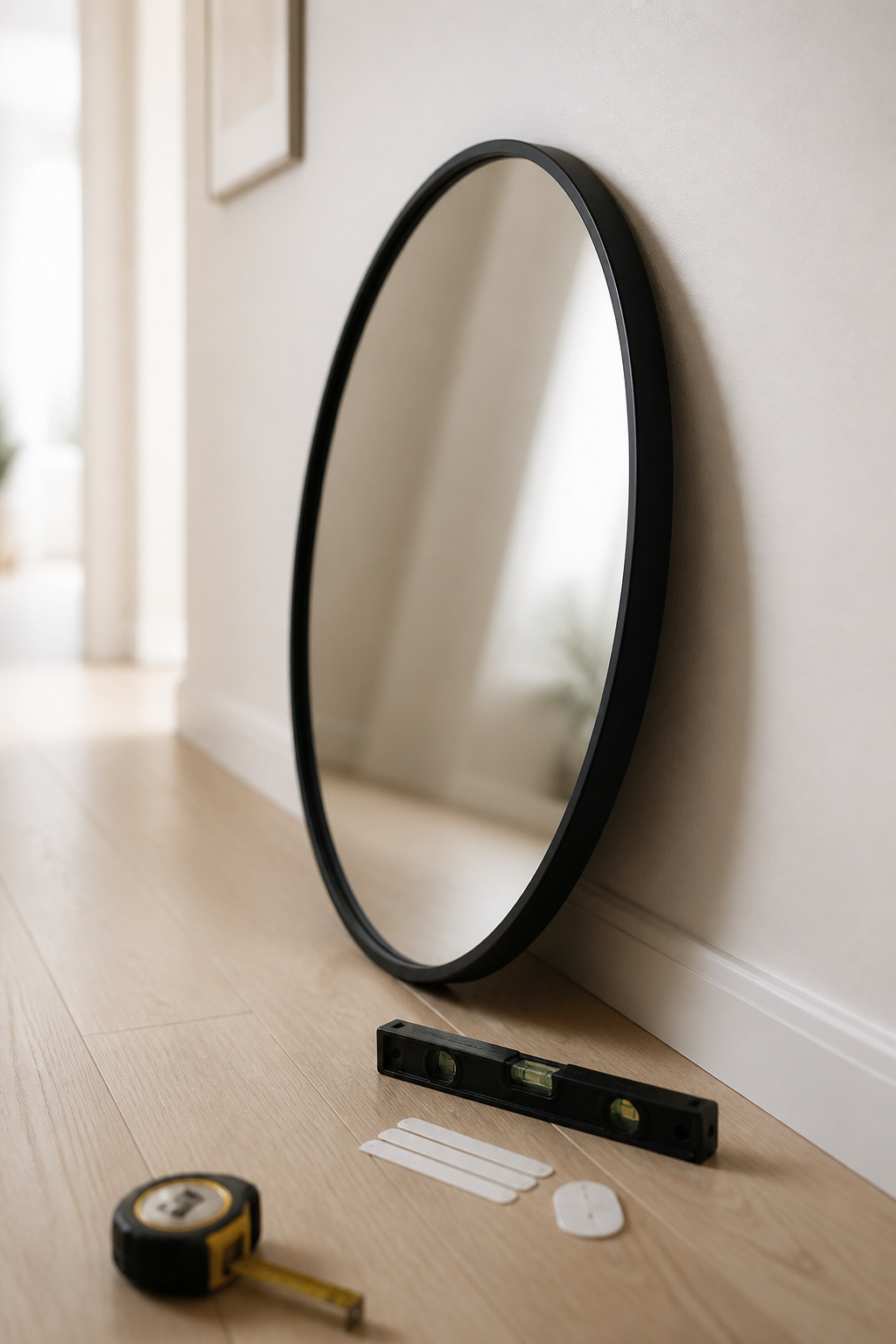
The one change to make before you buy anything
Take the mirror already hanging and re-hang it on the hallway’s side wall, aimed at the nearest doorway or lamp. It costs nothing and shows how much fixture and paint you actually need, usually less than assumed. No mirror in the house? Hold a hand mirror against candidate spots along that wall and watch what comes back.
What this doesn’t fix (and when to call an electrician)
None of these four moves adds a hardwired fixture, a switch, or a new circuit. Every plug-in and battery option here assumes an outlet within cord reach; no outlet at all is an electrician’s conversation, not a styling one. Wired sconce shopping (wattage, boxes, installation) belongs in a different guide.
Bringing the rest of the entry up to match
A bright hallway is still not an arrival. If yours doubles as the entry, defining the entry threshold is the next move, and the wider set of apartment entryway ideas covers the storage and layout decisions this article left alone.
Mirror on the side wall, the right lumens in warm white, paint once there’s light to bounce, pale rug last: four moves, in that order. You now know which is free, which one carries the room, and exactly where a no-rewire fix stops and a hardwired one has to start.
FAQ
Do battery-powered lights work well for a hallway?
For one dim spot, yes. For a whole hallway, no. Puck and closet-style fixtures run 50 to 100 lumens, which is accent level. Rechargeable-bulb sconces reach around 200 lumens for about 50 hours per charge, then need recharging weekly. Layer them beside a mirror and a brighter plug-in fixture doing the ambient work.
What color paint reflects the most light in a dark hallway?
A warm white at LRV 80 or above, rather than whatever the name promises. Jotun Lady Egg White reads 84 and Benjamin Moore Swiss Coffee OC-45 reads 82. In a space with no direct sun, lift that target 5 to 10 points and favour warm undertones. Sheen counts too: eggshell reflects 10-25% of incident light, flat only 0-5%.
Can mirrors really make a hallway feel brighter, or just bigger?
Both, and they are separate effects. Opposite a light source, a mirror can add up to two visual stops of perceived brightness alongside a 25-35% perceived depth gain. Aimed at a blank wall it delivers neither. An end-wall mirror usually reflects the dim hall itself, so it deepens the space without brightening it.