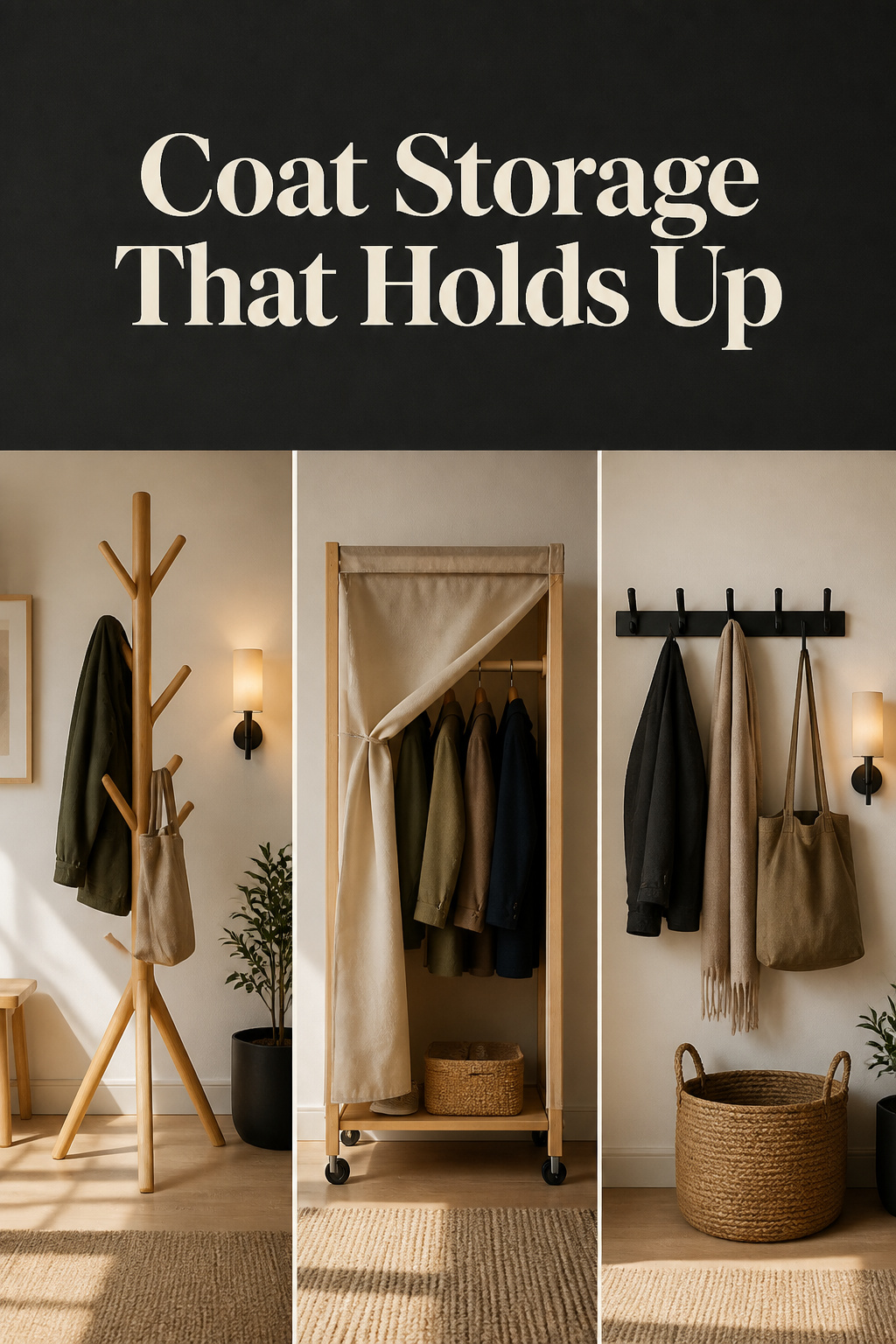
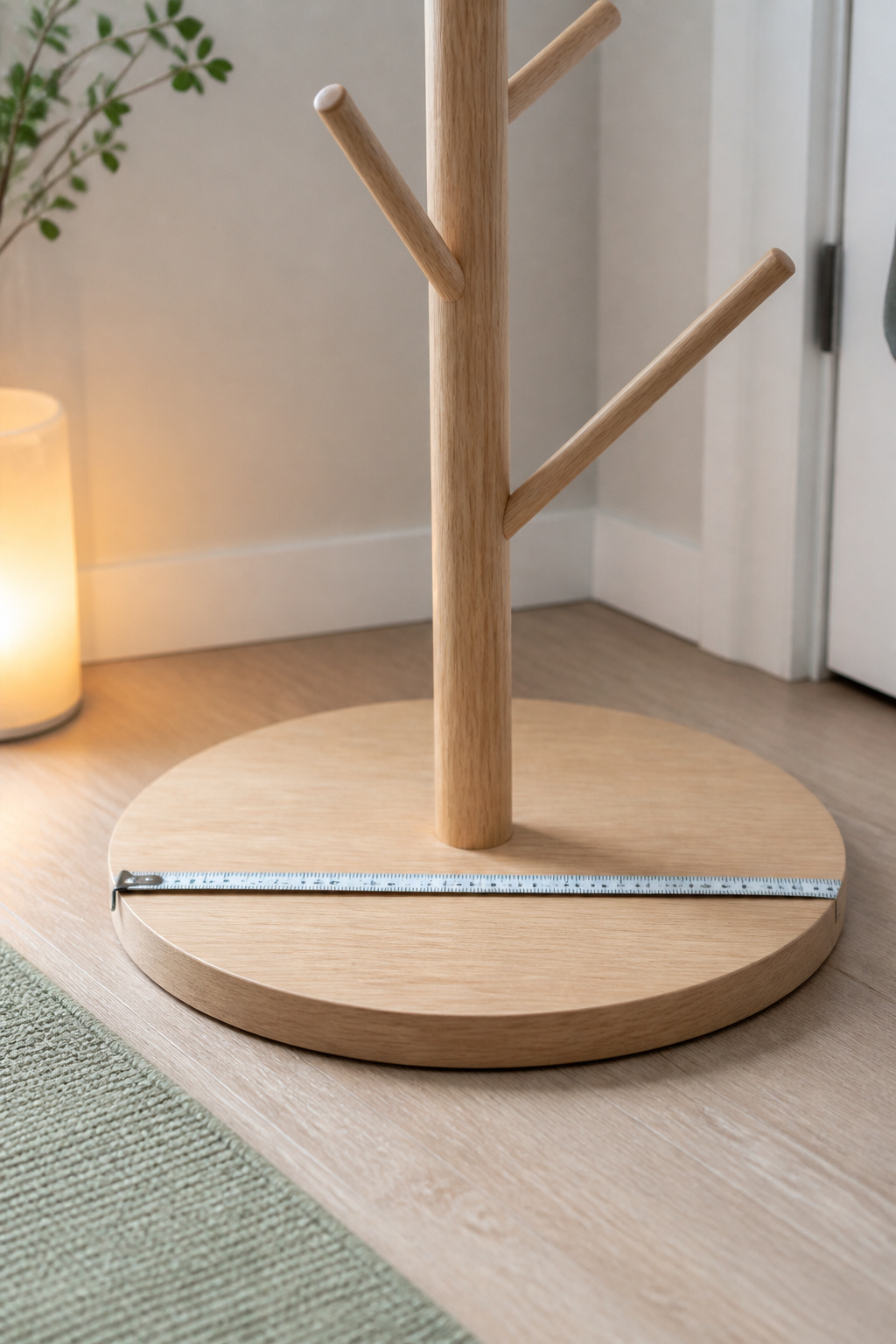
Measure a coat rack’s base across, then measure the rack’s height. A circular base needs to span 40% of that height; a tripod base needs 60%. That ratio explains most “this thing tips over” reviews online better than any weight rating. So the first move in coat storage without a closet is checking a number no product page prints on the box, not shopping for something heavier.
TL;DR
- Base diameter decides stability: 40% of the rack’s height for a circular base, 60% for a tripod. Nothing else predicts a tip-over as well.
- Space hooks 10-12 inches apart centre to centre for winter coats. A five-coat load runs upward of 50 lbs, fine across six to eight hooks, risky on two.
- Adhesive tops out early: five Command jumbo hooks total 37.5 lbs, before the 25-50% you lose on humid or matte walls. Above that, load the floor instead.
The rack isn’t the only thing that fails. The other half is volume: an entry with hooks becomes where every coat lives.
The real reason coat storage without a closet tips over
Base footprint vs. coat weight: what actually causes a tip-over
Solid wood bases hold 40-60 lbs, metal tube 15-25, plastic 5-10, and none of those numbers stop a rack going over, because a tip-over is an off-centre load problem. Hang three coats on the two hooks nearest the door and the load moves outside the base’s footprint, so the rack rotates around one foot. You can hear it coming, incidentally: a foot lifts and clicks back down as somebody pulls a coat off.
The stability math in one sentence
Base diameter as a percentage of rack height (40% circular, 60% tripod) outranks hook count, coat weight and price combined. Regulators test the same physics: the federal STURDY Act rule, effective September 2023, puts clothing storage furniture over 27 inches tall through simulated-load stability tests rather than judging it by weight. Coat racks sit outside its scope but tip the same way.
Four systems that solve different constraints
They are unranked, because each one solves a different constraint.
| System | Rough cost | Rated to hold | Space it takes | Suits |
|---|---|---|---|---|
| Freestanding rack | $10-$88 | 44 lbs (IKEA MULIG) | 39 x 18 in floor | A corner nobody walks through |
| Garment rail | ~$83 (VEVOR) | 45 lbs, top rod | 68.5 x 17.7 in floor | A wall you can give up |
| Wall hook rail | Hardware only | 40 lbs (Prepac 36 in) | 11.5 in projection | Entries with no spare floor |
| Seasonal rotation | $22.99 (four bags) | Empties the entry | 4-6 in under a bed | Every system above |
“Fits up to 12 coats” predicts nothing; a published footprint does.
Freestanding racks and coat trees
Base footprint to look for before buying
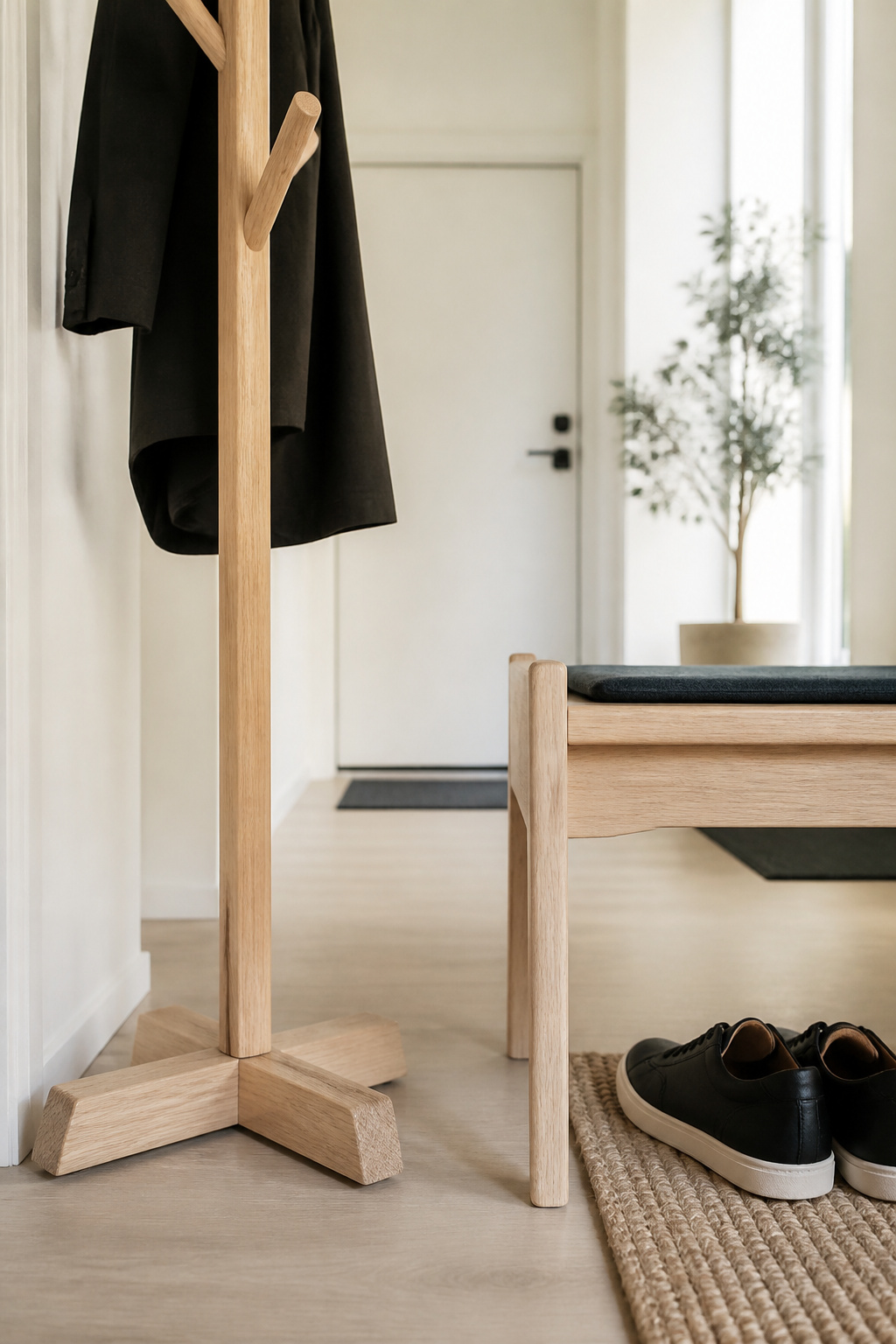
The cheapest rack in the shop is often the steadiest, and that ranking annoys people. IKEA’s MULIG is $9.99: 39 in wide, 18⅛ deep, 59⅞ tall, steel, rated to 44 lbs: wide, low-slung, past the ratio. The HEMNES hat rack is $79.99 at 33½ x 13⅜ x 15¾ in with no published load rating at all. Better-looking, but $70 doesn’t buy stability: a 60-inch rack wants roughly 24 in of circular base, or 36 in of tripod spread.
Load distribution across hooks, not all on one
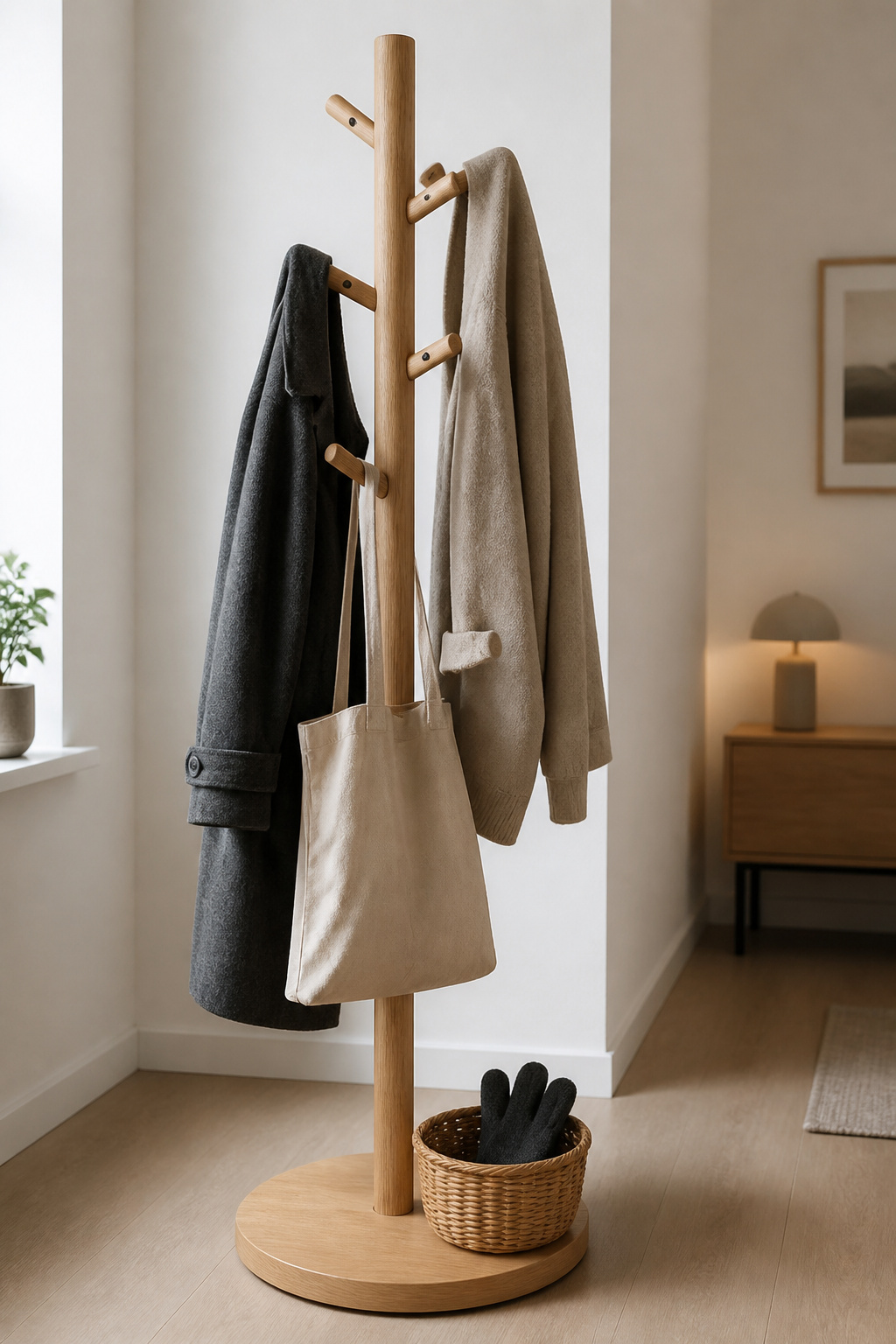
Five coats, damp scarves and a couple of totes run upward of 50 lbs: 6-8 lbs per hook across six to eight hooks, enough to exceed one arm’s rating on two. So spacing does as much work as capacity:
- 10-12 in between hooks, centre to centre, for winter coats
- 6 in of clearance between the hook bodies themselves
Use the far hooks too.
Anchoring options that don’t touch a wall
Some leases forbid wall hardware outright, adhesive included. A leaning ladder rack answers that with geometry: Yamazaki’s Tower model stands 63¼ in tall at $88, with the base specified to sit 10-15 in out from the wall it leans on. Read the rung rating first: about 2.2 lbs: a scarf and a light jacket per rung, not a wet parka, so it supplements a rated rack rather than replacing one.
Garment rails
Rail height and coat length so nothing drags
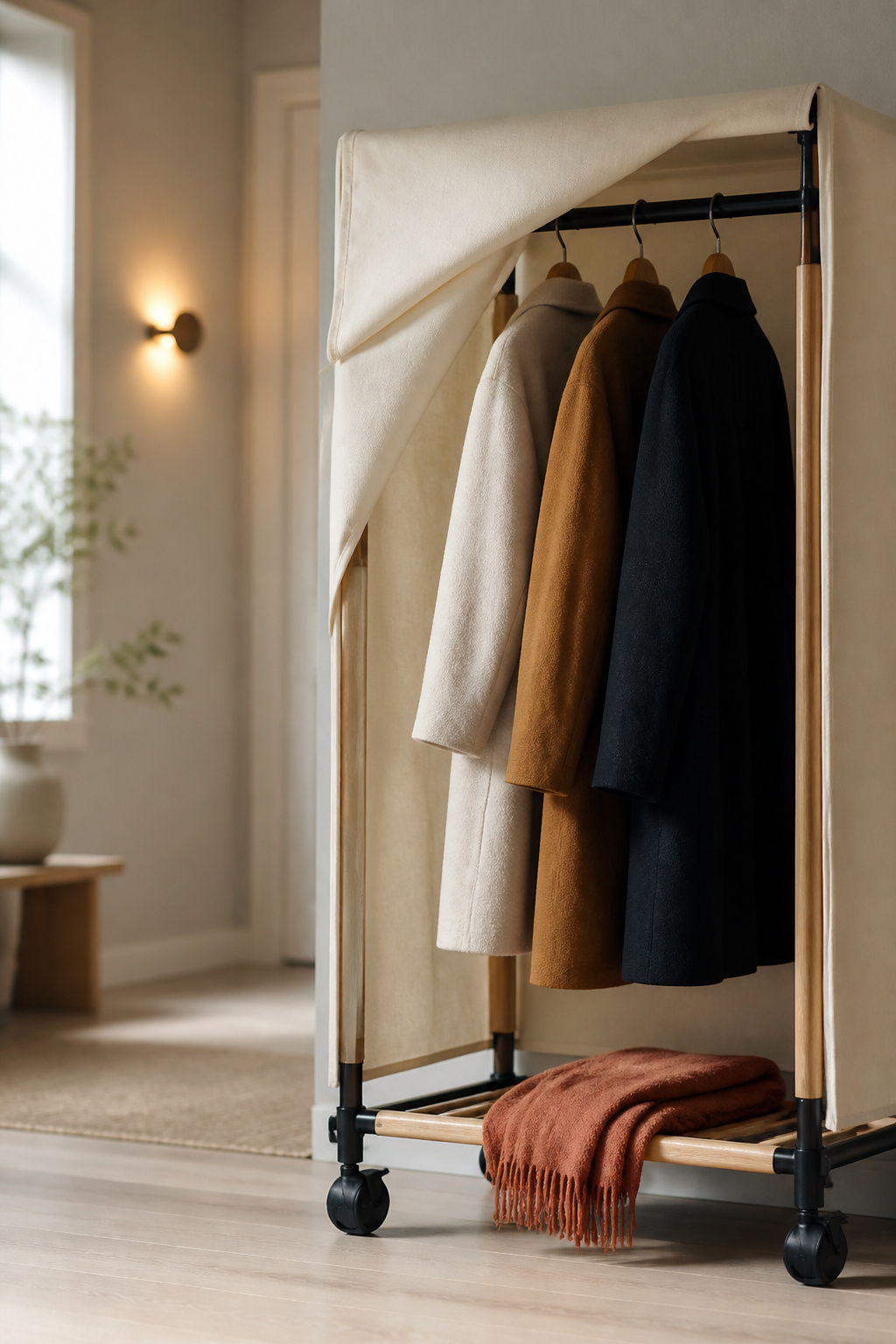
A single closet rod sits 66 inches off the floor by convention, and most garment rails land in the same 63-72 in range. A full-length coat runs 40-48 in, so that height leaves 15-25 in of clear floor under the hems. Set it lower and wool creases where it folds against the floor.
Wheeled vs. fixed for a tight entry
VEVOR’s heavy-duty rolling rack (68.5 x 17.7 x 70.9 in, top rod rated to 45 lbs, around $83) ships without casters despite the name, per the manufacturer’s own product Q&A, so check the caster spec before you buy. Buy locking casters, too: an unlocked rail travels when a coat gets yanked off it. Slim racks under 24 in wide exist as a retail category: a size range to search by, not a model I can vouch for.
Covering it without trapping moisture
A vinyl cover blocks moisture from leaving as well as dust from arriving, so a rain-soaked coat zipped inside has nowhere to send its humidity: the mildew smell. Breathable covers, non-woven polypropylene or mesh-panelled, exist for this reason. The free version: hang a wet coat on an end hook uncovered until it’s dry through.
Wall-mounted systems within damage-free weight limits
What an adhesive hook rail can actually hold
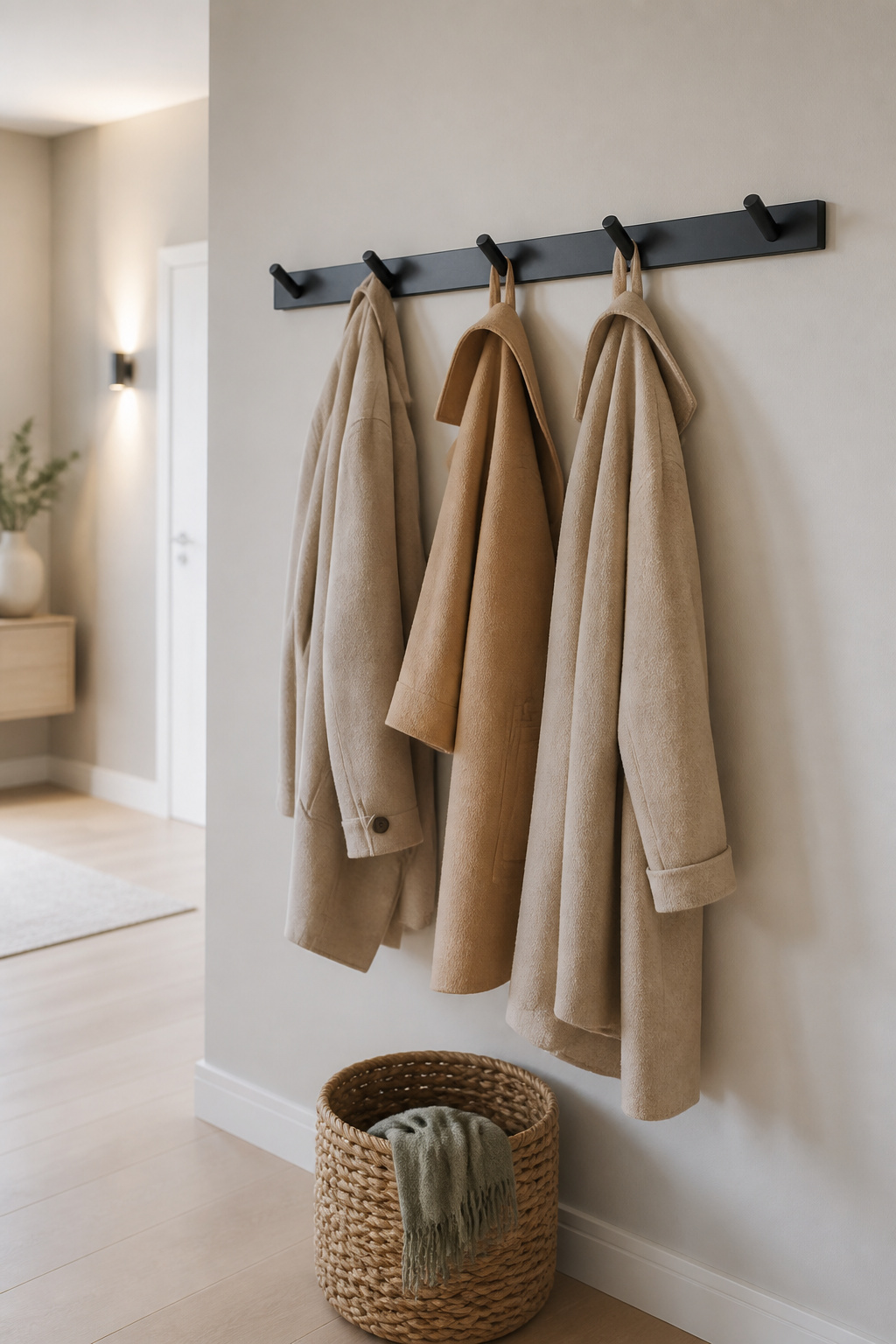
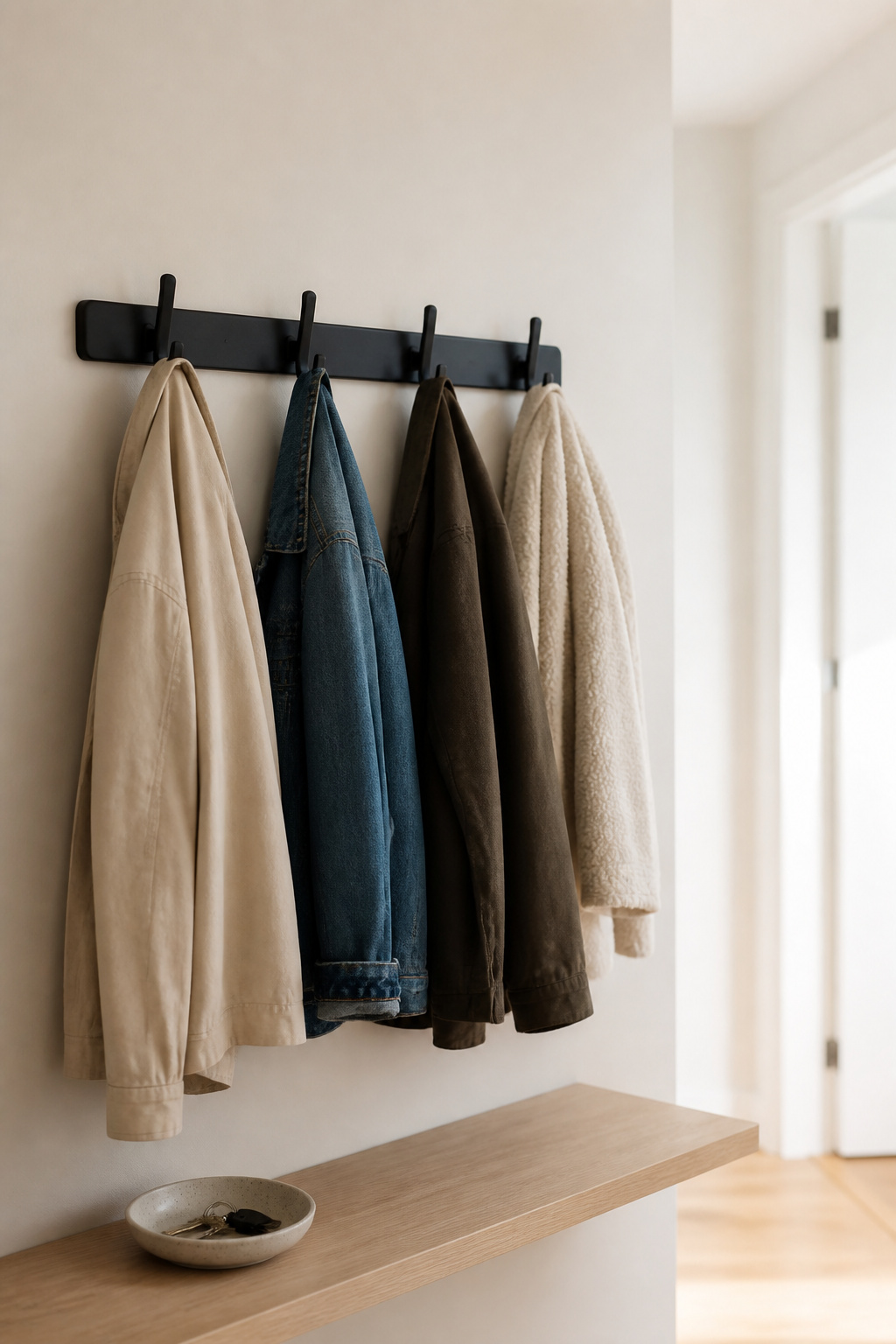
Command’s jumbo adhesive hooks hold 7.5 lbs each; medium utility hooks 3 lbs. Five jumbo hooks therefore top out around 37.5 lbs, before the 25-50% you lose on warm, humid or matte-painted walls, and 3M says its adhesives aren’t built for load-bearing use at all. Screws move that ceiling: 15-30 lbs on a drywall anchor, 50-80 in a stud. Which fixing suits your wall and your deposit is its own subject: damage-free mounting methods.
Spacing hooks so the load stays even
Same rule as the freestanding racks: 10-12 in centre to centre for winter coats, 6 in between hook bodies. Five hooks crammed into one stud bay behave like two once the coats compress. Spread matters more for adhesive: each strip pair bonds to its own patch of wall.
When to switch to a freestanding piece instead
More wall system is the wrong answer once the coat load passes any adhesive ceiling. Standard wardrobe depth runs 22-24 in, or 28 in where bulky coats hang square, and a hinged door needs another 24-30 in of floor to swing where a sliding door needs none, usually the deciding factor in a narrow entry. IKEA’s VUKU is $12.99 for 29⅛ x 20⅛ x 58⅝ in with a rod and zip cover: a pop-up mesh closet rather than furniture, fine for a season or guest overflow, not a permanent piece by the door.
Rotating coats by season so the entry doesn’t become the wardrobe
What actually needs to live by the door
Professional organizer Ben Soreff puts the mechanism in seven words: “Where there are coat hooks, people will hang coats.” Capacity invites filling, which is why the rack that coped in October is a wall of wool by February. A realistic count by the door is one in-season coat per person plus an all-weather layer. Shoes compete for the same square footage: shoe storage for the same small footprint covers that side.

Where the off-season coats go instead
A four-pack of jumbo 47 x 35 in vacuum bags runs $22.99 and compresses coats by roughly 80% of their packed volume, a hand pump standing in where there’s no vacuum. Flat, they slide anywhere with 4-6 in of clearance. Leave the top quarter of each bag unfilled to protect the seal, and wash and fully dry every coat first. Sealed-in moisture is what makes one smell musty on unpacking.
A five-minute swap routine twice a year
Do it in spring and fall. Sorting is the part people postpone, so make it the first move:
- Pull every coat off the rack, onto the bed.
- Sort into two piles: this season, and stored.
- Vacuum-seal the stored pile in the same session, not “later this week”.
- Rehang the keepers spread across the hooks, not bunched at the door end.
Five minutes, twice a year, and the coat count never creeps past what the storage was rated to hold.
If none of this fits: two other places to look
When a bench-with-storage setup solves this better than any rack
Some readers are describing a seating problem in coat-storage words. A bench is built for sitting first, storage second, and if the friction is needing somewhere to perch while the boots come off, no rack fixes it. Benches fit tighter spots than people expect: 20 x 12 x 18 in flush to the back wall of a 24-in-deep nook. Our entryway bench guide is the better page when sitting down is the real problem.
When a full drop-zone system is worth the bigger footprint
Four people, four bags, one door, 8:15 on a Tuesday: a drop-zone problem wearing a coat-storage costume. A drop zone holds keys, shoes, backpacks and mail together: hooks, cubbies and shelves in one system rather than a single piece. If that’s your morning, our drop-zone guide is where the layouts live.
The one stability check to run before you buy anything on this page
Find the stated base diameter and the stated height, then divide: 40% for a circular base, 60% for a tripod. A rack that fails on paper fails in the apartment, and a listing with no base measurement has answered you already. For a wall option, take the published rating, subtract 25-50% for a humid or matte wall, then add up what’s actually going on that wall before you hang anything else.
A rack tips because its base is too narrow for its height and the load ended up on one side. Fix the ratio, spread the hooks, and a $10 steel rail outlives a handsome hall tree. Choose by constraint, not looks: spare floor means freestanding, a spare wall means a rail, neither means hooks at their limit, too many coats means bags under the bed. The rest of making a small rental entry work runs on the same habit: check the published number before the price.
FAQ
Where do guests hang coats if there’s no closet?
Keep a lightweight rack out of the walkway and bring it in only when people come over. IKEA’s $9.99 MULIG holds 44 lbs and stores in a bedroom between parties. Over-door hooks take 10-15 lbs each for smaller overflow. Don’t stack guest coats onto a system already at capacity.
How do I stop a coat rack from turning into a dumping pile?
Capacity is the cause: where there are coat hooks, people will hang coats, as professional organizer Ben Soreff observes. Limit what’s allowed to live there instead of adding hooks. Keep the current season only: one coat per household member plus a rain shell, and store the rest compressed.
What’s the difference between a coat rack and a coat stand?
Nothing much. They’re the same piece under different regional names: a minimalist freestanding or wall-mounted unit with four to eight hooks, no seating and no shelving. The genuinely different product is a hall tree, combining hooks at varying heights with a bench, shoe storage and often a mirror.