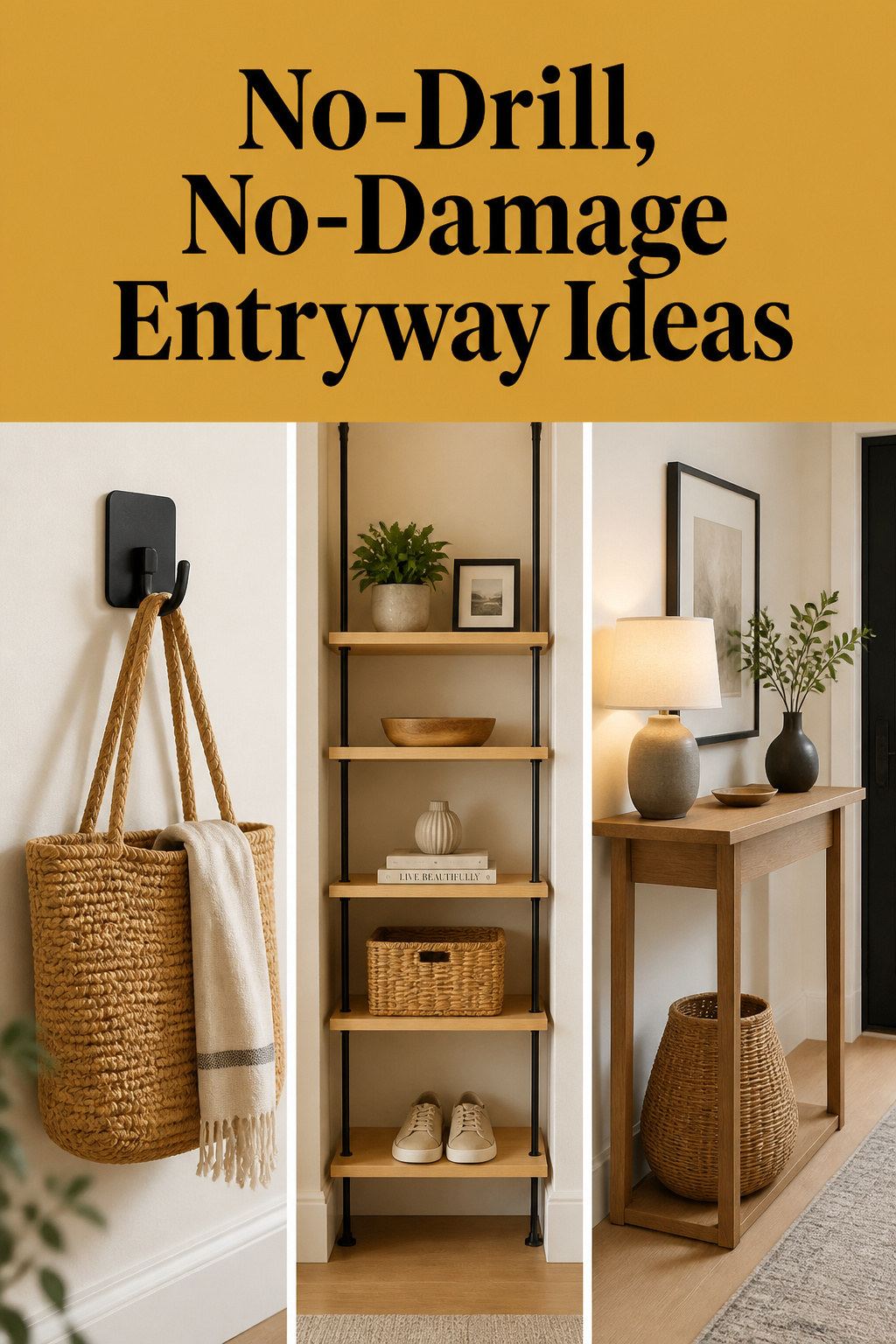
Ask around and you’ll hear the same verdict: renter-friendly entryway gear doesn’t hold anything real. One hook peels off with a tote bag on it, and the whole category gets written off as decoration. Damage-free hardware still runs from a 1-pound picture strip to an anti-tip kit QDOS rates at 200 pounds. What usually kills a no-drill mount is a rating nobody read, a surface nobody checked, or an hour of cure time nobody waited out.
TL;DR
- Adhesive is rated for smooth painted drywall: a 16-pound strip holds about 8 pounds on light texture and 4 on heavy.
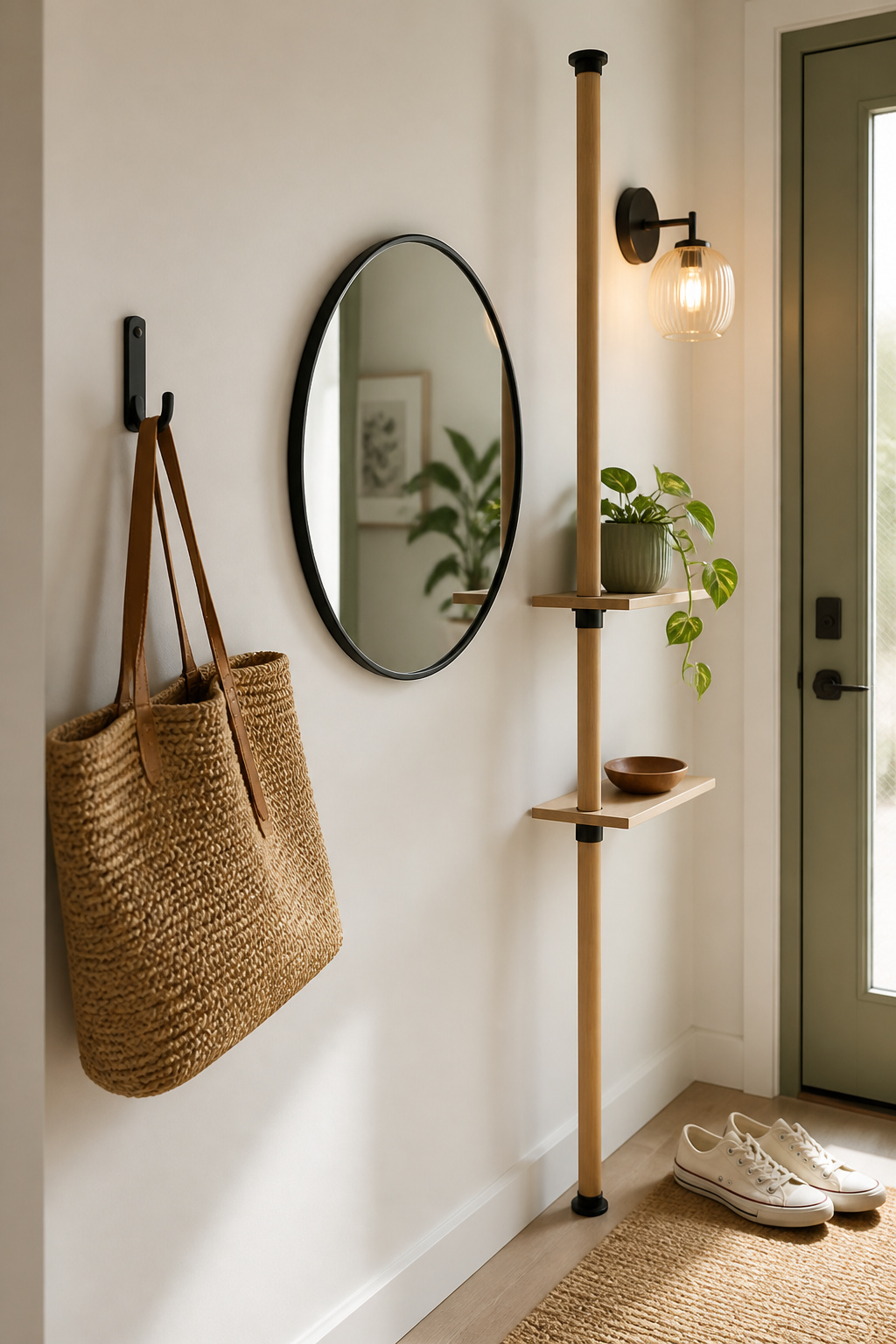
- Tension rods hold roughly 5-20 pounds standard, up to 26 heavy-duty (about 15 lb per linear foot as an evenly-loaded shelf), and should sit 1-2 inches shorter than the opening’s narrowest point.
- Removal is directional. Stretch strips straight down, never outward, or you’ll trade normal wear and tear for a $50-200 drywall repair.
Most of the distrust traces back to one bad hook, years ago, that everyone still quotes as proof.
The myth that a renter-friendly entryway can’t hold anything
What “no drill” actually rules out (and what it doesn’t)
No drill rules out one thing: permanent penetration. Screws, nails, drilled anchors: anything leaving a hole a landlord calls damage rather than wear. That’s the whole restriction, and it says nothing about hold. HUD guidance treats nail and pin holes as normal wear and tear a landlord can’t deduct for. What costs you the deposit is a large screw hole, or the drywall crater an overloaded anchor leaves behind. So the stereotype traces to one failure mode: an under-rated hook, loaded past its limit.
Weight ratings, tested plainly
The range, in numbers the manufacturers publish:
| Method | Rated hold | Where it stops |
|---|---|---|
| Command picture strips (per pair) | 1 lb small to 5 lb XL | Not load-bearing shelves, per 3M |
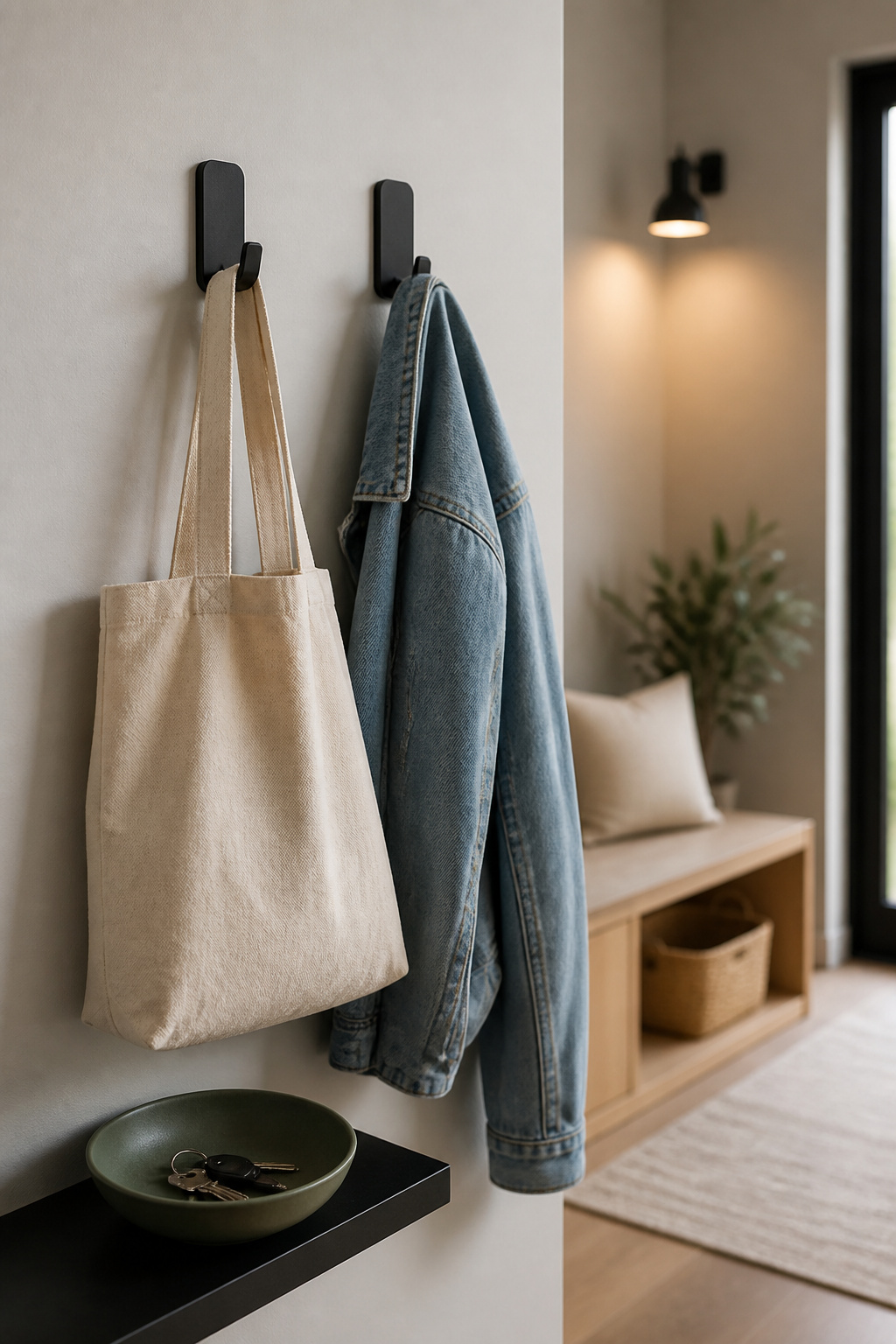
| Command jumbo adhesive hook | 7.5 lb (utility hook, 3 lb) | Smooth drywall, single-point loads |
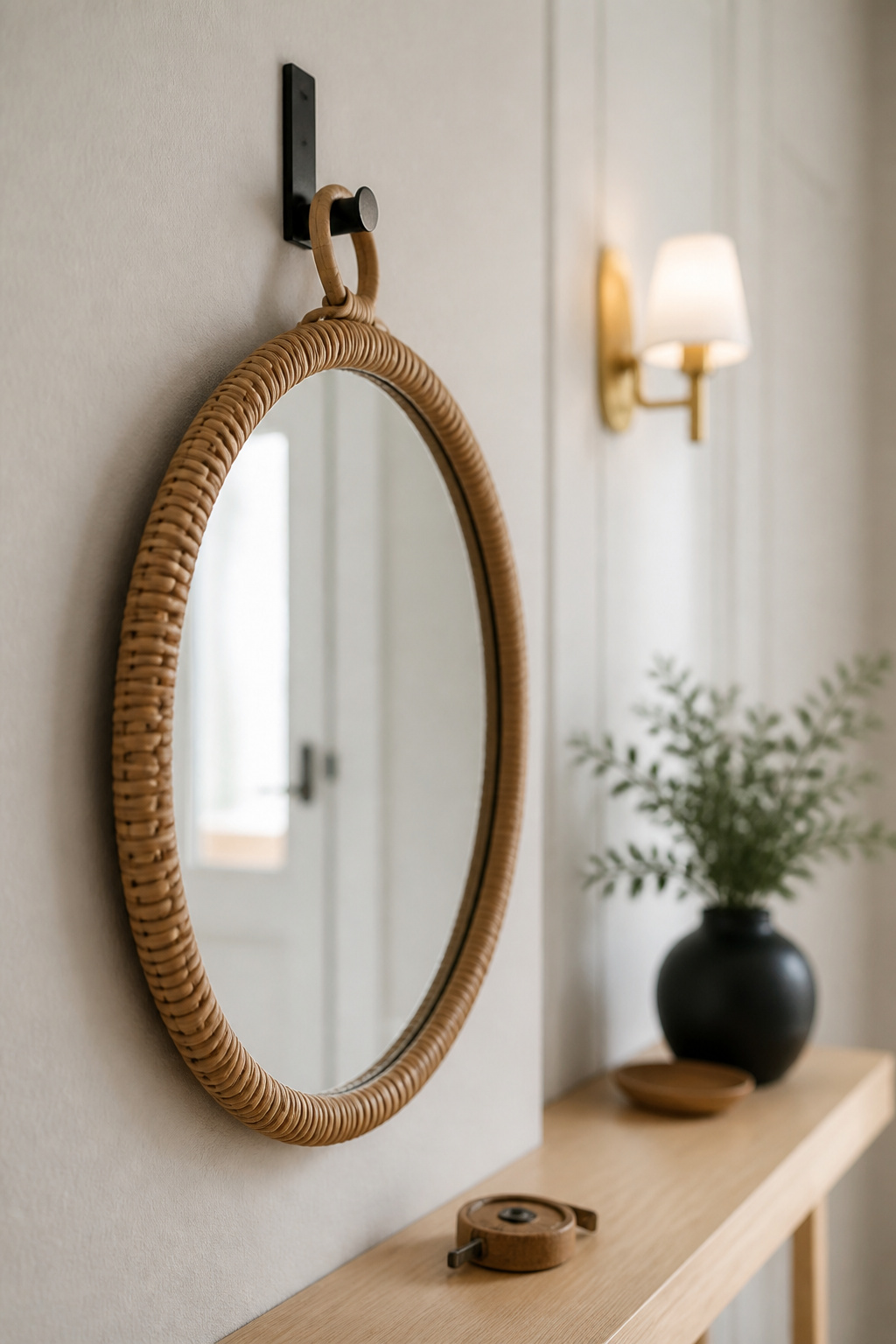
| XL heavyweight mirror strips | 20 lb, mirrors to 24 x 36 in | Size is part of the rating |
| No-drill tension rod | 5-20 lb, to 26 lb heavy-duty | Even loads only |
| QDOS Zero-Screw anti-tip kit | 200 lb (manufacturer rating) | Catches a tip, doesn’t hold weight |
Heavier holds get built from more pairs working together, not from a stronger strip.
What the ratings cover, and what they don’t
Every number above is a manufacturer’s, not the adjective on the front of the box. Ratings assume ideal conditions, so I’ll flag the real-world discount for texture, humidity and heat. A damage-free answer doesn’t exist for every load. A genuinely heavy shelf needs a landlord conversation or a freestanding piece, not a bolder sticker.
Adhesive hook and strip systems
Real weight limits by surface type
Sixteen pounds, eight pounds, four pounds. Same strip, three walls. On smooth painted drywall a strip holds its full rated capacity. On light texture the practical number halves. On heavy texture, it halves again. Warm, humid days and matte or flat paint take another 25-50% off the lab rating. 3M rules out popcorn ceilings, raw concrete and unfinished wood entirely. For masonry, buy the strips made for brick.
Cure time before you load it (the step people skip)
Press for a full 30 seconds. Then wait an hour before you hang anything.
- 30 seconds of firm pressure at application (timed, not estimated)
- 1 hour minimum before you load it
- 7 days after painting before a strip touches that wall
- 28 days for full cure, which is what buys a clean removal later
Adhesive doesn’t care that you moved in on Saturday. Wipe the spot with 70% isopropyl alcohol first, too, because oils and dust cut contact area, and contact area is the product.
What survives move-out and what doesn’t
Removal depends on direction more than force. Stretch the tab straight down, parallel to the wall, and the strip releases along its own length. Pull outward and you take paint with you. Temperature matters more than people expect, as well. Above roughly 105°F the strip’s rubber core softens toward creep failure; below 50°F it goes brittle.
Tension rods and pressure-fit systems
Where tension beats adhesive
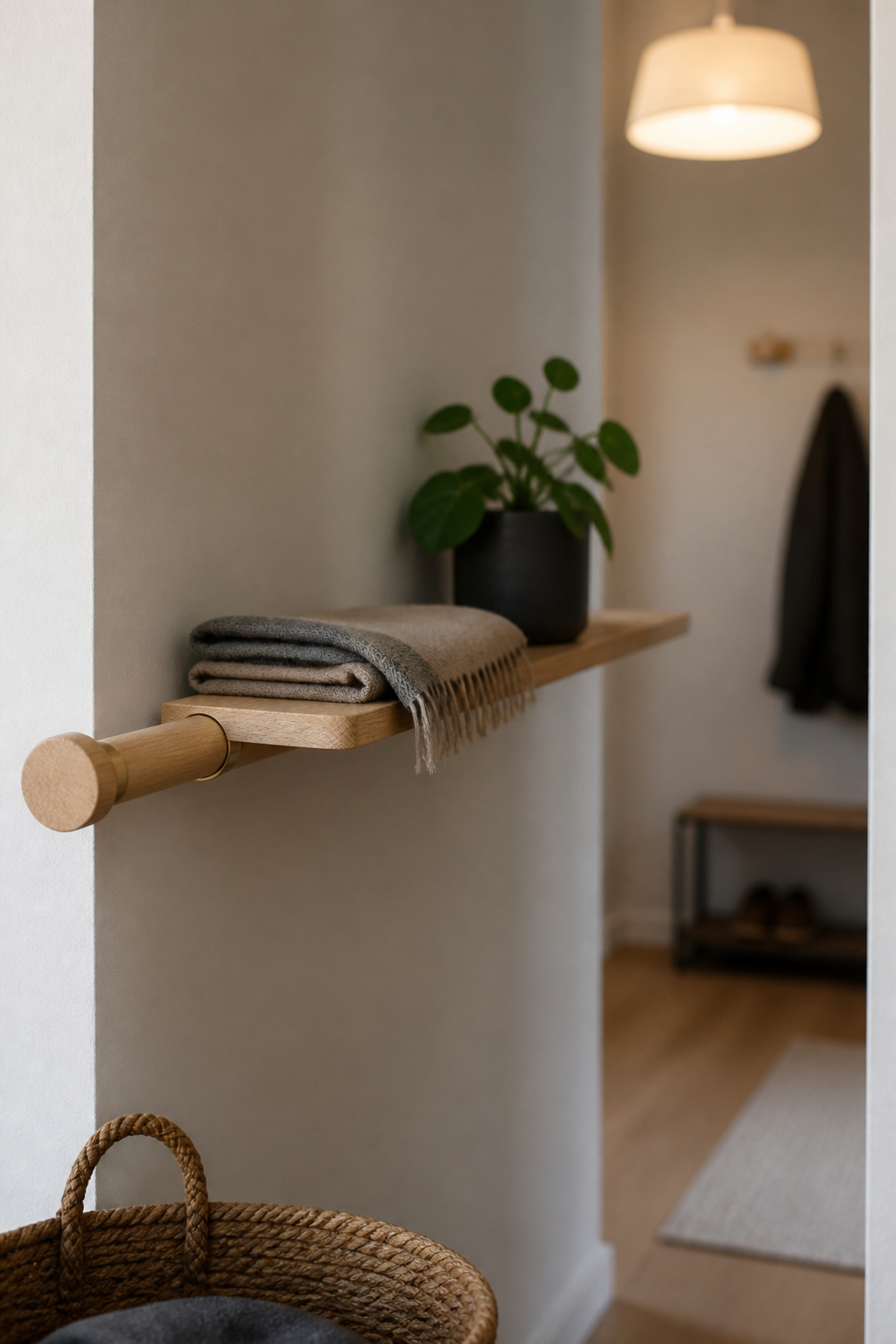
What do you do with a brick wall, or heavy texture adhesive can’t grip? Tension. These mounts hold by spring pressure between two opposing surfaces: a doorway, an alcove, a narrow entry nook. Wedged into a window casing, a rod leaves zero marks, because nothing ever touches the wall. As a shelf support with the load spread along its length, expect roughly 15 pounds per linear foot, a different number than the rod’s total hold for hanging a curtain, since a shelf’s weight rides evenly across the span instead of pulling from the ends.
Sizing a rod so it doesn’t slip
Eight years running crews for a remodeling contractor in Tennessee taught me one line I still repeat: pros measure, beginners guess. Measure the opening at its narrowest point, then buy a rod 1-2 inches shorter than that. An undersized rod twisted out to fill the gap grips harder than one bought to exact width. Standard rods span up to 48 inches. A wider nook needs two rods and a connector, because one rod stretched near its maximum is the most common slip point of all.
What not to hang from one
Sheer curtains, a slim shelf, a scarf rail: light and evenly spread. Not a winter coat. One heavy parka hung off-centre torques the rod sideways instead of loading it downward. That twist is what drops a correctly sized rod still inside its rating.
Freestanding pieces that need nothing on the wall
When freestanding beats a wall mount
The mistake is treating freestanding as the consolation prize. It’s the only damage-free option no pound rating bounds, because nothing is asked of the wall at all. For anything heavier than what even a 200-pound anti-tip kit is built to catch, freestanding is the answer.
Stability tricks for tall or top-heavy pieces
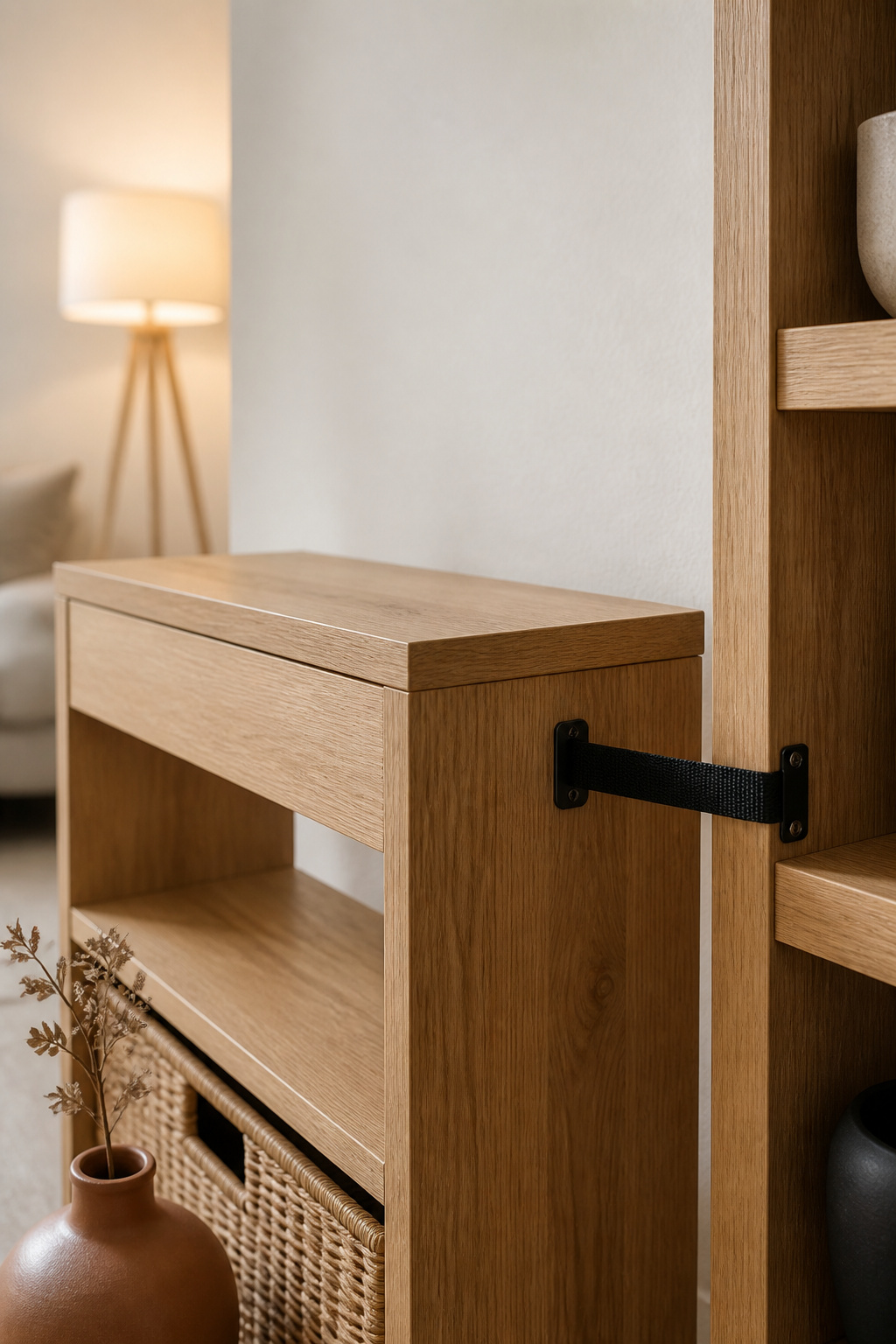
Freestanding and secured are two different words. CPSC data puts tip-overs at roughly 17,800 injuries and 20 deaths a year in the US, most often to kids one to three. So load the heaviest things on the lowest shelf. Decorative weight stacked at eye level is the usual reason a stable piece turns tip-prone. Better still, strap the tall piece to a heavier neighbouring one. Furniture-to-furniture anchoring keeps the safety without a fastener in the drywall.
Weight anchoring without a single screw
QDOS makes a Zero-Screw kit that anchors furniture with two small drywall pins and an adhesive disc, rated to 200 pounds. That’s the manufacturer’s own number, with no independent comparison to check it against. The free version works too: weight the base. A rattan basket loaded low drops the centre of gravity for nothing. And put the tall piece in a corner, where two walls remove most of the directions it could fall.
Peel-and-stick surfaces
Where peel-and-stick earns its keep (floor, backsplash-style panels, small accent walls)
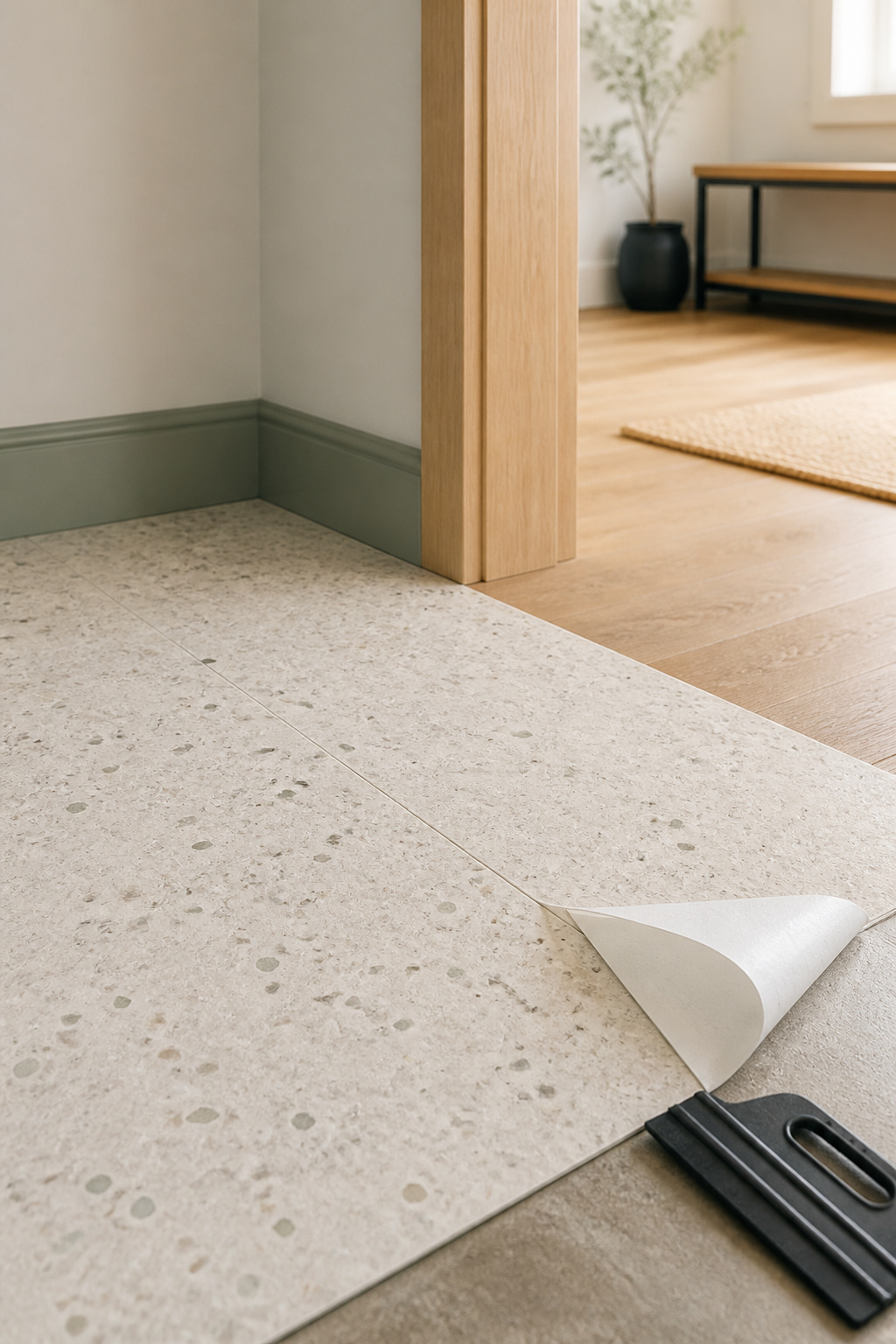
Melted snow puddles by the door for twenty minutes every February, and that puddle decides whether peel-and-stick belongs in your entry. Most guidance for it was written for a kitchen backsplash, so it needs translating. Moisture is the named failure mode for this flooring. That makes it right for a dry landing and wrong for a mudroom that floods at every thaw. Nothing else here reverses this cheaply, though: vinyl floor tile runs $1-$5 per square foot material-only, and sheet packs $1.50-$4.
Application mistakes that cause peeling
Two conditions cause most failures, and both are about the wall, not the product. Peel-and-stick wallpaper wants a smooth surface in satin or semi-gloss, cured 30+ days. Matte or flat paint and texture are what bubble and lift. Over fresh paint, tile needs 21 days minimum, because paint keeps outgassing after it feels dry. Then technique: peel half the backing at a time, and press each tile into place. Stretch one to reach and you’ve distorted the pattern for every tile after it.
Full removal at move-out, tested
Buy vinyl-coated rather than paper-based; an entry takes damp shoes. Lifespan is 3-5 years mid-range and 5-7+ for premium, though a humid corner can start lifting around 3.5. Tempaper’s own guidance draws the line at paint finish rather than price: sheen releases the adhesive cleanly, while matte or flat can come away with the paper.
Those same weight limits decide closet-free coat storage that respects those limits, and the identical no-damage logic runs into no-rewire fixes for a dark hallway.
The move-out test: what actually comes back off clean
The three questions to ask before you buy any “renter-friendly” product
Fifty to two hundred dollars. That’s the drywall repair a failed anchor buys you, and three questions in the aisle avoid it. Does the manufacturer publish a pound rating, or only the word “strong”? Does your surface match what that rating assumes: smooth, cured, wiped clean? And does the brand name a removal technique? One that tells you to pull straight down has thought about the end of the relationship.
A five-minute test you can do in the store
- Find the per-pair or per-hook pound number on the package. “Jumbo” is a size of drink, not a weight rating.
- Read the surface list. If drywall, tile, wood and brick aren’t named, assume it was tested on somebody else’s wall.
- Look for a cure window. A stated wait time means the manufacturer load-tested it; no wait time means you’re buying an adjective.
Command prints the surface list and removal method on the package, the baseline other brands should be measured against.
What to do the day you move out
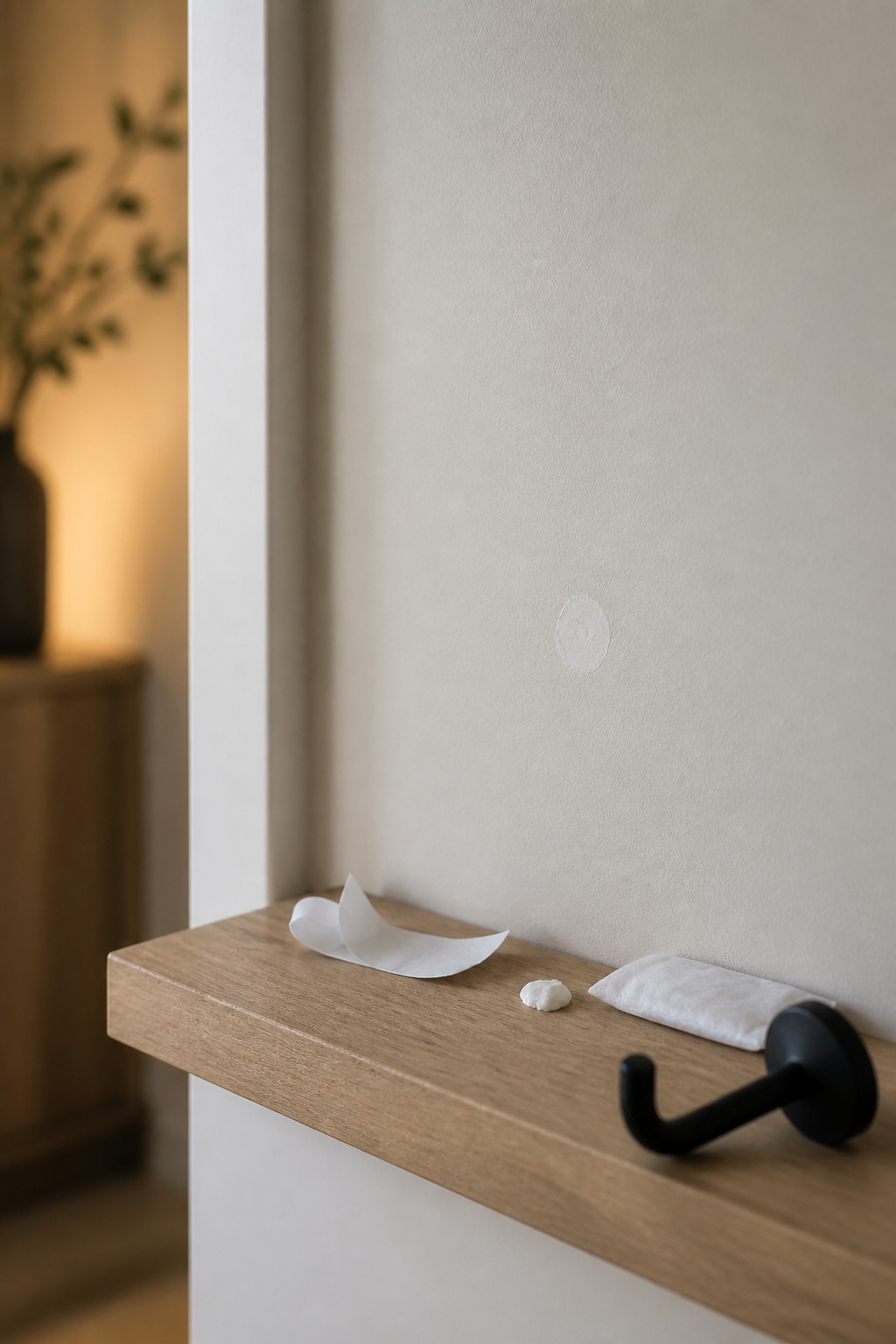
Take everything down straight, not out: one mount at a time, unhurried. Then walk every point with your phone flashlight held flat against the wall. Raking light shows residue and faint marks a straight-on glance misses. HUD’s standard is on your side for the pin-sized marks left behind. It’s the anchor you left in, or the strip torn off sideways, that becomes a deduction.
The myth got the failure right and the cause wrong. Damage-free hardware lets go when somebody bought an adjective, stuck it on the wrong wall, and loaded it inside the hour. Tonight, put the heaviest thing in your entry (the loaded tote, the winter coat, the mirror you keep meaning to hang) on whatever scale’s in the house, bathroom or kitchen. Let that number pick the method. Everything else stacks on that one decision, and the full guide to rental entryways covers the rest.
FAQ
Do adhesive hooks really hold as much weight as they claim?
On the surface they’re rated for, yes. 3M rates Command strips by pair, from 1 pound small to 5 pounds XL, and jumbo hooks separately to 7.5 pounds. The gap between claim and reality is a condition mismatch: textured walls roughly halve capacity per texture level, and heat, humidity or flat paint take another 25-50%.
Will removable wallpaper damage rental walls?
It’s designed not to, and on the right surface it doesn’t. The real risk is paint finish, because matte or flat paint can absorb the water-based adhesive and lift off with the paper. Satin or semi-gloss releases cleanly. Manufacturers want a smooth wall cured 30+ days, and vinyl-coated versions handle an entry’s damp better.
How long do damage-free adhesive strips last before they need replacing?
Indefinitely in climate-controlled conditions, but temperature shortens that fast. Above roughly 105°F the adhesive creeps, and below 50°F it turns brittle. Replace on sight of yellowing, cracking, edge-lifting, or an item wobbling more than it used to. For comparison, peel-and-stick wallpaper runs 3-5 years mid-range and 5-7+ premium.