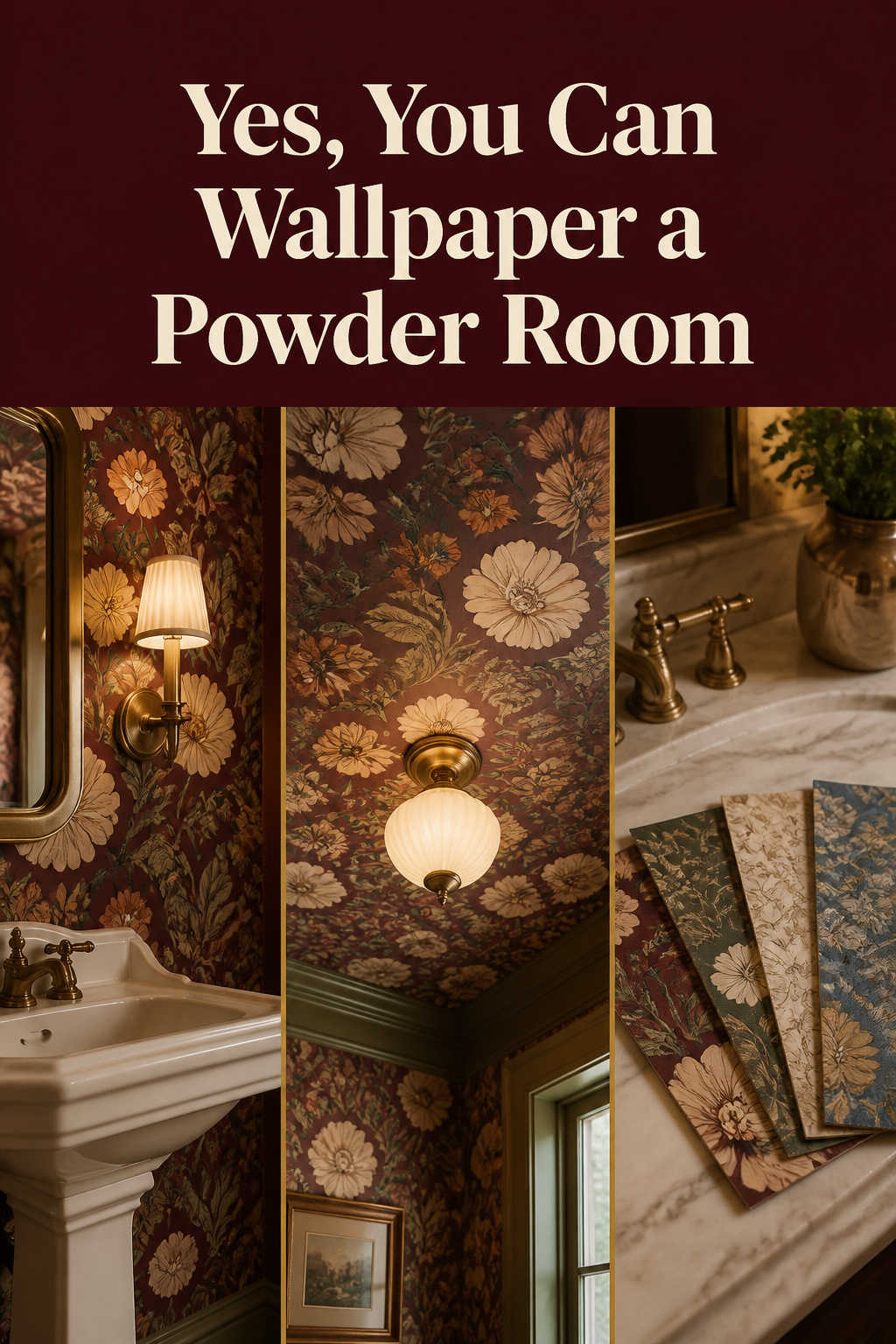
Ask almost anyone whether wallpaper belongs in a bathroom and the answer is the same: no, it will peel. I have given that answer myself, in print, about a bathroom with a shower in it. But the rule hides a condition nobody says out loud, and powder room wallpaper is where that condition stops applying. A half bath has no shower and no sustained steam. Take the steam away and most of the precautions come off with it.
TL;DR
- The bathroom wallpaper rule is a steam rule, not a bathroom rule, so all four paper types stay viable here.
- Prep decides survival. Most powder rooms wear flat builder latex: scrape, sand, seal with a pigmented acrylic primer-sealer, then size the wall.
- Order by net wall area, not room size: add 10% waste for a repeat under 10in and 15-20% above, then round up to a full 56-60 sq ft double roll.
The bathroom wallpaper rule has a silent condition
The rule has no origin story worth telling. It has a mechanism.
Where the “no wallpaper in a bathroom” rule comes from
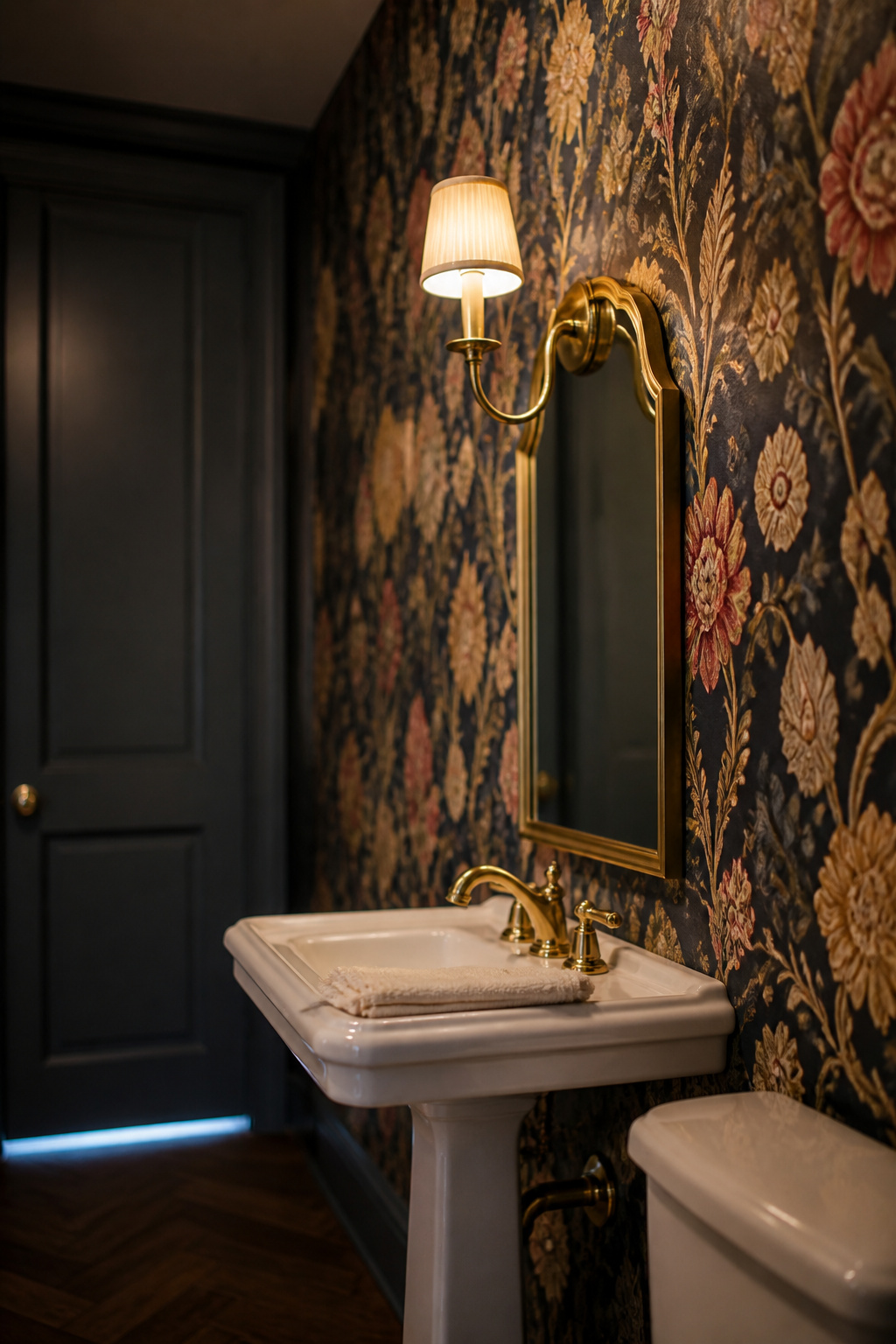
Wallpaper is cellulose, and cellulose was never built for the steam a bathroom makes daily. Vapour weakens the adhesive bond, seams curl, and behind them sits a damp pocket where mold grows. Frank Vega of Waldwick Wallpaper & Paint puts the trigger far more specifically than “bathrooms”: papering directly above a showerhead.
The variable that changes the rule: no shower, no sustained steam
Here I mark an exception to my own prior rule. I have written the damp-bathroom version of this advice, and it stands for a room with a shower in it. A powder room is not that room. A guest washes their hands for fifteen seconds, throwing splash at the basin: a placement problem, solved by leaving the splash zone unpapered, not a humidity load the whole room must be specified against. The guidance narrows the same way once you read past the headline: paper stays feasible in a half bath with only a sink and toilet.
What the wall has to be first: plaster, sizing and the builder-latex trap
Most of what I know about surfaces came from one bench, in the converted carriage house where my rescue pieces get brought back. It is where a finish comes off and a new one goes down, and the lesson never changes: a finish is only as good as what sits under it.
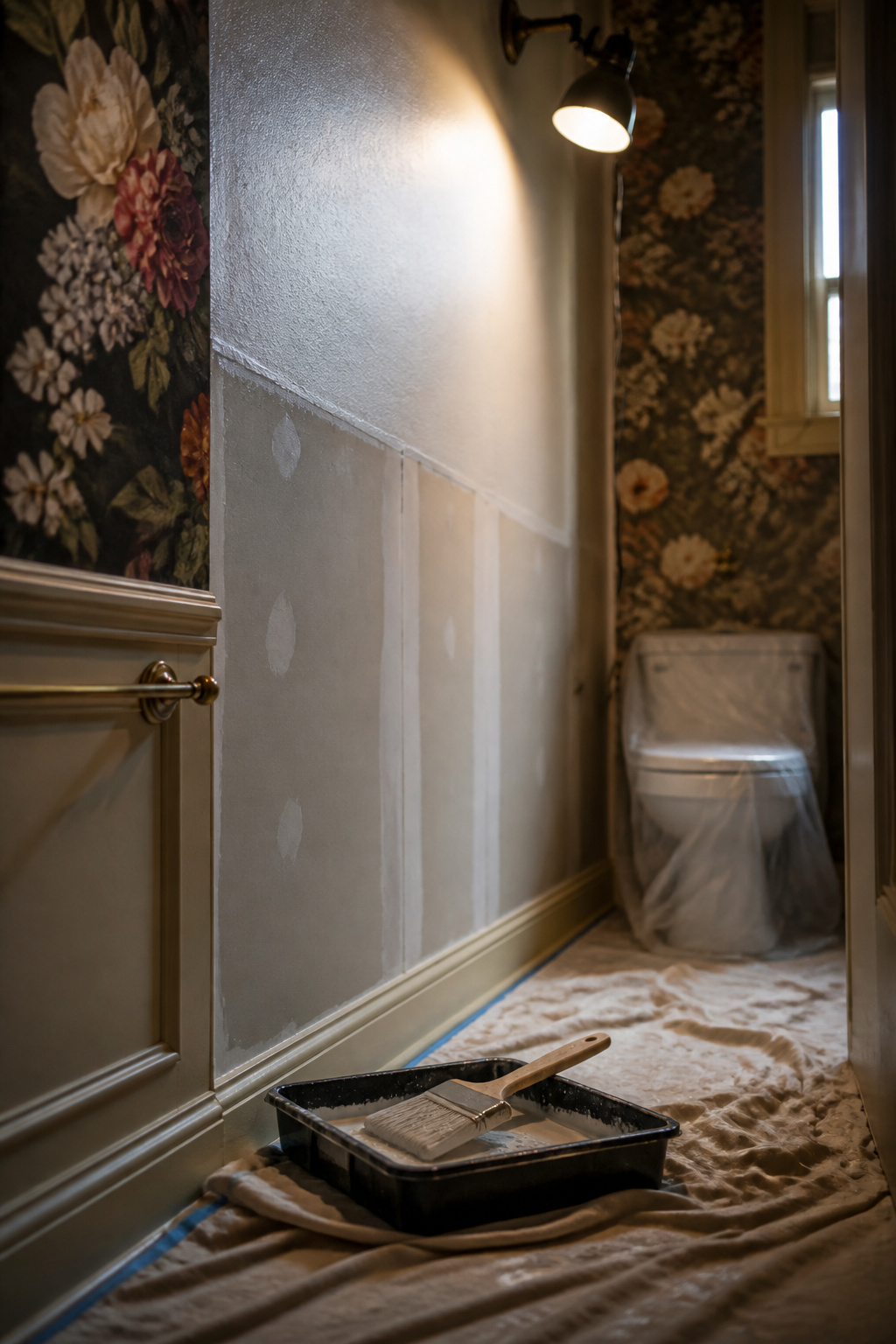
Skimmed plaster vs bare drywall
Both are hygroscopic, so paste applied straight onto either dries out before it bonds. Both are abrasive too, and you cannot slide a strip into a pattern match across a rough wall.
Sizing before paste
Sizing fixes both: a commercial size, a paste let down with roughly 25% more water than the normal mix, or a mist coat of primer. Each seals porosity and leaves a glossy face the paper slides across and grips. It also makes stripping easier later, and that reversibility is worth protecting.
The builder-latex problem most powder rooms hide
Your powder room is almost certainly not bare drywall; it is flat contractor-grade latex, and wallpaper adheres to your paint, not your wall. Rub it hard with a damp towel for thirty seconds. Paint on the towel confirms latex: scrape, sand, then seal with a pigmented acrylic primer-sealer. Skip that seal and the drywall’s paper face absorbs the paste. Strip the paper eight years from now and the drywall face comes with it.
Choosing the right powder room wallpaper for a room with no shower
Four families of paper compete for this wall, trading moisture tolerance against cost and against how easily the job comes off. Read the ranges as directional; pricing swings by retailer.
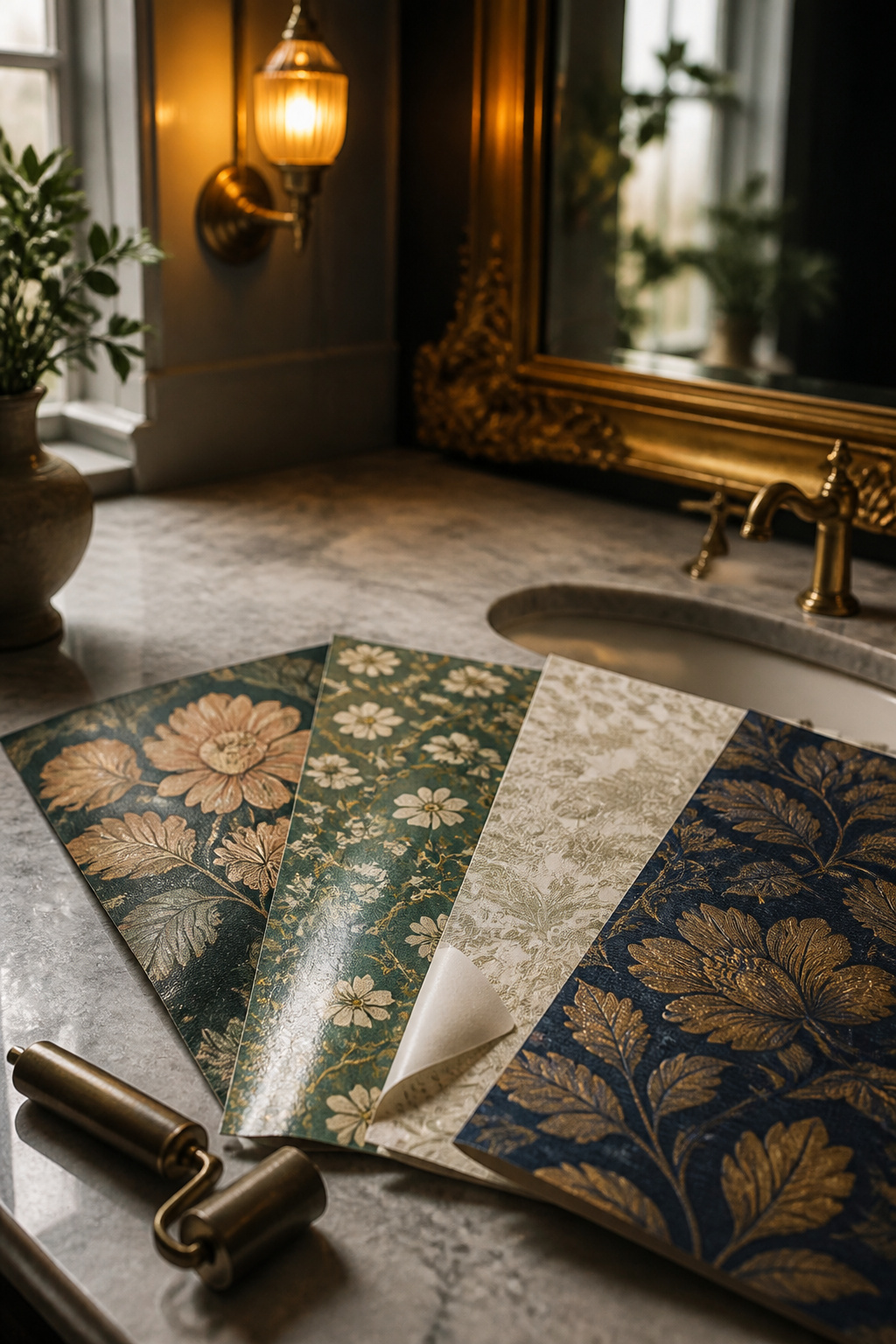
| Paper type | Moisture tolerance | Material cost | Coming back off |
|---|---|---|---|
| Traditional paste | Good once sized; most durable | $3.90-5.99/sq ft | Hardest; professional removal |
| Prepasted | Comparable; water-activated | $20-80/roll | Difficult after a few years |
| Peel-and-stick | Lowest; weakens in humidity | $25-50/roll of ~28 sq ft | Easiest of the four |
| Vinyl-coated | Highest; rated moisture-resistant | $25-50/roll of ~28 sq ft | Hardest; needs scoring |
Traditional paste
The longest-lasting of the four when hung properly, at $60-150 per double roll in labour.
Prepasted
Water-activated adhesive, so paste-mixing disappears, but that bond keeps strengthening, which is why it resists removal later.
Peel-and-stick
Pressure-sensitive adhesive that grips without moisture, so it strips most easily. Vega flags it as steam-susceptible, which costs little in a room generating none.
Vinyl-coated
Manufacturer-rated steam- and moisture-resistant. Commercial vinyl grades Type I, II or III by weight under the Wallcovering Association’s WA-101 classification, a commercial convention; no code sets a wallcovering grade in a private half bath.
Pattern scale in a room you touch every wall of
The small-print advice everyone repeats for small rooms goes wrong here.
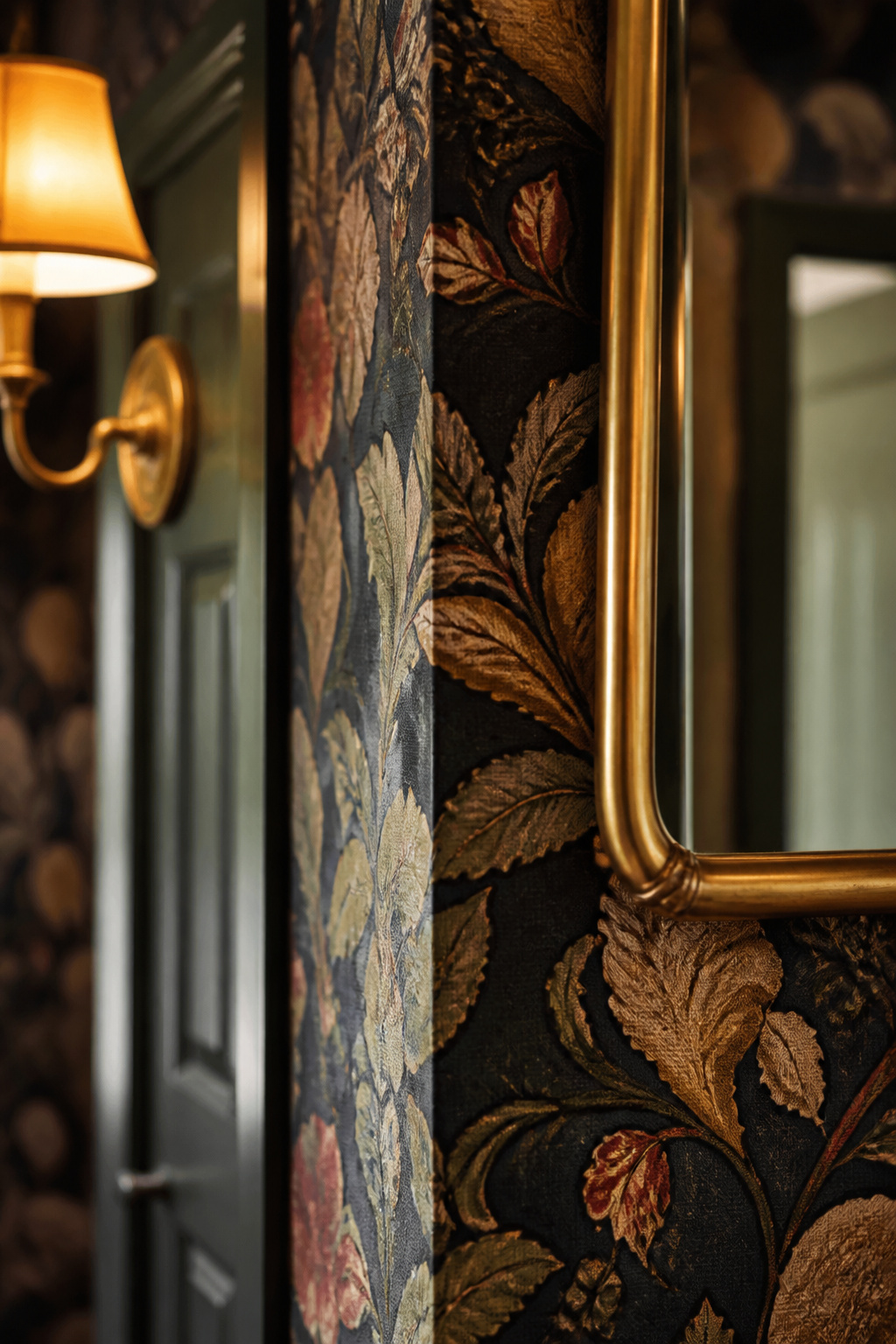
Large-scale pattern reads intentional; busy pattern reads chaotic
It assumes you view the wall from across a room. Here every wall sits within arm’s reach at once, so a busy print becomes noise at the exact distance you meet it, while a large-scale motif behaves as one deliberate gesture. If that is more commitment than you want, the case for painting it dark instead buys similar depth without the arithmetic.
What breaks the repeat: the door, the mirror wall, the sink splash
Professional hangers plan the drop layout before cutting, to avoid stranding a half-motif sliver beside a door frame. Instead of trimming to the opening at the table, allow a controlled 20-30mm overlap onto the frame and trim in place. Bridge above the door with off-cuts that hold the repeat.
The ceiling is the cheapest dramatic surface in the house
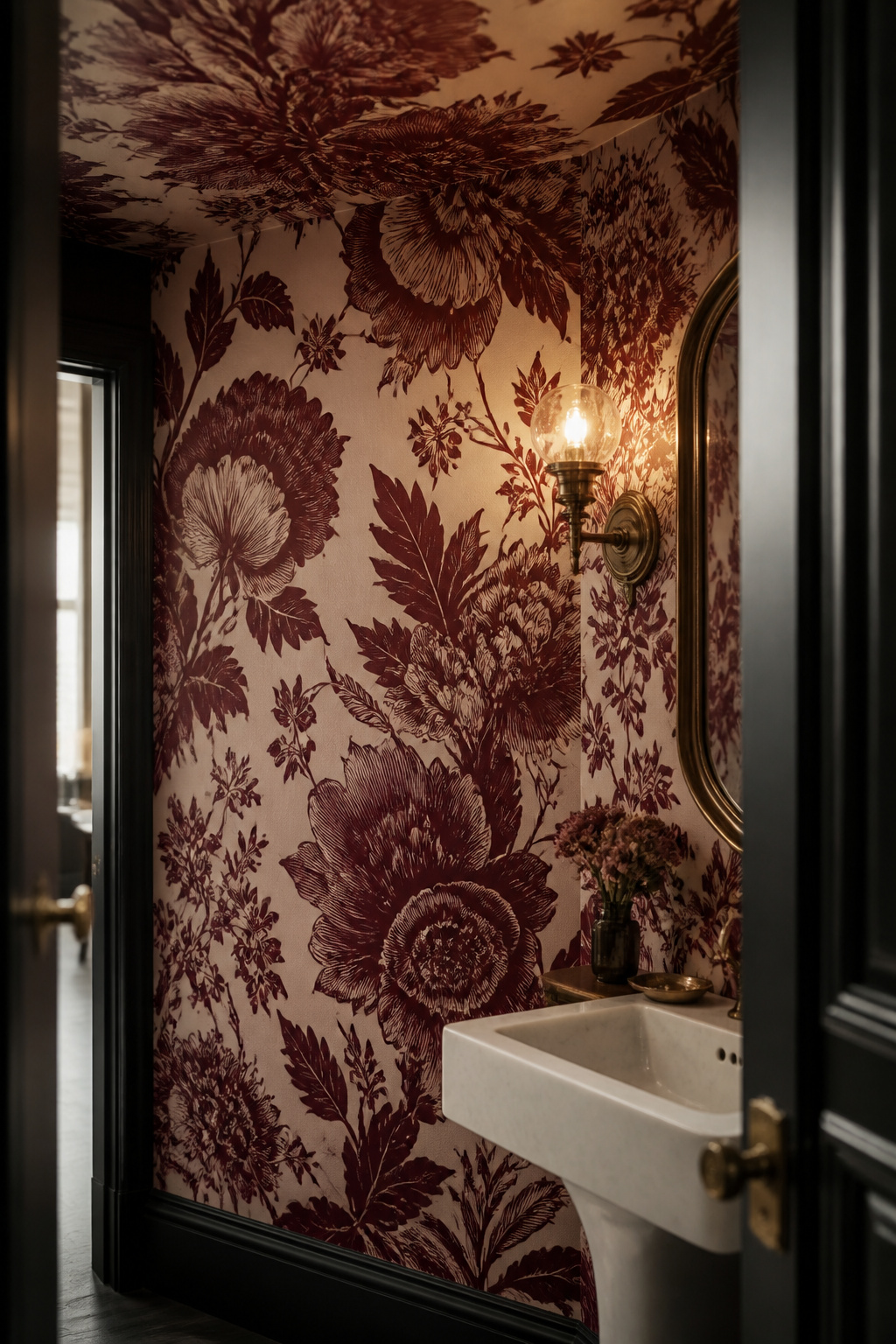
A powder-room ceiling is where a genuinely bold decision costs about one roll of paper.
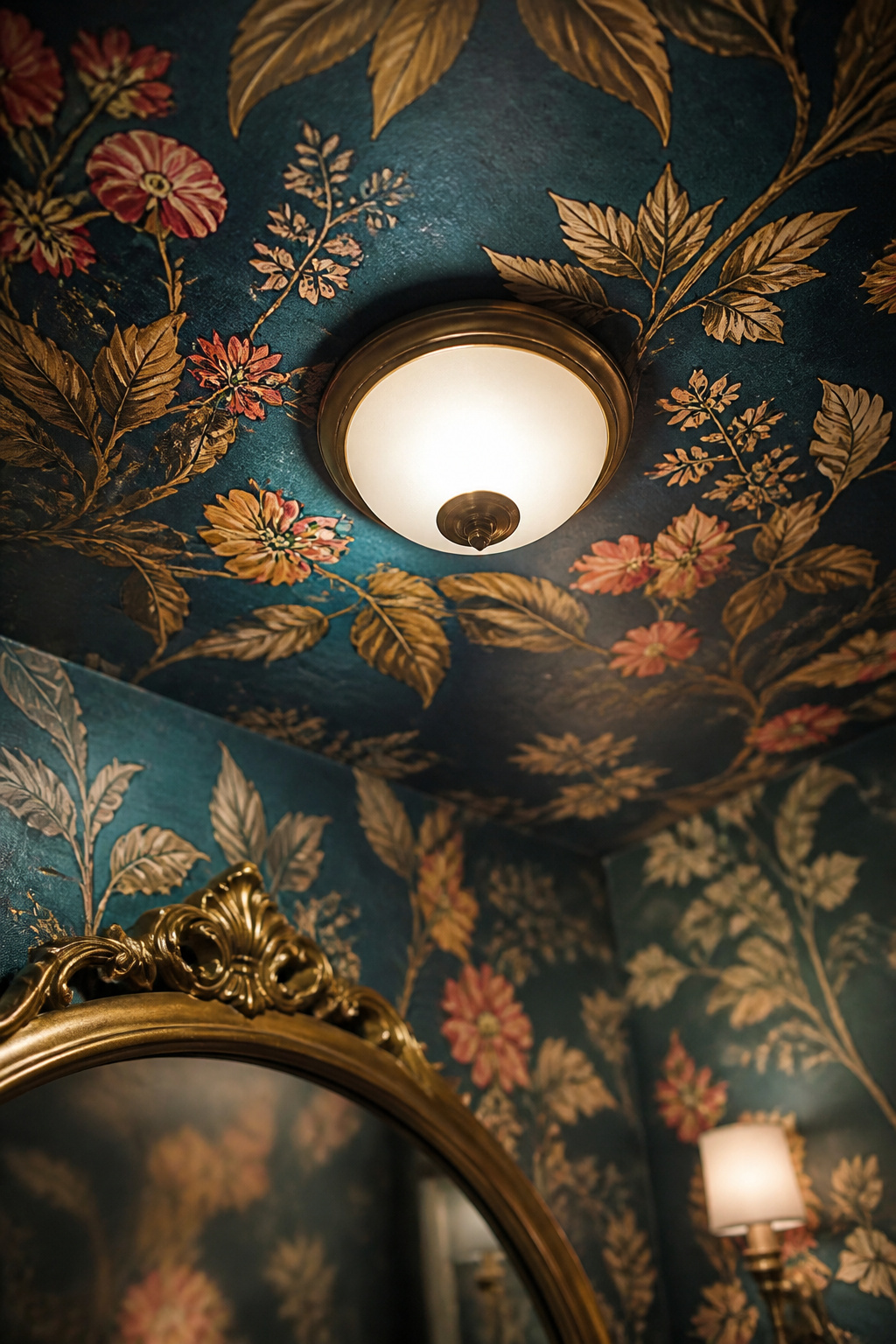
Why a powder-room ceiling usually takes a single roll
The compact footprint is why the move works at all. Brad Pierce of Haven Home Staging recommends papering the walls and the ceiling, or colour-drenching the room and papering the walls. Keep the pattern scale identical on both planes, or the wrap breaks.
Where the panelling stops and the paper starts, if the wall below is wainscoted
If board-and-batten or beadboard runs below, the cap rail sets the paper’s starting line. What decides where it lands is covered in where the panelling stops and the paper starts. For the full sequence, see the powder room ideas that hold up in a room with no shower.
Doing the math: net wall area to roll count, and why hanging it costs more here
The costliest mistake here is ordering the right paper in the wrong quantity.
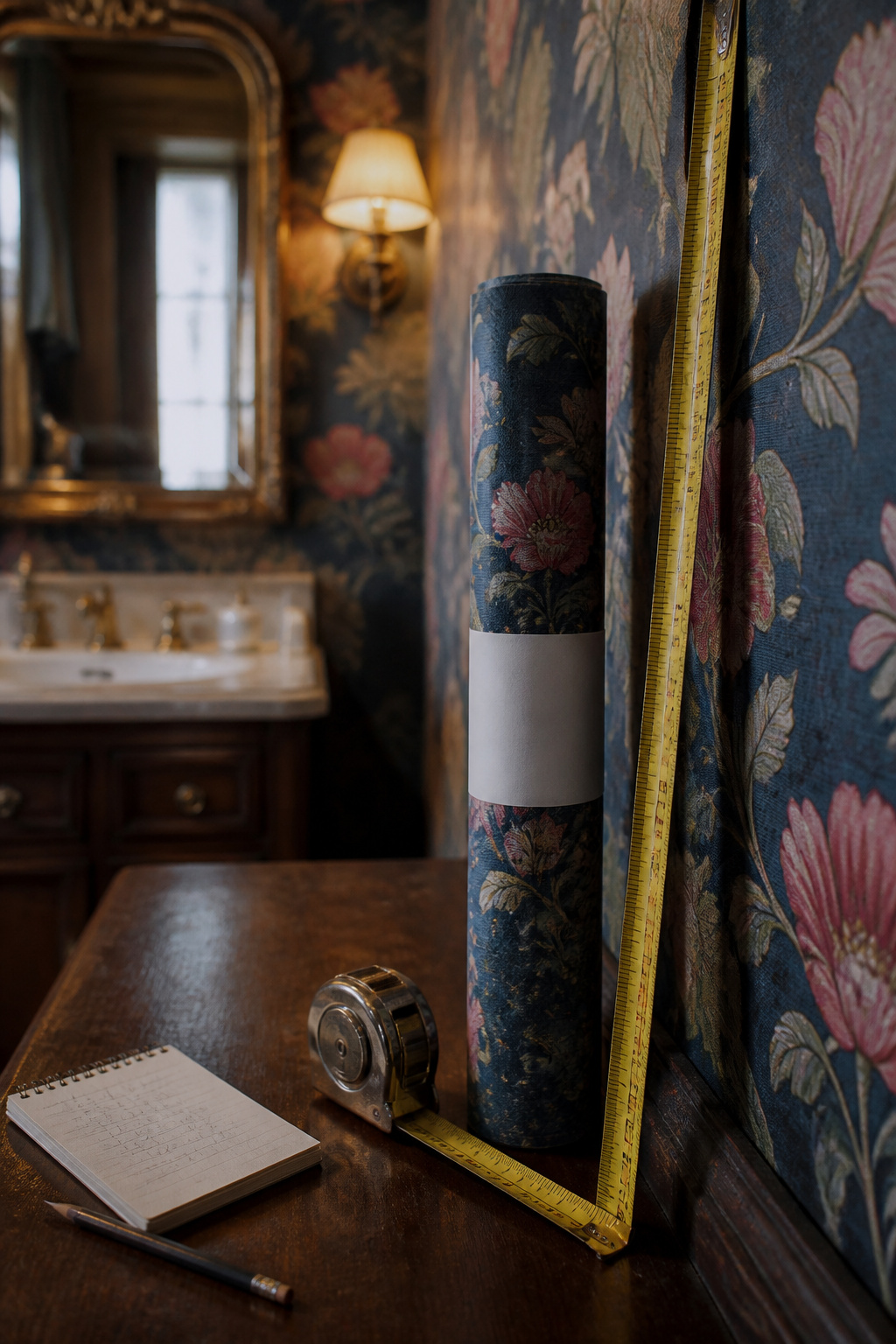
Measure net wall area after the door, mirror and splash are deducted
Work in wall area, never room size, deducting the door opening, the mirror and any splash strip you leave unpapered. One caution runs the other way: takeoff guidance for rooms with many cut-ins says to count openings as wall anyway, since trimming waste tends to equal the area saved.
Account for pattern repeat and drop
Pattern repeat is the vertical distance before the design starts again along the roll. A straight match aligns strips on one plane; a half-drop match shifts them vertically and wastes more. For a repeat up to about 26cm (10in) add 10%; above that, where this room’s patterns sit, add 15-20%.
Convert to roll count
A standard double roll covers roughly 56-60 sq ft. Divide, then always round up: a reorder can arrive from another production run, and that colour shift (a dye-lot mismatch) only shows once the paper is up.
Price the small-room labour premium
Hanging is quoted at $3-7 per sq ft, but that range comes from open-wall jobs. Two independent 2026 trade pricing guides put standard residential work near $5.50-6 per sq ft against bathrooms nearer $8, for the reason both name: the cut-in count around toilet, vanity and corners. This room is the worst value per square foot you will buy from a hanger.
Here is the chain on one hypothetical room. Every dimension is invented for illustration.
- Assume a 22-linear-foot wall run at an 8ft ceiling: 22 × 8 = 176 sq ft gross.
- Deduct assumed openings of about 17 sq ft for the door, 6 for the mirror and 4 of splash strip: 149 sq ft net.
- Apply the 20% large-repeat waste factor: 149 × 1.2 is about 179 sq ft.
- Divide by a 56 sq ft double roll: 3.2 rolls, rounded up to 4, all one dye lot.
You now have what the blanket rule never gave you: why a half bath is the exception, and the standard the wall underneath has to meet. Take a damp towel to the wall and watch for paint lifting. That test sets your prep path before you choose a pattern.
FAQ
How long does wallpaper actually last in a powder room before it needs replacing?
Trade estimates put wallpaper’s general lifespan around 10 to 15 years, with vinyl and non-woven papers outlasting cheaper paper-based ones. Treat that loosely: it rests on a single installer estimate, and no source gives a powder-room-specific number. Humid rooms shorten it, which argues for a washable grade even here.
Do you need a specific primer for bathroom wallpaper, or will any wall primer work?
General wallpaper primer or sizing does the same job in any room: it seals porosity and creates a slidable, strippable surface. For a bathroom, installers add a mold-resistant primer step ahead of paste, because trapped-moisture mold behind the paper is bathroom-specific. Builder-grade flat latex needs its own scrape-sand-and-seal step regardless.
Can you wallpaper over textured (orange-peel) walls in a half bath?
Functionally yes, because paste-the-wall non-woven papers adhere to textured surfaces without a bonding problem. The real issue is visual: the texture telegraphs through, and in a humid room it can trap moisture behind the paper. The fix is a skim coat of joint compound, sanded smooth and primed.