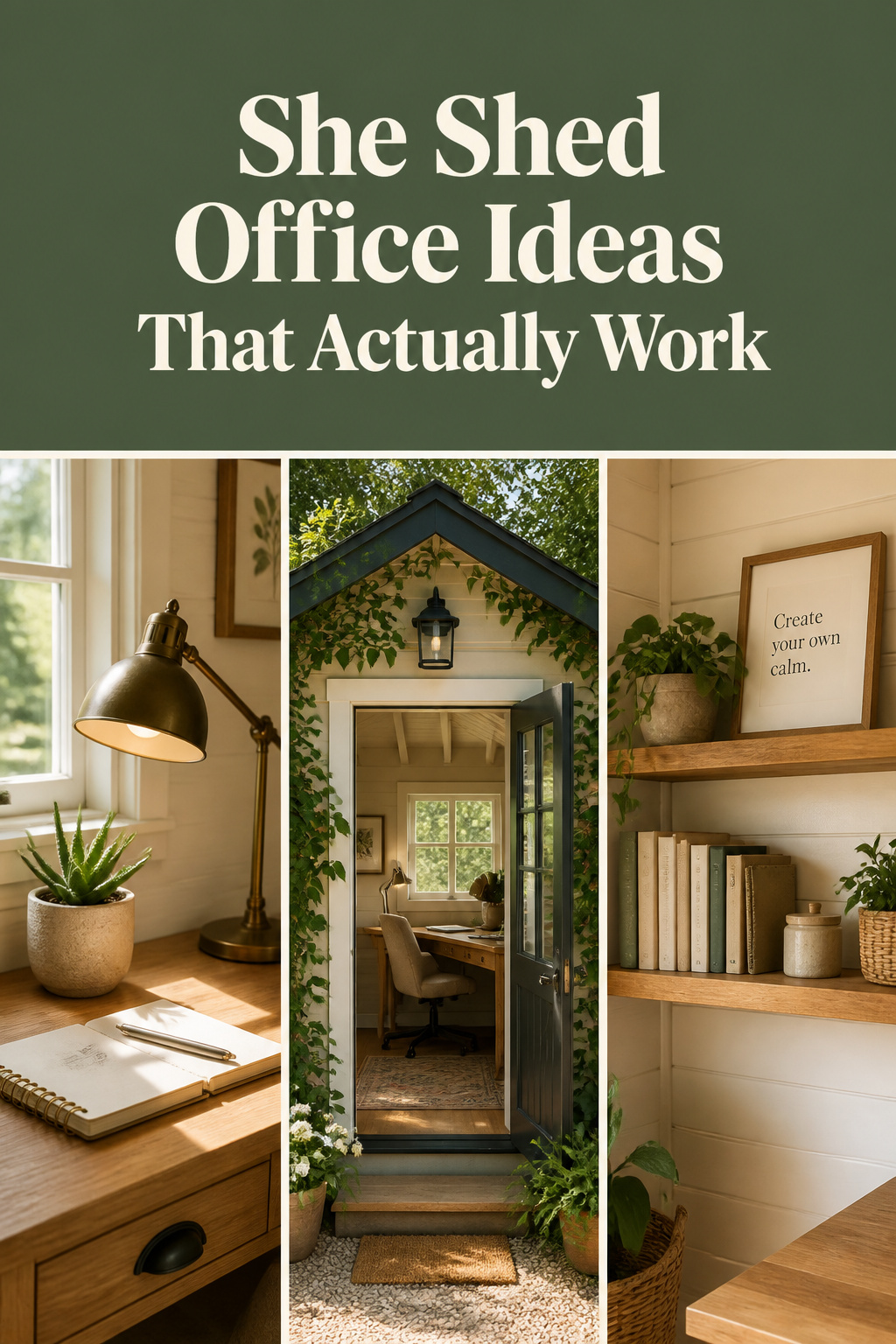

For two years you worked from the kitchen table, with the kettle, the laundry pile, and whoever else is home inside your line of sight. The best she shed office ideas start by fixing that one thing: putting twenty steps of garden between your desk and the house. That short walk does something a closed laptop never can — it tells your brain the workday has started, and later, that it’s over.
TL;DR
- A working backyard office shed needs three things a pretty garden room doesn’t: a dedicated electrical circuit, reliable Wi-Fi or buried ethernet, and year-round heating and cooling.
- Plan for a 10×12 ft (120 sq ft) footprint as the realistic minimum, and set the desk perpendicular to the window — daylight on the side, no glare on the screen, no backlit video calls.
- The twenty-step walk across the garden, plus a consistent open-and-shutdown ritual, is what separates work from home; without the ritual, the distance alone doesn’t switch your brain over.
The Backyard Office She Shed: Why the Distance Matters
The before: working from the kitchen table with the house around you
The trouble with the kitchen table is that it’s both your office and your home, and your brain never agrees on which. Household movement, kitchen sounds, and chores within sightline keep fragmenting your focus the way an office building naturally prevents. Worse, the day never really ends — you close the laptop and the work is still sitting there at dinner.
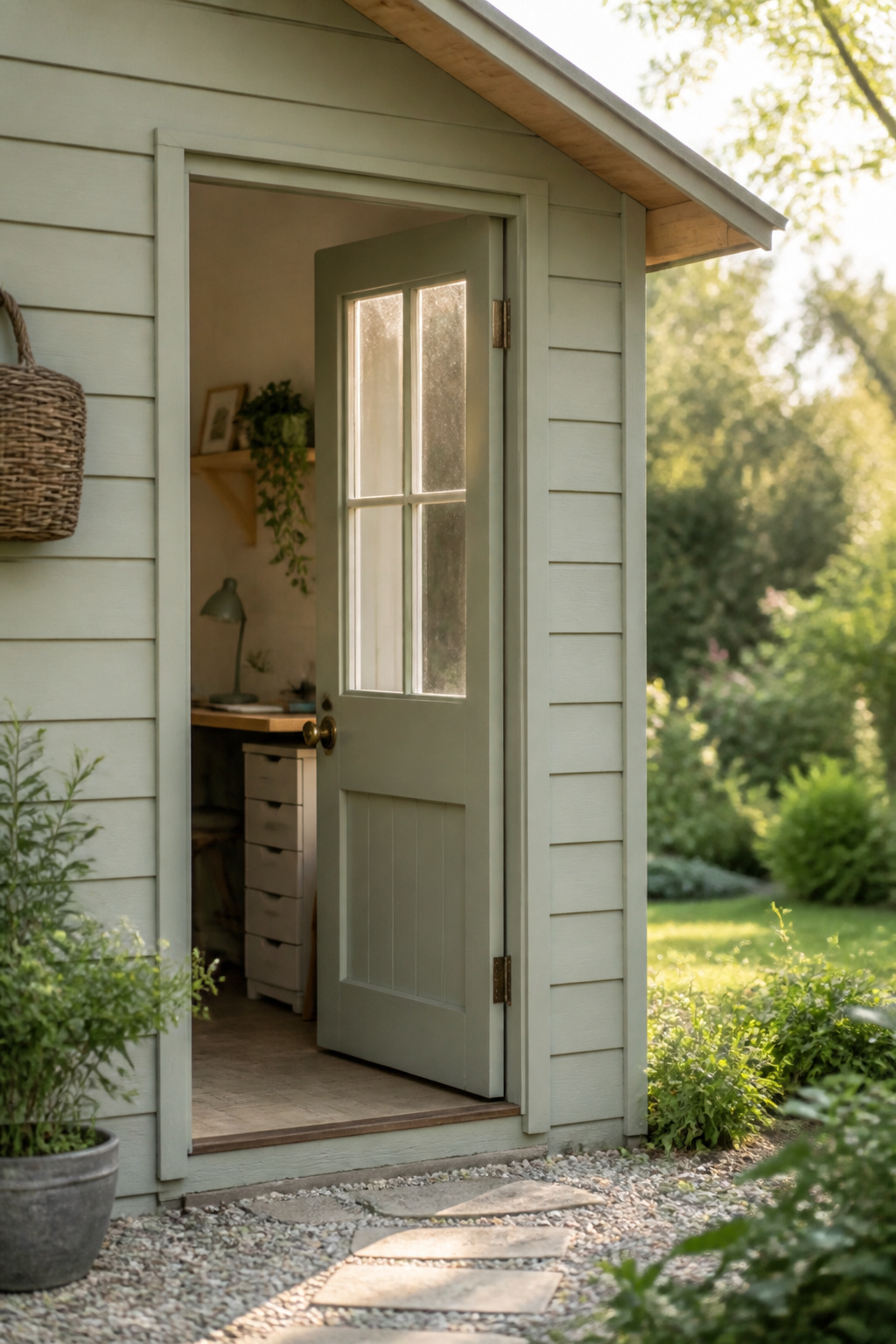
The after: twenty steps from the back door and the workday begins
A purpose-built shed creates the separation a living-room laptop can’t. Stepping inside shifts your mindset; locking the door at five tells your brain work has genuinely ended, so the evening becomes restorative rather than a long tail of work anxiety. Remote-work researchers call the lost commute a missing “decompression transition” — and the walk across the garden is your micro-commute back.
What separates a functional office from a pretty garden room
A garden room is decorative and seasonal. A working office needs three things it doesn’t: a dedicated electrical circuit, reliable connectivity, and year-round temperature control. Skip those and the space works a few mild months a year, for low-demand tasks only. Footprint matters too — 10×12 ft (120 sq ft) is the most-cited minimum for a desk, an ergonomic chair, storage, and room to move. For the full picture on purpose and siting, the backyard she shed inspiration pillar walks the whole journey.
Desk Placement and Sightlines: The Decision That Shapes Everything
Years ago a client heated, roofed, and furnished a showpiece patio they never used — until I moved the seating fifteen feet to catch the evening sun, and suddenly they lived out there. A shed office runs on the same truth: placement beats budget. Where the desk sits decides your light, your glare, your video calls, and whether a standing desk fits. Here’s how the options compare in a 10×12 footprint.
| Desk position | Natural light | Garden view | Glare / call risk | Verdict |
|---|---|---|---|---|
| Perpendicular to window | Side daylight, even | In peripheral vision | Low — best balance | The default choice |
| Facing the window | Strong, direct | Full, distracting | Monitor glare; backlit caller | Avoid |
| Window behind you | Bright background | None | Worst — silhouette on calls | Avoid |
Where the desk should face — and where it should not
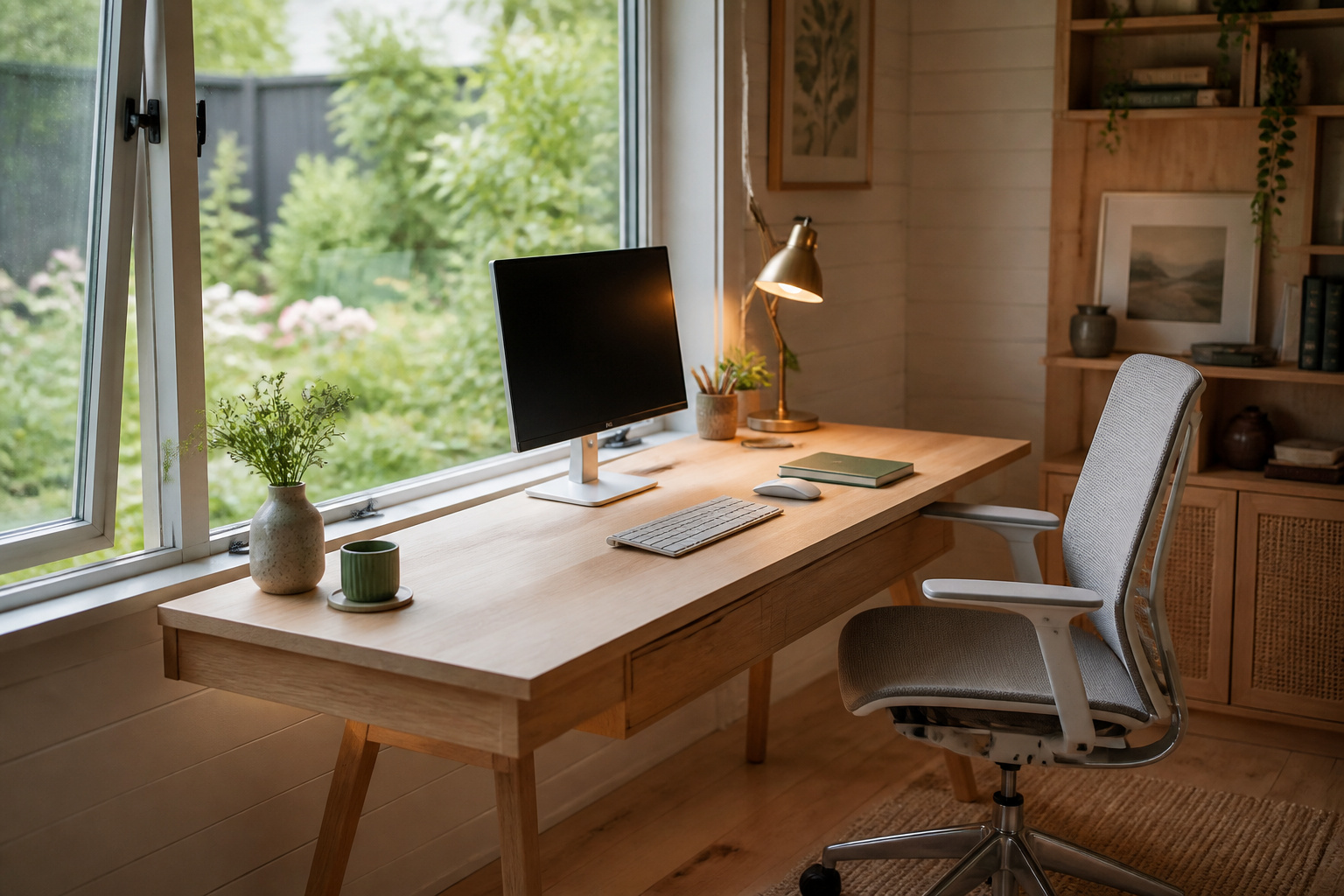
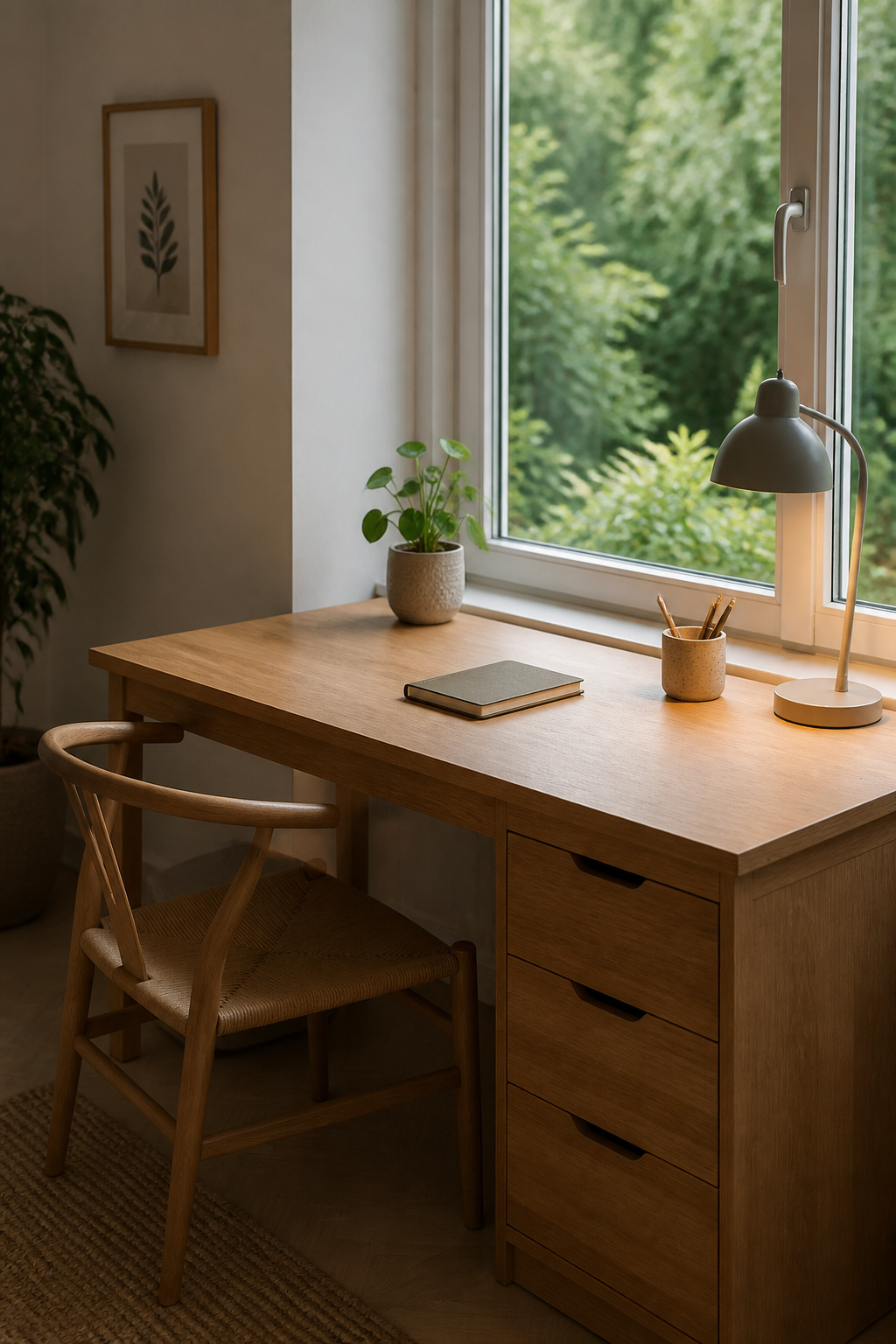
Set the desk perpendicular to the window, at 90 degrees. As Oakywood’s ergonomics team puts it, that gives “optimal access to daylight and the chance to look outside and take a break, without the sun shining directly on your screen.” Facing the window washes out the monitor and backlights you on calls; the window behind you is the single worst orientation — your face goes dark against the bright glass.
Sightline to the garden: a tool, not a distraction
A side window keeps the garden at the edge of your attention, offering a mental rest without pulling you off the screen — a view that restores you rather than competes with your work. In a 10×12 shed, the perpendicular position usually runs the desk along a 10-ft wall with the window on the adjacent 12-ft wall, leaving 3–4 ft of clearance behind the chair.
Standing desk vs fixed: the small-shed calculation
A sit/stand desk fits a 10×12 shed — most electric models are 48–60 inches wide and tuck along the 10-ft wall. Watch the ceiling, though: prefab sheds often run 7 ft at the eaves, and standing desks top out around 48–50 inches extended, leaving roughly 34–38 inches above the surface — figures to check against your own shed, not a spec guarantee. Under about 80 sq ft, a fixed 29–30 inch desk plus a good adjustable chair is smarter. Fitting a desk into a tight footprint is really a layout problem, and these small-footprint layout tips go deeper on zoning the single room.
Light and Glare Control for a Full-Day Workspace
Orienting the shed for usable daylight — morning vs afternoon sun
Where does the sun land at two in the afternoon? That question decides your orientation. East-facing windows give the best office light: cool morning sun through your peak focus hours, gone by early afternoon. West-facing is the trap — dim all morning, then flooded with low, glaring sun that can raise the temperature 10°F or more. South-facing is the steady compromise: consistent light, a high sun angle that dodges acute glare, and a little passive winter warmth.
Window treatments that give you light without screen glare
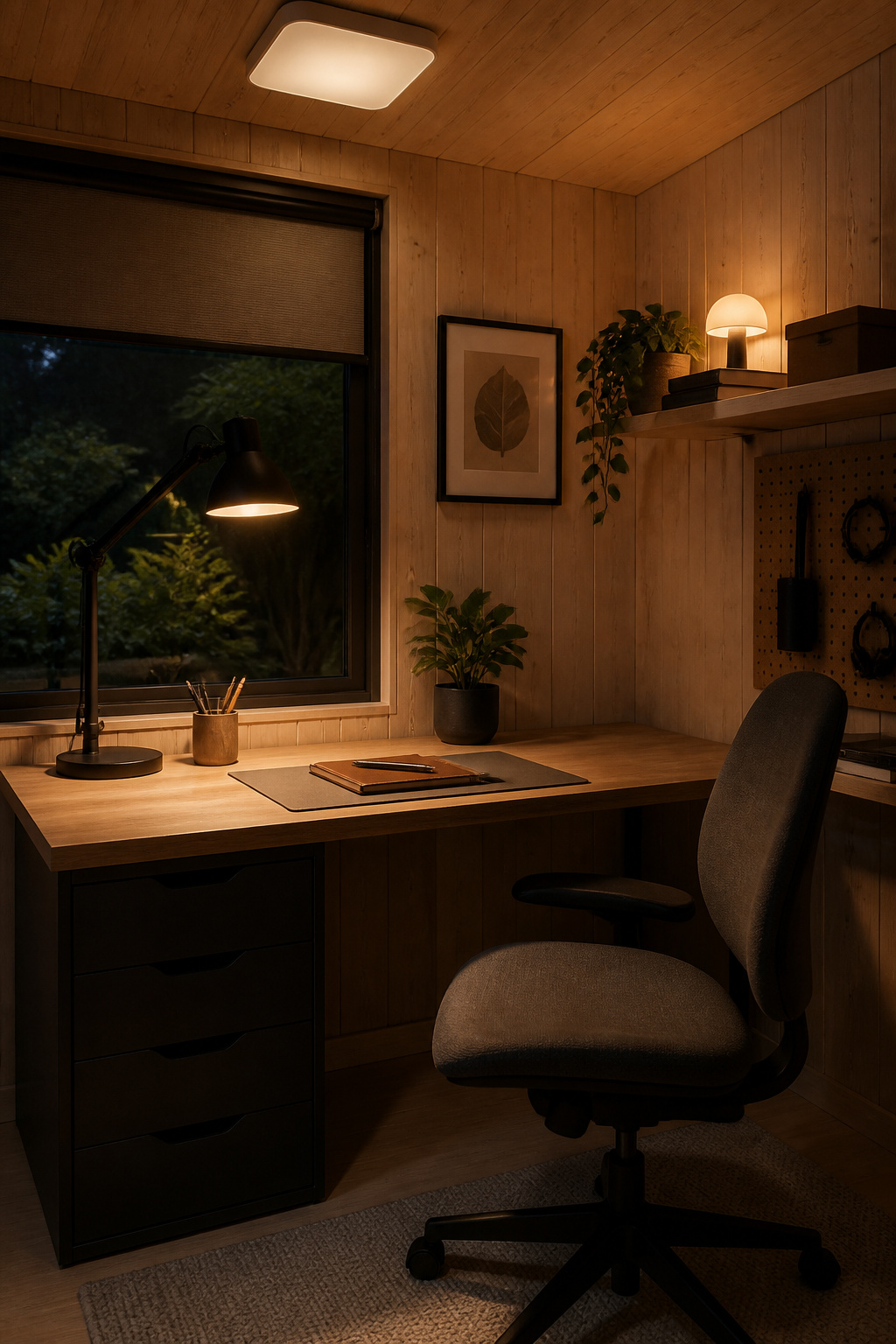
Solar shades with a 3–5% openness factor are the standard fix beside a screen — they scatter the sun and cut monitor glare while keeping a clear garden view. In a shed that heats and cools fast, light-filtering cellular shades add thermal insulation too. One thing to skip: sheer fabric directly behind your chair, which turns you into a near-silhouette on every call.
Artificial light: the layering that stops eye fatigue
Daylight runs out before your workday does, so build three layers so your eyes aren’t fighting one harsh overhead by four o’clock:
- Ambient — an overhead LED panel at 4000K neutral white, cool enough to keep you alert.
- Task — a directional desk lamp delivering 300–500 lux on the work surface, aimed clear of the monitor.
- Accent — a warm 2700–3000K lamp behind the screen that softens the contrast against a dark wall.
Flicker-free LED matters too: the micro-flicker of old fluorescent tubes is what builds into headaches over a full day. This layering is the heart of making a she shed work from home setup comfortable, not just functional.
Connectivity and Power: Getting the Tech Right
A backyard office shed lives or dies on two decisions — how it connects and how it’s powered. Both have well-defined options with real trade-offs in cost and reliability.
| Connectivity option | Range limit | Rough cost | Install | Reliability |
|---|---|---|---|---|
| Wi-Fi extender | ~15 m | $20–$100 | Plug-in | Light use; drops on calls |
| Mesh node (wired backhaul) | 20–30 m | Moderate | Some wiring | Full speed, seamless |
| Buried Cat 6 ethernet | up to 100 m | Higher | Trench + electrician | Highest — no loss |
Wi-Fi in a backyard shed: extender, mesh node or ethernet
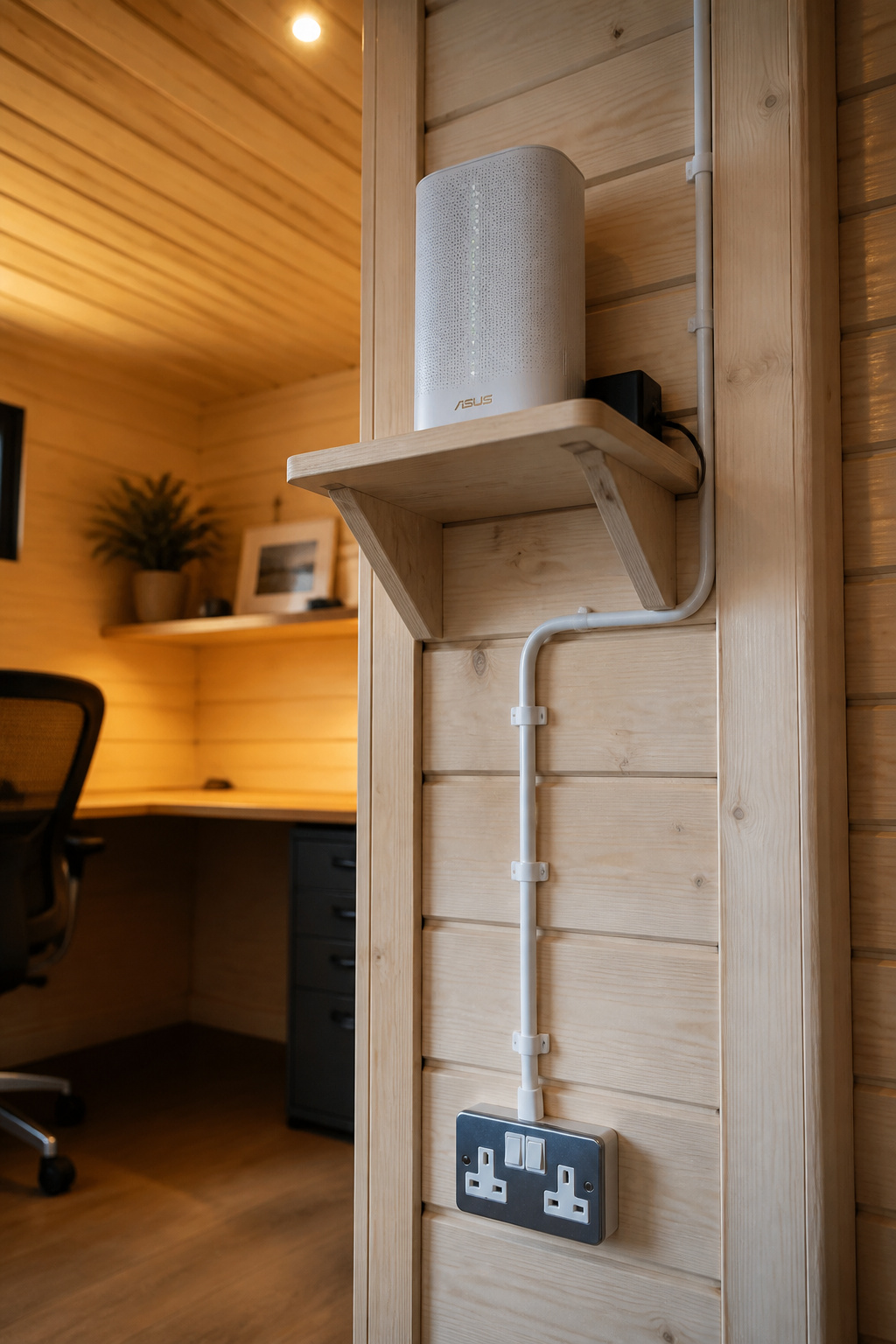
An extender is cheapest and fine for browsing, but it halves throughput and drops mid-call. A mesh node fed by wired ethernet backhaul gives full speed with seamless roaming out to 20–30 metres. For a full-day video-call office, buried Cat 6 cable in conduit (6 inches deep) is the professional answer — as The WiFi Specialist puts it, wired ethernet “delivers your full broadband speed with virtually no performance loss” up to 100 metres.
Circuit planning: outlets, UPS and a dedicated circuit
Running power to a detached shed costs roughly $1,000–$3,800, needs a licensed electrician, and almost always needs a permit. Spec a dedicated 20-amp circuit so the computer isn’t sharing with a heater, and confirm every outlet is GFCI-protected, as US code requires for outbuildings. A UPS rated 900VA or above buys 5–15 minutes to save and shut down cleanly through a cut. An all-day office leans hard on powering and heating the shed — that spoke covers the systems in depth.
Video call setup — background, acoustics and camera angle
Put the camera at hairline height, angled slightly down, on a monitor arm or shelf. Light your face from the front or 45 degrees to the side — never from behind. For the hollow echo of a bare shed, soft surfaces do the work: a rug, curtains, and a loaded bookshelf each cut reflections, and together they make calls sound natural, not boxy.
All-Day Comfort: Heating, Cooling and Ergonomics
Temperature control: the minimum for a productive winter office
Cognitive work holds up best at 20–22°C (68–72°F). A Cornell study found that lifting a cold room into that range cut typing errors by nearly 44% — comfort is productivity, not luxury. A ductless mini-split is the most-recommended solution: it heats and cools from one quiet wall unit, and for a 10×12 shed, 6,000–9,000 BTU is typically enough. It only works with insulation behind it, though — an uninsulated shell forces the unit to run flat out.
Chair and posture for a shed with lower ceiling heights
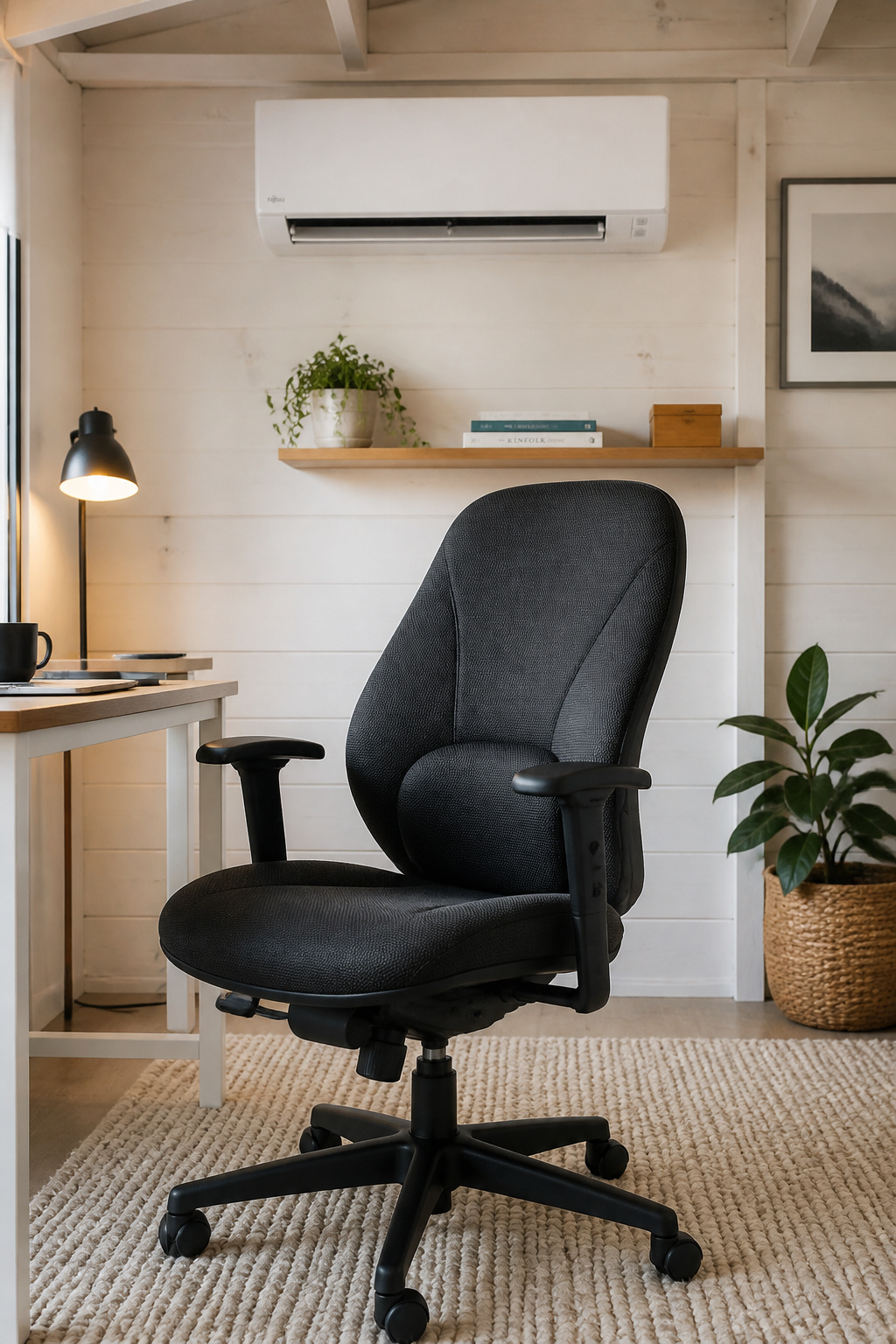
The chair is the one comfort investment a full-day shed can’t skip — a cheap one produces back pain within 2–3 hours no matter how nice the desk is. Get adjustable seat height, lumbar support, and armrests. Set the top of the monitor at or just below eye level, usually 20–28 inches above the desk; a monitor arm hits that height and frees surface space in a compact layout.
Sound: what gets in, what to do about it
The door is the biggest leak — a hollow-core panel admits far more street noise than a solid-core one, so weatherstrip the frame and fit a sweep at the bottom. Double-glazing cuts transmission through the windows. Inside, the same soft furnishings that tame call echo — rug, curtains, loaded shelves — calm the acoustics for long work sessions. Exact noise reduction varies by shed, so treat this as direction rather than a guarantee.
She Shed Office Design Ideas: Making It Feel Like a Workspace
The design move that signals ‘office’: a real desk, a real chair, a real light
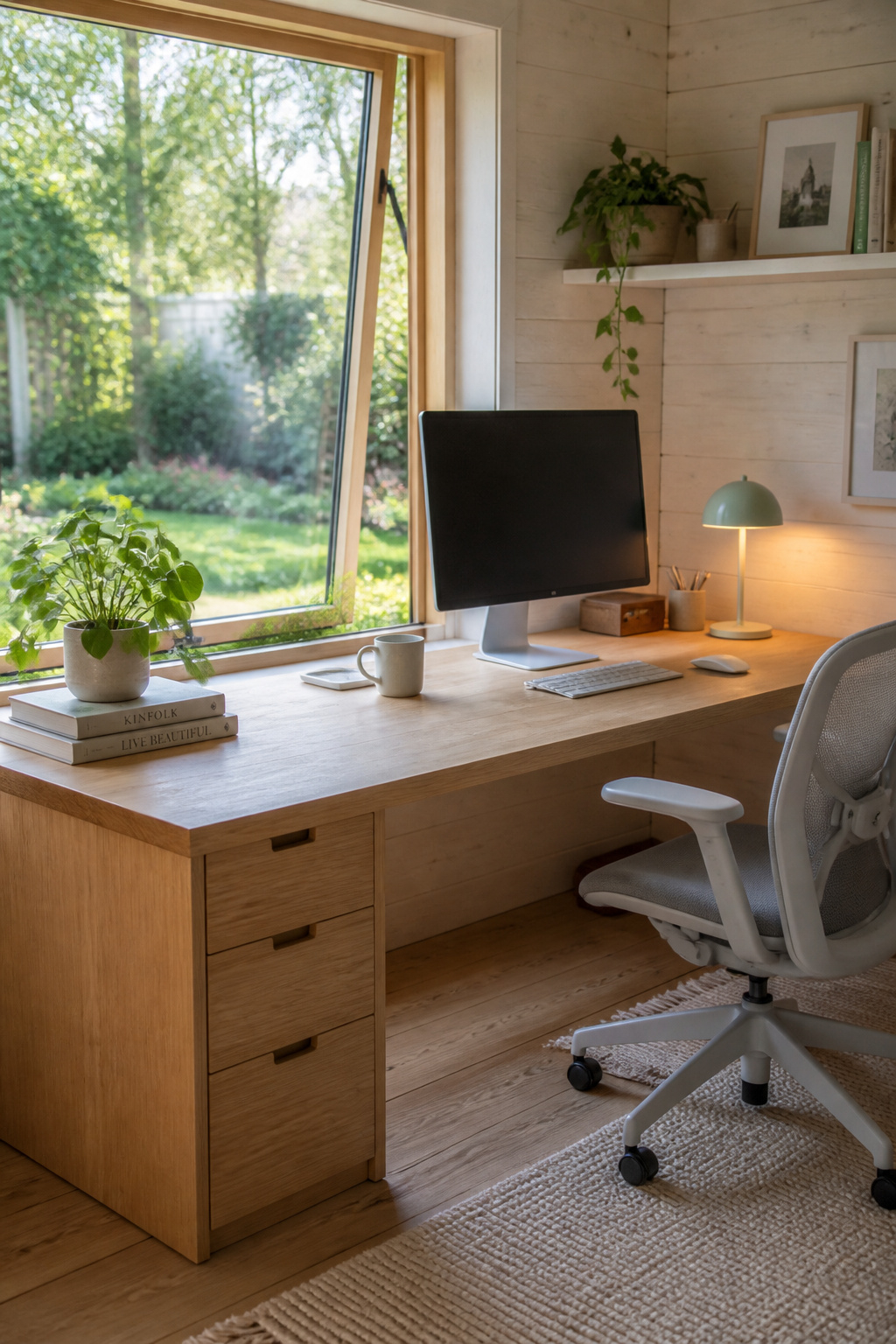
The fastest way a shed stops reading as a garden room is a full-size desk — minimum 48 inches wide — in a purposeful position, not a patio table dragged outside. Pair it with a real ergonomic chair and a dedicated task lamp. Design guides keep landing on that same trifecta: each piece quietly says “I work here,” not “I escape here.”
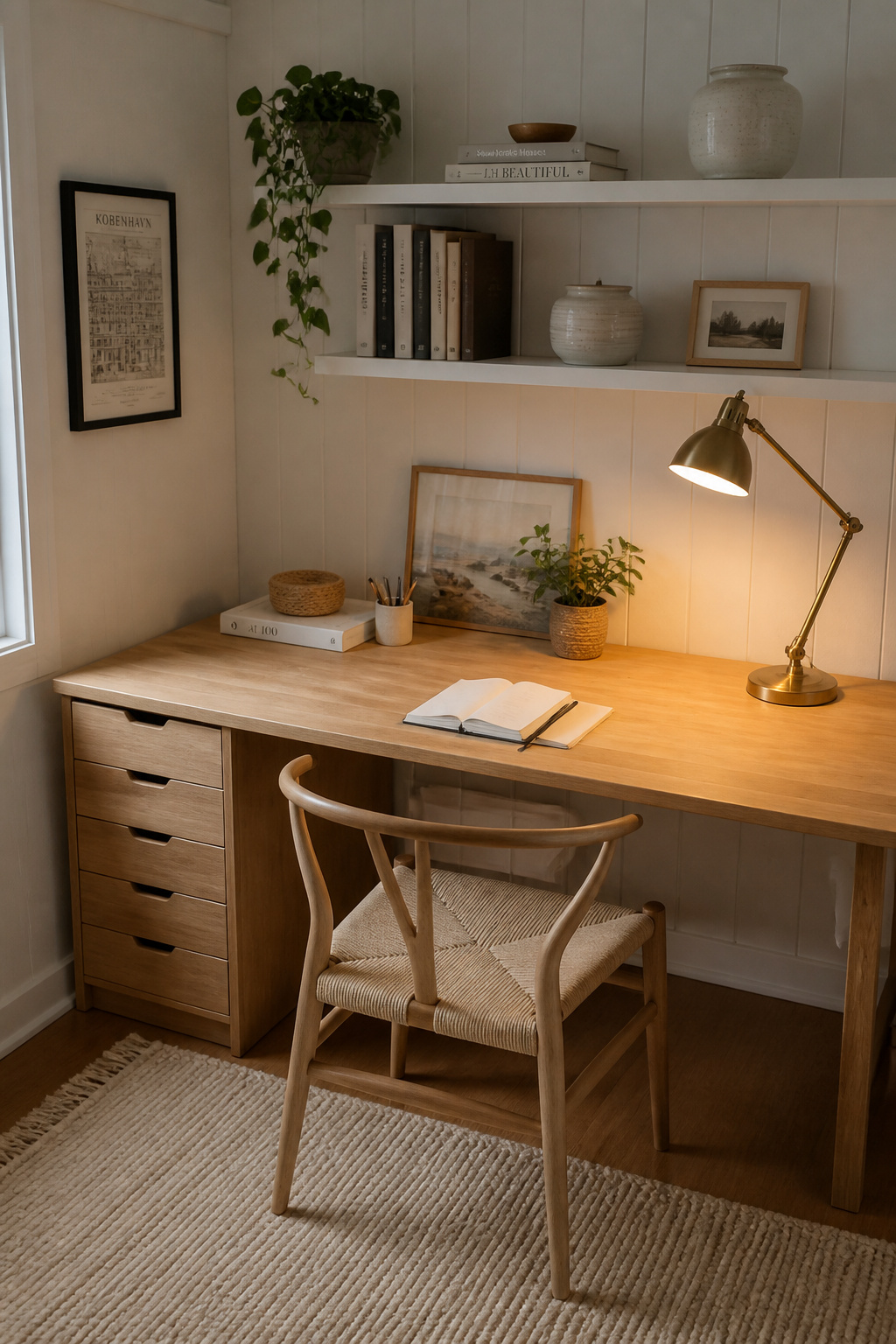
Storage that doesn’t eat the floor: floating shelves and vertical wall use
Floor space is the scarce currency in a shed, so send storage up the walls. Floating shelves at 72–84 inches hold a full office of books and files with zero floor footprint — 6–8 linear feet does it in a 10×12. An under-desk rolling pedestal recovers knee-height space and keeps the surface clear, itself a strong “this is a workspace” signal. Leave the primary sightline wall mostly bare; a wall packed solid makes the room feel smaller.
The threshold ritual that starts and ends the workday
Here’s the part most people skip, and the one that activates everything else. The shed gives you physical separation, but a small consistent ritual is what flips your brain into and out of work mode. Open the same way each day — unlock, switch on the lamp, make a drink. Close the same way — clear the desk, shut the laptop, lock the door, then walk back through the garden as a stand-in for the commute. The actions matter less than doing them daily; remote-work practitioners recommend it as a practical substitute for the lost commute, and it costs nothing.
Picture that first proper evening: you tidy the desk, switch off the lamp, pull the door shut, and walk back across the grass with the day genuinely behind you. That’s the whole promise of a backyard office — not a prettier shed, but a real edge between work and home. Get the three essentials right, set the desk perpendicular to the window, and keep the daily ritual. Do that, and the twenty steps across the garden become the best commute you’ll ever have.
FAQ
How do I get Wi-Fi in a backyard she shed office?
For a shed within 15 metres with a faint existing signal, a Wi-Fi extender ($20–$100) is cheapest, but it halves speed and can be unreliable on video calls. The most reliable option is buried Cat 6 ethernet in conduit, 6 inches deep, which delivers full broadband over up to 100 metres. A mesh node on wired backhaul is the middle ground within 20–30 metres.
What size she shed do I need for a home office?
A 10×12 ft (120 sq ft) footprint is the recommended minimum for a single-person office — it holds a full-size desk, an ergonomic chair, and a storage zone with room to move all day. An 8×10 (80 sq ft) fits a desk and chair but leaves almost no circulation. If you want a standing desk with room to step back, plan for 12×12 or larger.
Do I need planning permission to use a garden shed as an office?
In the UK, an occasional office shed usually falls under permitted development if it’s under 15 sq m, single-storey, and not in the front garden. In the US, most areas don’t require a permit under 120 sq ft, but local ordinances vary, so check first. Running electricity almost always needs a separate permit and a licensed electrician, regardless of size.