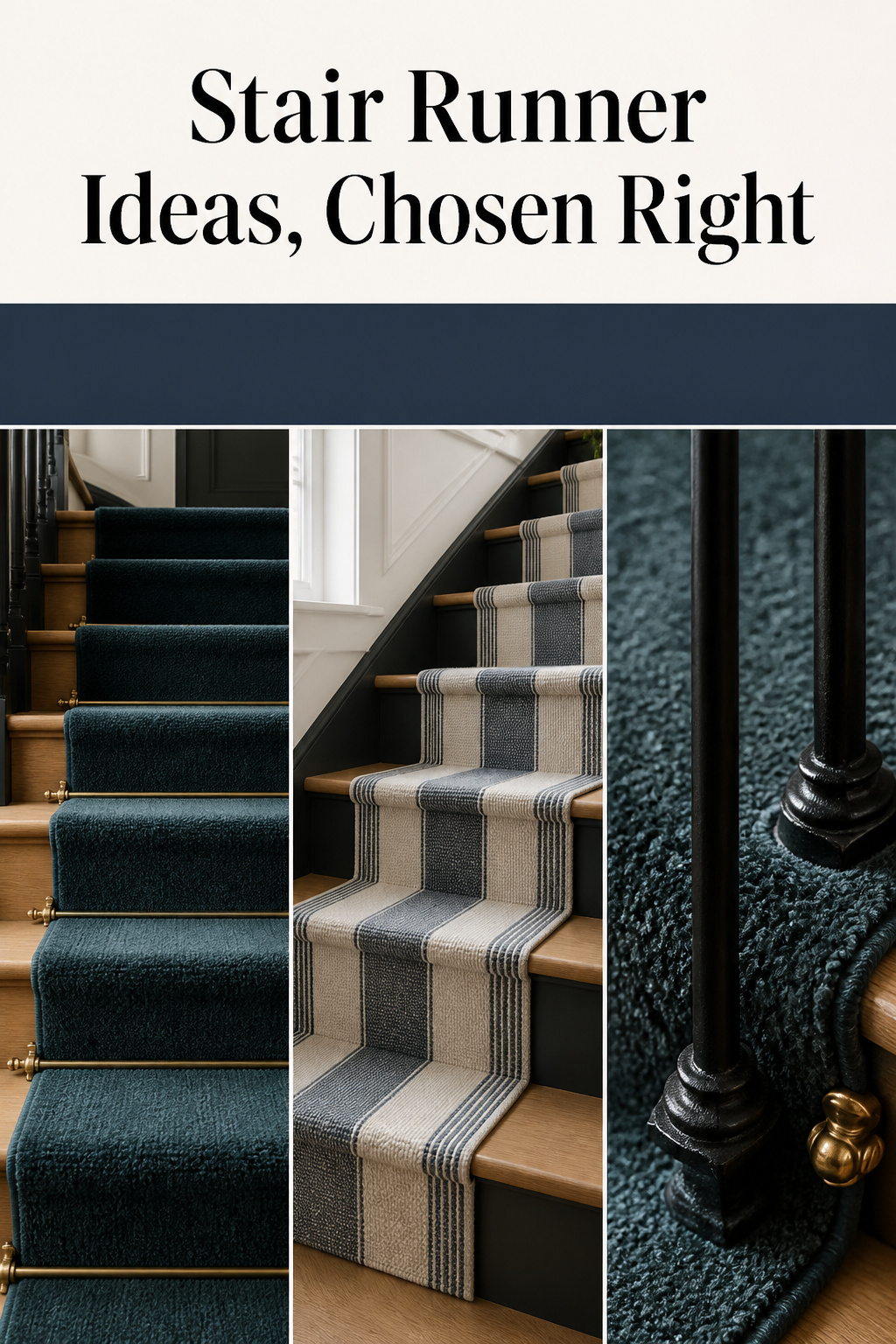
Search stair runner ideas and you get a hundred photographs and almost no reasons. What decides whether you still like it in five years is what this textile will be after ten thousand footsteps. So I sort runners in one order: material first, width second, pattern last, install route after all three.
TL;DR
- Buy density before colour: 50-70+ oz/sq yd of face weight is the range specified for stairs, while 25-35 oz/sq yd belongs in a low-traffic room.
- Runners come in standard widths of 27, 30, 32 and 36 inches. Measure clear stair width first, then take the width leaving about 4 inches of tread per side.
- A stapled waterfall install is a real weekend job: This Old House rates it 1 of 5 for skill, 3 hours and $262-$568 in materials for 13 steps. Wool with rods runs $80-$180 per step.
What a stair runner needs to do
On stairs, a runner takes wear a floor rug never faces.
The job stairs ask of a runner
Floor traffic spreads across a wide surface. Stair traffic concentrates it: every step lands on the nosing, the front edge of the tread. That is why underlay and grippers are load-bearing here. The runner also has to lie flat across risers up to 7-3/4 inches and treads of at least 10 inches (IRC R311.7.5).
Why ‘ten thousand footsteps’ is the right way to think about material
I spent six years in a 38-square-metre apartment where the dining table was also the desk and the worktable. One surface absorbed every kind of daily use, and it taught me this: a material chosen for how it looks tells the truth about itself within a year.
Upholstery buyers have a number for this: the Wyzenbeek double-rub test, 3,000-9,000 rubs for light duty, 30,000+ for heavy-duty residential. It is an upholstery-fabric test, not a stair standard, and no runner carries a rub count. Only the order of questions transfers.
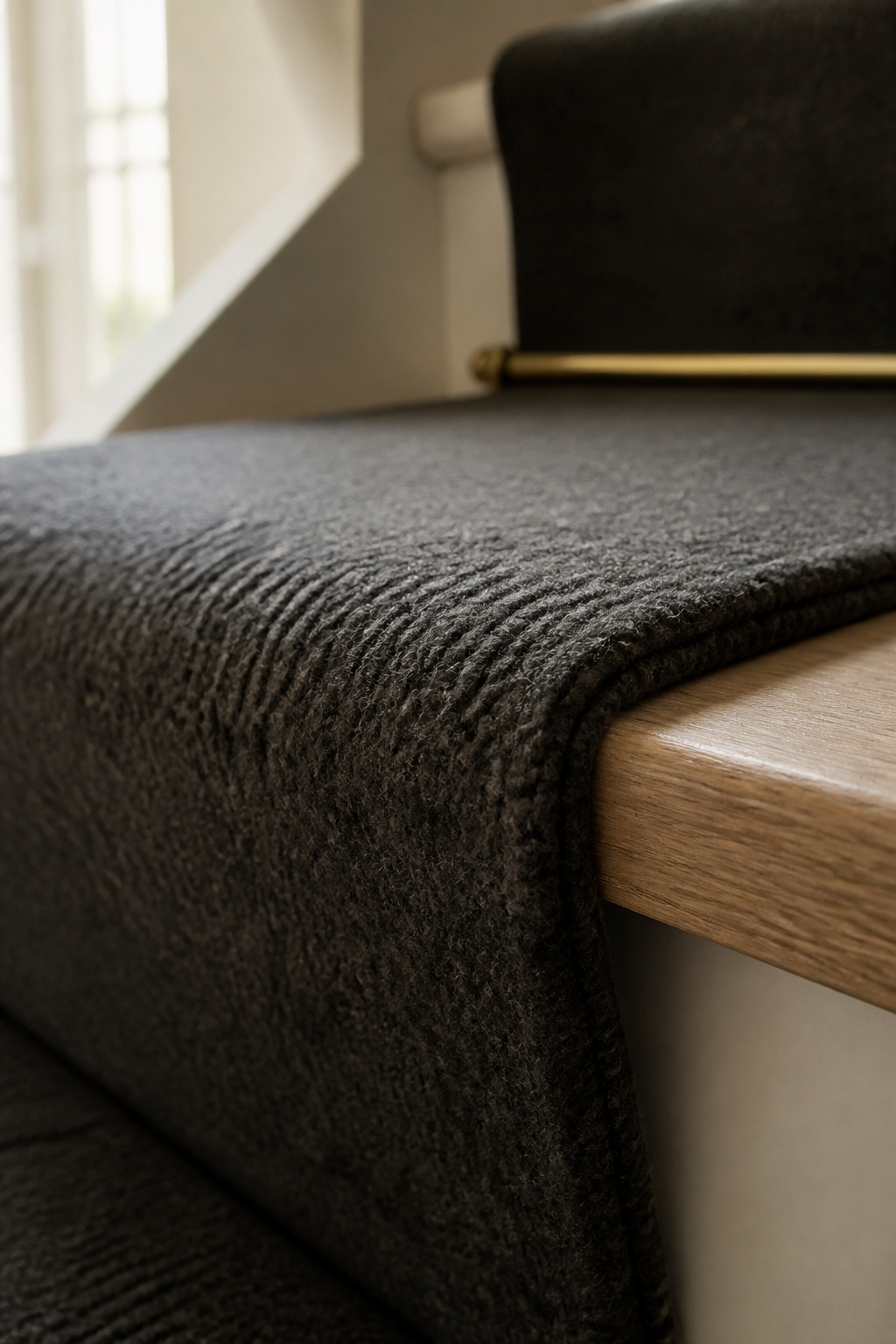
The stair equivalent is face weight: 25-35 oz/sq yd for low-traffic rooms, 35-50 for most rooms, 50-70+ for stairs. Under roughly 40 oz/sq yd you are asking a floor-traffic textile to do stair work. So ask the ounce weight before the colour. A shop that cannot tell you has answered you anyway.
Material, width, then pattern
Material decides whether the runner survives; width and reveal decide whether the install looks intentional. Pattern comes third, the only purely aesthetic decision. Over 68% of Scandinavian consumers choose natural fibres such as wool and linen for durability ahead of looks alone.
Wool, flatweave or pile: choosing the material that survives stairs
Wool density and why it matters more than fiber name alone
Price sorts the field faster than any swatch. Dash and Albert’s stair-specific wool runners sit at $70-$120 per linear foot, against $40-$80 for cotton and $30-$60 for synthetics. Wool springs back after compression and holds colour under traffic. The 80/20 wool-nylon blend is the common middle, improving crush resistance at half the cost: $5-$12 per square foot against $10-$20.
On a tight budget, I buy the blend at full stair density rather than pure wool at a thin one.
Flatweave vs pile: how each wears on a nosing
Flatweave interlocks warp and weft into a low profile, so no raised pile sits at the nosing to crush. Tight loop behaves similarly; both give traction and hide marks. Deep cut pile, like Stark’s cut-pile wool lines, is richer underfoot and accepts the crush trade-off. I put flatweave or tight loop on the daily flight, and cut pile on a secondary staircase.
Synthetic and blend options worth considering
Polypropylene is tough, stain-resistant and easy to maintain, with a realistic 5-8 year life against wool’s 10-15, which is an honest trade on a tight budget. Sisal, jute and seagrass are harder to defend on a main flight: real texture, but 3-5 years. And “washable” is not a standardised claim, so read the care label.
Getting the width and tread reveal right
The most common ordering mistake is a 36-inch runner bought for a 34-inch staircase.
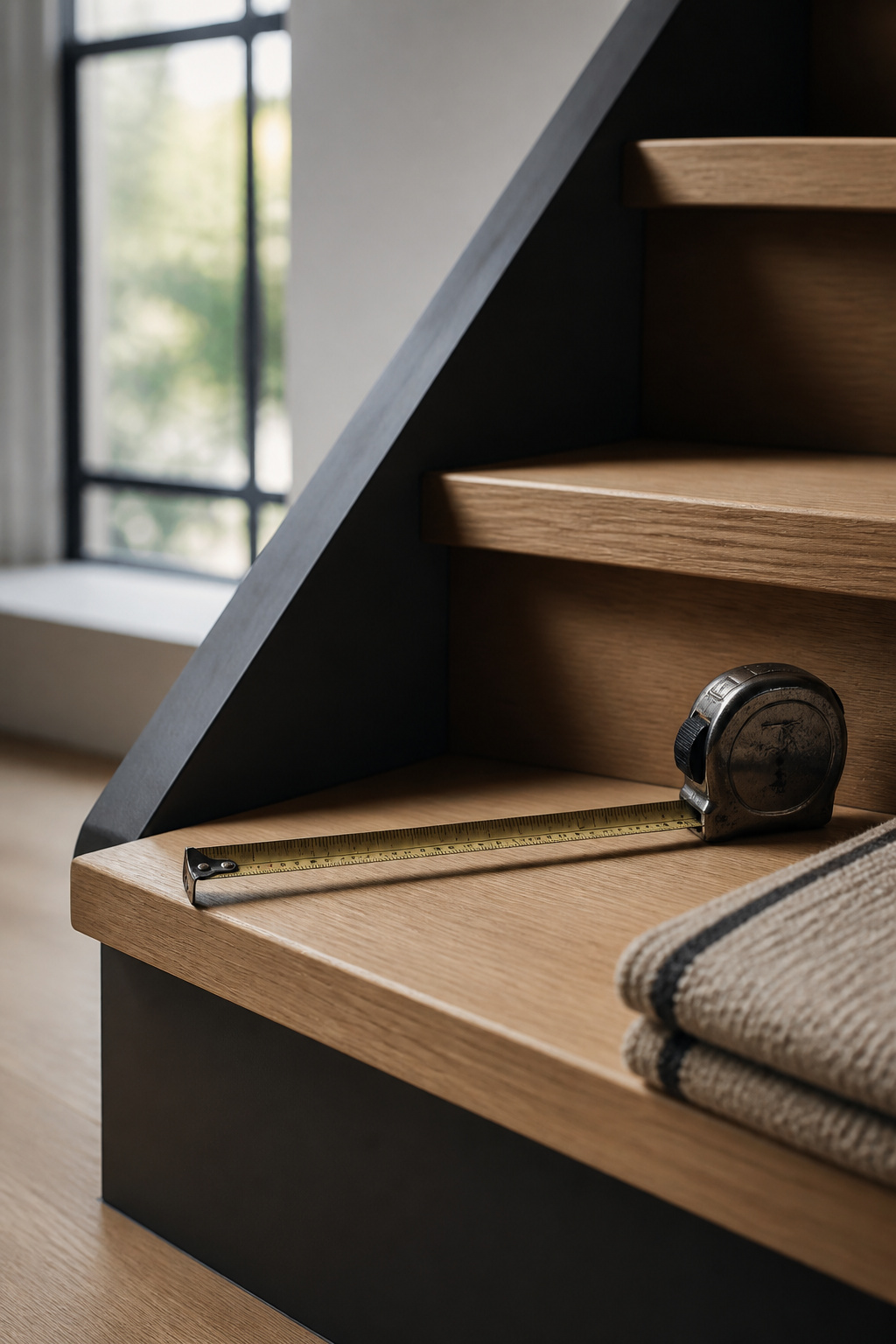
Standard runner widths and what they mean for tread reveal
Pre-made runners come in a small set of widths: 27, 30, 32 and 36 inches. Staircases vary far more, so a 30-inch runner leaves 3 inches of wood per side on a 36-inch staircase, and 6 inches on a 42-inch one. Reveals run 3 to 12 inches per side, roughly 4 being the balanced default.
Measuring your own staircase before you shop
Take these numbers first:
- Measure riser height on a representative step, floor to tread lip.
- Measure tread depth on the same step, lip to riser.
- Multiply each by the step count, then add the totals for overall length.
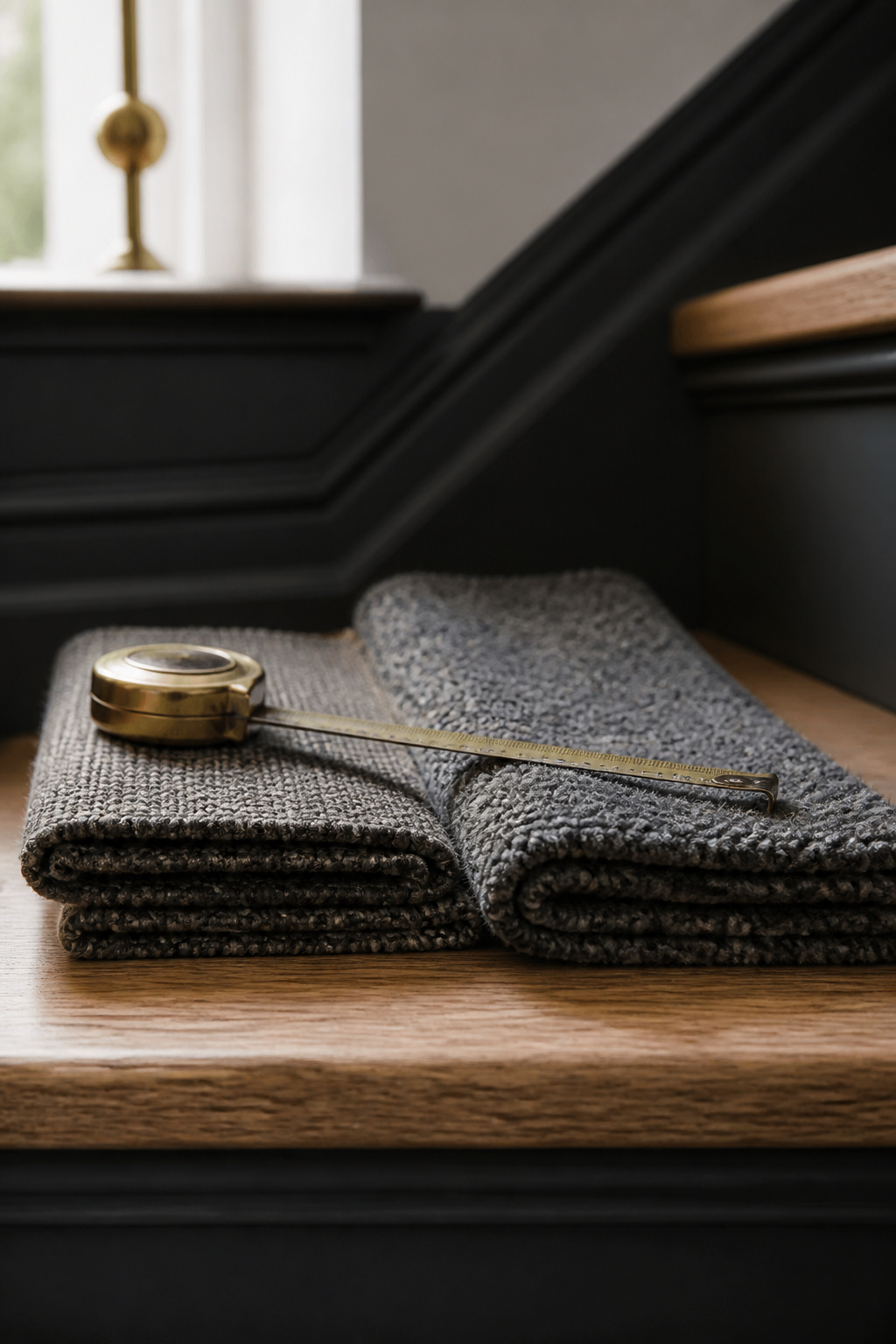
- Add at least 6 inches of waste allowance; ends are often left unbound for trimming.
- For turns and landings, run string along the path the runner will take.
Skip step five and the length comes up short at the turns.
When a narrower runner is the better-proportioned choice
A wider reveal, toward 6-8 inches a side, looks deliberate and shows off oak treads and a painted stringer. A narrower one, toward 3-4 inches, gives a fuller, warmer stair. Under about 34 inches of clear width, take the 27-inch runner.
Pattern on a diagonal: what holds up and what fights the stairs
A pattern behaves differently when it climbs instead of lying flat.
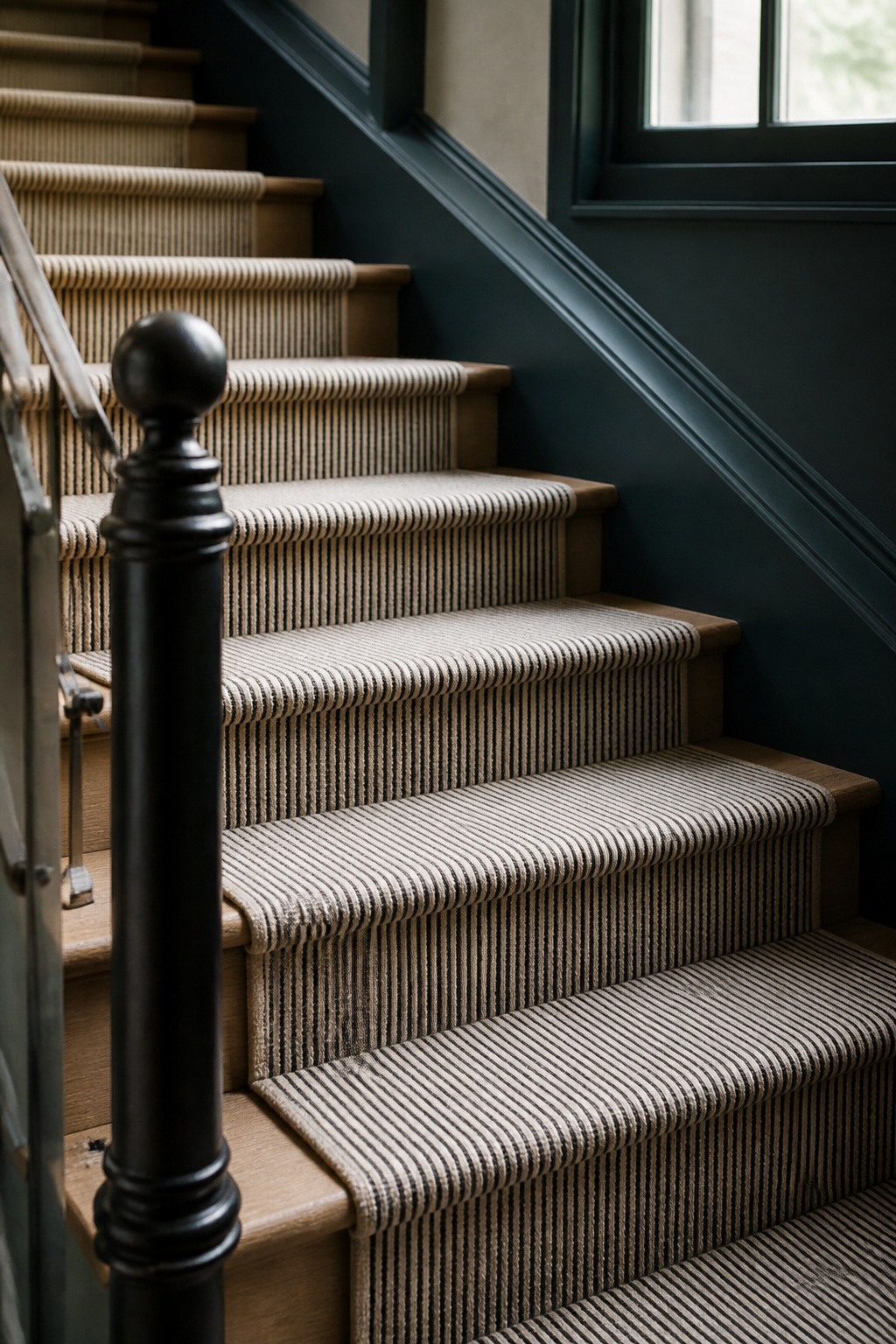
Why pattern behaves differently on a stair than a floor
It gets divided. A pattern repeat is the distance between two points where the design becomes identical again, and on a custom install it has to be factored into the yardage. On winding stairs the advice is firmer: plain or small repeats only, since each step is cut individually and misalignment has nowhere to hide.
Patterns that read well going up a pitch
Stripes are the workhorse. Busy stripes hide dirt and wear, and vertical ones add apparent height. Stripes also suit both install styles. Houzz frames the category well: staircases are large-scale furniture in need of upholstering.
Large-scale florals are where I part company with most runner shopping, and this is my own judgment rather than a published rule. A repeat short enough to land inside one tread-and-riser unit resolves into a motif; a large one is cut apart by every tread edge, so the eye never assembles it.
When plain wins
On any staircase with turns, winders or an irregular tread count, plain or near-solid is the lower-risk choice: no alignment is left to fail. Plain also earns its keep where the stairs are painted, since a dense flatweave in a deep tone lets texture and the stringer carry it.
Rods, waterfall or professional install: the two honest routes
A borrowed pneumatic stapler and a Saturday: that is one route’s entire equipment list.
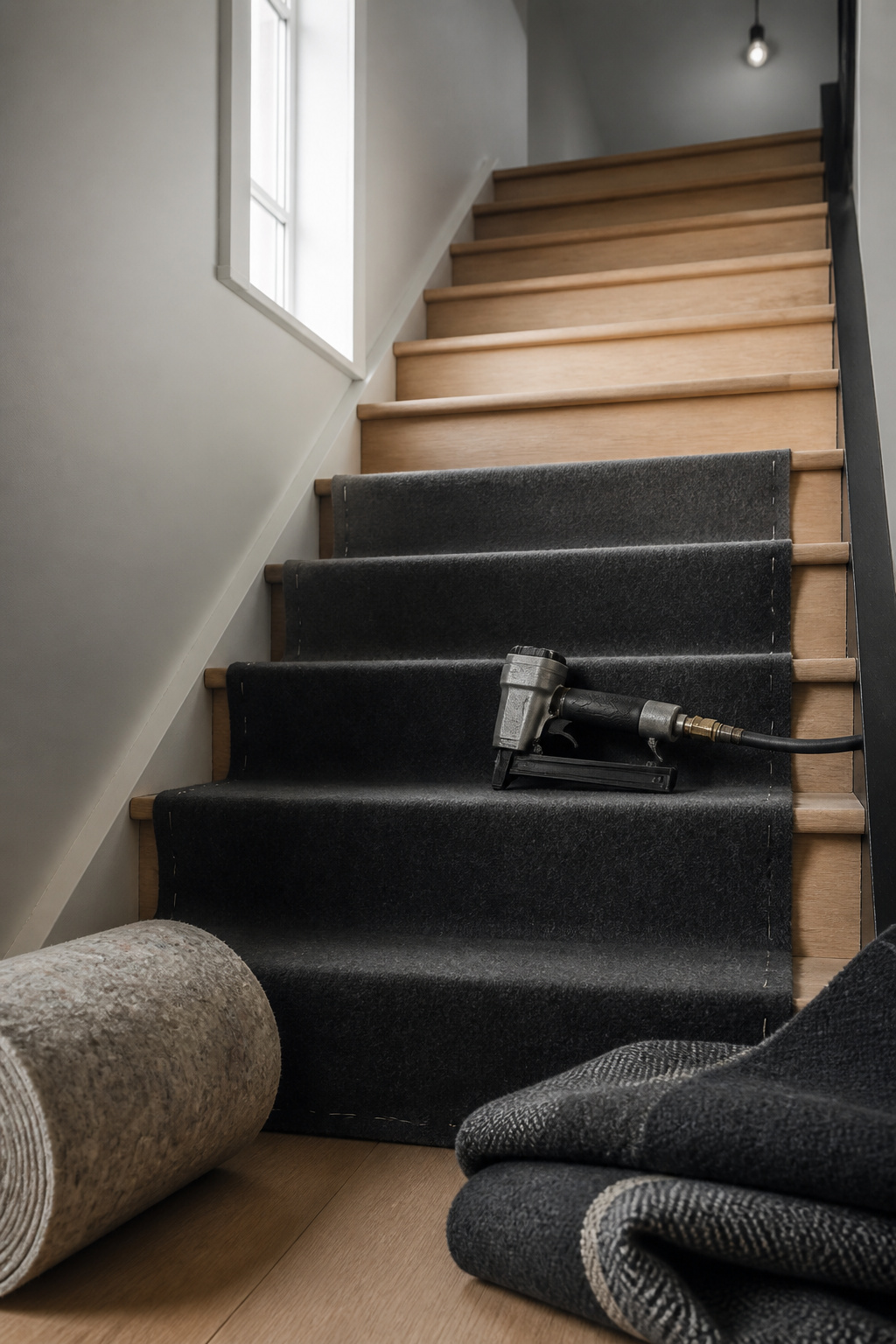
Stapled waterfall install: cost and skill required
This Old House rates a stapled install at skill level 1 of 5, though precise cutting and placement make or break it. Their 13-step project runs $262-$568 in materials and takes about 3 hours. Cut padding slightly narrower than the runner, tape it down, then work top-down, keeping the runner taut around every nosing.
Stair rods: cost, look and what they demand of the runner
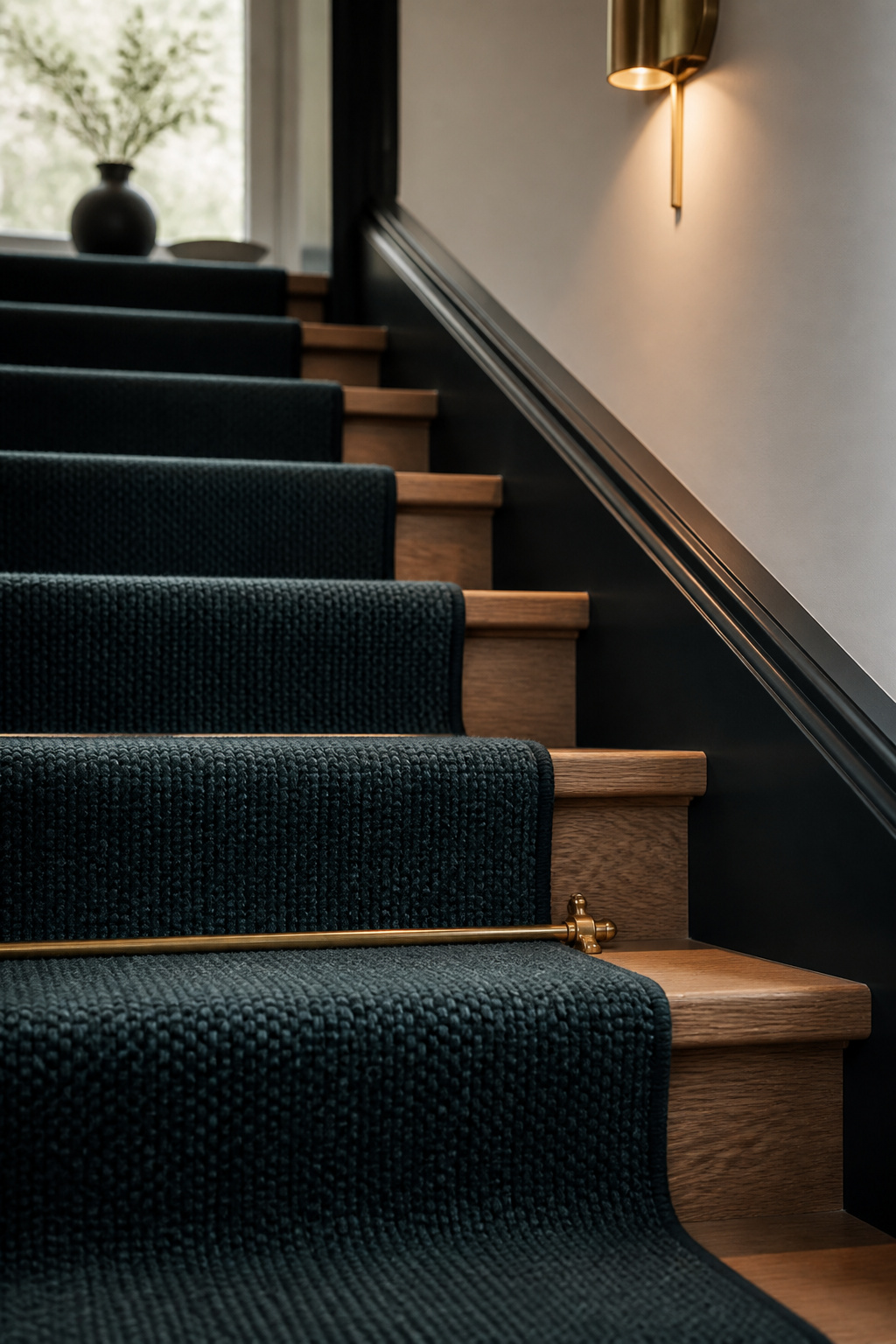
Rods change the budget and the character of the job. Brass rods run $15-$40 each, and rod-and-clip hardware adds $250-$700 over a glued-down finish, from polished brass to satin nickel. Rods also forgive: each anchors the runner’s line regardless of small variances underneath, while a waterfall install conceals nothing.
| Route | Cost per step | Skill and time | What it forgives |
|---|---|---|---|
| Stapled waterfall (polypropylene) | $25-$55 installed | DIY, 1 of 5; ~3 hours for 13 steps | Nothing; every cut shows |
| Wool with brass rods | $80-$180 | Professional advised; $250-$700 hardware | Minor cutting variances |
Across 14 steps that is roughly $1,120-$2,520 for wool with rods against about $560 for the polypropylene waterfall. Those figures all trace to one source, the CarpetInstallCost stair runner cost guide, so treat them as that guide’s numbers, not a market rate. On straight stairs, I take the waterfall row.
When to hire it out
Curved and winding staircases generally need bespoke fabrication, every step measured and cut individually. Wool with rods on a primary flight belongs there too, for the pattern matching alone. A waterfall install on a straight secondary staircase is the realistic homeowner project.
Choosing your runner: which stair runner ideas fit your stairs
The decision rule in one pass
Run four checks in order and the field collapses. Density first: 50+ oz/sq yd on any primary flight. Width second: measure clear stair width, then take the standard width leaving 4-8 inches of tread per side. Pattern third: plain or small-repeat on curves, stripe or geometric on straight flights. Install last: waterfall on a straight secondary stair, rods or a professional for wool.
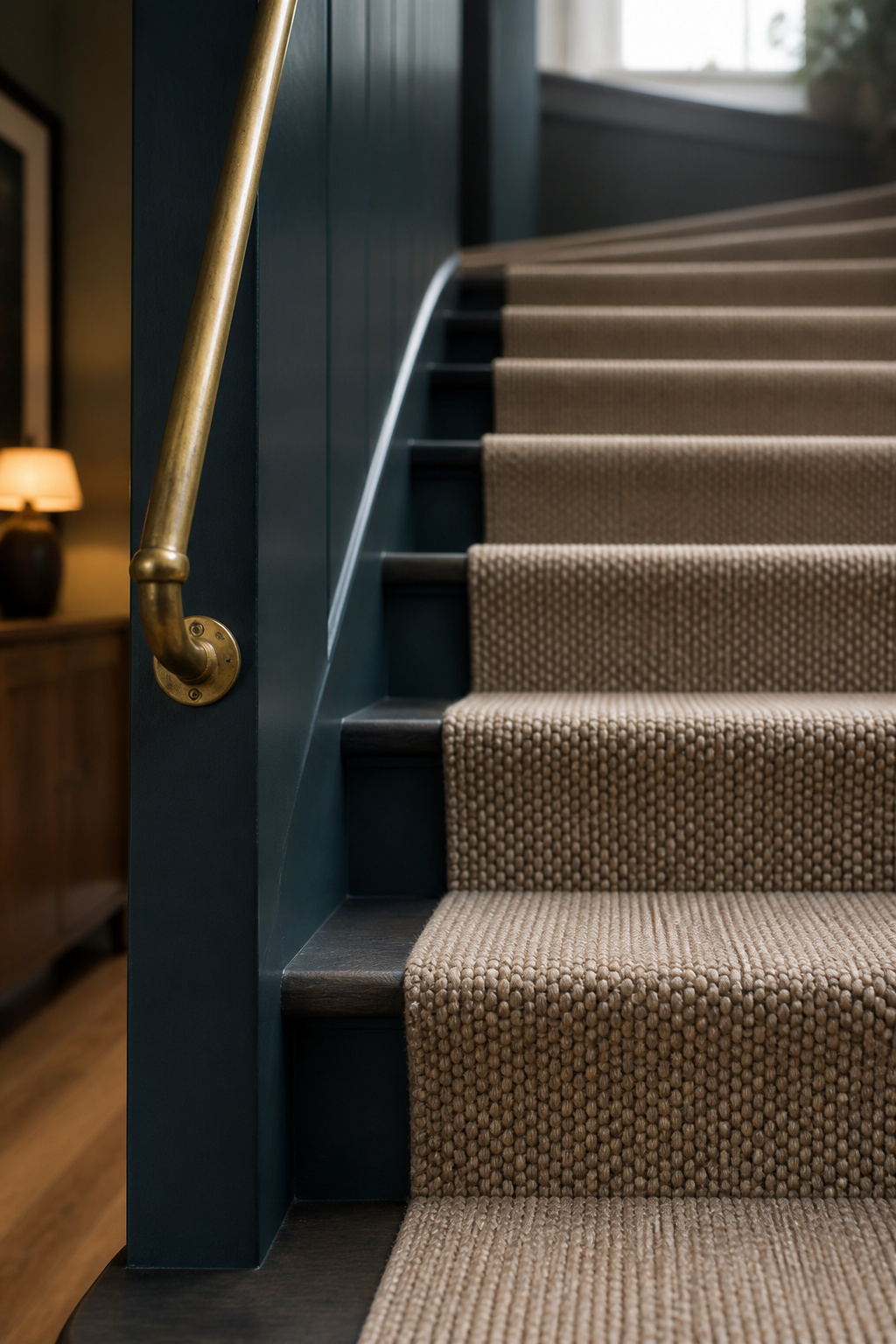
Matching the runner to the painted scheme already on the stairs
Choose the runner against the paint you have committed to. A deep blue-green or charcoal stringer wants the same value register: a deep wool tone that settles into the paint, or a warm neutral flatweave contrasting cleanly. If the paint is undecided, work through the painted scheme the runner sits against first; if you are still at demolition, the carpet-to-wood groundwork comes before either.
What comes after the runner is installed
Two things worth a glance once it is down, and neither is a runner decision. If you’re using a nosing contrast stripe, check it still reads clearly underfoot in low light (a lighting question). And confirm the handrail still meets height code (a railing question). Both belong to the rest of the staircase project.
Decide density, then width, then pattern, then install, and the showroom stops being overwhelming. Ask for a density number before you buy a swatch, measure before you order a width, and budget rods separately from the runner price.
Tonight, take the tape measure to your own stairs. Clear width, riser height, tread depth, step count, plus six inches for waste: five numbers, and you walk into any showroom already knowing which runner is yours to buy. The rest of the staircase can wait its turn; there are more ways to update an old staircase once this one is settled.
FAQ
Can you put a stair runner on curved or winding stairs?
Yes, though it usually requires custom fabrication: each curved step is measured individually for riser height, tread depth and width, then cut as its own piece. Choose plain or small-repeat patterns, since alignment problems show badly on winders. For an L-shaped turn, a mitered join bonded with adhesive works well.
How much does a professional stair runner installation cost?
Pre-made polypropylene runners cost $25-$55 per step installed, custom broadloom-cut runners $40-$100, and wool with brass rods $80-$180. A standard 12-15 step staircase therefore lands around $400-$1,500 for mid-tier work. Labour alone, for basic stapled or glued installs, runs $3-$8 per stair.
Do stair runners work with radiant or in-floor heating on the landing?
Generally yes, provided the pad underneath is heat-compatible. RugPadUSA, a rug pad retailer, advises avoiding rubber-only backings on radiant floors because continuous heat can degrade them. Its recommended alternative is a felt-based pad without rubber components, sold around 1/4 to 1/2 inch thick.