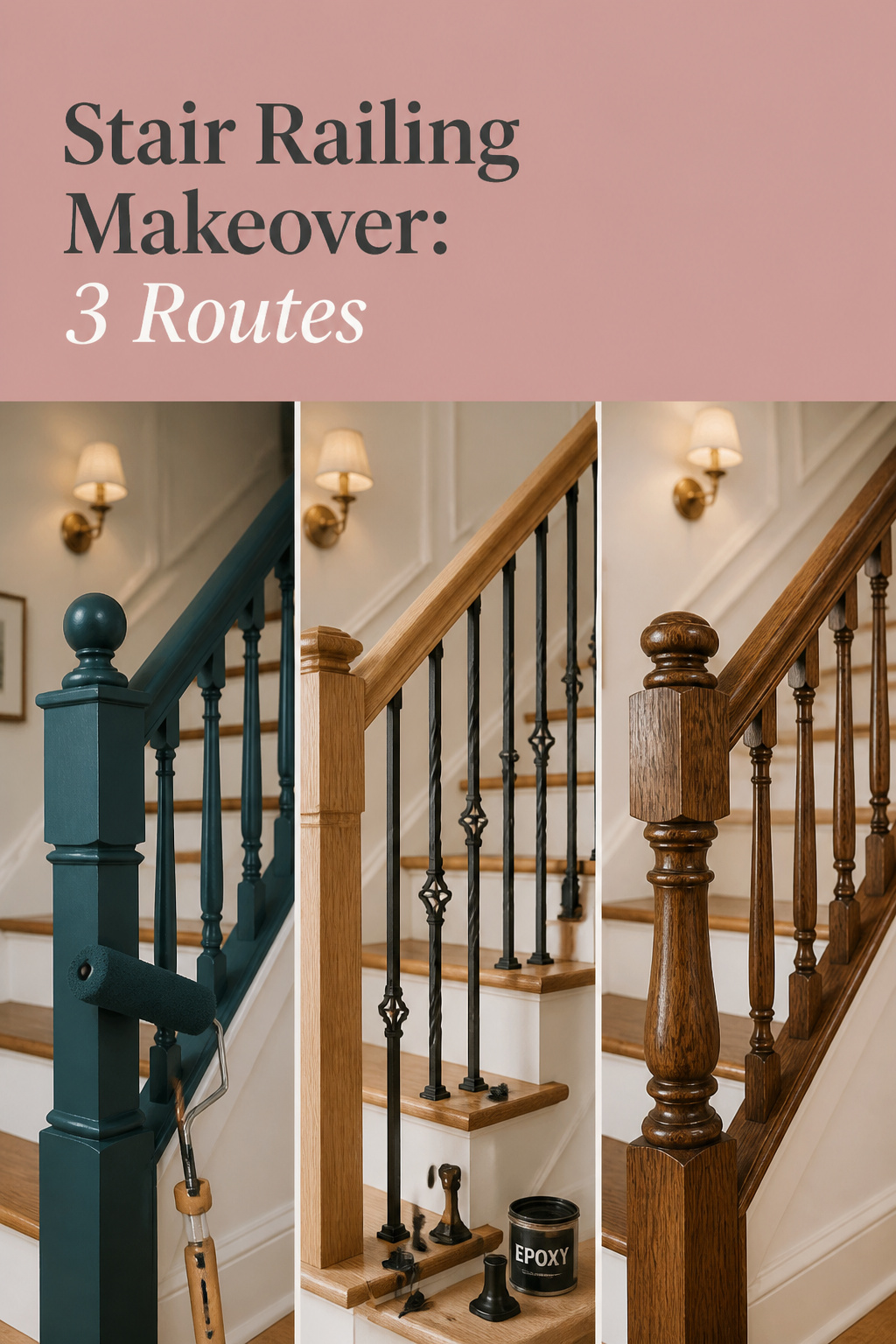
Newel posts changed shape roughly every twenty years. The 1850s turned them beefy and usually out of walnut, paneled box newels ran through the early 1880s, and by the 1890s posts had gone tall and appliquéd. Then the Craftsman decades pared them back down. So the post at the bottom of your stairs tells you when the staircase was built, and a stair railing makeover goes very differently depending on the answer.
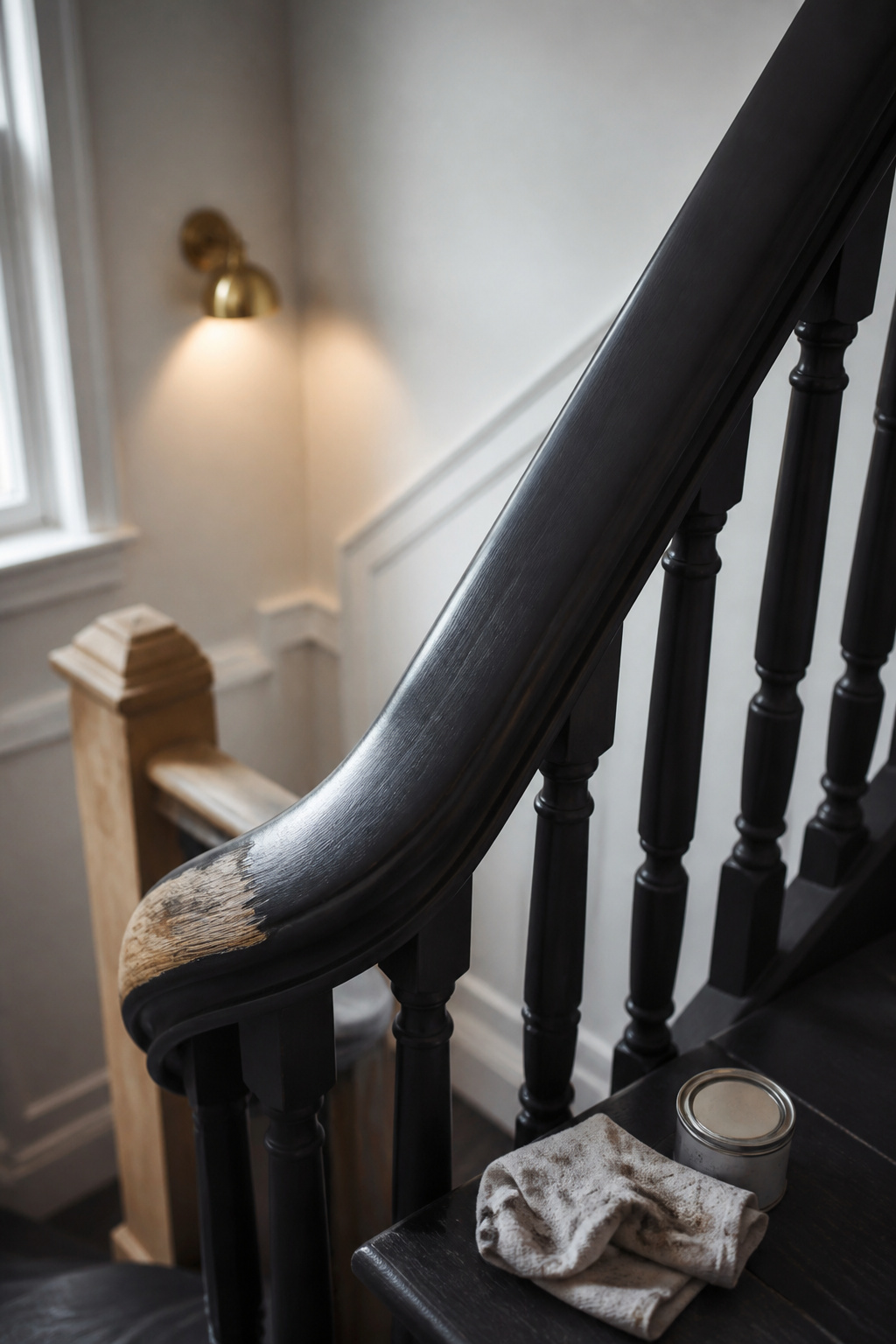
TL;DR
- Read the rail first: newel profile, baluster shape and grain tightness date it in five minutes, and tight old-growth grain is what earns a restoration over a replacement.
- Paint is the least disruptive route and the shortest-lived: it typically shows wear within 5-7 years under regular contact, against 7-10 for polyurethane and 15-20 for powder-coated metal.
- A wood-to-iron baluster swap is quoted at $400 to $2,500 or more installed, and no clear opening may exceed code: 4 inches on guards, 4-3/8 inches for stair guard infill.
The bigger risk is signing up for a job the railing does not need, or stripping an original that deserved keeping, more than picking the wrong color.
Reading your railing before you touch it
Put a hand on the newel post at the foot of the stairs. Of everything in the house, that post dates the staircase fastest.
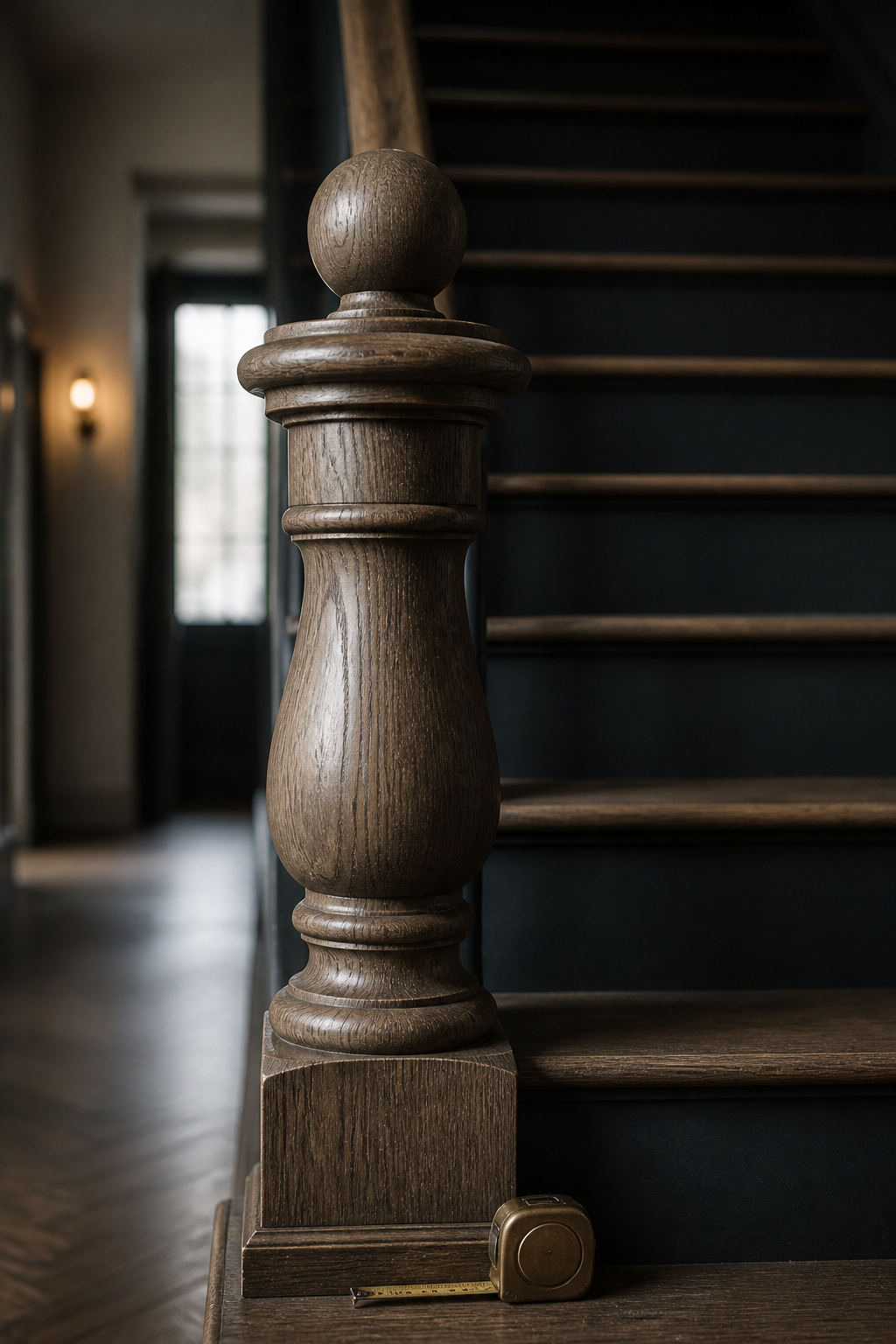
Dating the rail: joinery, profile and hardware tells
Newel form moved in clear decade-by-decade steps, and Architectural Observer’s survey of them places most rails quickly.
| Era | Tell-tale detail |
|---|---|
| 1850s-1880s | Beefy turned walnut newels, then paneled box newels with burled insets |
| 1890s-1900s | Tall box newels, appliquéd ornament, stout turned balusters |
| 1910s-1920s | Pared-down Craftsman newels; iron balustrades in Revival houses |
| 1930s | Restrained Colonial Revival and Neoclassical proportions |
Stout turned balusters beside a tall box newel are the 1890s imitating Colonial tradition.
What’s original and what’s a prior owner’s repair
Now walk the run and find the length that doesn’t match. Old-growth shows tightly spaced rings with a high share of dense latewood; managed-forest lumber grows fast, wide-ringed and soft. A section with visibly wider grain is almost always a later splice. Honey oak throughout, curved spindles with knobs, a pony wall instead of an open run? That’s the 1990s builder-grade set.
Why this five-minute read changes which route you pick
Hand-cut joinery in dense old-growth is the strongest case for restoring over replacing, because that density is why the rail already survived a century of hands. A 1990s replacement carries no such case, so stripping one is labor spent protecting nothing.
Route one: paint that survives hand oils and daily grip
Five to seven years is how long paint typically lasts under regular hand contact, against 7 to 10 for polyurethane and 15 to 20 for powder-coated metal. Least disruptive, and the shortest-lived of the three finishes.
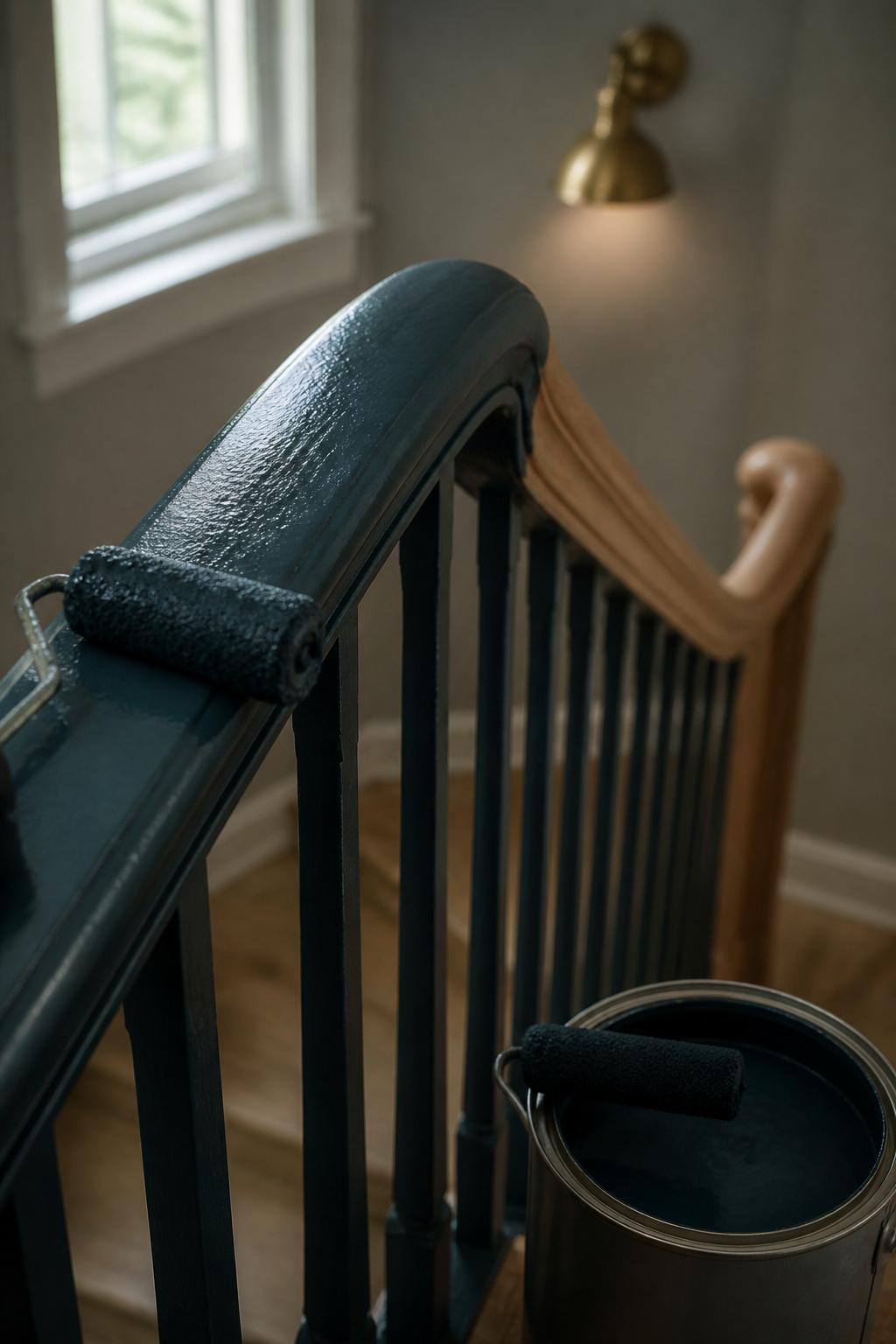
Finishes that hold up to a hand on the rail every day
Paint sits on the surface instead of bonding in the way powder coating does, so it chips first where a hand grips and twists. Sheen is therefore a durability decision: satin hides minor scratches far better than gloss, and high gloss feels slippery under a gripping hand.
Prep specific to a handrail vs a flat surface
A handrail is a grease magnet; a baseboard isn’t. On intact, non-peeling varnish you can skip sanding: deglosser applied twice in circular motions, then a TSP wash to lift hand oils before priming. Skip that degreasing and paint peels at the grip zone within a year. If the finish is failing, sand instead: 120 grit, then 220, dust pulled off with a wet/dry vacuum.
What paint can’t fix
Paint is a finish decision, never a structural one. It won’t tighten a loose newel-to-baluster joint, close a hairline crack, or stop a rail flexing under a grip. Over deep gouges or alligatored varnish, a fresh coat telegraphs every flaw within a season.
Route two: swapping balusters without touching the rail
What if the handrail is sound and only the spindles date the house? Then leave the rail where it is.
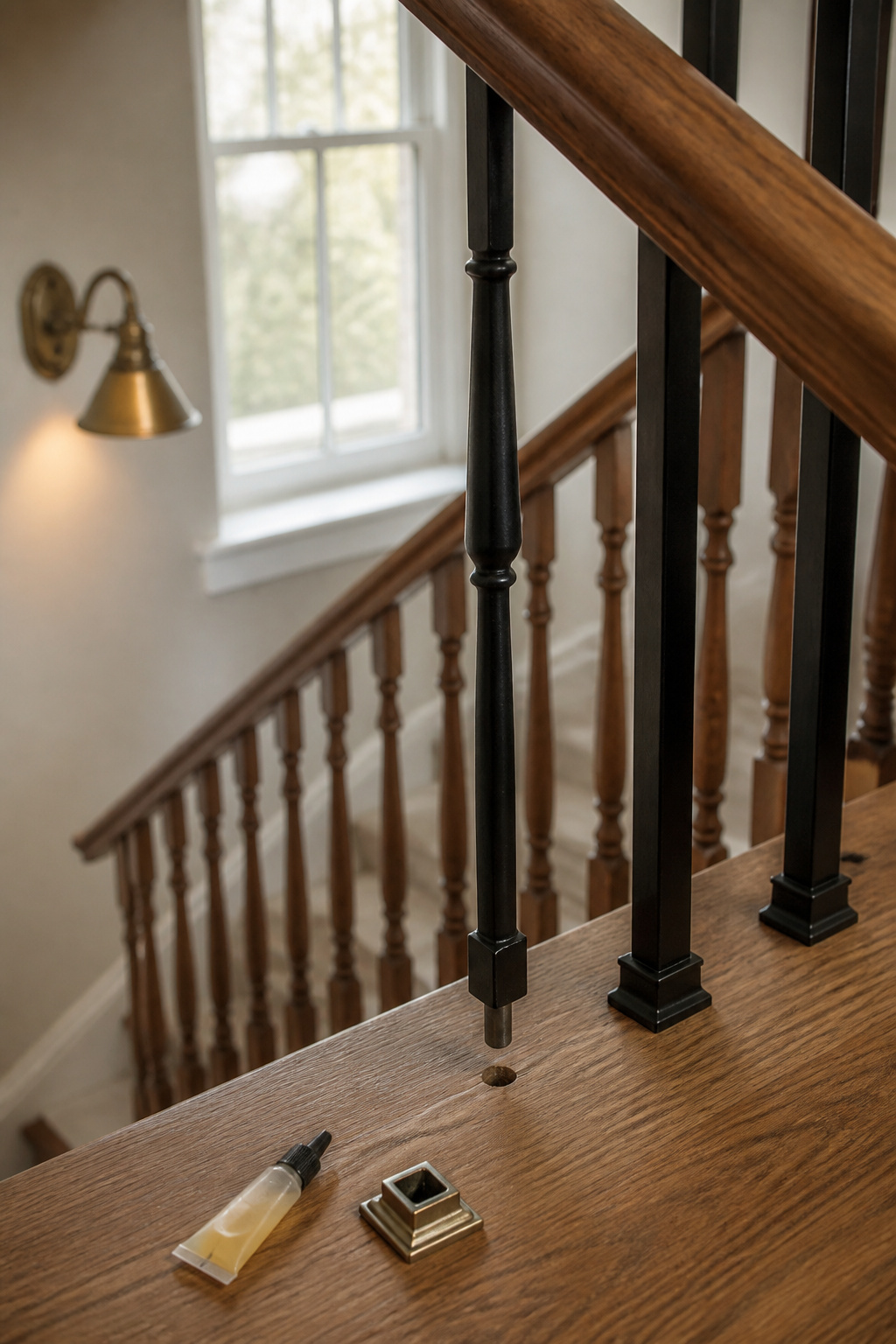
Wood-to-iron baluster swaps and what they change
Iron is durable and low-maintenance; wood costs more per piece but takes stain or paint indefinitely. Powder-coated iron can never be refinished once it’s in. Stair-parts retailers quote $400 to $2,500 or more for a conversion installed. Those are marketing figures rather than a neutral survey, so read it as a rough bracket and not a firm quote. My position, and it is not the popular one: epoxying iron into an old-growth rail is a one-way door. The rail gets bored, the original spindles go in the skip, and nobody who owns the house next can undo either move.
Matching baluster spacing to code
Spacing is not an eye judgment. The IRC sets a maximum 4-inch clear opening on guards, with 4-3/8 inches applying to stair guard infill. No sphere that size may pass through. One exception: R312.1.3 permits a 6-inch sphere in the triangle formed by tread, riser and bottom rail. Borrow those 6 inches for the vertical run and the guard fails inspection.
What the rail itself needs to accept new balusters
The rail must be deep enough to swallow each baluster top before it drops into the tread:
- Drill 1 to 1-1/2 inches up into the handrail’s underside at each position.
- Drill 1/4 to 1/2 inch down into the tread or floor for the lower end.
- Cut each baluster 3/4 inch longer than the vertical distance needed, so it slides up into the rail before dropping into the lower hole.
- Set both ends in non-drip clear epoxy, fit base shoes, and keep the stairs unused for the 24-hour cure.
Measure that underside before buying iron. A shallow rail rules the method out.
Route three: full refinish, when the rail itself needs work
The fastest way to ruin a turned baluster is a heat gun. They run 1,100°F and up: hot enough to vaporize old lead paint, and hot enough that debris lodged in a turning can smolder unnoticed. That account comes from Old House Guy, a restoration blog rather than a standards body. One specialist’s testimony, not a cross-checked figure.
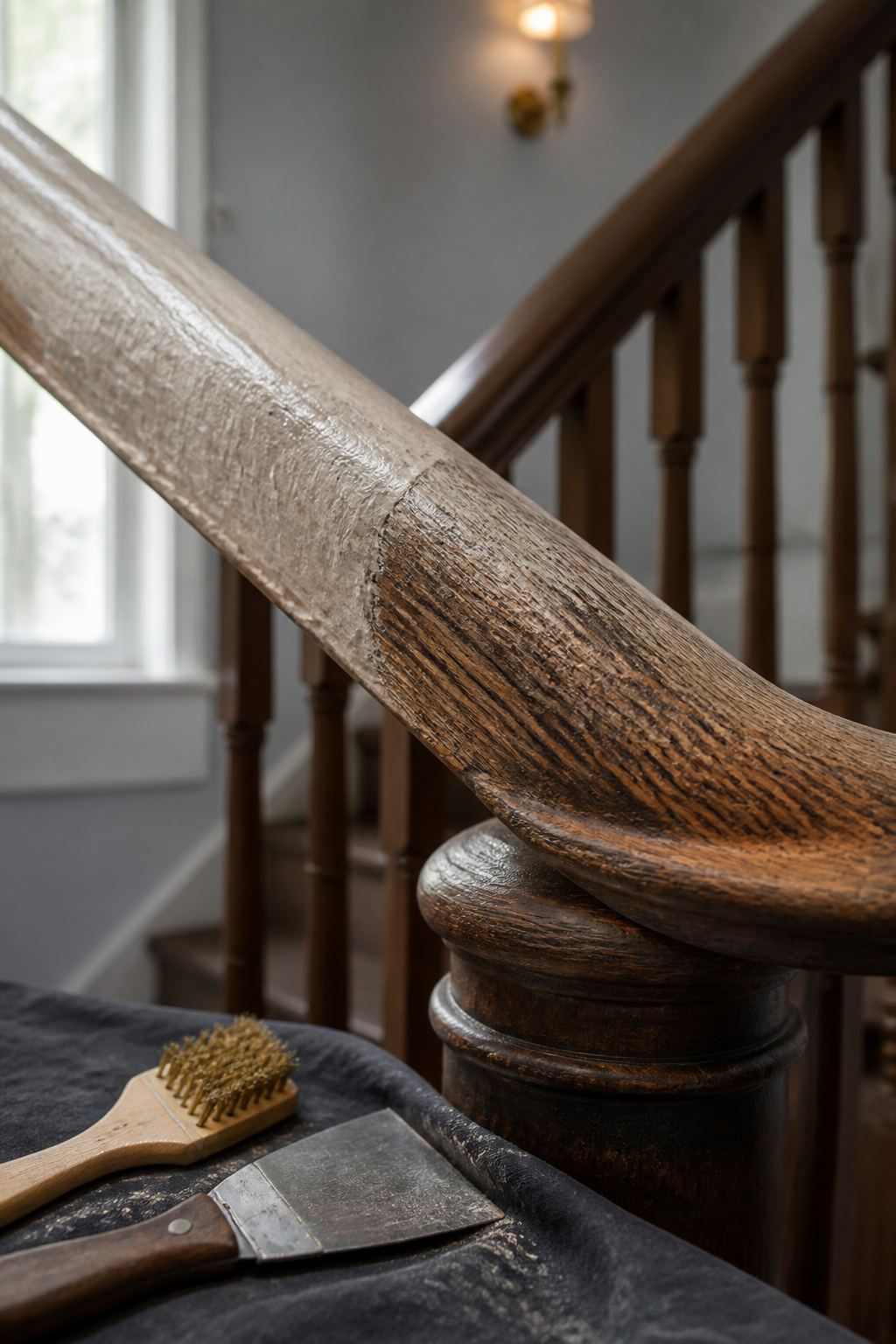
Signs the rail needs stripping and refinishing, not just paint
Alligatored varnish, deep gouges and finish worn to bare wood all point one way: strip back to sound wood first. If what’s underneath is old-growth, the case gets stronger. Fine Homebuilding’s restoration feature states it plainly: where a house has old-growth lumber, choose maintenance over replacement.
Stripping methods that don’t damage old-growth wood
My workshop sits in a converted carriage house, and rescue work fills its benches: rails, balusters and newels pulled from houses about to lose them. The method there is unglamorous. Thick chemical stripper worked in with a brass-bristle brush, then a warm high-phosphate wash, a TSP wash and a vinegar rinse. Brass lifts softened finish out of turnings without gouging old wood the way steel does. Sanding follows, but only the amount you’d use dusting furniture. Heavier sanding takes off the patina it protects. Where heat helps, infrared removers run a gentler 400-600°F and meet EPA Renovation, Repair and Painting rules.
What a full refinish costs in time
Angi’s contractor-sourced figures put professional stair refinishing near $800 on average, across a wide $120 to $3,000 range. Read what that number prices, though. It’s tread-and-riser sanding; Angi’s own guidance excludes banister and baluster work from those figures outright and warns that carved or curved rail detail can double the budget on top. No comparable published bracket exists for rail-only refinishing, so treat $800-plus as a floor for this route, not a quote. Time holds steadier across both jobs: a professional team can sand a straightforward flight in as little as two hours; a homeowner working evenings alone on rail and spindles should expect up to a week. Prep is the largest share.
What’s worth restoring vs what’s fair game to replace
Old wood is better material, and the reasons are physical rather than sentimental.
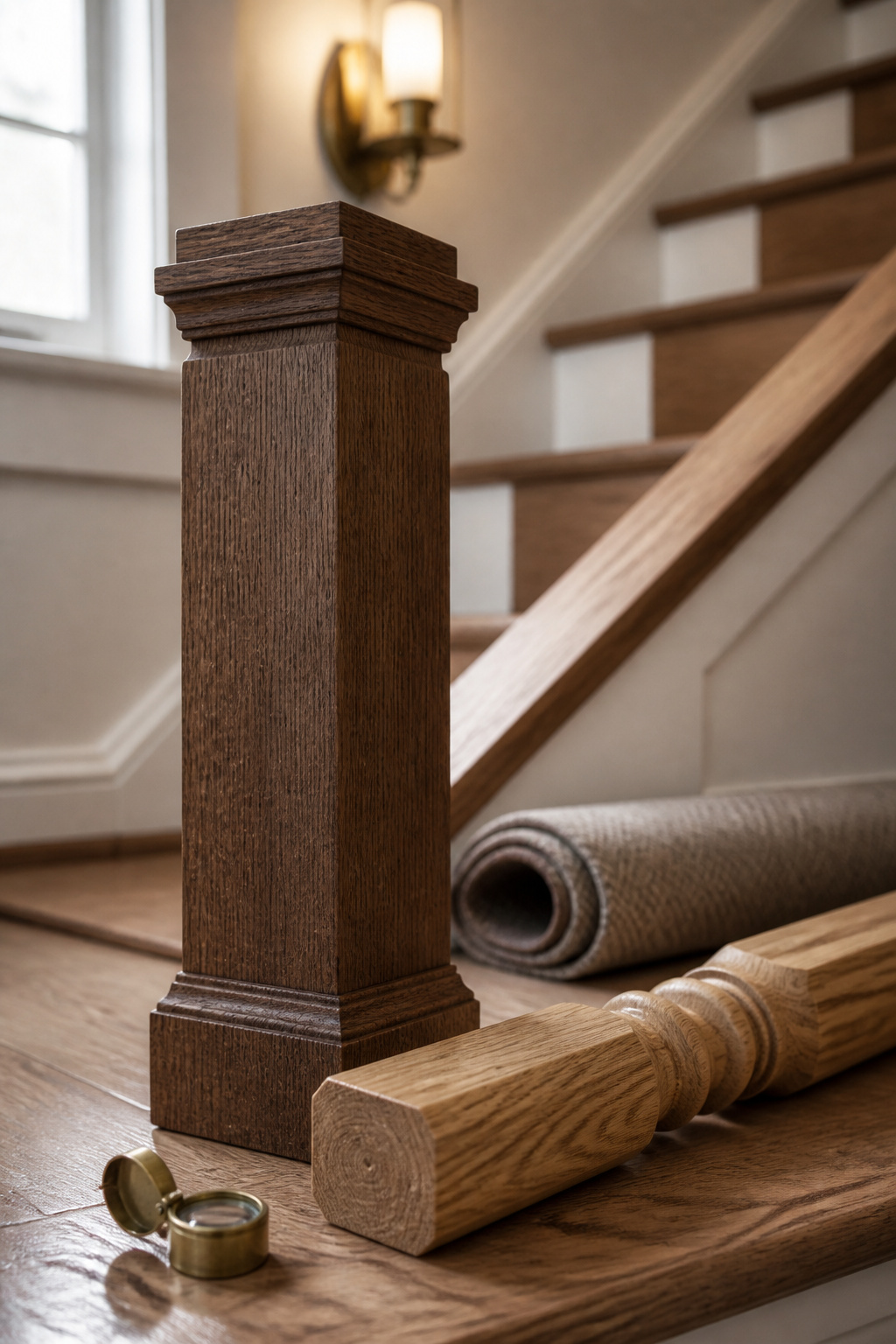
Hand-cut joinery and old-growth grain: what earns restoration
Slow growth produced tight rings with more dense latewood, so old-growth stock is stronger under load and more dimensionally stable. It also carries more heartwood, the decay-resistant core a tree lays down as it ages. Managed-forest timber is largely juvenile wood, which warps and checks. Add hand-cut joinery and the railing is worth the labor.
Builder-grade rails where replacement wins
Honey oak, curved spindles with knobs, a pony wall: none of it carries restoration value. Wholesale replacement isn’t the answer either, since a full staircase swap runs around $25,000. So the practical move is smaller: paint the spindles white and keep the wood handrail, or change the balusters alone.
Deciding for a house that isn’t obviously period
Most houses aren’t obviously anything. When the architecture won’t tell you, the wood will: tight-grained, heavy stock earns the labor without a pedigree, soft wide-grained lumber doesn’t. Mixed rails get mixed answers. An old-growth newel above a replaced baluster run is two decisions: restore the post, swap the spindles.
Coordinating your stair railing makeover with the rest of the stairs
Stand at the bottom and photograph the flight on your phone. On a small screen the rail, the treads and the wall collapse into one surface, roughly how a visitor sees them.
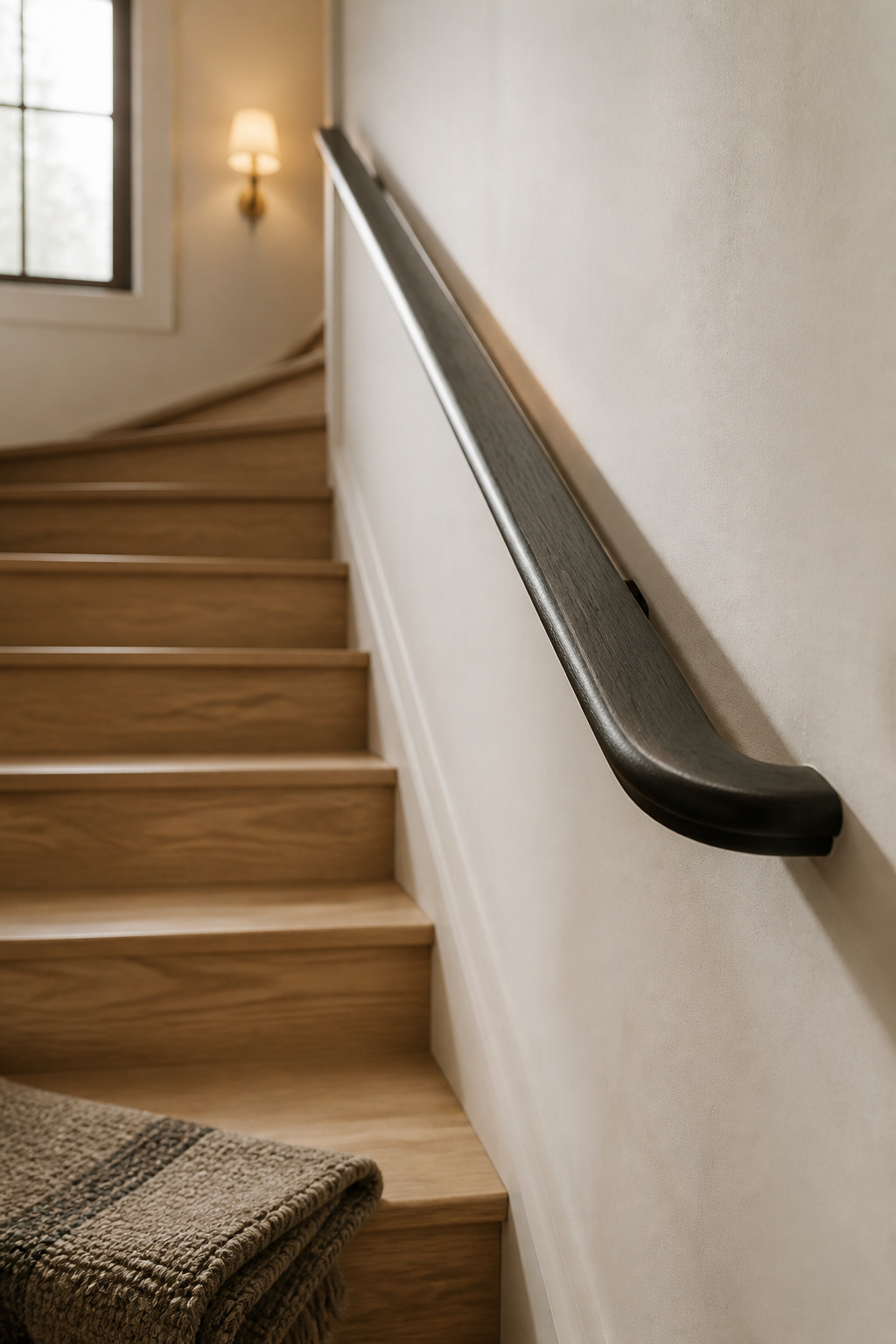
Matching railing tone to painted treads and risers
Wood carries a warm or cool undertone, and keeping every stair component in one temperature family is the biggest lever you have. Three approaches hold up: monochromatic, complementary (the rail a shade darker for definition), or deliberate contrast where the stair is the focal point. Undertones bite when ignored. Farrow & Ball’s Railings No. 31, the near-black most banisters end up wearing, has an LRV near 28.4 and a blue cast that shifts navy under cool light. So settle coordinating painted treads and risers first.
Where the railing meets the stairwell wall
Where a handrail is wall-mounted, the IRC requires at least 1-1/2 inches of clearance, about the room a hand needs to wrap the grip. The aesthetic half of that junction is my call rather than a published rule: a rail’s finish and the wall behind it work as one system in every stairwell I’ve stood in. So plan finishing the stairwell walls with the rail’s tone decided.
Sequencing this project against other stair work
Assess before buying anything: treads, floors and rail together. Then sequence by surface area: lock tread and riser color first, choose the railing finish against it, and leave the wall last so it reacts to both. If the railing is one job among several, staircase makeover ideas for every budget sets the order for the rest.
Let the rail decide the route
Read first, commit second. Five minutes at the newel post tells you whether you’re holding old-growth with hand-cut joinery or a 1990s replacement, and that answer sorts the routes. Paint when the wood is sound and disruption is what you’re minimizing. Swap balusters when the rail is fine and the spindles date the house. Strip and refinish only when the finish has failed to bare wood and the wood is worth the week. What I’d avoid: heat guns on turnings, epoxy in an original rail, and any route chosen before the read. You’re the current steward of a railing that will outlast your ownership, so leave the next owner something they can undo.
FAQ
Can you paint over a stained wood railing?
Yes, provided the existing varnish is intact and not peeling. Apply liquid-sandpaper deglosser twice in circular motions, then wash with TSP to lift hand oils before priming. That degreasing step prevents peeling at the grip zone. Finish with two coats of bonding primer-and-paint in satin, drying overnight between them.
How much does it cost to replace stair balusters?
Stair-parts retailers quote $400 to $2,500 or more for a full wood-to-iron conversion covering removal, materials and professional installation, with baluster count, iron type and finish quality driving the spread. Installed railing more broadly runs $20-$60 per linear foot in wood and $50-$250 in metal.
Are iron balusters worth the upgrade over wood?
It depends on how often you expect to change the finish. Iron is cheaper per piece, more durable and needs minimal upkeep, but powder-coated iron cannot be repainted or restained once installed. Wood costs more and asks for maintenance, yet takes new color indefinitely. That makes wood the flexible choice for an evolving house.