
Everyone knows stacked machines shake more. Consumer Reports put that on a lab bench and found otherwise: stacking a matched pair barely changed measured vibration versus running the washer alone. So when you’re chasing washer dryer vibration in a stack, the stack is rarely the culprit. Level, load, hardware and floor are the places to look: six causes, six symptoms, and the fix for one does nothing for the other five.
TL;DR
- A shaking stack is not automatically a broken stack. Consumer Reports found vibration peaks at the start and end of the spin cycle even on correctly installed machines.
- Run the free checks first: level, then load. LG puts best balance at roughly two-thirds of drum capacity.
- Pads are the internet’s favourite fix, and Consumer Reports found they “didn’t cut vibration by much.” Worth $20 to $45 as a try; a resonating timber floor needs stiffening instead.
A shaking stack doesn’t mean it’s broken
Why a stacked pair shakes more than the same machines side by side
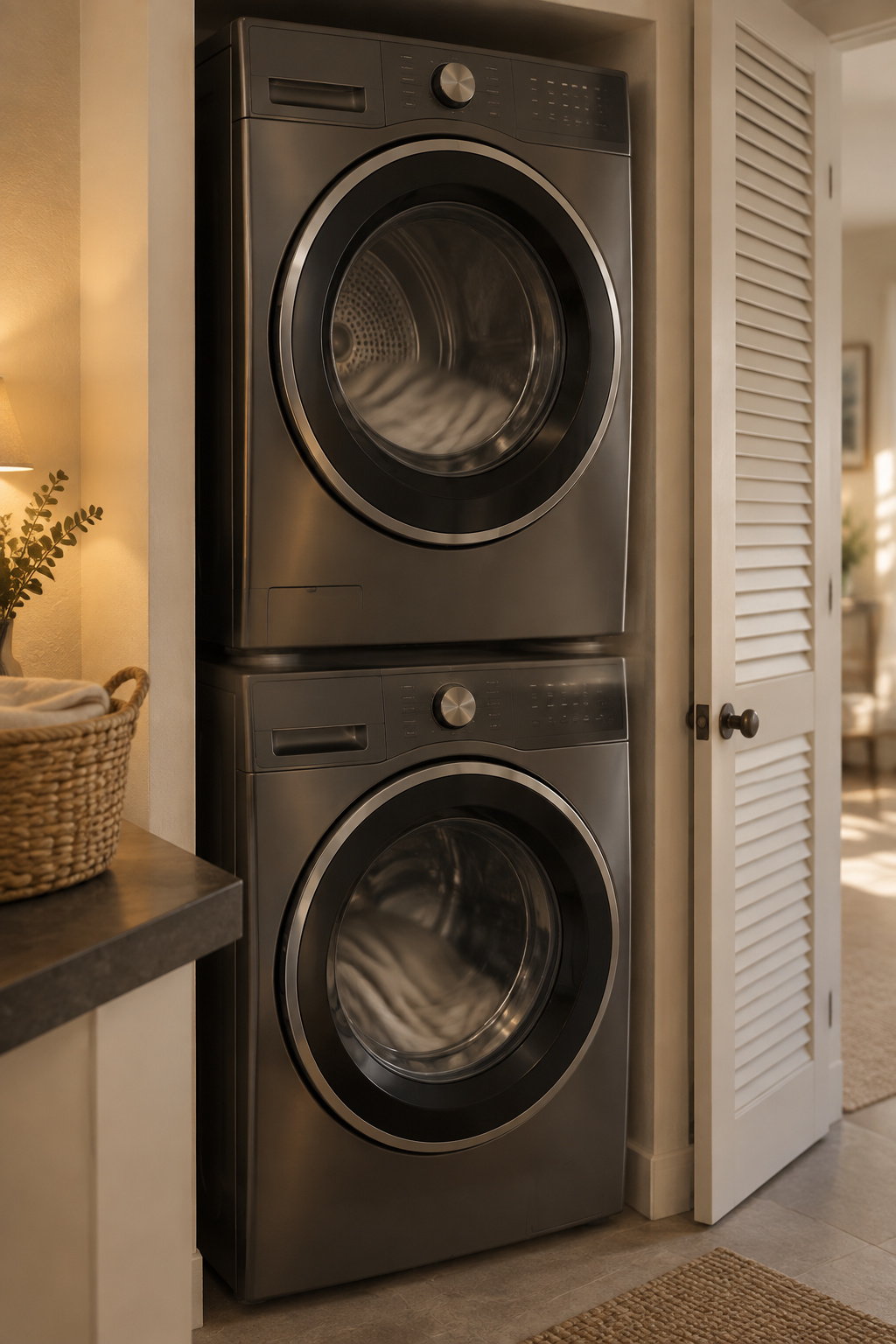
Front-loaders vibrate by design: high spin speeds, a tub rotation closer to a dryer’s. Why a stack feels worse is reasoning, not a lab result: 270 to 370 pounds held higher, one route out through the bracket rather than two footprints.
The myth: vibration always means a failing machine
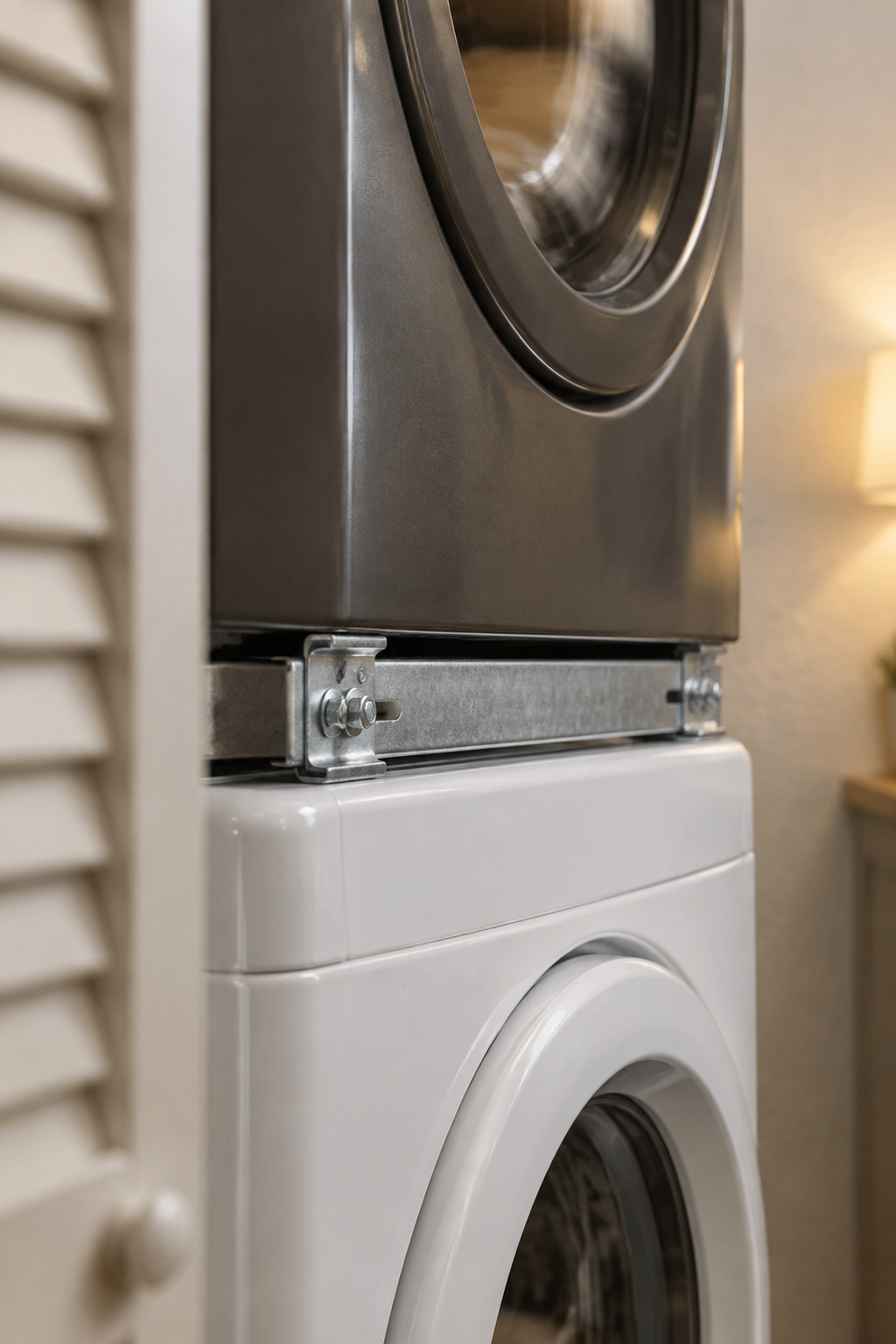
Usually something is off, not broken. Whirlpool says an unlevel front-load washer leads to excessive vibration, noise and damage over time. And some movement is the machine working: vibration peaks at the start and end of the spin, as the drum runs up through its resonant speed and back.
This is about the machine and the stack, not the room next door
One boundary up front, because it saves people redoing correct work. Below is vibration where it starts: appliances, bracket, feet, floor. A hum carrying through a bedroom wall is room-level acoustics. Our upstairs laundry room series covers it under laundry room soundproofing. Rocking, walking and banging belong here.
Six places washer dryer vibration comes from
Symptom, likely axis, and next step
Read your symptom, not the internet’s.
| What you feel | Likely axis | Next step |
|---|---|---|
| Rocking; clunk at spin start and end | 1–2: level, bolts, bracket | Level, then hardware |
| Comes and goes load to load | 3: load balance | Redistribute or use the bulky cycle |
| Low hum through the floor, worse upstairs | 4–5: feet, floor stiffness | Pads; brace the floor if it survives |
| Worse than it was at move-in | 6: bracket loose or sheared | The five-minute bracket check |
Why matching the symptom to the right axis saves you from guessing
Because the popular fix suits one row of it. A pad treats vibration leaving through the feet, and does nothing for a washer out of level, a comforter balled on one side, or a screw that has walked loose.
How to use this table before you buy anything
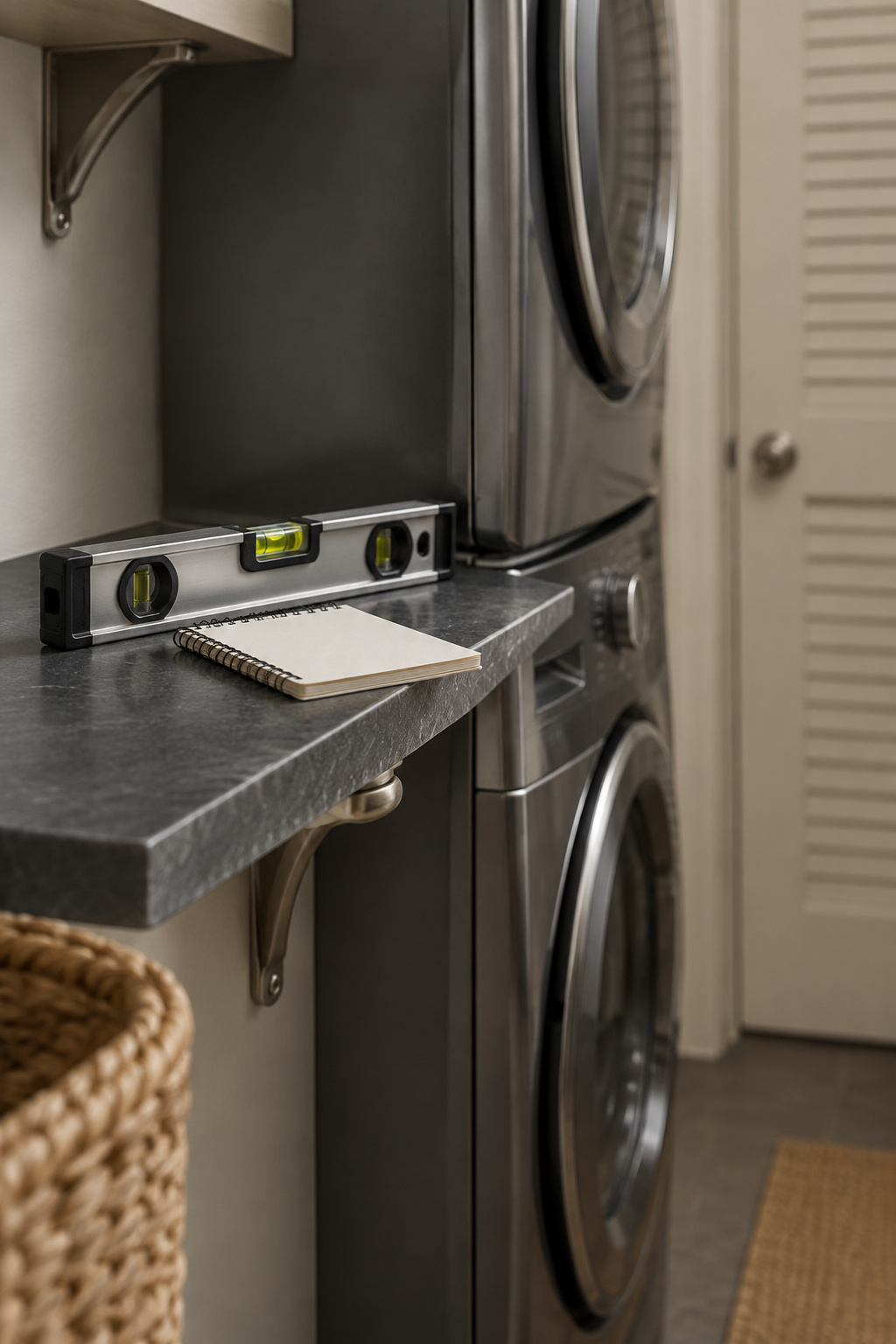
Cost-order it. Level and load are free; four pads run $20 to $45; floor bracing is carpentry. In that order, you never buy floor work for a machine that needed a quarter-turn on one foot.
Axis 1–2: an unlevel base or a bad bolt or bracket
Symptom: rhythmic rocking mid-spin, or a bang at cycle start and end
Put a flat hand on the dryer during a spin. A steady low buzz is normal. A rock you can feel in a beat, or a clunk as the cycle winds up and back down, points here.
Cause: levelled too late, bolts left in, or a bracket never properly set
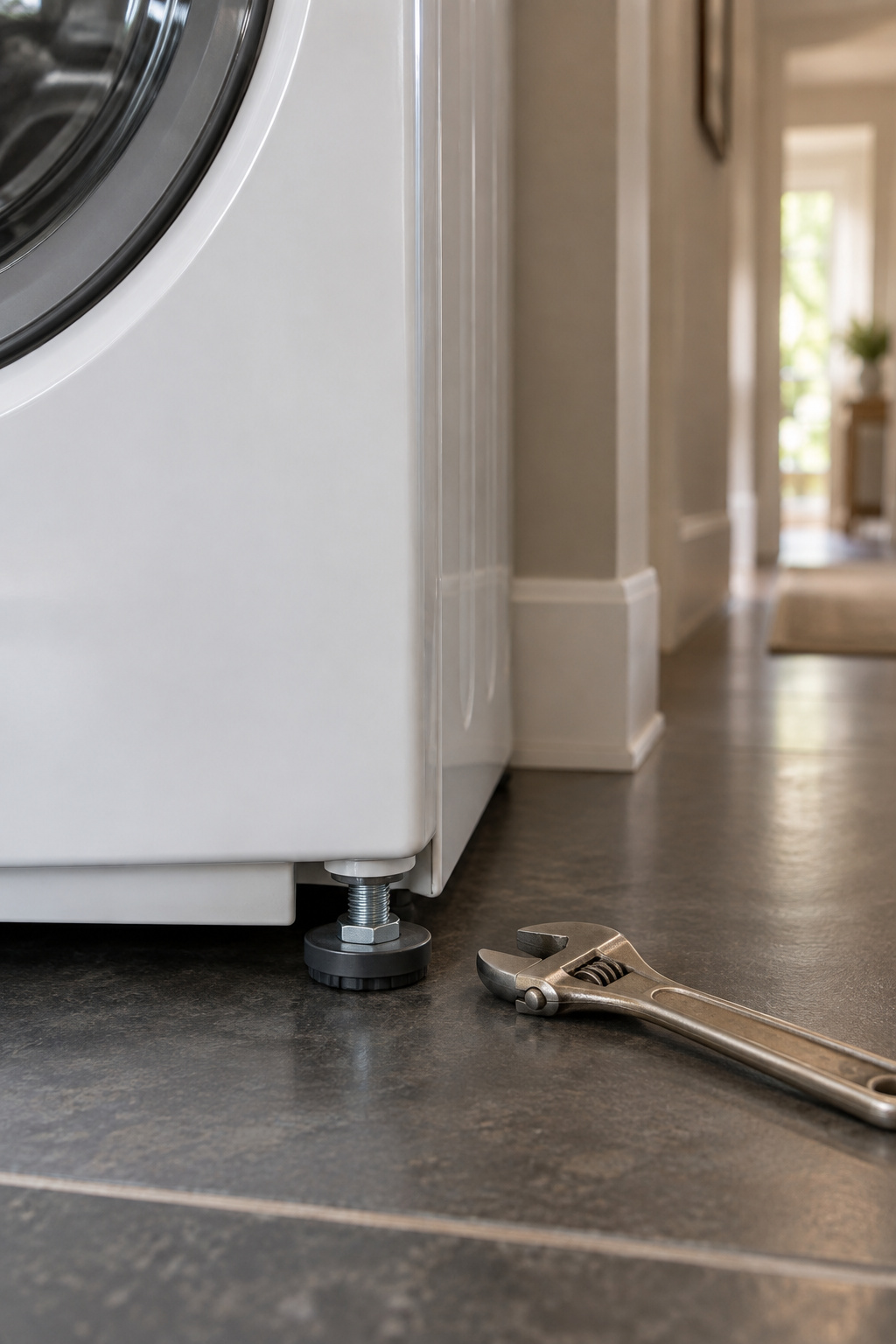
Three versions of one story. Whirlpool’s sequence puts “place your washer and check levelness” before the dryer’s feet are even swapped, so a pair levelled afterwards was levelled in the wrong order. Shipping bolts lock the drum’s suspension for transport; left in, the washer runs locked out and drives that shake up the bracket. And GE caps its own stacking screws at 18 in-lbs. Exceed it, strip the screw, and you build tomorrow’s vibration.
Fix: diagnose here, then use the how-to
Re-levelling a stacked pair means taking the top machine off: two people, not one. Diagnose here, then work from how the stack was installed rather than improvising against something that outweighs you.
Axis 3: load balance and cycle behaviour
Symptom: vibration that comes and goes load to load
Every cycle, or only some? Installation and floor causes are constant. Imbalance is intermittent: fine on Tuesday’s towels, brutal on Saturday’s duvet.
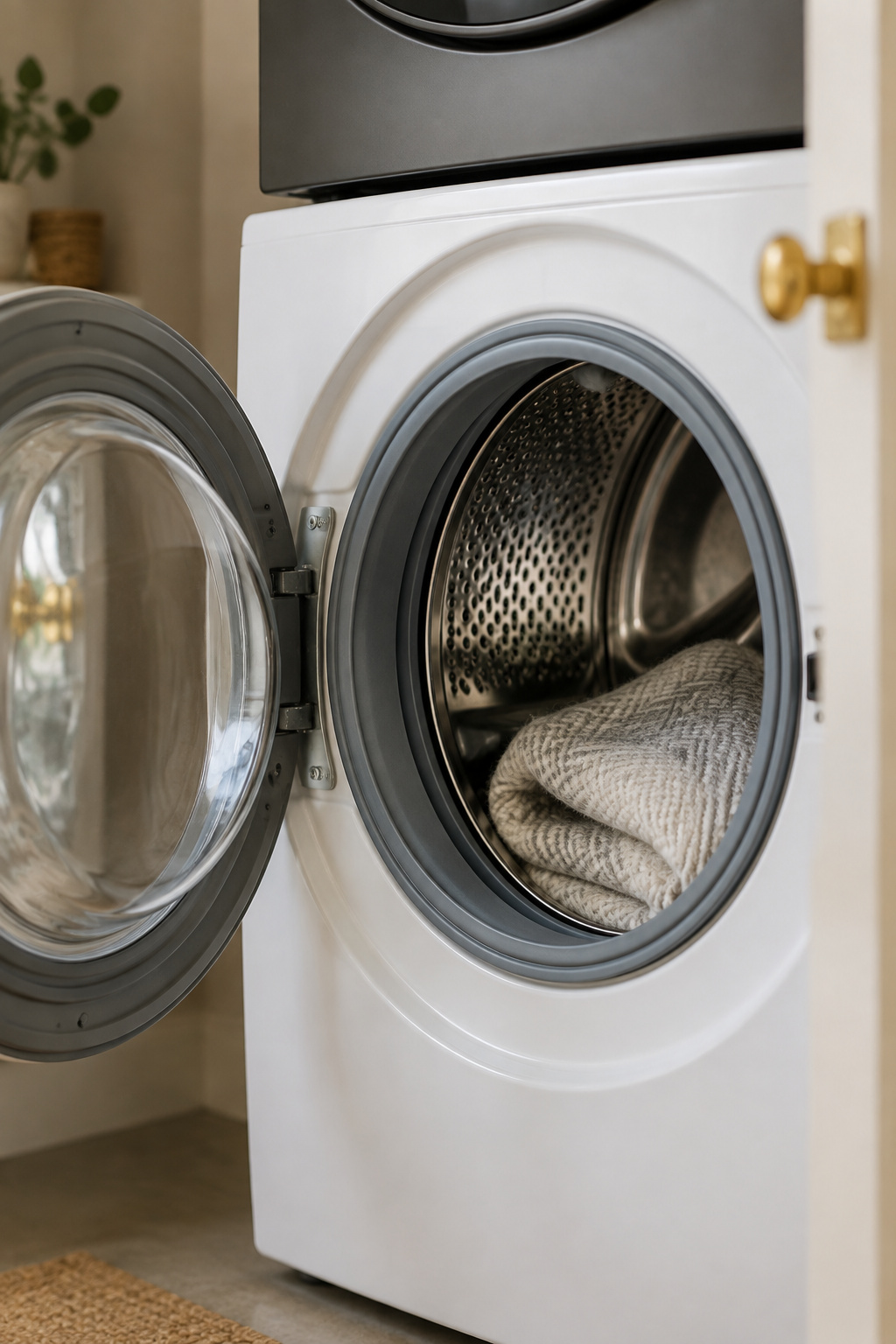
Cause: uneven or oversized loads, especially bulky single items
LG describes its UE error as laundry piling on one side of the drum despite the drum’s attempts to redistribute it. Both extremes trigger it. One comforter, one weighted rug, one padded coat: a heavy mass swinging instead of laundry spread around the wall.
Fix: the loading habit that solves most of this for free
Load to about two-thirds of drum capacity, LG’s own figure. Pad a bulky item with towels, or use the bulky cycle. On an imbalance error, pause and redistribute by hand. Forcing a restart asks the bracket to absorb what the drum couldn’t.
Axis 4–5: anti-vibration pads, mats and floor stiffness
Symptom: low-frequency hum through the floor, worse upstairs or over a joist span
Felt through your feet a room away rather than heard, and worse on wood framing than concrete. In one published structural-engineering case study of timber-framed apartments, the floor cassettes and the spin cycle both measured 15 to 18 Hz. The floor wasn’t weak. It was in tune with the machine.
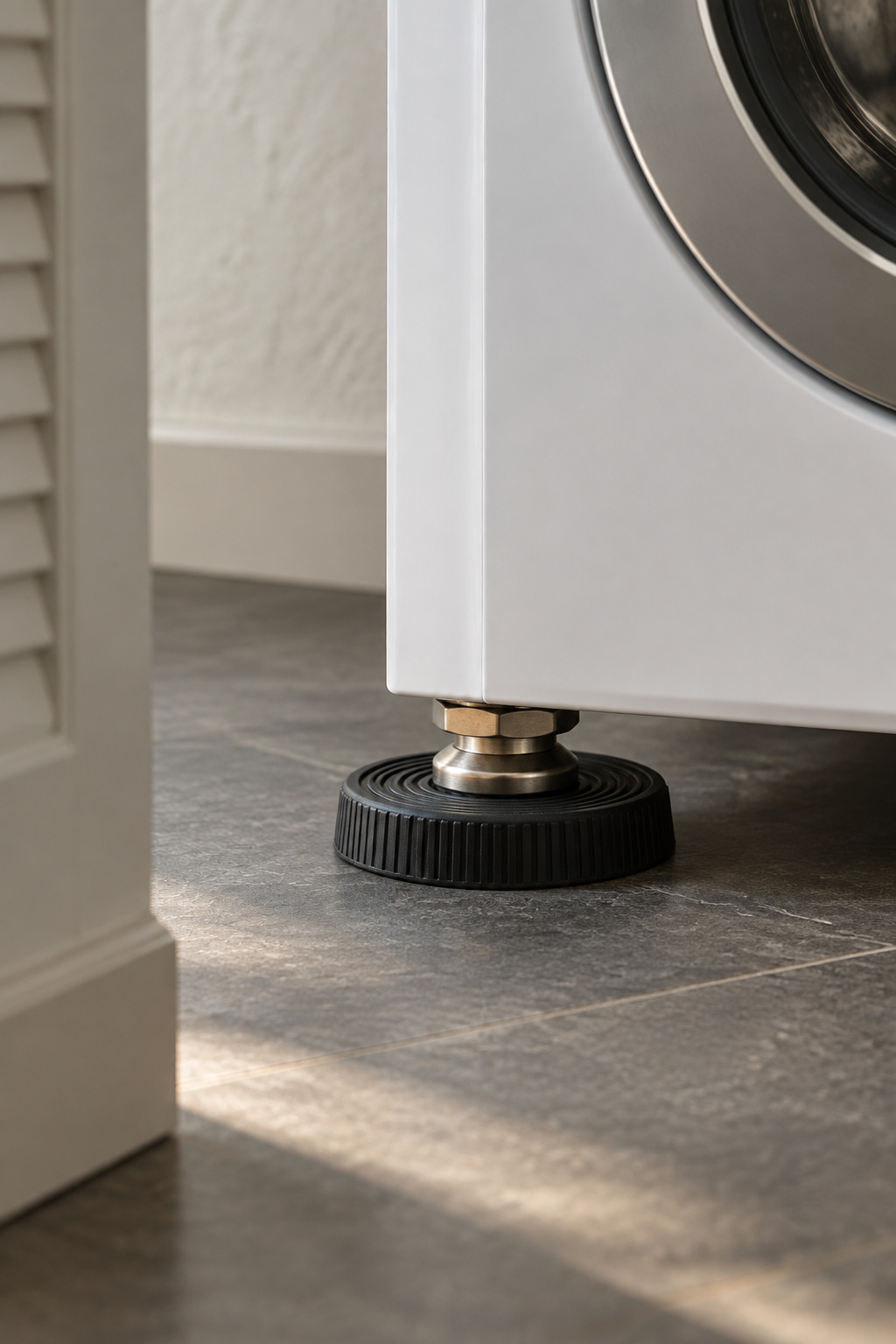
What pads do and don’t fix
This is the part that annoys anyone with pads already in a cart. Consumer Reports’ own lab testing found anti-vibration pads “didn’t cut vibration by much.” The most-recommended fix on the internet, tested, underperforming. Not useless: cheap, reversible, and aimed at foot-level transfer. Still no answer to a resonating floor, and none to level, load or hardware.
I built my first piece of furniture at twenty-two, from two sheets of plywood. It’s still in my garage: dented, ugly, load-bearing. What kept it alive wasn’t the joinery. It sat dead flat and didn’t move when I leaned on it. Ugly-strong beats pretty-weak. The pad under a foot matters far less than whether what it stands on is solid.
Buying the right pad, and when the fix is bracing the floor instead
Four pads isolate at four points; a mat 24 by 24 inches or larger works across the whole base. If the hum survives level, bolts, bracket, load and pads, stop shopping. In that same case study, stiffening the floor (blocking between joists plus a rigid diaphragm board fixed under them) cut transmitted vibration by 65%. A carpentry number, not a pad number.
Axis 6: the bracket check most owners never run
Symptom: vibration that’s gotten worse since move-in day
Worse over time is the tell. Present from day one means installation; quiet for two years and noisy now means something changed condition: hardware loosened, or a floor settled.
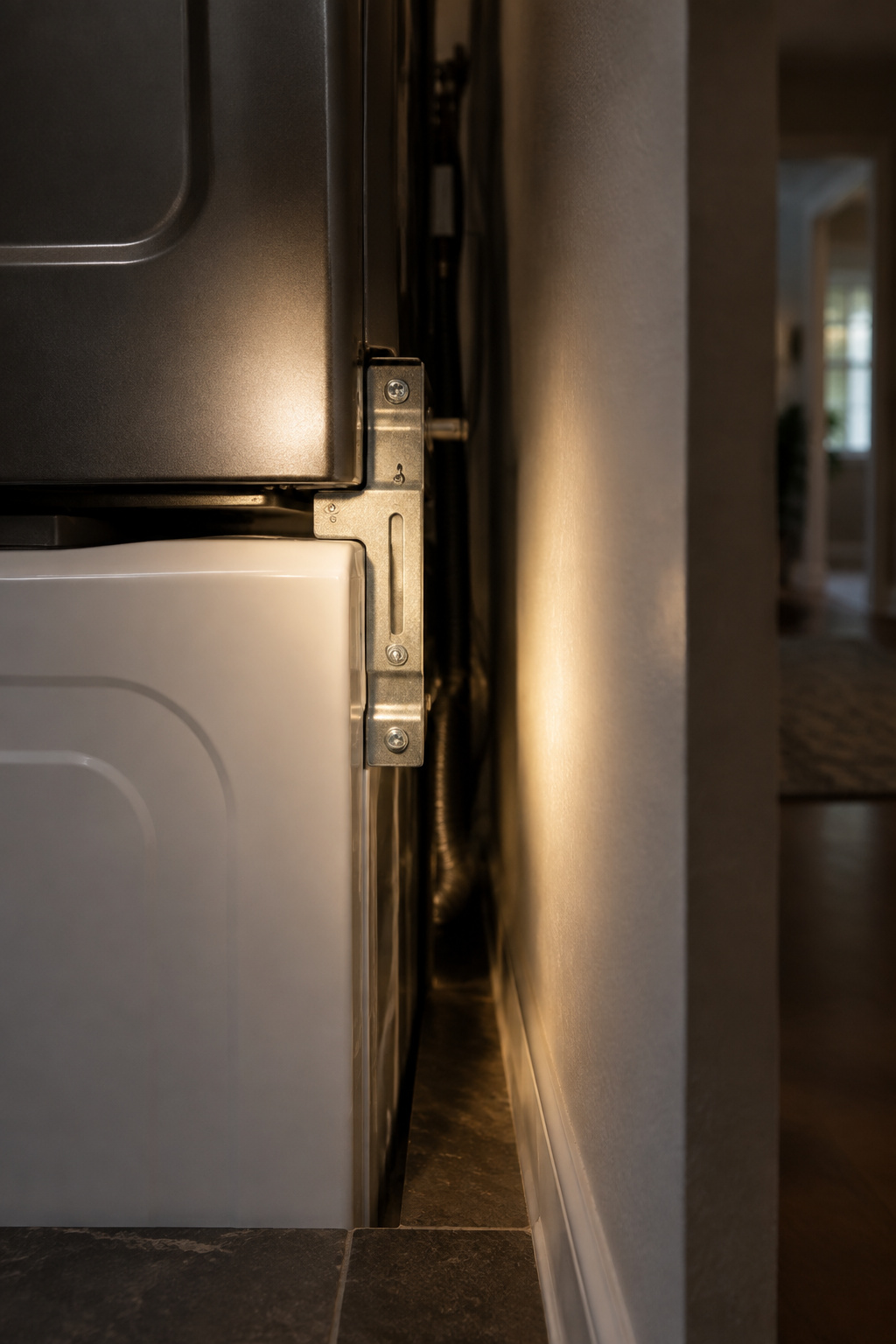
Cause: a bracket that’s sheared or backed off with use
Plain fatigue. Every unbalanced spin loads the bracket the same direction, and fasteners snug at install slacken a fraction at a time. With play in it, the bracket stops being a rigid tie and starts being a hinge. Techs pulling dryers off washers do find brackets sheared through, the dryer resting on gravity alone. Bosch is blunt: without a proper bracket, the dryer walks off the washer during spin.
Fix: rule it in or out here, run the check over there
Bracket failure is one of six causes on this list, not a project to start from this article. Our guide to stacking a washer and dryer safely walks through the actual check: what a healthy bracket looks like, how much play means trouble, and when a marked bracket gets replaced instead of retightened. Come here to decide whether the bracket is your axis; go there to do something about it.
When the room is the problem, not the stack
The difference between machine vibration and room-level noise transfer
All six axes describe vibration at its source. Whether it becomes sound next door depends on wall construction and adjacency, a separate question entirely.
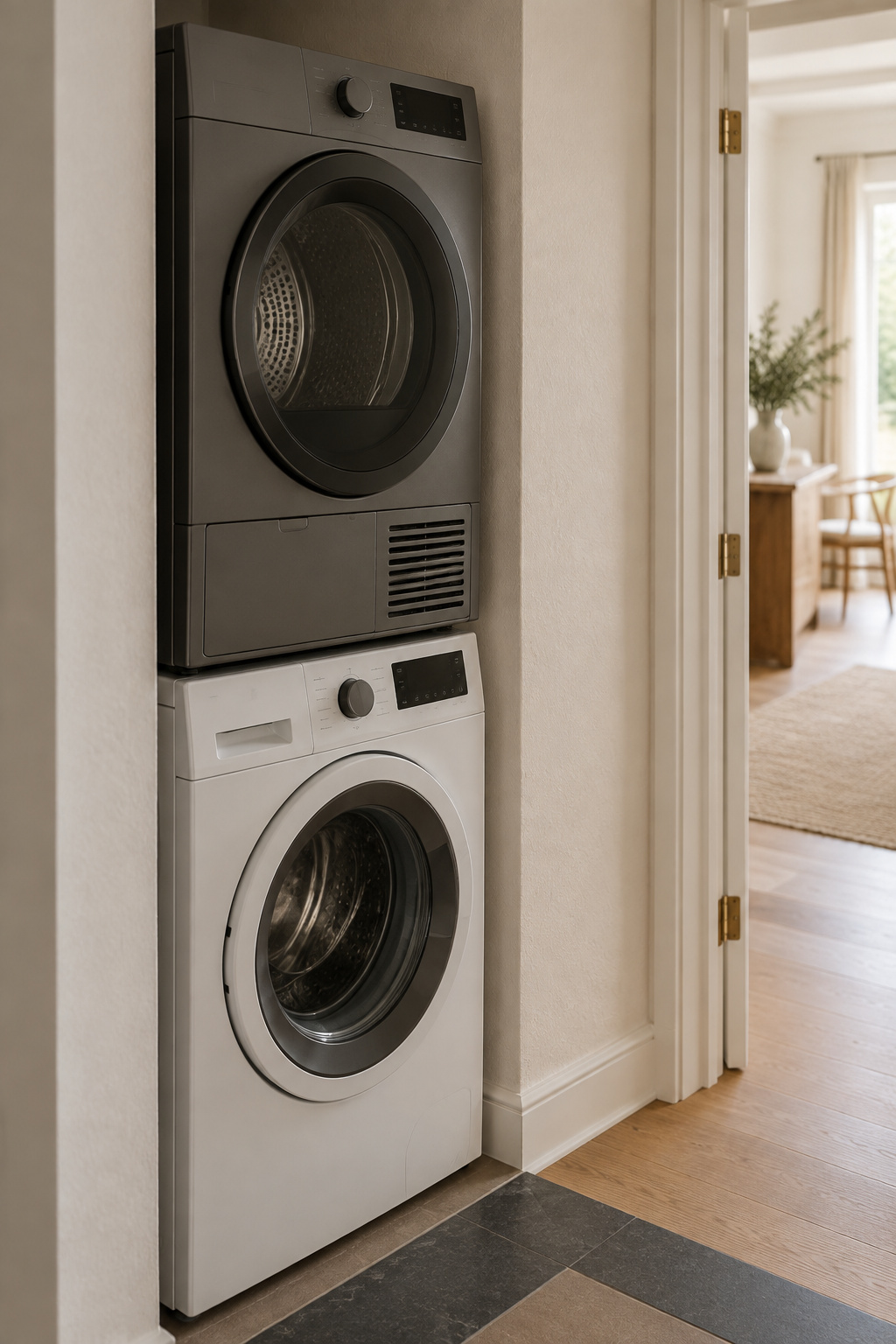
Why this stops at the machine and the floor beneath it
Fix all six and a stack goes from visibly shaking to essentially still. That’s the ceiling: a balanced, floor-braced pair can still be audible through an untreated wall, and re-levelling won’t change it.
A stack against a shared wall needs this thinking early
So layout deserves a thought before anything gets bolted together. A stack sharing a bedroom wall, or tucked into laundry in a bathroom beside a room meant for rest, wants acoustic planning at the drawing stage. Settle it while you’re still planning a stacked washer and dryer.
Start tonight, for free. Run a load, hand on the dryer top, and note whether the shake is constant, intermittent, or worst at the ends of the spin. Tomorrow, put a level across the washer both ways. Those two observations land you on one of six axes, which is the difference between a quarter-turn on a foot and a pad that was never going to help.
FAQ
Is it normal for a stacked washer and dryer to move during the spin cycle?
Some movement is normal, especially at the start and end of the spin. Consumer Reports found vibration peaks there even on correctly installed machines. Sustained rocking, walking across the floor, or a bang mid-cycle is not normal, and usually traces back to a washer that isn’t level.
Can a stacked washer and dryer fall over from vibration?
The dryer can shift or walk off the washer during a high-speed spin if the stacking bracket was never fitted, was fitted wrongly, or has since failed. Bosch describes that outcome directly, including damage and injury. A correctly installed, periodically checked bracket prevents it.
Do all stacked washer and dryer pairs need anti-vibration pads?
No. A level, properly bolted, well-loaded stack on a stiff floor often needs none. Pads address vibration transmitting through the feet, not installation or balance faults, and Consumer Reports found they didn’t cut vibration by much. Worth trying, never the first fix.