Most people shopping for an apartment size washer and dryer are measuring a wall, but the number that decides the purchase is printed on a plate behind the machine, and almost nobody checks it first. Many compact dryers run on the same 120-volt outlet as a table lamp; a full-size electric dryer wants a dedicated 240-volt circuit most apartments were never wired for. So power comes first here, then capacity, then what a week of laundry looks like on a smaller drum.
TL;DR
- Miele’s TXR 860 WP sheet lists 120V, 15 amps; GE’s compact dryer, 15-20 amps. Full-size electric wants a dedicated 240V, 30A circuit, and Bosch’s compact dryers are the 220/240V exception, so check your model.
- A compact pair is shorter and shallower than a full-size stack, often by enough to turn a marginal closet into a workable one.
- The cost is drum size: 2.2-2.4 cu ft washers against 4.0-5.0, and a king comforter needs around 5.0.
The detail most buyers miss: power
Why many compact and combo dryers run on a standard 120V circuit
Miele’s spec sheet for the TXR 860 WP heat-pump dryer lists 120V, 15 amps, on a NEMA 5-15 plug, the same plug your kettle uses. GE’s 24-inch compact dryer asks for 120 volts, 15 or 20 amps, three-prong.
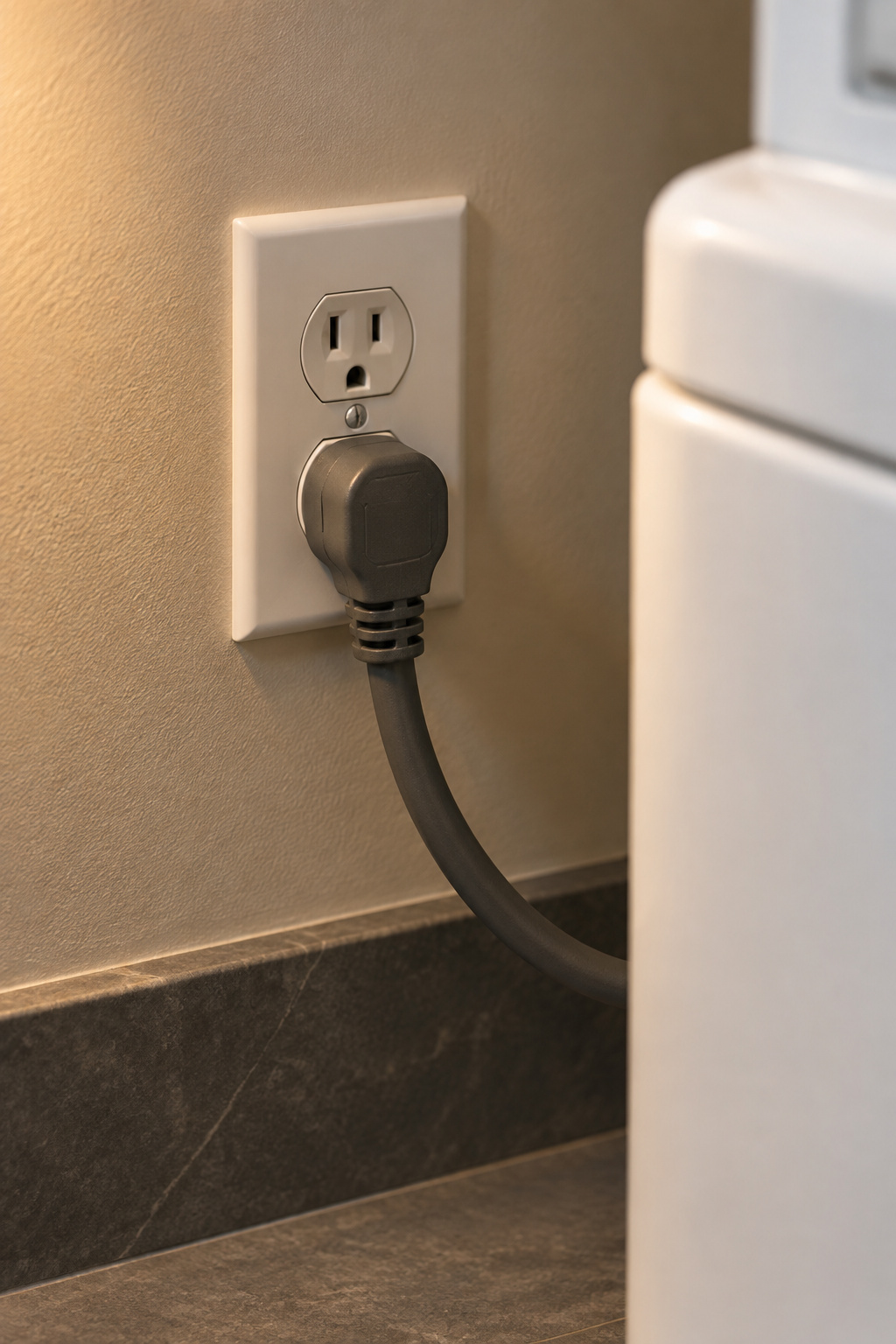
But compact does not automatically mean 120V. Bosch’s compact heat-pump and condensation dryers take 220/240V, and the washer plugs into the dryer to share that supply. Check the specific model every time.
What a full-size electric dryer’s 240V requirement rules out
A full-size electric dryer needs a dedicated 240-volt, 30-amp circuit on a NEMA 14-30 plug. A closet or hallway in an apartment rarely has one, and adding one means hiring an electrician, usually pulling a permit depending on where you live, and in a shared building, asking a board or landlord.
Checking your building’s circuit before you shop
Look at the outlet in the room you have in mind. An ordinary three-prong socket runs a 120V compact dryer with no electrical work; a large round or block-shaped one means 240V is already there. Check amperage too: a tired 15-amp circuit can trip under load.
What an apartment size washer and dryer is: the 24-inch class
What defines a 24-inch, European-size pair
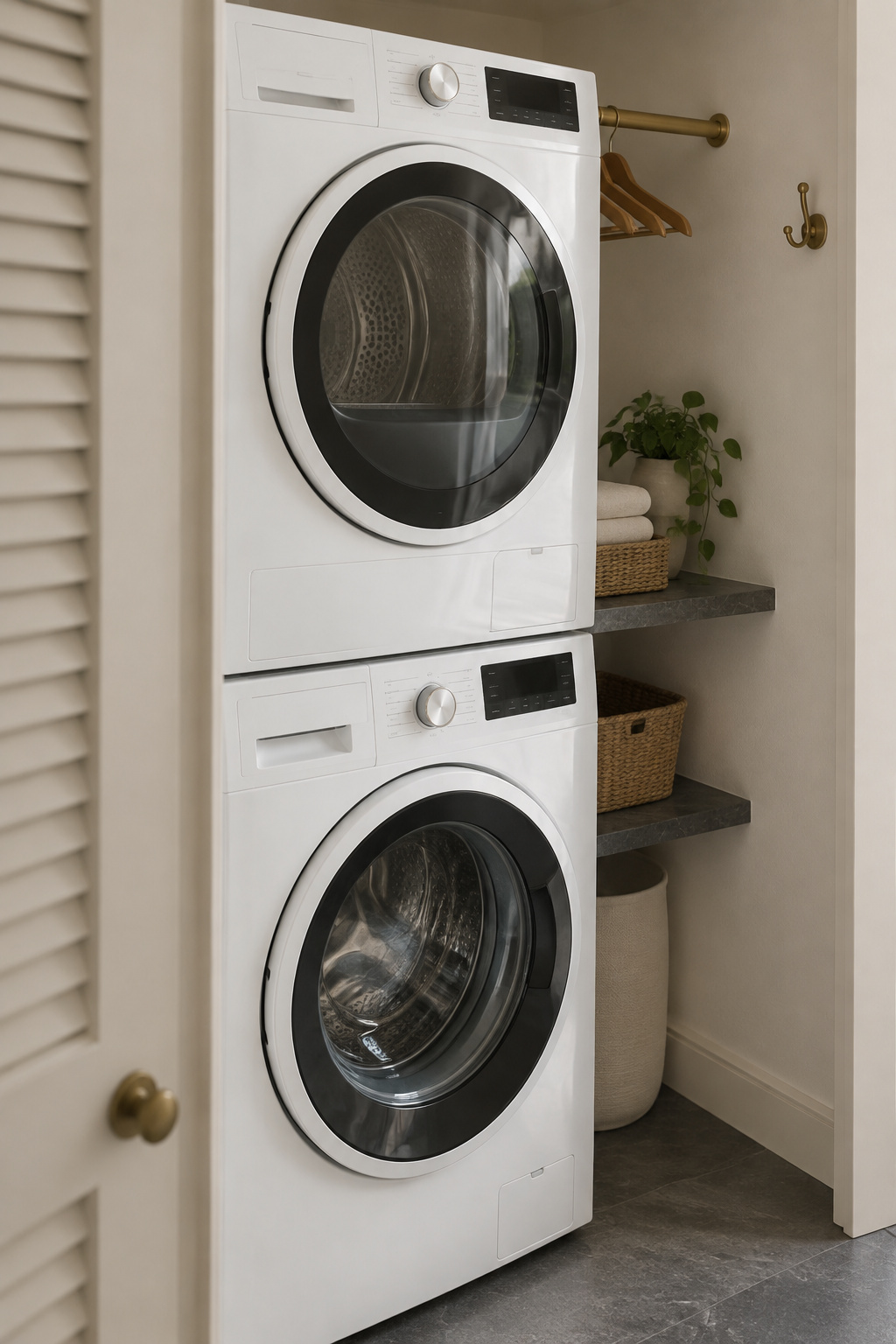
A compact pair is twenty-four inches wide, 24 to 26 deep, and roughly 66 to 76 tall when stacked. Inside, the washer holds 2.2 to 2.4 cu ft and the dryer 4.0 to 4.3, and those figures are consistent across brands. The format is European: small apartments and costly electricity made efficient drums normal there decades earlier.
The brands merchandising this as a distinct category
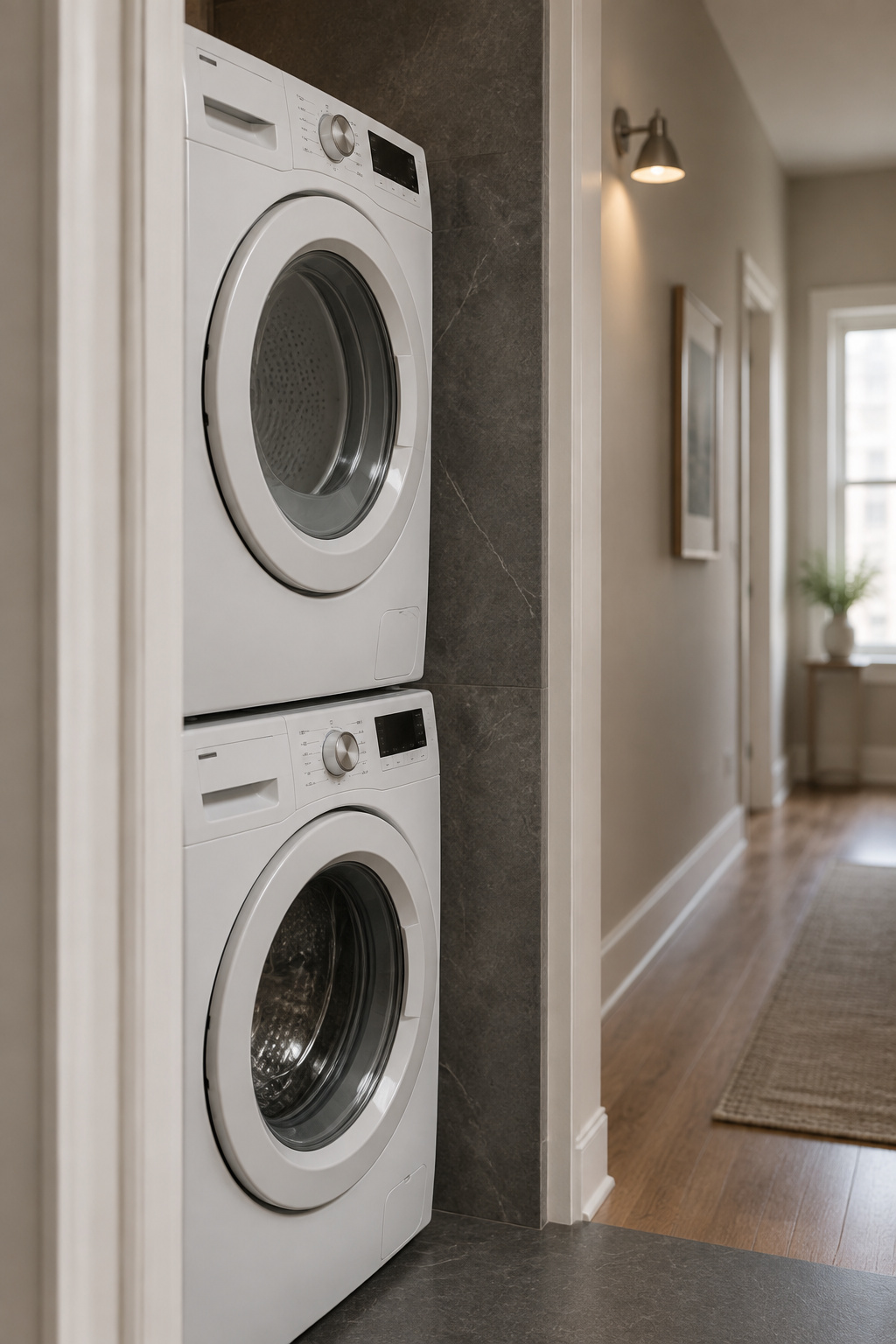
Miele, Bosch, LG and GE all publish dedicated 24-inch lines for apartments and condos, and Midea arrived recently with a ventless all-in-one priced below the European names. Samsung and Electrolux sell here too; availability varies by region.
Where compact stops and full-size starts
Width draws the line: 24 inches is compact and 27 is full-size. Those four inches compound into depth and height, so a room can clear one class and fail the other.
What you give up in capacity
Load size in real terms: how many towels, how many bedsheets
Maytag’s capacity chart puts a compact washer’s range at fewer than nine bath towels a load: one or two baskets, enough for one or two people.
| Compact (24 in) | Full-size (27 in) | |
|---|---|---|
| Washer | 2.2-2.4 cu ft | 4.0-5.0 cu ft |
| Dryer | 4.0-4.3 cu ft | 7-9 cu ft |
The washer row is the one to read. A compact drum holds about half of a full-size one, and that is the whole trade.
What more frequent, smaller loads mean for your week
A couple’s laundry runs three to four loads a week. A compact drum absorbs that by running slightly more often. That’s a normal rhythm for a smaller machine, and it doesn’t strain it.
Where capacity matters and where it doesn’t
A washer should run half to three-quarters full so clothes can move, which puts usable capacity under the rated figure. With everyday clothing you’ll barely notice; with bulky items it decides everything. A king comforter needs roughly 5.0 cu ft, more than any 24-inch washer offers, so that load leaves home for good.
What you gain in placement freedom
Rooms a 24-inch pair opens up that 27-inch never could
The eight to fourteen inches of height and six to eight of depth a compact stack saves decide whether a shallow corridor cupboard is a candidate or a fantasy.
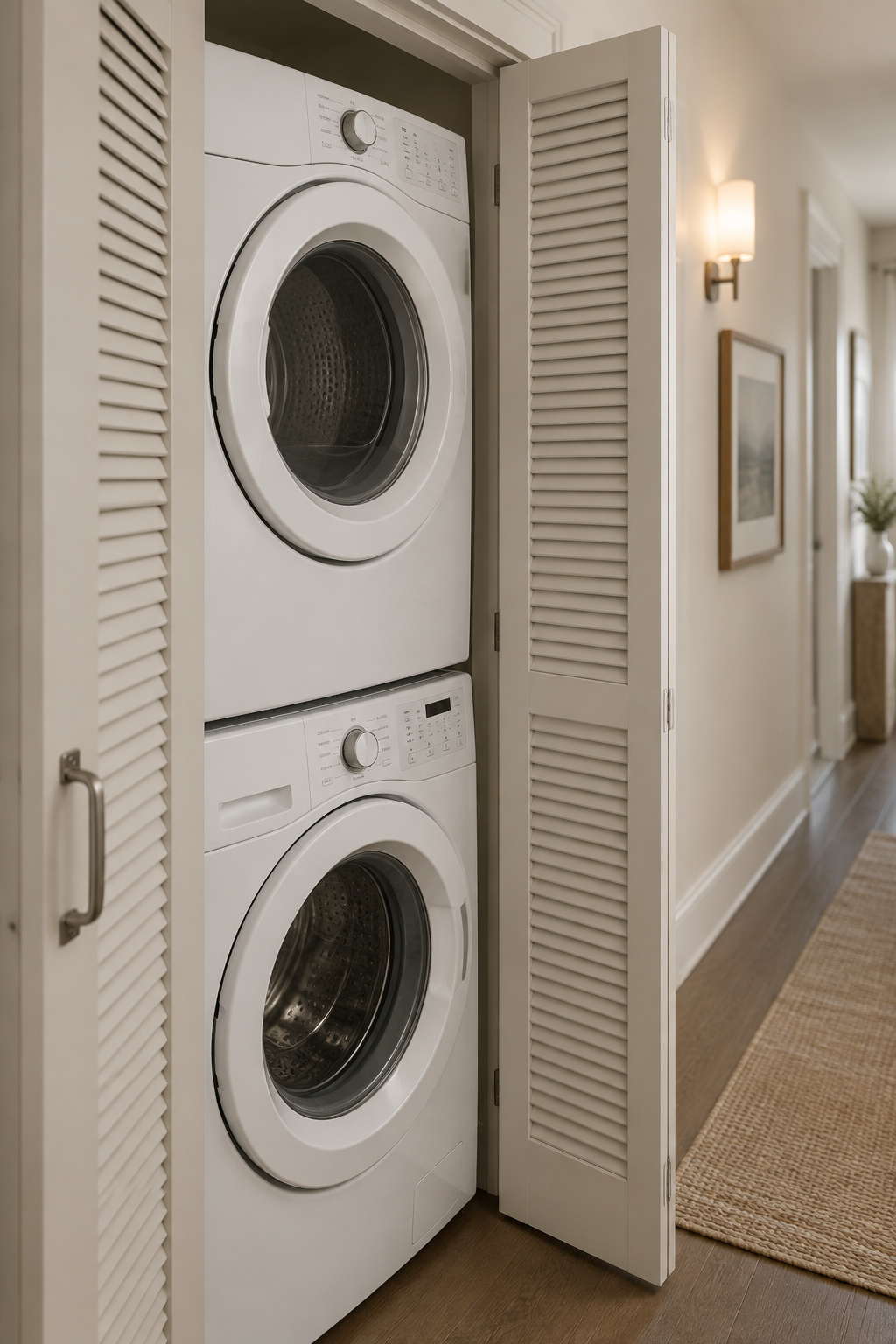
Why a shallower stack changes what a closet or cupboard can hold
A ventless compact dryer also does away with the vent elbow, the deepest thing behind the machine. Here size and power help each other: no duct, no dedicated circuit, less depth.
Storage that doesn’t require discipline: sizing the machines to the room
I count storage that requires discipline as failed design, and a too-tight full-size install is exactly that: you mind the door swing and load in a set order, forever. Size the machines to the room and it stops asking anything of you.
Planning a week of laundry around a smaller drum
A realistic weekly rhythm for one or two people
For six years I lived in 38 square metres in Malmö. Every object owned a place, and the dining table was also my desk and my workbench, and it was clear by evening, always. Laundry took the same shape: Tuesday and Friday, small loads, done before the table was needed. I never waited for a full hamper and never once felt short of machine. A ventless compact dryer helps: a cycle can finish overnight, in hours the room is idle.
Where a compact pair struggles for a family
Push a family of four’s typical volume, roughly seven loads a week, through a drum half the size and the arithmetic turns unkind: more days with the machine running, or longer batched ones. That’s my reasoning from load volumes, not a survey of compact owners, but the direction is clear. Winter bedding makes the laundromat a standing appointment.
The habit that makes compact feel like enough
Run on a fixed schedule, every second evening, rather than waiting for the hamper to fill. Nearly every complaint I hear about compact machines traces back to a full-size habit carried over rather than to the drum.
Once you’ve gone compact, the clearances change too
Why a shorter stack still needs the same air-gap discipline
Smaller machines get no discount on air. They still want clearance at the sides and behind for hoses and ventilation, and an enclosed closet still needs top and bottom openings.
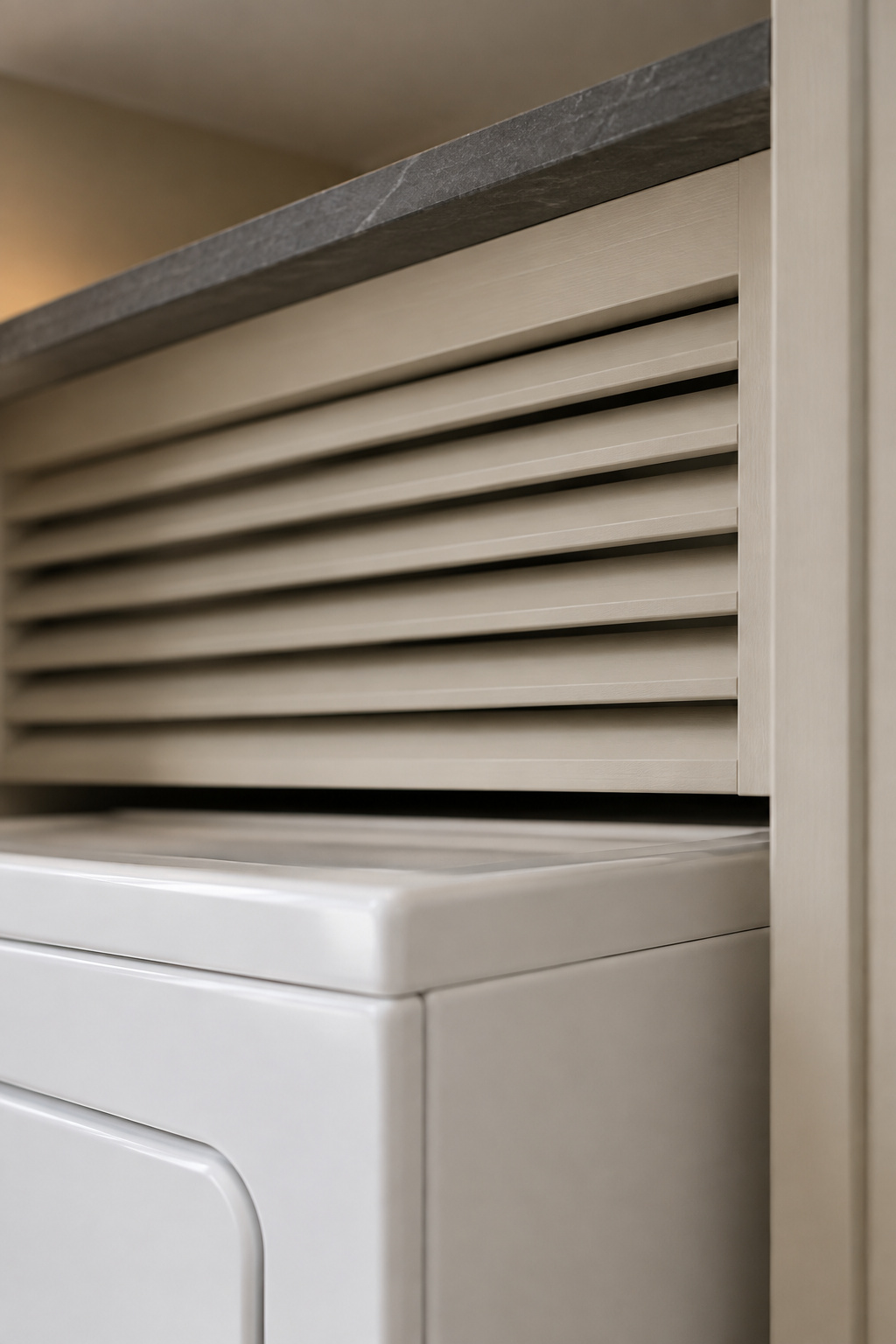
What to re-check once the size class changes
When you switch class, three numbers move together: closet opening, depth and stacked height. Re-measure a space you sized for full-size against the compact figures instead of assuming it fits with room to spare. A matched stacking kit is still mandatory at any size.
Measuring for compact specifically
The full checklist, both classes side by side, lives in the guide to stacked washer dryer dimensions. Take a tape measure to it before you order.
Where compact pairs make the most sense
Who should choose compact
Choose compact when the room is the constraint, not the budget. It’s a clean fit for one or two people whose bulky items are rare enough to handle elsewhere a few times a year. For a seven-load household with king bedding, it isn’t.
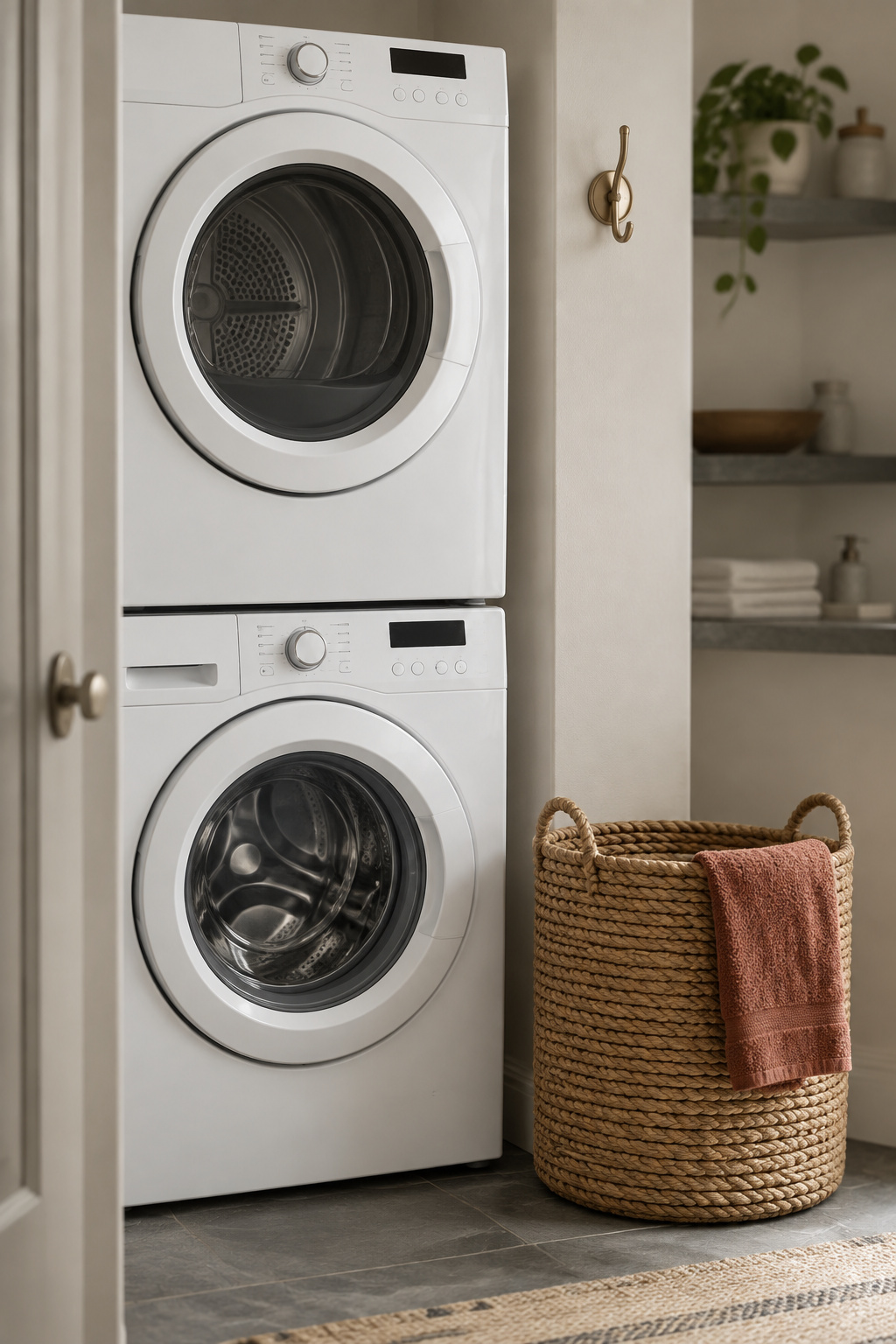
The hallway cupboard case compact pairs make possible
The clearest case is a shallow cupboard on a landing, joinery built long before anyone imagined a washing machine in it. Compact turns that into a hallway laundry closet that works. Still choosing the room? Start with what a vertical laundry setup involves.
Buying compact for the price, then regretting the capacity
Compact ventless dryers, heat-pump models especially, carry a real premium over full-size vented equivalents, so buying this class because it looks cheaper is the regret reviewers flag again and again. Buy it because the room demands it and your volume suits it, and you get the right machine in a room that finally has one.
FAQ
Is a compact washer and dryer big enough for a family?
It can be, if you adjust your expectations. A family of four typically runs about seven loads a week rather than one big wash, so plan on a load every other day. King bedding is the hard limit: no 24-inch washer takes it, so it goes to a laundromat.
Do 24-inch washer dryer pairs need special hookups?
Water and drain hookups are ordinary. The difference is electrical: many compact dryers, including Miele’s heat-pump models, plug into a standard 120V, 15-amp household outlet per the manufacturer’s spec sheet. Not all do: Bosch’s compact dryers need 220/240V, so check the model first.
Are European-size washers and dryers more expensive than full-size?
Often, yes. Compact heat-pump models from Miele and Bosch sit above comparable full-size vented pairs, and Miele’s carries a further premium over Bosch’s compact lines. But Midea’s newer 24-inch entry undercuts the legacy European brands, so the spread inside the class is wide.